KRISHNA
PUBLIC SCHOOL
Koni, Bilaspur
Gravitation.
Kepler’s law
Universal law of gravitation.
Force of gravitation on earth & on
moon.
Acceleration due to gravity.
Free fall.
Mass & weight .
Movement, or a tendency to
move, towards a centre of
gravity, as in the falling of
bodies to the earth is known as
Gravitation .
The force of attraction between
any two particle in the universe
is called Gravitation or
Gravitational force. For
example: moving of planet
around the sun in universe or
falling of apple from tree toward
earth.
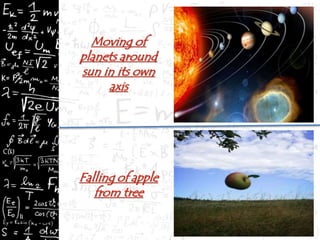
Moving of
planets around
sun in its own
axis
Falling of apple
from tree
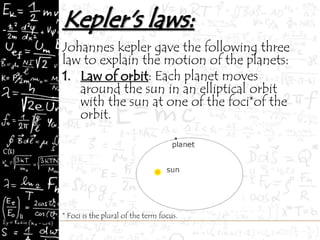
Johannes kepler gave the following three
law to explain the motion of the planets:
1. Law of orbit: Each planet moves
around the sun in an elliptical orbit
with the sun at one of the foci*of the
orbit.
* Foci is the plural of the term focus.
Sun
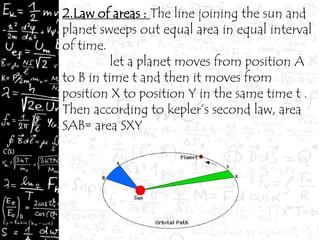
2.Law of areas : The line joining the sun and
planet sweeps out equal area in equal interval
of time.
let a planet moves from position A
to B in time t and then it moves from
position X to position Y in the same time t .
Then according to kepler’s second law, area
SAB= area SXY
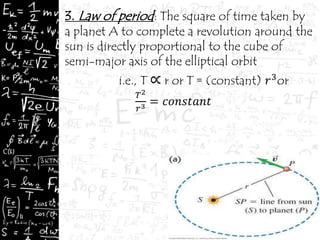
3. Law of period: The square of time taken by
a planet A to complete a revolution around the
sun is directly proportional to the cube of
semi-major axis of the elliptical orbit
i.e., T āˆ r or T = (constant) š‘Ÿ3
or
š‘‡2
š‘Ÿ3 = š‘š‘œš‘›š‘ š‘”š‘Žš‘›š‘”
According to this law, the force of attraction
between two Particle or bodies is (i)directly
proportional to the product of their masses
and (ii) inversely proportional to the square
of the distance between these particle or
bodies.
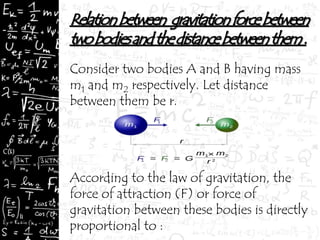
Consider two bodies A and B having mass
m1 and m2 respectively. Let distance
between them be r.
According to the law of gravitation, the
force of attraction (F) or force of
gravitation between these bodies is directly
proportional to :
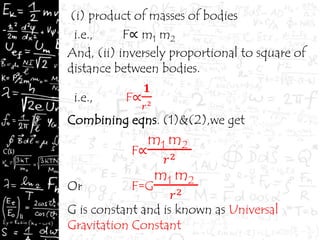
(i) product of masses of bodies
i.e., Fāˆ m1 m2
And, (ii) inversely proportional to square of
distance between bodies.
i.e., Fāˆ
šŸ
š‘Ÿ2
Combining eqns. (1)&(2),we get
Fāˆ
m1 m2
š‘Ÿ2
Or F=G
m1 m2
š‘Ÿ2
G is constant and is known as Universal
Gravitation Constant
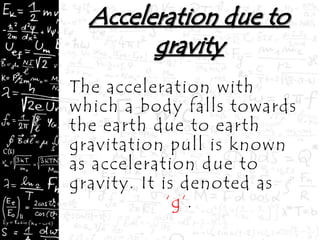
The acceleration with
which a body falls towards
the earth due to earth
gravitation pull is known
as acceleration due to
gravity. It is denoted as
ā€˜g’.
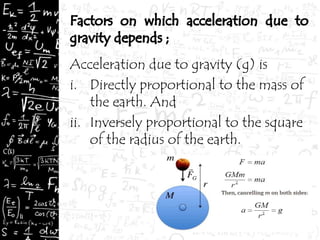
Acceleration due to gravity (g) is
i. Directly proportional to the mass of
the earth. And
ii. Inversely proportional to the square
of the radius of the earth.
The falling body of which only which
only force of gravitation of the earth
acts is known as freely falling body and
such fall of a body is known as free fall.
A freely falling body has acceleration
equal to acceleration due to gravity.
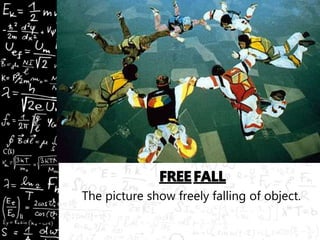
The picture show freely falling of object.
Mass :
ass of a body is defined as the
quantity of matter contained in the
body. Since mass of body is a measure
of inertia of the body, so mass is also
know as Inertia mass.
The unit of mass is kilogram (KG)
Weight :
T h e f o r c e w i t h w h i c h t h e
b o d y i s a t t r a c t e d b y t h e
e a r t h i s k n o w n a s t h e
w e i g h t o f t h e b o d y .
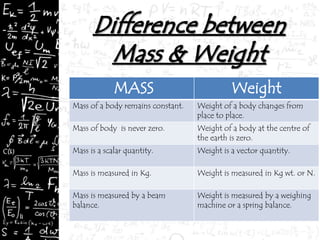
MASS Weight
Mass of a body remains constant. Weight of a body changes from
place to place.
Mass of body is never zero. Weight of a body at the centre of
the earth is zero.
Mass is a scalar quantity. Weight is a vector quantity.
Mass is measured in Kg. Weight is measured in Kg wt. or N.
Mass is measured by a beam
balance.
Weight is measured by a weighing
machine or a spring balance.
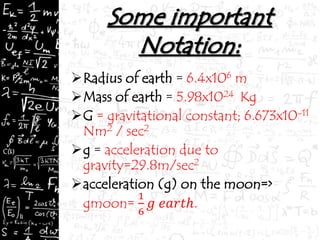
Radius of earth = 6.4x10⁶ m
Mass of earth = 5.98x1024 Kg
G = gravitational constant; 6.673x10⁻¹¹
Nm2 / sec2
g = acceleration due to
gravity=29.8m/sec2
acceleration (g) on the moon=>
gmoon=
1
6
š‘” š‘’š‘Žš‘Ÿš‘”ā„Ž.
Presentation on gravitation for class 9th

Presentation on gravitation for class 9th

  • 1.
  • 3.
    Gravitation. Kepler’s law Universal lawof gravitation. Force of gravitation on earth & on moon. Acceleration due to gravity. Free fall. Mass & weight .
  • 4.
    Movement, or atendency to move, towards a centre of gravity, as in the falling of bodies to the earth is known as Gravitation .
  • 5.
    The force ofattraction between any two particle in the universe is called Gravitation or Gravitational force. For example: moving of planet around the sun in universe or falling of apple from tree toward earth.
  • 6.
    Moving of planets around sunin its own axis Falling of apple from tree
  • 7.
    Johannes kepler gavethe following three law to explain the motion of the planets: 1. Law of orbit: Each planet moves around the sun in an elliptical orbit with the sun at one of the foci*of the orbit. * Foci is the plural of the term focus. Sun
  • 8.
    2.Law of areas: The line joining the sun and planet sweeps out equal area in equal interval of time. let a planet moves from position A to B in time t and then it moves from position X to position Y in the same time t . Then according to kepler’s second law, area SAB= area SXY
  • 9.
    3. Law ofperiod: The square of time taken by a planet A to complete a revolution around the sun is directly proportional to the cube of semi-major axis of the elliptical orbit i.e., T āˆ r or T = (constant) š‘Ÿ3 or š‘‡2 š‘Ÿ3 = š‘š‘œš‘›š‘ š‘”š‘Žš‘›š‘”
  • 10.
    According to thislaw, the force of attraction between two Particle or bodies is (i)directly proportional to the product of their masses and (ii) inversely proportional to the square of the distance between these particle or bodies.
  • 11.
    Consider two bodiesA and B having mass m1 and m2 respectively. Let distance between them be r. According to the law of gravitation, the force of attraction (F) or force of gravitation between these bodies is directly proportional to :
  • 12.
    (i) product ofmasses of bodies i.e., Fāˆ m1 m2 And, (ii) inversely proportional to square of distance between bodies. i.e., Fāˆ šŸ š‘Ÿ2 Combining eqns. (1)&(2),we get Fāˆ m1 m2 š‘Ÿ2 Or F=G m1 m2 š‘Ÿ2 G is constant and is known as Universal Gravitation Constant
  • 14.
    The acceleration with whicha body falls towards the earth due to earth gravitation pull is known as acceleration due to gravity. It is denoted as ā€˜g’.
  • 15.
    Acceleration due togravity (g) is i. Directly proportional to the mass of the earth. And ii. Inversely proportional to the square of the radius of the earth.
  • 16.
    The falling bodyof which only which only force of gravitation of the earth acts is known as freely falling body and such fall of a body is known as free fall. A freely falling body has acceleration equal to acceleration due to gravity.
  • 17.
    The picture showfreely falling of object.
  • 18.
    Mass : ass ofa body is defined as the quantity of matter contained in the body. Since mass of body is a measure of inertia of the body, so mass is also know as Inertia mass. The unit of mass is kilogram (KG)
  • 19.
    Weight : T he f o r c e w i t h w h i c h t h e b o d y i s a t t r a c t e d b y t h e e a r t h i s k n o w n a s t h e w e i g h t o f t h e b o d y .
  • 20.
    MASS Weight Mass ofa body remains constant. Weight of a body changes from place to place. Mass of body is never zero. Weight of a body at the centre of the earth is zero. Mass is a scalar quantity. Weight is a vector quantity. Mass is measured in Kg. Weight is measured in Kg wt. or N. Mass is measured by a beam balance. Weight is measured by a weighing machine or a spring balance.
  • 21.
    Radius of earth= 6.4x10⁶ m Mass of earth = 5.98x1024 Kg G = gravitational constant; 6.673x10⁻¹¹ Nm2 / sec2 g = acceleration due to gravity=29.8m/sec2 acceleration (g) on the moon=> gmoon= 1 6 š‘” š‘’š‘Žš‘Ÿš‘”ā„Ž.