SCIENCE-PHYSICS
CLASS X
CHAPTER 1
LAWS OF MOTION
PART - 1
By S.PRIYA MSc,B.Ed
IN THIS SESSION, YOU ARE GOING TO LEARN
ABOUT
 REST AND MOTION OF AN
OBJECT
 MECHANICS
 ARISTOTLE AND GALILEO’S
PROPOSAL ABOUT
FORCE
 INERETIA
 TYPES OF INERTIA
 EXAMPLES OF INERTIA
 LINEAR MOMENTUM
 NEWTON’S FIRST LAW OF
MOTION
 ACTION OF FORCES
 ROTATING EFFECT OF
FORCE
 TORQUE
 COUPLE
 MOMENT OF COUPLE
 APPLICATIONS OF
TORQUE
 PRINCIPLE OF MOMENTS
INTRODUCTION: REST AND MOTION
Things around us are related to one
another.
Some bodies are at rest and some
are in motion.
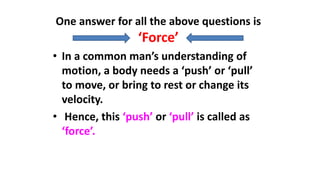
REST – A Stationary position of an object. Ex- a
ball at rest
MOTION- An object is displacing from one
place to another.
Ex- a moving toy car
Rest and motion are interrelated terms.
• When a body is at rest, starts moving,
Similarly,
• When a moving object comes to rest, you
would like to know what brings it to rest?
• Further, If a moving object speeds up or
slows down or changes its direction.
• What speeds up or slows down the body?
• What changes the direction of motion?
• a question that arises in our mind is
‘what causes the body to move?’
One answer for all the above questions is
‘Force’
• In a common man’s understanding of
motion, a body needs a ‘push’ or ‘pull’
to move, or bring to rest or change its
velocity.
• Hence, this ‘push’ or ‘pull’ is called as
‘force’.
Before start to explain the force, let us
discuss the importance of ‘MECHANICS’
It is the branch of physics deals with the
effect of force on bodies, when they are at
rest and motion.
In modern research and development in
automatic control, engine performance and
electrical machines highly dependent upon
the basic principles of mechanics
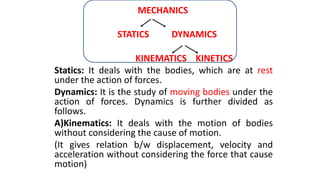
MECHANICS
STATICS DYNAMICS
KINEMATICS KINETICS
Statics: It deals with the bodies, which are at rest
under the action of forces.
Dynamics: It is the study of moving bodies under the
action of forces. Dynamics is further divided as
follows.
A)Kinematics: It deals with the motion of bodies
without considering the cause of motion.
(It gives relation b/w displacement, velocity and
acceleration without considering the force that cause
motion)
B)Kinetics: It deals with the motion of bodies
considering the cause of motion and gives the
relation b/w the motion of bodies.
you have learnt about various types of motion
such as
 linear motion,
circular motion,
oscillatory motion, and so on.
So far in your previous class, you have discussed
the motion of bodies in terms of their
displacement, velocity, and acceleration. In this
unit, let us investigate the cause of motion
• Let us define force in a more scientific
manner using the three laws proposed by Sir
Isaac Newton.
• These laws help you to understand the
motion of a body and also to predict the
future course of its motion, if you know the
forces acting on it.
• Before Newton formulated his three laws of
motion, a different perception about the
force and motion of bodies prevailed.
• Let us first look at these ideas and then
eventually learn about Newton’s laws in this
unit.
Aristotle- a Greek Philosopher and
Scientist- proposal about force
• According to him the natural state of earthly bodies is
‘rest’.
• He stated that a moving body naturally comes to rest
without any external influence of the force. Such
motions are termed as ‘natural motion’ (Force
independent)
• He also proposed that a force (a push or a pull) is
needed to make the bodies to move from their natural
state (rest) and behave contrary to their own natural
state called as ‘violent motion’ (Force dependent).
• Further, he said
Galileo proposed the following concepts about
force, motion and inertia of bodies
• (i) The natural state of all earthly bodies is either
the state of rest or the state of uniform motion.
• (ii) A body in motion will continue to be in the
same state of motion as long as no external force is
applied.
• (iii) When a force is applied on bodies, they resist
any change in their state. This property of bodies is
called ‘inertia’.
• (iv) When dropped from a height in vacuum, bodies
of different size, shape and mass fall at the same
rate and reach the ground at the same time.
THANKS FOR WATCHING
REMAINING TOPICS OF CLASS 10
WILL BE ON NEXT VIDEO

X science physics - laws of motion part 1

  • 1.
    SCIENCE-PHYSICS CLASS X CHAPTER 1 LAWSOF MOTION PART - 1 By S.PRIYA MSc,B.Ed
  • 2.
    IN THIS SESSION,YOU ARE GOING TO LEARN ABOUT  REST AND MOTION OF AN OBJECT  MECHANICS  ARISTOTLE AND GALILEO’S PROPOSAL ABOUT FORCE  INERETIA  TYPES OF INERTIA  EXAMPLES OF INERTIA  LINEAR MOMENTUM  NEWTON’S FIRST LAW OF MOTION  ACTION OF FORCES  ROTATING EFFECT OF FORCE  TORQUE  COUPLE  MOMENT OF COUPLE  APPLICATIONS OF TORQUE  PRINCIPLE OF MOMENTS
  • 3.
    INTRODUCTION: REST ANDMOTION Things around us are related to one another. Some bodies are at rest and some are in motion. REST – A Stationary position of an object. Ex- a ball at rest MOTION- An object is displacing from one place to another. Ex- a moving toy car Rest and motion are interrelated terms.
  • 4.
    • When abody is at rest, starts moving, Similarly, • When a moving object comes to rest, you would like to know what brings it to rest? • Further, If a moving object speeds up or slows down or changes its direction. • What speeds up or slows down the body? • What changes the direction of motion? • a question that arises in our mind is ‘what causes the body to move?’
  • 5.
    One answer forall the above questions is ‘Force’ • In a common man’s understanding of motion, a body needs a ‘push’ or ‘pull’ to move, or bring to rest or change its velocity. • Hence, this ‘push’ or ‘pull’ is called as ‘force’.
  • 6.
    Before start toexplain the force, let us discuss the importance of ‘MECHANICS’ It is the branch of physics deals with the effect of force on bodies, when they are at rest and motion. In modern research and development in automatic control, engine performance and electrical machines highly dependent upon the basic principles of mechanics
  • 7.
    MECHANICS STATICS DYNAMICS KINEMATICS KINETICS Statics:It deals with the bodies, which are at rest under the action of forces. Dynamics: It is the study of moving bodies under the action of forces. Dynamics is further divided as follows. A)Kinematics: It deals with the motion of bodies without considering the cause of motion. (It gives relation b/w displacement, velocity and acceleration without considering the force that cause motion)
  • 8.
    B)Kinetics: It dealswith the motion of bodies considering the cause of motion and gives the relation b/w the motion of bodies. you have learnt about various types of motion such as  linear motion, circular motion, oscillatory motion, and so on. So far in your previous class, you have discussed the motion of bodies in terms of their displacement, velocity, and acceleration. In this unit, let us investigate the cause of motion
  • 9.
    • Let usdefine force in a more scientific manner using the three laws proposed by Sir Isaac Newton. • These laws help you to understand the motion of a body and also to predict the future course of its motion, if you know the forces acting on it. • Before Newton formulated his three laws of motion, a different perception about the force and motion of bodies prevailed. • Let us first look at these ideas and then eventually learn about Newton’s laws in this unit.
  • 10.
    Aristotle- a GreekPhilosopher and Scientist- proposal about force • According to him the natural state of earthly bodies is ‘rest’. • He stated that a moving body naturally comes to rest without any external influence of the force. Such motions are termed as ‘natural motion’ (Force independent) • He also proposed that a force (a push or a pull) is needed to make the bodies to move from their natural state (rest) and behave contrary to their own natural state called as ‘violent motion’ (Force dependent). • Further, he said
  • 11.
    Galileo proposed thefollowing concepts about force, motion and inertia of bodies • (i) The natural state of all earthly bodies is either the state of rest or the state of uniform motion. • (ii) A body in motion will continue to be in the same state of motion as long as no external force is applied. • (iii) When a force is applied on bodies, they resist any change in their state. This property of bodies is called ‘inertia’. • (iv) When dropped from a height in vacuum, bodies of different size, shape and mass fall at the same rate and reach the ground at the same time.
  • 12.
    THANKS FOR WATCHING REMAININGTOPICS OF CLASS 10 WILL BE ON NEXT VIDEO