The Climate Change Science Program’s Strategic Plan for Climate and Global Change Research  Richard H. Moss Climate Change Science Program
This Presentation Mission of Climate Change Science Program Process for developing the Strategic Plan Strategic Plan overview Near-term (2-4 year) climate change decision support resources Long-term global change research Program Management Request for comments
CCSP Mission Provide science-based information on climate and global change to inform public debate, policymaking, and management of natural resources
Science-Based Questions Confronting Society With what confidence can we attribute observed changes in climate to human activities? How will the Earth system respond to natural variability and human-induced changes in the future? How sensitive and adaptable are ecosystems—and related socio-economic systems—to interacting changes in climate and other environmental conditions? What are the projected costs and benefits of potential response strategies?
Resource Management and Science—Some Examples Anticipating effects of pollution from remote locations through long-range transport processes Linking models of watersheds, agricultural outputs, and economic activity to assess tradeoffs of competing uses Evaluating the sensitivity of forest growth to altered temperature and precipitation Analyzing the role of climate information in managing energy supply/demand
CCSP Science for Society and Decision Support Resource Management Models Outcomes New Understanding Public Debate Policy Decisions Management Decisions Educational Resources Scenario Comparison and Evaluation Observations Reports and Findings Research Atmosphere Climate Water cycle Land use/cover Carbon cycle Ecosystems Human Dimensions Climate and Earth Science Questions Outputs Inputs Decision Support Resources National, Sectoral, and Regional Issues
Both Focus and Breadth are Needed to Meet CCSP Objectives Focus on near-term climate change decision support resources (CCRI) Address key climate change uncertainties and their potential implications Continue research on related global change issues (USGCRP) Full range of global change issues Sustained research for issues and products requiring more than 2-4 years Providing foundation for future applications
 
Strategic Plan Development Process National Research Council (NRC) provides ongoing advice  Federal scientists and program managers prepare draft Stakeholders provide input for draft plan at CCSP workshop and during comment period CCSP revises plan based on comments Revised plan submitted to Congress and NRC
Overview of 2002 Draft Part I: Climate change decision support resources (CCRI) Part II: Broad Earth system research (USGCRP) Part III: Communications, international cooperation, and management
Climate Change Focused Decision Support (CCRI) Research Focused on Key Climate Change Uncertainties  Climate Quality Observations, Monitoring, and Data Management   Decision Support Resources
Research Focused on Key Climate Change Uncertainties What are the relative contributions of different aerosols to climate change? What are the magnitudes and distributions of North American carbon sources and sinks, and what are the processes controlling their dynamics? How much of expected climate change is the consequence of feedback processes?
Climate Quality Observations, Monitoring, and Data Management How has global climate changed over the past fifty years or more, and what level of confidence do existing data provide in attributing change?  What is the current state of the climate, how does it compare with the past, and how can observations be improved?  How real are the differences in surface and tropospheric temperature trends?  How do we improve observations of biological and ecological systems to understand their response to climate variability and change?  How accessible is the climate record?
Decision Support Resources Focus on both national policy analysis and operational resource management Analytic techniques for serving decision needs (including scenario development) Applied climate modeling Resources for risk analysis and decision making under uncertainty
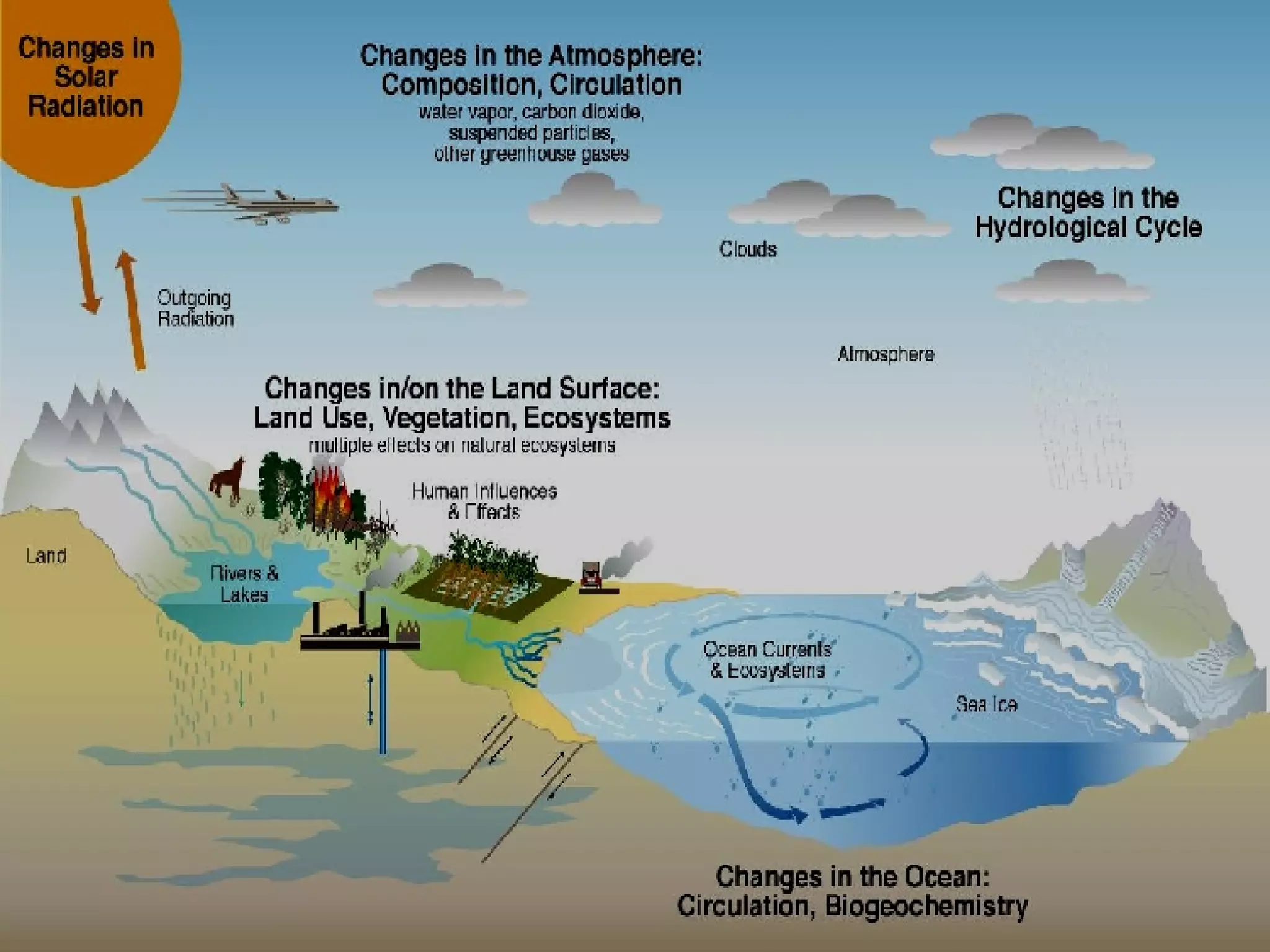
Broad, Ongoing Earth System Research (USGCRP) Atmospheric Composition  Climate Variability and Change Water Cycle  Land Use/Land Cover Change  Carbon Cycle  Ecosystems  Human Contributions and Responses to Global Environmental Change  Grand Challenges in Modeling, Observations, and Information Systems
Climate Variability and Change:  Key Questions What is the sensitivity of climate change projections to feedbacks in the climate system? To what extent can predictions of climate variability and projections of long-term climate change be improved? What is the likelihood of abrupt climate changes? Whether and how are the frequencies, intensities, and locations of extreme events altered by natural climate variations and human-induced climate changes? How can interactions between producers and users of climate information be structured to ensure essential information is identified and provided?
Research Elements Include Societal Interactions Atmospheric Composition Q3: Effects of long-range transport of pollution on regional air quality, crops, and ecosystems? Water Cycle Q5: Implications of global water cycle variability and change for human societies and ecosystems? Land Use/Land Cover Change: All questions assess interactions of society and environment, either driving forces or effects
…Societal Interactions Carbon Cycle Q6: How will the Earth system respond to options for managing carbon, and what scientific information is needed for evaluating these options? Ecosystems Q2 and 3: Effects of global change on ecosystem goods and services, and options for management? Human Contributions…: Driving forces, and factors affecting sensitivity and adaptation (including health effects)
Program Management Distributed program Mechanisms Scientific guidance Interagency planning and implementation CCSP/SGCR role Set and refine integrated program goals/priorities Review all programs that contribute to climate and global change science Interact with external advisory groups
CCSP Workshop: Opportunity for Comments Information gathering for further program development, e.g.,  Does the proposed focus meet the Nation’s needs for information? Which proposed deliverables are most useful? Is the proposed program feasible? Where are there gaps and overlaps? How can synthesis and integration be improved? …
Thank you!

Moss-3dec2002

  • 1.
    The Climate ChangeScience Program’s Strategic Plan for Climate and Global Change Research Richard H. Moss Climate Change Science Program
  • 2.
    This Presentation Missionof Climate Change Science Program Process for developing the Strategic Plan Strategic Plan overview Near-term (2-4 year) climate change decision support resources Long-term global change research Program Management Request for comments
  • 3.
    CCSP Mission Providescience-based information on climate and global change to inform public debate, policymaking, and management of natural resources
  • 4.
    Science-Based Questions ConfrontingSociety With what confidence can we attribute observed changes in climate to human activities? How will the Earth system respond to natural variability and human-induced changes in the future? How sensitive and adaptable are ecosystems—and related socio-economic systems—to interacting changes in climate and other environmental conditions? What are the projected costs and benefits of potential response strategies?
  • 5.
    Resource Management andScience—Some Examples Anticipating effects of pollution from remote locations through long-range transport processes Linking models of watersheds, agricultural outputs, and economic activity to assess tradeoffs of competing uses Evaluating the sensitivity of forest growth to altered temperature and precipitation Analyzing the role of climate information in managing energy supply/demand
  • 6.
    CCSP Science forSociety and Decision Support Resource Management Models Outcomes New Understanding Public Debate Policy Decisions Management Decisions Educational Resources Scenario Comparison and Evaluation Observations Reports and Findings Research Atmosphere Climate Water cycle Land use/cover Carbon cycle Ecosystems Human Dimensions Climate and Earth Science Questions Outputs Inputs Decision Support Resources National, Sectoral, and Regional Issues
  • 7.
    Both Focus andBreadth are Needed to Meet CCSP Objectives Focus on near-term climate change decision support resources (CCRI) Address key climate change uncertainties and their potential implications Continue research on related global change issues (USGCRP) Full range of global change issues Sustained research for issues and products requiring more than 2-4 years Providing foundation for future applications
  • 8.
  • 9.
    Strategic Plan DevelopmentProcess National Research Council (NRC) provides ongoing advice Federal scientists and program managers prepare draft Stakeholders provide input for draft plan at CCSP workshop and during comment period CCSP revises plan based on comments Revised plan submitted to Congress and NRC
  • 10.
    Overview of 2002Draft Part I: Climate change decision support resources (CCRI) Part II: Broad Earth system research (USGCRP) Part III: Communications, international cooperation, and management
  • 11.
    Climate Change FocusedDecision Support (CCRI) Research Focused on Key Climate Change Uncertainties Climate Quality Observations, Monitoring, and Data Management  Decision Support Resources
  • 12.
    Research Focused onKey Climate Change Uncertainties What are the relative contributions of different aerosols to climate change? What are the magnitudes and distributions of North American carbon sources and sinks, and what are the processes controlling their dynamics? How much of expected climate change is the consequence of feedback processes?
  • 13.
    Climate Quality Observations,Monitoring, and Data Management How has global climate changed over the past fifty years or more, and what level of confidence do existing data provide in attributing change? What is the current state of the climate, how does it compare with the past, and how can observations be improved? How real are the differences in surface and tropospheric temperature trends? How do we improve observations of biological and ecological systems to understand their response to climate variability and change? How accessible is the climate record?
  • 14.
    Decision Support ResourcesFocus on both national policy analysis and operational resource management Analytic techniques for serving decision needs (including scenario development) Applied climate modeling Resources for risk analysis and decision making under uncertainty
  • 15.
    Broad, Ongoing EarthSystem Research (USGCRP) Atmospheric Composition Climate Variability and Change Water Cycle Land Use/Land Cover Change Carbon Cycle Ecosystems Human Contributions and Responses to Global Environmental Change Grand Challenges in Modeling, Observations, and Information Systems
  • 16.
    Climate Variability andChange: Key Questions What is the sensitivity of climate change projections to feedbacks in the climate system? To what extent can predictions of climate variability and projections of long-term climate change be improved? What is the likelihood of abrupt climate changes? Whether and how are the frequencies, intensities, and locations of extreme events altered by natural climate variations and human-induced climate changes? How can interactions between producers and users of climate information be structured to ensure essential information is identified and provided?
  • 17.
    Research Elements IncludeSocietal Interactions Atmospheric Composition Q3: Effects of long-range transport of pollution on regional air quality, crops, and ecosystems? Water Cycle Q5: Implications of global water cycle variability and change for human societies and ecosystems? Land Use/Land Cover Change: All questions assess interactions of society and environment, either driving forces or effects
  • 18.
    …Societal Interactions CarbonCycle Q6: How will the Earth system respond to options for managing carbon, and what scientific information is needed for evaluating these options? Ecosystems Q2 and 3: Effects of global change on ecosystem goods and services, and options for management? Human Contributions…: Driving forces, and factors affecting sensitivity and adaptation (including health effects)
  • 19.
    Program Management Distributedprogram Mechanisms Scientific guidance Interagency planning and implementation CCSP/SGCR role Set and refine integrated program goals/priorities Review all programs that contribute to climate and global change science Interact with external advisory groups
  • 20.
    CCSP Workshop: Opportunityfor Comments Information gathering for further program development, e.g., Does the proposed focus meet the Nation’s needs for information? Which proposed deliverables are most useful? Is the proposed program feasible? Where are there gaps and overlaps? How can synthesis and integration be improved? …
  • 21.