Planning for Climate Change in the Technical Analysis of Floodplain Mapping and Flood Control Projects Presented June 9, 2009 Association of State Floodplain Managers Conference Concurrent Session B-3  Climate Change in Floodplain Management Decisions Authors: Michael DePue, PE, CFM  (PBS&J) David T. Williams, PhD., PH., D.WRE, PE, CFM (PBS&J) Kris Esterson (PBS&J) For Copy of Presentation Contact Michael DePue, PE, CFM Vice President, PBS&J 10 East Doty Street, Suite 800 Madison, WI, USA 53703 Main: 1-608-204-5950 [email_address]
Outline Climate Change Trends Adapting our Technical Analyses to Climate Change References
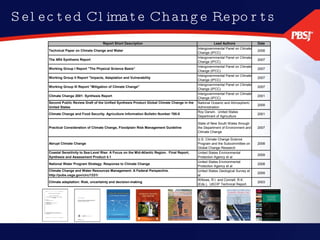
Selected Climate Change Reports
Worldwide Projected Precipitation Changes From:  IPCC, 2007: Climate Change 2007: Synthesis Report. Contribution of Working Groups I, II and III to the Fourth Assessment Report of the Intergovernmental Panel on Climate Change [Core Writing Team, Pachauri, R.K and Reisinger, A. (eds.)]. IPCC, Geneva, Switzerland, 104 pp. More Precip Less Precip
Worldwide Projected Changes in Runoff From:  IPCC, 2007: Climate Change 2007: Synthesis Report. Contribution of Working Groups I, II and III to the Fourth Assessment Report of the Intergovernmental Panel on Climate Change [Core Writing Team, Pachauri, R.K and Reisinger, A. (eds.)]. IPCC, Geneva, Switzerland, 104 pp. More Runoff Less Runoff
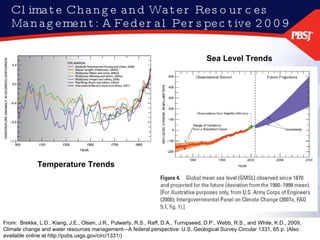
Climate Change and Water Resources Management: A Federal Perspective 2009 From:  Brekke, L.D., Kiang, J.E., Olsen, J.R., Pulwarty, R.S., Raff, D.A., Turnipseed, D.P., Webb, R.S., and White, K.D., 2009, Climate change and water resources management—A federal perspective: U.S. Geological Survey Circular 1331, 65 p. (Also available online at http://pubs.usgs.gov/circ/1331/) Temperature Trends Sea Level Trends
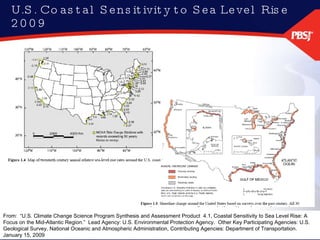
U.S. Coastal Sensitivity to Sea Level Rise 2009 From:  “U.S. Climate Change Science Program Synthesis and Assessment Product  4.1, Coastal Sensitivity to Sea Level Rise: A Focus on the Mid-Atlantic Region.”  Lead Agency: U.S. Environmental Protection Agency.  Other Key Participating Agencies: U.S. Geological Survey, National Oceanic and Atmospheric Administration, Contributing Agencies: Department of Transportation.  January 15, 2009
Climate Change in the United States.  April 27, 2009  www.climatescience.gov Key findings Average U.S. temperature has risen more than 2°F over the past 50 years Precipitation has increased an average of about 5 percent over the past 50 years Wet areas wetter, dry areas drier. Heaviest downpours have increased approximately 20 percent on average in the past century Strongest increases in the wettest places. Many types of extreme weather events have become more frequent and intense during the past 40 to 50 years. From:  Third Public Review Draft of the Unified Synthesis Product Global Climate Change in the United States.  National Oceanic and Atmospheric Administration (NOAA), Department of Commerce.  April 27, 2009.
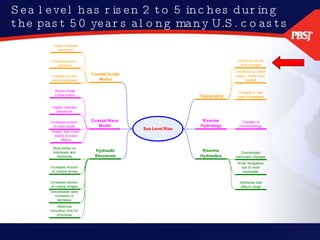
Climate Change in the United States.  April 27, 2009  www.climatescience.gov Key findings (continued) Destructive energy of Atlantic hurricanes has increased  In eastern Pacific, the strongest hurricanes have become stronger since the 1980s even while the total number of storms has decreased. Sea level has risen 2 to 5 inches during the past 50 years along many U.S. coasts For cold-season storms outside the tropics, storm tracks are shifting northward and the strongest storms are projected to become stronger. Arctic sea ice is declining rapidly and this is projected to continue From:  Third Public Review Draft of the Unified Synthesis Product Global Climate Change in the United States.  National Oceanic and Atmospheric Administration (NOAA), Department of Commerce.  April 27, 2009.
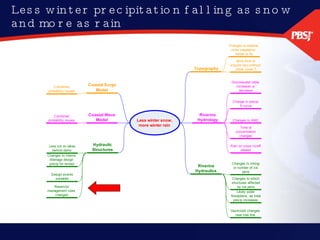
Climate Change in the United States.  April 27, 2009  www.climatescience.gov Other trends occurring on regional scale A longer growing season Less winter precipitation falling as snow and more as rain Reduced snowpack Earlier breakup of winter ice on lakes and rivers Earlier spring snowmelt and earlier peak river flows In some areas, average fall precipitation has increased by 30 percent Increase in percentage of land area experiencing drought Warmer coast waters and more hurricanes From:  Third Public Review Draft of the Unified Synthesis Product Global Climate Change in the United States.  National Oceanic and Atmospheric Administration (NOAA), Department of Commerce.  April 27, 2009.
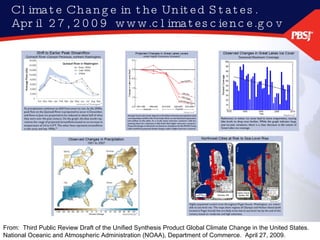
Climate Change in the United States.  April 27, 2009  www.climatescience.gov From:  Third Public Review Draft of the Unified Synthesis Product Global Climate Change in the United States.  National Oceanic and Atmospheric Administration (NOAA), Department of Commerce.  April 27, 2009.
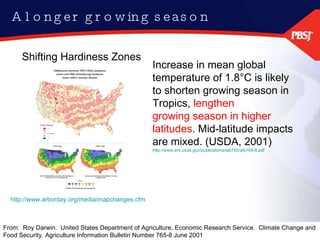
A longer growing season http://www.arborday.org/media/mapchanges.cfm Shifting Hardiness Zones  Increase in mean global temperature of 1.8°C is likely to shorten growing season in Tropics,  lengthen growing season in higher latitudes . Mid-latitude impacts are mixed. (USDA, 2001) http://www.ers.usda.gov/publications/aib765/aib765-8.pdf From:  Roy Darwin.  United States Department of Agriculture, Economic Research Service.  Climate Change and Food Security. Agriculture Information Bulletin Number 765-8 June 2001
Increased summer continental drying and associated risk of drought (USGS, Abrupt Climate Change, 2008) Water infrastructure will have to be redesigned. Water use will have to adjust to limited water availability. From:  CCSP, 2008: Abrupt Climate Change. A report by the U.S. Climate Change Science Program and the Subcommittee on Global Change Research [Clark, P.U., A.J. Weaver (coordinating lead authors), E. Brook, E.R. Cook, T.L. Delworth, and K. Steffen (chapter lead authors)]. U.S. Geological Survey, Reston, VA, 459 pp.
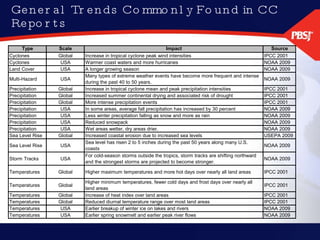
General Trends Commonly Found in CC Reports
Adapting our Technical Analyses to Climate Change
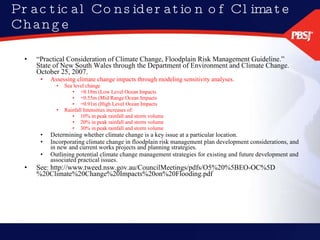
Practical Consideration of Climate Change “ Practical Consideration of Climate Change, Floodplain Risk Management Guideline.”  State of New South Wales through the Department of Environment and Climate Change.  October 25, 2007.  Assessing climate change impacts through modeling sensitivity analyses.  Sea level change +0.18m (Low Level Ocean Impacts  +0.55m (Mid Range Ocean Impacts  +0.91m (High Level Ocean Impacts  Rainfall Intensities increases of: 10% in peak rainfall and storm volume  20% in peak rainfall and storm volume  30% in peak rainfall and storm volume  Determining whether climate change is a key issue at a particular location. Incorporating climate change in floodplain risk management plan development considerations, and in new and current works projects and planning strategies.  Outlining potential climate change management strategies for existing and future development and associated practical issues.  See: http://www.tweed.nsw.gov.au/CouncilMeetings/pdfs/O5%20%5BEO-OC%5D%20Climate%20Change%20Impacts%20on%20Flooding.pdf
USACE Sea Level Policy “ Planning for Sea Level Rise: U.S. Army Corps of Engineers Policy.” Kevin Knuuti, ASCE conference proceedings: “Solutions to Coastal Disasters ‘02” edited by Lesley Ewing and Louise Wallendorf USACE will follow the recommendations of the National Research Council (NRC) “Responding to Changes in Sea Level: Engineering Implications” (NRC, 1987). Consider potential sea level rise in all coastal projects Feasibility studies consider range of possible future rates of SLR  Strategies that cover the broadest ranges of possible SLR will have preference Consider impacts of SLR based on historic rate for now Sensitivity analysis for design versus SLR range Extrapolate local SLR as low range (about 0.4m by 2100) Use Curve III from NRC reports as high range (about 1.5m by 2100) Make design so that it can be easily modified once constructed to respond to actual SLR observations Interim Guidance for Incorporating Sea-Level Change into Project Planning and Design.  Underwent final peer review January 2009, not yet released. Provides interim guidance for the incorporation of sea-level rise in the project management, planning, engineering, design, construction, operation, and maintenance of USACE projects. Contains many elements of document above, but greatly expands on discussion
Moving Beyond Vulnerability Assessment Results of vulnerability assessments have galvanized the federal response to climate change. Development of specific guidance for use at the local or project level. Including: Detailed sea level change guidance Methods and policies for non-stationary cases Extensions of concepts presented in USGS Circular 1331 to support implementation of climate change adaptation and mitigation projects.
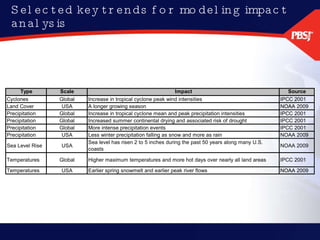
Selected key trends for modeling impact analysis
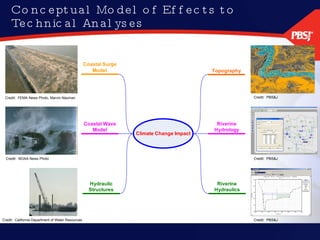
Conceptual Model of Effects to Technical Analyses Credit:  FEMA News Photo, Marvin Nauman  Credit:  NOAA News Photo Credit:  California Department of Water Resources Credit:  PBS&J Credit:  PBS&J Credit:  PBS&J
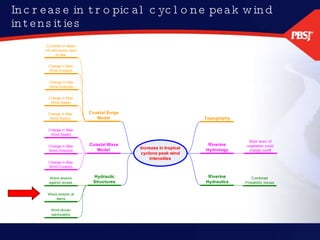
Increase in tropical cyclone peak wind intensities
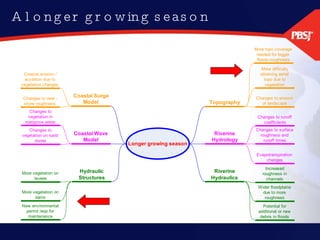
A longer growing season
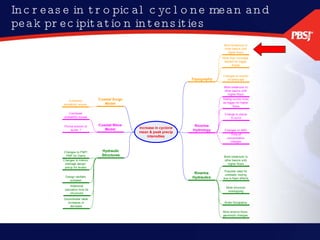
Increase in tropical cyclone mean and peak precipitation intensities
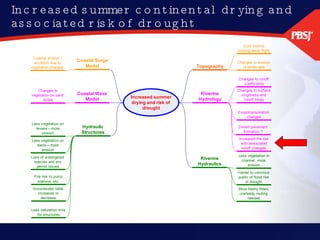
Increased summer continental drying and associated risk of drought
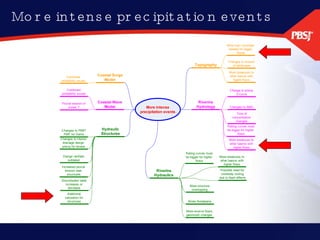
More intense precipitation events
Less winter precipitation falling as snow and more as rain
Sea level has risen 2 to 5 inches during the past 50 years along many U.S. coasts
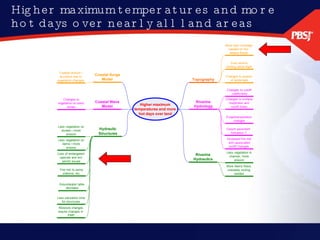
Higher maximum temperatures and more hot days over nearly all land areas
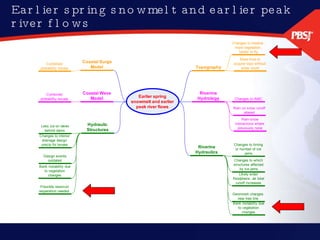
Earlier spring snowmelt and earlier peak river flows
References Bates, B.C., Z.W. Kundzewicz, S. Wu and J.P. Palutikof, Eds., 2008: Climate Change and Water. Technical Paper of the Intergovernmental Panel on Climate Change, IPCC Secretariat, Geneva, 210 pp. IPCC, 2007: Climate Change 2007: Synthesis Report. Contribution of Working Groups I, II and III to the Fourth Assessment Report of the Intergovernmental Panel on Climate Change [Core Writing Team, Pachauri, R.K and Reisinger, A. (eds.)]. IPCC, Geneva, Switzerland, 104 pp. IPCC, 2007: Climate Change 2007: The Physical Science Basis. Contribution of Working Group I to the Fourth Assessment Report of the Intergovernmental Panel on Climate Change [Solomon, S., D. Qin, M. Manning, Z. Chen, M. Marquis, K.B. Averyt, M. Tignor and H.L. Miller (eds.)]. Cambridge University Press, Cambridge, United Kingdom and New York, NY, USA, 996 pp. IPCC, 2007: Climate Change 2007: Impacts, Adaptation and Vulnerability. Contribution of Working Group II to the Fourth Assessment Report of the Intergovernmental Panel on Climate Change, M.L. Parry, O.F. Canziani, J.P. Palutikof, P.J. van der Linden and C.E. Hanson, Eds., Cambridge University Press, Cambridge, UK, 976pp. IPCC, 2007: Climate Change 2007: Mitigation. Contribution of Working Group III to the Fourth Assessment Report of the Intergovernmental Panel on Climate Change [B. Metz, O.R. Davidson, P.R. Bosch, R. Dave, L.A. Meyer (eds)], Cambridge University Press, Cambridge, United Kingdom and New York, NY, USA., XXX pp.  Second Public Review Draft of the Unified Synthesis Product Global Climate Change in the United States.  National Oceanic and Atmospheric Administration (NOAA), Department of Commerce.  January 13, 2009.  Roy Darwin.  United States Department of Agriculture, Economic Research Service.  Climate Change and Food Security. Agriculture Information Bulletin Number 765-8 June 2001 “ Practical Consideration of Climate Change, Floodplain Risk Management Guideline.”  State of New South Wales through the Department of Environment and Climate Change.  October 25, 2007.  See:  http://www.tweed.nsw.gov.au/CouncilMeetings/pdfs/O5%20%5BEO-OC%5D%20Climate%20Change%20Impacts%20on%20Flooding.pdf   CCSP, 2008: Abrupt Climate Change. A report by the U.S. Climate Change Science Program and the Subcommittee on Global Change Research [Clark, P.U., A.J. Weaver (coordinating lead authors), E. Brook, E.R. Cook, T.L. Delworth, and K. Steffen (chapter lead authors)]. U.S. Geological Survey, Reston, VA, 459 pp.  “ U.S. Climate Change Science Program Synthesis and Assessment Product  4.1, Coastal Sensitivity to Sea Level Rise: A Focus on the Mid-Atlantic Region.”  Lead Agency: U.S. Environmental Protection Agency.  Other Key Participating Agencies: U.S. Geological Survey, National Oceanic and Atmospheric Administration, Contributing Agencies: Department of Transportation.  January 15, 2009 National Water Program Strategy, Response to Climate Change.  U.S. Environmental Protection Agency Office of Water (4101M) EPA 800-R-08-001.  http://www.epa.gov/water/climatechange ,  September 2008 Brekke, L.D., Kiang, J.E., Olsen, J.R., Pulwarty, R.S., Raff, D.A., Turnipseed, D.P., Webb, R.S., and White, K.D., 2009, Climate change and water resources management—A federal perspective: U.S. Geological Survey Circular 1331, 65 p. (Also available online at  http://pubs.usgs.gov/circ/1331/ ) Willows, R.I. and Connell, R.K. (Eds.). (2003). Climate adaptation: Risk, uncertainty and decision-making.  UKCIP Technical Report. UKCIP, Oxford. IPCC, 2001: Climate Change 2001: Synthesis Report. A Contribution of Working Groups I, II, and III to the Third Assessment Report of the Integovernmental Panel on Climate Change [Watson, R.T. and the Core Writing Team (eds.)]. Cambridge University Press, Cambridge, United Kingdom, and New York, NY, USA, 398 pp.
QUESTIONS?

Planning For Climate Change In The Technical Analysis 6 9 09

  • 1.
    Planning for ClimateChange in the Technical Analysis of Floodplain Mapping and Flood Control Projects Presented June 9, 2009 Association of State Floodplain Managers Conference Concurrent Session B-3 Climate Change in Floodplain Management Decisions Authors: Michael DePue, PE, CFM (PBS&J) David T. Williams, PhD., PH., D.WRE, PE, CFM (PBS&J) Kris Esterson (PBS&J) For Copy of Presentation Contact Michael DePue, PE, CFM Vice President, PBS&J 10 East Doty Street, Suite 800 Madison, WI, USA 53703 Main: 1-608-204-5950 [email_address]
  • 2.
    Outline Climate ChangeTrends Adapting our Technical Analyses to Climate Change References
  • 3.
  • 4.
    Worldwide Projected PrecipitationChanges From: IPCC, 2007: Climate Change 2007: Synthesis Report. Contribution of Working Groups I, II and III to the Fourth Assessment Report of the Intergovernmental Panel on Climate Change [Core Writing Team, Pachauri, R.K and Reisinger, A. (eds.)]. IPCC, Geneva, Switzerland, 104 pp. More Precip Less Precip
  • 5.
    Worldwide Projected Changesin Runoff From: IPCC, 2007: Climate Change 2007: Synthesis Report. Contribution of Working Groups I, II and III to the Fourth Assessment Report of the Intergovernmental Panel on Climate Change [Core Writing Team, Pachauri, R.K and Reisinger, A. (eds.)]. IPCC, Geneva, Switzerland, 104 pp. More Runoff Less Runoff
  • 6.
    Climate Change andWater Resources Management: A Federal Perspective 2009 From: Brekke, L.D., Kiang, J.E., Olsen, J.R., Pulwarty, R.S., Raff, D.A., Turnipseed, D.P., Webb, R.S., and White, K.D., 2009, Climate change and water resources management—A federal perspective: U.S. Geological Survey Circular 1331, 65 p. (Also available online at http://pubs.usgs.gov/circ/1331/) Temperature Trends Sea Level Trends
  • 7.
    U.S. Coastal Sensitivityto Sea Level Rise 2009 From: “U.S. Climate Change Science Program Synthesis and Assessment Product 4.1, Coastal Sensitivity to Sea Level Rise: A Focus on the Mid-Atlantic Region.” Lead Agency: U.S. Environmental Protection Agency. Other Key Participating Agencies: U.S. Geological Survey, National Oceanic and Atmospheric Administration, Contributing Agencies: Department of Transportation. January 15, 2009
  • 8.
    Climate Change inthe United States. April 27, 2009 www.climatescience.gov Key findings Average U.S. temperature has risen more than 2°F over the past 50 years Precipitation has increased an average of about 5 percent over the past 50 years Wet areas wetter, dry areas drier. Heaviest downpours have increased approximately 20 percent on average in the past century Strongest increases in the wettest places. Many types of extreme weather events have become more frequent and intense during the past 40 to 50 years. From: Third Public Review Draft of the Unified Synthesis Product Global Climate Change in the United States. National Oceanic and Atmospheric Administration (NOAA), Department of Commerce. April 27, 2009.
  • 9.
    Climate Change inthe United States. April 27, 2009 www.climatescience.gov Key findings (continued) Destructive energy of Atlantic hurricanes has increased In eastern Pacific, the strongest hurricanes have become stronger since the 1980s even while the total number of storms has decreased. Sea level has risen 2 to 5 inches during the past 50 years along many U.S. coasts For cold-season storms outside the tropics, storm tracks are shifting northward and the strongest storms are projected to become stronger. Arctic sea ice is declining rapidly and this is projected to continue From: Third Public Review Draft of the Unified Synthesis Product Global Climate Change in the United States. National Oceanic and Atmospheric Administration (NOAA), Department of Commerce. April 27, 2009.
  • 10.
    Climate Change inthe United States. April 27, 2009 www.climatescience.gov Other trends occurring on regional scale A longer growing season Less winter precipitation falling as snow and more as rain Reduced snowpack Earlier breakup of winter ice on lakes and rivers Earlier spring snowmelt and earlier peak river flows In some areas, average fall precipitation has increased by 30 percent Increase in percentage of land area experiencing drought Warmer coast waters and more hurricanes From: Third Public Review Draft of the Unified Synthesis Product Global Climate Change in the United States. National Oceanic and Atmospheric Administration (NOAA), Department of Commerce. April 27, 2009.
  • 11.
    Climate Change inthe United States. April 27, 2009 www.climatescience.gov From: Third Public Review Draft of the Unified Synthesis Product Global Climate Change in the United States. National Oceanic and Atmospheric Administration (NOAA), Department of Commerce. April 27, 2009.
  • 12.
    A longer growingseason http://www.arborday.org/media/mapchanges.cfm Shifting Hardiness Zones Increase in mean global temperature of 1.8°C is likely to shorten growing season in Tropics, lengthen growing season in higher latitudes . Mid-latitude impacts are mixed. (USDA, 2001) http://www.ers.usda.gov/publications/aib765/aib765-8.pdf From: Roy Darwin. United States Department of Agriculture, Economic Research Service. Climate Change and Food Security. Agriculture Information Bulletin Number 765-8 June 2001
  • 13.
    Increased summer continentaldrying and associated risk of drought (USGS, Abrupt Climate Change, 2008) Water infrastructure will have to be redesigned. Water use will have to adjust to limited water availability. From: CCSP, 2008: Abrupt Climate Change. A report by the U.S. Climate Change Science Program and the Subcommittee on Global Change Research [Clark, P.U., A.J. Weaver (coordinating lead authors), E. Brook, E.R. Cook, T.L. Delworth, and K. Steffen (chapter lead authors)]. U.S. Geological Survey, Reston, VA, 459 pp.
  • 14.
    General Trends CommonlyFound in CC Reports
  • 15.
    Adapting our TechnicalAnalyses to Climate Change
  • 16.
    Practical Consideration ofClimate Change “ Practical Consideration of Climate Change, Floodplain Risk Management Guideline.” State of New South Wales through the Department of Environment and Climate Change. October 25, 2007. Assessing climate change impacts through modeling sensitivity analyses. Sea level change +0.18m (Low Level Ocean Impacts +0.55m (Mid Range Ocean Impacts +0.91m (High Level Ocean Impacts Rainfall Intensities increases of: 10% in peak rainfall and storm volume 20% in peak rainfall and storm volume 30% in peak rainfall and storm volume Determining whether climate change is a key issue at a particular location. Incorporating climate change in floodplain risk management plan development considerations, and in new and current works projects and planning strategies. Outlining potential climate change management strategies for existing and future development and associated practical issues. See: http://www.tweed.nsw.gov.au/CouncilMeetings/pdfs/O5%20%5BEO-OC%5D%20Climate%20Change%20Impacts%20on%20Flooding.pdf
  • 17.
    USACE Sea LevelPolicy “ Planning for Sea Level Rise: U.S. Army Corps of Engineers Policy.” Kevin Knuuti, ASCE conference proceedings: “Solutions to Coastal Disasters ‘02” edited by Lesley Ewing and Louise Wallendorf USACE will follow the recommendations of the National Research Council (NRC) “Responding to Changes in Sea Level: Engineering Implications” (NRC, 1987). Consider potential sea level rise in all coastal projects Feasibility studies consider range of possible future rates of SLR Strategies that cover the broadest ranges of possible SLR will have preference Consider impacts of SLR based on historic rate for now Sensitivity analysis for design versus SLR range Extrapolate local SLR as low range (about 0.4m by 2100) Use Curve III from NRC reports as high range (about 1.5m by 2100) Make design so that it can be easily modified once constructed to respond to actual SLR observations Interim Guidance for Incorporating Sea-Level Change into Project Planning and Design. Underwent final peer review January 2009, not yet released. Provides interim guidance for the incorporation of sea-level rise in the project management, planning, engineering, design, construction, operation, and maintenance of USACE projects. Contains many elements of document above, but greatly expands on discussion
  • 18.
    Moving Beyond VulnerabilityAssessment Results of vulnerability assessments have galvanized the federal response to climate change. Development of specific guidance for use at the local or project level. Including: Detailed sea level change guidance Methods and policies for non-stationary cases Extensions of concepts presented in USGS Circular 1331 to support implementation of climate change adaptation and mitigation projects.
  • 19.
    Selected key trendsfor modeling impact analysis
  • 20.
    Conceptual Model ofEffects to Technical Analyses Credit: FEMA News Photo, Marvin Nauman Credit: NOAA News Photo Credit: California Department of Water Resources Credit: PBS&J Credit: PBS&J Credit: PBS&J
  • 21.
    Increase in tropicalcyclone peak wind intensities
  • 22.
  • 23.
    Increase in tropicalcyclone mean and peak precipitation intensities
  • 24.
    Increased summer continentaldrying and associated risk of drought
  • 25.
  • 26.
    Less winter precipitationfalling as snow and more as rain
  • 27.
    Sea level hasrisen 2 to 5 inches during the past 50 years along many U.S. coasts
  • 28.
    Higher maximum temperaturesand more hot days over nearly all land areas
  • 29.
    Earlier spring snowmeltand earlier peak river flows
  • 30.
    References Bates, B.C.,Z.W. Kundzewicz, S. Wu and J.P. Palutikof, Eds., 2008: Climate Change and Water. Technical Paper of the Intergovernmental Panel on Climate Change, IPCC Secretariat, Geneva, 210 pp. IPCC, 2007: Climate Change 2007: Synthesis Report. Contribution of Working Groups I, II and III to the Fourth Assessment Report of the Intergovernmental Panel on Climate Change [Core Writing Team, Pachauri, R.K and Reisinger, A. (eds.)]. IPCC, Geneva, Switzerland, 104 pp. IPCC, 2007: Climate Change 2007: The Physical Science Basis. Contribution of Working Group I to the Fourth Assessment Report of the Intergovernmental Panel on Climate Change [Solomon, S., D. Qin, M. Manning, Z. Chen, M. Marquis, K.B. Averyt, M. Tignor and H.L. Miller (eds.)]. Cambridge University Press, Cambridge, United Kingdom and New York, NY, USA, 996 pp. IPCC, 2007: Climate Change 2007: Impacts, Adaptation and Vulnerability. Contribution of Working Group II to the Fourth Assessment Report of the Intergovernmental Panel on Climate Change, M.L. Parry, O.F. Canziani, J.P. Palutikof, P.J. van der Linden and C.E. Hanson, Eds., Cambridge University Press, Cambridge, UK, 976pp. IPCC, 2007: Climate Change 2007: Mitigation. Contribution of Working Group III to the Fourth Assessment Report of the Intergovernmental Panel on Climate Change [B. Metz, O.R. Davidson, P.R. Bosch, R. Dave, L.A. Meyer (eds)], Cambridge University Press, Cambridge, United Kingdom and New York, NY, USA., XXX pp. Second Public Review Draft of the Unified Synthesis Product Global Climate Change in the United States. National Oceanic and Atmospheric Administration (NOAA), Department of Commerce. January 13, 2009. Roy Darwin. United States Department of Agriculture, Economic Research Service. Climate Change and Food Security. Agriculture Information Bulletin Number 765-8 June 2001 “ Practical Consideration of Climate Change, Floodplain Risk Management Guideline.” State of New South Wales through the Department of Environment and Climate Change. October 25, 2007. See: http://www.tweed.nsw.gov.au/CouncilMeetings/pdfs/O5%20%5BEO-OC%5D%20Climate%20Change%20Impacts%20on%20Flooding.pdf CCSP, 2008: Abrupt Climate Change. A report by the U.S. Climate Change Science Program and the Subcommittee on Global Change Research [Clark, P.U., A.J. Weaver (coordinating lead authors), E. Brook, E.R. Cook, T.L. Delworth, and K. Steffen (chapter lead authors)]. U.S. Geological Survey, Reston, VA, 459 pp. “ U.S. Climate Change Science Program Synthesis and Assessment Product 4.1, Coastal Sensitivity to Sea Level Rise: A Focus on the Mid-Atlantic Region.” Lead Agency: U.S. Environmental Protection Agency. Other Key Participating Agencies: U.S. Geological Survey, National Oceanic and Atmospheric Administration, Contributing Agencies: Department of Transportation. January 15, 2009 National Water Program Strategy, Response to Climate Change. U.S. Environmental Protection Agency Office of Water (4101M) EPA 800-R-08-001. http://www.epa.gov/water/climatechange , September 2008 Brekke, L.D., Kiang, J.E., Olsen, J.R., Pulwarty, R.S., Raff, D.A., Turnipseed, D.P., Webb, R.S., and White, K.D., 2009, Climate change and water resources management—A federal perspective: U.S. Geological Survey Circular 1331, 65 p. (Also available online at http://pubs.usgs.gov/circ/1331/ ) Willows, R.I. and Connell, R.K. (Eds.). (2003). Climate adaptation: Risk, uncertainty and decision-making. UKCIP Technical Report. UKCIP, Oxford. IPCC, 2001: Climate Change 2001: Synthesis Report. A Contribution of Working Groups I, II, and III to the Third Assessment Report of the Integovernmental Panel on Climate Change [Watson, R.T. and the Core Writing Team (eds.)]. Cambridge University Press, Cambridge, United Kingdom, and New York, NY, USA, 398 pp.
  • 31.