Mortgage LOS Implementation: 
A Roadmap for Sustainability 
A successful and sustainable loan origination system requires rigorous 
timelines, infrastructure readiness and workflow management. 
Executive Summary 
A loan origination system (LOS) is a powerful 
tool for developing the mortgage landscape of 
a lending organization and increasing lender 
responsiveness to market changes. Mortgage 
lenders implement a loan origination platform 
to stay competitive, increase efficiency, speed 
turnaround times, control loan quality and remain 
compliant with lending rules and regulations. 
Studies suggest that 35% of LOS platform imple-mentations 
fail and that 65% exceed budgets and 
timelines. A lack of thorough preparation and the 
absence of a clear roadmap add to the problem. 
Because it can take some time before the 
benefits are realized, the LOS should be aligned 
with the organization’s long-term strategy, with 
the goal of ultimately being absorbed as one of 
the core systems. That said, during the implemen-tation, 
many elements can go wrong and spiral 
out of control, resulting in a disastrous outcome. 
Therefore, it is critical to develop an effective 
implementation roadmap. 
This white paper evaluates the most common 
factors leading to LOS implementation failures. 
We then provide a roadmap that organizations 
can adopt to improve the odds of a successful 
implementation. 
Challenges of Implementing LOS 
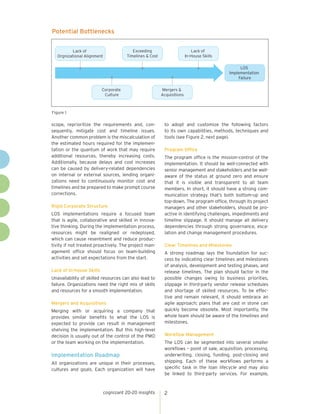
Lack of Organizational Alignment 
When an organization decides to implement an 
LOS, it should be prepared for a long journey. 
It takes an average of 8 to 24 months to com-plete 
the implementation, depending on custom-izations, 
integrations and channels. Hence, it’s 
important that the cross-functional leadership 
team is aligned with the goals and objectives 
of the initiative. This will prevent any potential 
challenges when management weighs the short-term 
benefits against the long-term to decide 
on the future course. Well-developed goals and 
objectives can help resolve such challenges, 
enabling a more effective outcome. 
Exceeding Timelines and Cost 
Exceeding the budget and/or taking longer than 
expected to implement the LOS are among 
the top reasons for failure. Several factors 
typically cause delays and/or increase costs. 
For example, a change in the business scenario 
can trigger a new set of requirements. Every 
organization needs a strong governance and 
change management plan to control the project 
cognizant 20-20 insights | september 2014 
• Cognizant 20-20 Insights
cognizant 20-20 insights 2 
scope, reprioritize the requirements and, con-sequently, 
mitigate cost and timeline issues. 
Another common problem is the miscalculation of 
the estimated hours required for the implemen-tation 
or the quantum of work that may require 
additional resources, thereby increasing costs. 
Additionally, because delays and cost increases 
can be caused by delivery-related dependencies 
on internal or external sources, lending organi-zations 
need to continuously monitor cost and 
timelines and be prepared to make prompt course 
corrections. 
Rigid Corporate Structure 
LOS implementations require a focused team 
that is agile, collaborative and skilled in innova-tive 
thinking. During the implementation process, 
resources might be realigned or redeployed, 
which can cause resentment and reduce produc-tivity 
if not treated proactively. The project man-agement 
office should focus on team-building 
activities and set expectations from the start. 
Lack of In-house Skills 
Unavailability of skilled resources can also lead to 
failure. Organizations need the right mix of skills 
and resources for a smooth implementation. 
Mergers and Acquisitions 
Merging with or acquiring a company that 
provides similar benefits to what the LOS is 
expected to provide can result in management 
shelving the implementation. But this high-level 
decision is usually out of the control of the PMO 
or the team working on the implementation. 
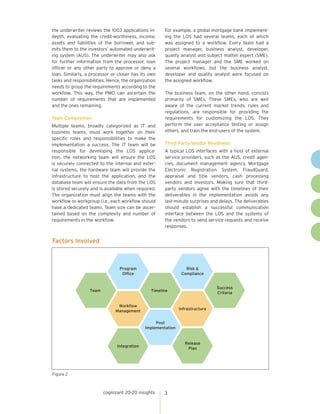
Implementation Roadmap 
All organizations are unique in their processes, 
cultures and goals. Each organization will have 
to adopt and customize the following factors 
to its own capabilities, methods, techniques and 
tools (see Figure 2, next page). 
Program Office 
The program office is the mission-control of the 
implementation. It should be well-connected with 
senior management and stakeholders and be well-aware 
of the status at ground zero and ensure 
that it is visible and transparent to all team 
members. In short, it should have a strong com-munication 
strategy that’s both bottom-up and 
top-down. The program office, through its project 
managers and other stakeholders, should be pro-active 
in identifying challenges, impediments and 
timeline slippage. It should manage all delivery 
dependencies through strong governance, esca-lation 
and change management procedures. 
Clear Timelines and Milestones 
A strong roadmap lays the foundation for suc-cess 
by indicating clear timelines and milestones 
of analysis, development and testing phases, and 
release timelines. The plan should factor in the 
possible changes owing to business priorities, 
slippage in third-party vendor release schedules 
and shortage of skilled resources. To be effec-tive 
and remain relevant, it should embrace an 
agile approach; plans that are cast in stone can 
quickly become obsolete. Most importantly, the 
whole team should be aware of the timelines and 
milestones. 
Workflow Management 
The LOS can be segmented into several smaller 
workflows – point of sale, acquisition, processing, 
underwriting, closing, funding, post-closing and 
shipping. Each of these workflows performs a 
specific task in the loan lifecycle and may also 
be linked to third-party services. For example, 
Potential Bottlenecks 
Figure 1 
Corporate 
Culture 
Mergers & 
Acquisitions 
LOS 
Implementation 
Failure 
Exceeding 
Timelines & Cost 
Lack of 
In-House Skills 
Lack of 
Orgnizational Alignment
cognizant 20-20 insights 3 
the underwriter reviews the 1003 applications in-depth, 
evaluating the credit-worthiness, income, 
assets and liabilities of the borrower, and sub-mits 
them to the investors’ automated underwrit-ing 
system (AUS). The underwriter may also ask 
for further information from the processor, loan 
officer or any other party to approve or deny a 
loan. Similarly, a processor or closer has its own 
tasks and responsibilities. Hence, the organization 
needs to group the requirements according to the 
workflow. This way, the PMO can ascertain the 
number of requirements that are implemented 
and the ones remaining. 
Team Composition 
Multiple teams, broadly categorized as IT and 
business teams, must work together on their 
specific roles and responsibilities to make the 
implementation a success. The IT team will be 
responsible for developing the LOS applica-tion, 
the networking team will ensure the LOS 
is securely connected to the internal and exter-nal 
systems, the hardware team will provide the 
infrastructure to host the application, and the 
database team will ensure the data from the LOS 
is stored securely and is available when required. 
The organization must align the teams with the 
workflow or workgroup (i.e., each workflow should 
have a dedicated team). Team size can be ascer-tained 
based on the complexity and number of 
requirements in the workflow. 
For example, a global mortgage bank implement-ing 
the LOS had several teams, each of which 
was assigned to a workflow. Every team had a 
project manager, business analyst, developer, 
quality analyst and subject matter expert (SME). 
The project manager and the SME worked on 
several workflows, but the business analyst, 
developer and quality analyst were focused on 
the assigned workflow. 
The business team, on the other hand, consists 
primarily of SMEs. These SMEs, who are well 
aware of the current market trends, rules and 
regulations, are responsible for providing the 
requirements for customizing the LOS. They 
perform the user acceptance testing or assign 
others, and train the end-users of the system. 
Third-Party Vendor Readiness 
A typical LOS interfaces with a host of external 
service providers, such as the AUS, credit agen-cies, 
document management agency, Mortgage 
Electronic Registration System, FraudGuard, 
appraisal and title vendors, cash processing 
vendors and investors. Making sure that third-party 
vendors agree with the timelines of their 
deliverables in the implementation avoids any 
last-minute surprises and delays. The deliverables 
should establish a successful communication 
interface between the LOS and the systems of 
the vendors to send service requests and receive 
responses. 
Factors Involved 
Figure 2 
Team 
Workflow 
Management 
Timeline 
Risk & 
Compliance 
Success 
Criteria 
Infrastructure 
Release 
Plan 
Program 
Office 
Integration 
Post 
Implementation
cognizant 20-20 insights 4 
Infrastructure Readiness 
The organization should finalize the infrastruc-ture 
requirements during the LOS selection 
phase. The infrastructure would largely depend 
on the type of LOS architecture/ownership model 
under consideration. That is, the organization 
should determine whether it wants a traditional 
in-house hosted system or something more 
contemporary, such as software delivered as 
a service (or SaaS) model. In advance, lenders 
should conduct a thorough review of factors such 
as costs, long-term maintenance, data security 
and business continuity. 
Integration with Downstream Systems 
Many functions in the organization, such as 
finance, accounting, servicing, secondary market-ing 
and reporting, require LOS data at different 
stages of the loan lifecycle. 
For example, the hedging team may need certain 
loan data points as soon as the rate is locked 
with the borrower. And a larger set of loan data 
points may be required for boarding the loan into 
a servicing system after it is closed and funded. 
Therefore, the team working on integrating the 
downstream systems with the LOS must under-stand 
the data requirements and triggers of each 
system. The situation becomes complex if the 
downstream systems do not accept the industry 
standard extracts that most LOSs produce or if 
data is required in different formats by differ-ent 
systems. Property type, for example, may 
be required in alphanumeric format by one 
system and in numeric code by another. The most 
common practice in such situations is to store the 
LOS data in a database and transform it accord-ing 
to the rules and requirements of each of the 
systems before passing data to them. 
Regulation and Compliance 
The U.S. mortgage industry is heavily governed 
by regulations, which are continuously changing. 
To avoid hefty fines, it is crucial for mortgage 
firms to establish a group that only focuses on 
compliance. During implementation, the compli-ance 
group should provide a set of regulatory 
requirements to be implemented before the 
origination system is rolled out. The quality 
control team should be responsible for testing 
whether the implementation of these require-ments 
is within the acceptable criteria of the 
compliance group. 
Release Plan 
The release plan should be part of the communi-cation 
strategy of the PMO right from the initial 
stage. The plan should mostly address the “how” 
and “who” of the release (i.e., “How are you going 
to release and to whom?”). 
There are several ways to address the “how” 
part. A mortgage lender may decide to roll out a 
commercial off-the-shelf (COTS) version (with 
LOS customizations of product and pricing, 
security and integration with downstream 
systems at the very least) to help get users 
started on the system and then frequently release 
additional customizations for each workflow. 
Another mortgage lender may decide to customize 
the COTS version so that it adheres to the firm’s 
business, compliance, regulatory and security 
requirements before rolling it out. Other cus-tomizations 
can then be rolled out in a phased 
manner. Each organization should customize the 
release plan to its own needs and priorities. 
All roll-out methods should follow a top-down 
approach. That is to say, the initial release and 
subsequent customizations should follow the loan 
lifecycle. The initial releases should be focused 
on the workflow that captures the borrowers’ 
information, rate locks, product selection, AUS 
and other documentation-related information. In 
some LOSs, this workflow is called an acquisition 
or application. As the loan transitions from this 
state to other workflows, the subsequent releases 
should be focused on processing, underwriting, 
closing, funding, post-closing and shipping. 
Just prior to the release, it is a good practice to 
conduct a small pilot phase comprising specific 
units or branches before releasing the system 
across the organization. This can help to gauge 
potential levels of user acceptance and general 
functioning of all other systems that are con-nected 
to the LOS, as well as LOS application 
performance. When the governing committee 
feels that it has gathered enough confidence 
in the real-time functioning of the LOS, it can 
release the system across the organization. 
Post-Implementation Plan 
Having a plan for post-implementation activities 
is as important as the implementation plan itself. 
With any new system, the users must unlearn 
older ways of doing things and embrace a new 
system. Thorough training of each resource in 
his or her own area of specialization is, therefore,
World Headquarters 
500 Frank W. Burr Blvd. 
Teaneck, NJ 07666 USA 
Phone: +1 201 801 0233 
Fax: +1 201 801 0243 
Toll Free: +1 888 937 3277 
Email: inquiry@cognizant.com 
European Headquarters 
1 Kingdom Street 
Paddington Central 
London W2 6BD 
Phone: +44 (0) 207 297 7600 
Fax: +44 (0) 207 121 0102 
Email: infouk@cognizant.com 
India Operations Headquarters 
#5/535, Old Mahabalipuram Road 
Okkiyam Pettai, Thoraipakkam 
Chennai, 600 096 India 
Phone: +91 (0) 44 4209 6000 
Fax: +91 (0) 44 4209 6060 
Email: inquiryindia@cognizant.com 
 
© Copyright 2014, Cognizant. All rights reserved. No part of this document may be reproduced, stored in a retrieval system, transmitted in any form or by any 
means, electronic, mechanical, photocopying, recording, or otherwise, without the express written permission from Cognizant. The information contained herein is 
subject to change without notice. All other trademarks mentioned herein are the property of their respective owners. 
About Cognizant 
Cognizant (NASDAQ: CTSH) is a leading provider of information technology, consulting, and business process 
outsourcing services, dedicated to helping the world's leading companies build stronger businesses. Headquartered 
in Teaneck, New Jersey (U.S.), Cognizant combines a passion for client satisfaction, technology innovation, deep 
industry and business process expertise, and a global, collaborative workforce that embodies the future of work. With 
over 75 development and delivery centers worldwide and approximately 187,400 employees as of June 30, 2014, 
Cognizant is a member of the NASDAQ-100, the S&P 500, the Forbes Global 2000, and the Fortune 500 and is ranked 
among the top performing and fastest growing companies in the world. 
Visit us online at www.cognizant.com or follow us on Twitter: Cognizant. 
essential. Apart from this, there should be several 
resources that are well-trained on overall sys-tem 
functionalities. These resources should help 
others in the organization overcome initial new 
user challenges. A mortgage lender, for example, 
should create an LOS help desk immediately after 
rolling out the LOS. 
It’s also a good practice to maintain a log of user 
feedback, collected through the helpdesk, for 
further LOS improvement. 
Success Criteria 
Every organization should establish success cri-teria 
at the beginning of the implementation pro-cess. 
These can include: 
• To what degree has the new LOS reduced the 
need for manual workarounds? 
• Is there any time spent correcting the data 
from the LOS when it’s loaded into a servicing 
system or before the loan is sold to investors? 
• Is the loan production process fully compliant 
with existing regulations? 
• Is the time taken to close and fund a loan within 
the expected timelines of stakeholders? 
• Is the overall cost to originate a loan acceptable? 
Answers to questions like these will help ascer-tain 
return-on-investment (ROI) and the level of 
success. These answers may not be available 
immediately after the implementation. The 
governing body will have to wait for the LOS 
efficiencies to surface to properly measure ROI. 
Looking Ahead 
An LOS implementation is a long and complex 
process. Multiple technology, business and human 
resources must come together to ensure suc-cess. 
Given its enormity and complexity, the LOS 
needs an implementation that is agile and 
responsive to the organization’s specific needs 
and challenges. 
Moreover, sustaining the focus over time is 
crucial for organizations that want to continu-ously 
improve their business by placing the 
customer at the core of their value proposition, 
while generating greater process efficiencies. 
About the Authors 
Chayan Jagsukh is a Senior Consultant with Cognizant Business Consulting’s Banking and 
Financial Services Practice. He has worked for over nine years with leading global banks on 
project management, product management and business process optimization. He can be reached 
at Chayan.Jagsukh@cognizant.com. 
Avishek Bimal is a Senior Manager Consulting with Cognizant Business Consulting’s Banking and 
Financial Services Practice and has worked for over 13 years in the banking and insurance space on 
projects spanning business and IT strategy, business process optimization and complex project 
execution. He can be reached at Avishek.Bimal@cognizant.com.

Mortgage LOS Implementation: A Roadmap for Sustainability

  • 1.
    Mortgage LOS Implementation: A Roadmap for Sustainability A successful and sustainable loan origination system requires rigorous timelines, infrastructure readiness and workflow management. Executive Summary A loan origination system (LOS) is a powerful tool for developing the mortgage landscape of a lending organization and increasing lender responsiveness to market changes. Mortgage lenders implement a loan origination platform to stay competitive, increase efficiency, speed turnaround times, control loan quality and remain compliant with lending rules and regulations. Studies suggest that 35% of LOS platform imple-mentations fail and that 65% exceed budgets and timelines. A lack of thorough preparation and the absence of a clear roadmap add to the problem. Because it can take some time before the benefits are realized, the LOS should be aligned with the organization’s long-term strategy, with the goal of ultimately being absorbed as one of the core systems. That said, during the implemen-tation, many elements can go wrong and spiral out of control, resulting in a disastrous outcome. Therefore, it is critical to develop an effective implementation roadmap. This white paper evaluates the most common factors leading to LOS implementation failures. We then provide a roadmap that organizations can adopt to improve the odds of a successful implementation. Challenges of Implementing LOS Lack of Organizational Alignment When an organization decides to implement an LOS, it should be prepared for a long journey. It takes an average of 8 to 24 months to com-plete the implementation, depending on custom-izations, integrations and channels. Hence, it’s important that the cross-functional leadership team is aligned with the goals and objectives of the initiative. This will prevent any potential challenges when management weighs the short-term benefits against the long-term to decide on the future course. Well-developed goals and objectives can help resolve such challenges, enabling a more effective outcome. Exceeding Timelines and Cost Exceeding the budget and/or taking longer than expected to implement the LOS are among the top reasons for failure. Several factors typically cause delays and/or increase costs. For example, a change in the business scenario can trigger a new set of requirements. Every organization needs a strong governance and change management plan to control the project cognizant 20-20 insights | september 2014 • Cognizant 20-20 Insights
  • 2.
    cognizant 20-20 insights2 scope, reprioritize the requirements and, con-sequently, mitigate cost and timeline issues. Another common problem is the miscalculation of the estimated hours required for the implemen-tation or the quantum of work that may require additional resources, thereby increasing costs. Additionally, because delays and cost increases can be caused by delivery-related dependencies on internal or external sources, lending organi-zations need to continuously monitor cost and timelines and be prepared to make prompt course corrections. Rigid Corporate Structure LOS implementations require a focused team that is agile, collaborative and skilled in innova-tive thinking. During the implementation process, resources might be realigned or redeployed, which can cause resentment and reduce produc-tivity if not treated proactively. The project man-agement office should focus on team-building activities and set expectations from the start. Lack of In-house Skills Unavailability of skilled resources can also lead to failure. Organizations need the right mix of skills and resources for a smooth implementation. Mergers and Acquisitions Merging with or acquiring a company that provides similar benefits to what the LOS is expected to provide can result in management shelving the implementation. But this high-level decision is usually out of the control of the PMO or the team working on the implementation. Implementation Roadmap All organizations are unique in their processes, cultures and goals. Each organization will have to adopt and customize the following factors to its own capabilities, methods, techniques and tools (see Figure 2, next page). Program Office The program office is the mission-control of the implementation. It should be well-connected with senior management and stakeholders and be well-aware of the status at ground zero and ensure that it is visible and transparent to all team members. In short, it should have a strong com-munication strategy that’s both bottom-up and top-down. The program office, through its project managers and other stakeholders, should be pro-active in identifying challenges, impediments and timeline slippage. It should manage all delivery dependencies through strong governance, esca-lation and change management procedures. Clear Timelines and Milestones A strong roadmap lays the foundation for suc-cess by indicating clear timelines and milestones of analysis, development and testing phases, and release timelines. The plan should factor in the possible changes owing to business priorities, slippage in third-party vendor release schedules and shortage of skilled resources. To be effec-tive and remain relevant, it should embrace an agile approach; plans that are cast in stone can quickly become obsolete. Most importantly, the whole team should be aware of the timelines and milestones. Workflow Management The LOS can be segmented into several smaller workflows – point of sale, acquisition, processing, underwriting, closing, funding, post-closing and shipping. Each of these workflows performs a specific task in the loan lifecycle and may also be linked to third-party services. For example, Potential Bottlenecks Figure 1 Corporate Culture Mergers & Acquisitions LOS Implementation Failure Exceeding Timelines & Cost Lack of In-House Skills Lack of Orgnizational Alignment
  • 3.
    cognizant 20-20 insights3 the underwriter reviews the 1003 applications in-depth, evaluating the credit-worthiness, income, assets and liabilities of the borrower, and sub-mits them to the investors’ automated underwrit-ing system (AUS). The underwriter may also ask for further information from the processor, loan officer or any other party to approve or deny a loan. Similarly, a processor or closer has its own tasks and responsibilities. Hence, the organization needs to group the requirements according to the workflow. This way, the PMO can ascertain the number of requirements that are implemented and the ones remaining. Team Composition Multiple teams, broadly categorized as IT and business teams, must work together on their specific roles and responsibilities to make the implementation a success. The IT team will be responsible for developing the LOS applica-tion, the networking team will ensure the LOS is securely connected to the internal and exter-nal systems, the hardware team will provide the infrastructure to host the application, and the database team will ensure the data from the LOS is stored securely and is available when required. The organization must align the teams with the workflow or workgroup (i.e., each workflow should have a dedicated team). Team size can be ascer-tained based on the complexity and number of requirements in the workflow. For example, a global mortgage bank implement-ing the LOS had several teams, each of which was assigned to a workflow. Every team had a project manager, business analyst, developer, quality analyst and subject matter expert (SME). The project manager and the SME worked on several workflows, but the business analyst, developer and quality analyst were focused on the assigned workflow. The business team, on the other hand, consists primarily of SMEs. These SMEs, who are well aware of the current market trends, rules and regulations, are responsible for providing the requirements for customizing the LOS. They perform the user acceptance testing or assign others, and train the end-users of the system. Third-Party Vendor Readiness A typical LOS interfaces with a host of external service providers, such as the AUS, credit agen-cies, document management agency, Mortgage Electronic Registration System, FraudGuard, appraisal and title vendors, cash processing vendors and investors. Making sure that third-party vendors agree with the timelines of their deliverables in the implementation avoids any last-minute surprises and delays. The deliverables should establish a successful communication interface between the LOS and the systems of the vendors to send service requests and receive responses. Factors Involved Figure 2 Team Workflow Management Timeline Risk & Compliance Success Criteria Infrastructure Release Plan Program Office Integration Post Implementation
  • 4.
    cognizant 20-20 insights4 Infrastructure Readiness The organization should finalize the infrastruc-ture requirements during the LOS selection phase. The infrastructure would largely depend on the type of LOS architecture/ownership model under consideration. That is, the organization should determine whether it wants a traditional in-house hosted system or something more contemporary, such as software delivered as a service (or SaaS) model. In advance, lenders should conduct a thorough review of factors such as costs, long-term maintenance, data security and business continuity. Integration with Downstream Systems Many functions in the organization, such as finance, accounting, servicing, secondary market-ing and reporting, require LOS data at different stages of the loan lifecycle. For example, the hedging team may need certain loan data points as soon as the rate is locked with the borrower. And a larger set of loan data points may be required for boarding the loan into a servicing system after it is closed and funded. Therefore, the team working on integrating the downstream systems with the LOS must under-stand the data requirements and triggers of each system. The situation becomes complex if the downstream systems do not accept the industry standard extracts that most LOSs produce or if data is required in different formats by differ-ent systems. Property type, for example, may be required in alphanumeric format by one system and in numeric code by another. The most common practice in such situations is to store the LOS data in a database and transform it accord-ing to the rules and requirements of each of the systems before passing data to them. Regulation and Compliance The U.S. mortgage industry is heavily governed by regulations, which are continuously changing. To avoid hefty fines, it is crucial for mortgage firms to establish a group that only focuses on compliance. During implementation, the compli-ance group should provide a set of regulatory requirements to be implemented before the origination system is rolled out. The quality control team should be responsible for testing whether the implementation of these require-ments is within the acceptable criteria of the compliance group. Release Plan The release plan should be part of the communi-cation strategy of the PMO right from the initial stage. The plan should mostly address the “how” and “who” of the release (i.e., “How are you going to release and to whom?”). There are several ways to address the “how” part. A mortgage lender may decide to roll out a commercial off-the-shelf (COTS) version (with LOS customizations of product and pricing, security and integration with downstream systems at the very least) to help get users started on the system and then frequently release additional customizations for each workflow. Another mortgage lender may decide to customize the COTS version so that it adheres to the firm’s business, compliance, regulatory and security requirements before rolling it out. Other cus-tomizations can then be rolled out in a phased manner. Each organization should customize the release plan to its own needs and priorities. All roll-out methods should follow a top-down approach. That is to say, the initial release and subsequent customizations should follow the loan lifecycle. The initial releases should be focused on the workflow that captures the borrowers’ information, rate locks, product selection, AUS and other documentation-related information. In some LOSs, this workflow is called an acquisition or application. As the loan transitions from this state to other workflows, the subsequent releases should be focused on processing, underwriting, closing, funding, post-closing and shipping. Just prior to the release, it is a good practice to conduct a small pilot phase comprising specific units or branches before releasing the system across the organization. This can help to gauge potential levels of user acceptance and general functioning of all other systems that are con-nected to the LOS, as well as LOS application performance. When the governing committee feels that it has gathered enough confidence in the real-time functioning of the LOS, it can release the system across the organization. Post-Implementation Plan Having a plan for post-implementation activities is as important as the implementation plan itself. With any new system, the users must unlearn older ways of doing things and embrace a new system. Thorough training of each resource in his or her own area of specialization is, therefore,
  • 5.
    World Headquarters 500Frank W. Burr Blvd. Teaneck, NJ 07666 USA Phone: +1 201 801 0233 Fax: +1 201 801 0243 Toll Free: +1 888 937 3277 Email: inquiry@cognizant.com European Headquarters 1 Kingdom Street Paddington Central London W2 6BD Phone: +44 (0) 207 297 7600 Fax: +44 (0) 207 121 0102 Email: infouk@cognizant.com India Operations Headquarters #5/535, Old Mahabalipuram Road Okkiyam Pettai, Thoraipakkam Chennai, 600 096 India Phone: +91 (0) 44 4209 6000 Fax: +91 (0) 44 4209 6060 Email: inquiryindia@cognizant.com © Copyright 2014, Cognizant. All rights reserved. No part of this document may be reproduced, stored in a retrieval system, transmitted in any form or by any means, electronic, mechanical, photocopying, recording, or otherwise, without the express written permission from Cognizant. The information contained herein is subject to change without notice. All other trademarks mentioned herein are the property of their respective owners. About Cognizant Cognizant (NASDAQ: CTSH) is a leading provider of information technology, consulting, and business process outsourcing services, dedicated to helping the world's leading companies build stronger businesses. Headquartered in Teaneck, New Jersey (U.S.), Cognizant combines a passion for client satisfaction, technology innovation, deep industry and business process expertise, and a global, collaborative workforce that embodies the future of work. With over 75 development and delivery centers worldwide and approximately 187,400 employees as of June 30, 2014, Cognizant is a member of the NASDAQ-100, the S&P 500, the Forbes Global 2000, and the Fortune 500 and is ranked among the top performing and fastest growing companies in the world. Visit us online at www.cognizant.com or follow us on Twitter: Cognizant. essential. Apart from this, there should be several resources that are well-trained on overall sys-tem functionalities. These resources should help others in the organization overcome initial new user challenges. A mortgage lender, for example, should create an LOS help desk immediately after rolling out the LOS. It’s also a good practice to maintain a log of user feedback, collected through the helpdesk, for further LOS improvement. Success Criteria Every organization should establish success cri-teria at the beginning of the implementation pro-cess. These can include: • To what degree has the new LOS reduced the need for manual workarounds? • Is there any time spent correcting the data from the LOS when it’s loaded into a servicing system or before the loan is sold to investors? • Is the loan production process fully compliant with existing regulations? • Is the time taken to close and fund a loan within the expected timelines of stakeholders? • Is the overall cost to originate a loan acceptable? Answers to questions like these will help ascer-tain return-on-investment (ROI) and the level of success. These answers may not be available immediately after the implementation. The governing body will have to wait for the LOS efficiencies to surface to properly measure ROI. Looking Ahead An LOS implementation is a long and complex process. Multiple technology, business and human resources must come together to ensure suc-cess. Given its enormity and complexity, the LOS needs an implementation that is agile and responsive to the organization’s specific needs and challenges. Moreover, sustaining the focus over time is crucial for organizations that want to continu-ously improve their business by placing the customer at the core of their value proposition, while generating greater process efficiencies. About the Authors Chayan Jagsukh is a Senior Consultant with Cognizant Business Consulting’s Banking and Financial Services Practice. He has worked for over nine years with leading global banks on project management, product management and business process optimization. He can be reached at Chayan.Jagsukh@cognizant.com. Avishek Bimal is a Senior Manager Consulting with Cognizant Business Consulting’s Banking and Financial Services Practice and has worked for over 13 years in the banking and insurance space on projects spanning business and IT strategy, business process optimization and complex project execution. He can be reached at Avishek.Bimal@cognizant.com.