


Moodle and the Living Curriculum
Unitec
Past

                                    History


>> UNITEC INSTITUTE OF TECHNOLOGY
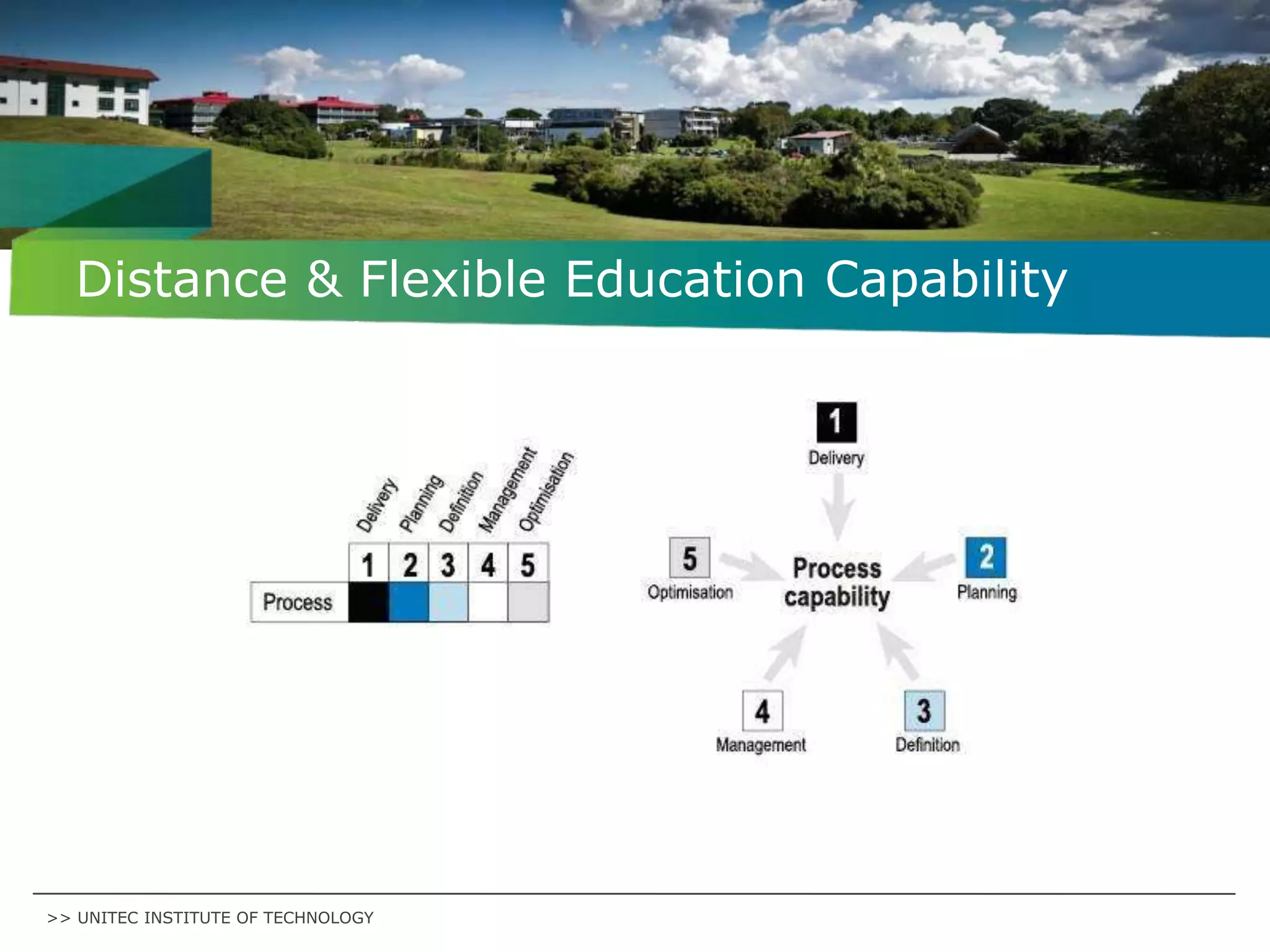
Distance & Flexible Education Capability
  Assessment


>> UNITEC INSTITUTE OF TECHNOLOGY
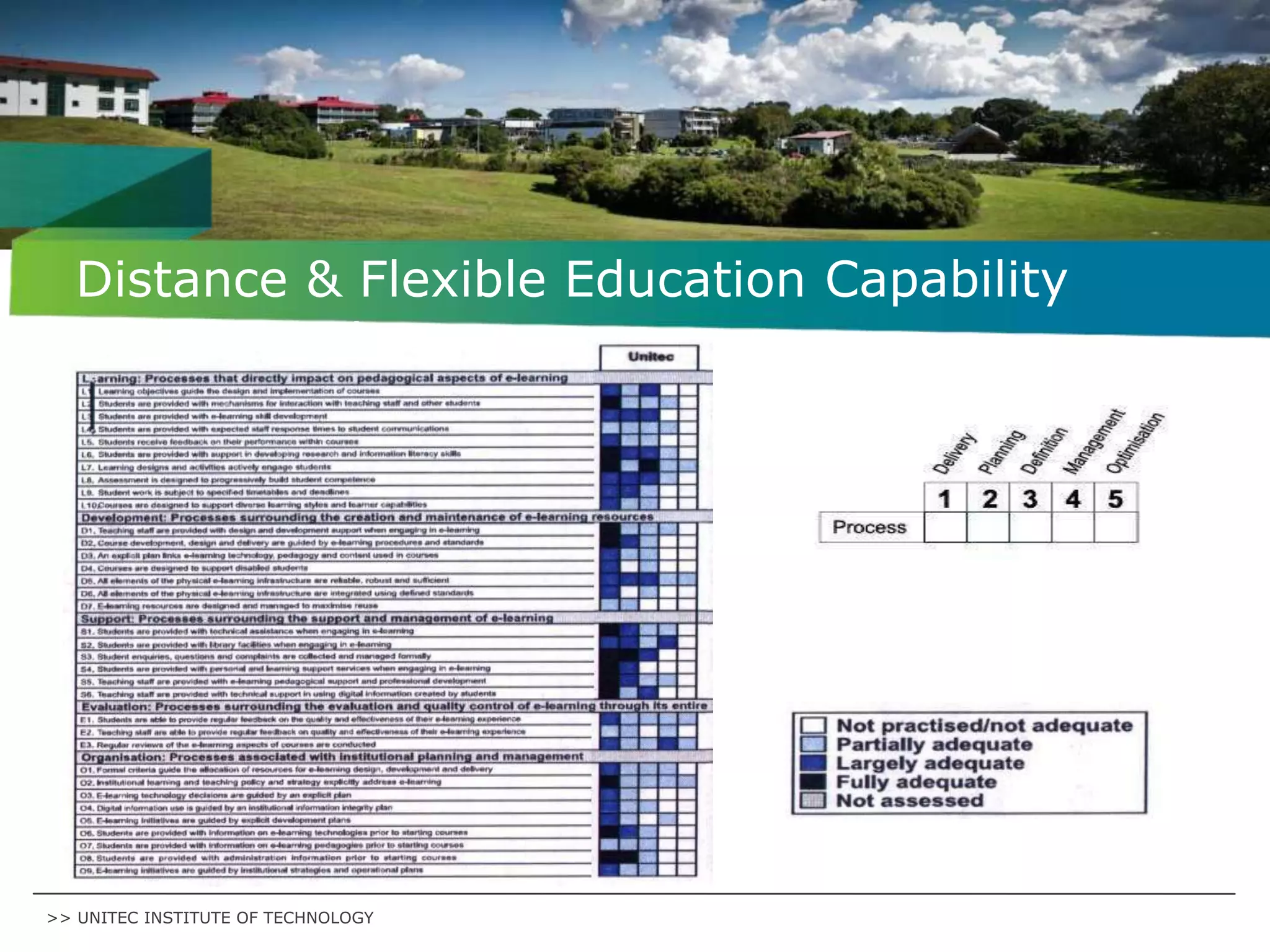
Distance & Flexible Education Capability
  Assessment


>> UNITEC INSTITUTE OF TECHNOLOGY
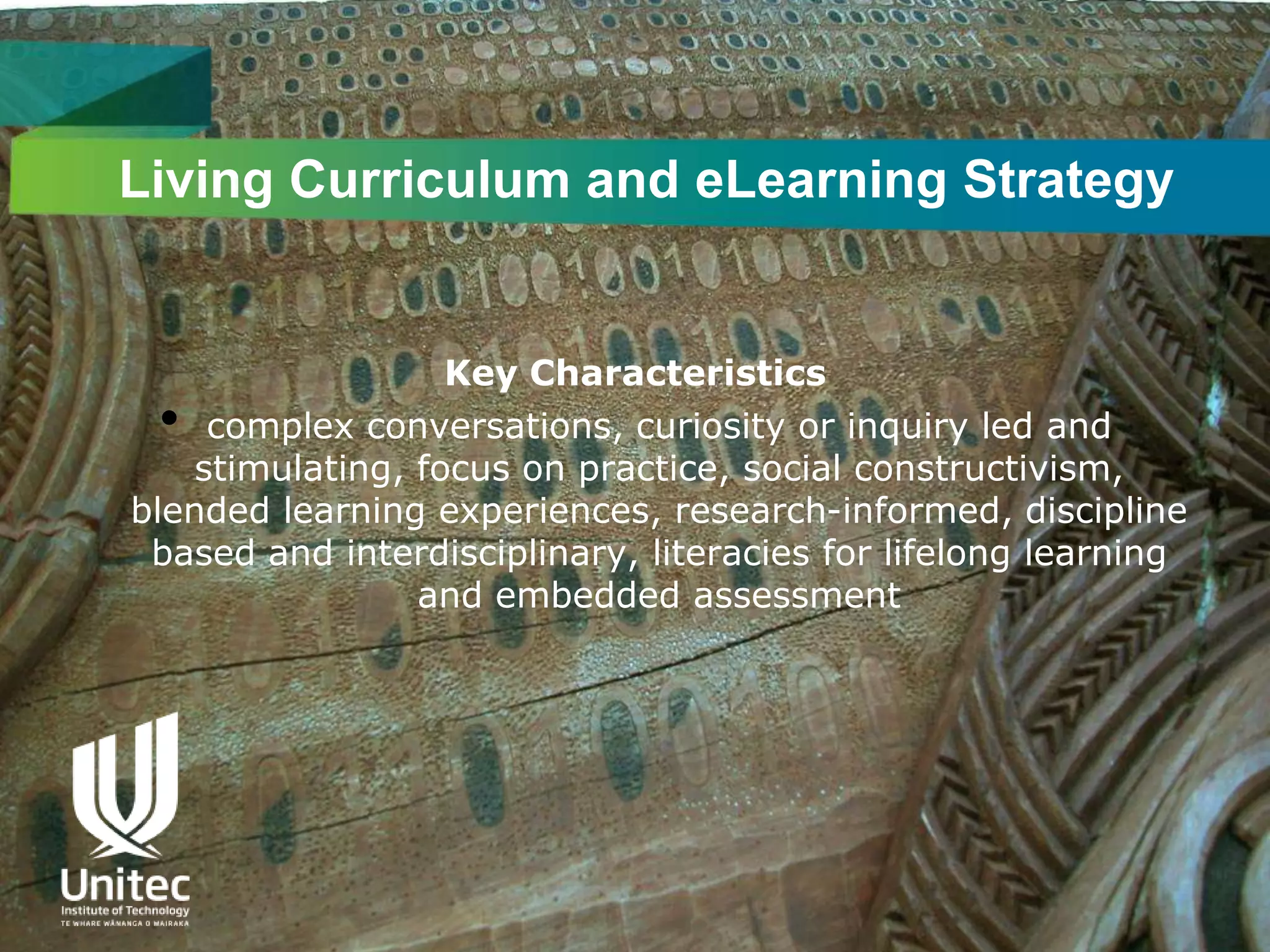
Living Curriculum and eLearning Strategy


                   Key Characteristics
 •   complex conversations, curiosity or inquiry led and
    stimulating, focus on practice, social constructivism,
blended learning experiences, research-informed, discipline
 based and interdisciplinary, literacies for lifelong learning
                 and embedded assessment
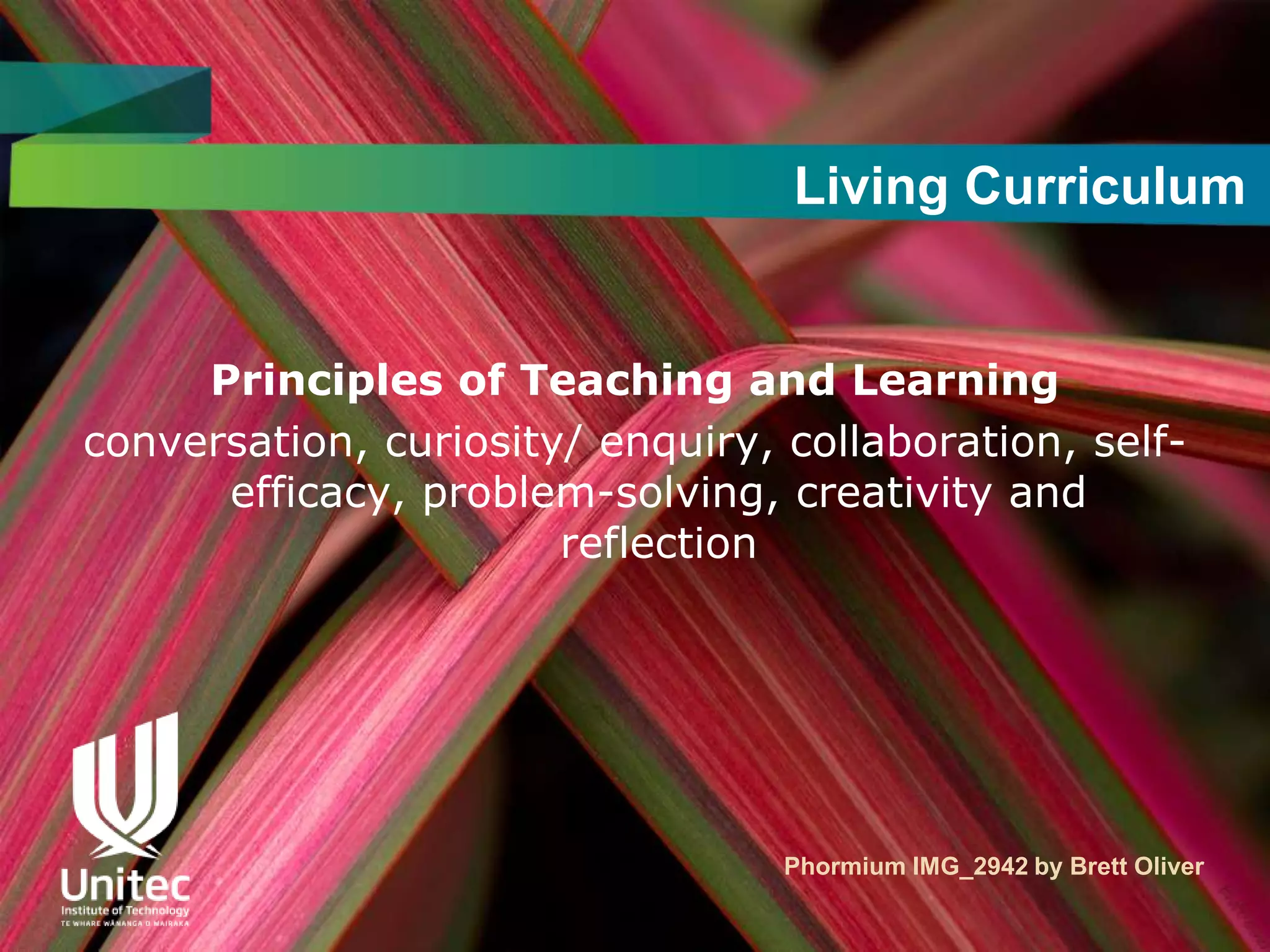
Living Curriculum


     Principles of Teaching and Learning
conversation, curiosity/ enquiry, collaboration, self-
      efficacy, problem-solving, creativity and
                       reflection


                                  Phormium IMG_2942 by Brett Oliver
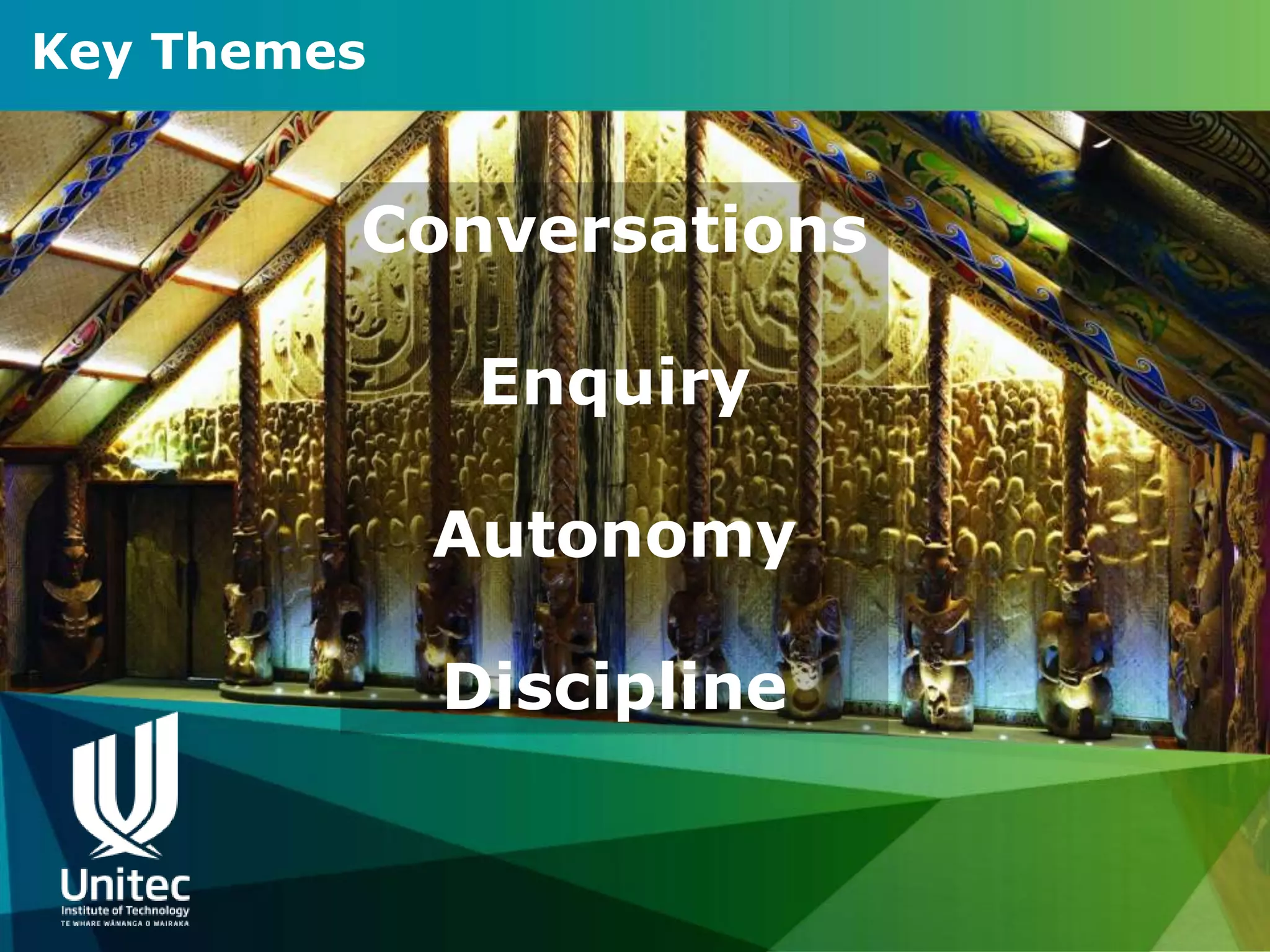
Key Themes


         Conversations

              Enquiry

             Autonomy

             Discipline
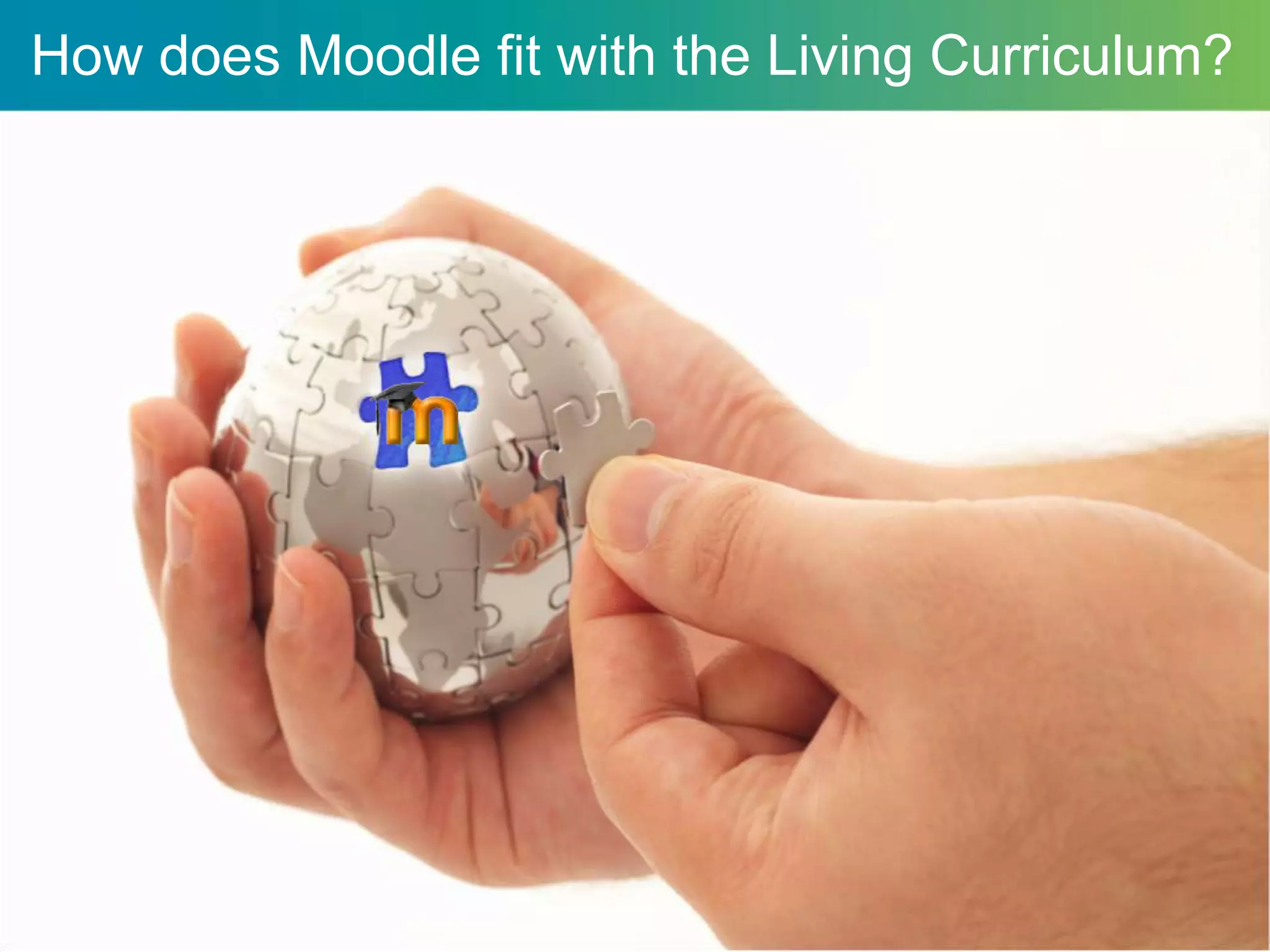
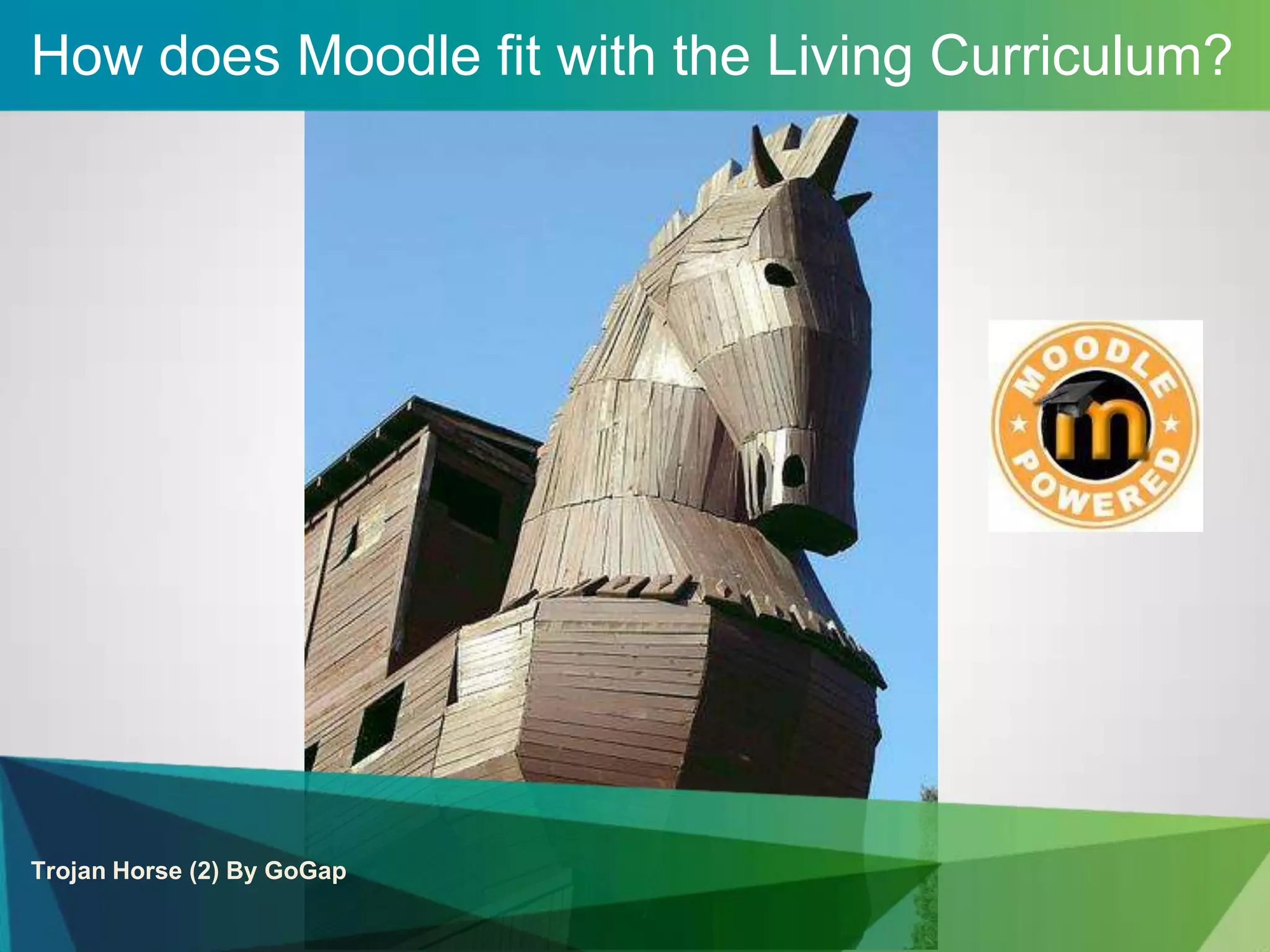
How does Moodle fit with the Living Curriculum?


Trojan Horse (2) By GoGap
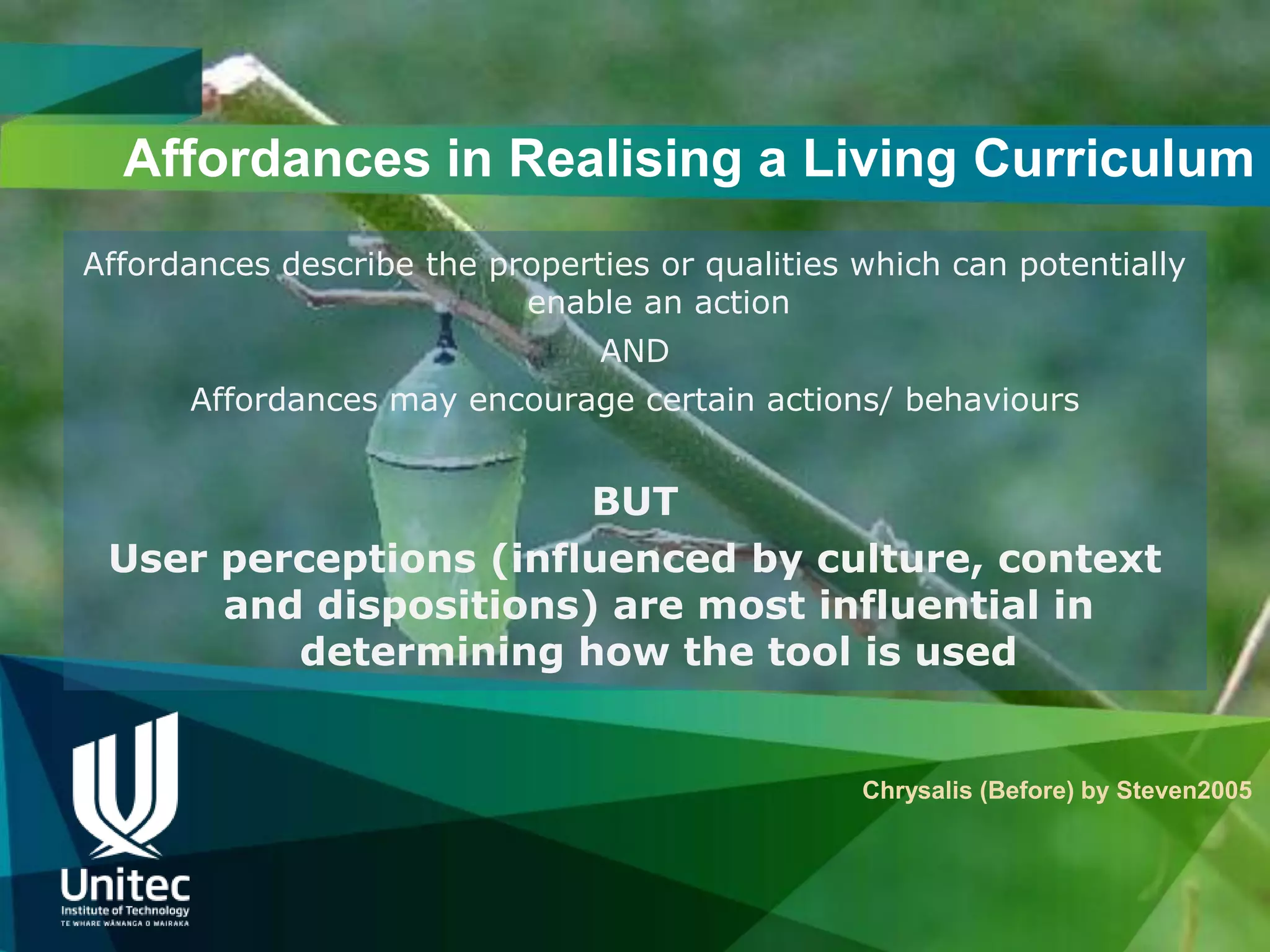
Affordances in Realising a Living Curriculum
Affordances describe the properties or qualities which can
                potentially enable an action


 Affordances may encourage certain actions/ behaviours


                           BUT


  User perceptions (influenced by culture, context and
 dispositions) are most influential in determining how the
                        tool is used


                                         Chrysalis (Before) by Steven2005
Conversations and Ako as Puawaitanga

  Conversations     Ako as             Conversations about enquiry, knowledge, practice,
  how learners      puawaitanga        learning and teaching are significant for
  engage with       Ako                engagement between and among learners, teachers,
  self and others   acknowledges       practitioners, communities, scholars, and with self
  to develop        that curriculum    and texts. Conversation develops beyond chat or
  understandings    development        discussion and becomes true dialogue that involves
                    derives from       analysis, synthesis, critical thinking and reflection.
                    diverse forms      Effective conversations help to build inclusive
                    of intercultural   relationships, involve questions as well as answer,
                    communicatio       and facilitate the expression of different points of
                    n.                 view. Conversations are contextually situated, and
                                       both technology and relationships mediate and
                                       facilitate conversations.


                                                               Excerpt from: Unitec, (n.d.) Ako:
                                                          learning together [Brochure]. Unitec,
                                                                       Auckland, New Zealand.
Enquiry and Ako as Wānanga


  Enquiry     Ako as wānanga.                The process of enquiry is at the heart of the
  how         Wānanga informs the            tertiary learning experience. It necessitates
  learners    curriculum through critical    reflecting on the world within the
  go about    enquiry. The relationship      perspective of a domain, formulating a
  asking      of the learner and the         question, locating information in response to
  and         teacher is interdependent,     the question, interpreting and testing ideas
  answering   and reciprocal for personal    and information, generating and synthesising
  questions   and communal good. In          ideas, and presenting and reflecting on the
              this context, the teacher is   process. Synthesis, reflection and evaluation
              prepared to learn from the     will in turn generate questions for further
              learner.                       exploration.


                                                             Excerpt from: Unitec, (n.d.) Ako:
                                                        learning together [Brochure]. Unitec,
                                                                     Auckland, New Zealand.
Autonomy and Ako as Mana


 Autonomy        Ako as mana. Mana binds the   Individuals taking increasing charge of
 how learners    authority of learner and      their own learning, which may be best
 increasingly    teacher with matauranga       achieved through a scaffolded and
 develop their   (knowledge). Integrity is     staged process of learning how to
 capability      developed through a process   learn, planning, managing and
 and             of poutama (scaffolded        reflecting on the process and products
 confidence      learning).                    of learning.


                                                          Excerpt from: Unitec, (n.d.) Ako:
                                                     learning together [Brochure]. Unitec,
                                                                  Auckland, New Zealand.
Discipline and Ako as Kaupapa


  Discipline       Ako as kaupapa.     Defined as a community of practice which has a
  how learners     Kaupapa is a        (contested and evolving) body of knowledge and
  engage with      process by which    theory, based on particular ways of knowing and
  the knowledge    intellect           practising, which is taught and applied and
  that underpins   internalises,       researched. A discipline has its own literacies
  the discipline   distinguishes and   and language. Members of the discipline
                   creates new         (faculty, learners, practitioners, scholars, etc)
                   knowledge.          identify with this community of practice and
                                       help to induct new members.


                                                           Excerpt from: Unitec, (n.d.) Ako:
                                                      learning together [Brochure]. Unitec,
                                                                   Auckland, New Zealand.
Affordances in Realising a Living Curriculum
Affordances describe the properties or qualities which can potentially
                           enable an action
                                AND
      Affordances may encourage certain actions/ behaviours


                       BUT
 User perceptions (influenced by culture, context
      and dispositions) are most influential in
         determining how the tool is used


                                                 Chrysalis (Before) by Steven2005
Considering Teacher Dispositions

“…habits of mind ... that filter one's knowledge,
skills, and beliefs and impact the action one takes
in a classroom...” (Thornton, 2006)

“[Dispositions] are the source of the recognition
(or misrecognition) of learning opportunities and
provide strategy and motivation for the inevitable
improvisation that is learning” (Carr et al., 2010)
Considering Teacher Dispositions

Teachers who engage with new innovations that
significantly differ from their usual practices, and
the cultural norms of their teaching environments
are generally ill-equipped for success.

As learners successfully develop competencies
they become more inclined to apply them and
recognise the opportunities and reasons for doing
so.
Considering Teacher Dispositions

Claxton and Carr (2004) suggest “the
environment may need to invite learners to
participate, actively engage them and include
their prior knowledge in conversations and
interactions of joint attention, or provoke them to
recognise opportunities that are unfamiliar and
new” (cited in Carr et al., 2010)
Supporting Teachers to Develop and
      Transfer Dispositions

“…teachers need to know the affordances and
constraints of various technologies and how
specific technologies might support their own
teaching practices and curricular goals” (Zhao et
al, 2002)
Supporting Teachers to Develop and
      Transfer Dispositions

Tishman, Jay and Perkins (1993) suggest thinking
dispositions are learned through a process of
enculturation, and use four elements in teaching thinking
dispositions: modelling, explanations, peer interactions
and both formal and informal feedback.

Zhao et al. (2002) found three significant factors for
success: technology proficiency, pedagogical compatibility,
and social awareness
Summary

    The affordances of an LMS can align closely with
an institutional pedagogy, and can help encourage
specific design-intended behaviours in teachers and
learners.


However teacher perceptions influence how or
whether the affordances are recognised.


The dispositions required can be learned and
transferred.
Summary

Intentional strategies need to be employed to address
teachers perceptions if they are to successfully transfer
their teaching dispositions to the new context,
knowledge and perceptions.

     Literature suggests an iterative teacher training and
support process which involves practical technology
use, an interactive group context which encourages
reflection and communication on the technologies and
their pedagogical potential/ application.
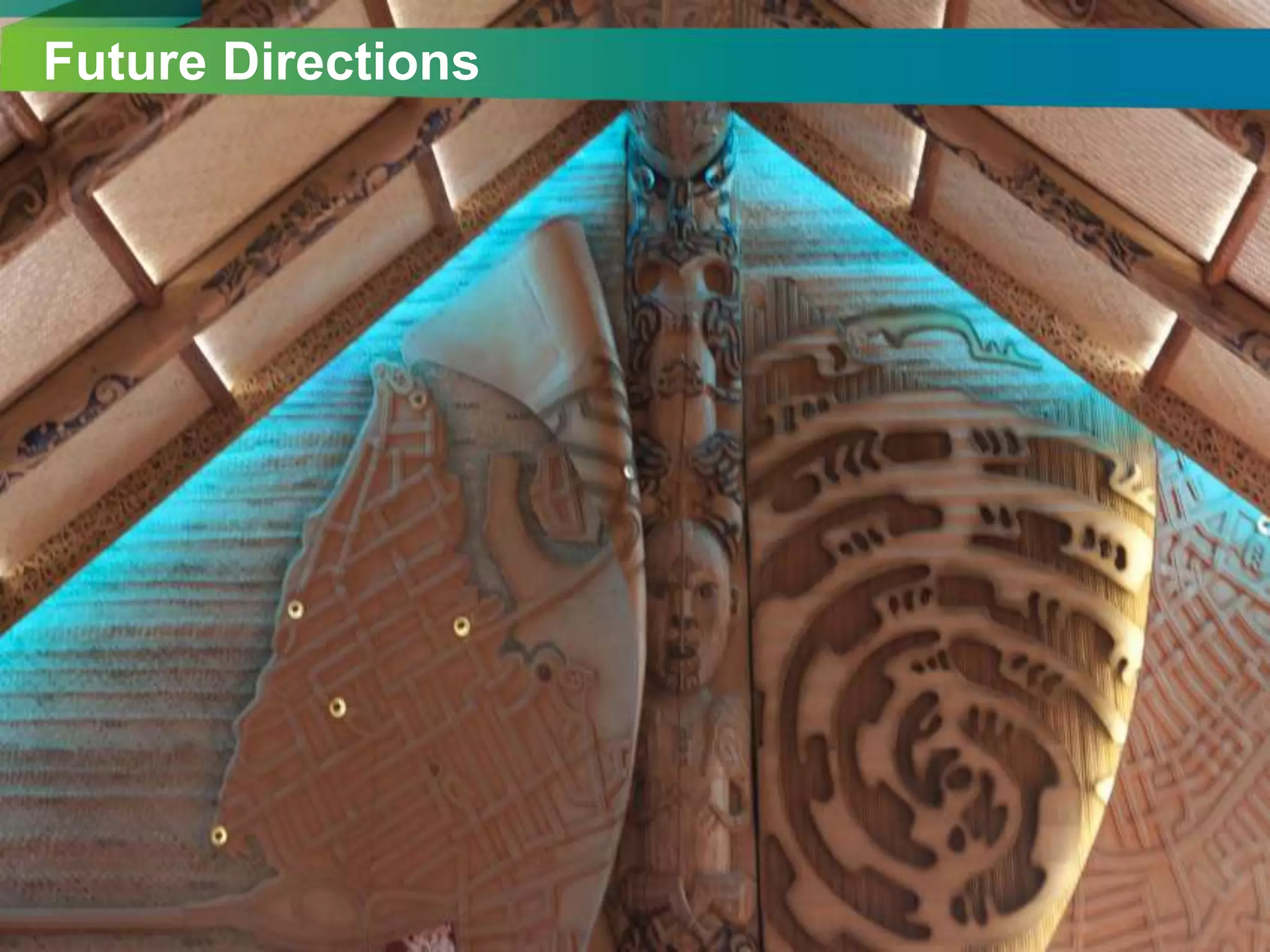
Future Directions
DSP 147: Thank You! 2007-10-11By vernhart
Image Credits

Chrysalis (Before) by Steven2005
(http://farm1.staticflickr.com/100/295999531_ce0b1a6f06.jpg )
Phormium IMG_2942 by Brett Oliver
(http://farm2.staticflickr.com/1266/1246712235_85b2a26571.jpg)
Building #1 by By cogdogblog (Alan Levine)
(http://farm1.staticflickr.com/2/2472100_1f14617e42.jpg)
Trojan Horse (2) By GoGap
(http://farm1.staticflickr.com/104/253649673_4eed26ea98.jpg)
DSP 147: Thank You! 2007-10-11By vernhart
(http://www.flickr.com/photos/vernhart/1574355240/sizes/m/in/photostream/)
Presentation References
Full References can be found in Roder, T. & Rata-Skudder, N. (2012) Moodle and the
Living Curriculum

      Carr, M., Smith, A. B., Duncan, J., Jones, C., Lee, W., & Marshall, K. (2010). Learning in the
Making: Disposition and Design in Early Education. Rotterdam: Sense Publishers
      John, P., & Sutherland, R. (2005). Affordance, opportunity and the pedagogical implications
of ICT. Educational Review, 57(4), 405-413.
McLoughlin, C., & Lee, M. J. W. (2007). Social software and participatory learning: Pedagogical
choices with technology affordances in the Web 2.0 era. Paper presented at Ascilite: Singapore.
Roder, T., & Rata-Skudder, N. (2012, 14-15 September 2012). A community approach to staff
development in eLearning. Paper presented at the 1st Moodle Research Conference, Heraklion,
Crete-Greece.
      Thornton, H. (2006). Dispositions in action: do dispositions make a difference in practice?
Teacher Education Quarterly, 33(2).
Tishman, S., Jay, E., & Perkins, D. N. (1992). Teaching Thinking Dispositions: From Transmission
to Enculturation. Harvard University, Cambridge. Retrieved from
http://learnweb.harvard.edu/alps/thinking/docs/article2.html
      Unitec, (n.d.). Ako: learning together [Brochure]. Unitec, Auckland, New Zealand.
      Unitec, (2010). Mapping the Living Curriculum [Internal document]. Unitec, Auckland, New
Zealand.
      Zhao, Y., Pugh, K., Sheldon, S., & Byers, J. L. (2002). Conditions for Classroom Technology
Innovations. Teachers College Record, 104(3), 482-515.

Moodle and the Living Curriculum

  • 1.
    Moodle and theLiving Curriculum
  • 2.
  • 3.
    Past History >> UNITEC INSTITUTE OF TECHNOLOGY
  • 4.
    Distance & FlexibleEducation Capability Assessment >> UNITEC INSTITUTE OF TECHNOLOGY
  • 5.
    Distance & FlexibleEducation Capability Assessment >> UNITEC INSTITUTE OF TECHNOLOGY
  • 6.
    Living Curriculum andeLearning Strategy Key Characteristics • complex conversations, curiosity or inquiry led and stimulating, focus on practice, social constructivism, blended learning experiences, research-informed, discipline based and interdisciplinary, literacies for lifelong learning and embedded assessment
  • 7.
    Living Curriculum Principles of Teaching and Learning conversation, curiosity/ enquiry, collaboration, self- efficacy, problem-solving, creativity and reflection Phormium IMG_2942 by Brett Oliver
  • 8.
    Key Themes Conversations Enquiry Autonomy Discipline
  • 9.
    How does Moodlefit with the Living Curriculum?
  • 11.
    How does Moodlefit with the Living Curriculum? Trojan Horse (2) By GoGap
  • 12.
    Affordances in Realisinga Living Curriculum Affordances describe the properties or qualities which can potentially enable an action Affordances may encourage certain actions/ behaviours BUT User perceptions (influenced by culture, context and dispositions) are most influential in determining how the tool is used Chrysalis (Before) by Steven2005
  • 13.
    Conversations and Akoas Puawaitanga Conversations Ako as Conversations about enquiry, knowledge, practice, how learners puawaitanga learning and teaching are significant for engage with Ako engagement between and among learners, teachers, self and others acknowledges practitioners, communities, scholars, and with self to develop that curriculum and texts. Conversation develops beyond chat or understandings development discussion and becomes true dialogue that involves derives from analysis, synthesis, critical thinking and reflection. diverse forms Effective conversations help to build inclusive of intercultural relationships, involve questions as well as answer, communicatio and facilitate the expression of different points of n. view. Conversations are contextually situated, and both technology and relationships mediate and facilitate conversations. Excerpt from: Unitec, (n.d.) Ako: learning together [Brochure]. Unitec, Auckland, New Zealand.
  • 14.
    Enquiry and Akoas Wānanga Enquiry Ako as wānanga. The process of enquiry is at the heart of the how Wānanga informs the tertiary learning experience. It necessitates learners curriculum through critical reflecting on the world within the go about enquiry. The relationship perspective of a domain, formulating a asking of the learner and the question, locating information in response to and teacher is interdependent, the question, interpreting and testing ideas answering and reciprocal for personal and information, generating and synthesising questions and communal good. In ideas, and presenting and reflecting on the this context, the teacher is process. Synthesis, reflection and evaluation prepared to learn from the will in turn generate questions for further learner. exploration. Excerpt from: Unitec, (n.d.) Ako: learning together [Brochure]. Unitec, Auckland, New Zealand.
  • 15.
    Autonomy and Akoas Mana Autonomy Ako as mana. Mana binds the Individuals taking increasing charge of how learners authority of learner and their own learning, which may be best increasingly teacher with matauranga achieved through a scaffolded and develop their (knowledge). Integrity is staged process of learning how to capability developed through a process learn, planning, managing and and of poutama (scaffolded reflecting on the process and products confidence learning). of learning. Excerpt from: Unitec, (n.d.) Ako: learning together [Brochure]. Unitec, Auckland, New Zealand.
  • 16.
    Discipline and Akoas Kaupapa Discipline Ako as kaupapa. Defined as a community of practice which has a how learners Kaupapa is a (contested and evolving) body of knowledge and engage with process by which theory, based on particular ways of knowing and the knowledge intellect practising, which is taught and applied and that underpins internalises, researched. A discipline has its own literacies the discipline distinguishes and and language. Members of the discipline creates new (faculty, learners, practitioners, scholars, etc) knowledge. identify with this community of practice and help to induct new members. Excerpt from: Unitec, (n.d.) Ako: learning together [Brochure]. Unitec, Auckland, New Zealand.
  • 17.
    Affordances in Realisinga Living Curriculum Affordances describe the properties or qualities which can potentially enable an action AND Affordances may encourage certain actions/ behaviours BUT User perceptions (influenced by culture, context and dispositions) are most influential in determining how the tool is used Chrysalis (Before) by Steven2005
  • 18.
    Considering Teacher Dispositions “…habitsof mind ... that filter one's knowledge, skills, and beliefs and impact the action one takes in a classroom...” (Thornton, 2006) “[Dispositions] are the source of the recognition (or misrecognition) of learning opportunities and provide strategy and motivation for the inevitable improvisation that is learning” (Carr et al., 2010)
  • 19.
    Considering Teacher Dispositions Teacherswho engage with new innovations that significantly differ from their usual practices, and the cultural norms of their teaching environments are generally ill-equipped for success. As learners successfully develop competencies they become more inclined to apply them and recognise the opportunities and reasons for doing so.
  • 20.
    Considering Teacher Dispositions Claxtonand Carr (2004) suggest “the environment may need to invite learners to participate, actively engage them and include their prior knowledge in conversations and interactions of joint attention, or provoke them to recognise opportunities that are unfamiliar and new” (cited in Carr et al., 2010)
  • 21.
    Supporting Teachers toDevelop and Transfer Dispositions “…teachers need to know the affordances and constraints of various technologies and how specific technologies might support their own teaching practices and curricular goals” (Zhao et al, 2002)
  • 22.
    Supporting Teachers toDevelop and Transfer Dispositions Tishman, Jay and Perkins (1993) suggest thinking dispositions are learned through a process of enculturation, and use four elements in teaching thinking dispositions: modelling, explanations, peer interactions and both formal and informal feedback. Zhao et al. (2002) found three significant factors for success: technology proficiency, pedagogical compatibility, and social awareness
  • 23.
    Summary The affordances of an LMS can align closely with an institutional pedagogy, and can help encourage specific design-intended behaviours in teachers and learners. However teacher perceptions influence how or whether the affordances are recognised. The dispositions required can be learned and transferred.
  • 24.
    Summary Intentional strategies needto be employed to address teachers perceptions if they are to successfully transfer their teaching dispositions to the new context, knowledge and perceptions. Literature suggests an iterative teacher training and support process which involves practical technology use, an interactive group context which encourages reflection and communication on the technologies and their pedagogical potential/ application.
  • 25.
  • 26.
    DSP 147: ThankYou! 2007-10-11By vernhart
  • 27.
    Image Credits Chrysalis (Before)by Steven2005 (http://farm1.staticflickr.com/100/295999531_ce0b1a6f06.jpg ) Phormium IMG_2942 by Brett Oliver (http://farm2.staticflickr.com/1266/1246712235_85b2a26571.jpg) Building #1 by By cogdogblog (Alan Levine) (http://farm1.staticflickr.com/2/2472100_1f14617e42.jpg) Trojan Horse (2) By GoGap (http://farm1.staticflickr.com/104/253649673_4eed26ea98.jpg) DSP 147: Thank You! 2007-10-11By vernhart (http://www.flickr.com/photos/vernhart/1574355240/sizes/m/in/photostream/)
  • 28.
    Presentation References Full Referencescan be found in Roder, T. & Rata-Skudder, N. (2012) Moodle and the Living Curriculum Carr, M., Smith, A. B., Duncan, J., Jones, C., Lee, W., & Marshall, K. (2010). Learning in the Making: Disposition and Design in Early Education. Rotterdam: Sense Publishers John, P., & Sutherland, R. (2005). Affordance, opportunity and the pedagogical implications of ICT. Educational Review, 57(4), 405-413. McLoughlin, C., & Lee, M. J. W. (2007). Social software and participatory learning: Pedagogical choices with technology affordances in the Web 2.0 era. Paper presented at Ascilite: Singapore. Roder, T., & Rata-Skudder, N. (2012, 14-15 September 2012). A community approach to staff development in eLearning. Paper presented at the 1st Moodle Research Conference, Heraklion, Crete-Greece. Thornton, H. (2006). Dispositions in action: do dispositions make a difference in practice? Teacher Education Quarterly, 33(2). Tishman, S., Jay, E., & Perkins, D. N. (1992). Teaching Thinking Dispositions: From Transmission to Enculturation. Harvard University, Cambridge. Retrieved from http://learnweb.harvard.edu/alps/thinking/docs/article2.html Unitec, (n.d.). Ako: learning together [Brochure]. Unitec, Auckland, New Zealand. Unitec, (2010). Mapping the Living Curriculum [Internal document]. Unitec, Auckland, New Zealand. Zhao, Y., Pugh, K., Sheldon, S., & Byers, J. L. (2002). Conditions for Classroom Technology Innovations. Teachers College Record, 104(3), 482-515.