Technology &
Problem- Based
Learning in Action
Allison Hughes | ITEC 800 | Fall 2015
How do technology &
problem-based learning (PBL)
increase student
engagement?
Fall 2015 Allison Hughes | ITEC 800 | Dr. Donohue2
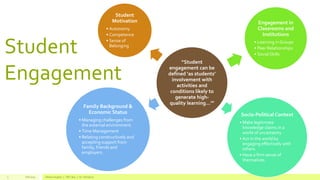
Student
Engagement
Fall 2015 Allison Hughes | ITEC 800 | Dr. Donohue3
“Student
engagement can be
defined ‘as students’
involvement with
activities and
conditions likely to
generate high-
quality learning…’”
Student
Motivation
• Autonomy
• Competence
• Sense of
Belonging
Engagement in
Classrooms and
Institutions
• Learning in Groups
• Peer Relationships
• Social Skills
Socio-Political Context
• Make legitimate
knowledge claims in a
world of uncertainty
• Act in the world by
engaging effectively with
others.
• Have a firm sense of
themselves.
Family Background &
Economic Status
• Managing challenges from
the external environment.
• Time Management
• Relating constructively and
accepting support from
family, friends and
employers.
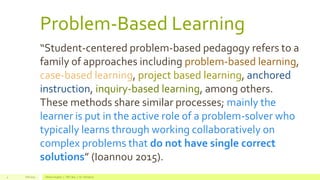
Problem-Based Learning
Fall 2015 Allison Hughes | ITEC 800 | Dr. Donohue4
“Student-centered problem-based pedagogy refers to a
family of approaches including problem-based learning,
case-based learning, project based learning, anchored
instruction, inquiry-based learning, among others.
These methods share similar processes; mainly the
learner is put in the active role of a problem-solver who
typically learns through working collaboratively on
complex problems that do not have single correct
solutions” (Ioannou 2015).
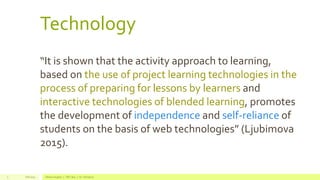
Technology
Fall 2015 Allison Hughes | ITEC 800 | Dr. Donohue5
“It is shown that the activity approach to learning,
based on the use of project learning technologies in the
process of preparing for lessons by learners and
interactive technologies of blended learning, promotes
the development of independence and self-reliance of
students on the basis of web technologies” (Ljubimova
2015).
To put my research into action, I made a
community college level English course.The
modules cover assignments related to a research
writing project.
You can view the course here (you will need to sign up with
Canvas):
ENGL 100 Course
The following slides explain how the modules tie in to the
research I did.
Fall 2015 Allison Hughes | ITEC 800 | Dr. Donohue6
Fall 2015 Allison Hughes | ITEC 800 | Dr. Donohue7
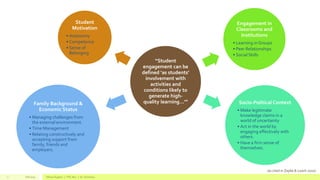
“Student
engagement can be
defined ‘as students’
involvement with
activities and
conditions likely to
generate high-
quality learning…’”
Student
Motivation
• Autonomy
• Competence
• Sense of
Belonging
Engagement in
Classrooms and
Institutions
• Learning in Groups
• Peer Relationships
• Social Skills
Socio-Political Context
• Make legitimate
knowledge claims in a
world of uncertainty
• Act in the world by
engaging effectively with
others.
• Have a firm sense of
themselves.
Family Background &
Economic Status
• Managing challenges from
the external environment.
• Time Management
• Relating constructively and
accepting support from
family, friends and
employers.
(as cited in Zepke & Leach 2010)
Fall 2015 Allison Hughes | ITEC 800 | Dr. Donohue8
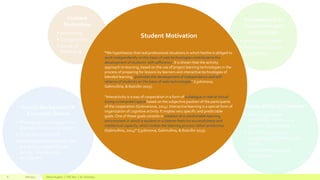
Student Motivation
“We hypothesize that real professional situations in which he/she is obliged to
work independently on the basis of web technologies contribute to the
development of students’ self-sufficiency. It is shown that the activity
approach to learning, based on the use of project learning technologies in the
process of preparing for lessons by learners and interactive technologies of
blended learning, promotes the development of independence and self-
reliance of students on the basis of web technologies” (Ljubimova,
Galimullina, & Ibatullin 2015).
“Interactivity is a way of cooperation in a form of a dialogue in real or virtual
(using a computer) space based on the subjective position of the participants
of the cooperation (Golovanova, 2014). Interactive learning is a special form of
organization of cognitive activity. It implies very specific and predictable
goals. One of these goals consists in creation of a comfortable learning
environment in which a student or a listener feels his successfulness and
intellectual capacity, which makes the learning process rather productive
(Galimullina, 2014)” (Ljubimova, Galimullina, & Ibatullin 2015).
Fall 2015 Allison Hughes | ITEC 800 | Dr. Donohue9
Problem-Based Learning >>>
Student Motivation:
The class is learning about the same text,
Wool by Hugh Howey, and larger concept,
global warming, but they are free to put
that into whatever context they see
appropriate. In this assignment, PBL is
giving learners the ability to shape their
own learning.
Fall 2015 Allison Hughes | ITEC 800 | Dr. Donohue10
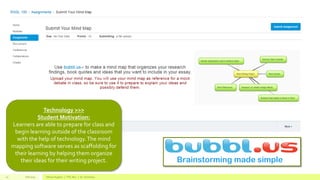
Technology >>>
Student Motivation:
Learners are able to prepare for class and
begin learning outside of the classroom
with the help of technology.The mind
mapping software serves as scaffolding for
their learning by helping them organize
their ideas for their writing project.
Fall 2015 Allison Hughes | ITEC 800 | Dr. Donohue11
Engagement in Classrooms and Institutions
“…[A] multimodal learning environment which affords
interaction with content and among learners as well as
collaboration and reflection across collocated and
networked learning spaces may be able to provide
additional support for student-centered problem-based
pedagogies” (as cited in Ioannou 2015).
“’We took pictures of specific artifacts and moments using
our tablets or smartphones, we looked at them at the end
of each tutorial and chose a couple to upload on
Facebook; they helped us keep a record of our progress
and recall information and parts of the process’” (as cited
in Ioannou 2015).
Fall 2015 Allison Hughes | ITEC 800 | Dr. Donohue12
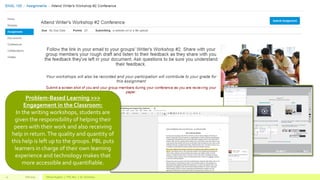
Problem-Based Learning >>>
Engagement in the Classroom:
In the writing workshops, students are
given the responsibility of helping their
peers with their work and also receiving
help in return.The quality and quantity of
this help is left up to the groups. PBL puts
learners in charge of their own learning
experience and technology makes that
more accessible and quantifiable.
Fall 2015 Allison Hughes | ITEC 800 | Dr. Donohue13
Socio-Political Context
“Researchers working on the rapidly developing sciences
of pedagogy and instructional design are clear that
improved learning outcomes take place in a more
mentor-like environment that allows the student to
experiment, fail, be guided to the right path and
subsequently learn to master a subject or a process”
(Bertrand 2010).
“…[S]ocial media platforms may make learning more
ludic and thus enable more learners to take in the
information that may change their present cognitive
status into a new, reflection-based type of knowledge
that may be applied in new situations” (Mondahl &
Razmerita 2009)
Fall 2015 Allison Hughes | ITEC 800 | Dr. Donohue14
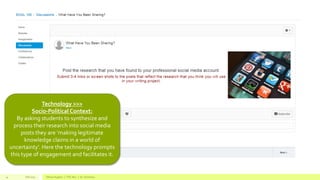
Technology >>>
Socio-Political Context:
By asking students to synthesize and
process their research into social media
posts they are ‘making legitimate
knowledge claims in a world of
uncertainty’. Here the technology prompts
this type of engagement and facilitates it.
Fall 2015 Allison Hughes | ITEC 800 | Dr. Donohue15
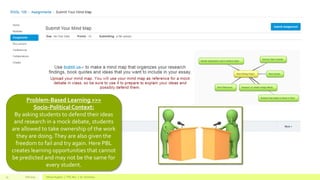
Problem-Based Learning >>>
Socio-Political Context:
By asking students to defend their ideas
and research in a mock debate, students
are allowed to take ownership of the work
they are doing.They are also given the
freedom to fail and try again. Here PBL
creates learning opportunities that cannot
be predicted and may not be the same for
every student.
Fall 2015 Allison Hughes | ITEC 800 | Dr. Donohue16
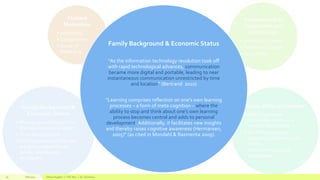
Family Background & Economic Status
“As the information technology revolution took off
with rapid technological advances, communication
became more digital and portable, leading to near
instantaneous communication unrestricted by time
and location” (Bertrand 2010)
“Learning comprises reflection on one’s own learning
processes – a form of meta cognition – where the
ability to stop and think about one’s own learning
process becomes central and adds to personal
development. Additionally, it facilitates new insights
and thereby raises cognitive awareness (Hermansen,
2005)” (as cited in Mondahl & Razmerita 2009).
Fall 2015 Allison Hughes | ITEC 800 | Dr. Donohue17
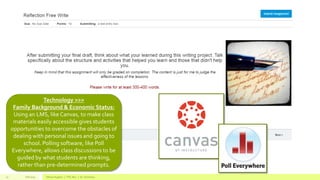
Technology >>>
Family Background & Economic Status:
Using an LMS, like Canvas, to make class
materials easily accessible gives students
opportunities to overcome the obstacles of
dealing with personal issues and going to
school. Polling software, like Poll
Everywhere, allows class discussions to be
guided by what students are thinking,
rather than pre-determined prompts.
References
Bertrand,W. E. (2010). HIGHER EDUCATIONANDTECHNOLOGYTRANSFER:THE EFFECTS OF
'TECHNOSCLEROSIS'ON DEVELOPMENT. Journal of InternationalAffairs, (1). 101.
Cleaver,A. (2009, November 21).The book. Retrieved December 1, 2015, from
http://tinyurl.com/p7q7gum
Ioannou,A.,Vasiliou, C., Zaphiris, P., Arh,T., Klobucar,T., & Pipan, M. (2015).Creative Multimodal
Learning Environments and Blended Interaction for Problem-Based Activity in HCI Education.
Techtrends: Linking ResearchAnd PracticeTo Improve Learning, 59(2), 47-56.
Ljubimova, E. M., Galimullina, E. Z., & Ibatullin, R. R. (2015).The Development of University Students'
Self-Sufficiency Based on InteractiveTechnologies byTheir Immersion in the Professional Activity.
International EducationStudies, 8(4), 192-199.
Mondahl, M., & Razmerita, L. (2014). Social Media, Collaboration and Social Learning--ACase-Study of
Foreign Language Learning. ElectronicJournalOf E-Learning, 12(4), 339-352.
School visit. (2009, September 14). Retrieved December 1, 2015, from http://tinyurl.com/o37g27a
Terr Har, K. (2011, March 13). Retrieved December 1, 2015, from http://tinyurl.com/gnwgm5j
Zepke, N., & Leach, L. (2010). Beyond hard outcomes: 'soft' outcomes and engagement as student
success. Teaching In Higher Education, 15(6), 661-673.
July 22, 2012 Footer text here18

Technology & Problem- Based Learning in Action

  • 1.
    Technology & Problem- Based Learningin Action Allison Hughes | ITEC 800 | Fall 2015
  • 2.
    How do technology& problem-based learning (PBL) increase student engagement? Fall 2015 Allison Hughes | ITEC 800 | Dr. Donohue2
  • 3.
    Student Engagement Fall 2015 AllisonHughes | ITEC 800 | Dr. Donohue3 “Student engagement can be defined ‘as students’ involvement with activities and conditions likely to generate high- quality learning…’” Student Motivation • Autonomy • Competence • Sense of Belonging Engagement in Classrooms and Institutions • Learning in Groups • Peer Relationships • Social Skills Socio-Political Context • Make legitimate knowledge claims in a world of uncertainty • Act in the world by engaging effectively with others. • Have a firm sense of themselves. Family Background & Economic Status • Managing challenges from the external environment. • Time Management • Relating constructively and accepting support from family, friends and employers.
  • 4.
    Problem-Based Learning Fall 2015Allison Hughes | ITEC 800 | Dr. Donohue4 “Student-centered problem-based pedagogy refers to a family of approaches including problem-based learning, case-based learning, project based learning, anchored instruction, inquiry-based learning, among others. These methods share similar processes; mainly the learner is put in the active role of a problem-solver who typically learns through working collaboratively on complex problems that do not have single correct solutions” (Ioannou 2015).
  • 5.
    Technology Fall 2015 AllisonHughes | ITEC 800 | Dr. Donohue5 “It is shown that the activity approach to learning, based on the use of project learning technologies in the process of preparing for lessons by learners and interactive technologies of blended learning, promotes the development of independence and self-reliance of students on the basis of web technologies” (Ljubimova 2015).
  • 6.
    To put myresearch into action, I made a community college level English course.The modules cover assignments related to a research writing project. You can view the course here (you will need to sign up with Canvas): ENGL 100 Course The following slides explain how the modules tie in to the research I did. Fall 2015 Allison Hughes | ITEC 800 | Dr. Donohue6
  • 7.
    Fall 2015 AllisonHughes | ITEC 800 | Dr. Donohue7 “Student engagement can be defined ‘as students’ involvement with activities and conditions likely to generate high- quality learning…’” Student Motivation • Autonomy • Competence • Sense of Belonging Engagement in Classrooms and Institutions • Learning in Groups • Peer Relationships • Social Skills Socio-Political Context • Make legitimate knowledge claims in a world of uncertainty • Act in the world by engaging effectively with others. • Have a firm sense of themselves. Family Background & Economic Status • Managing challenges from the external environment. • Time Management • Relating constructively and accepting support from family, friends and employers. (as cited in Zepke & Leach 2010)
  • 8.
    Fall 2015 AllisonHughes | ITEC 800 | Dr. Donohue8 Student Motivation “We hypothesize that real professional situations in which he/she is obliged to work independently on the basis of web technologies contribute to the development of students’ self-sufficiency. It is shown that the activity approach to learning, based on the use of project learning technologies in the process of preparing for lessons by learners and interactive technologies of blended learning, promotes the development of independence and self- reliance of students on the basis of web technologies” (Ljubimova, Galimullina, & Ibatullin 2015). “Interactivity is a way of cooperation in a form of a dialogue in real or virtual (using a computer) space based on the subjective position of the participants of the cooperation (Golovanova, 2014). Interactive learning is a special form of organization of cognitive activity. It implies very specific and predictable goals. One of these goals consists in creation of a comfortable learning environment in which a student or a listener feels his successfulness and intellectual capacity, which makes the learning process rather productive (Galimullina, 2014)” (Ljubimova, Galimullina, & Ibatullin 2015).
  • 9.
    Fall 2015 AllisonHughes | ITEC 800 | Dr. Donohue9 Problem-Based Learning >>> Student Motivation: The class is learning about the same text, Wool by Hugh Howey, and larger concept, global warming, but they are free to put that into whatever context they see appropriate. In this assignment, PBL is giving learners the ability to shape their own learning.
  • 10.
    Fall 2015 AllisonHughes | ITEC 800 | Dr. Donohue10 Technology >>> Student Motivation: Learners are able to prepare for class and begin learning outside of the classroom with the help of technology.The mind mapping software serves as scaffolding for their learning by helping them organize their ideas for their writing project.
  • 11.
    Fall 2015 AllisonHughes | ITEC 800 | Dr. Donohue11 Engagement in Classrooms and Institutions “…[A] multimodal learning environment which affords interaction with content and among learners as well as collaboration and reflection across collocated and networked learning spaces may be able to provide additional support for student-centered problem-based pedagogies” (as cited in Ioannou 2015). “’We took pictures of specific artifacts and moments using our tablets or smartphones, we looked at them at the end of each tutorial and chose a couple to upload on Facebook; they helped us keep a record of our progress and recall information and parts of the process’” (as cited in Ioannou 2015).
  • 12.
    Fall 2015 AllisonHughes | ITEC 800 | Dr. Donohue12 Problem-Based Learning >>> Engagement in the Classroom: In the writing workshops, students are given the responsibility of helping their peers with their work and also receiving help in return.The quality and quantity of this help is left up to the groups. PBL puts learners in charge of their own learning experience and technology makes that more accessible and quantifiable.
  • 13.
    Fall 2015 AllisonHughes | ITEC 800 | Dr. Donohue13 Socio-Political Context “Researchers working on the rapidly developing sciences of pedagogy and instructional design are clear that improved learning outcomes take place in a more mentor-like environment that allows the student to experiment, fail, be guided to the right path and subsequently learn to master a subject or a process” (Bertrand 2010). “…[S]ocial media platforms may make learning more ludic and thus enable more learners to take in the information that may change their present cognitive status into a new, reflection-based type of knowledge that may be applied in new situations” (Mondahl & Razmerita 2009)
  • 14.
    Fall 2015 AllisonHughes | ITEC 800 | Dr. Donohue14 Technology >>> Socio-Political Context: By asking students to synthesize and process their research into social media posts they are ‘making legitimate knowledge claims in a world of uncertainty’. Here the technology prompts this type of engagement and facilitates it.
  • 15.
    Fall 2015 AllisonHughes | ITEC 800 | Dr. Donohue15 Problem-Based Learning >>> Socio-Political Context: By asking students to defend their ideas and research in a mock debate, students are allowed to take ownership of the work they are doing.They are also given the freedom to fail and try again. Here PBL creates learning opportunities that cannot be predicted and may not be the same for every student.
  • 16.
    Fall 2015 AllisonHughes | ITEC 800 | Dr. Donohue16 Family Background & Economic Status “As the information technology revolution took off with rapid technological advances, communication became more digital and portable, leading to near instantaneous communication unrestricted by time and location” (Bertrand 2010) “Learning comprises reflection on one’s own learning processes – a form of meta cognition – where the ability to stop and think about one’s own learning process becomes central and adds to personal development. Additionally, it facilitates new insights and thereby raises cognitive awareness (Hermansen, 2005)” (as cited in Mondahl & Razmerita 2009).
  • 17.
    Fall 2015 AllisonHughes | ITEC 800 | Dr. Donohue17 Technology >>> Family Background & Economic Status: Using an LMS, like Canvas, to make class materials easily accessible gives students opportunities to overcome the obstacles of dealing with personal issues and going to school. Polling software, like Poll Everywhere, allows class discussions to be guided by what students are thinking, rather than pre-determined prompts.
  • 18.
    References Bertrand,W. E. (2010).HIGHER EDUCATIONANDTECHNOLOGYTRANSFER:THE EFFECTS OF 'TECHNOSCLEROSIS'ON DEVELOPMENT. Journal of InternationalAffairs, (1). 101. Cleaver,A. (2009, November 21).The book. Retrieved December 1, 2015, from http://tinyurl.com/p7q7gum Ioannou,A.,Vasiliou, C., Zaphiris, P., Arh,T., Klobucar,T., & Pipan, M. (2015).Creative Multimodal Learning Environments and Blended Interaction for Problem-Based Activity in HCI Education. Techtrends: Linking ResearchAnd PracticeTo Improve Learning, 59(2), 47-56. Ljubimova, E. M., Galimullina, E. Z., & Ibatullin, R. R. (2015).The Development of University Students' Self-Sufficiency Based on InteractiveTechnologies byTheir Immersion in the Professional Activity. International EducationStudies, 8(4), 192-199. Mondahl, M., & Razmerita, L. (2014). Social Media, Collaboration and Social Learning--ACase-Study of Foreign Language Learning. ElectronicJournalOf E-Learning, 12(4), 339-352. School visit. (2009, September 14). Retrieved December 1, 2015, from http://tinyurl.com/o37g27a Terr Har, K. (2011, March 13). Retrieved December 1, 2015, from http://tinyurl.com/gnwgm5j Zepke, N., & Leach, L. (2010). Beyond hard outcomes: 'soft' outcomes and engagement as student success. Teaching In Higher Education, 15(6), 661-673. July 22, 2012 Footer text here18