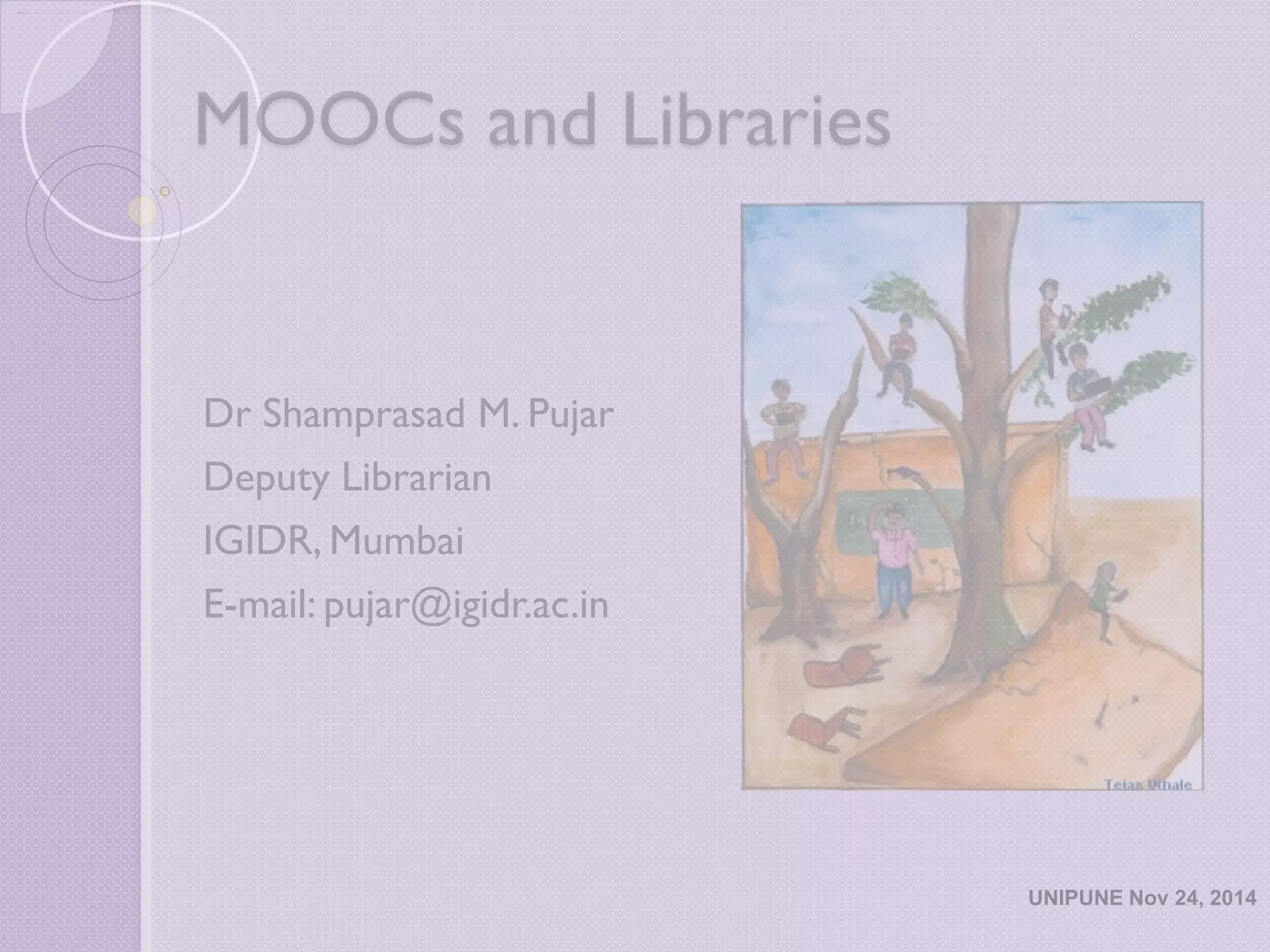
MOOCs and Libraries 
UNIPUNE Nov 24, 2014 
Dr Shamprasad M. 
Pujar 
Deputy Librarian 
IGIDR, Mumbai 
E-mail: 
pujar@igidr.ac.in
Agenda 
 Introduction 
 What is a MOOC? 
 Key players 
 MOOCs and libraries 
 MOOCs and LIS education 
 Conclusion
Introduction 
 Technological developments over a period of time have brought in 
changes in a way the Higher Education (HE) is communicated and 
delivered 
 Class room  Distance  E-learning  Online 
 The year 2012 saw a new model - MOOCs, which is set to revolutionize 
the higher education 
 World’s prestigious universities like MIT, Stanford, Princeton etc offering 
courses to masses for free, irrespective of their age and geographical 
locations 
 Their popularity is such that, people in millions are taking these courses 
to earn a certificate to improve their CV 
 They are considered as purveyors of HE, by the same time concerns 
raised about their disruptive nature, which may diminish the quality of 
campus education and impact the support institutions like libraries
What is a MOOC? 
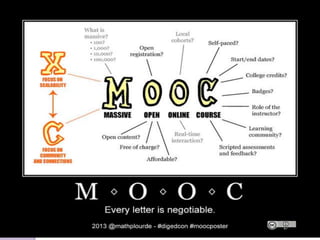
 MOOC stands for ‘Massive Open Online Course’ 
 Delivering of content of courses virtually to anyone, who is 
interested in taking the courses 
 “It is an online platform aiming at large-scale interactive 
participation and open access via the web. In addition to 
traditional course materials such as videos, readings, and 
problem sets, MOOCs provide interactive user forums, quizzes 
that help build a community for the students, professors, and 
teaching assistants (TAs)” - Wikipedia
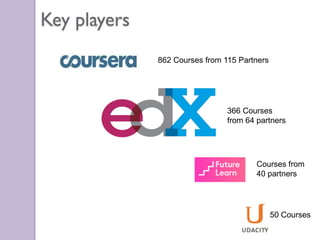
Key players 
862 Courses from 115 Partners 
366 Courses 
from 64 partners 
Courses from 
40 partners 
50 Courses
MOOCs and Libraries 
 Too early to predict what would be the role of 
libraries 
 According to Forest Wright , two characteristics of 
MOOCs, their enrollment and hosting by third 
parties make it difficult for libraries to integrate their 
services 
 OCLC in its event on ‘MOOCs and Libraries’ held in 
2013 identified few areas in which libraries/librarians 
have a role in MOOCs
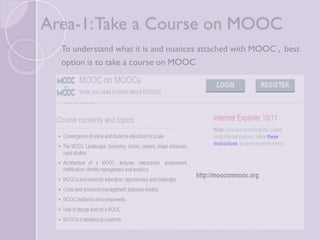
Area-1: Take a Course on 
MOOC 
 To understand what it is and nuances attached with MOOC , 
best option is to take a course on MOOC
Area-2 Involve with MOOC 
development 
 Engagement with the faculty help in the betterment of course
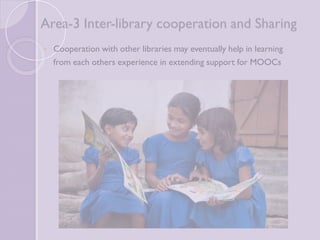
Area-3 Inter-library cooperation and 
Sharing 
 Cooperation with other libraries may eventually help in 
learning from each others experience in extending support for 
MOOCs
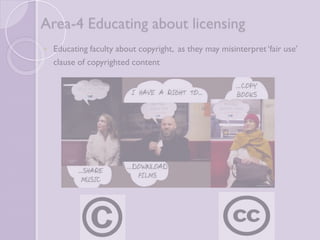
Area-4 Educating about licensing 
 Educating faculty about copyright, as they may misinterpret 
‘fair use’ clause of copyrighted content
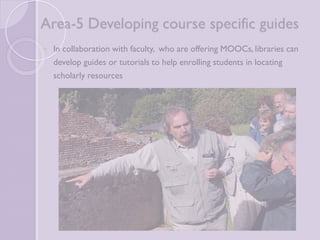
Area-5 Developing course specific 
guides 
 In collaboration with faculty, who are offering MOOCs, libraries 
can develop guides or tutorials to help enrolling students in 
locating scholarly resources
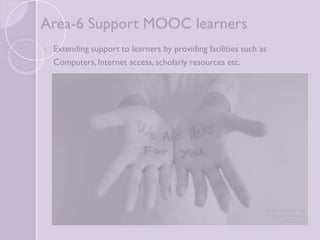
Area-6 Support MOOC learners 
 Extending support to learners by providing facilities such as 
Computers, Internet access, scholarly resources etc.
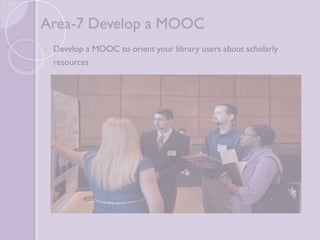
Area-7 Develop a MOOC 
 Develop a MOOC to orient your library users about scholarly 
resources
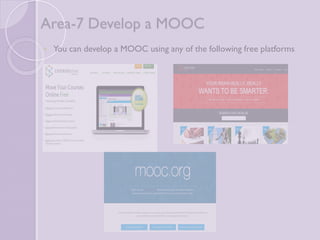
Area-7 Develop a MOOC 
 You can develop a MOOC using any of the following free 
platforms
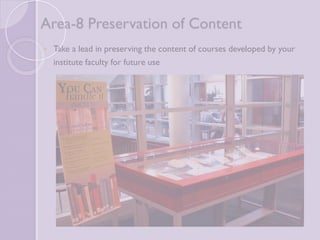
Area-8 Preservation of Content 
 Take a lead in preserving the content of courses developed by 
your institute faculty for future use
MOOCs and LIS Education 
 MOOCs extend an opportunity for librarians to update their 
skills and earn a certificate 
 There are already few courses in LIS offered through MOOCs 
and many more are expected in the near future 
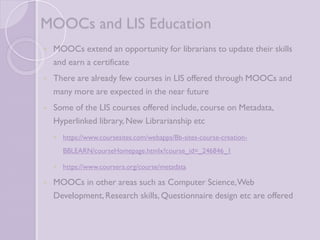
 Some of the LIS courses offered include, course on Metadata, 
Hyperlinked library, New Librarianship etc 
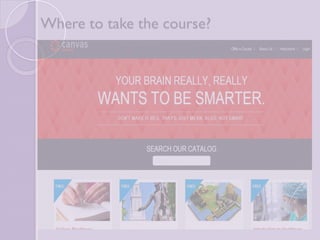
 https://www.coursesites.com/webapps/Bb-sites-course-creation- 
BBLEARN/courseHomepage.htmlx?course_id=_246846_1 
 https://www.coursera.org/course/metadata 
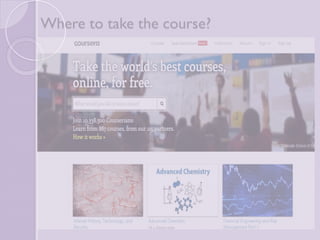
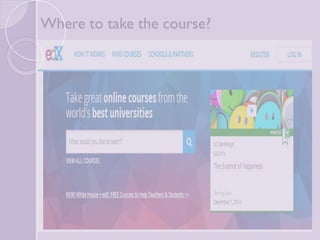
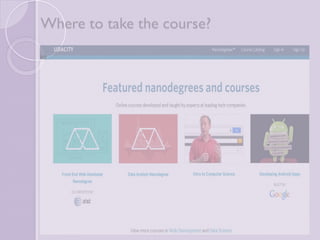
 MOOCs in other areas such as Computer Science, Web 
Development, Research skills, Questionnaire design etc are 
offered
Where to take the course?
How MOOCs can help LIS 
Departments 
 MOOCs may help in improving the overall quality of education 
 May meet certain challenges faced by departments such as 
shortage of faculty, funds, skill levels, infrastructure etc 
 Possible for students to learn courses from different 
universities (Similar to Choice Based Courses) 
 Collaboration with other departments / faculty in building the 
courses 
 Help in raising the profile of a teacher, department and 
university 
 Adopting Flipped Classroom environment
Conclusion 
 MOOCs have brought in opportunities for librarianship in 
improving services and quality of LIS education 
 Libraries and Librarians need to prop up this new breed of 
education to sustain themselves for the future and to expand 
their bases 
 LIS teachers also need to embrace this new model as it is very 
difficult for any single school to provide training in all segments 
of modern librarianship
Reach me at: pujar@igidr.ac.in 
Blog: http://spujar.wordpress.com 
Twitter: @shampujar 
Acknowledgements: 
Photographs used in the presentation are from Flickr, Google Images (CC 
license). Illustration on first slide by Mr Tejas Uthale (11th Std Student)

Mooc libraries-pujar

  • 1.
    MOOCs and Libraries UNIPUNE Nov 24, 2014 Dr Shamprasad M. Pujar Deputy Librarian IGIDR, Mumbai E-mail: pujar@igidr.ac.in
  • 2.
    Agenda  Introduction  What is a MOOC?  Key players  MOOCs and libraries  MOOCs and LIS education  Conclusion
  • 3.
    Introduction  Technologicaldevelopments over a period of time have brought in changes in a way the Higher Education (HE) is communicated and delivered  Class room  Distance  E-learning  Online  The year 2012 saw a new model - MOOCs, which is set to revolutionize the higher education  World’s prestigious universities like MIT, Stanford, Princeton etc offering courses to masses for free, irrespective of their age and geographical locations  Their popularity is such that, people in millions are taking these courses to earn a certificate to improve their CV  They are considered as purveyors of HE, by the same time concerns raised about their disruptive nature, which may diminish the quality of campus education and impact the support institutions like libraries
  • 4.
    What is aMOOC?  MOOC stands for ‘Massive Open Online Course’  Delivering of content of courses virtually to anyone, who is interested in taking the courses  “It is an online platform aiming at large-scale interactive participation and open access via the web. In addition to traditional course materials such as videos, readings, and problem sets, MOOCs provide interactive user forums, quizzes that help build a community for the students, professors, and teaching assistants (TAs)” - Wikipedia
  • 6.
    Key players 862Courses from 115 Partners 366 Courses from 64 partners Courses from 40 partners 50 Courses
  • 7.
    MOOCs and Libraries  Too early to predict what would be the role of libraries  According to Forest Wright , two characteristics of MOOCs, their enrollment and hosting by third parties make it difficult for libraries to integrate their services  OCLC in its event on ‘MOOCs and Libraries’ held in 2013 identified few areas in which libraries/librarians have a role in MOOCs
  • 8.
    Area-1: Take aCourse on MOOC  To understand what it is and nuances attached with MOOC , best option is to take a course on MOOC
  • 9.
    Area-2 Involve withMOOC development  Engagement with the faculty help in the betterment of course
  • 10.
    Area-3 Inter-library cooperationand Sharing  Cooperation with other libraries may eventually help in learning from each others experience in extending support for MOOCs
  • 11.
    Area-4 Educating aboutlicensing  Educating faculty about copyright, as they may misinterpret ‘fair use’ clause of copyrighted content
  • 12.
    Area-5 Developing coursespecific guides  In collaboration with faculty, who are offering MOOCs, libraries can develop guides or tutorials to help enrolling students in locating scholarly resources
  • 13.
    Area-6 Support MOOClearners  Extending support to learners by providing facilities such as Computers, Internet access, scholarly resources etc.
  • 14.
    Area-7 Develop aMOOC  Develop a MOOC to orient your library users about scholarly resources
  • 15.
    Area-7 Develop aMOOC  You can develop a MOOC using any of the following free platforms
  • 16.
    Area-8 Preservation ofContent  Take a lead in preserving the content of courses developed by your institute faculty for future use
  • 17.
    MOOCs and LISEducation  MOOCs extend an opportunity for librarians to update their skills and earn a certificate  There are already few courses in LIS offered through MOOCs and many more are expected in the near future  Some of the LIS courses offered include, course on Metadata, Hyperlinked library, New Librarianship etc  https://www.coursesites.com/webapps/Bb-sites-course-creation- BBLEARN/courseHomepage.htmlx?course_id=_246846_1  https://www.coursera.org/course/metadata  MOOCs in other areas such as Computer Science, Web Development, Research skills, Questionnaire design etc are offered
  • 18.
    Where to takethe course?
  • 19.
    Where to takethe course?
  • 20.
    Where to takethe course?
  • 21.
    Where to takethe course?
  • 22.
    How MOOCs canhelp LIS Departments  MOOCs may help in improving the overall quality of education  May meet certain challenges faced by departments such as shortage of faculty, funds, skill levels, infrastructure etc  Possible for students to learn courses from different universities (Similar to Choice Based Courses)  Collaboration with other departments / faculty in building the courses  Help in raising the profile of a teacher, department and university  Adopting Flipped Classroom environment
  • 23.
    Conclusion  MOOCshave brought in opportunities for librarianship in improving services and quality of LIS education  Libraries and Librarians need to prop up this new breed of education to sustain themselves for the future and to expand their bases  LIS teachers also need to embrace this new model as it is very difficult for any single school to provide training in all segments of modern librarianship
  • 24.
    Reach me at:pujar@igidr.ac.in Blog: http://spujar.wordpress.com Twitter: @shampujar Acknowledgements: Photographs used in the presentation are from Flickr, Google Images (CC license). Illustration on first slide by Mr Tejas Uthale (11th Std Student)

Editor's Notes

  • #4 Use multiple points, if necessary.
  • #5 Use multiple points, if necessary.
  • #8 Use multiple points, if necessary.
  • #9 Use multiple points, if necessary.
  • #10 Use multiple points, if necessary.
  • #11 Use multiple points, if necessary.
  • #12 Use multiple points, if necessary.
  • #13 Use multiple points, if necessary.
  • #14 Use multiple points, if necessary.
  • #15 Use multiple points, if necessary.
  • #16 Use multiple points, if necessary.
  • #17 Use multiple points, if necessary.
  • #18 Use multiple points, if necessary.
  • #19 Use multiple points, if necessary.
  • #20 Use multiple points, if necessary.
  • #21 Use multiple points, if necessary.
  • #22 Use multiple points, if necessary.
  • #23 Use multiple points, if necessary.
  • #24 Use multiple points, if necessary.