NON-PRICE COMPETITION
AND CARTELS
Hezron Sadock
CONTENT
Non-Price Competition
● Introduction
● Price war and how it leads to non- price competition
● Market share strategies in non-competition
Collusive Oligopoly
● Tacit oligopoly and Cartels
● Price and output determination in Collusive oligopoly
● Cartels and factors for its formation
INTRODUCTION
Features of Oligopoly
● Few sellers
● Homogenous or non-homogeneous
products(Differentiated product)
● Entry barriers
● Interdependence in decision
making
● Non-Price Competition
What is Non-Price Competition?
It is the approach in oligopoly
market where major players of the
same or differentiated good, opt for
other marketing strategies other
than price competition to gain the
market share.
PRICE WAR
● Competition among firms that
produce the homogeneous or
differentiated goods to win the
market share by the means of
lowering product prices.
● At the end, price war benefits
customers than the firms themselves.
● Firms will thus opt not to
compete by lowering prices
but use other approaches to
win customers and the market
share in the industry
Reliance Jio: The Story that reshaped India
Telecommunication Industry
● Entered in Sept 2016
● Market share of 22.4%
● Free calls,SMS and data for
first 6 months.
● Market share of 34.7%
● Forced to merger with Idea
● Market share 31.7%
● BSNL has 11.2%
MARKET STRATEGIES IN NON-PRICE
COMPETITION
● Aggressive market strategies
● Product bundling
● Influencing value perception to
customers
● Branding
● Offering better service
The extreme case of non price
competition is the formation
of Collusive Oligopoly or
Cartels.
COLLUSIVE OLIGOPOLY
● Agreement among rival firms of the same good, in mutual interest
on various accounts such as price, market share or production
output.
● When the agreement is formal it is known as Explicit Collusion or
Cartel
● When the agreement is informal it is called Tacit Collusion
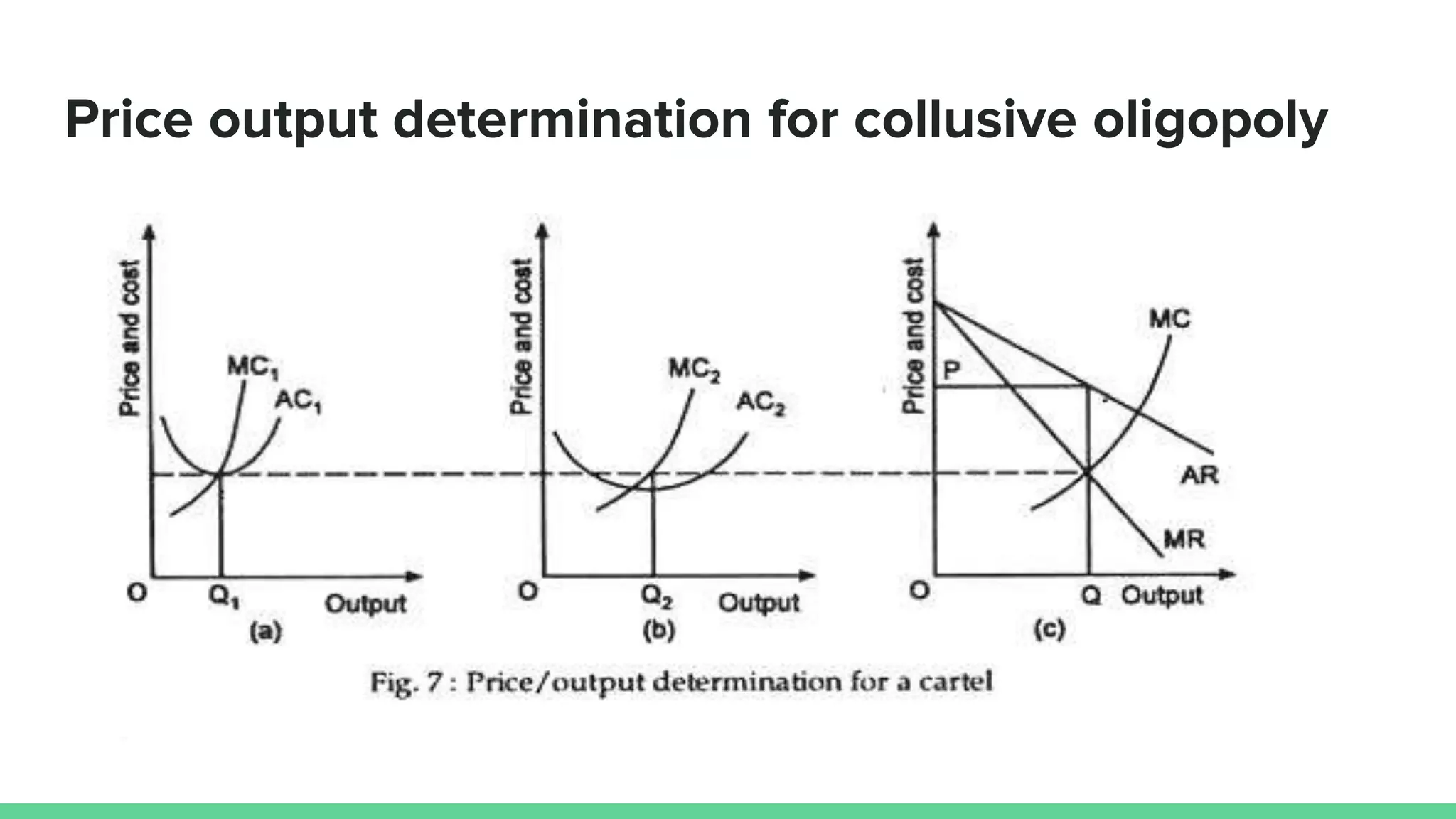
Price output determination for collusive oligopoly
CARTELS
● A formal agreement among firms producing homogeneous good.
● Agreements may involve:
Price or total industry output,
Market share or allocation of customers,
Allocation of territories
Division of profits.
● Types of cartels:
Centralized Cartels - There is a centralized body which decides on price.
Market Cartels - Members divide the market and fix the price independently.
Factors for Cartel formation and Sustainability
1. Number of firms in the industry.
Fewer the firms, easier to form and sustain the cartel, and vice versa.
2. The Nature of the product.
Better for homogeneous goods than differentiated goods.
3. Cost Structure.
Without the common cost structure, survival of the cartel will be in question.
OPEC
Organization of Petroleum
Exporting Countries
Members: 12 countries
Control over 42% of the petroleum
industry share as per 2012
Have more than 70% of the total world
oil reserves
THANK YOU

Non-price competition

  • 1.
  • 2.
    CONTENT Non-Price Competition ● Introduction ●Price war and how it leads to non- price competition ● Market share strategies in non-competition Collusive Oligopoly ● Tacit oligopoly and Cartels ● Price and output determination in Collusive oligopoly ● Cartels and factors for its formation
  • 3.
    INTRODUCTION Features of Oligopoly ●Few sellers ● Homogenous or non-homogeneous products(Differentiated product) ● Entry barriers ● Interdependence in decision making ● Non-Price Competition What is Non-Price Competition? It is the approach in oligopoly market where major players of the same or differentiated good, opt for other marketing strategies other than price competition to gain the market share.
  • 4.
    PRICE WAR ● Competitionamong firms that produce the homogeneous or differentiated goods to win the market share by the means of lowering product prices. ● At the end, price war benefits customers than the firms themselves. ● Firms will thus opt not to compete by lowering prices but use other approaches to win customers and the market share in the industry
  • 5.
    Reliance Jio: TheStory that reshaped India Telecommunication Industry ● Entered in Sept 2016 ● Market share of 22.4% ● Free calls,SMS and data for first 6 months. ● Market share of 34.7% ● Forced to merger with Idea ● Market share 31.7% ● BSNL has 11.2%
  • 6.
    MARKET STRATEGIES INNON-PRICE COMPETITION ● Aggressive market strategies ● Product bundling ● Influencing value perception to customers ● Branding ● Offering better service
  • 7.
    The extreme caseof non price competition is the formation of Collusive Oligopoly or Cartels.
  • 8.
    COLLUSIVE OLIGOPOLY ● Agreementamong rival firms of the same good, in mutual interest on various accounts such as price, market share or production output. ● When the agreement is formal it is known as Explicit Collusion or Cartel ● When the agreement is informal it is called Tacit Collusion
  • 9.
    Price output determinationfor collusive oligopoly
  • 10.
    CARTELS ● A formalagreement among firms producing homogeneous good. ● Agreements may involve: Price or total industry output, Market share or allocation of customers, Allocation of territories Division of profits. ● Types of cartels: Centralized Cartels - There is a centralized body which decides on price. Market Cartels - Members divide the market and fix the price independently.
  • 11.
    Factors for Cartelformation and Sustainability 1. Number of firms in the industry. Fewer the firms, easier to form and sustain the cartel, and vice versa. 2. The Nature of the product. Better for homogeneous goods than differentiated goods. 3. Cost Structure. Without the common cost structure, survival of the cartel will be in question.
  • 12.
    OPEC Organization of Petroleum ExportingCountries Members: 12 countries Control over 42% of the petroleum industry share as per 2012 Have more than 70% of the total world oil reserves
  • 13.