
MARKET STRUCTURE AND
MARKET POWER
Prabesh Ghimire
Health Care Market
Market concepts
Situation where buyers and sellers interact
• To trade goods and/or services
• Directly or through intermediaries
Situation where forces on demand and supply
interact to determine the price of goods and
services being exchanged
Mechanism for
• Determining the prices and quantities of goods
• Communicating information about prices
• Distribution of goods and services
2Prabesh Ghimire
Market structure
Organizational and other characteristics of a
market
Identifies how a market is made up of
Determines the nature of competition in the
market
Spectrum: Powerless>>Powerful
3Prabesh Ghimire
Determinants of Market Structure
The number and size of firms in the market
Nature of products/services provided
The extent of barriers to entry and exit
The degree of information available to both
buyers and sellers regarding price and product
characteristics
Market power: The degree to which the firms can
influence price
4Prabesh Ghimire
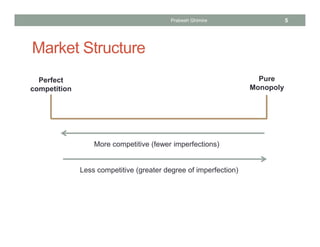
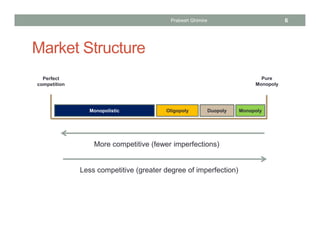
Market Structure
5
Perfect
competition
Pure
Monopoly
More competitive (fewer imperfections)
Less competitive (greater degree of imperfection)
Prabesh Ghimire
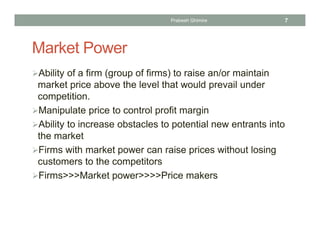
Market Structure
6
Perfect
competition
Pure
Monopoly
More competitive (fewer imperfections)
Less competitive (greater degree of imperfection)
MonopolyDuopolyOligopolyMonopolistic
Prabesh Ghimire
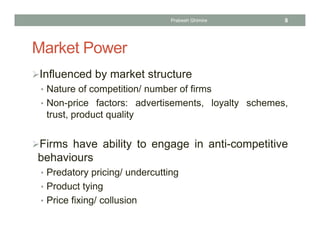
Market Power
Ability of a firm (group of firms) to raise an/or maintain
market price above the level that would prevail under
competition.
Manipulate price to control profit margin
Ability to increase obstacles to potential new entrants into
the market
Firms with market power can raise prices without losing
customers to the competitors
Firms>>>Market power>>>>Price makers
7Prabesh Ghimire
Market Power
Influenced by market structure
• Nature of competition/ number of firms
• Non-price factors: advertisements, loyalty schemes,
trust, product quality
Firms have ability to engage in anti-competitive
behaviours
• Predatory pricing/ undercutting
• Product tying
• Price fixing/ collusion
8Prabesh Ghimire
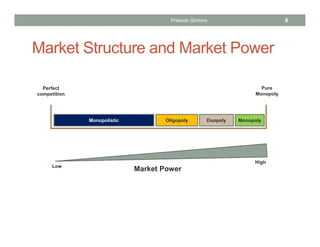
Market Structure and Market Power
9
Perfect
competition
Pure
Monopoly
Market Power
MonopolyDuopolyOligopolyMonopolistic
Low
High
Prabesh Ghimire
Perfect market
Theoretical (ideal) market structure
 Benchmark to which real-life market structures
can be compared
Also called competitive market
Examples
• Agricultural markets: e.g. dairy market (nearly perfect)
• Mining products: iron, coal, etc.
10Prabesh Ghimire
Characteristics of Perfect Market
Many producers and consumers
Homogenous products:
• Products are perfect substitutes
• Consumers are unable to differentiate between
products sold by different sellers/firms
No market power
• Cannot influence market price
• If a firm raise its price, consumers would buy from a
competitor with a lower price instead.
• Firms are price takers
11Prabesh Ghimire
Characteristics of Perfect Market
 No barriers to entry and exit
 Knowledge (Information) of product:
• Perfect information about price and product
characteristics
 No externalities
• The costs and benefits are fully reflected by the market
price of goods and services
Absence of selling and transportation cost
No intervention from outside is required
12Prabesh Ghimire
Monopolistic Market
 Situation in which many firms with slightly
different products compete.
Production costs are above what may achieve by
perfectly competitive firms
Examples
• Restaurants
• Hairdressers
• Clothing: Designer clothes, boutique
• TV channels
• Noodles, Toothpaste, Shampoo………
13Prabesh Ghimire
Characteristics of Monopolistic Market
Many producers and many consumers
Heterogeneous products:
• Goods/service perform same basic functions
• Difference in type, style, quality, reputation, appearance,
etc.
Involves a great deal of non-price competition
based on product differentiation
• Leads to heavy marketing
No barriers to entry and exit
14Prabesh Ghimire
Characteristics of Monopolistic Market
Imperfect information
• Buyers do not have complete market information
• Which product is better?
• What is a fair price of the product?
Market power: Firms have some degree of
market power
• Can raise product prices without losing all its customers
• Can lower prices without triggering a potentially ruinous
price war with competitors
15Prabesh Ghimire
Characteristics of Monopolistic Market
Profit
• Results in normal profits in the long term.
 Independence
• Firms independently sets the terms of exchange for its
product
• No consideration on what effect its decisions may have
on competitors
• Firm’s action will have a negligible effect on overall
market conditions
16Prabesh Ghimire
Oligopoly
Market dominated by small number of large
sellers (oligopolists)
Characterized by interdependence of firms
• Decision of one firm influenced by the decision of other firms.
Can result from various forms of collusion
• Reduce competition and lead to higher prices for consumers
Examples:
• Private clinics in small town
• Internet service providers: World link, Vianet, Broadlink, Websurfer
• Telephone services: NTC, Ncell, Smart Cell, Hello Nepal
• Soft drink industry: Pepsi, Coca-cola
17Prabesh Ghimire
Characteristics of Oligopoly Market
Few number of producers/ sellers
• Few large sellers and can collude
Barriers to entry are high
• Government license, high investment, patents, access
to expensive and complex technology, consumer loyalty
High market power
• Ability to set price
• Price setters rather than price takers
18Prabesh Ghimire
Characteristics of Oligopoly Market
Product differentiation
Product may be homogenous (steel) or differentiated (automobiles)
 Interdependence
• Most distinctive feature
• Each firm is so large that its action affect market
conditions
• Decision of one firm affects the decision of others
• Price rigidity
19Prabesh Ghimire
Characteristics of Oligopoly Market
Consumer knowledge
• Consumers have imperfect knowledge as to price, cost
and product quality.
Profit
• Firms can retain long run abnormal profits
• Barriers to entry prevents sideline firms from entering
market to excess profits
Non-price competition
• Firms compete on terms other than price
• Advertisement, loyalty schemes, product differentiation
20Prabesh Ghimire
Monopoly
Market structure where a specific person or
enterprise/firm is the only supplier of particular good/
service
Characterized by lack of competition to produce/sell good
or service, lack of substitutes and high price.
Examples
• Nepal Oil Corporation
• Salt trading Corporation
• Electricity
• Pharmaceutical industry with specific patent
• Single hospital in remote area
21Prabesh Ghimire
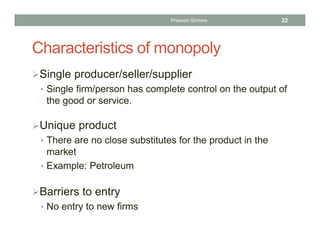
Characteristics of monopoly
Single producer/seller/supplier
• Single firm/person has complete control on the output of
the good or service.
Unique product
• There are no close substitutes for the product in the
market
• Example: Petroleum
Barriers to entry
• No entry to new firms
22Prabesh Ghimire
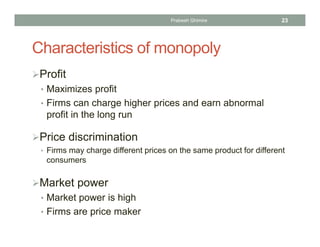
Characteristics of monopoly
Profit
• Maximizes profit
• Firms can charge higher prices and earn abnormal
profit in the long run
Price discrimination
• Firms may charge different prices on the same product for different
consumers
Market power
• Market power is high
• Firms are price maker
23Prabesh Ghimire
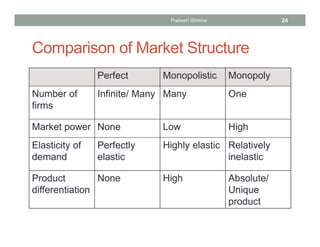
Comparison of Market Structure
Perfect Monopolistic Monopoly
Number of
firms
Infinite/ Many Many One
Market power None Low High
Elasticity of
demand
Perfectly
elastic
Highly elastic Relatively
inelastic
Product
differentiation
None High Absolute/
Unique
product
24Prabesh Ghimire
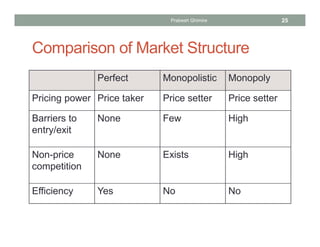
Comparison of Market Structure
Perfect Monopolistic Monopoly
Pricing power Price taker Price setter Price setter
Barriers to
entry/exit
None Few High
Non-price
competition
None Exists High
Efficiency Yes No No
25Prabesh Ghimire

Market structure

  • 1.
    MARKET STRUCTURE AND MARKETPOWER Prabesh Ghimire Health Care Market
  • 2.
    Market concepts Situation wherebuyers and sellers interact • To trade goods and/or services • Directly or through intermediaries Situation where forces on demand and supply interact to determine the price of goods and services being exchanged Mechanism for • Determining the prices and quantities of goods • Communicating information about prices • Distribution of goods and services 2Prabesh Ghimire
  • 3.
    Market structure Organizational andother characteristics of a market Identifies how a market is made up of Determines the nature of competition in the market Spectrum: Powerless>>Powerful 3Prabesh Ghimire
  • 4.
    Determinants of MarketStructure The number and size of firms in the market Nature of products/services provided The extent of barriers to entry and exit The degree of information available to both buyers and sellers regarding price and product characteristics Market power: The degree to which the firms can influence price 4Prabesh Ghimire
  • 5.
    Market Structure 5 Perfect competition Pure Monopoly More competitive(fewer imperfections) Less competitive (greater degree of imperfection) Prabesh Ghimire
  • 6.
    Market Structure 6 Perfect competition Pure Monopoly More competitive(fewer imperfections) Less competitive (greater degree of imperfection) MonopolyDuopolyOligopolyMonopolistic Prabesh Ghimire
  • 7.
    Market Power Ability ofa firm (group of firms) to raise an/or maintain market price above the level that would prevail under competition. Manipulate price to control profit margin Ability to increase obstacles to potential new entrants into the market Firms with market power can raise prices without losing customers to the competitors Firms>>>Market power>>>>Price makers 7Prabesh Ghimire
  • 8.
    Market Power Influenced bymarket structure • Nature of competition/ number of firms • Non-price factors: advertisements, loyalty schemes, trust, product quality Firms have ability to engage in anti-competitive behaviours • Predatory pricing/ undercutting • Product tying • Price fixing/ collusion 8Prabesh Ghimire
  • 9.
    Market Structure andMarket Power 9 Perfect competition Pure Monopoly Market Power MonopolyDuopolyOligopolyMonopolistic Low High Prabesh Ghimire
  • 10.
    Perfect market Theoretical (ideal)market structure  Benchmark to which real-life market structures can be compared Also called competitive market Examples • Agricultural markets: e.g. dairy market (nearly perfect) • Mining products: iron, coal, etc. 10Prabesh Ghimire
  • 11.
    Characteristics of PerfectMarket Many producers and consumers Homogenous products: • Products are perfect substitutes • Consumers are unable to differentiate between products sold by different sellers/firms No market power • Cannot influence market price • If a firm raise its price, consumers would buy from a competitor with a lower price instead. • Firms are price takers 11Prabesh Ghimire
  • 12.
    Characteristics of PerfectMarket  No barriers to entry and exit  Knowledge (Information) of product: • Perfect information about price and product characteristics  No externalities • The costs and benefits are fully reflected by the market price of goods and services Absence of selling and transportation cost No intervention from outside is required 12Prabesh Ghimire
  • 13.
    Monopolistic Market  Situationin which many firms with slightly different products compete. Production costs are above what may achieve by perfectly competitive firms Examples • Restaurants • Hairdressers • Clothing: Designer clothes, boutique • TV channels • Noodles, Toothpaste, Shampoo……… 13Prabesh Ghimire
  • 14.
    Characteristics of MonopolisticMarket Many producers and many consumers Heterogeneous products: • Goods/service perform same basic functions • Difference in type, style, quality, reputation, appearance, etc. Involves a great deal of non-price competition based on product differentiation • Leads to heavy marketing No barriers to entry and exit 14Prabesh Ghimire
  • 15.
    Characteristics of MonopolisticMarket Imperfect information • Buyers do not have complete market information • Which product is better? • What is a fair price of the product? Market power: Firms have some degree of market power • Can raise product prices without losing all its customers • Can lower prices without triggering a potentially ruinous price war with competitors 15Prabesh Ghimire
  • 16.
    Characteristics of MonopolisticMarket Profit • Results in normal profits in the long term.  Independence • Firms independently sets the terms of exchange for its product • No consideration on what effect its decisions may have on competitors • Firm’s action will have a negligible effect on overall market conditions 16Prabesh Ghimire
  • 17.
    Oligopoly Market dominated bysmall number of large sellers (oligopolists) Characterized by interdependence of firms • Decision of one firm influenced by the decision of other firms. Can result from various forms of collusion • Reduce competition and lead to higher prices for consumers Examples: • Private clinics in small town • Internet service providers: World link, Vianet, Broadlink, Websurfer • Telephone services: NTC, Ncell, Smart Cell, Hello Nepal • Soft drink industry: Pepsi, Coca-cola 17Prabesh Ghimire
  • 18.
    Characteristics of OligopolyMarket Few number of producers/ sellers • Few large sellers and can collude Barriers to entry are high • Government license, high investment, patents, access to expensive and complex technology, consumer loyalty High market power • Ability to set price • Price setters rather than price takers 18Prabesh Ghimire
  • 19.
    Characteristics of OligopolyMarket Product differentiation Product may be homogenous (steel) or differentiated (automobiles)  Interdependence • Most distinctive feature • Each firm is so large that its action affect market conditions • Decision of one firm affects the decision of others • Price rigidity 19Prabesh Ghimire
  • 20.
    Characteristics of OligopolyMarket Consumer knowledge • Consumers have imperfect knowledge as to price, cost and product quality. Profit • Firms can retain long run abnormal profits • Barriers to entry prevents sideline firms from entering market to excess profits Non-price competition • Firms compete on terms other than price • Advertisement, loyalty schemes, product differentiation 20Prabesh Ghimire
  • 21.
    Monopoly Market structure wherea specific person or enterprise/firm is the only supplier of particular good/ service Characterized by lack of competition to produce/sell good or service, lack of substitutes and high price. Examples • Nepal Oil Corporation • Salt trading Corporation • Electricity • Pharmaceutical industry with specific patent • Single hospital in remote area 21Prabesh Ghimire
  • 22.
    Characteristics of monopoly Singleproducer/seller/supplier • Single firm/person has complete control on the output of the good or service. Unique product • There are no close substitutes for the product in the market • Example: Petroleum Barriers to entry • No entry to new firms 22Prabesh Ghimire
  • 23.
    Characteristics of monopoly Profit •Maximizes profit • Firms can charge higher prices and earn abnormal profit in the long run Price discrimination • Firms may charge different prices on the same product for different consumers Market power • Market power is high • Firms are price maker 23Prabesh Ghimire
  • 24.
    Comparison of MarketStructure Perfect Monopolistic Monopoly Number of firms Infinite/ Many Many One Market power None Low High Elasticity of demand Perfectly elastic Highly elastic Relatively inelastic Product differentiation None High Absolute/ Unique product 24Prabesh Ghimire
  • 25.
    Comparison of MarketStructure Perfect Monopolistic Monopoly Pricing power Price taker Price setter Price setter Barriers to entry/exit None Few High Non-price competition None Exists High Efficiency Yes No No 25Prabesh Ghimire