Towards SMART and Seamless e-Government
Course offered by: KAIST Global ITTP
Student: Erdenebold Tumennast
Korea Advanced Institution of Science and Technology (ITTP)
Dec 9 , 2014
E-Government Country Report of Mongolia
Table of Contents
2
Introduction
• Country Profile
• History timeline
• ICT market
• Global ranking & rational political environment
• E-Government National Program
• E-Government National Strategy Conceptualization
Methodolo
• Conceptual Framework
• Research Framework
• ICT & Telecom Infrastructure
• Datacenter
• Standard Framework
• Security
• Data collection and analysis
Conclusion
Background
E-Government policy
E-Government organizational structure
Challenges
E-Government HR Development
E-Government Projects
E-Government Laws and Regulations
E-Government Infrastructure
Recommendations and Conclusion
3
Background
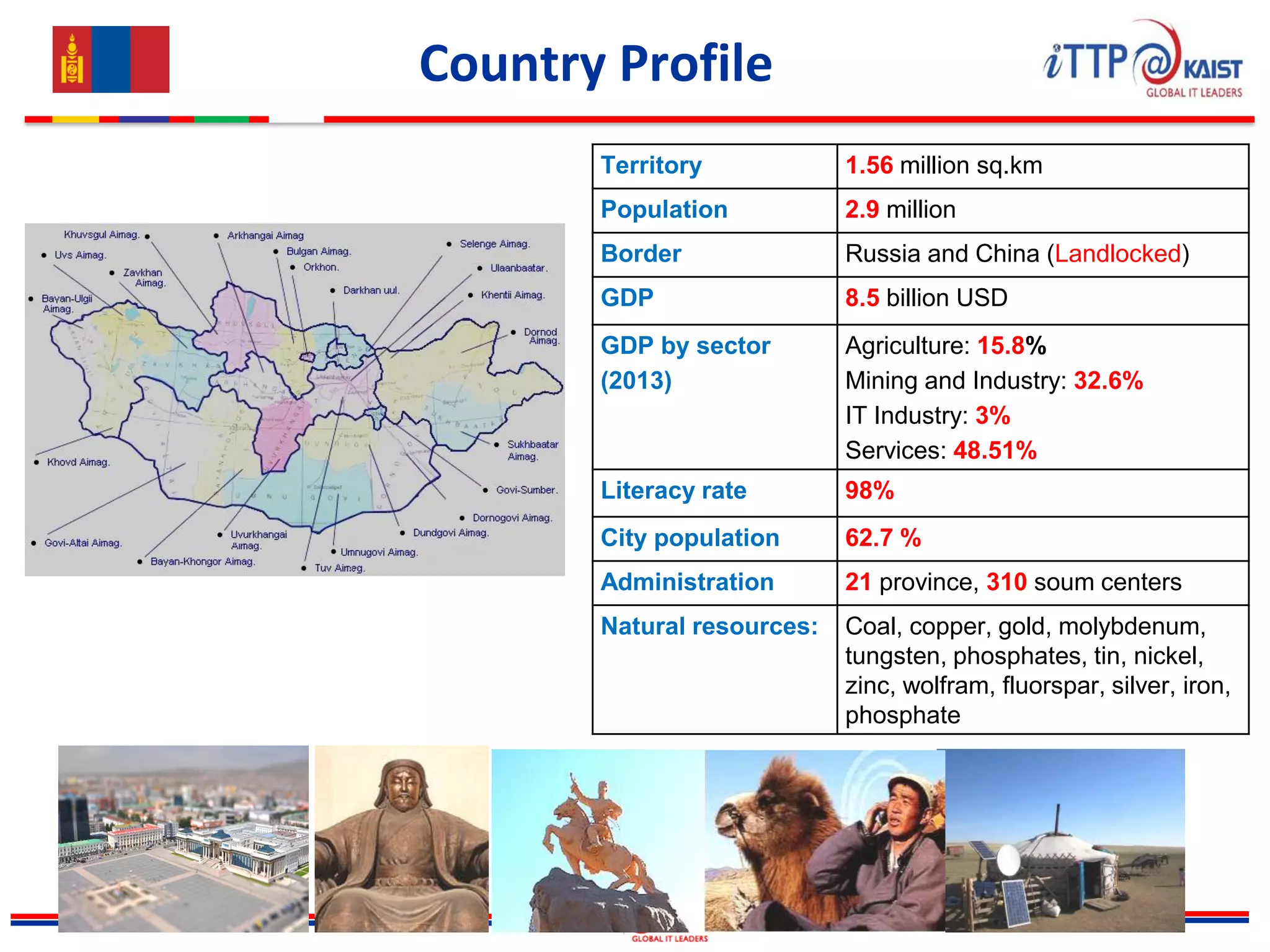
Country Profile
Territory 1.56 million sq.km
Population 2.9 million
Border Russia and China (Landlocked)
GDP 8.5 billion USD
GDP by sector
(2013)
Agriculture: 15.8%
Mining and Industry: 32.6%
IT Industry: 3%
Services: 48.51%
Literacy rate 98%
City population 62.7 %
Administration 21 province, 310 soum centers
Natural resources: Coal, copper, gold, molybdenum,
tungsten, phosphates, tin, nickel,
zinc, wolfram, fluorspar, silver, iron,
phosphate
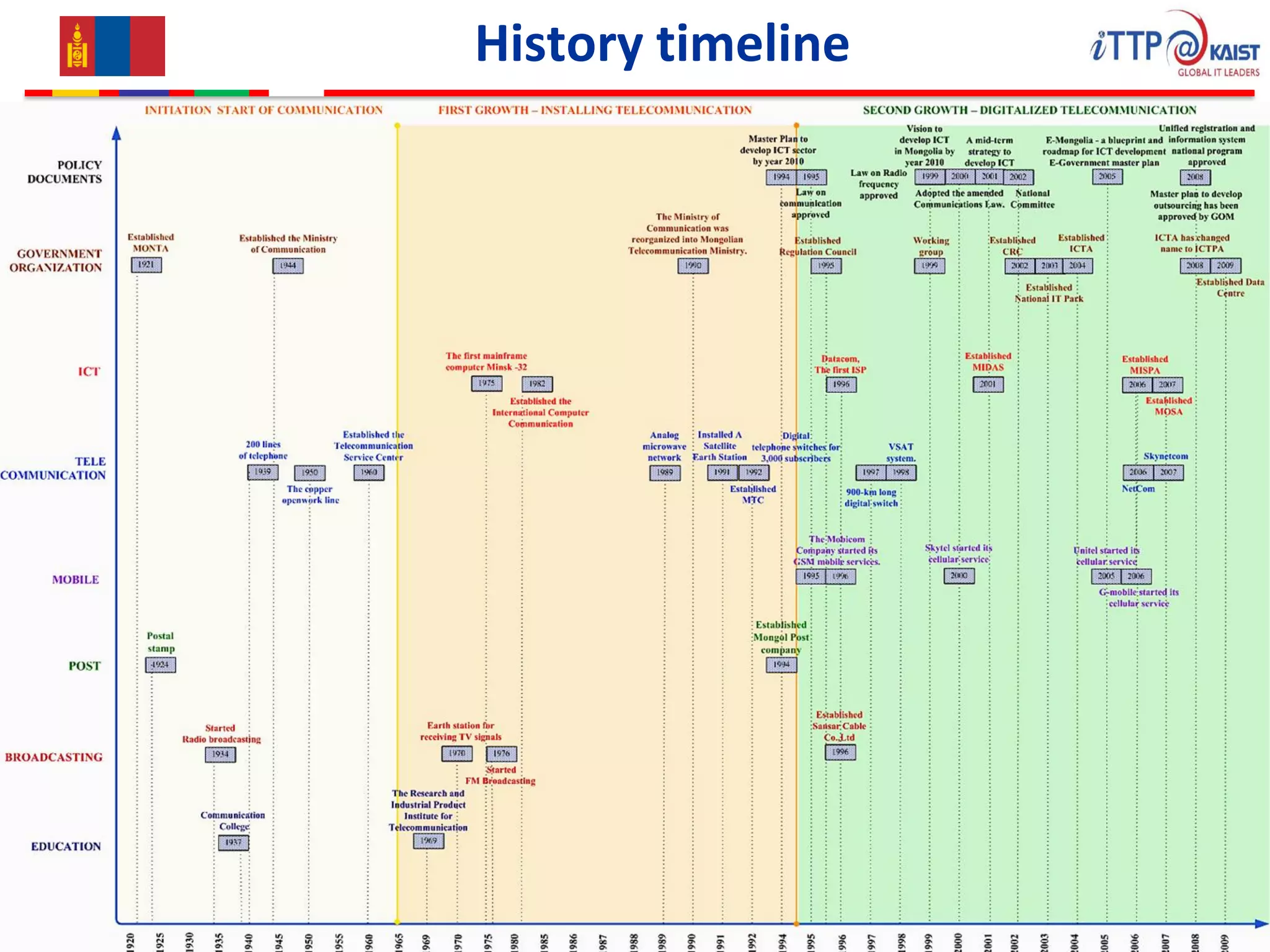
History timeline
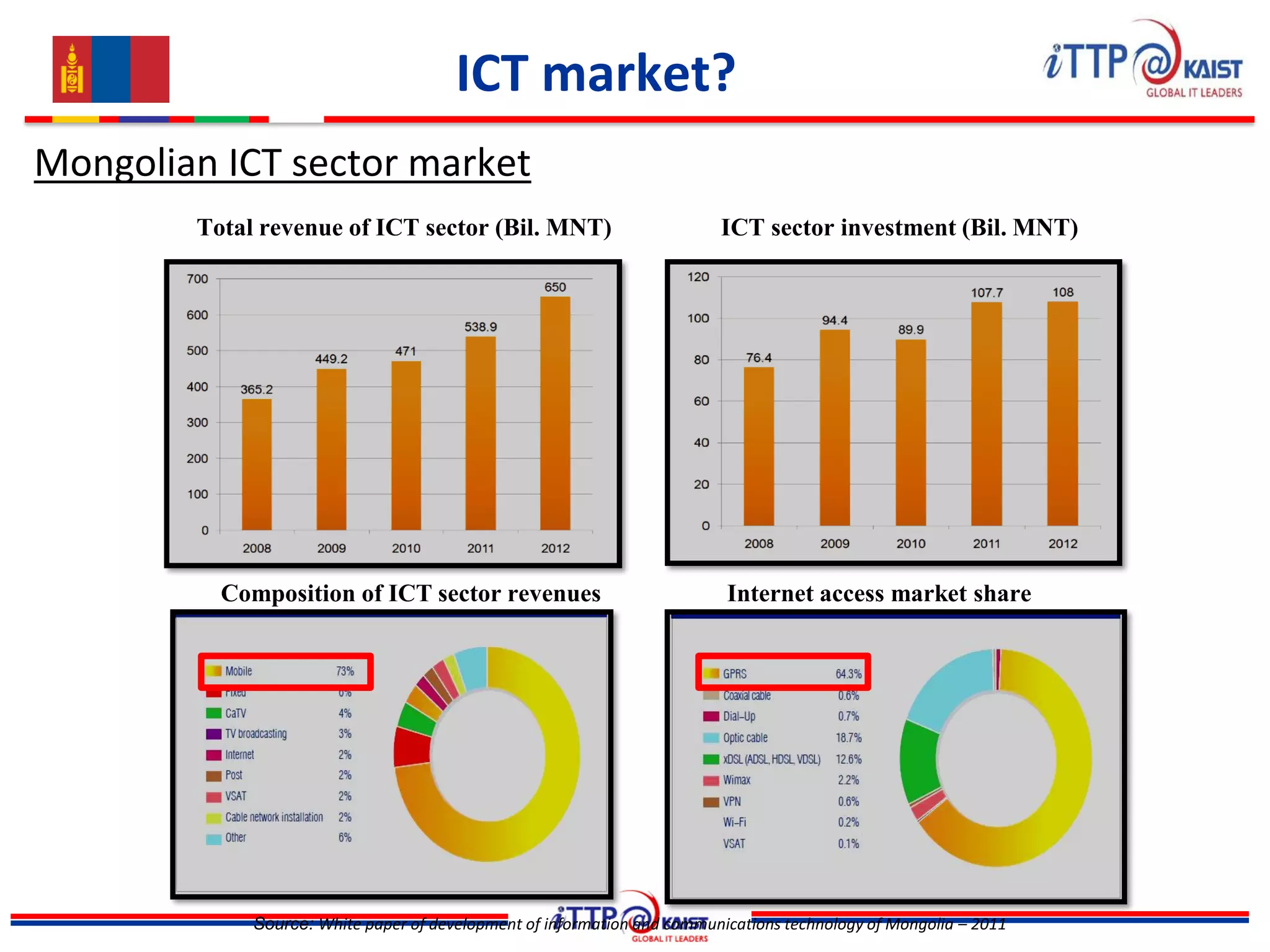
ICT market?
Mongolian ICT sector market
Total revenue of ICT sector (Bil. MNT) ICT sector investment (Bil. MNT)
Composition of ICT sector revenues Internet access market share
Source: White paper of development of information and communications technology of Mongolia – 2011
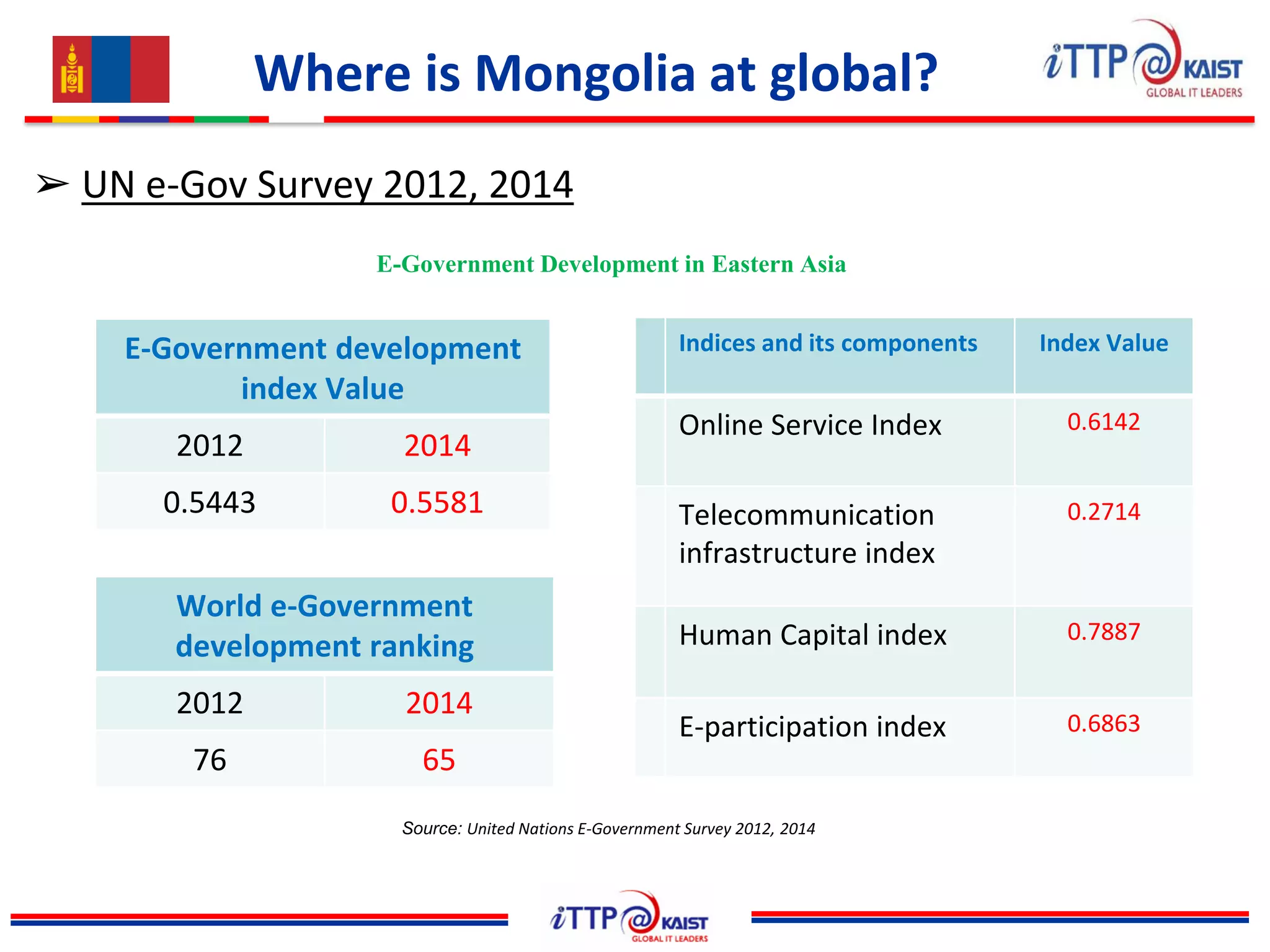
Where is Mongolia at global?
➢ UN e-Gov Survey 2012, 2014
E-Government Development in Eastern Asia
E-Government development
index Value
2012 2014
0.5443 0.5581
Source: United Nations E-Government Survey 2012, 2014
World e-Government
development ranking
2012 2014
76 65
Indices and its components Index Value
Online Service Index 0.6142
Telecommunication
infrastructure index
0.2714
Human Capital index 0.7887
E-participation index 0.6863
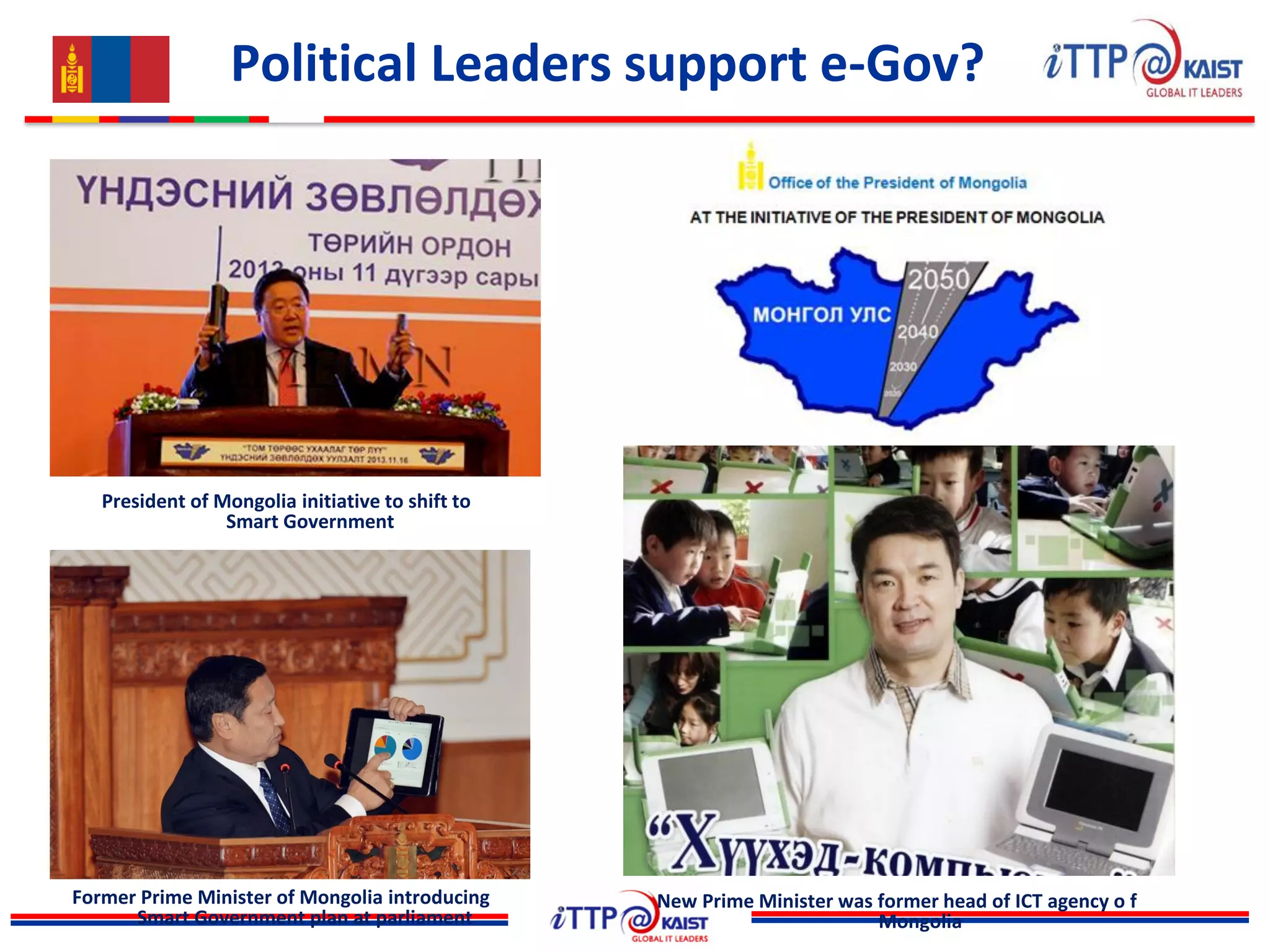
Political Leaders support e-Gov?
President of Mongolia initiative to shift to
Smart Government
Former Prime Minister of Mongolia introducing
Smart Government plan at parliament
New Prime Minister was former head of ICT agency o f
Mongolia
9
1. E-Government Policy
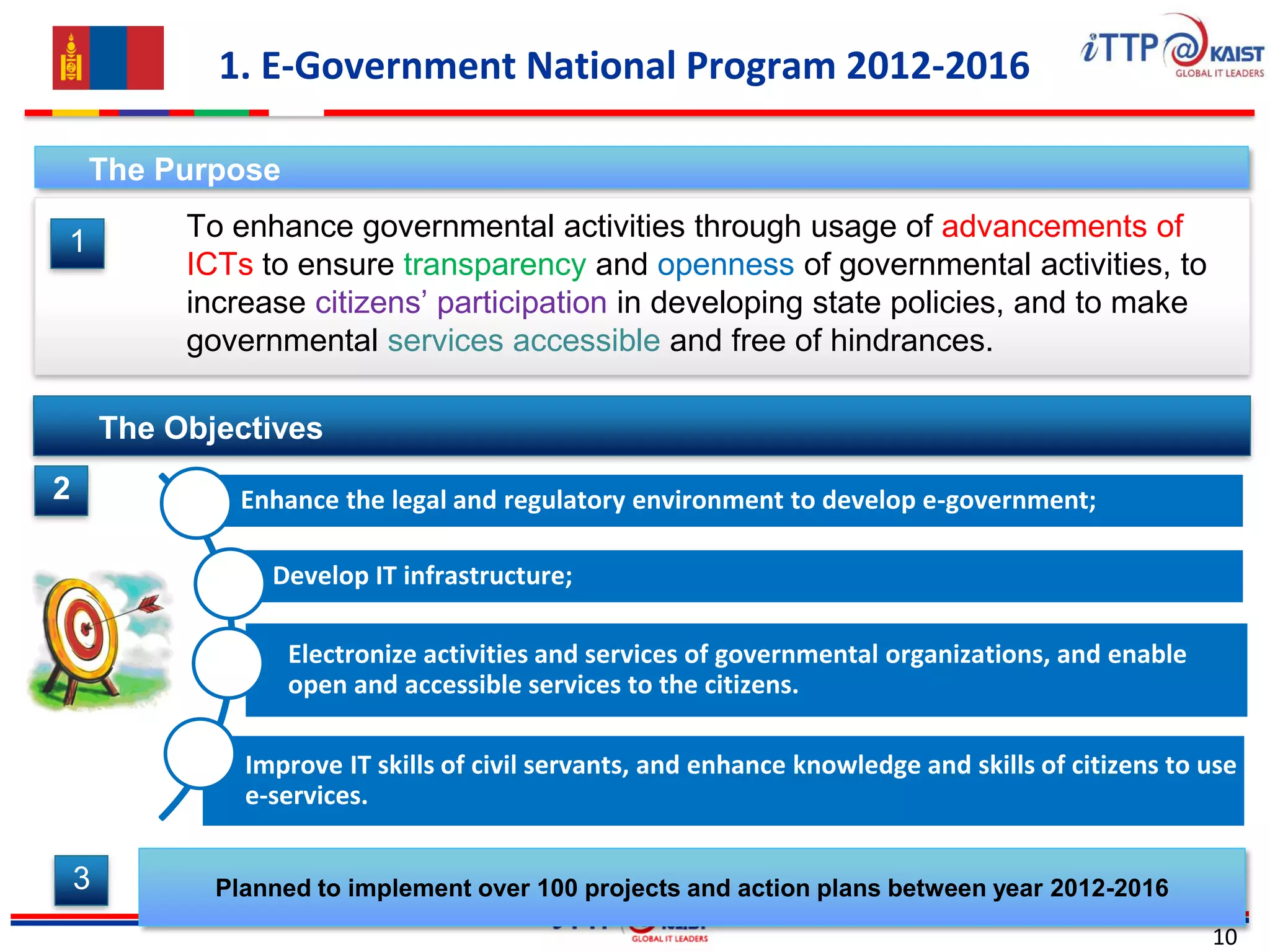
1. E-Government National Program 2012-2016
10
To enhance governmental activities through usage of advancements of
ICTs to ensure transparency and openness of governmental activities, to
increase citizens’ participation in developing state policies, and to make
governmental services accessible and free of hindrances.
The Purpose
The Objectives
1
Planned to implement over 100 projects and action plans between year 2012-2016
Enhance the legal and regulatory environment to develop e-government;
Develop IT infrastructure;
Electronize activities and services of governmental organizations, and enable
open and accessible services to the citizens.
Improve IT skills of civil servants, and enhance knowledge and skills of citizens to use
e-services.
2
3
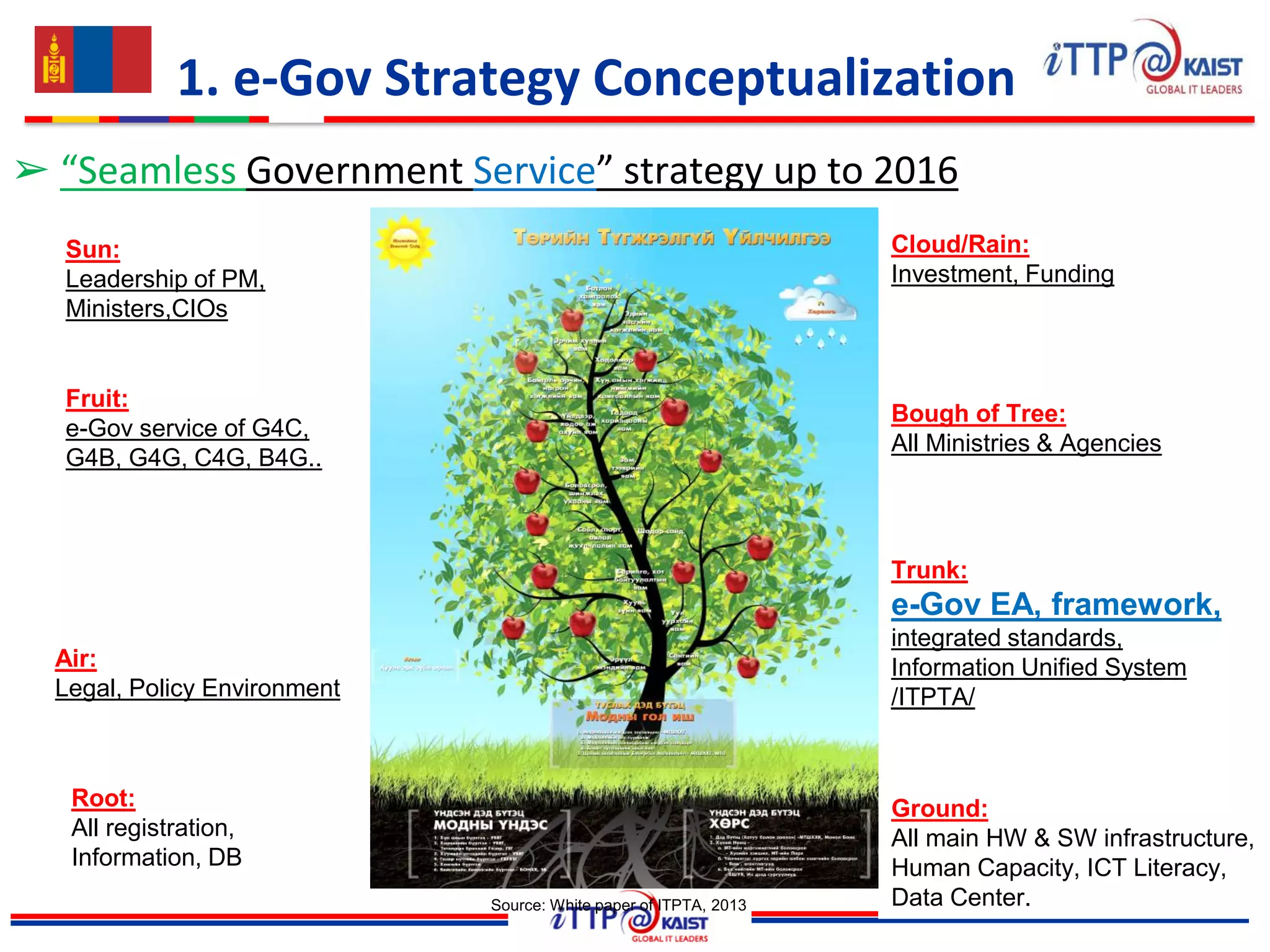
Ground:
All main HW & SW infrastructure,
Human Capacity, ICT Literacy,
Data Center.
Root:
All registration,
Information, DB
1. e-Gov Strategy Conceptualization
➢ “Seamless Government Service” strategy up to 2016
Sun:
Leadership of PM,
Ministers,CIOs
Air:
Legal, Policy Environment
Cloud/Rain:
Investment, Funding
Trunk:
e-Gov EA, framework,
integrated standards,
Information Unified System
/ITPTA/
Fruit:
e-Gov service of G4C,
G4B, G4G, C4G, B4G..
Bough of Tree:
All Ministries & Agencies
Source: White paper of ITPTA, 2013
12
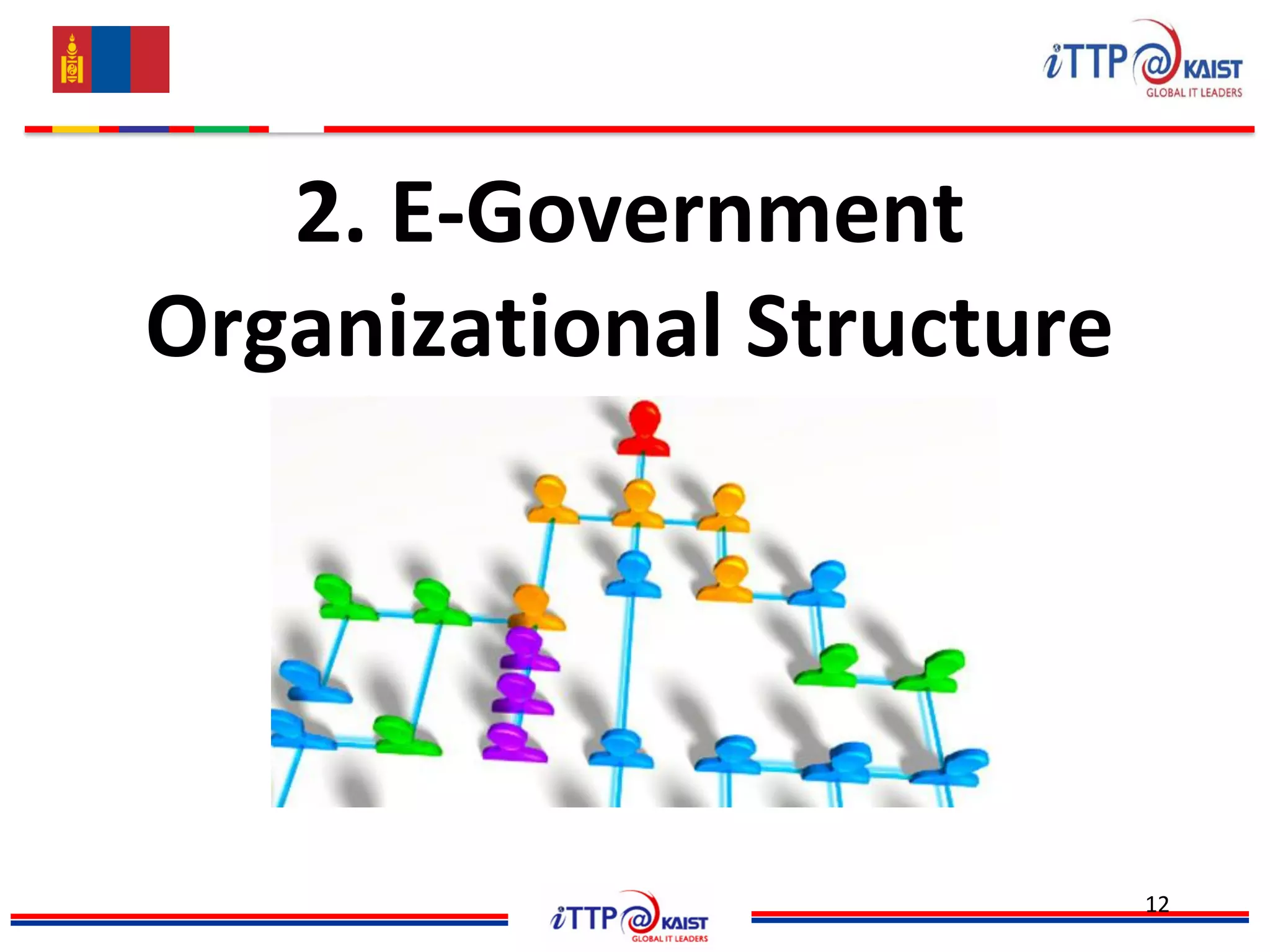
2. E-Government
Organizational Structure
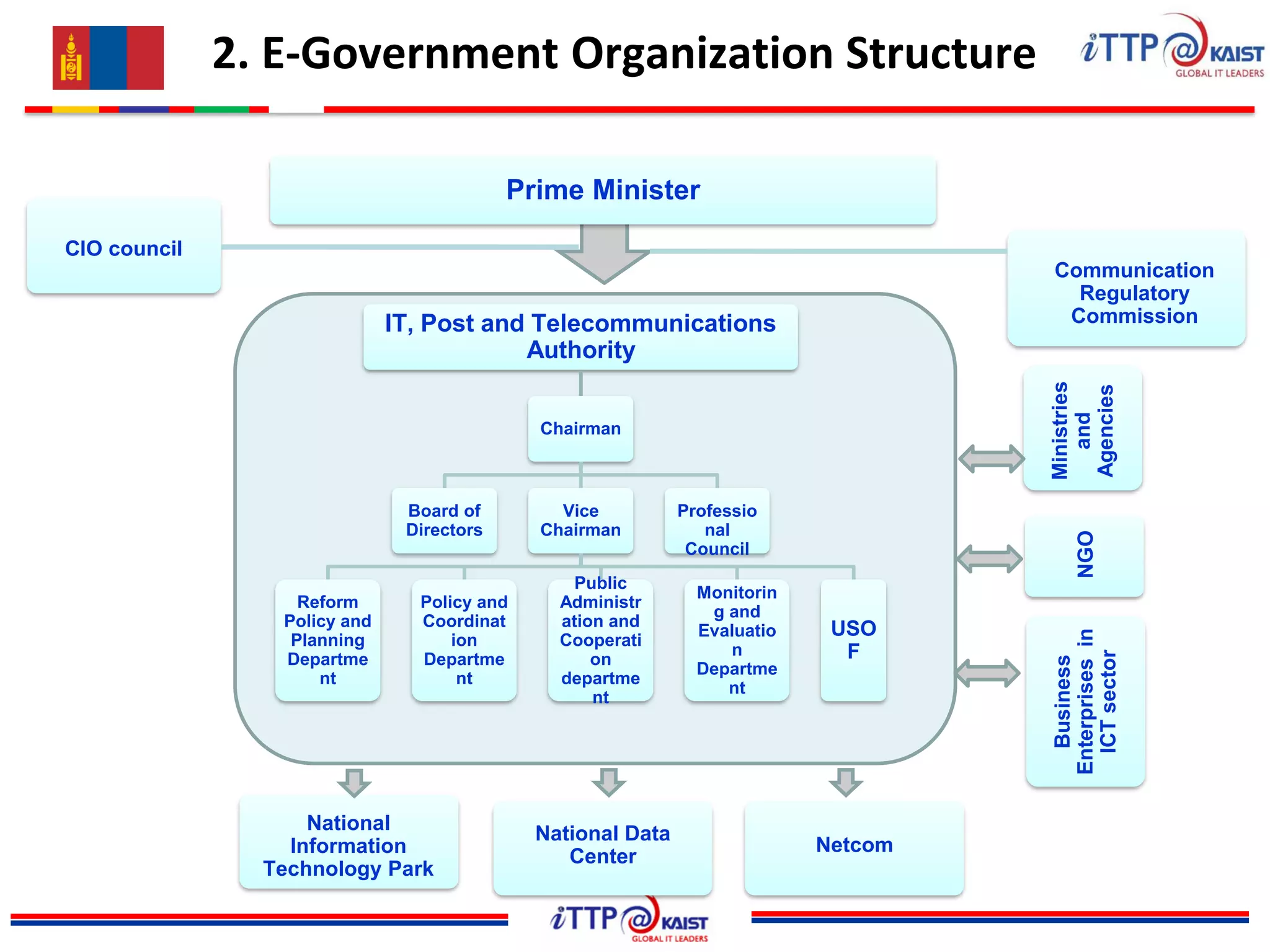
2. E-Government Organization Structure
IT, Post and Telecommunications
Authority
Chairman
Board of
Directors
Vice
Chairman
Reform
Policy and
Planning
Departme
nt
Policy and
Coordinat
ion
Departme
nt
Public
Administr
ation and
Cooperati
on
departme
nt
Monitorin
g and
Evaluatio
n
Departme
nt
USO
F
Professio
nal
Council
Communication
Regulatory
Commission
National
Information
Technology Park
Netcom
National Data
Center
Prime Minister
Ministries
and
Agencies
Business
Enterprisesin
ICTsector
CIO council
NGO
14
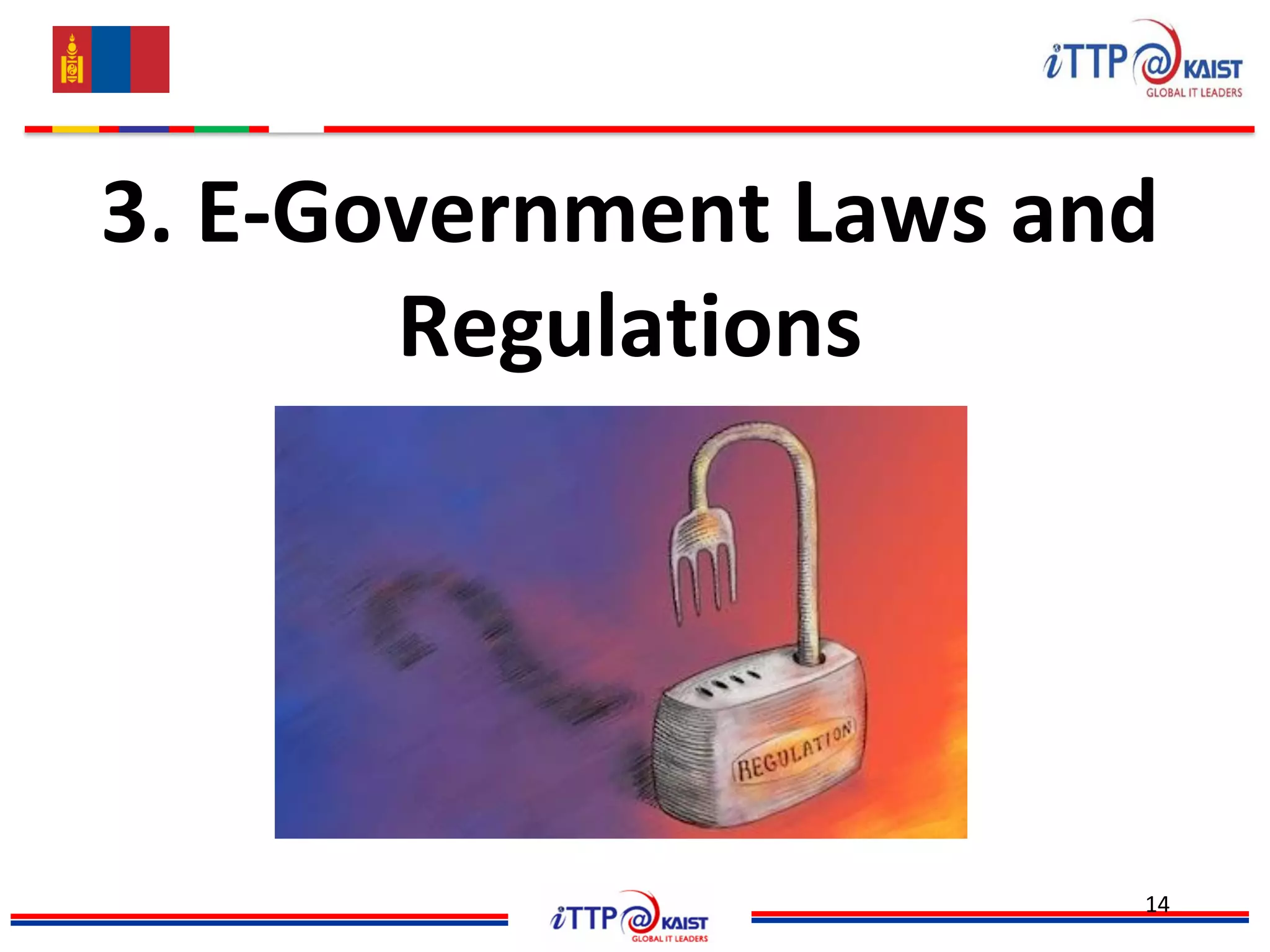
3. E-Government Laws and
Regulations
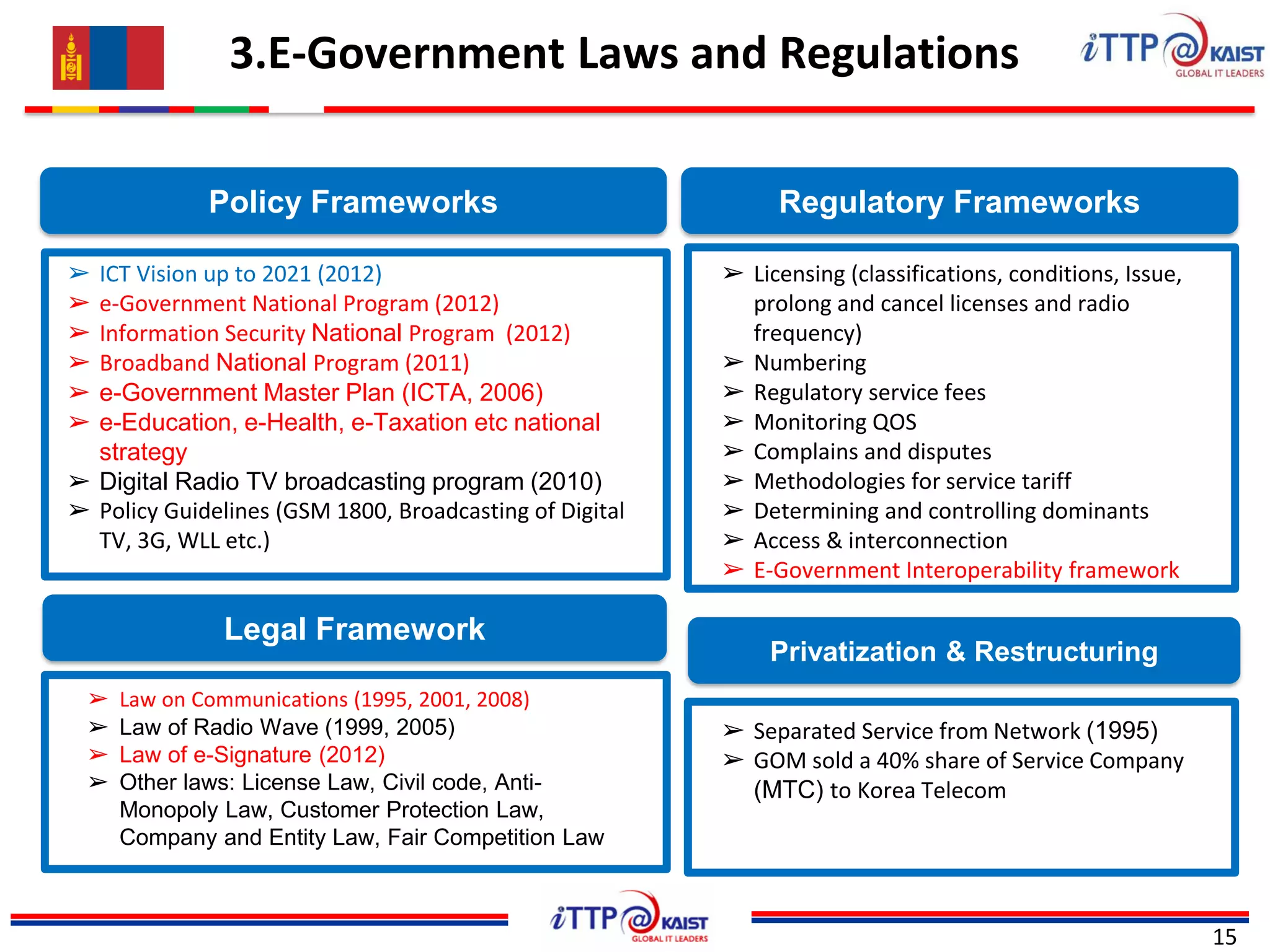
3.E-Government Laws and Regulations
15
Source: NIA, 2013
Policy Frameworks Regulatory Frameworks
➢ ICT Vision up to 2021 (2012)
➢ e-Government National Program (2012)
➢ Information Security National Program (2012)
➢ Broadband National Program (2011)
➢ e-Government Master Plan (ICTA, 2006)
➢ e-Education, e-Health, e-Taxation etc national
strategy
➢ Digital Radio TV broadcasting program (2010)
➢ Policy Guidelines (GSM 1800, Broadcasting of Digital
TV, 3G, WLL etc.)
➢ Licensing (classifications, conditions, Issue,
prolong and cancel licenses and radio
frequency)
➢ Numbering
➢ Regulatory service fees
➢ Monitoring QOS
➢ Complains and disputes
➢ Methodologies for service tariff
➢ Determining and controlling dominants
➢ Access & interconnection
➢ E-Government Interoperability framework
Privatization & Restructuring
➢ Separated Service from Network (1995)
➢ GOM sold a 40% share of Service Company
(MTC) to Korea Telecom
Legal Framework
➢ Law on Communications (1995, 2001, 2008)
➢ Law of Radio Wave (1999, 2005)
➢ Law of e-Signature (2012)
➢ Other laws: License Law, Civil code, Anti-
Monopoly Law, Customer Protection Law,
Company and Entity Law, Fair Competition Law
16
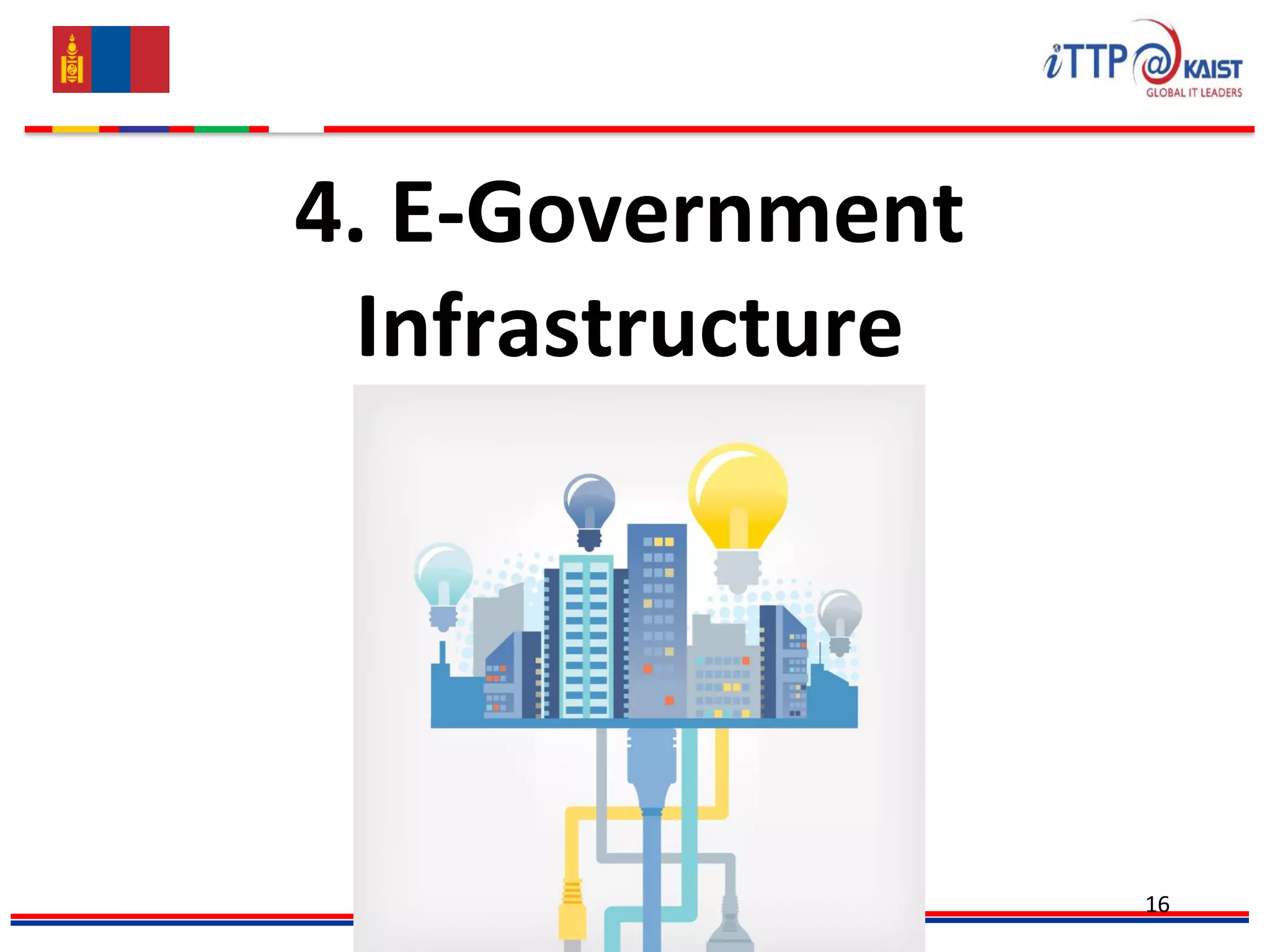
4. E-Government
Infrastructure
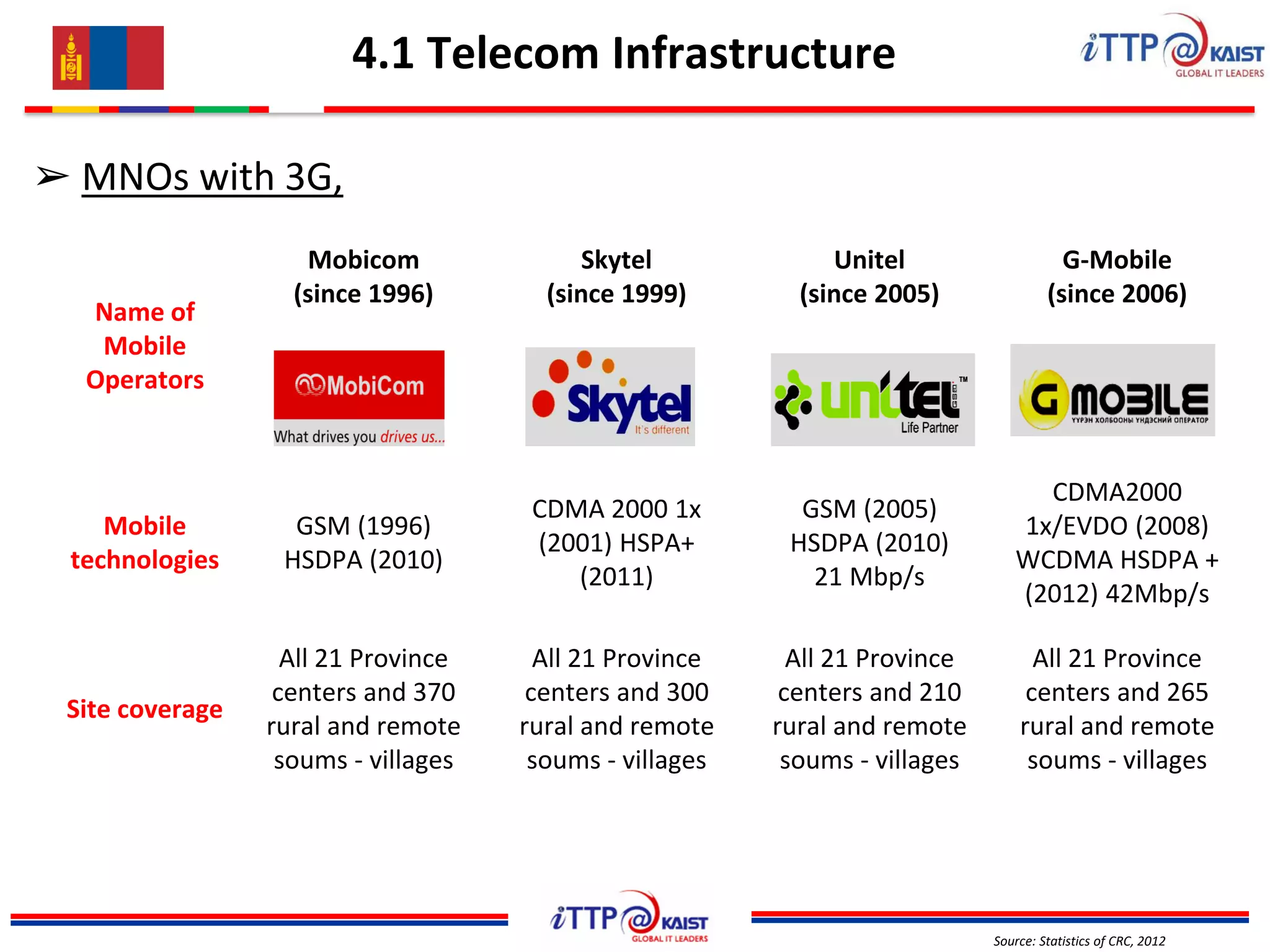
Source: Statistics of CRC, 2012
4.1 Telecom Infrastructure
➢ MNOs with 3G,
Name of
Mobile
Operators
Mobicom
(since 1996)
Skytel
(since 1999)
Unitel
(since 2005)
G-Mobile
(since 2006)
Mobile
technologies
GSM (1996)
HSDPA (2010)
CDMA 2000 1x
(2001) HSPA+
(2011)
GSM (2005)
HSDPA (2010)
21 Mbp/s
CDMA2000
1x/EVDO (2008)
WCDMA HSDPA +
(2012) 42Mbp/s
Site coverage
All 21 Province
centers and 370
rural and remote
soums - villages
All 21 Province
centers and 300
rural and remote
soums - villages
All 21 Province
centers and 210
rural and remote
soums - villages
All 21 Province
centers and 265
rural and remote
soums - villages
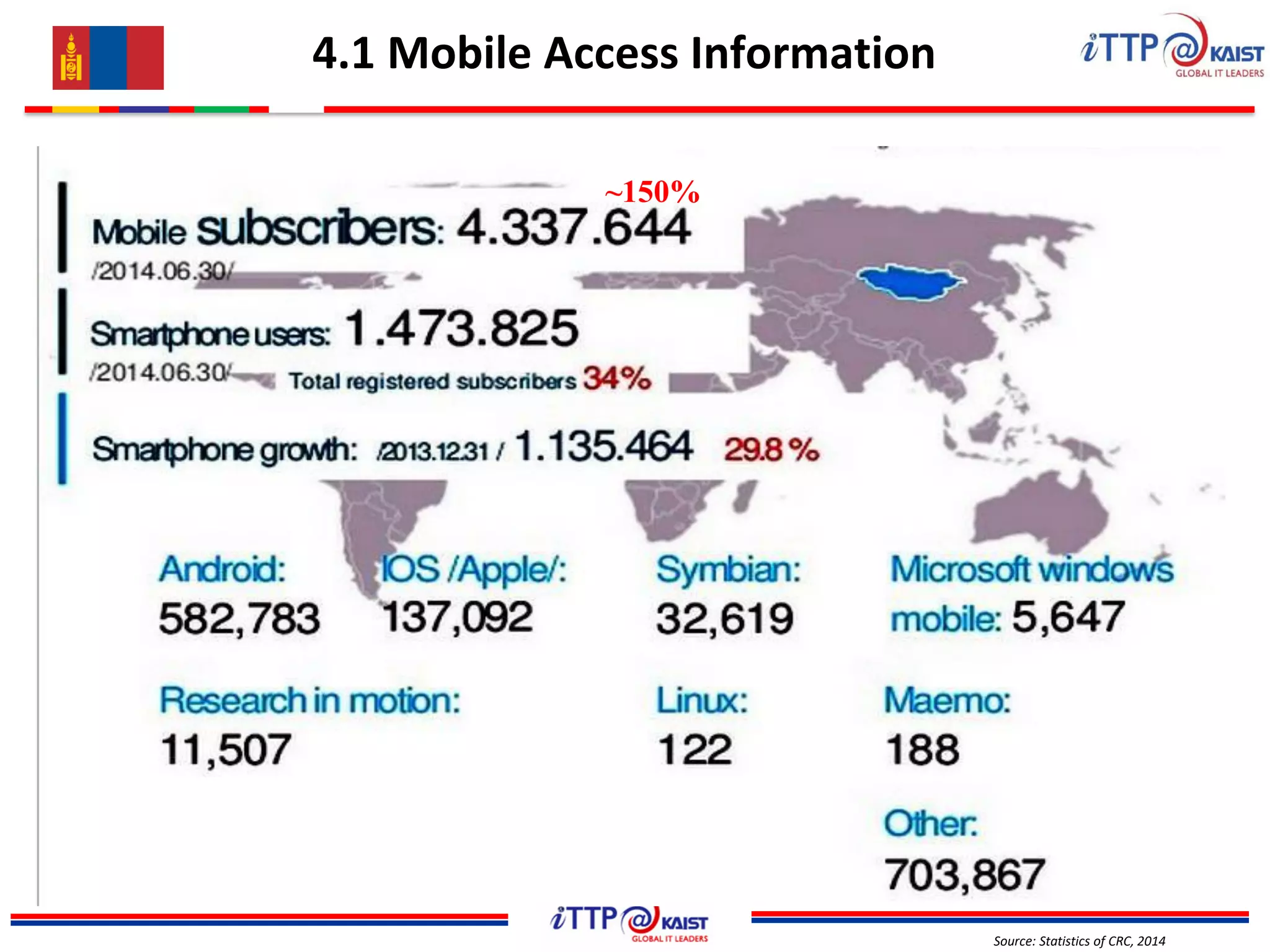
Source: Statistics of CRC, 2014
4.1 Mobile Access Information
~150%
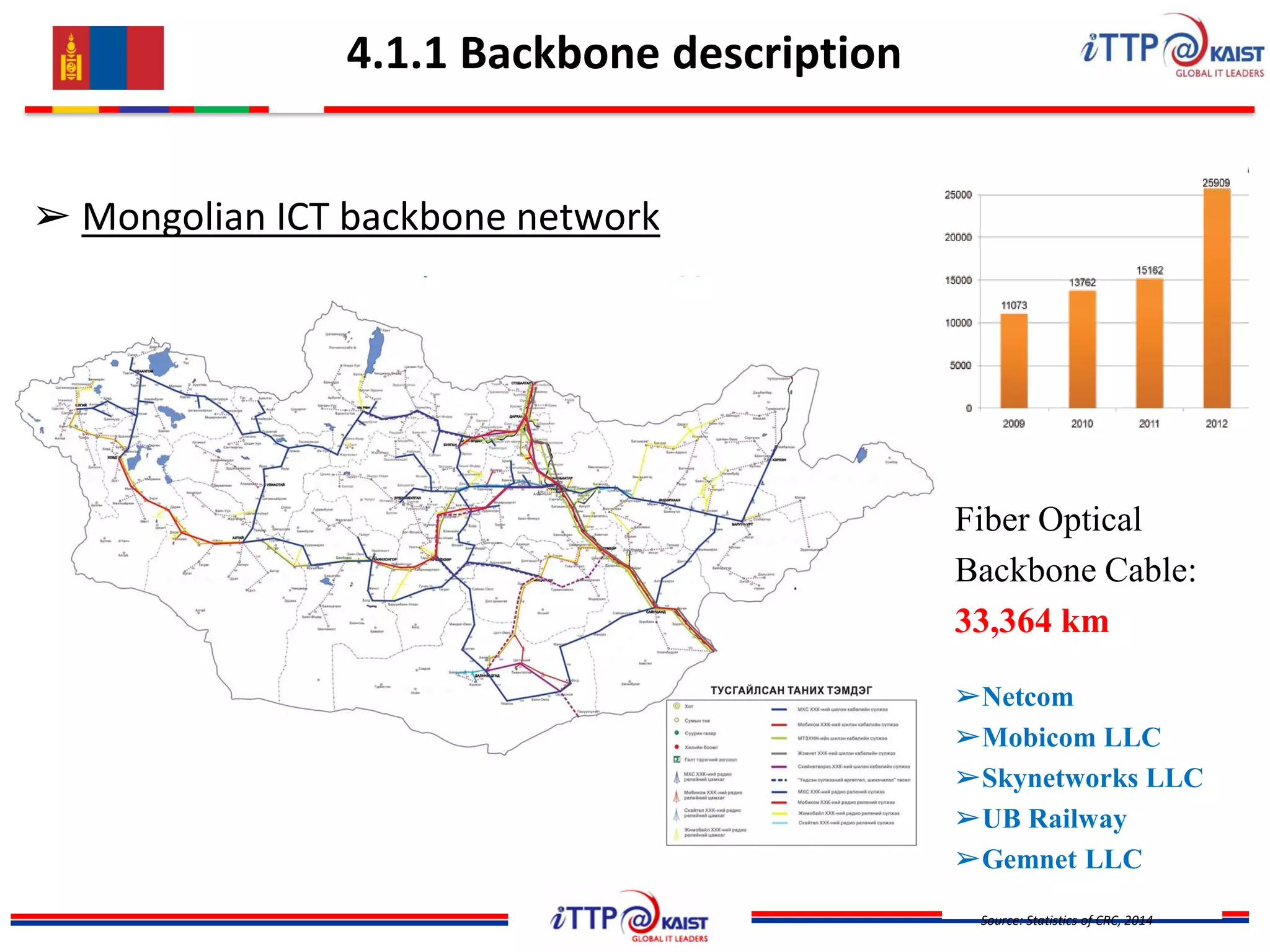
Fiber Optical
Backbone Cable:
33,364 km
➢Netcom
➢Mobicom LLC
➢Skynetworks LLC
➢UB Railway
➢Gemnet LLC
Source: Statistics of CRC, 2014
➢ Mongolian ICT backbone network
4.1.1 Backbone description
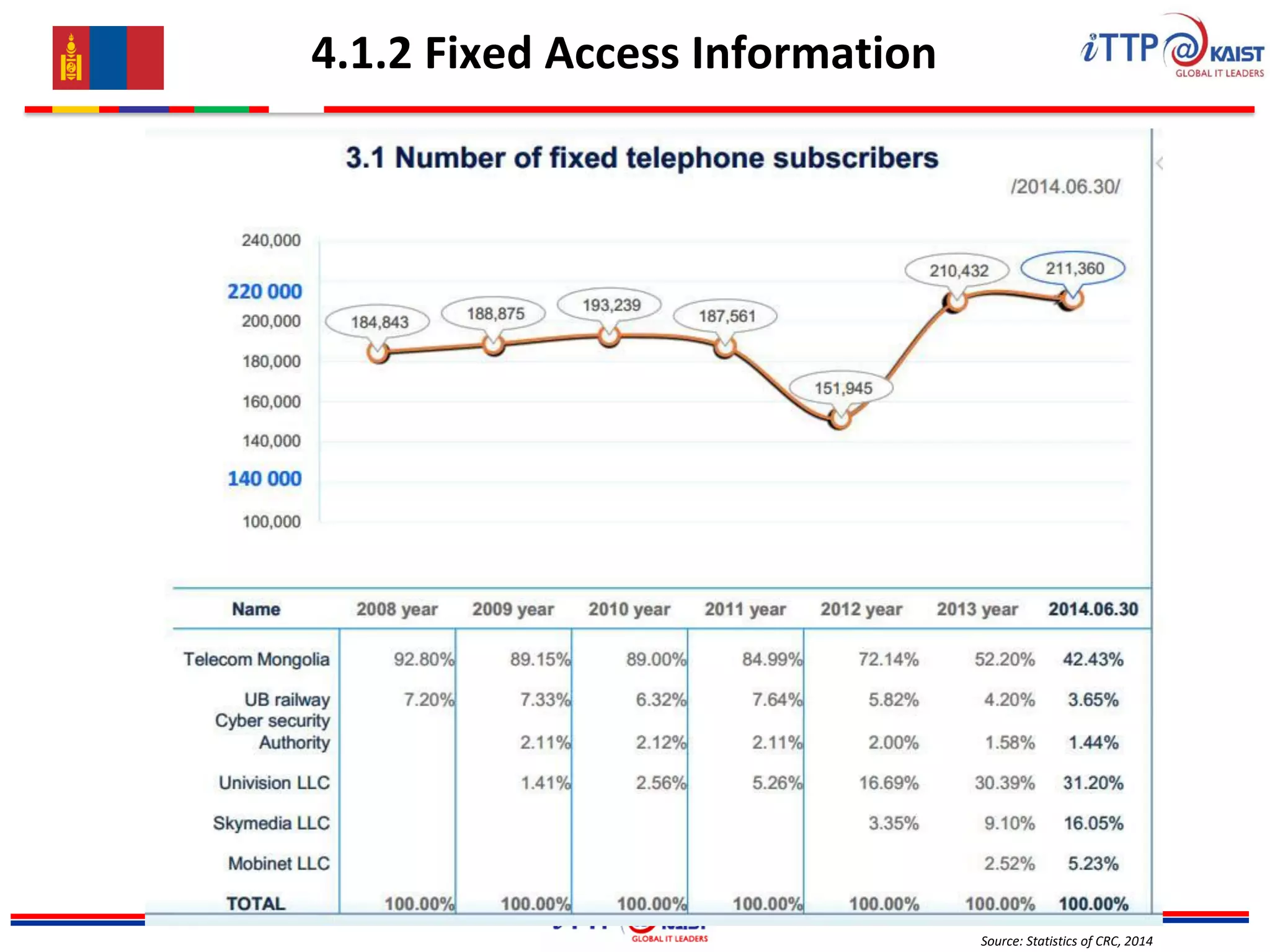
Source: Statistics of CRC, 2014
4.1.2 Fixed Access Information
MNDC operation and services
21
2
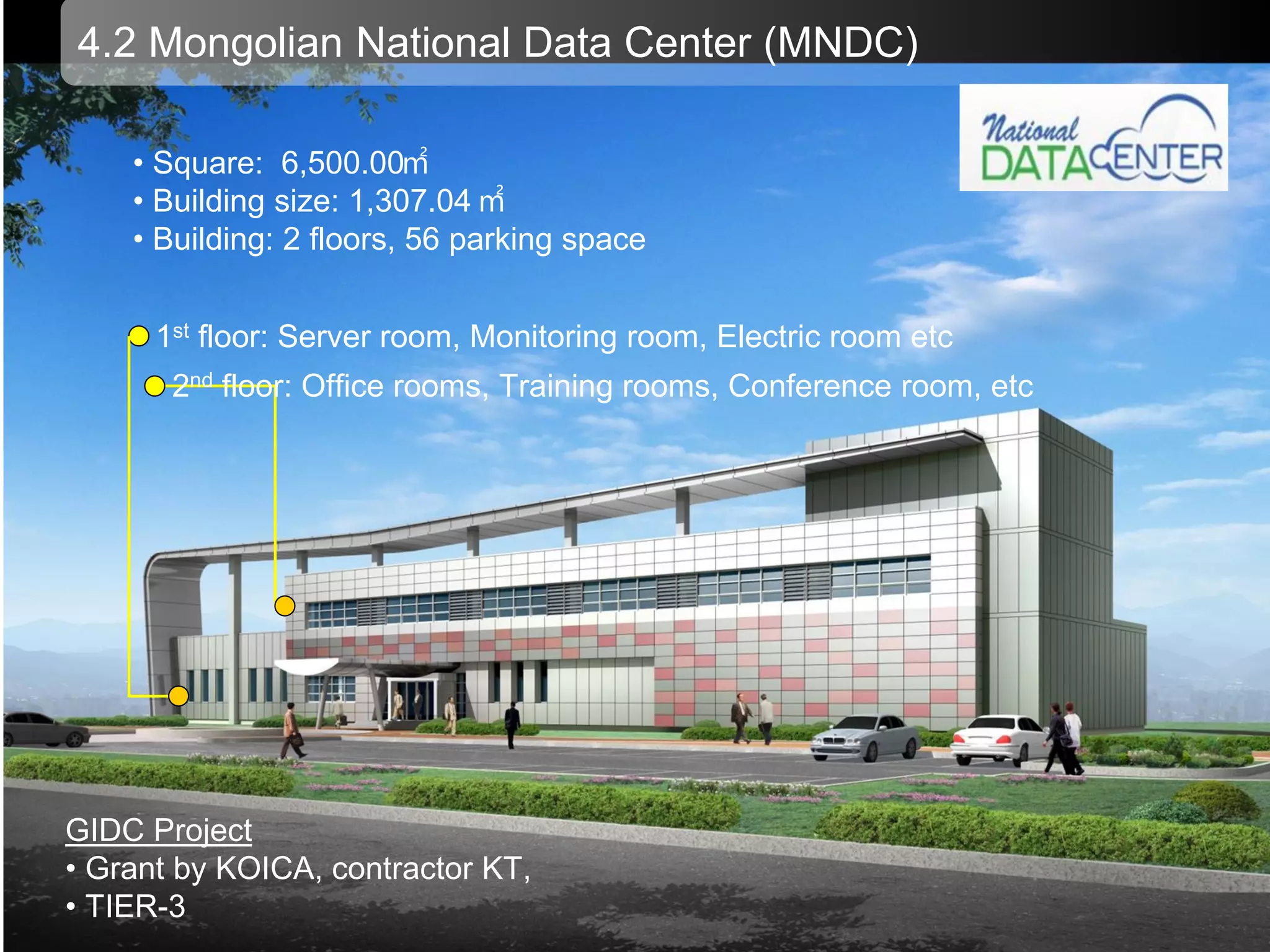
4.2 Mongolian National Data Center (MNDC)
• Square: 6,500.00㎡
• Building size: 1,307.04 ㎡
• Building: 2 floors, 56 parking space
1st floor: Server room, Monitoring room, Electric room etc
2nd floor: Office rooms, Training rooms, Conference room, etc
GIDC Project
• Grant by KOICA, contractor KT,
• TIER-3
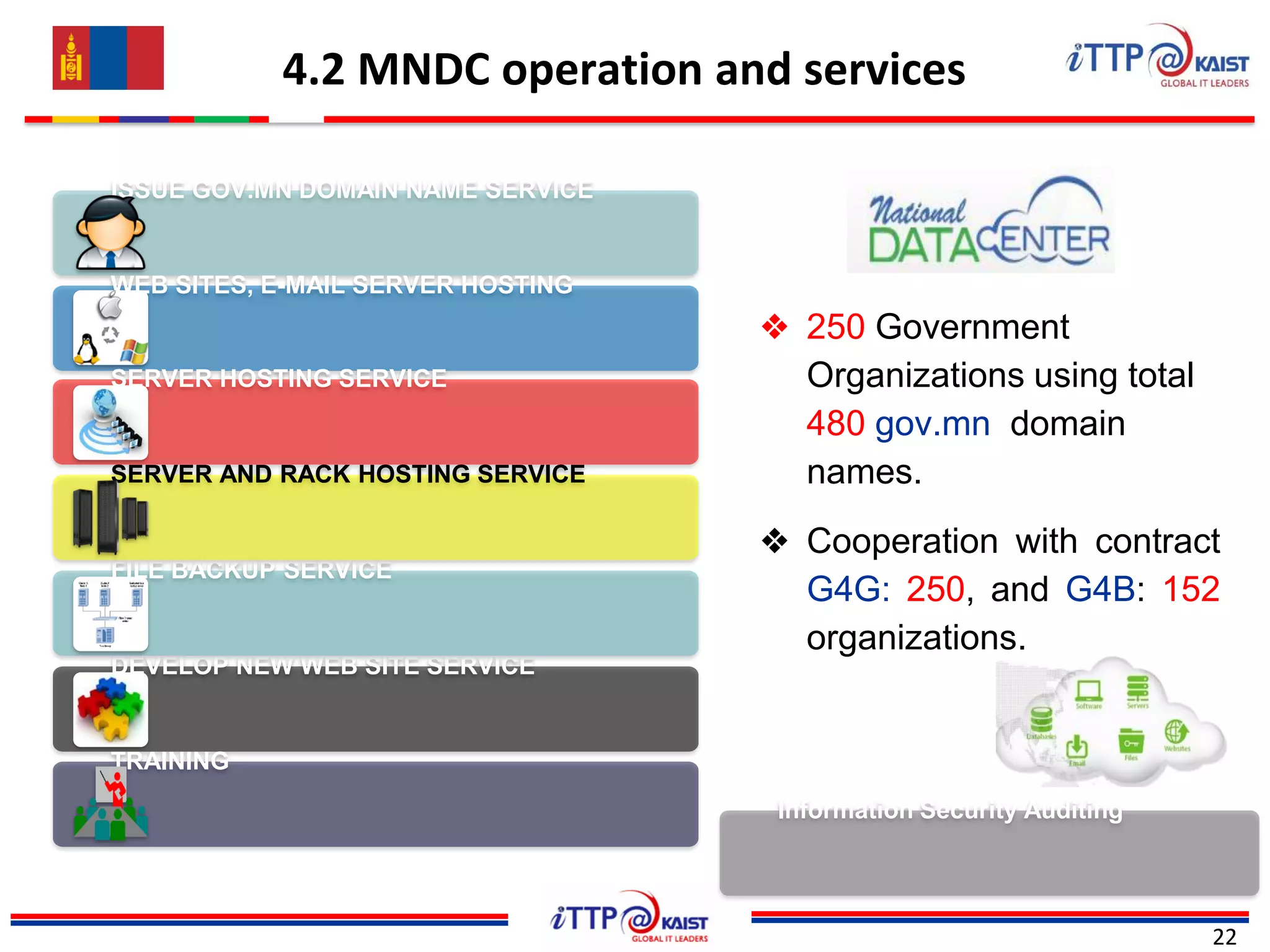
4.2 MNDC operation and services
22
DEVELOP NEW WEB SITE SERVICE
FILE BACKUP SERVICE
TRAINING
ISSUE GOV.MN DOMAIN NAME SERVICE
WEB SITES, E-MAIL SERVER HOSTING
SERVER HOSTING SERVICE
SERVER AND RACK HOSTING SERVICE
❖ 250 Government
Organizations using total
480 gov.mn domain
names.
❖ Cooperation with contract
G4G: 250, and G4B: 152
organizations.
Information Security Auditing
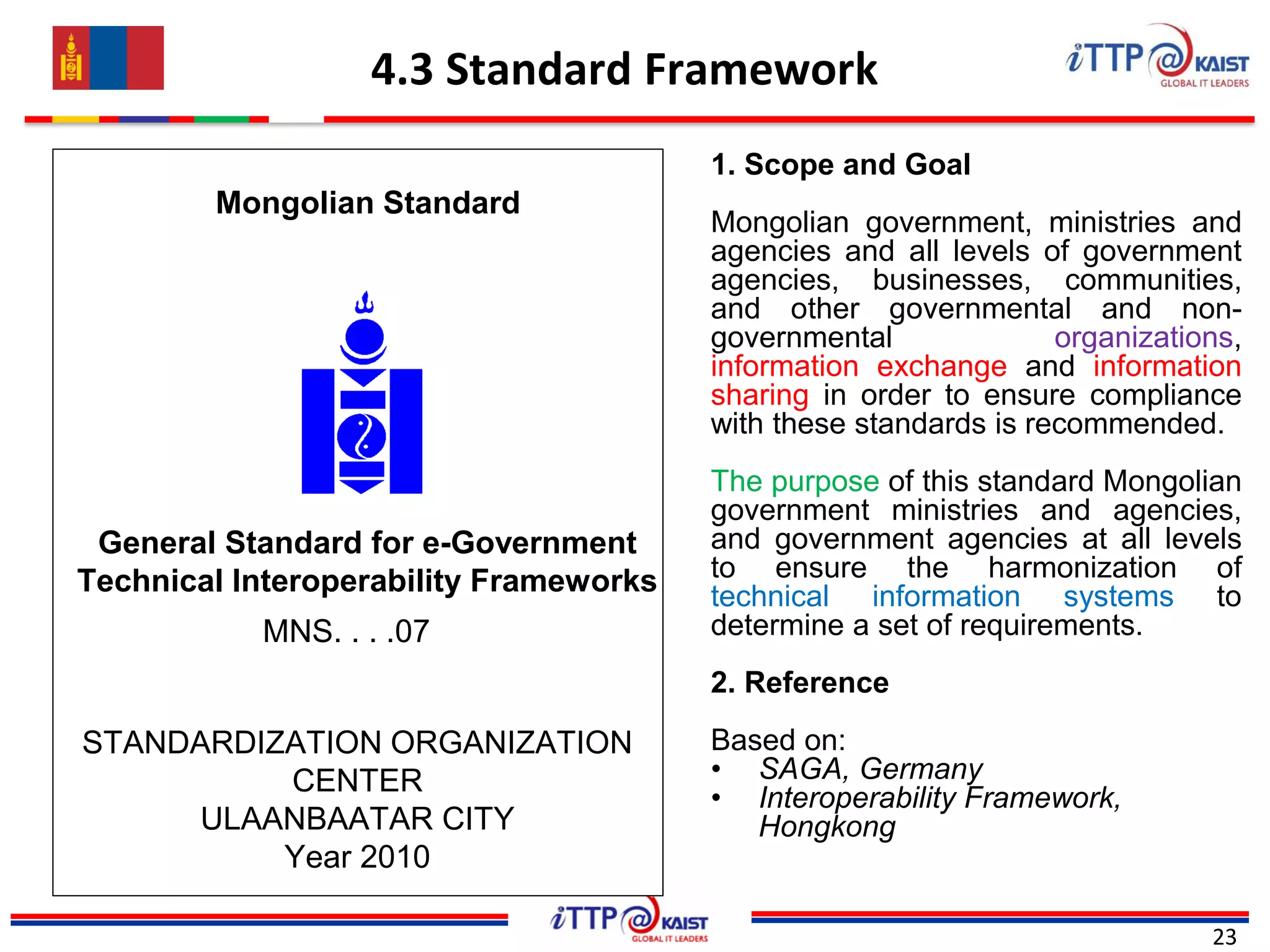
4.3 Standard Framework
23
1. Scope and Goal
Mongolian government, ministries and
agencies and all levels of government
agencies, businesses, communities,
and other governmental and non-
governmental organizations,
information exchange and information
sharing in order to ensure compliance
with these standards is recommended.
The purpose of this standard Mongolian
government ministries and agencies,
and government agencies at all levels
to ensure the harmonization of
technical information systems to
determine a set of requirements.
2. Reference
Based on:
• SAGA, Germany
• Interoperability Framework,
Hongkong
Mongolian Standard
General Standard for e-Government
Technical Interoperability Frameworks
MNS. . . .07
STANDARDIZATION ORGANIZATION
CENTER
ULAANBAATAR CITY
Year 2010
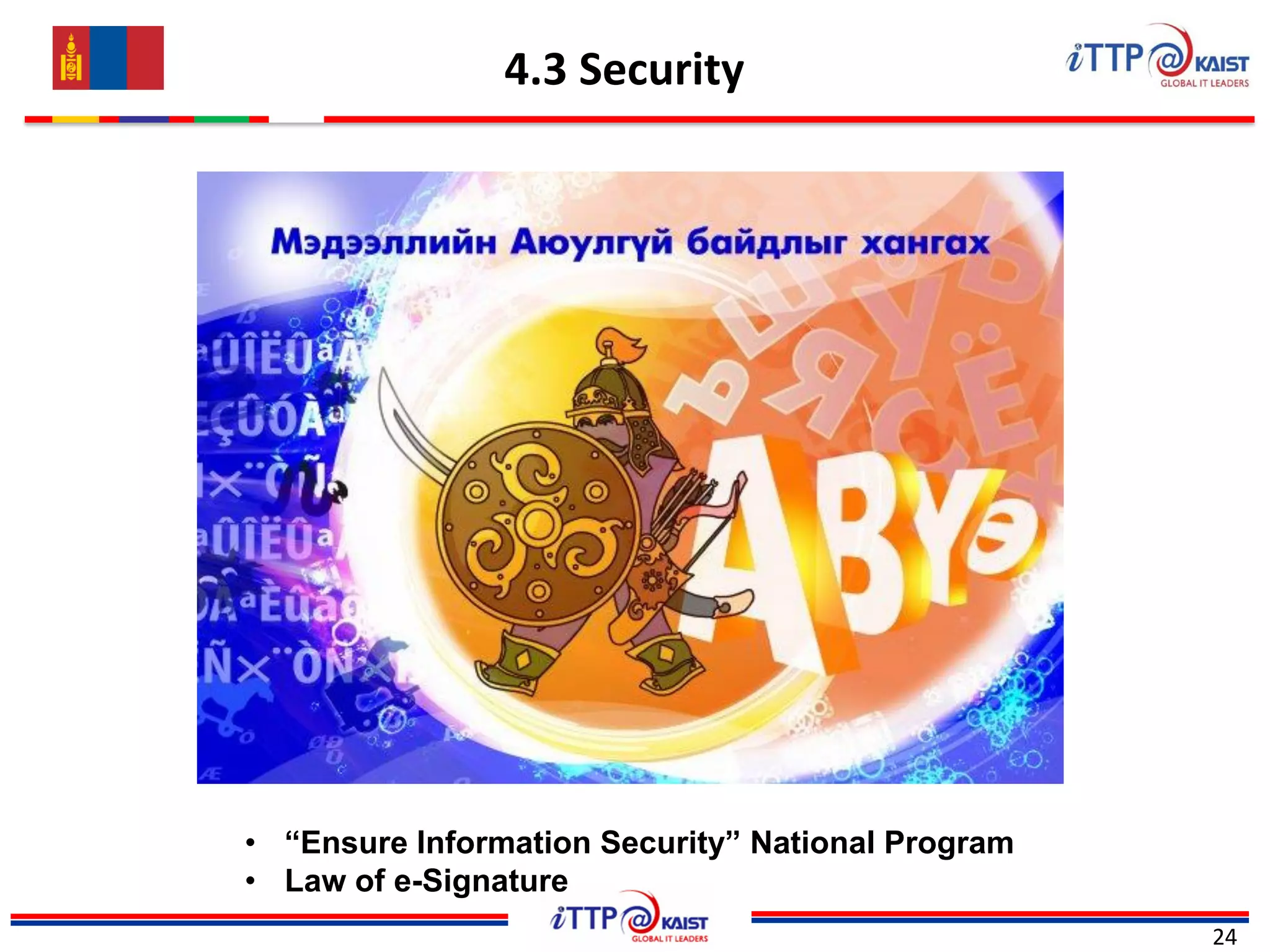
4.3 Security
24
• “Ensure Information Security” National Program
• Law of e-Signature
25
5. E-Government
Projects
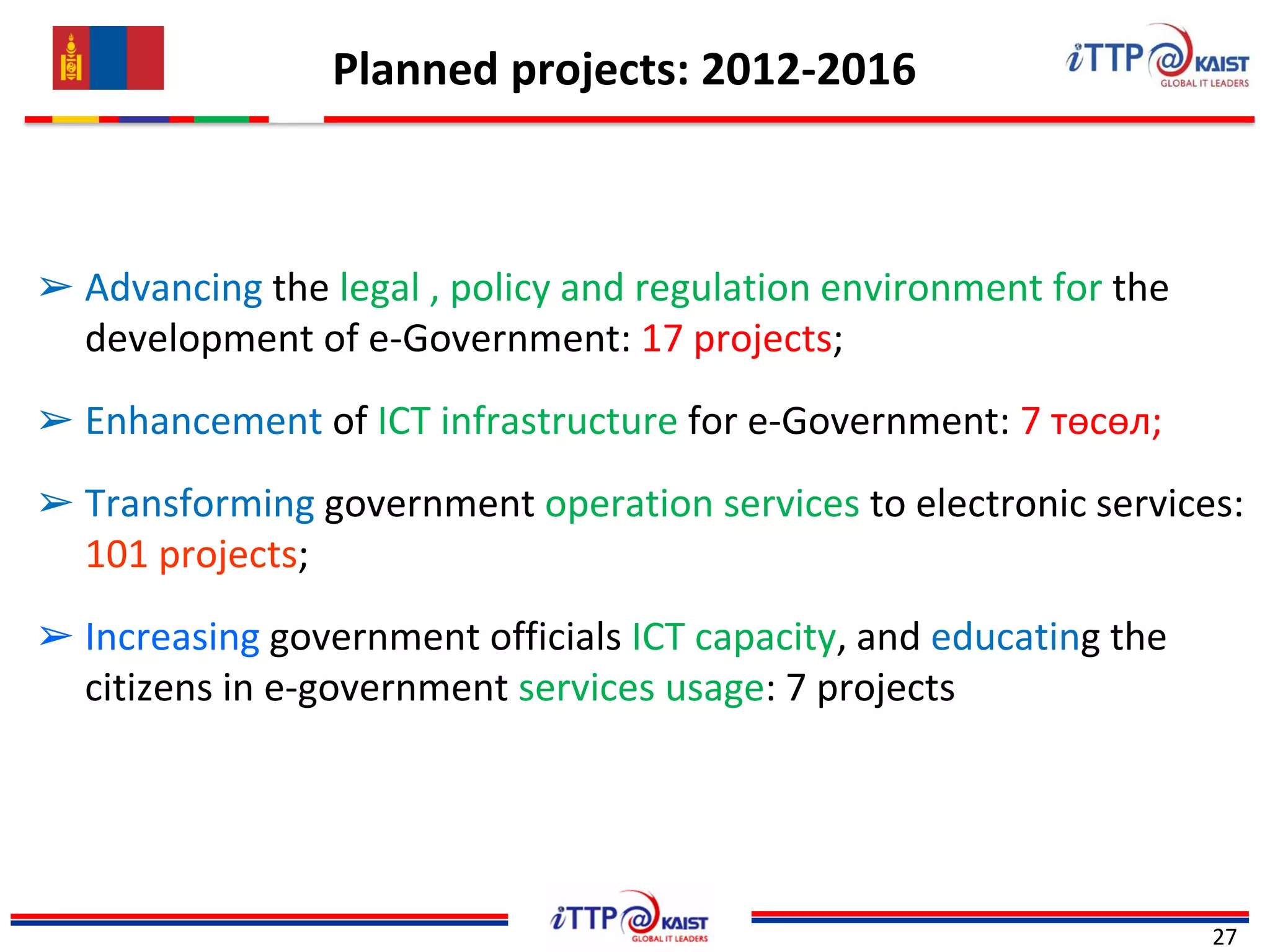
Planned projects: 2012-2016
27
➢ Advancing the legal , policy and regulation environment for the
development of e-Government: 17 projects;
➢ Enhancement of ICT infrastructure for e-Government: 7 төсөл;
➢ Transforming government operation services to electronic services:
101 projects;
➢ Increasing government officials ICT capacity, and educating the
citizens in e-government services usage: 7 projects
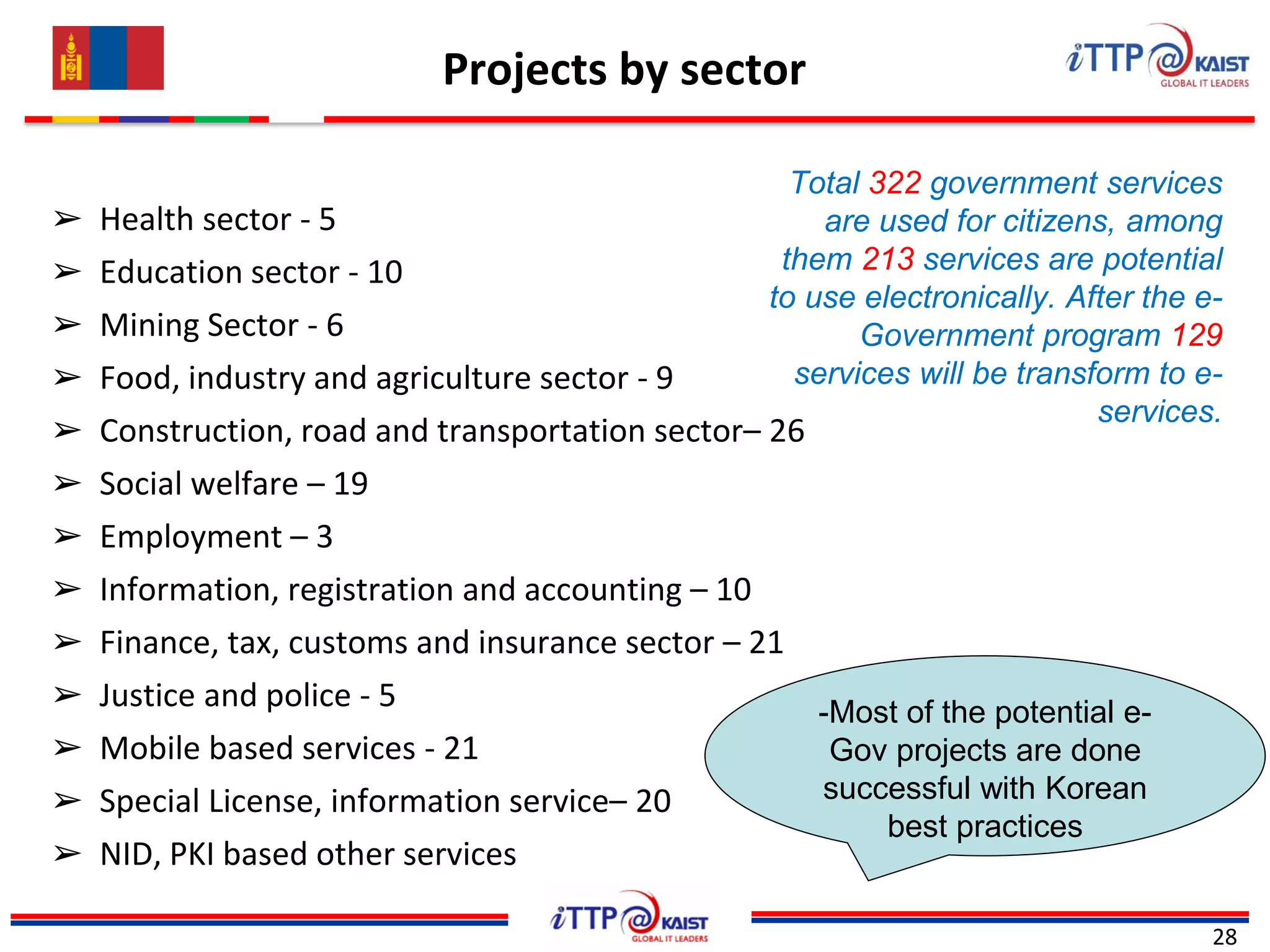
Projects by sector
28
➢ Health sector - 5
➢ Education sector - 10
➢ Mining Sector - 6
➢ Food, industry and agriculture sector - 9
➢ Construction, road and transportation sector– 26
➢ Social welfare – 19
➢ Employment – 3
➢ Information, registration and accounting – 10
➢ Finance, tax, customs and insurance sector – 21
➢ Justice and police - 5
➢ Mobile based services - 21
➢ Special License, information service– 20
➢ NID, PKI based other services
Total 322 government services
are used for citizens, among
them 213 services are potential
to use electronically. After the e-
Government program 129
services will be transform to e-
services.
-Most of the potential e-
Gov projects are done
successful with Korean
best practices
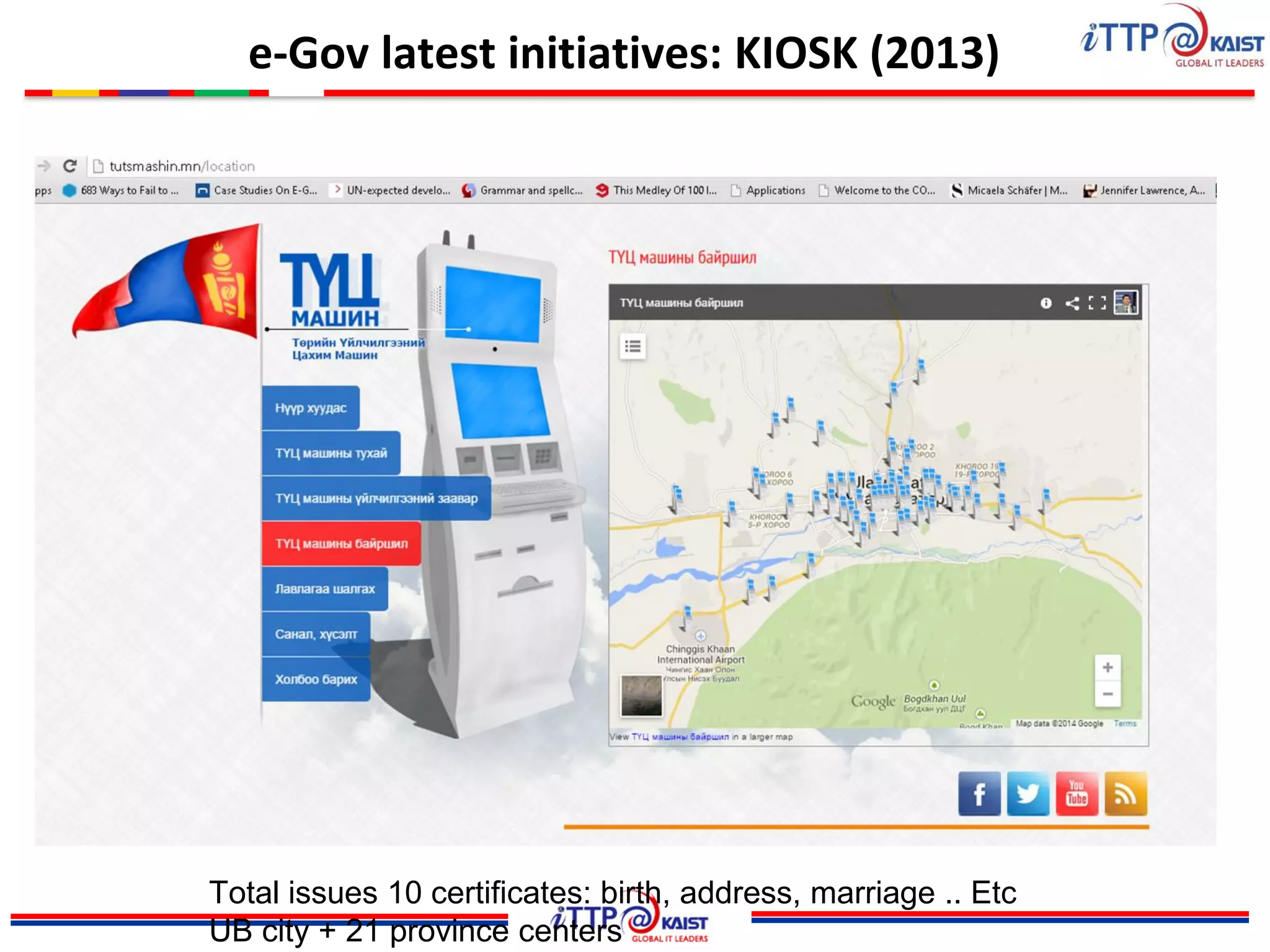
e-Gov latest initiatives: KIOSK (2013)
Total issues 10 certificates: birth, address, marriage .. Etc
UB city + 21 province centers
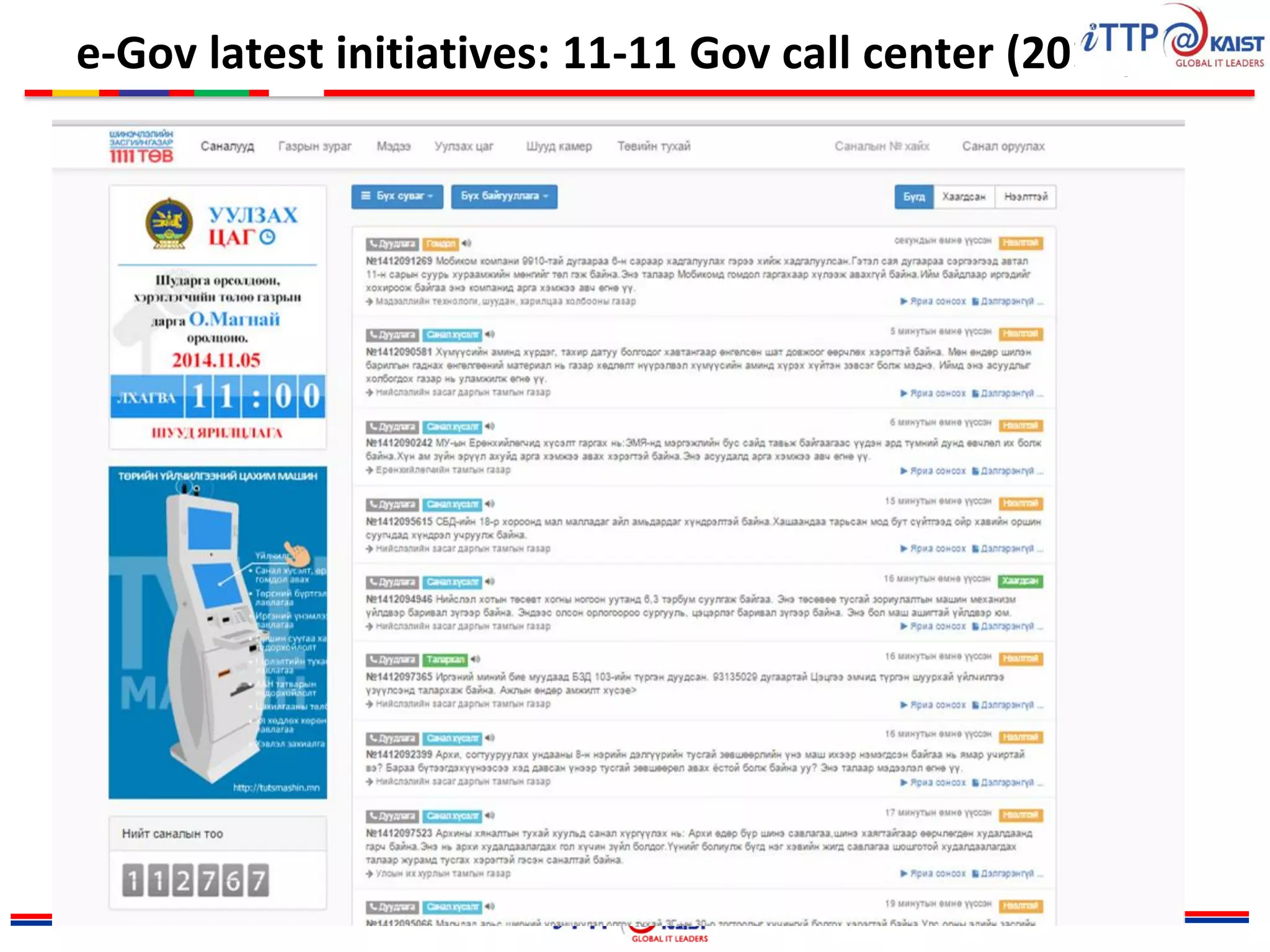
e-Gov latest initiatives: 11-11 Gov call center (2012)
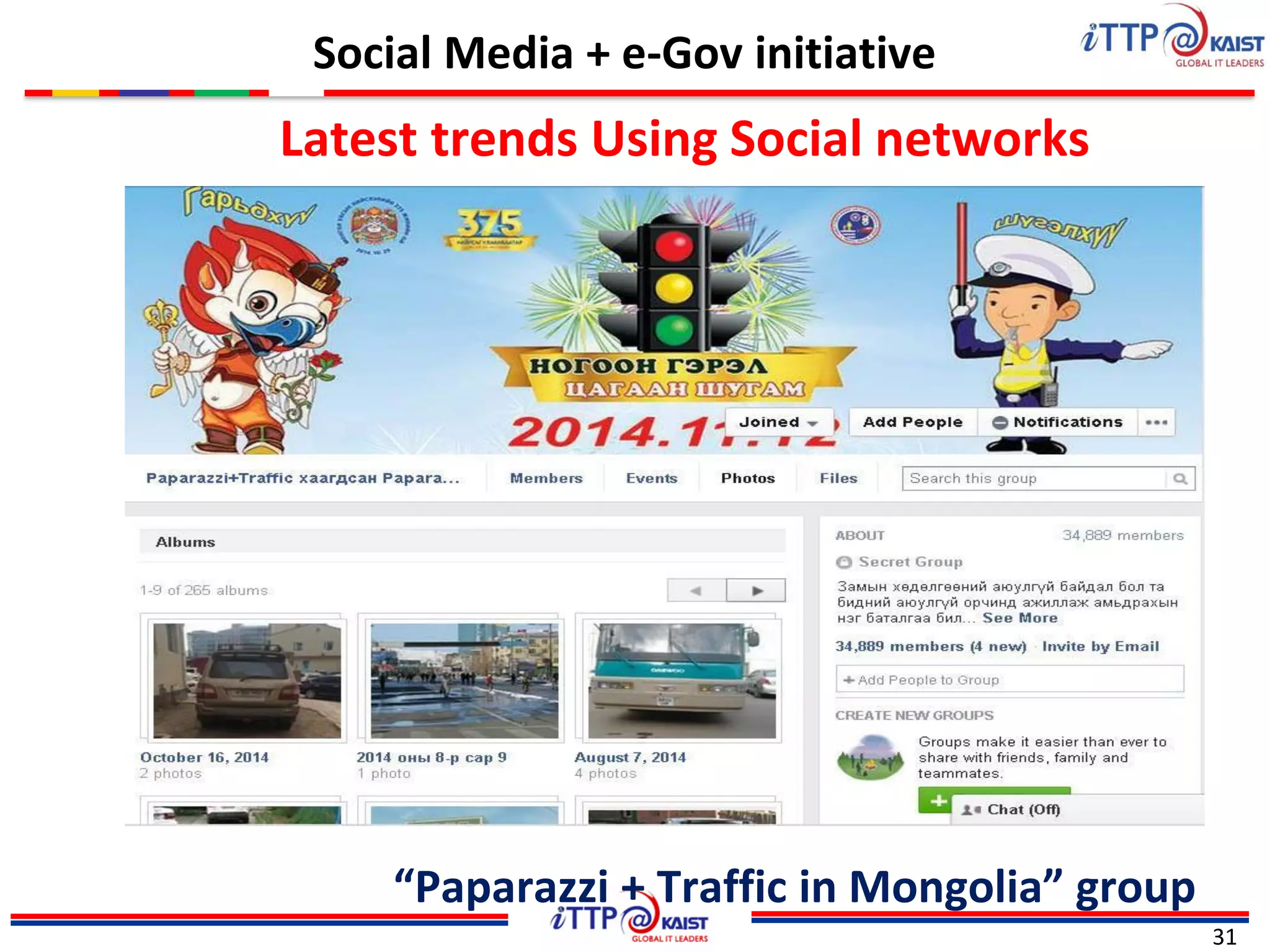
Social Media + e-Gov initiative
Latest trends Using Social networks
31
“Paparazzi + Traffic in Mongolia” group
32
6. E-Government
HR Development
Human Resource Development
33
➢ The number of employees working at ICT sector - 7320
➢ The number of universities, which prepares ICT specialists -
24
➢ The number of graduates, who majored in ICT, annual-1000
➢ NITP issued certificate of Asian engineering training to 836
ICT experts during 2006-2012
➢ NITP incubator prepares 2010–2011 total 240 smart device
application developers. Trainees total 423 educated in in
smart application expert training.
Public-Private partnership
34
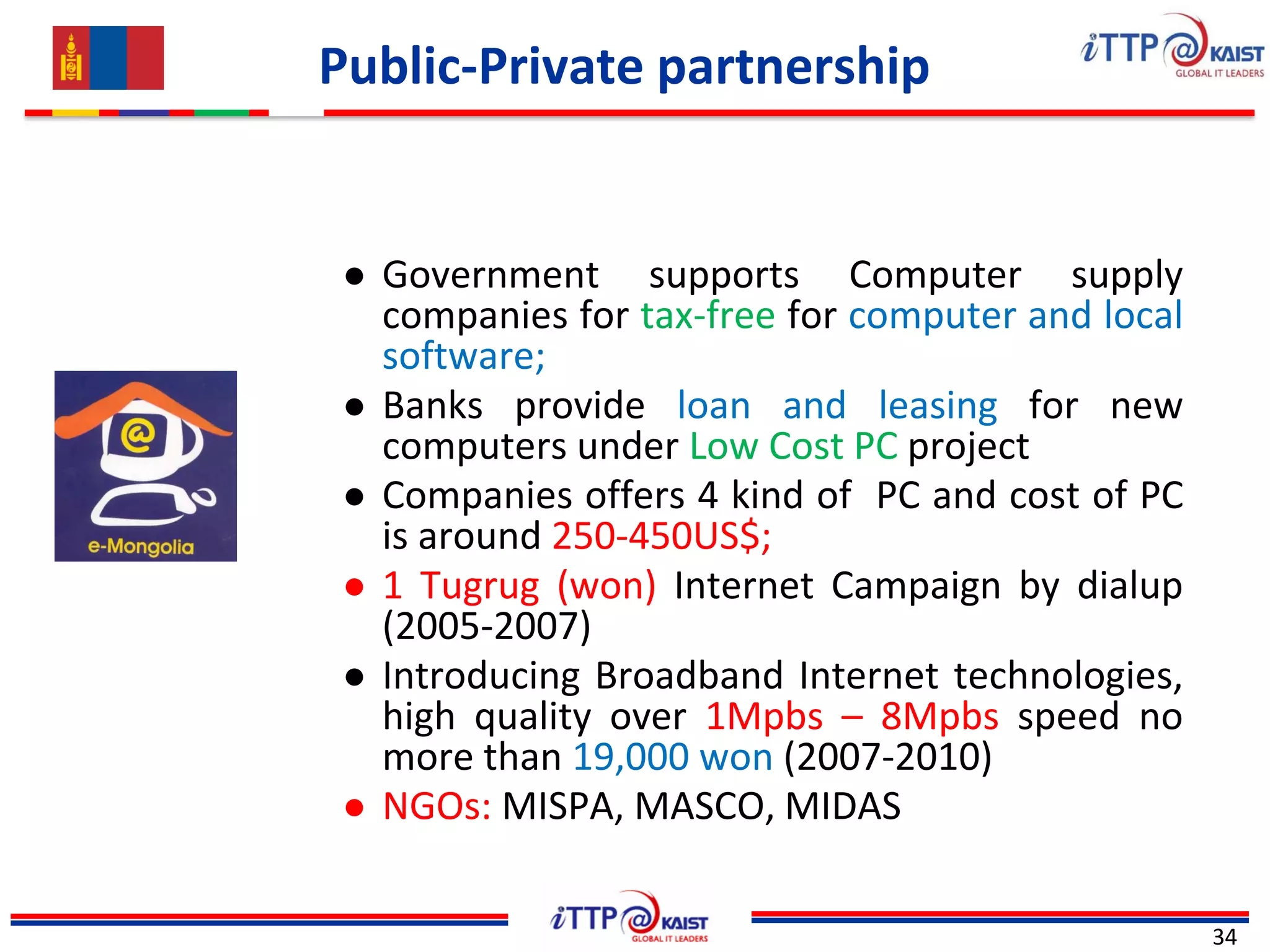
● Government supports Computer supply
companies for tax-free for computer and local
software;
● Banks provide loan and leasing for new
computers under Low Cost PC project
● Companies offers 4 kind of PC and cost of PC
is around 250-450US$;
● 1 Tugrug (won) Internet Campaign by dialup
(2005-2007)
● Introducing Broadband Internet technologies,
high quality over 1Mpbs – 8Mpbs speed no
more than 19,000 won (2007-2010)
● NGOs: MISPA, MASCO, MIDAS
Funding
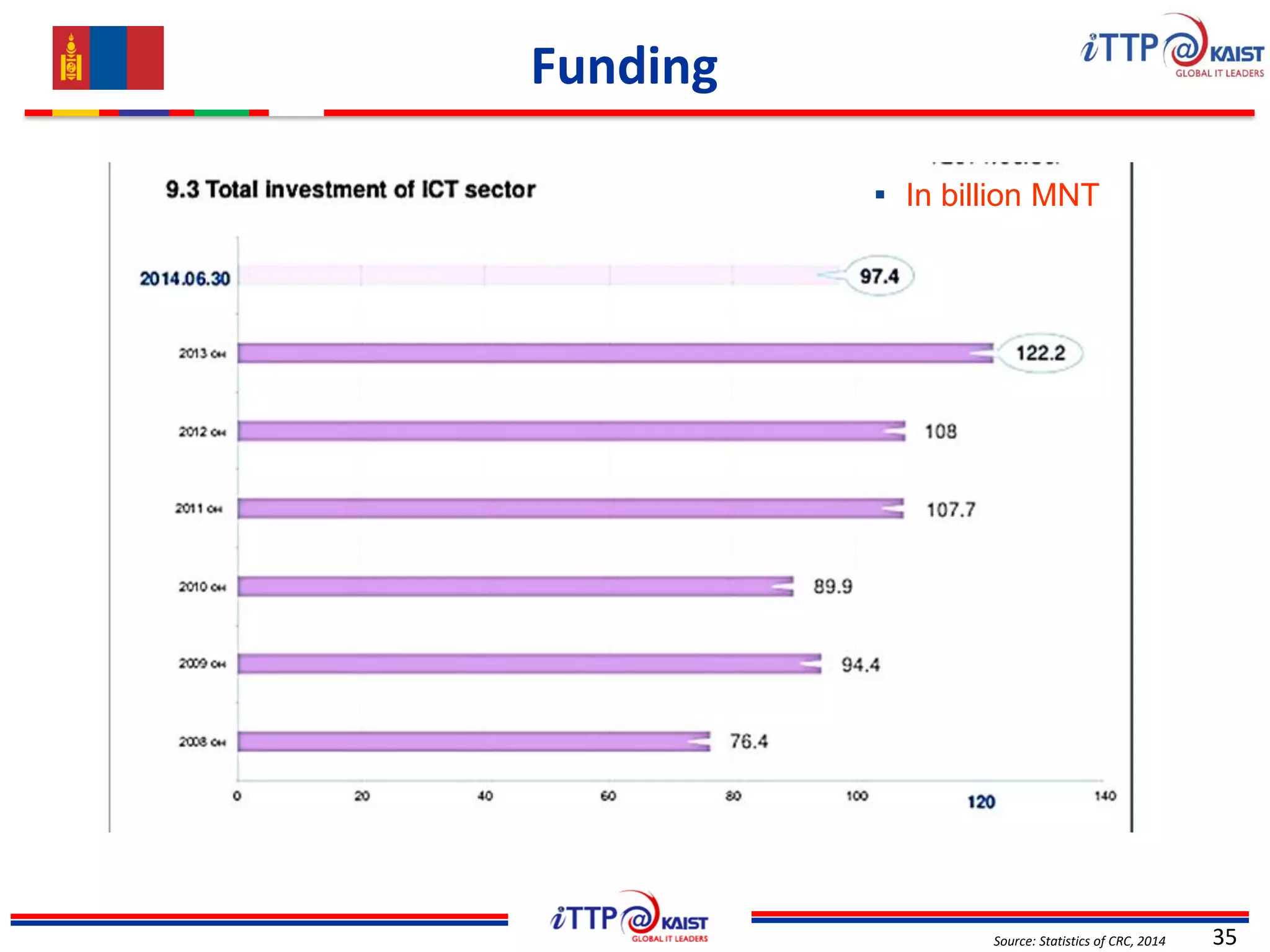
35Source: Statistics of CRC, 2014
▪ In billion MNT
Funding
36
1) National annual budget
2) Grant or soft loan
3) Universal Service Obligation Fund (USOF)
1)USOF is Legally created in 2001 / operational in 2007
2)USOF was able to fully take advantage of the practical experience gained working
with 2006 WB Pilot projects
3)USOF is composed from 2% levies of taxable revenues of communications
service providers
4)95% is generated from Telecommunications (by 2010)
5)Control of USOF transferred from CRC to the ICTPA in 2009
6)For 2007-2010, USOF disbursed about 85% of collections ($8m)
7)Expenditure of USOF
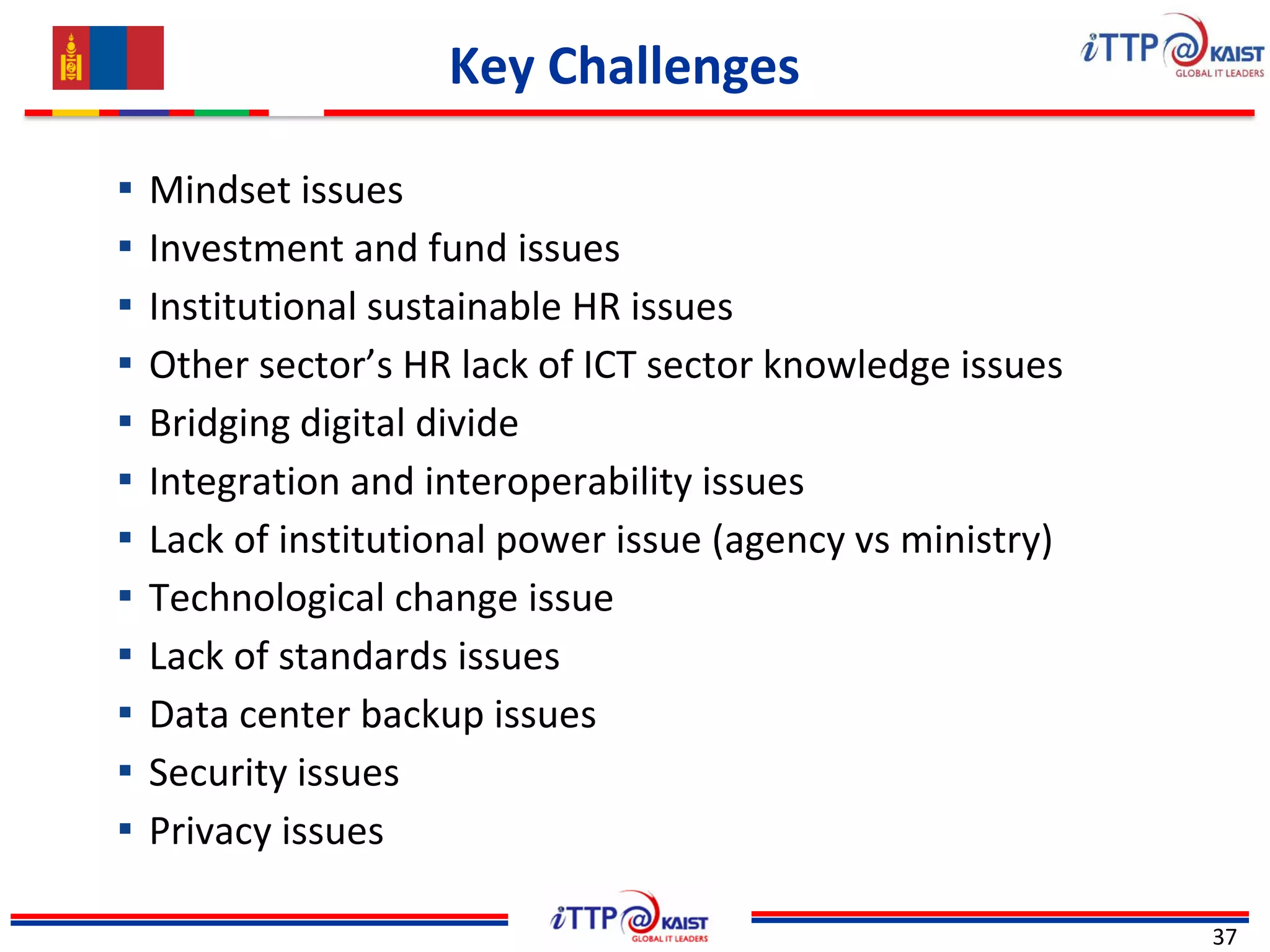
Key Challenges
37
▪ Mindset issues
▪ Investment and fund issues
▪ Institutional sustainable HR issues
▪ Other sector’s HR lack of ICT sector knowledge issues
▪ Bridging digital divide
▪ Integration and interoperability issues
▪ Lack of institutional power issue (agency vs ministry)
▪ Technological change issue
▪ Lack of standards issues
▪ Data center backup issues
▪ Security issues
▪ Privacy issues
38
7. Recommendations
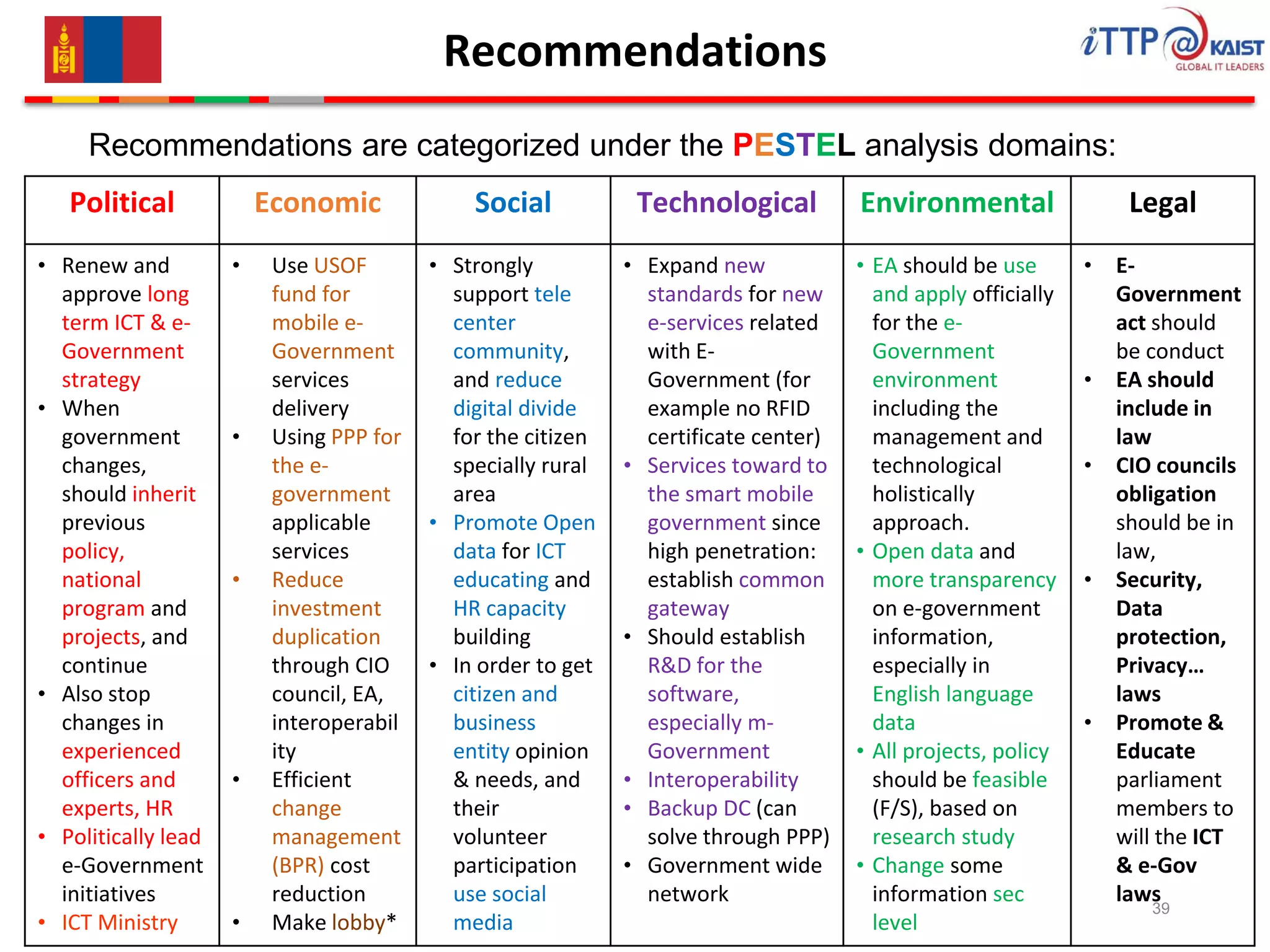
Recommendations
39
Political Economic Social Technological Environmental Legal
• Renew and
approve long
term ICT & e-
Government
strategy
• When
government
changes,
should inherit
previous
policy,
national
program and
projects, and
continue
• Also stop
changes in
experienced
officers and
experts, HR
• Politically lead
e-Government
initiatives
• ICT Ministry
• Use USOF
fund for
mobile e-
Government
services
delivery
• Using PPP for
the e-
government
applicable
services
• Reduce
investment
duplication
through CIO
council, EA,
interoperabil
ity
• Efficient
change
management
(BPR) cost
reduction
• Make lobby*
• Strongly
support tele
center
community,
and reduce
digital divide
for the citizen
specially rural
area
• Promote Open
data for ICT
educating and
HR capacity
building
• In order to get
citizen and
business
entity opinion
& needs, and
their
volunteer
participation
use social
media
• Expand new
standards for new
e-services related
with E-
Government (for
example no RFID
certificate center)
• Services toward to
the smart mobile
government since
high penetration:
establish common
gateway
• Should establish
R&D for the
software,
especially m-
Government
• Interoperability
• Backup DC (can
solve through PPP)
• Government wide
network
• EA should be use
and apply officially
for the e-
Government
environment
including the
management and
technological
holistically
approach.
• Open data and
more transparency
on e-government
information,
especially in
English language
data
• All projects, policy
should be feasible
(F/S), based on
research study
• Change some
information sec
level
• E-
Government
act should
be conduct
• EA should
include in
law
• CIO councils
obligation
should be in
law,
• Security,
Data
protection,
Privacy…
laws
• Promote &
Educate
parliament
members to
will the ICT
& e-Gov
laws
Recommendations are categorized under the PESTEL analysis domains:
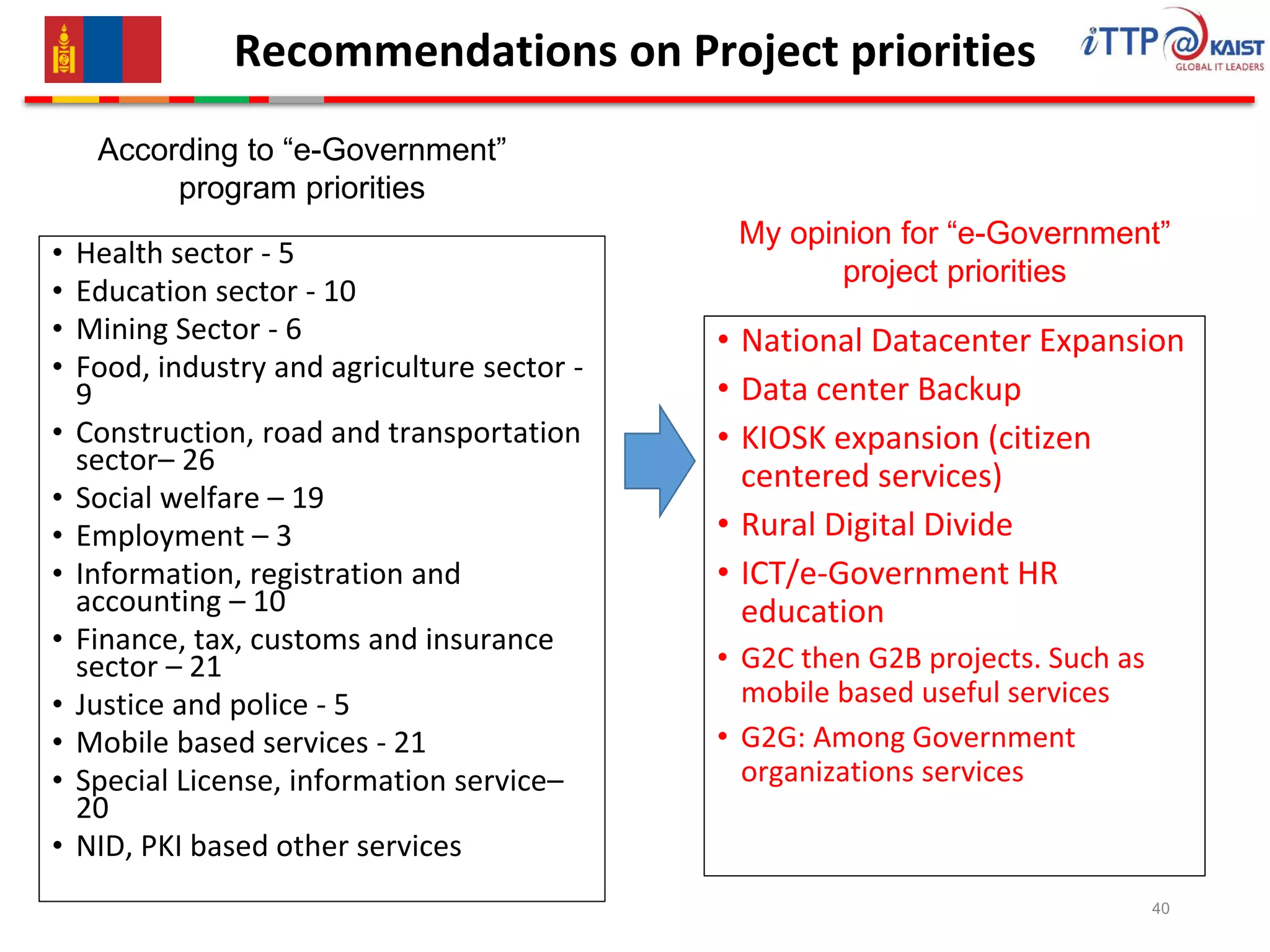
Recommendations on Project priorities
40
According to “e-Government”
program priorities
• Health sector - 5
• Education sector - 10
• Mining Sector - 6
• Food, industry and agriculture sector -
9
• Construction, road and transportation
sector– 26
• Social welfare – 19
• Employment – 3
• Information, registration and
accounting – 10
• Finance, tax, customs and insurance
sector – 21
• Justice and police - 5
• Mobile based services - 21
• Special License, information service–
20
• NID, PKI based other services
• National Datacenter Expansion
• Data center Backup
• KIOSK expansion (citizen
centered services)
• Rural Digital Divide
• ICT/e-Government HR
education
• G2C then G2B projects. Such as
mobile based useful services
• G2G: Among Government
organizations services
My opinion for “e-Government”
project priorities
41
8.Conclusion
42
Conclusion
• Based on the current study and situation of
Mongolian e-Government, and using my
own skill and knowledge recommendations
are implicated.
• Limitation of the study is dedicated for only
one country Mongolia, and importance of
the report is that it has covered wide view
parts of e-government, and made
recommendations for the government
officials.
9.References
• ICT White Paper of Mongolia, Year 2011, ITPTA.
• CRC Annual book-2012, Communication Regulatory Commission of Mongolia.
• ICT Korea - Mongolia History and Lessons Learned by Young Sik Kim, 2011
• United Nations E-Government Survey, 2012, UNPAN.
• ICTA , KOICA & SK, “Mongolian ICT Development e-Government Framework
Project Report”, 2006
• Mongolian ICT Development e-Government Framework Project report, by KOICA,
ICTA, and SK, 2006
• http://www.itpta.gov.mn /
• http://www.crc.gov.mn/
• http://unpan3.un.org/egovkb/
• http://www.ndc.gov.mn/
43
44
Q&A?
THANK YOU
감사합니다 БАЯРЛАЛАА
tumennast21@gmail.com

Mongolian e-Government Introduction by Tumennast KAIST ITTP 2014

  • 1.
    Towards SMART andSeamless e-Government Course offered by: KAIST Global ITTP Student: Erdenebold Tumennast Korea Advanced Institution of Science and Technology (ITTP) Dec 9 , 2014 E-Government Country Report of Mongolia
  • 2.
    Table of Contents 2 Introduction •Country Profile • History timeline • ICT market • Global ranking & rational political environment • E-Government National Program • E-Government National Strategy Conceptualization Methodolo • Conceptual Framework • Research Framework • ICT & Telecom Infrastructure • Datacenter • Standard Framework • Security • Data collection and analysis Conclusion Background E-Government policy E-Government organizational structure Challenges E-Government HR Development E-Government Projects E-Government Laws and Regulations E-Government Infrastructure Recommendations and Conclusion
  • 3.
  • 4.
    Country Profile Territory 1.56million sq.km Population 2.9 million Border Russia and China (Landlocked) GDP 8.5 billion USD GDP by sector (2013) Agriculture: 15.8% Mining and Industry: 32.6% IT Industry: 3% Services: 48.51% Literacy rate 98% City population 62.7 % Administration 21 province, 310 soum centers Natural resources: Coal, copper, gold, molybdenum, tungsten, phosphates, tin, nickel, zinc, wolfram, fluorspar, silver, iron, phosphate
  • 5.
  • 6.
    ICT market? Mongolian ICTsector market Total revenue of ICT sector (Bil. MNT) ICT sector investment (Bil. MNT) Composition of ICT sector revenues Internet access market share Source: White paper of development of information and communications technology of Mongolia – 2011
  • 7.
    Where is Mongoliaat global? ➢ UN e-Gov Survey 2012, 2014 E-Government Development in Eastern Asia E-Government development index Value 2012 2014 0.5443 0.5581 Source: United Nations E-Government Survey 2012, 2014 World e-Government development ranking 2012 2014 76 65 Indices and its components Index Value Online Service Index 0.6142 Telecommunication infrastructure index 0.2714 Human Capital index 0.7887 E-participation index 0.6863
  • 8.
    Political Leaders supporte-Gov? President of Mongolia initiative to shift to Smart Government Former Prime Minister of Mongolia introducing Smart Government plan at parliament New Prime Minister was former head of ICT agency o f Mongolia
  • 9.
  • 10.
    1. E-Government NationalProgram 2012-2016 10 To enhance governmental activities through usage of advancements of ICTs to ensure transparency and openness of governmental activities, to increase citizens’ participation in developing state policies, and to make governmental services accessible and free of hindrances. The Purpose The Objectives 1 Planned to implement over 100 projects and action plans between year 2012-2016 Enhance the legal and regulatory environment to develop e-government; Develop IT infrastructure; Electronize activities and services of governmental organizations, and enable open and accessible services to the citizens. Improve IT skills of civil servants, and enhance knowledge and skills of citizens to use e-services. 2 3
  • 11.
    Ground: All main HW& SW infrastructure, Human Capacity, ICT Literacy, Data Center. Root: All registration, Information, DB 1. e-Gov Strategy Conceptualization ➢ “Seamless Government Service” strategy up to 2016 Sun: Leadership of PM, Ministers,CIOs Air: Legal, Policy Environment Cloud/Rain: Investment, Funding Trunk: e-Gov EA, framework, integrated standards, Information Unified System /ITPTA/ Fruit: e-Gov service of G4C, G4B, G4G, C4G, B4G.. Bough of Tree: All Ministries & Agencies Source: White paper of ITPTA, 2013
  • 12.
  • 13.
    2. E-Government OrganizationStructure IT, Post and Telecommunications Authority Chairman Board of Directors Vice Chairman Reform Policy and Planning Departme nt Policy and Coordinat ion Departme nt Public Administr ation and Cooperati on departme nt Monitorin g and Evaluatio n Departme nt USO F Professio nal Council Communication Regulatory Commission National Information Technology Park Netcom National Data Center Prime Minister Ministries and Agencies Business Enterprisesin ICTsector CIO council NGO
  • 14.
    14 3. E-Government Lawsand Regulations
  • 15.
    3.E-Government Laws andRegulations 15 Source: NIA, 2013 Policy Frameworks Regulatory Frameworks ➢ ICT Vision up to 2021 (2012) ➢ e-Government National Program (2012) ➢ Information Security National Program (2012) ➢ Broadband National Program (2011) ➢ e-Government Master Plan (ICTA, 2006) ➢ e-Education, e-Health, e-Taxation etc national strategy ➢ Digital Radio TV broadcasting program (2010) ➢ Policy Guidelines (GSM 1800, Broadcasting of Digital TV, 3G, WLL etc.) ➢ Licensing (classifications, conditions, Issue, prolong and cancel licenses and radio frequency) ➢ Numbering ➢ Regulatory service fees ➢ Monitoring QOS ➢ Complains and disputes ➢ Methodologies for service tariff ➢ Determining and controlling dominants ➢ Access & interconnection ➢ E-Government Interoperability framework Privatization & Restructuring ➢ Separated Service from Network (1995) ➢ GOM sold a 40% share of Service Company (MTC) to Korea Telecom Legal Framework ➢ Law on Communications (1995, 2001, 2008) ➢ Law of Radio Wave (1999, 2005) ➢ Law of e-Signature (2012) ➢ Other laws: License Law, Civil code, Anti- Monopoly Law, Customer Protection Law, Company and Entity Law, Fair Competition Law
  • 16.
  • 17.
    Source: Statistics ofCRC, 2012 4.1 Telecom Infrastructure ➢ MNOs with 3G, Name of Mobile Operators Mobicom (since 1996) Skytel (since 1999) Unitel (since 2005) G-Mobile (since 2006) Mobile technologies GSM (1996) HSDPA (2010) CDMA 2000 1x (2001) HSPA+ (2011) GSM (2005) HSDPA (2010) 21 Mbp/s CDMA2000 1x/EVDO (2008) WCDMA HSDPA + (2012) 42Mbp/s Site coverage All 21 Province centers and 370 rural and remote soums - villages All 21 Province centers and 300 rural and remote soums - villages All 21 Province centers and 210 rural and remote soums - villages All 21 Province centers and 265 rural and remote soums - villages
  • 18.
    Source: Statistics ofCRC, 2014 4.1 Mobile Access Information ~150%
  • 19.
    Fiber Optical Backbone Cable: 33,364km ➢Netcom ➢Mobicom LLC ➢Skynetworks LLC ➢UB Railway ➢Gemnet LLC Source: Statistics of CRC, 2014 ➢ Mongolian ICT backbone network 4.1.1 Backbone description
  • 20.
    Source: Statistics ofCRC, 2014 4.1.2 Fixed Access Information
  • 21.
    MNDC operation andservices 21 2 4.2 Mongolian National Data Center (MNDC) • Square: 6,500.00㎡ • Building size: 1,307.04 ㎡ • Building: 2 floors, 56 parking space 1st floor: Server room, Monitoring room, Electric room etc 2nd floor: Office rooms, Training rooms, Conference room, etc GIDC Project • Grant by KOICA, contractor KT, • TIER-3
  • 22.
    4.2 MNDC operationand services 22 DEVELOP NEW WEB SITE SERVICE FILE BACKUP SERVICE TRAINING ISSUE GOV.MN DOMAIN NAME SERVICE WEB SITES, E-MAIL SERVER HOSTING SERVER HOSTING SERVICE SERVER AND RACK HOSTING SERVICE ❖ 250 Government Organizations using total 480 gov.mn domain names. ❖ Cooperation with contract G4G: 250, and G4B: 152 organizations. Information Security Auditing
  • 23.
    4.3 Standard Framework 23 1.Scope and Goal Mongolian government, ministries and agencies and all levels of government agencies, businesses, communities, and other governmental and non- governmental organizations, information exchange and information sharing in order to ensure compliance with these standards is recommended. The purpose of this standard Mongolian government ministries and agencies, and government agencies at all levels to ensure the harmonization of technical information systems to determine a set of requirements. 2. Reference Based on: • SAGA, Germany • Interoperability Framework, Hongkong Mongolian Standard General Standard for e-Government Technical Interoperability Frameworks MNS. . . .07 STANDARDIZATION ORGANIZATION CENTER ULAANBAATAR CITY Year 2010
  • 24.
    4.3 Security 24 • “EnsureInformation Security” National Program • Law of e-Signature
  • 25.
  • 27.
    Planned projects: 2012-2016 27 ➢Advancing the legal , policy and regulation environment for the development of e-Government: 17 projects; ➢ Enhancement of ICT infrastructure for e-Government: 7 төсөл; ➢ Transforming government operation services to electronic services: 101 projects; ➢ Increasing government officials ICT capacity, and educating the citizens in e-government services usage: 7 projects
  • 28.
    Projects by sector 28 ➢Health sector - 5 ➢ Education sector - 10 ➢ Mining Sector - 6 ➢ Food, industry and agriculture sector - 9 ➢ Construction, road and transportation sector– 26 ➢ Social welfare – 19 ➢ Employment – 3 ➢ Information, registration and accounting – 10 ➢ Finance, tax, customs and insurance sector – 21 ➢ Justice and police - 5 ➢ Mobile based services - 21 ➢ Special License, information service– 20 ➢ NID, PKI based other services Total 322 government services are used for citizens, among them 213 services are potential to use electronically. After the e- Government program 129 services will be transform to e- services. -Most of the potential e- Gov projects are done successful with Korean best practices
  • 29.
    e-Gov latest initiatives:KIOSK (2013) Total issues 10 certificates: birth, address, marriage .. Etc UB city + 21 province centers
  • 30.
    e-Gov latest initiatives:11-11 Gov call center (2012)
  • 31.
    Social Media +e-Gov initiative Latest trends Using Social networks 31 “Paparazzi + Traffic in Mongolia” group
  • 32.
  • 33.
    Human Resource Development 33 ➢The number of employees working at ICT sector - 7320 ➢ The number of universities, which prepares ICT specialists - 24 ➢ The number of graduates, who majored in ICT, annual-1000 ➢ NITP issued certificate of Asian engineering training to 836 ICT experts during 2006-2012 ➢ NITP incubator prepares 2010–2011 total 240 smart device application developers. Trainees total 423 educated in in smart application expert training.
  • 34.
    Public-Private partnership 34 ● Governmentsupports Computer supply companies for tax-free for computer and local software; ● Banks provide loan and leasing for new computers under Low Cost PC project ● Companies offers 4 kind of PC and cost of PC is around 250-450US$; ● 1 Tugrug (won) Internet Campaign by dialup (2005-2007) ● Introducing Broadband Internet technologies, high quality over 1Mpbs – 8Mpbs speed no more than 19,000 won (2007-2010) ● NGOs: MISPA, MASCO, MIDAS
  • 35.
    Funding 35Source: Statistics ofCRC, 2014 ▪ In billion MNT
  • 36.
    Funding 36 1) National annualbudget 2) Grant or soft loan 3) Universal Service Obligation Fund (USOF) 1)USOF is Legally created in 2001 / operational in 2007 2)USOF was able to fully take advantage of the practical experience gained working with 2006 WB Pilot projects 3)USOF is composed from 2% levies of taxable revenues of communications service providers 4)95% is generated from Telecommunications (by 2010) 5)Control of USOF transferred from CRC to the ICTPA in 2009 6)For 2007-2010, USOF disbursed about 85% of collections ($8m) 7)Expenditure of USOF
  • 37.
    Key Challenges 37 ▪ Mindsetissues ▪ Investment and fund issues ▪ Institutional sustainable HR issues ▪ Other sector’s HR lack of ICT sector knowledge issues ▪ Bridging digital divide ▪ Integration and interoperability issues ▪ Lack of institutional power issue (agency vs ministry) ▪ Technological change issue ▪ Lack of standards issues ▪ Data center backup issues ▪ Security issues ▪ Privacy issues
  • 38.
  • 39.
    Recommendations 39 Political Economic SocialTechnological Environmental Legal • Renew and approve long term ICT & e- Government strategy • When government changes, should inherit previous policy, national program and projects, and continue • Also stop changes in experienced officers and experts, HR • Politically lead e-Government initiatives • ICT Ministry • Use USOF fund for mobile e- Government services delivery • Using PPP for the e- government applicable services • Reduce investment duplication through CIO council, EA, interoperabil ity • Efficient change management (BPR) cost reduction • Make lobby* • Strongly support tele center community, and reduce digital divide for the citizen specially rural area • Promote Open data for ICT educating and HR capacity building • In order to get citizen and business entity opinion & needs, and their volunteer participation use social media • Expand new standards for new e-services related with E- Government (for example no RFID certificate center) • Services toward to the smart mobile government since high penetration: establish common gateway • Should establish R&D for the software, especially m- Government • Interoperability • Backup DC (can solve through PPP) • Government wide network • EA should be use and apply officially for the e- Government environment including the management and technological holistically approach. • Open data and more transparency on e-government information, especially in English language data • All projects, policy should be feasible (F/S), based on research study • Change some information sec level • E- Government act should be conduct • EA should include in law • CIO councils obligation should be in law, • Security, Data protection, Privacy… laws • Promote & Educate parliament members to will the ICT & e-Gov laws Recommendations are categorized under the PESTEL analysis domains:
  • 40.
    Recommendations on Projectpriorities 40 According to “e-Government” program priorities • Health sector - 5 • Education sector - 10 • Mining Sector - 6 • Food, industry and agriculture sector - 9 • Construction, road and transportation sector– 26 • Social welfare – 19 • Employment – 3 • Information, registration and accounting – 10 • Finance, tax, customs and insurance sector – 21 • Justice and police - 5 • Mobile based services - 21 • Special License, information service– 20 • NID, PKI based other services • National Datacenter Expansion • Data center Backup • KIOSK expansion (citizen centered services) • Rural Digital Divide • ICT/e-Government HR education • G2C then G2B projects. Such as mobile based useful services • G2G: Among Government organizations services My opinion for “e-Government” project priorities
  • 41.
  • 42.
    42 Conclusion • Based onthe current study and situation of Mongolian e-Government, and using my own skill and knowledge recommendations are implicated. • Limitation of the study is dedicated for only one country Mongolia, and importance of the report is that it has covered wide view parts of e-government, and made recommendations for the government officials.
  • 43.
    9.References • ICT WhitePaper of Mongolia, Year 2011, ITPTA. • CRC Annual book-2012, Communication Regulatory Commission of Mongolia. • ICT Korea - Mongolia History and Lessons Learned by Young Sik Kim, 2011 • United Nations E-Government Survey, 2012, UNPAN. • ICTA , KOICA & SK, “Mongolian ICT Development e-Government Framework Project Report”, 2006 • Mongolian ICT Development e-Government Framework Project report, by KOICA, ICTA, and SK, 2006 • http://www.itpta.gov.mn / • http://www.crc.gov.mn/ • http://unpan3.un.org/egovkb/ • http://www.ndc.gov.mn/ 43
  • 44.