1
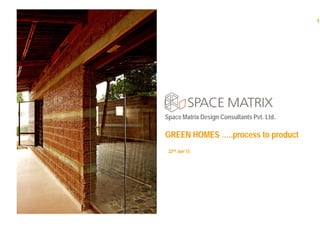
GREEN HOMES …..process to product
Space Matrix Design Consultants Pvt. Ltd.
22nd Jun’13
2
Sustainable living
is a philosophy of modern living based on economy,
technology, environmental preservation and social values without
sacrificing comfort
Source: Soontorn Boonyatikarn et. Al, Bangkok
3Man as a Sustainable being
Hot - Humid
Hot - Dry
4
What is SustainableWhat is Sustainable Architecture ?Architecture ?
• Site analysis and development
• Climatological design
• Building form and Orientation
• Passive heating and cooling
• Ventilation and indoor air quality
• Building materials
• Embodied energy
• Thermal performance
• Water management
• Waste management
• Energy management
Sustainable architecture is building design that accounts for all aspects of the building
that will affect and be affected by the environment. It looks at a holistic design approach
based on the following factors:
5
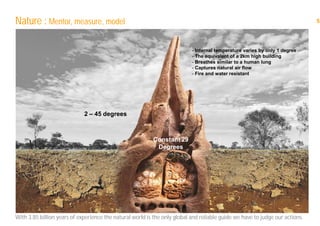
With 3.85 billion years of experience the natural world is the only global and reliable guide we have to judge our actions.
Constant 29
Degrees
2 – 45 degrees
- Internal temperature varies by only 1 degree
- The equivalent of a 2km high building
- Breathes similar to a human lung
- Captures natural air flow
- Fire and water resistant
Nature : Mentor, measure, model
6
6
Green Features for Homes
Process…
7
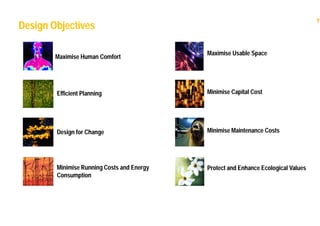
Maximise Human Comfort
Efficient Planning
Design for Change
Minimise Running Costs and Energy
Consumption
Maximise Usable Space
Minimise Capital Cost
Minimise Maintenance Costs
Protect and Enhance Ecological Values
Design Objectives
8
Master Planning
Secured by Design
Landscape & ecology
Community involvement
Micro-climate
Living Streets
(e.g..Shared surfacing)
Movement & Permeability
Adaptability &
Flexibility
Resource management
[Energy, water ]
Place making
Waste management
9
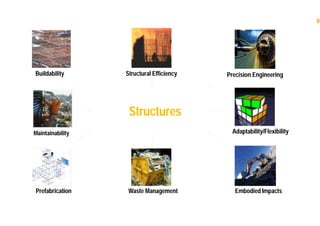
Structures
Buildability Structural Efficiency
Embodied Impacts
Maintainability
Prefabrication
Adaptability/Flexibility
Precision Engineering
Waste Management
10
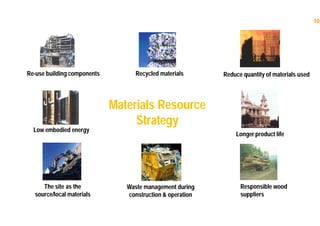
Materials Resource
Strategy
Re-use building components Recycled materials
Responsible wood
suppliers
Low embodied energy
The site as the
source/local materials
Longer product life
Reduce quantity of materials used
Waste management during
construction & operation
11
11
Green Features for Homes
Process…
12
12
Site Efficiency
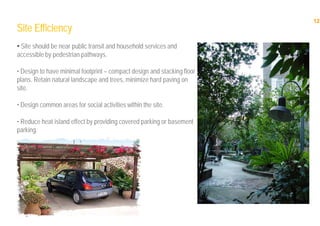
• Site should be near public transit and household services and
accessible by pedestrian pathways.
• Design to have minimal footprint – compact design and stacking floor
plans. Retain natural landscape and trees, minimize hard paving on
site.
• Design common areas for social activities within the site.
• Reduce heat island effect by providing covered parking or basement
parking.
13
13
Water Efficiency
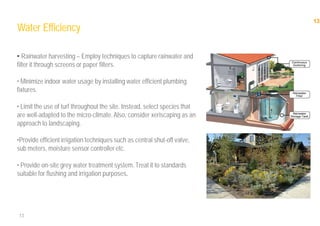
• Rainwater harvesting – Employ techniques to capture rainwater and
filter it through screens or paper filters.
• Minimize indoor water usage by installing water efficient plumbing
fixtures.
• Limit the use of turf throughout the site. Instead, select species that
are well-adapted to the micro-climate.Also, consider xeriscaping as an
approach to landscaping.
•Provide efficient irrigation techniques such as central shut-off valve,
sub meters, moisture sensor controller etc.
• Provide on-site grey water treatment system. Treat it to standards
suitable for flushing and irrigation purposes.
14
14
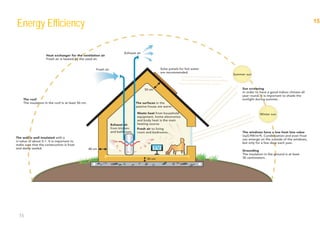
Energy Efficiency
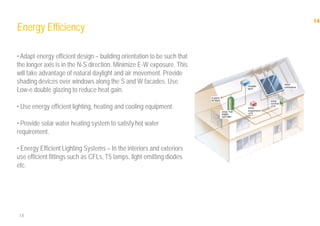
• Adapt energy efficient design – building orientation to be such that
the longer axis is in the N-S direction. Minimize E-W exposure. This
will take advantage of natural daylight and air movement. Provide
shading devices over windows along the S and W facades. Use
Low-e double glazing to reduce heat gain.
• Use energy efficient lighting, heating and cooling equipment.
• Provide solar water heating system to satisfy hot water
requirement.
• Energy Efficient Lighting Systems – In the interiors and exteriors
use efficient fittings such as CFLs, T5 lamps, light emitting diodes
etc.
15
15
Energy Efficiency
16
16
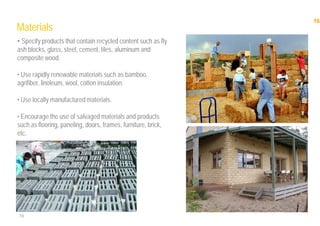
Materials
• Specify products that contain recycled content such as fly
ash blocks, glass, steel, cement, tiles, aluminum and
composite wood.
• Use rapidly renewable materials such as bamboo,
agrifiber, linoleum, wool, cotton insulation.
• Use locally manufactured materials.
• Encourage the use of salvaged materials and products
such as flooring, paneling, doors, frames, furniture, brick,
etc.
17
17
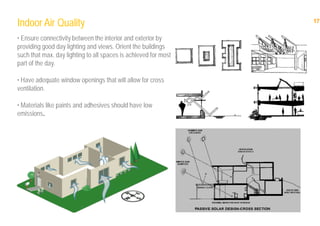
Indoor Air Quality
• Ensure connectivity between the interior and exterior by
providing good day lighting and views. Orient the buildings
such that max. day lighting to all spaces is achieved for most
part of the day.
• Have adequate window openings that will allow for cross
ventilation.
• Materials like paints and adhesives should have low
emissions.
18
18
Green Features for Homes
Product…
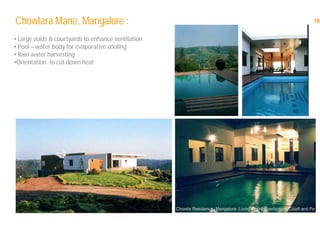
19Chowtara Mane, Mangalore :
• Large voids & courtyards to enhance ventilation
• Pool – water body for evaporative cooling
• Rain water harvesting
•Orientation to cut down heat
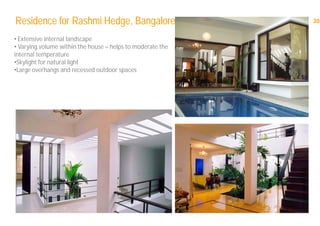
20Residence for Rashmi Hedge, Bangalore:
• Extensive internal landscape
• Varying volume within the house – helps to moderate the
internal temperature
•Skylight for natural light
•Large overhangs and recessed outdoor spaces
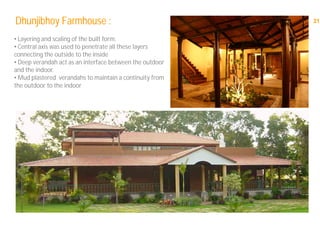
21Dhunjibhoy Farmhouse :
• Layering and scaling of the built form.
• Central axis was used to penetrate all these layers
connecting the outside to the inside
• Deep verandah act as an interface between the outdoor
and the indoor.
• Mud plastered verandahs to maintain a continuity from
the outdoor to the indoor
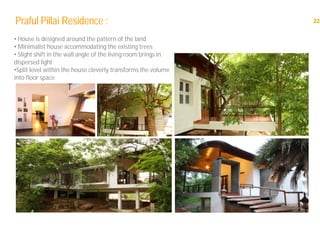
22Praful Pillai Residence :
• House is designed around the pattern of the land
• Minimalist house accommodating the existing trees
• Slight shift in the wall angle of the living room brings in
dispersed light
•Split level within the house cleverly transforms the volume
into floor space
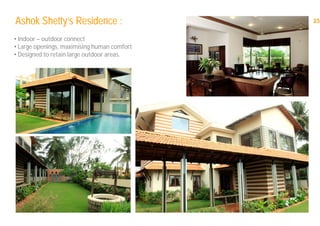
23Ashok Shetty’s Residence :
• Indoor – outdoor connect
• Large openings, maximising human comfort
• Designed to retain large outdoor areas.
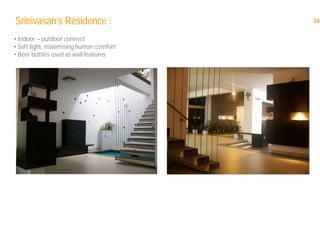
24Srinivasan’s Residence :
• Indoor – outdoor connect
• Soft light, maximising human comfort
• Beer bottles used as wall features
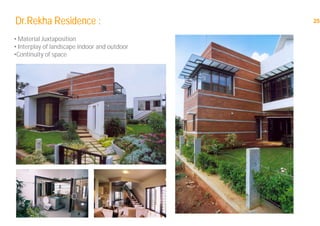
25Dr.Rekha Residence :
• Material Juxtaposition
• Interplay of landscape indoor and outdoor
•Continuity of space
26
Need based Appropriate Architecture
• To preserve heritage of our PAST
• Continuity with our past in our PRESENT
• Conserving energy for our FUTURE
27
“What good is a house,
if you haven't got a decent planet to put it on?”
- Henry David Thoreau

Anup naik green_homes

  • 1.
    1 GREEN HOMES …..processto product Space Matrix Design Consultants Pvt. Ltd. 22nd Jun’13
  • 2.
    2 Sustainable living is aphilosophy of modern living based on economy, technology, environmental preservation and social values without sacrificing comfort Source: Soontorn Boonyatikarn et. Al, Bangkok
  • 3.
    3Man as aSustainable being Hot - Humid Hot - Dry
  • 4.
    4 What is SustainableWhatis Sustainable Architecture ?Architecture ? • Site analysis and development • Climatological design • Building form and Orientation • Passive heating and cooling • Ventilation and indoor air quality • Building materials • Embodied energy • Thermal performance • Water management • Waste management • Energy management Sustainable architecture is building design that accounts for all aspects of the building that will affect and be affected by the environment. It looks at a holistic design approach based on the following factors:
  • 5.
    5 With 3.85 billionyears of experience the natural world is the only global and reliable guide we have to judge our actions. Constant 29 Degrees 2 – 45 degrees - Internal temperature varies by only 1 degree - The equivalent of a 2km high building - Breathes similar to a human lung - Captures natural air flow - Fire and water resistant Nature : Mentor, measure, model
  • 6.
    6 6 Green Features forHomes Process…
  • 7.
    7 Maximise Human Comfort EfficientPlanning Design for Change Minimise Running Costs and Energy Consumption Maximise Usable Space Minimise Capital Cost Minimise Maintenance Costs Protect and Enhance Ecological Values Design Objectives
  • 8.
    8 Master Planning Secured byDesign Landscape & ecology Community involvement Micro-climate Living Streets (e.g..Shared surfacing) Movement & Permeability Adaptability & Flexibility Resource management [Energy, water ] Place making Waste management
  • 9.
    9 Structures Buildability Structural Efficiency EmbodiedImpacts Maintainability Prefabrication Adaptability/Flexibility Precision Engineering Waste Management
  • 10.
    10 Materials Resource Strategy Re-use buildingcomponents Recycled materials Responsible wood suppliers Low embodied energy The site as the source/local materials Longer product life Reduce quantity of materials used Waste management during construction & operation
  • 11.
    11 11 Green Features forHomes Process…
  • 12.
    12 12 Site Efficiency • Siteshould be near public transit and household services and accessible by pedestrian pathways. • Design to have minimal footprint – compact design and stacking floor plans. Retain natural landscape and trees, minimize hard paving on site. • Design common areas for social activities within the site. • Reduce heat island effect by providing covered parking or basement parking.
  • 13.
    13 13 Water Efficiency • Rainwaterharvesting – Employ techniques to capture rainwater and filter it through screens or paper filters. • Minimize indoor water usage by installing water efficient plumbing fixtures. • Limit the use of turf throughout the site. Instead, select species that are well-adapted to the micro-climate.Also, consider xeriscaping as an approach to landscaping. •Provide efficient irrigation techniques such as central shut-off valve, sub meters, moisture sensor controller etc. • Provide on-site grey water treatment system. Treat it to standards suitable for flushing and irrigation purposes.
  • 14.
    14 14 Energy Efficiency • Adaptenergy efficient design – building orientation to be such that the longer axis is in the N-S direction. Minimize E-W exposure. This will take advantage of natural daylight and air movement. Provide shading devices over windows along the S and W facades. Use Low-e double glazing to reduce heat gain. • Use energy efficient lighting, heating and cooling equipment. • Provide solar water heating system to satisfy hot water requirement. • Energy Efficient Lighting Systems – In the interiors and exteriors use efficient fittings such as CFLs, T5 lamps, light emitting diodes etc.
  • 15.
  • 16.
    16 16 Materials • Specify productsthat contain recycled content such as fly ash blocks, glass, steel, cement, tiles, aluminum and composite wood. • Use rapidly renewable materials such as bamboo, agrifiber, linoleum, wool, cotton insulation. • Use locally manufactured materials. • Encourage the use of salvaged materials and products such as flooring, paneling, doors, frames, furniture, brick, etc.
  • 17.
    17 17 Indoor Air Quality •Ensure connectivity between the interior and exterior by providing good day lighting and views. Orient the buildings such that max. day lighting to all spaces is achieved for most part of the day. • Have adequate window openings that will allow for cross ventilation. • Materials like paints and adhesives should have low emissions.
  • 18.
    18 18 Green Features forHomes Product…
  • 19.
    19Chowtara Mane, Mangalore: • Large voids & courtyards to enhance ventilation • Pool – water body for evaporative cooling • Rain water harvesting •Orientation to cut down heat
  • 20.
    20Residence for RashmiHedge, Bangalore: • Extensive internal landscape • Varying volume within the house – helps to moderate the internal temperature •Skylight for natural light •Large overhangs and recessed outdoor spaces
  • 21.
    21Dhunjibhoy Farmhouse : •Layering and scaling of the built form. • Central axis was used to penetrate all these layers connecting the outside to the inside • Deep verandah act as an interface between the outdoor and the indoor. • Mud plastered verandahs to maintain a continuity from the outdoor to the indoor
  • 22.
    22Praful Pillai Residence: • House is designed around the pattern of the land • Minimalist house accommodating the existing trees • Slight shift in the wall angle of the living room brings in dispersed light •Split level within the house cleverly transforms the volume into floor space
  • 23.
    23Ashok Shetty’s Residence: • Indoor – outdoor connect • Large openings, maximising human comfort • Designed to retain large outdoor areas.
  • 24.
    24Srinivasan’s Residence : •Indoor – outdoor connect • Soft light, maximising human comfort • Beer bottles used as wall features
  • 25.
    25Dr.Rekha Residence : •Material Juxtaposition • Interplay of landscape indoor and outdoor •Continuity of space
  • 26.
    26 Need based AppropriateArchitecture • To preserve heritage of our PAST • Continuity with our past in our PRESENT • Conserving energy for our FUTURE
  • 27.
    27 “What good isa house, if you haven't got a decent planet to put it on?” - Henry David Thoreau