Schindler India ~ Case Study Prepared by  : Rajesh Srivastava Roll No. : 20 Batch : EPGDIM  (2010-12)
CONTENTS History of Schindler Characters in the case study Profile : Silvio Napoli Indian operations  Schindler India strategy: The swatch project The Indian entry project Indian Organisation Man mgmt: Developing the Relationship The India business plan The Indian Elevator Market Segmentation Competition Product strategy Outsourcing strategy Business challenges What went Wrong? Conclusion Current scenario
History of Schindler Robert Schindle established the company in 1874 in Switzerland Company began manufacturing elevators in 1889 Did not have a local market base in India until 1950s by appointing a local distributor Alfred N Schindler took over the company in 1987; becoming the 4 th  generation in line 1998 : Schindler increased revenue worth $ 6.6 billion around the world Company has over 38,000 employees in 97 subsidiaries
Characters in the Case Study Schindler Top Management Staff: Alfred N Schindler (Chairman & CEO) Luc Bonnard (Vice Chairman of the Board & Member of Executive Committee) Alfred Spoerri (Member of the Board of Directors & Executive Committee) Schindler India key Manager Profiles: Silvio Napoli (VP, Schindler South Asia) Meher Karan Singh (MD) T.A.K Mathews (VP-Field Operations) Ronnie Dante (GM- Engineering) Jujudhan Jena (CFO)
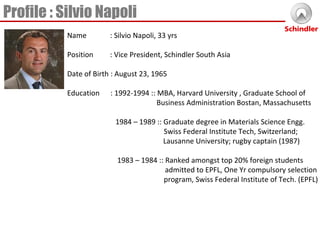
Name   : Silvio Napoli, 33 yrs Position   : Vice President, Schindler South Asia Date of Birth : August 23, 1965 Education  : 1992-1994 :: MBA, Harvard University , Graduate School of    Business Administration Bostan, Massachusetts   1984 – 1989 :: Graduate degree in Materials Science Engg.    Swiss Federal Institute Tech, Switzerland;  Lausanne University; rugby captain (1987)   1983 – 1984 :: Ranked amongst top 20% foreign students   admitted to EPFL, One Yr compulsory selection    program, Swiss Federal Institute of Tech. (EPFL)  Profile : Silvio Napoli
Napoli’s First Project in Schindler The project goal was to develop a standardized elevator at a lower cost than the existing, more customized product The outcome was the S001 an elevator that can’t be customized  Used many parts supplied from outside  Used newer process The entire supply chain was restructured  Cycle time was reduced to half of the standard 20- to 30- weeks
 
Schindler :: Indian operations  1925 – The First elevator by Schindler in India installed  1958 – Long Term Distribution Agreement with ECE (an Indian Organisation) 1985 – Termination of Distribution Agreement with ECE 1985 – Technical Collaboration with Mumbai based company Bharat Bijlee Ltd.  BBL was authorised to manufacture, market & sell Schindler products in Indian market    After acquiring 12% equity stake in BBL, Schindler became the No.2 player in Indian elevator market.    A decade later they maintained 10-15% share in market 1995 – Alfred  Schindler visited Indian market to review the market potential, he found there    was huge growth potential in Indian elevator market & found it was similar to China 1995 – To take management control in Indian market, Schindler proposed BBL a new JV, but    negotiation proved difficult & finally collapsed  1996 – Collaboration with BBL ended and Schindler began considering options to establish    own operations in India. 1998 – March ‘98, Silvio Napoli was sent to establish Schindler business in India
The Indian Entry Project Boston Consulting Group (BCG) was engaged by Schindler to look for alternative local partners as negotiations with BBL broke down in India It was now legally feasible to start up wholly owned company in India for a multinational A business plan for Schindler Market entry was approved by the Corporate Executive Committee (VRA) in October’95 Mr. Napoli was offered the job of creating the Indian subsidiary In November’95, Mr. Napoli came to India for the first time
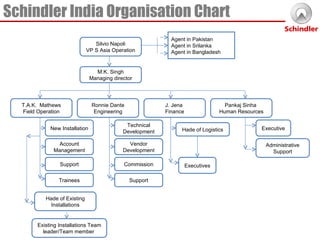
Schindler India Organisation Chart Silvio Napoli VP S Asia Operation Agent in Pakistan Agent in Srilanka Agent in Bangladesh M.K. Singh Managing director T.A.K.  Mathews Field Operation Ronnie Dante Engineering Pankaj Sinha  Human Resources J. Jena  Finance Executive Administrative Support Hade of Logistics Executives Technical Development Vendor Development Commission Support New Installation Account Management Support Trainees Existing Installations Team leader/Team member  Hade of Existing Installations
Man Mgmt.: Developing the Relationship There were initial clashes of timetable of the senior staff  as they were still not finished with their previous job Different management styles of the top executives also led to problems Silvio Napoli was regarded as a tough and aggressive manager by the staff members The scenario greatly differed from where Mr. Napoli came from and India The internal environment of the organization was informal according to the employees
The Indian Business Plan The plan had two basic elements : Sell a focused line of standard products Outsource key manufacturing and logistics functions The business had many opportunities coming up in India after the liberalization of Economy in 1990’s Construction industry was reviving  Rapid urbanization A ban on collapsible gate elevators was enforced by the Indian Standards Institute (ISI)
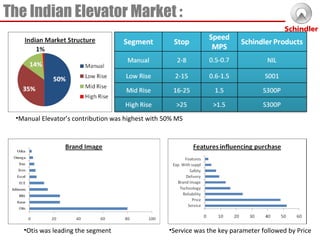
The Indian Elevator Market : Otis was leading the segment  Manual Elevator’s contribution was highest with 50% MS Service was the key parameter followed by Price
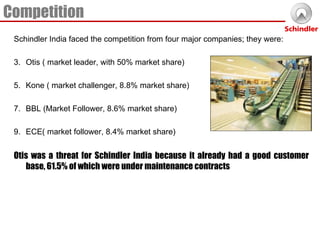
Competition Schindler India faced the competition from four major companies; they were: Otis ( market leader, with 50% market share) Kone ( market challenger, 8.8% market share) BBL (Market Follower, 8.6% market share) ECE( market follower, 8.4% market share) Otis was a threat for Schindler India because it already had a good customer base, 61.5% of which were under maintenance contracts
 
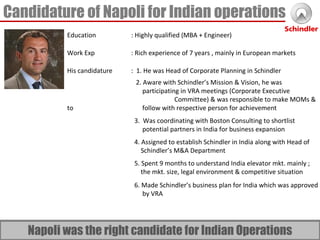
Education  : Highly qualified (MBA + Engineer)  Work Exp  : Rich experience of 7 years , mainly in European markets His candidature  :  1. He was Head of Corporate Planning in Schindler   2. Aware with Schindler’s Mission & Vision, he was    participating in VRA meetings (Corporate Executive      Committee) & was responsible to make MOMs & to    follow with respective person for achievement    3.  Was coordinating with Boston Consulting to shortlist  potential partners in India for business expansion   4. Assigned to establish Schindler in India along with Head of    Schindler’s M&A Department     5. Spent 9 months to understand India elevator mkt. mainly ;  the mkt. size, legal environment & competitive situation   6. Made Schindler’s business plan for India which was approved    by VRA Candidature of Napoli for Indian operations Napoli was the right candidate for Indian Operations
Business Challenges Sales force was bringing in orders, but not for the standard products The transfer cost of S001 has increased The import duties on elevators has also increased There was lack of motivation in the organization about the sales strategy Things were not going well
Outsourcing Strategy Silvio Napoli's business plan was to outsource the production of 90% of the components of S001 from local suppliers the safety equipment would be imported from Schindler plant in south-east Asia The basic on-site assembly work would also be outsourced Eventually they would install their own dedicated plant to manufacture the parts
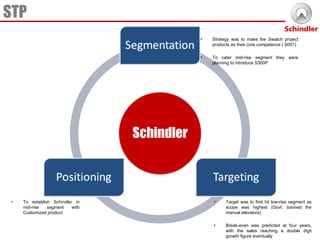
STP Strategy was to make the Swatch project products as their core competence ( S001) To cater mid-rise segment they were planning to introduce S300P Target was to first hit low-rise segment as scope was highest (Govt. banned the manual elevators) Break-even was predicted at four years, with the sales reaching a double digit growth figure eventually To establish Schindler in mid-rise segment with Customized product
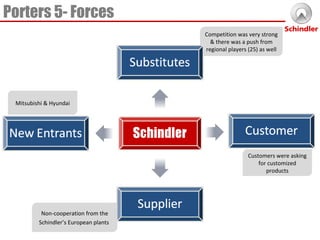
Non-cooperation from the Schindler’s European plants  Competition was very strong & there was a push from regional players (25) as well Porters 5- Forces Customers were asking for customized products Mitsubishi & Hyundai
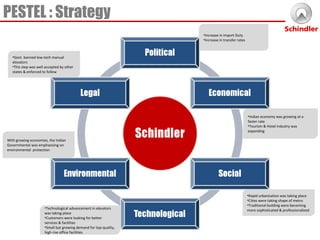
Increase in import Duty Increase in transfer rates PESTEL : Strategy  Indian economy was growing at a faster rate Tourism & Hotel industry was expanding Rapid urbanization was taking place Cities were taking shape of metro Traditional building were becoming more sophisticated & professionalized Technological advancement in elevators was taking place  Customers were looking for better services & facilities Small but growing demand for top-quality, high rise office facilities Govt. banned low-tech manual elevators This step was well accepted by other states & enforced to follow With growing economies, the Indian Governmental was emphasising on environmental  protection
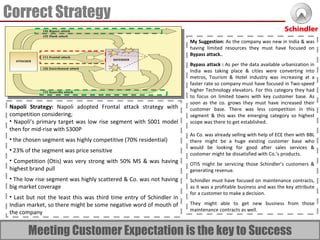
Correct Strategy Napoli Strategy:  Napoli adopted Frontal attack strategy with competition considering; Napoli’s primary target was low rise segment with S001 model then for mid-rise with S300P the chosen segment was highly competitive (70% residential) 23% of the segment was price sensitive Competition (Otis) was very strong with 50% MS & was having highest brand pull The low rise segment was highly scattered & Co. was not having big market coverage Last but not the least this was third time entry of Schindler in Indian market, so there might be some negative word of mouth of the company My Suggestion:  As the company was new in India & was having limited resources they must have focused on  Bypass attack. . Bypass attack :  As per the data available urbanization in India was taking place & cities were converting into metros, Tourism & Hotel industry was increasing at a faster rate so company must have focused in Two-speed higher Technology elevators. For this category they had to focus on limited towns with key customer base. As soon as the co. grows they must have increased their customer base. There was less competition in this segment & this was the emerging category so highest scope was there to get established. As Co. was already selling with help of ECE then with BBL there might be a huge existing customer base who would be looking for good after sales services & customer might be dissatisfied with Co.’s products.  OTIS might be servicing those Schindler’s customers & generating revenue. Schindler must have focused on maintenance contracts, as it was a profitable business and was the key attribute for a customer to make a decision. They might able to get new business from those maintenance contracts as well. Meeting Customer Expectation is the key to Success
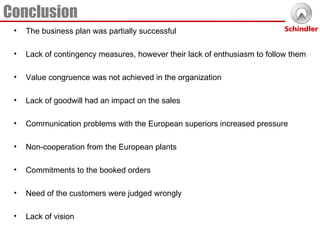
Conclusion The business plan was partially successful Lack of contingency measures, however their lack of enthusiasm to follow them Value congruence was not achieved in the organization Lack of goodwill had an impact on the sales Communication problems with the European superiors increased pressure Non-cooperation from the European plants  Commitments to the booked orders Need of the customers were judged wrongly Lack of vision
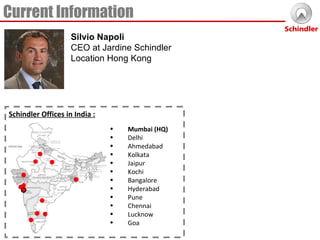
Current Information Silvio Napoli  CEO at Jardine Schindler  Location Hong Kong Mumbai (HQ) Delhi Ahmedabad Kolkata Jaipur Kochi Bangalore Hyderabad Pune Chennai Lucknow Goa Schindler Offices in India :
I extremely thanks to Mr. Silvio Napoli for sharing this valuable case with managers of tomorrow.

Schindler case study

  • 1.
    Schindler India ~Case Study Prepared by : Rajesh Srivastava Roll No. : 20 Batch : EPGDIM (2010-12)
  • 2.
    CONTENTS History ofSchindler Characters in the case study Profile : Silvio Napoli Indian operations Schindler India strategy: The swatch project The Indian entry project Indian Organisation Man mgmt: Developing the Relationship The India business plan The Indian Elevator Market Segmentation Competition Product strategy Outsourcing strategy Business challenges What went Wrong? Conclusion Current scenario
  • 3.
    History of SchindlerRobert Schindle established the company in 1874 in Switzerland Company began manufacturing elevators in 1889 Did not have a local market base in India until 1950s by appointing a local distributor Alfred N Schindler took over the company in 1987; becoming the 4 th generation in line 1998 : Schindler increased revenue worth $ 6.6 billion around the world Company has over 38,000 employees in 97 subsidiaries
  • 4.
    Characters in theCase Study Schindler Top Management Staff: Alfred N Schindler (Chairman & CEO) Luc Bonnard (Vice Chairman of the Board & Member of Executive Committee) Alfred Spoerri (Member of the Board of Directors & Executive Committee) Schindler India key Manager Profiles: Silvio Napoli (VP, Schindler South Asia) Meher Karan Singh (MD) T.A.K Mathews (VP-Field Operations) Ronnie Dante (GM- Engineering) Jujudhan Jena (CFO)
  • 5.
    Name : Silvio Napoli, 33 yrs Position : Vice President, Schindler South Asia Date of Birth : August 23, 1965 Education : 1992-1994 :: MBA, Harvard University , Graduate School of Business Administration Bostan, Massachusetts 1984 – 1989 :: Graduate degree in Materials Science Engg. Swiss Federal Institute Tech, Switzerland; Lausanne University; rugby captain (1987) 1983 – 1984 :: Ranked amongst top 20% foreign students admitted to EPFL, One Yr compulsory selection program, Swiss Federal Institute of Tech. (EPFL) Profile : Silvio Napoli
  • 6.
    Napoli’s First Projectin Schindler The project goal was to develop a standardized elevator at a lower cost than the existing, more customized product The outcome was the S001 an elevator that can’t be customized Used many parts supplied from outside Used newer process The entire supply chain was restructured Cycle time was reduced to half of the standard 20- to 30- weeks
  • 7.
  • 8.
    Schindler :: Indianoperations 1925 – The First elevator by Schindler in India installed 1958 – Long Term Distribution Agreement with ECE (an Indian Organisation) 1985 – Termination of Distribution Agreement with ECE 1985 – Technical Collaboration with Mumbai based company Bharat Bijlee Ltd.  BBL was authorised to manufacture, market & sell Schindler products in Indian market  After acquiring 12% equity stake in BBL, Schindler became the No.2 player in Indian elevator market.  A decade later they maintained 10-15% share in market 1995 – Alfred Schindler visited Indian market to review the market potential, he found there was huge growth potential in Indian elevator market & found it was similar to China 1995 – To take management control in Indian market, Schindler proposed BBL a new JV, but negotiation proved difficult & finally collapsed 1996 – Collaboration with BBL ended and Schindler began considering options to establish own operations in India. 1998 – March ‘98, Silvio Napoli was sent to establish Schindler business in India
  • 9.
    The Indian EntryProject Boston Consulting Group (BCG) was engaged by Schindler to look for alternative local partners as negotiations with BBL broke down in India It was now legally feasible to start up wholly owned company in India for a multinational A business plan for Schindler Market entry was approved by the Corporate Executive Committee (VRA) in October’95 Mr. Napoli was offered the job of creating the Indian subsidiary In November’95, Mr. Napoli came to India for the first time
  • 10.
    Schindler India OrganisationChart Silvio Napoli VP S Asia Operation Agent in Pakistan Agent in Srilanka Agent in Bangladesh M.K. Singh Managing director T.A.K. Mathews Field Operation Ronnie Dante Engineering Pankaj Sinha Human Resources J. Jena Finance Executive Administrative Support Hade of Logistics Executives Technical Development Vendor Development Commission Support New Installation Account Management Support Trainees Existing Installations Team leader/Team member Hade of Existing Installations
  • 11.
    Man Mgmt.: Developingthe Relationship There were initial clashes of timetable of the senior staff as they were still not finished with their previous job Different management styles of the top executives also led to problems Silvio Napoli was regarded as a tough and aggressive manager by the staff members The scenario greatly differed from where Mr. Napoli came from and India The internal environment of the organization was informal according to the employees
  • 12.
    The Indian BusinessPlan The plan had two basic elements : Sell a focused line of standard products Outsource key manufacturing and logistics functions The business had many opportunities coming up in India after the liberalization of Economy in 1990’s Construction industry was reviving Rapid urbanization A ban on collapsible gate elevators was enforced by the Indian Standards Institute (ISI)
  • 13.
    The Indian ElevatorMarket : Otis was leading the segment Manual Elevator’s contribution was highest with 50% MS Service was the key parameter followed by Price
  • 14.
    Competition Schindler Indiafaced the competition from four major companies; they were: Otis ( market leader, with 50% market share) Kone ( market challenger, 8.8% market share) BBL (Market Follower, 8.6% market share) ECE( market follower, 8.4% market share) Otis was a threat for Schindler India because it already had a good customer base, 61.5% of which were under maintenance contracts
  • 15.
  • 16.
    Education :Highly qualified (MBA + Engineer) Work Exp : Rich experience of 7 years , mainly in European markets His candidature : 1. He was Head of Corporate Planning in Schindler 2. Aware with Schindler’s Mission & Vision, he was participating in VRA meetings (Corporate Executive Committee) & was responsible to make MOMs & to follow with respective person for achievement 3. Was coordinating with Boston Consulting to shortlist potential partners in India for business expansion 4. Assigned to establish Schindler in India along with Head of Schindler’s M&A Department 5. Spent 9 months to understand India elevator mkt. mainly ; the mkt. size, legal environment & competitive situation 6. Made Schindler’s business plan for India which was approved by VRA Candidature of Napoli for Indian operations Napoli was the right candidate for Indian Operations
  • 17.
    Business Challenges Salesforce was bringing in orders, but not for the standard products The transfer cost of S001 has increased The import duties on elevators has also increased There was lack of motivation in the organization about the sales strategy Things were not going well
  • 18.
    Outsourcing Strategy SilvioNapoli's business plan was to outsource the production of 90% of the components of S001 from local suppliers the safety equipment would be imported from Schindler plant in south-east Asia The basic on-site assembly work would also be outsourced Eventually they would install their own dedicated plant to manufacture the parts
  • 19.
    STP Strategy wasto make the Swatch project products as their core competence ( S001) To cater mid-rise segment they were planning to introduce S300P Target was to first hit low-rise segment as scope was highest (Govt. banned the manual elevators) Break-even was predicted at four years, with the sales reaching a double digit growth figure eventually To establish Schindler in mid-rise segment with Customized product
  • 20.
    Non-cooperation from theSchindler’s European plants Competition was very strong & there was a push from regional players (25) as well Porters 5- Forces Customers were asking for customized products Mitsubishi & Hyundai
  • 21.
    Increase in importDuty Increase in transfer rates PESTEL : Strategy Indian economy was growing at a faster rate Tourism & Hotel industry was expanding Rapid urbanization was taking place Cities were taking shape of metro Traditional building were becoming more sophisticated & professionalized Technological advancement in elevators was taking place Customers were looking for better services & facilities Small but growing demand for top-quality, high rise office facilities Govt. banned low-tech manual elevators This step was well accepted by other states & enforced to follow With growing economies, the Indian Governmental was emphasising on environmental protection
  • 22.
    Correct Strategy NapoliStrategy: Napoli adopted Frontal attack strategy with competition considering; Napoli’s primary target was low rise segment with S001 model then for mid-rise with S300P the chosen segment was highly competitive (70% residential) 23% of the segment was price sensitive Competition (Otis) was very strong with 50% MS & was having highest brand pull The low rise segment was highly scattered & Co. was not having big market coverage Last but not the least this was third time entry of Schindler in Indian market, so there might be some negative word of mouth of the company My Suggestion: As the company was new in India & was having limited resources they must have focused on Bypass attack. . Bypass attack : As per the data available urbanization in India was taking place & cities were converting into metros, Tourism & Hotel industry was increasing at a faster rate so company must have focused in Two-speed higher Technology elevators. For this category they had to focus on limited towns with key customer base. As soon as the co. grows they must have increased their customer base. There was less competition in this segment & this was the emerging category so highest scope was there to get established. As Co. was already selling with help of ECE then with BBL there might be a huge existing customer base who would be looking for good after sales services & customer might be dissatisfied with Co.’s products. OTIS might be servicing those Schindler’s customers & generating revenue. Schindler must have focused on maintenance contracts, as it was a profitable business and was the key attribute for a customer to make a decision. They might able to get new business from those maintenance contracts as well. Meeting Customer Expectation is the key to Success
  • 23.
    Conclusion The businessplan was partially successful Lack of contingency measures, however their lack of enthusiasm to follow them Value congruence was not achieved in the organization Lack of goodwill had an impact on the sales Communication problems with the European superiors increased pressure Non-cooperation from the European plants Commitments to the booked orders Need of the customers were judged wrongly Lack of vision
  • 24.
    Current Information SilvioNapoli CEO at Jardine Schindler Location Hong Kong Mumbai (HQ) Delhi Ahmedabad Kolkata Jaipur Kochi Bangalore Hyderabad Pune Chennai Lucknow Goa Schindler Offices in India :
  • 25.
    I extremely thanksto Mr. Silvio Napoli for sharing this valuable case with managers of tomorrow.