MojoFacets
So, you have data and browser?


           Dobrica Pavlinušić
        http://blog.rot13.org
HULK, Knjižnica Filozofskog fakulteta u Zagrebu
 Slobodni Festival 4, Čakovec, 2. srpnja 2010.
Goal

Create a faceted data browser, using web
 browser as a client with data stored on
         server in perl's memory.

 Allow data modification while keeping
 changes to for recovery or replication.

Modify data and generate reports using
 simple perl snippets (it's in memory!)
Overview
●   Faceted browsing
●   MojoFacets
     – Input formats
     – Faceted browsing, editing and plotting
     – Eval perl code over items or facets
●   Google Chrome Development
     – Chrome Application
     – Speed Tracer
Facets?

 A faceted classification system allows the
assignment of multiple classifications to an
   object, enabling the classifications to be
 ordered in multiple ways, rather than in a
  single, pre-determined, taxonomic order.

    SIMILE Exhibit Widget – in-browser
      implementation for < 1000 items
       http://www.simile-widgets.org/
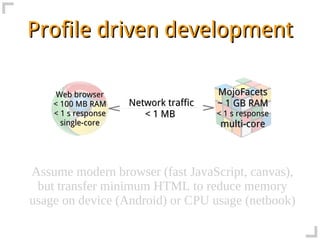
Profile driven development

     Web browser                       MojoFacets
    < 100 MB RAM     Network traffic   ~ 1 GB RAM
    < 1 s response      < 1 MB         < 1 s response
      single-core                      multi-core


Assume modern browser (fast JavaScript, canvas),
 but transfer minimum HTML to reduce memory
usage on device (Android) or CPU usage (netbook)
http://www.youtube.com/view_play_list?p=ED435109B7ABD426
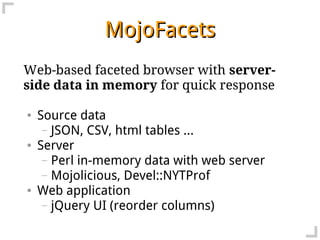
MojoFacets
Web-based faceted browser with server-
side data in memory for quick response

●   Source data
     – JSON, CSV, html tables ...
●   Server
     – Perl in-memory data with web server
     – Mojolicious, Devel::NYTProf
●   Web application
     – jQuery UI (reorder columns)
Input formats
●   JSON – Exhibit format with items
●   TXT – pipe | delimited, multiline format
     – Plants for the Future
●   CSV – cp1250 encoded
●   Storable
     – Concateneted serialized perl objects
     – scripts/vmstat.pl – generate output
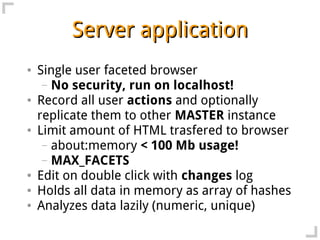
Server application
●   Single user faceted browser
     – No security, run on localhost!
●   Record all user actions and optionally
    replicate them to other MASTER instance
●   Limit amount of HTML trasfered to browser
     – about:memory < 100 Mb usage!
     – MAX_FACETS
●   Edit on double click with changes log
●   Holds all data in memory as array of hashes
●   Analyzes data lazily (numeric, unique)
Filter values = facet
●   Subset of all values for a column in dataset
●   Can be applied across different datasets with
    the same column name
●   Selection of values using regex in browser
●   Graph counts using canvas (< MAX_FACETS)
●   Export to text file
●   Copy/paste to spreadsheet (white ;)
●   Eval perl code to filter or create agregates
    ($value, $count, $checked, $out)
●   Multiple filters are combined and cached
Browsing and editing
●   Show items as table or list
●   Graph all values using gnuplot server-side
    (and export data as side-effect)
●   Edit any cell on double click
     – Repeatable values delimited by 
     – Create changes which can be applied to
       different datasets or new versions
●   Load code snippets based on visible columns
     – $row -> $update            # map
     – $out->{something}++ # collect
Development
    using
   Google
   Chrome
Google Chrome Application
$ google-chrome --enable-apps

$ cat chrome-app/manifest.json
{
  "name": "Mojo Facets",
  "version": "1",
  "icons": { "24": "24.png", "128": "128.png" },
  "launch": {
     "web_url": "http://localhost:3000/"
  },
  "permissions": [],
  "web_content": {
     "enabled": true,
     "origin": "http://localhost"
  }
}
To get application tab...
...load unpacked extension...
...and open new tab
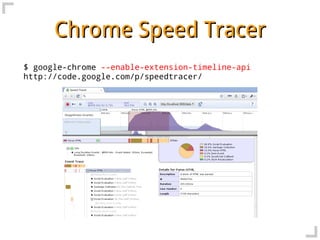
Chrome Speed Tracer
$ google-chrome --enable-extension-timeline-api
http://code.google.com/p/speedtracer/
Find out more!
Blog
http://blog.rot13.org/mojofacets
github
http://github.com/dpavlin/MojoFacets
Project updates
https://www.ohloh.net/p/MojoFacets
Questions?


http://blog.rot13.org

Mojo Facets – so, you have data and browser?

  • 1.
    MojoFacets So, you havedata and browser? Dobrica Pavlinušić http://blog.rot13.org HULK, Knjižnica Filozofskog fakulteta u Zagrebu Slobodni Festival 4, Čakovec, 2. srpnja 2010.
  • 2.
    Goal Create a faceteddata browser, using web browser as a client with data stored on server in perl's memory. Allow data modification while keeping changes to for recovery or replication. Modify data and generate reports using simple perl snippets (it's in memory!)
  • 3.
    Overview ● Faceted browsing ● MojoFacets – Input formats – Faceted browsing, editing and plotting – Eval perl code over items or facets ● Google Chrome Development – Chrome Application – Speed Tracer
  • 4.
    Facets? A facetedclassification system allows the assignment of multiple classifications to an object, enabling the classifications to be ordered in multiple ways, rather than in a single, pre-determined, taxonomic order. SIMILE Exhibit Widget – in-browser implementation for < 1000 items http://www.simile-widgets.org/
  • 5.
    Profile driven development Web browser MojoFacets < 100 MB RAM Network traffic ~ 1 GB RAM < 1 s response < 1 MB < 1 s response single-core multi-core Assume modern browser (fast JavaScript, canvas), but transfer minimum HTML to reduce memory usage on device (Android) or CPU usage (netbook)
  • 6.
  • 7.
    MojoFacets Web-based faceted browserwith server- side data in memory for quick response ● Source data – JSON, CSV, html tables ... ● Server – Perl in-memory data with web server – Mojolicious, Devel::NYTProf ● Web application – jQuery UI (reorder columns)
  • 8.
    Input formats ● JSON – Exhibit format with items ● TXT – pipe | delimited, multiline format – Plants for the Future ● CSV – cp1250 encoded ● Storable – Concateneted serialized perl objects – scripts/vmstat.pl – generate output
  • 9.
    Server application ● Single user faceted browser – No security, run on localhost! ● Record all user actions and optionally replicate them to other MASTER instance ● Limit amount of HTML trasfered to browser – about:memory < 100 Mb usage! – MAX_FACETS ● Edit on double click with changes log ● Holds all data in memory as array of hashes ● Analyzes data lazily (numeric, unique)
  • 10.
    Filter values =facet ● Subset of all values for a column in dataset ● Can be applied across different datasets with the same column name ● Selection of values using regex in browser ● Graph counts using canvas (< MAX_FACETS) ● Export to text file ● Copy/paste to spreadsheet (white ;) ● Eval perl code to filter or create agregates ($value, $count, $checked, $out) ● Multiple filters are combined and cached
  • 11.
    Browsing and editing ● Show items as table or list ● Graph all values using gnuplot server-side (and export data as side-effect) ● Edit any cell on double click – Repeatable values delimited by ¶ – Create changes which can be applied to different datasets or new versions ● Load code snippets based on visible columns – $row -> $update # map – $out->{something}++ # collect
  • 12.
    Development using Google Chrome
  • 13.
    Google Chrome Application $google-chrome --enable-apps $ cat chrome-app/manifest.json { "name": "Mojo Facets", "version": "1", "icons": { "24": "24.png", "128": "128.png" }, "launch": { "web_url": "http://localhost:3000/" }, "permissions": [], "web_content": { "enabled": true, "origin": "http://localhost" } }
  • 14.
  • 15.
  • 16.
  • 17.
    Chrome Speed Tracer $google-chrome --enable-extension-timeline-api http://code.google.com/p/speedtracer/
  • 18.
  • 19.