STERILIZATION
DEFINITION:
Sterilization is the process by which an article, surface or
medium is freed of all living microorganisms either in the
vegetative or spore state.
CLASSIFICATION
•Candle filters
•Asbestos filters
•Sintered glass
filters
•Membrane filters.
DRY HEAT:
Dry heat kills the micro-organism by denaturation of protein and
destructive oxidation of intracellular components.
Divided into 4 types
 Flaming
 Red heat
 Incineration
 Hot air oven
1.FLAMING:
Materials are sterilized on holding to Bunsen burner for shorter
duration.
USES: for the Sterilization of
 Scalpels
 Glass slides
 Cover slips
 Mouth of culture tubes
 Neck of flasks
2. RED HEAT:
Materials are sterilized on holding to Bunsen burner for
shorter to longer duration until they become red hot
USES: Sterilization of
 Inoculating loops or wires
 Tips of forceps
 Scissors
 spatulas
3. INCINERATION:
It is disposal of biomedical waste or microbiological waste
wherein a temperature of 850-1200 0
C is applied and all the
wastes are turned into ash.
USES:
 Soiled dressings
 Beddings of patient
 Animal carcasses
 Pathological material
4. HOT AIR OVEN:
Definition:-Hot air ovens are
electrical devices which use dry heat
to sterilize. They were originally
developed by Pasteur.
Principle:
The killed effect of dry heat is due to
protein denaturation, oxidative
damage & the toxic effect of elevated
levels of eletrolytes.
Time and temperature:- A holding
period of 160˚C for 1hr is used
Precaution:
 The oven should not be overloaded.
 The articles to be sterilized should be free from water traces and
properly covered with craft paper.
 The material should be properly arranged to allow free circulation of
air.
 Rubber material except silicon rubber or inflammable material should
not be kept.
 The oven should be opened only after proper cooling to avoid cracking
of glassware by sudden cooling.
Uses: Used to sterilize the following materials
 Glassware
 Pharmaceutical products
 Forceps
 Scissors
 Scalpels
 & other surgical instruments
MOIST HEAT:
Principle:
It kills the micro organisms by denaturation of protein & destructive
oxidation of intracellular components, water participates in this
process.
 Sterilization by moist heat is again classified under 3groups
1. Temperature below 100˚C
2. Temperature at 100˚C
3. Temperature above 100˚C
TEMPERATURE BELOW 100˚C:
Pasteurization: Pasteurization is the process of applying low heat to kill
pathogens and inactivate spoilage enzymes. It does not kill bacterial
spores, so pasteurization does not truly sterilize products. Pasteurization is
named for Louis Pasteur, who developed a method to kill microbes in 1864
Pasteurization or pasteurization is a process in which packaged and non-
packaged foods (such as milk and fruit juice) are treated with mild heat,
usually to less than 100 °C (212 °F), to eliminate pathogens and extend shelf
life.
This are done by 2 methods-
1. HOLDER METHOD: Applying 63˚C for 30 mins
2. FLASH METHOD: Applying 72˚C for 15-20 sec followed by quick cooling
to 13˚C or lower.
Most vegetative bacteria like Mycobacterium, Salmonella, Brucella are rapidly
killed by this two methods but Coxiella burnetii survive holder method.
Water bath:
water bath is laboratory equipment made from a container filled with
heated water. It is used to incubate samples in water at a constant
temperature over a long period of time. It is also used to enable certain
chemical reactions to occur at high temperature.
• For sterilization of serum or body fluid containing coagulable
protein.
• Heating for 1hr at 56˚C on several successive days in waterbath
• For serum or protein: 56˚C/hour for several successive days.
• For cystoscopes, specula: 75˚C/ 10 mins.
• Clothing, bed clothes, eating utensils, nursing equipment-
washing at 70- 80˚C for several minutes.
Inspissation:
Inspissation is the process used when heating high-protein
containing media; for example to enable recovery of bacteria for
testing. Once inspissation has occurred, any stained bacteria,
such as Mycobacteria, can then be isolated. Here the media with
high protein is
• Heated at 80-85˚C for 30 mins on 3 successive days in
inspissator.
• 1st
exposure on day 1 kills all vegetative forms. Spores, which
are not destroyed, would germinate to form vegetative forms
before the 2nd
exposure
• 2nd
exposure on day 2 kills newly formed vegetative forms.
• Spores, if at all present, germinate till 3rd
exposure & would be
killed on 3rd
exposure on day 3 ensuring complete sterilization.
Uses:
For sterilization of media such as L.J. media (lowenstein-
jensen’s) and loeffler’s serum slope
TEMPERATURE AT 100˚C:
Boiling:
Boiling at 100˚C for 10 - 30 mins kills most of the vegetative forms
of bacteria, many spores can survive it. Eg Clostridium tetani.
Addition of 2% sodium carbonate promotes sterilization.
Uses:
Pipettes, Cylinders, Rubber stoppers, Scalpels, Forceps, Scissors
Syringes, etc. when absolute sterility is not required
Tyndallization:
Sterilization of a fluid by heating it repeatedly to a point slightly below
that of boiling. With each heating, the bacteria which have developed
from the more resistant spores are destroyed; when finally no
undeveloped spores remain the fluid is sterile.
 The culture media is steamed at 100˚C for 30mins for 3 successive
days.
 The vegetative cells are destroyed at 1st
exposure, the spores present
will germinate on successive days & will be killed by second & third
exposure.
 This method can be applied only to nutrient media in which spores can
germinate in the intervals between steaming.
TEMPERATURE ABOVE 100˚C:
Autoclave: Autoclaves operate at high temperature and
pressure in order to kill microorganisms and spores.
They are used to decontaminate certain biological waste and
sterilize media, instruments and lab ware.
PRINCIPLE:
• Water boils when its vapour pressure equals that of surrounding
atmosphere. Hence, when pressure inside a closed vessel
increased, the temperature at which water boils also increased
producing dry saturated steam.
• At normal pressure, water boils at 1000
C but when pressure inside
a closed vessel increases ,the temperature at which water boils
also increases.
Components of Autoclave:
• Autoclave comprises of three parts: a pressure chamber a lid
and an electrical heater
1.Pressure chamber consists of:-
• It is a large cylinder in which the materials to be sterilized are
placed. It is made up of gunmetal or stainless steel and placed in
a supporting iron case
2.The lid is fastened by screw clamps and rendered air tight by
an asbestos washer. The lid bears the following
• A discharge tap for air and steam discharge
• A pressure gauge (sets the pressure at a particular level)
• A safety valve(to remove the excess steam)
• An electrical heater is attached to the jacket , the bears the
water to produce steam
Procedure:
• A cylinder is filled with sufficient water and the material to be
sterilized is placed inside the pressure chamber. The lid is closed
and the electrical heater is put on
• The pressure gauge is adjusted to the required pressure
• After the water boils, the steam and air mixture is allowed to
escape through the discharge tap till all the air has been
displaced
• The steam pressure rises inside and when it reaches the desired
set level ,the safety valve opens and excess steam escapes out
• The holding period is counted from this point of time, which is
about 15 minutes in most cases
• After the holding period, the electrical heater is stopped and the
autoclave is allowed to cool till the pressure gauge indicates that
the pressure inside is equal to the atmospheric pressure
• The discharge tap is opened slowly and air is allowed to enter
the autoclave. The lid is now opened and the sterilized materials
are removed
Sterilization conditions:
• 1210
C for 15 minutes at pressure of 15 pounds.
• This is most commonly used sterilization condition for autoclave
Uses:
 All solid and liquid media
 Distilled water
 Saline solution
 Laboratory coats
 Swabs, syringes and needles
 Surgical instruments
 Dressing material
 Laboratory ware
 Pharmaceutical products
Precautions:
 All air must be expelled out of the autoclave.
 To avoid drenching by the condensed steam, the cotton
wool plugs should be covered with craft paper or
cellophane sheets.
 The lid should be opened when the outside & inside
pressure is equal.
 Opening of lid when the pressure inside is low, i.e.
below atmospheric pressure will cause evaporation of
water and loss of water from the medium/liquid
reducing quantity of the medium/liquid.
Types of autoclaves-
1. Steam jacketed autoclave
2. Downward displacement autoclave
3. Multipurpose autoclave for porous load
4. Transportable bench-top autoclave
5. High security autoclave
Radiation
There are 2 general types of radiation used for sterilization,
•ionizing radiation
•non-ionizing radiation.
1. Ionizing radiation-
It is the use of short wavelength, high-intensity radiation to destroy
microorganisms.
This radiation can come in the form of gamma or X-rays that react
with DNA resulting in a damaged cell.
Used to sterilize pre packed disposable items such as plastic
syringes, catheters, transfusion sets etc
2.Non-ionizing radiation:-
It uses longer wavelength (250nm-280nm) and lower energy.
As a result, non-ionizing radiation loses the ability to penetrate
substances, and can only be used for sterilizing surfaces.
Its effective in killing vegetative forms of the organisms and rarely
spores
The most common form of non-ionizing radiation is ultraviolet light,
which is used in a variety of manners throughout industry.
Inhibits DNA replication and may form toxic substances in the
culture media
Filtration (mechanical) method:-
• Helps to remove bacteria from heat labile
liquids
• Items: sera and solutions of sugars or
antibiotics.
• Principle: as viruses pass through the ordinary
filters, filtration can be used to obtain bacteria free
filtrates of clinical samples for virus
isolation.
Types of filters:-
•Candle filters
•Asbestos filters
•Sintered glass filters
•Membrane filters.
1.Candle filter:-
• Manufactured in different grades of porosity
and widely used for purification of water for
industrial and drinking purposes.
• Made up of porous procelain or kieselguhr
• Inexpensive and available in different sizes
2.Asbestos filter(Seitz filter)
• Disposable
• Single use disc made up of asbestos(magnesium
trisilicate)
• Tend to alkalinise filtered liquids.
• The pore size of filter ranges from 0.01 to 5 microns.
• Usage is discouraged because of its carcinogenic property.
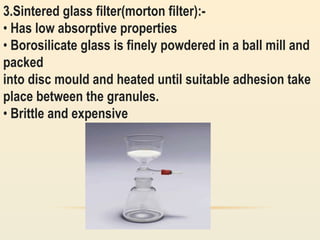
3.Sintered glass filter(morton filter):-
• Has low absorptive properties
• Borosilicate glass is finely powdered in a ball mill and
packed
into disc mould and heated until suitable adhesion take
place between the granules.
• Brittle and expensive
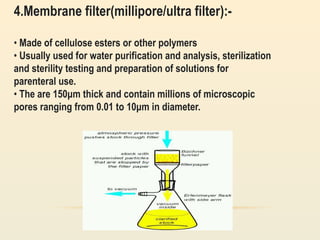
4.Membrane filter(millipore/ultra filter):-
• Made of cellulose esters or other polymers
• Usually used for water purification and analysis, sterilization
and sterility testing and preparation of solutions for
parenteral use.
• The are 150μm thick and contain millions of microscopic
pores ranging from 0.01 to 10μm in diameter.
Thank u

STERILIZATION (2).pptx. Topic strelixation

  • 1.
  • 2.
    DEFINITION: Sterilization is theprocess by which an article, surface or medium is freed of all living microorganisms either in the vegetative or spore state.
  • 3.
  • 4.
    DRY HEAT: Dry heatkills the micro-organism by denaturation of protein and destructive oxidation of intracellular components. Divided into 4 types  Flaming  Red heat  Incineration  Hot air oven
  • 5.
    1.FLAMING: Materials are sterilizedon holding to Bunsen burner for shorter duration. USES: for the Sterilization of  Scalpels  Glass slides  Cover slips  Mouth of culture tubes  Neck of flasks
  • 6.
    2. RED HEAT: Materialsare sterilized on holding to Bunsen burner for shorter to longer duration until they become red hot USES: Sterilization of  Inoculating loops or wires  Tips of forceps  Scissors  spatulas
  • 7.
    3. INCINERATION: It isdisposal of biomedical waste or microbiological waste wherein a temperature of 850-1200 0 C is applied and all the wastes are turned into ash. USES:  Soiled dressings  Beddings of patient  Animal carcasses  Pathological material
  • 8.
    4. HOT AIROVEN: Definition:-Hot air ovens are electrical devices which use dry heat to sterilize. They were originally developed by Pasteur. Principle: The killed effect of dry heat is due to protein denaturation, oxidative damage & the toxic effect of elevated levels of eletrolytes. Time and temperature:- A holding period of 160˚C for 1hr is used
  • 10.
    Precaution:  The ovenshould not be overloaded.  The articles to be sterilized should be free from water traces and properly covered with craft paper.  The material should be properly arranged to allow free circulation of air.  Rubber material except silicon rubber or inflammable material should not be kept.  The oven should be opened only after proper cooling to avoid cracking of glassware by sudden cooling.
  • 11.
    Uses: Used tosterilize the following materials  Glassware  Pharmaceutical products  Forceps  Scissors  Scalpels  & other surgical instruments
  • 12.
    MOIST HEAT: Principle: It killsthe micro organisms by denaturation of protein & destructive oxidation of intracellular components, water participates in this process.  Sterilization by moist heat is again classified under 3groups 1. Temperature below 100˚C 2. Temperature at 100˚C 3. Temperature above 100˚C
  • 13.
    TEMPERATURE BELOW 100˚C: Pasteurization:Pasteurization is the process of applying low heat to kill pathogens and inactivate spoilage enzymes. It does not kill bacterial spores, so pasteurization does not truly sterilize products. Pasteurization is named for Louis Pasteur, who developed a method to kill microbes in 1864 Pasteurization or pasteurization is a process in which packaged and non- packaged foods (such as milk and fruit juice) are treated with mild heat, usually to less than 100 °C (212 °F), to eliminate pathogens and extend shelf life. This are done by 2 methods- 1. HOLDER METHOD: Applying 63˚C for 30 mins 2. FLASH METHOD: Applying 72˚C for 15-20 sec followed by quick cooling to 13˚C or lower. Most vegetative bacteria like Mycobacterium, Salmonella, Brucella are rapidly killed by this two methods but Coxiella burnetii survive holder method.
  • 14.
    Water bath: water bathis laboratory equipment made from a container filled with heated water. It is used to incubate samples in water at a constant temperature over a long period of time. It is also used to enable certain chemical reactions to occur at high temperature. • For sterilization of serum or body fluid containing coagulable protein. • Heating for 1hr at 56˚C on several successive days in waterbath • For serum or protein: 56˚C/hour for several successive days. • For cystoscopes, specula: 75˚C/ 10 mins. • Clothing, bed clothes, eating utensils, nursing equipment- washing at 70- 80˚C for several minutes.
  • 15.
    Inspissation: Inspissation is theprocess used when heating high-protein containing media; for example to enable recovery of bacteria for testing. Once inspissation has occurred, any stained bacteria, such as Mycobacteria, can then be isolated. Here the media with high protein is • Heated at 80-85˚C for 30 mins on 3 successive days in inspissator. • 1st exposure on day 1 kills all vegetative forms. Spores, which are not destroyed, would germinate to form vegetative forms before the 2nd exposure • 2nd exposure on day 2 kills newly formed vegetative forms. • Spores, if at all present, germinate till 3rd exposure & would be killed on 3rd exposure on day 3 ensuring complete sterilization.
  • 16.
    Uses: For sterilization ofmedia such as L.J. media (lowenstein- jensen’s) and loeffler’s serum slope
  • 17.
    TEMPERATURE AT 100˚C: Boiling: Boilingat 100˚C for 10 - 30 mins kills most of the vegetative forms of bacteria, many spores can survive it. Eg Clostridium tetani. Addition of 2% sodium carbonate promotes sterilization. Uses: Pipettes, Cylinders, Rubber stoppers, Scalpels, Forceps, Scissors Syringes, etc. when absolute sterility is not required
  • 18.
    Tyndallization: Sterilization of afluid by heating it repeatedly to a point slightly below that of boiling. With each heating, the bacteria which have developed from the more resistant spores are destroyed; when finally no undeveloped spores remain the fluid is sterile.  The culture media is steamed at 100˚C for 30mins for 3 successive days.  The vegetative cells are destroyed at 1st exposure, the spores present will germinate on successive days & will be killed by second & third exposure.  This method can be applied only to nutrient media in which spores can germinate in the intervals between steaming.
  • 19.
    TEMPERATURE ABOVE 100˚C: Autoclave:Autoclaves operate at high temperature and pressure in order to kill microorganisms and spores. They are used to decontaminate certain biological waste and sterilize media, instruments and lab ware. PRINCIPLE: • Water boils when its vapour pressure equals that of surrounding atmosphere. Hence, when pressure inside a closed vessel increased, the temperature at which water boils also increased producing dry saturated steam. • At normal pressure, water boils at 1000 C but when pressure inside a closed vessel increases ,the temperature at which water boils also increases.
  • 20.
    Components of Autoclave: •Autoclave comprises of three parts: a pressure chamber a lid and an electrical heater 1.Pressure chamber consists of:- • It is a large cylinder in which the materials to be sterilized are placed. It is made up of gunmetal or stainless steel and placed in a supporting iron case 2.The lid is fastened by screw clamps and rendered air tight by an asbestos washer. The lid bears the following • A discharge tap for air and steam discharge • A pressure gauge (sets the pressure at a particular level) • A safety valve(to remove the excess steam)
  • 21.
    • An electricalheater is attached to the jacket , the bears the water to produce steam Procedure: • A cylinder is filled with sufficient water and the material to be sterilized is placed inside the pressure chamber. The lid is closed and the electrical heater is put on • The pressure gauge is adjusted to the required pressure • After the water boils, the steam and air mixture is allowed to escape through the discharge tap till all the air has been displaced • The steam pressure rises inside and when it reaches the desired set level ,the safety valve opens and excess steam escapes out
  • 22.
    • The holdingperiod is counted from this point of time, which is about 15 minutes in most cases • After the holding period, the electrical heater is stopped and the autoclave is allowed to cool till the pressure gauge indicates that the pressure inside is equal to the atmospheric pressure • The discharge tap is opened slowly and air is allowed to enter the autoclave. The lid is now opened and the sterilized materials are removed Sterilization conditions: • 1210 C for 15 minutes at pressure of 15 pounds. • This is most commonly used sterilization condition for autoclave
  • 24.
    Uses:  All solidand liquid media  Distilled water  Saline solution  Laboratory coats  Swabs, syringes and needles  Surgical instruments  Dressing material  Laboratory ware  Pharmaceutical products
  • 25.
    Precautions:  All airmust be expelled out of the autoclave.  To avoid drenching by the condensed steam, the cotton wool plugs should be covered with craft paper or cellophane sheets.  The lid should be opened when the outside & inside pressure is equal.  Opening of lid when the pressure inside is low, i.e. below atmospheric pressure will cause evaporation of water and loss of water from the medium/liquid reducing quantity of the medium/liquid.
  • 26.
    Types of autoclaves- 1.Steam jacketed autoclave 2. Downward displacement autoclave 3. Multipurpose autoclave for porous load 4. Transportable bench-top autoclave 5. High security autoclave
  • 27.
    Radiation There are 2general types of radiation used for sterilization, •ionizing radiation •non-ionizing radiation. 1. Ionizing radiation- It is the use of short wavelength, high-intensity radiation to destroy microorganisms. This radiation can come in the form of gamma or X-rays that react with DNA resulting in a damaged cell. Used to sterilize pre packed disposable items such as plastic syringes, catheters, transfusion sets etc
  • 28.
    2.Non-ionizing radiation:- It useslonger wavelength (250nm-280nm) and lower energy. As a result, non-ionizing radiation loses the ability to penetrate substances, and can only be used for sterilizing surfaces. Its effective in killing vegetative forms of the organisms and rarely spores The most common form of non-ionizing radiation is ultraviolet light, which is used in a variety of manners throughout industry. Inhibits DNA replication and may form toxic substances in the culture media
  • 29.
    Filtration (mechanical) method:- •Helps to remove bacteria from heat labile liquids • Items: sera and solutions of sugars or antibiotics. • Principle: as viruses pass through the ordinary filters, filtration can be used to obtain bacteria free filtrates of clinical samples for virus isolation.
  • 30.
    Types of filters:- •Candlefilters •Asbestos filters •Sintered glass filters •Membrane filters.
  • 31.
    1.Candle filter:- • Manufacturedin different grades of porosity and widely used for purification of water for industrial and drinking purposes. • Made up of porous procelain or kieselguhr • Inexpensive and available in different sizes
  • 32.
    2.Asbestos filter(Seitz filter) •Disposable • Single use disc made up of asbestos(magnesium trisilicate) • Tend to alkalinise filtered liquids. • The pore size of filter ranges from 0.01 to 5 microns. • Usage is discouraged because of its carcinogenic property.
  • 33.
    3.Sintered glass filter(mortonfilter):- • Has low absorptive properties • Borosilicate glass is finely powdered in a ball mill and packed into disc mould and heated until suitable adhesion take place between the granules. • Brittle and expensive
  • 34.
    4.Membrane filter(millipore/ultra filter):- •Made of cellulose esters or other polymers • Usually used for water purification and analysis, sterilization and sterility testing and preparation of solutions for parenteral use. • The are 150μm thick and contain millions of microscopic pores ranging from 0.01 to 10μm in diameter.
  • 35.