Information
Literacy:
What
Is It?
Finding a way through the word maze
2014
June 16, 2014 Information Literacy
2
Information Literacy
information literacy (IL)
• Skill in finding the information one
needs, including an understanding of
how libraries are organized,
familiarity with the resources they
provide (including information
formats and automated search tools),
and knowledge of commonly used
research techniques.
• ODLIS
What is Information Literacy?
http://campus.queens.edu/everett/M2.html
[QUILT]
3
QUILT’s definition
This definition is now at http://www.cilip.org.uk/get-involved/advocacy/information-literacy/pages/definition.aspx
4
5
What is information literacy?
Information Literacy
• Information Literacy is a
transformational process in which the learner
needs to find, understand, evaluate, and use
information in various forms to create for personal,
social or global purposes.
• Information Literacy shares a fundamental set of
core thinking- and problem-solving meta-skills
with other disciplines. Authentic cross-disciplinary
problems which include observation and inference,
analysis of symbols and models, comparison of
perspectives, and assessment of the rhetorical
context, engage students in developing mastery
information literacy over time.
Another concept
Information Competency for Faculty at
Rio Hondo College
• As defined by the Academic Senate for
California Community Colleges (1998),
information competency is the ability to:
• recognize the need for information,
• acquire and evaluate information,
• organize and maintain information, and
• interpret and communicate information
• What Is Information Competency?
June 16, 2014 Information Literacy
6
And then there’s “Information Competence”!
What is Information Competence?
• Information competence is the ability to
find, evaluate, use, and communicate
information in all of its various formats. It
represents the integration of library
literacy, computer literacy, media literacy,
ethics, critical thinking, and
communication skills.
• For Faculty: Improving Student Research
Skills and Building Information Competence
7
8
Literacy, Competence or Competency?
http://www.slideshare.net/j_iona/embedding-information-
literacy-in-a-competency-based-curriculum
June 16, 2014 Information Literacy
9
Adding to the confusion of terms!
Several other terms and combinations of
terms have been also used by different
authors:
• ‘infoliteracy’, ‘informacy’, ‘information
empowerment’, ‘information competence’,
‘information competency’, ‘information
competencies’, ‘information literacy skills’,
‘information literacy and skills’, ‘skills of
information literacy’, ‘information literacy
competence’, ‘information literacy
competencies’, ‘information competence skills’,
‘information handling skills’, ‘information
problem solving’, ‘information problem solving
skills’, ‘information fluency’, ‘information
mediacy’ and even ‘information mastery’
• Sirje Virkus: “Information literacy in Europe: a
literature review”
Information Research, Vol. 8 No. 4, July 2003
Sirje Virkus
June 16, 2014 Information Literacy
June 16, 2014
10
Now also as Information Literacies
Why the plural?
• The use of the term “information
literacies” emphasizes the complexity
and multiplicity of skills and
strategies involved in finding and
using information.
• Dianne Oberg: “Promoting Information
Literacies: A Focus on Inquiry.” 70th IFLA
General Conference and Council, 22-27 August
2004, Buenos Aires, Argentina
http://www.ifla.org/IV/ifla70/papers/088e-Oberg.pdf
Dr. Dianne Oberg
Ju
11
A related term often used outside
library media circles
• We learn best when we are at the center
of our own learning. Inquiry-based
learning is a learning process through
questions generated from the interests,
curiosities, and perspectives/experiences
of the learner. When investigations grow
from our own questions, curiosities, and
experiences, learning is an organic and
motivating process that is intrinsically
enjoyable.
•
ne 16, 2014 Information Literacy
Inquiry-based learning

http://www.inquirylearn.com/Inquirydef.htm
12
Project, Problem, and Inquiry-based Learning
Explore the Approaches
• Project-based learning, problem-
based learning, and inquiry-based
learning all three closely relate to the
information processing approach.
They all fit well with technology-rich
learning environments where the
focus is not on the hardware and
software, but on the learning
experience.
• Project, Problem, and Inquiry-based
Learning
http://eduscapes.com/tap/topic43.htm
June 16, 2014 Information Literacy
13
Another Related Term
Resource-Based Learning
• Resource-based learning actively
involves students, teachers and teacher-
librarians in the effective use of a wide
range of print, non print and human
resources . . . Students who use a wide
range of resources in various mediums
for learning have the opportunity to
approach a theme, issue or topic of study
in ways which allow for a range of
learning styles and access to the theme
or topic via cognitive or affective
appeals. More
• Resource-Based Learning: Approaches
Information Literacy
14
Yet another related term
Lifelong learning
• Lifelong learning is the process of acquiring
and expanding knowledge, skills, and
dispositions throughout your life to foster
well-being. It isn't about taking an adult
pottery class or reading a nonfiction book
occasionally. It's about the decisions you
make and the problems you solve in
everyday life. From enrolling in an
structured, formal education program to
considering whether to believe an
infomercial's gimmick, lifelong learning
takes many forms.
June 16, 2014 Information Literacy
The new emphasis from
AASL (as well as others)
21st Century Skills
15
Standards for the 21st-Century Learner, AASL, 2007.
Rights and permission on the use of the learning standards
June 16, 2014 Information Literacy
Why teach 21st century skills??
 21st-Century learners may be
tech-savvy, but they still can be
overwhelmed:
• . . . Today’s learners have grown up
in a “wired” world. They have
constant access to global information
resources through computers and
mobile devices, and they expect to be able to
retrieve information instantly. This bold new
generation questions the concept of cognitive
authority as mob indexing an Wikipedia permeate
the web. Learners are now surrounded by
information, whether in print, online, or in sound
bites of information.
• Empowering Learners: Guidelines for School Library Media Programs.
Chapter 1: Developing Visions for Learning. IV. The 21st-Century
Learner, p. 11.
16
June 16, 2014 Information Literacy
17
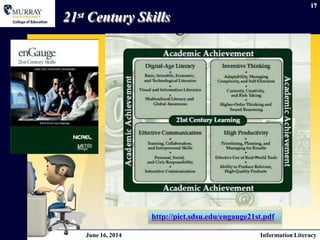
21st Century Skills
http://pict.sdsu.edu/engauge21st.pdf
Partnership for 21st Century Skills
18
http://www.p21.org/
A Wordle rendering of the P21 framework
19
http://www.wordle.net/show/wrdl/1218621/21st_Century_Skills
June 16, 2014 Information Literacy
Kentucky in P21
20
http://education.ky.gov/curriculum/docs/Pages/KY-Model-Curriculum-Framework.aspx
June 16, 2014 Information Literacy
Kentucky Model Curriculum
Framework 2011
21
http://education.ky.gov/curriculum/docs/Documents/Kentucky%20Model%20Curriculu
m%20Framework%202011%20revised%20July%2026.pdf /
June 16, 2014 Information Literacy
Kentucky’s thinking on 21st century skills
22
http://www.pbs.org/program/digital-media/
June 16, 2014 Information Literacy
Another 21st century organization
About ATC21S
• The Assessment and
Teaching of 21st-Century
Skills (ATC21S) is a
research project that proposes ways of
assessing 21st-century skills and
encourages teaching and adopting those
skills in the classroom.
23
June 16, 2014 Information Literacy
A 21st century process based on
Kuhlthau
Guided Inquiry
24
https://comminfo.rutgers.edu/~kuhlthau/docs/GI-School-Librarians-in-the-
21-Century.pdf
The book
Guided Inquiry:
Learning in the 21st Century
• Carol C. Kuhlthau, Leslie K. Maniotes,
and Ann K. Caspari
• October 2007, Libraries Unlimited
• Based on Kuhlthau’s six stage
Information Search Process, the authors present a
convincing argument for recasting Guided Inquiry as a
dynamic, innovative way of developing information
literacy. Part I discusses the theory and rationale behind
adopting a Guided Inquiry approach, as the authors
elucidate the expertise, roles, and responsibilities of each
member of the instructional team. Part II presents the
model in terms of its component parts. PreK-12.
25
How do we put it all together?
Use the school library!
*Now more than 20
states—including New
Jersey
26
27
June 16, 2014 Information Literacy
Another school library study
28
Phase 1 Report July 2010
Phase 2 Report Sept. 2011
http://www.njasl.info/wp-
content/NJ_study/2012_StudyOverview.pdf
June 16, 2014 Information Literacy
A Study from 2012
29
http://www.slj.com/2013/03/research/librarian-required-a-
new-study-shows-that-a-full-time-school-librarian-makes-
a-critical-difference-in-boosting-student-achievement/
http://paschoollibraryproject.org/research
June 16, 2014 Information Literacy
Where do these studies come from?
30
http://cissl.rutgers.edu/
June 16, 2014 Information Literacy
31
Keith Curry Lance
What Research Tells Us About the
Importance of School Libraries
• At this point . . . there is a clear consensus in
the results now [2002] available for eight
states*: School libraries are a powerful force
in the lives of America's children. The school
library is one of the few factors whose
contribution to academic achievement has
been documented empirically, and it is a
contribution that cannot be explained away
by other powerful influences on student
performance.
• White House Conference on School Libraries
• *19 states—see
*Now 21 states with
Pennsylvania 2012
32
A European view
School Library and School Librarianship
• The stream of information from TV channels,
Internet, CD-ROMs, computer programmes
etc. is unending. If the students, when they
become adult citizens, are not to feel lost and
helpless in the face of such rich sources of
information, they must learn [to] devise
personal strategies for information retrieval
while they are still at school. Information
Literacy and “strategies for independent
learning skill development” are key
components of any school library.
• From a White Paper by Gert Larsen, School Library
Advisor, Albertslund, Denmark, p. 7
• Part of Project GrandSlam - General Research and New
Development in School Libraries As Multimedia Learning
Centres
June 16, 2014 Information Literacy
33
The Key Concept?
Competence and comfort with information and
information sources
• Information literacy is the solution to Data Smog.
It allows us to cope by giving us the skills to know
when we need information and where to locate it
effectively and efficiently. It includes the
technological skills needed to use the modern
library as a gateway to information. It enables us
to analyze and evaluate the information we find,
thus giving us confidence in using that information
to make a decision or create a product.
• Introduction to Information Literacy, Association for College
and Research Libraries (a division of the American Library
Association)
Closing observation
34
http://www.kentuckyteacher.org/kentucky-teacher-of-the-year/2012/04/21st-century-skills-
need-21st-century-assessment/
June 16, 2014 Information Literacy

MIL Lesson 3.pptx

  • 1.
    Information Literacy: What Is It? Finding away through the word maze 2014
  • 2.
    June 16, 2014Information Literacy 2 Information Literacy information literacy (IL) • Skill in finding the information one needs, including an understanding of how libraries are organized, familiarity with the resources they provide (including information formats and automated search tools), and knowledge of commonly used research techniques. • ODLIS
  • 3.
    What is InformationLiteracy? http://campus.queens.edu/everett/M2.html [QUILT] 3
  • 4.
    QUILT’s definition This definitionis now at http://www.cilip.org.uk/get-involved/advocacy/information-literacy/pages/definition.aspx 4
  • 5.
    5 What is informationliteracy? Information Literacy • Information Literacy is a transformational process in which the learner needs to find, understand, evaluate, and use information in various forms to create for personal, social or global purposes. • Information Literacy shares a fundamental set of core thinking- and problem-solving meta-skills with other disciplines. Authentic cross-disciplinary problems which include observation and inference, analysis of symbols and models, comparison of perspectives, and assessment of the rhetorical context, engage students in developing mastery information literacy over time.
  • 6.
    Another concept Information Competencyfor Faculty at Rio Hondo College • As defined by the Academic Senate for California Community Colleges (1998), information competency is the ability to: • recognize the need for information, • acquire and evaluate information, • organize and maintain information, and • interpret and communicate information • What Is Information Competency? June 16, 2014 Information Literacy 6
  • 7.
    And then there’s“Information Competence”! What is Information Competence? • Information competence is the ability to find, evaluate, use, and communicate information in all of its various formats. It represents the integration of library literacy, computer literacy, media literacy, ethics, critical thinking, and communication skills. • For Faculty: Improving Student Research Skills and Building Information Competence 7
  • 8.
    8 Literacy, Competence orCompetency? http://www.slideshare.net/j_iona/embedding-information- literacy-in-a-competency-based-curriculum June 16, 2014 Information Literacy
  • 9.
    9 Adding to theconfusion of terms! Several other terms and combinations of terms have been also used by different authors: • ‘infoliteracy’, ‘informacy’, ‘information empowerment’, ‘information competence’, ‘information competency’, ‘information competencies’, ‘information literacy skills’, ‘information literacy and skills’, ‘skills of information literacy’, ‘information literacy competence’, ‘information literacy competencies’, ‘information competence skills’, ‘information handling skills’, ‘information problem solving’, ‘information problem solving skills’, ‘information fluency’, ‘information mediacy’ and even ‘information mastery’ • Sirje Virkus: “Information literacy in Europe: a literature review” Information Research, Vol. 8 No. 4, July 2003 Sirje Virkus June 16, 2014 Information Literacy
  • 10.
    June 16, 2014 10 Nowalso as Information Literacies Why the plural? • The use of the term “information literacies” emphasizes the complexity and multiplicity of skills and strategies involved in finding and using information. • Dianne Oberg: “Promoting Information Literacies: A Focus on Inquiry.” 70th IFLA General Conference and Council, 22-27 August 2004, Buenos Aires, Argentina http://www.ifla.org/IV/ifla70/papers/088e-Oberg.pdf Dr. Dianne Oberg
  • 11.
    Ju 11 A related termoften used outside library media circles • We learn best when we are at the center of our own learning. Inquiry-based learning is a learning process through questions generated from the interests, curiosities, and perspectives/experiences of the learner. When investigations grow from our own questions, curiosities, and experiences, learning is an organic and motivating process that is intrinsically enjoyable. • ne 16, 2014 Information Literacy Inquiry-based learning  http://www.inquirylearn.com/Inquirydef.htm
  • 12.
    12 Project, Problem, andInquiry-based Learning Explore the Approaches • Project-based learning, problem- based learning, and inquiry-based learning all three closely relate to the information processing approach. They all fit well with technology-rich learning environments where the focus is not on the hardware and software, but on the learning experience. • Project, Problem, and Inquiry-based Learning http://eduscapes.com/tap/topic43.htm June 16, 2014 Information Literacy
  • 13.
    13 Another Related Term Resource-BasedLearning • Resource-based learning actively involves students, teachers and teacher- librarians in the effective use of a wide range of print, non print and human resources . . . Students who use a wide range of resources in various mediums for learning have the opportunity to approach a theme, issue or topic of study in ways which allow for a range of learning styles and access to the theme or topic via cognitive or affective appeals. More • Resource-Based Learning: Approaches Information Literacy
  • 14.
    14 Yet another relatedterm Lifelong learning • Lifelong learning is the process of acquiring and expanding knowledge, skills, and dispositions throughout your life to foster well-being. It isn't about taking an adult pottery class or reading a nonfiction book occasionally. It's about the decisions you make and the problems you solve in everyday life. From enrolling in an structured, formal education program to considering whether to believe an infomercial's gimmick, lifelong learning takes many forms. June 16, 2014 Information Literacy
  • 15.
    The new emphasisfrom AASL (as well as others) 21st Century Skills 15 Standards for the 21st-Century Learner, AASL, 2007. Rights and permission on the use of the learning standards June 16, 2014 Information Literacy
  • 16.
    Why teach 21stcentury skills??  21st-Century learners may be tech-savvy, but they still can be overwhelmed: • . . . Today’s learners have grown up in a “wired” world. They have constant access to global information resources through computers and mobile devices, and they expect to be able to retrieve information instantly. This bold new generation questions the concept of cognitive authority as mob indexing an Wikipedia permeate the web. Learners are now surrounded by information, whether in print, online, or in sound bites of information. • Empowering Learners: Guidelines for School Library Media Programs. Chapter 1: Developing Visions for Learning. IV. The 21st-Century Learner, p. 11. 16
  • 17.
    June 16, 2014Information Literacy 17 21st Century Skills http://pict.sdsu.edu/engauge21st.pdf
  • 18.
    Partnership for 21stCentury Skills 18 http://www.p21.org/
  • 19.
    A Wordle renderingof the P21 framework 19 http://www.wordle.net/show/wrdl/1218621/21st_Century_Skills June 16, 2014 Information Literacy
  • 20.
  • 21.
    Kentucky Model Curriculum Framework2011 21 http://education.ky.gov/curriculum/docs/Documents/Kentucky%20Model%20Curriculu m%20Framework%202011%20revised%20July%2026.pdf / June 16, 2014 Information Literacy
  • 22.
    Kentucky’s thinking on21st century skills 22 http://www.pbs.org/program/digital-media/ June 16, 2014 Information Literacy
  • 23.
    Another 21st centuryorganization About ATC21S • The Assessment and Teaching of 21st-Century Skills (ATC21S) is a research project that proposes ways of assessing 21st-century skills and encourages teaching and adopting those skills in the classroom. 23 June 16, 2014 Information Literacy
  • 24.
    A 21st centuryprocess based on Kuhlthau Guided Inquiry 24 https://comminfo.rutgers.edu/~kuhlthau/docs/GI-School-Librarians-in-the- 21-Century.pdf
  • 25.
    The book Guided Inquiry: Learningin the 21st Century • Carol C. Kuhlthau, Leslie K. Maniotes, and Ann K. Caspari • October 2007, Libraries Unlimited • Based on Kuhlthau’s six stage Information Search Process, the authors present a convincing argument for recasting Guided Inquiry as a dynamic, innovative way of developing information literacy. Part I discusses the theory and rationale behind adopting a Guided Inquiry approach, as the authors elucidate the expertise, roles, and responsibilities of each member of the instructional team. Part II presents the model in terms of its component parts. PreK-12. 25
  • 26.
    How do weput it all together? Use the school library! *Now more than 20 states—including New Jersey 26
  • 27.
    27 June 16, 2014Information Literacy
  • 28.
    Another school librarystudy 28 Phase 1 Report July 2010 Phase 2 Report Sept. 2011 http://www.njasl.info/wp- content/NJ_study/2012_StudyOverview.pdf June 16, 2014 Information Literacy
  • 29.
    A Study from2012 29 http://www.slj.com/2013/03/research/librarian-required-a- new-study-shows-that-a-full-time-school-librarian-makes- a-critical-difference-in-boosting-student-achievement/ http://paschoollibraryproject.org/research June 16, 2014 Information Literacy
  • 30.
    Where do thesestudies come from? 30 http://cissl.rutgers.edu/ June 16, 2014 Information Literacy
  • 31.
    31 Keith Curry Lance WhatResearch Tells Us About the Importance of School Libraries • At this point . . . there is a clear consensus in the results now [2002] available for eight states*: School libraries are a powerful force in the lives of America's children. The school library is one of the few factors whose contribution to academic achievement has been documented empirically, and it is a contribution that cannot be explained away by other powerful influences on student performance. • White House Conference on School Libraries • *19 states—see *Now 21 states with Pennsylvania 2012
  • 32.
    32 A European view SchoolLibrary and School Librarianship • The stream of information from TV channels, Internet, CD-ROMs, computer programmes etc. is unending. If the students, when they become adult citizens, are not to feel lost and helpless in the face of such rich sources of information, they must learn [to] devise personal strategies for information retrieval while they are still at school. Information Literacy and “strategies for independent learning skill development” are key components of any school library. • From a White Paper by Gert Larsen, School Library Advisor, Albertslund, Denmark, p. 7 • Part of Project GrandSlam - General Research and New Development in School Libraries As Multimedia Learning Centres
  • 33.
    June 16, 2014Information Literacy 33 The Key Concept? Competence and comfort with information and information sources • Information literacy is the solution to Data Smog. It allows us to cope by giving us the skills to know when we need information and where to locate it effectively and efficiently. It includes the technological skills needed to use the modern library as a gateway to information. It enables us to analyze and evaluate the information we find, thus giving us confidence in using that information to make a decision or create a product. • Introduction to Information Literacy, Association for College and Research Libraries (a division of the American Library Association)
  • 34.