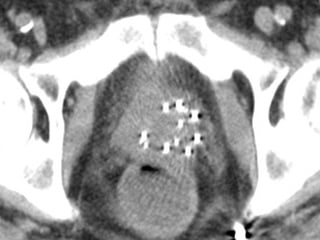
Management of low Risk Pca:


           Laurence Klotz
           Professor of Surgery
           Sunnybrook Health Sciences Centre
           University of Toronto
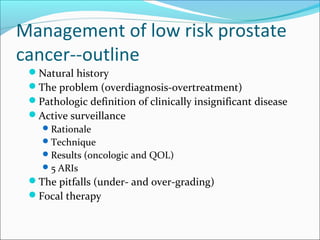
Management of low risk prostate
cancer--outline
 Natural history
 The problem (overdiagnosis-overtreatment)
 Pathologic definition of clinically insignificant disease
 Active surveillance
    Rationale
    Technique
    Results (oncologic and QOL)
    5 ARIs
 The pitfalls (under- and over-grading)
 Focal therapy
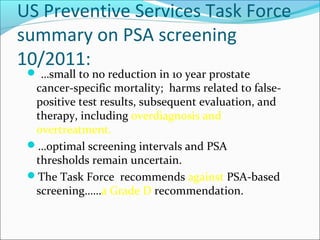
US Preventive Services Task Force
summary on PSA screening
10/2011:
  …small to no reduction in 10 year prostate
  cancer-specific mortality; harms related to false-
  positive test results, subsequent evaluation, and
  therapy, including overdiagnosis and
  overtreatment.
 …optimal screening intervals and PSA
  thresholds remain uncertain.
 The Task Force recommends against PSA-based
  screening……a Grade D recommendation.
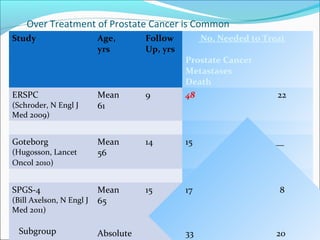
Over Treatment of Prostate Cancer is Common
Study                     Age,       Follow         No. Needed to Treat
                          yrs        Up, yrs
                                               Prostate Cancer
                                               Metastases
                                               Death
ERSPC                     Mean       9         48                    22
(Schroder, N Engl J       61
Med 2009)


Goteborg                  Mean       14        15                   __
(Hugosson, Lancet         56
Oncol 2010)


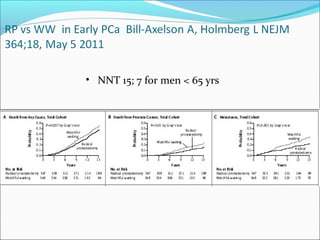
SPGS-4                    Mean       15        17                    8
(Bill Axelson, N Engl J   65
Med 2011)

  Subgroup                Absolute             33                    20
Management of Favorable Risk Prostate Cancer in the
       US


Hamilton AS et al, BJU Int 2010 (Data from SEER)
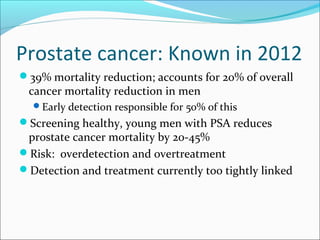
Prostate cancer: Known in 2012
39% mortality reduction; accounts for 20% of overall
 cancer mortality reduction in men
  Early detection responsible for 50% of this
Screening healthy, young men with PSA reduces
 prostate cancer mortality by 20-45%
Risk: overdetection and overtreatment
Detection and treatment currently too tightly linked
02/23/13
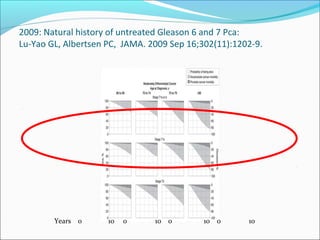
2009: Natural history of untreated Gleason 6 and 7 Pca:
Lu-Yao GL, Albertsen PC, JAMA. 2009 Sep 16;302(11):1202-9.


        Years 0      10   0     10 0        10 0      10
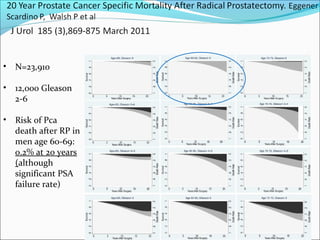
•   N=23,910

•   12,000 Gleason
    2-6

•   Risk of Pca
    death after RP in
    men age 60-69:
    0.2% at 20 years
    (although
    significant PSA
    failure rate)
•50% moderate -big
ED problem
•24% incontinence
problem
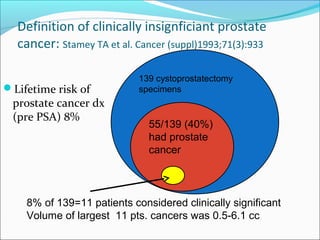
Definition of clinically insignficiant prostate
  cancer: Stamey TA et al. Cancer (suppl)1993;71(3):933

                            139 cystoprostatectomy
Lifetime risk of           specimens
 prostate cancer dx
 (pre PSA) 8%
                              55/139 (40%)
                              had prostate
                              cancer


    8% of 139=11 patients considered clinically significant
    Volume of largest 11 pts. cancers was 0.5-6.1 cc
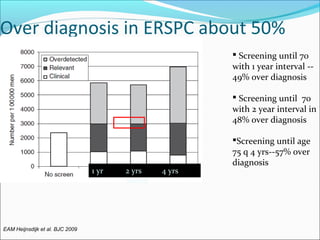
Over diagnosis in ERSPC about 50%
                                                            Screening until 70
                                                           with 1 year interval --
                                                           49% over diagnosis

                                                            Screening until 70
                                                           with 2 year interval in
                                                           48% over diagnosis

                                                           Screening until age
                                                           75 q 4 yrs--57% over
                                                           diagnosis
                                 1 yr   2 yrs      4 yrs
                                        Interval


EAM Heijnsdijk et al. BJC 2009
Stamey 1982                       Wolter et al, ERSPC
 •8% incidence of clinical Pca     •Diagnosis rate in unscreened
 •8% (11) of 139 cysto-            arm 50% of that in screened
 prostatectomy specimens had >     arm
 0.5 cc Gleason 3 or some 4        •Volume of 325 RP Cancers
 •4/3πr3 =1.0cc diameter sphere    •Threshold volume = 1.3 cc
                                   (1.4 cc diameter sphere)


                            1 cm

02/23/13
Watchful Waiting versus Surveillance
                   Watchful       Active
                   Waiting        Surveillance

    Primary aim     Avoid         Individualize
                    treatment     management
    Patient /Tumor Limited life   Fit for radical
    Characteristics expectancy/   treatment/
                    advanced      localized
                    disease       disease
    Treatment       Delayed       Early
    Timing
    Treatment       Palliative    Curative
    intent
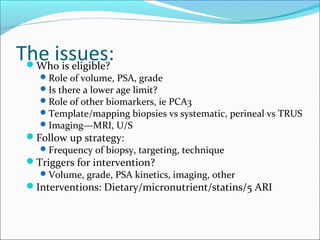
The issues:
 Who is eligible?
     Role of volume, PSA, grade
     Is there a lower age limit?
     Role of other biomarkers, ie PCA3
     Template/mapping biopsies vs systematic, perineal vs TRUS
     Imaging—MRI, U/S
 Follow up strategy:
    Frequency of biopsy, targeting, technique
 Triggers for intervention?
    Volume, grade, PSA kinetics, imaging, other
 Interventions: Dietary/micronutrient/statins/5 ARI
For Whom is Surveillance a Safe Management
Option?


                                         Favorable
                                         Risk
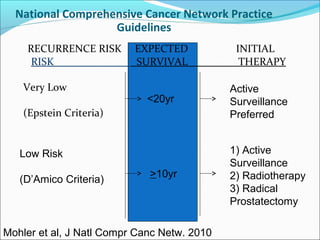
National Comprehensive Cancer Network Practice
                   Guidelines
    RECURRENCE RISK       EXPECTED            INITIAL
     RISK                 SURVIVAL             THERAPY

    Very Low                                 Active
                            <20yr            Surveillance
    (Epstein Criteria)                       Preferred


   Low Risk                                  1) Active
                                             Surveillance
                             >10yr           2) Radiotherapy
   (D’Amico Criteria)
                                             3) Radical
                                             Prostatectomy

Mohler et al, J Natl Compr Canc Netw. 2010
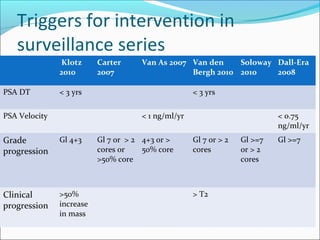
Triggers for intervention in
   surveillance series
               Klotz      Carter     Van As 2007 Van den    Soloway Dall-Era
               2010       2007                   Bergh 2010 2010    2008

PSA DT         < 3 yrs                              < 3 yrs

PSA Velocity                         < 1 ng/ml/yr                          < 0.75
                                                                           ng/ml/yr
Grade          Gl 4+3     Gl 7 or > 2 4+3 or >      Gl 7 or > 2   Gl >=7   Gl >=7
progression               cores or    50% core      cores         or > 2
                          >50% core                               cores


Clinical       >50%                                 > T2
progression    increase
               in mass
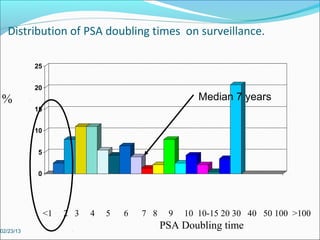
Distribution of PSA doubling times on surveillance.

           25


           20
%                                                    Median 7 years
           15


           10


           5


           0


                <1   2 3   4   5   6   7 8    9   10 10-15 20 30 40 50 100 >100
02/23/13
                                             PSA Doubling time
Follow-up
 Toronto (same as PRIAS)
    DRE/PSA every 3 months for 2yrs, then every 6 months
    Biopsy 6-12 months after enrollment, then every 3-4yrs
 Multi-institutional (Univ Miami, Univ British Columbia; MSKCC;
  Cleveland Clinic)
    DRE/PSA every 6-12 months
    Biopsy 18 months after enrollment, then every 1-3yrs
 Johns Hopkins
    DRE/PSA at 6 month intervals
    Biopsy annually until age 75yrs
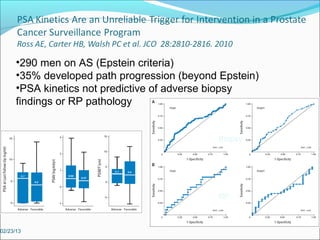
•290 men on AS (Epstein criteria)
      •35% developed path progression (beyond Epstein)
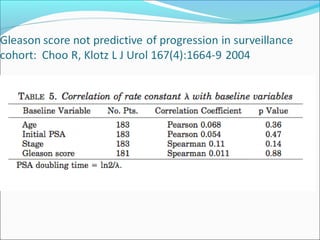
      •PSA kinetics not predictive of adverse biopsy
      findings or RP pathology


                                              Biopsy


                                              RP


02/23/13
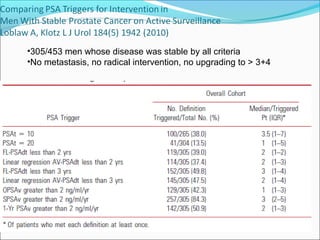
•305/453 men whose disease was stable by all criteria
•No metastasis, no radical intervention, no upgrading to > 3+4
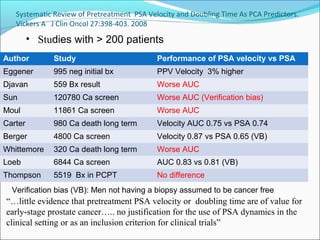
Systematic Review of Pretreatment PSA Velocity and Doubling Time As PCA Predictors.
   Vickers A J Clin Oncol 27:398-403. 2008

         • Studies with > 200 patients
Author        Study                         Performance of PSA velocity vs PSA
Eggener       995 neg initial bx            PPV Velocity 3% higher
Djavan        559 Bx result                 Worse AUC
Sun           120780 Ca screen              Worse AUC (Verification bias)
Moul          11861 Ca screen               Worse AUC
Carter        980 Ca death long term        Velocity AUC 0.75 vs PSA 0.74
Berger        4800 Ca screen                Velocity 0.87 vs PSA 0.65 (VB)
Whittemore    320 Ca death long term        Worse AUC
Loeb          6844 Ca screen                AUC 0.83 vs 0.81 (VB)
Thompson      5519 Bx in PCPT               No difference
  Verification bias (VB): Men not having a biopsy assumed to be cancer free
“…little evidence that pretreatment PSA velocity or doubling time are of value for
early-stage prostate cancer….. no justification for the use of PSA dynamics in the
clinical setting or as an inclusion criterion for clinical trials”
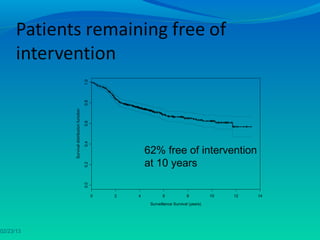
1.0
                                            0.8
           Survival distribution function
                                            0.6
                                            0.4


                                                              62% free of intervention
                                                              at 10 years
                                            0.2
                                            0.0


                                                  0   2   4           6            8           10   12   14
                                                               Surveillance Survival (years)


02/23/13
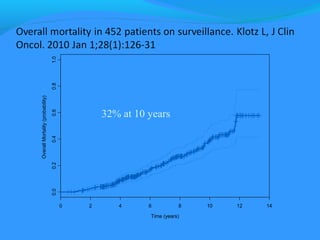
Overall Mortality (probability)
                    0.0   0.2          0.4             0.6           0.8   1.0


               0
               2
               4
               6
                                                   32% at 10 years


Time (years)
               8
               10
               12
               14
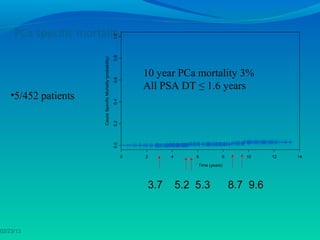
1.0
                                                               0.8
                      Cause Specific Mortality (probability)
                                                                         10 year PCa mortality 3%


                                                               0.6
                                                                         All PSA DT ≤ 1.6 years
    •5/452 patients
                                                               0.4
                                                               0.2
                                                               0.0


                                                                     0   2     4       6          8      10     12   14
                                                                                       Time (years)


                                                                         3.7       5.2 5.3            8.7 9.6


02/23/13
Summary of active surveillance studies
      Author          N       Median pT3 in RP OS            CSS
                              F/U mo pts
      Van As Eur Uro 326      22     8/18 44% 98             100

      Carter J Urol   407     41         10/49      98       100
                                         20%
      PRIAS           533-    48         4/24 17%   90       99
                      2000
      Soloway         99      45         0/2        100      100
      Roemeling       278     41                    89       100
      Khatami         270     63                    Not      100
                                                    stated
      Klotz JCO       452     73         14/24      82       97 @
                                         (58%)               10 yrs
      Total           2130-   43                    90       99.7
                      4000
• NNT 15; 7 for men < 65 yrs
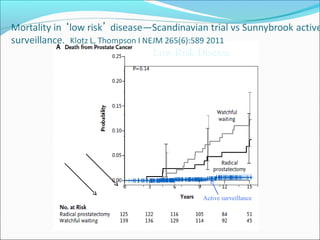
Low Risk Disease


                      1.0
                      0.8
 Cause Specific Mortality (probability)
0.2            0.4    0.0      0.6


                                          0   2    4   6           8        10      12       14
                                                        Time (years)   Active surveillance
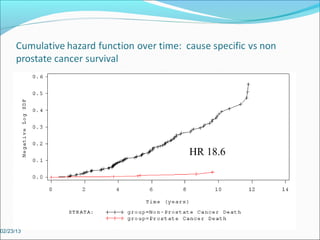
HR 18.6


02/23/13
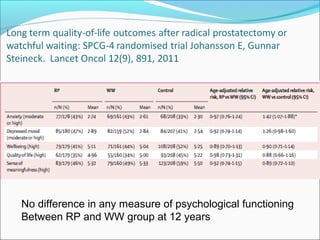
No difference in any measure of psychological functioning
Between RP and WW group at 12 years
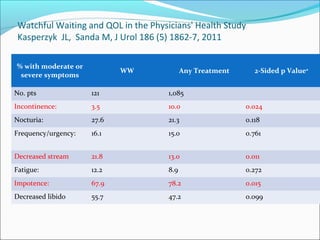
Watchful Waiting and QOL in the Physicians' Health Study
 Kasperzyk JL, Sanda M, J Urol 186 (5) 1862-7, 2011

% with moderate or
                            WW              Any Treatment      2-Sided p Value⁎
 severe symptoms

No. pts              121              1,085
Incontinence:        3.5              10.0                  0.024
Nocturia:            27.6             21.3                  0.118
Frequency/urgency:   16.1             15.0                  0.761


Decreased stream     21.8             13.0                  0.011
Fatigue:             12.2             8.9                   0.272
Impotence:           67.9             78.2                  0.015
Decreased libido     55.7             47.2                  0.099
Active surveillance and health-related QOL: results of the Finnish arm of a
prospective trial
Vasarainen H et al, BJU Int Epub 1 NOV 2011


 RAND-36 score          Inclusion        After 1 year on AS   P value


 Physical functioning   91 (13.6)        90 (12.9)            0.608

 Role physical          81 (34.2)        89 (25.7)            0.010
 Role emotional         82 (32.6)        88 (29.0)            0.052
 Vitality               76 (15.7)        76 (16.0)            0.582
 Mental health          81 (14.9)        81 (14.1)            0.696
 Social functioning     91 (14.4)        93 (14.0)            0.279
 Body pain              90 (15.6)        87 (18.7)            0.149
 General health         65 (15.2)        65 (16.3)            0.780


      N=75
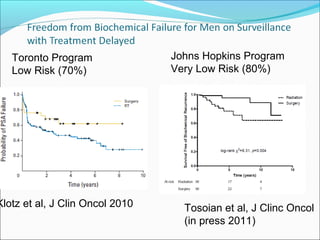
Toronto Program               Johns Hopkins Program
   Low Risk (70%)                Very Low Risk (80%)


Klotz et al, J Clin Oncol 2010     Tosoian et al, J Clinc Oncol
                                   (in press 2011)
Major Limitations of Current Paradigm:
Misclassification of Risk
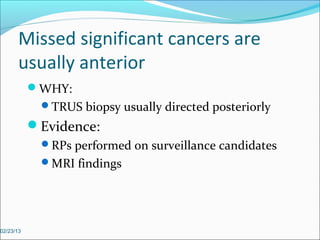
Missed significant cancers are
      usually anterior
           WHY:
            TRUS biopsy usually directed posteriorly
           Evidence:
            RPs performed on surveillance candidates
            MRI findings


02/23/13
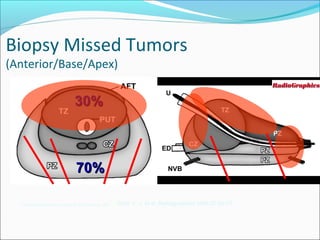
Biopsy Missed Tumors
(Anterior/Base/Apex)

                                  30%


                                   70%

  Copyright ©Radiological Society of North America, 2007   Choi, Y. J. et al. Radiographics 2007;27:63-75
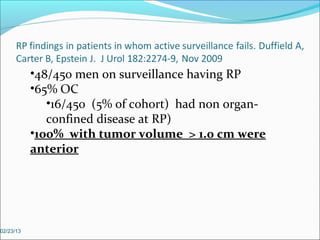
•48/450 men on surveillance having RP
           •65% OC
              •16/450 (5% of cohort) had non organ-
              confined disease at RP)
           •100% with tumor volume > 1.0 cm were
           anterior


02/23/13
•Negative predictive value
for ‘clinically significant’
PCa 95-98%
MRI Impacting Management


 65 yr old, PSA 5, one core positive for Gleason 6 (right)
 MRI: Large tumor in right anterior prostate with gross extra-
  capsular extension
• Trigger for intervention/targeted biopsy
•25% of surveillance
candidates
•Condordance between
GU pathologists for
these lesions 27%

McKenney J, Carroll P
J Urol 2011 186 (2), pg.
465-469
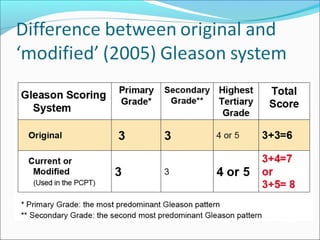
Modified Gleason scoring 2005:
 Grade inflation
  Reference                     Traditional Gleason   Modified Gleason
  Helpap Gleason 6             48%                    22%
           Gleason 7           26%                    68%
  Billis   Gleason 6           68%                    49%
           Gleason 7           26%                    39%


Helpap B Virchows Arch 2006 Dec;449(6):622-7
Billis A J Urol. 2008 Aug;180(2):548-52
Time to progression for patients with low- and
 intermediate-risk prostate cancer on surveillance.
                     • 90 men with intermediate risk disease
                     • 1/3 had Gleason 7, 2/3 PSA > 10
                     • No diffrence in any outcome compared to low risk


                 Cooperberg M R et al. JCO 2011;29:228-234
©2011 by American Society of Clinical Oncology
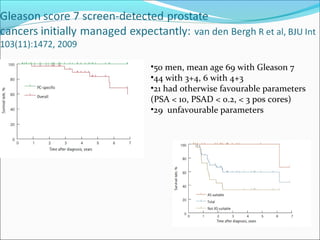
•50 men, mean age 69 with Gleason 7
•44 with 3+4, 6 with 4+3
•21 had otherwise favourable parameters
(PSA < 10, PSAD < 0.2, < 3 pos cores)
•29 unfavourable parameters
Biomarkers in active surveillance
Challenge: Interrogation of microfocal Gleason 6 in
 PZ to reveal occult high grade anterior cancer
‘Cancerization’—is it real
PCA3: Does not appear to correlate with higher grade
 cancer
Aureon: Systems pathology approach—promising
Many others in development
  Mitochondrial deletion assay
  SNPs
  Gene expression panel
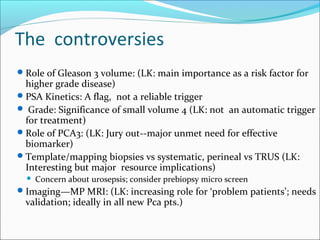
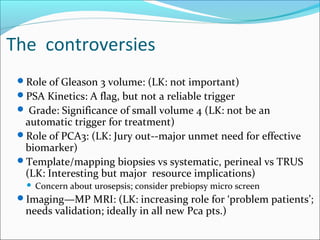
The controversies
 Role of Gleason 3 volume: (LK: main importance as a risk factor for
  higher grade disease)
 PSA Kinetics: A flag, not a reliable trigger
 Grade: Significance of small volume 4 (LK: not an automatic trigger
  for treatment)
 Role of PCA3: (LK: Jury out--major unmet need for effective
  biomarker)
 Template/mapping biopsies vs systematic, perineal vs TRUS (LK:
  Interesting but major resource implications)
     Concern about urosepsis; consider prebiopsy micro screen
 Imaging—MP MRI: (LK: increasing role for ‘problem patients’; needs
  validation; ideally in all new Pca pts.)
We need to communicate a difference
                                     message.


02/23/13
Tsunami of information: physicians, media, friends


Treatment outcomes                           Medical labyrinth

                     PANIC


Loss of autonomy                   Evidence based approach
                      Guidelines
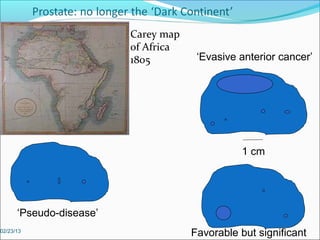
Carey map
                             of Africa
                         ‘   1805         ‘Evasive anterior cancer’


                                                    1 cm


      ‘Pseudo-disease’
02/23/13
                                         Favorable but significant
•   302 patients on surveillance randomized between dutasteride and
    placebo


    Relative Risk Reduction         44.3%                                             57.4%%
                                  P = 0.009                                      P = 0.007
                                              REDEEM: DS Figure 7.1, Table 7.4
The controversies
 Role of Gleason 3 volume: (LK: not important)
 PSA Kinetics: A flag, but not a reliable trigger
  Grade: Significance of small volume 4 (LK: not be an
  automatic trigger for treatment)
 Role of PCA3: (LK: Jury out--major unmet need for effective
  biomarker)
 Template/mapping biopsies vs systematic, perineal vs TRUS
  (LK: Interesting but major resource implications)
      Concern about urosepsis; consider prebiopsy micro screen
 Imaging—MP MRI: (LK: increasing role for ‘problem patients’;
  needs validation; ideally in all new Pca pts.)
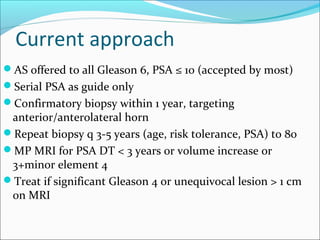
Current approach
AS offered to all Gleason 6, PSA ≤ 10 (accepted by most)
Serial PSA as guide only
Confirmatory biopsy within 1 year, targeting
 anterior/anterolateral horn
Repeat biopsy q 3-5 years (age, risk tolerance, PSA) to 80
MP MRI for PSA DT < 3 years or volume increase or
 3+minor element 4
Treat if significant Gleason 4 or unequivocal lesion > 1 cm
 on MRI
Focal Therapy

    Not all cancer has the potential to
    progress to invasive and metastatic
    cancer

    Novel imaging and precision biopsy
    can identify those lesions that are
    likely to progress

    Selective therapy to Clinically
    Significant lesions alone will be as
    effective as whole-gland treatment
    and carry less harm
Focal cryotherapy for localized prostate cancer: a report
 from the national Cryo On‐ Line Database (COLD) Registry


BJU International
pages no-no, 28 OCT 2011 DOI: 10.1111/j.1464-410X.2011.10578.x
http://onlinelibrary.wiley.com/doi/10.1111/j.1464-410X.2011.10578.x/full#f3
Focal Cryo Outcomes
Urinary continence (pad-free) 98.4%
Maintenance of spontaneous erections 58.1%
Prostate biopsy performed in 164/1160 (14.1%)
  Positive in 43 (26.3%) of those suspected of cancer
   recurrence
  Positive in 3.7% (43/1160) of treated patients.
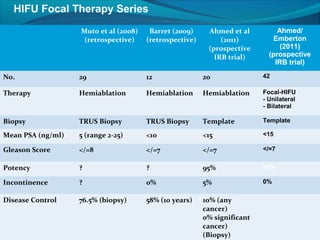
HIFU Focal Therapy Series
                   Muto et al (2008)    Barret (2009)     Ahmed et al          Ahmed/
                    (retrospective)    (retrospective)        (2011)         Emberton
                                                          (prospective          (2011)
                                                            IRB trial)      (prospective
                                                                              IRB trial)

No.                29                  12                20               42

Therapy            Hemiablation        Hemiablation      Hemiablation     Focal-HIFU
                                                                          - Unilateral
                                                                          - Bilateral

Biopsy             TRUS Biopsy         TRUS Biopsy       Template         Template

Mean PSA (ng/ml)   5 (range 2-25)      <10               <15              <15

Gleason Score      </=8                </=7              </=7             </=7


Potency            ?                   ?                 95%              90%

Incontinence       ?                   0%                5%               0%


Disease Control    76.5% (biopsy)      58% (10 years)    10% (any
                                                         cancer)
                                                         0% significant
                                                         cancer)
                                                         (Biopsy)
63
64
65
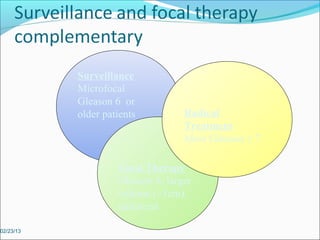
Surveillance
           Microfocal
           Gleason 6 or
           older patients          Radical
                                   Treatment
                                   Most Gleason ≥ 7

                    Focal Therapy
                    Gleason 6, larger
                    volume (>1cm),
                    unilateral

02/23/13
Low risk prostate cancer:
   Conclusions
Gleason pattern 3 very low metastatic potential
    ?Pseudo-cancer
 Main issue is missed higher grade cancers
Surveillance ‘a’ standard of care
    Safe in intermediate time frame
    RR Other Cause to PCa Mortality 19:1
    Validation of intervention triggers a priority
Increasing acceptance in North America
  Epidemiology, screening studies
  natural history
An evolving strategy (MRI, biomarkers)
Complementary to focal therapy—Brachy/Cryo/HIFU/Laser

Module 8 Dr Klotz-LowRiskPC

  • 1.
    Management of lowRisk Pca: Laurence Klotz Professor of Surgery Sunnybrook Health Sciences Centre University of Toronto
  • 2.
    Management of lowrisk prostate cancer--outline Natural history The problem (overdiagnosis-overtreatment) Pathologic definition of clinically insignificant disease Active surveillance  Rationale  Technique  Results (oncologic and QOL)  5 ARIs The pitfalls (under- and over-grading) Focal therapy
  • 4.
    US Preventive ServicesTask Force summary on PSA screening 10/2011:  …small to no reduction in 10 year prostate cancer-specific mortality; harms related to false- positive test results, subsequent evaluation, and therapy, including overdiagnosis and overtreatment. …optimal screening intervals and PSA thresholds remain uncertain. The Task Force recommends against PSA-based screening……a Grade D recommendation.
  • 5.
    Over Treatment ofProstate Cancer is Common Study Age, Follow No. Needed to Treat yrs Up, yrs Prostate Cancer Metastases Death ERSPC Mean 9 48 22 (Schroder, N Engl J 61 Med 2009) Goteborg Mean 14 15 __ (Hugosson, Lancet 56 Oncol 2010) SPGS-4 Mean 15 17 8 (Bill Axelson, N Engl J 65 Med 2011) Subgroup Absolute 33 20
  • 6.
    Management of FavorableRisk Prostate Cancer in the US Hamilton AS et al, BJU Int 2010 (Data from SEER)
  • 7.
    Prostate cancer: Knownin 2012 39% mortality reduction; accounts for 20% of overall cancer mortality reduction in men Early detection responsible for 50% of this Screening healthy, young men with PSA reduces prostate cancer mortality by 20-45% Risk: overdetection and overtreatment Detection and treatment currently too tightly linked
  • 8.
  • 9.
    2009: Natural historyof untreated Gleason 6 and 7 Pca: Lu-Yao GL, Albertsen PC, JAMA. 2009 Sep 16;302(11):1202-9. Years 0 10 0 10 0 10 0 10
  • 10.
    N=23,910 • 12,000 Gleason 2-6 • Risk of Pca death after RP in men age 60-69: 0.2% at 20 years (although significant PSA failure rate)
  • 11.
    •50% moderate -big EDproblem •24% incontinence problem
  • 13.
    Definition of clinicallyinsignficiant prostate cancer: Stamey TA et al. Cancer (suppl)1993;71(3):933 139 cystoprostatectomy Lifetime risk of specimens prostate cancer dx (pre PSA) 8% 55/139 (40%) had prostate cancer 8% of 139=11 patients considered clinically significant Volume of largest 11 pts. cancers was 0.5-6.1 cc
  • 14.
    Over diagnosis inERSPC about 50%  Screening until 70 with 1 year interval -- 49% over diagnosis  Screening until 70 with 2 year interval in 48% over diagnosis Screening until age 75 q 4 yrs--57% over diagnosis 1 yr 2 yrs 4 yrs Interval EAM Heijnsdijk et al. BJC 2009
  • 15.
    Stamey 1982 Wolter et al, ERSPC •8% incidence of clinical Pca •Diagnosis rate in unscreened •8% (11) of 139 cysto- arm 50% of that in screened prostatectomy specimens had > arm 0.5 cc Gleason 3 or some 4 •Volume of 325 RP Cancers •4/3πr3 =1.0cc diameter sphere •Threshold volume = 1.3 cc (1.4 cc diameter sphere) 1 cm 02/23/13
  • 16.
    Watchful Waiting versusSurveillance Watchful Active Waiting Surveillance Primary aim Avoid Individualize treatment management Patient /Tumor Limited life Fit for radical Characteristics expectancy/ treatment/ advanced localized disease disease Treatment Delayed Early Timing Treatment Palliative Curative intent
  • 17.
    The issues: Whois eligible?  Role of volume, PSA, grade  Is there a lower age limit?  Role of other biomarkers, ie PCA3  Template/mapping biopsies vs systematic, perineal vs TRUS  Imaging—MRI, U/S Follow up strategy:  Frequency of biopsy, targeting, technique Triggers for intervention?  Volume, grade, PSA kinetics, imaging, other Interventions: Dietary/micronutrient/statins/5 ARI
  • 18.
    For Whom isSurveillance a Safe Management Option? Favorable Risk
  • 19.
    National Comprehensive CancerNetwork Practice Guidelines RECURRENCE RISK EXPECTED INITIAL RISK SURVIVAL THERAPY Very Low Active <20yr Surveillance (Epstein Criteria) Preferred Low Risk 1) Active Surveillance >10yr 2) Radiotherapy (D’Amico Criteria) 3) Radical Prostatectomy Mohler et al, J Natl Compr Canc Netw. 2010
  • 20.
    Triggers for interventionin surveillance series Klotz Carter Van As 2007 Van den Soloway Dall-Era 2010 2007 Bergh 2010 2010 2008 PSA DT < 3 yrs < 3 yrs PSA Velocity < 1 ng/ml/yr < 0.75 ng/ml/yr Grade Gl 4+3 Gl 7 or > 2 4+3 or > Gl 7 or > 2 Gl >=7 Gl >=7 progression cores or 50% core cores or > 2 >50% core cores Clinical >50% > T2 progression increase in mass
  • 21.
    Distribution of PSAdoubling times on surveillance. 25 20 % Median 7 years 15 10 5 0 <1 2 3 4 5 6 7 8 9 10 10-15 20 30 40 50 100 >100 02/23/13 PSA Doubling time
  • 22.
    Follow-up  Toronto (sameas PRIAS)  DRE/PSA every 3 months for 2yrs, then every 6 months  Biopsy 6-12 months after enrollment, then every 3-4yrs  Multi-institutional (Univ Miami, Univ British Columbia; MSKCC; Cleveland Clinic)  DRE/PSA every 6-12 months  Biopsy 18 months after enrollment, then every 1-3yrs  Johns Hopkins  DRE/PSA at 6 month intervals  Biopsy annually until age 75yrs
  • 23.
    •290 men onAS (Epstein criteria) •35% developed path progression (beyond Epstein) •PSA kinetics not predictive of adverse biopsy findings or RP pathology Biopsy RP 02/23/13
  • 24.
    •305/453 men whosedisease was stable by all criteria •No metastasis, no radical intervention, no upgrading to > 3+4
  • 25.
    Systematic Review ofPretreatment PSA Velocity and Doubling Time As PCA Predictors. Vickers A J Clin Oncol 27:398-403. 2008 • Studies with > 200 patients Author Study Performance of PSA velocity vs PSA Eggener 995 neg initial bx PPV Velocity 3% higher Djavan 559 Bx result Worse AUC Sun 120780 Ca screen Worse AUC (Verification bias) Moul 11861 Ca screen Worse AUC Carter 980 Ca death long term Velocity AUC 0.75 vs PSA 0.74 Berger 4800 Ca screen Velocity 0.87 vs PSA 0.65 (VB) Whittemore 320 Ca death long term Worse AUC Loeb 6844 Ca screen AUC 0.83 vs 0.81 (VB) Thompson 5519 Bx in PCPT No difference Verification bias (VB): Men not having a biopsy assumed to be cancer free “…little evidence that pretreatment PSA velocity or doubling time are of value for early-stage prostate cancer….. no justification for the use of PSA dynamics in the clinical setting or as an inclusion criterion for clinical trials”
  • 26.
    1.0 0.8 Survival distribution function 0.6 0.4 62% free of intervention at 10 years 0.2 0.0 0 2 4 6 8 10 12 14 Surveillance Survival (years) 02/23/13
  • 27.
    Overall Mortality (probability) 0.0 0.2 0.4 0.6 0.8 1.0 0 2 4 6 32% at 10 years Time (years) 8 10 12 14
  • 28.
    1.0 0.8 Cause Specific Mortality (probability) 10 year PCa mortality 3% 0.6 All PSA DT ≤ 1.6 years •5/452 patients 0.4 0.2 0.0 0 2 4 6 8 10 12 14 Time (years) 3.7 5.2 5.3 8.7 9.6 02/23/13
  • 30.
    Summary of activesurveillance studies Author N Median pT3 in RP OS CSS F/U mo pts Van As Eur Uro 326 22 8/18 44% 98 100 Carter J Urol 407 41 10/49 98 100 20% PRIAS 533- 48 4/24 17% 90 99 2000 Soloway 99 45 0/2 100 100 Roemeling 278 41 89 100 Khatami 270 63 Not 100 stated Klotz JCO 452 73 14/24 82 97 @ (58%) 10 yrs Total 2130- 43 90 99.7 4000
  • 31.
    • NNT 15;7 for men < 65 yrs
  • 32.
    Low Risk Disease 1.0 0.8 Cause Specific Mortality (probability) 0.2 0.4 0.0 0.6 0 2 4 6 8 10 12 14 Time (years) Active surveillance
  • 33.
  • 34.
    No difference inany measure of psychological functioning Between RP and WW group at 12 years
  • 35.
    Watchful Waiting andQOL in the Physicians' Health Study Kasperzyk JL, Sanda M, J Urol 186 (5) 1862-7, 2011 % with moderate or WW Any Treatment 2-Sided p Value⁎ severe symptoms No. pts 121 1,085 Incontinence: 3.5 10.0 0.024 Nocturia: 27.6 21.3 0.118 Frequency/urgency: 16.1 15.0 0.761 Decreased stream 21.8 13.0 0.011 Fatigue: 12.2 8.9 0.272 Impotence: 67.9 78.2 0.015 Decreased libido 55.7 47.2 0.099
  • 36.
    Active surveillance andhealth-related QOL: results of the Finnish arm of a prospective trial Vasarainen H et al, BJU Int Epub 1 NOV 2011 RAND-36 score Inclusion After 1 year on AS P value Physical functioning 91 (13.6) 90 (12.9) 0.608 Role physical 81 (34.2) 89 (25.7) 0.010 Role emotional 82 (32.6) 88 (29.0) 0.052 Vitality 76 (15.7) 76 (16.0) 0.582 Mental health 81 (14.9) 81 (14.1) 0.696 Social functioning 91 (14.4) 93 (14.0) 0.279 Body pain 90 (15.6) 87 (18.7) 0.149 General health 65 (15.2) 65 (16.3) 0.780 N=75
  • 37.
    Toronto Program Johns Hopkins Program Low Risk (70%) Very Low Risk (80%) Klotz et al, J Clin Oncol 2010 Tosoian et al, J Clinc Oncol (in press 2011)
  • 38.
    Major Limitations ofCurrent Paradigm: Misclassification of Risk
  • 39.
    Missed significant cancersare usually anterior WHY: TRUS biopsy usually directed posteriorly Evidence: RPs performed on surveillance candidates MRI findings 02/23/13
  • 40.
    Biopsy Missed Tumors (Anterior/Base/Apex) 30% 70% Copyright ©Radiological Society of North America, 2007 Choi, Y. J. et al. Radiographics 2007;27:63-75
  • 41.
    •48/450 men onsurveillance having RP •65% OC •16/450 (5% of cohort) had non organ- confined disease at RP) •100% with tumor volume > 1.0 cm were anterior 02/23/13
  • 42.
    •Negative predictive value for‘clinically significant’ PCa 95-98%
  • 43.
    MRI Impacting Management 65 yr old, PSA 5, one core positive for Gleason 6 (right)  MRI: Large tumor in right anterior prostate with gross extra- capsular extension • Trigger for intervention/targeted biopsy
  • 45.
    •25% of surveillance candidates •Condordancebetween GU pathologists for these lesions 27% McKenney J, Carroll P J Urol 2011 186 (2), pg. 465-469
  • 46.
    Modified Gleason scoring2005: Grade inflation Reference Traditional Gleason Modified Gleason Helpap Gleason 6 48% 22% Gleason 7 26% 68% Billis Gleason 6 68% 49% Gleason 7 26% 39% Helpap B Virchows Arch 2006 Dec;449(6):622-7 Billis A J Urol. 2008 Aug;180(2):548-52
  • 48.
    Time to progressionfor patients with low- and intermediate-risk prostate cancer on surveillance. • 90 men with intermediate risk disease • 1/3 had Gleason 7, 2/3 PSA > 10 • No diffrence in any outcome compared to low risk Cooperberg M R et al. JCO 2011;29:228-234 ©2011 by American Society of Clinical Oncology
  • 49.
    •50 men, meanage 69 with Gleason 7 •44 with 3+4, 6 with 4+3 •21 had otherwise favourable parameters (PSA < 10, PSAD < 0.2, < 3 pos cores) •29 unfavourable parameters
  • 50.
    Biomarkers in activesurveillance Challenge: Interrogation of microfocal Gleason 6 in PZ to reveal occult high grade anterior cancer ‘Cancerization’—is it real PCA3: Does not appear to correlate with higher grade cancer Aureon: Systems pathology approach—promising Many others in development Mitochondrial deletion assay SNPs Gene expression panel
  • 51.
    The controversies  Roleof Gleason 3 volume: (LK: main importance as a risk factor for higher grade disease)  PSA Kinetics: A flag, not a reliable trigger  Grade: Significance of small volume 4 (LK: not an automatic trigger for treatment)  Role of PCA3: (LK: Jury out--major unmet need for effective biomarker)  Template/mapping biopsies vs systematic, perineal vs TRUS (LK: Interesting but major resource implications)  Concern about urosepsis; consider prebiopsy micro screen  Imaging—MP MRI: (LK: increasing role for ‘problem patients’; needs validation; ideally in all new Pca pts.)
  • 52.
    We need tocommunicate a difference message. 02/23/13
  • 53.
    Tsunami of information:physicians, media, friends Treatment outcomes Medical labyrinth PANIC Loss of autonomy Evidence based approach Guidelines
  • 54.
    Carey map of Africa ‘ 1805 ‘Evasive anterior cancer’ 1 cm ‘Pseudo-disease’ 02/23/13 Favorable but significant
  • 55.
    302 patients on surveillance randomized between dutasteride and placebo Relative Risk Reduction 44.3% 57.4%% P = 0.009 P = 0.007 REDEEM: DS Figure 7.1, Table 7.4
  • 56.
    The controversies Roleof Gleason 3 volume: (LK: not important) PSA Kinetics: A flag, but not a reliable trigger  Grade: Significance of small volume 4 (LK: not be an automatic trigger for treatment) Role of PCA3: (LK: Jury out--major unmet need for effective biomarker) Template/mapping biopsies vs systematic, perineal vs TRUS (LK: Interesting but major resource implications)  Concern about urosepsis; consider prebiopsy micro screen Imaging—MP MRI: (LK: increasing role for ‘problem patients’; needs validation; ideally in all new Pca pts.)
  • 57.
    Current approach AS offeredto all Gleason 6, PSA ≤ 10 (accepted by most) Serial PSA as guide only Confirmatory biopsy within 1 year, targeting anterior/anterolateral horn Repeat biopsy q 3-5 years (age, risk tolerance, PSA) to 80 MP MRI for PSA DT < 3 years or volume increase or 3+minor element 4 Treat if significant Gleason 4 or unequivocal lesion > 1 cm on MRI
  • 58.
    Focal Therapy Not all cancer has the potential to progress to invasive and metastatic cancer Novel imaging and precision biopsy can identify those lesions that are likely to progress Selective therapy to Clinically Significant lesions alone will be as effective as whole-gland treatment and carry less harm
  • 59.
    Focal cryotherapy forlocalized prostate cancer: a report from the national Cryo On‐ Line Database (COLD) Registry BJU International pages no-no, 28 OCT 2011 DOI: 10.1111/j.1464-410X.2011.10578.x http://onlinelibrary.wiley.com/doi/10.1111/j.1464-410X.2011.10578.x/full#f3
  • 60.
    Focal Cryo Outcomes Urinarycontinence (pad-free) 98.4% Maintenance of spontaneous erections 58.1% Prostate biopsy performed in 164/1160 (14.1%) Positive in 43 (26.3%) of those suspected of cancer recurrence Positive in 3.7% (43/1160) of treated patients.
  • 62.
    HIFU Focal TherapySeries Muto et al (2008) Barret (2009) Ahmed et al Ahmed/ (retrospective) (retrospective) (2011) Emberton (prospective (2011) IRB trial) (prospective IRB trial) No. 29 12 20 42 Therapy Hemiablation Hemiablation Hemiablation Focal-HIFU - Unilateral - Bilateral Biopsy TRUS Biopsy TRUS Biopsy Template Template Mean PSA (ng/ml) 5 (range 2-25) <10 <15 <15 Gleason Score </=8 </=7 </=7 </=7 Potency ? ? 95% 90% Incontinence ? 0% 5% 0% Disease Control 76.5% (biopsy) 58% (10 years) 10% (any cancer) 0% significant cancer) (Biopsy)
  • 63.
  • 64.
  • 65.
  • 66.
    Surveillance Microfocal Gleason 6 or older patients Radical Treatment Most Gleason ≥ 7 Focal Therapy Gleason 6, larger volume (>1cm), unilateral 02/23/13
  • 67.
    Low risk prostatecancer: Conclusions Gleason pattern 3 very low metastatic potential  ?Pseudo-cancer  Main issue is missed higher grade cancers Surveillance ‘a’ standard of care  Safe in intermediate time frame  RR Other Cause to PCa Mortality 19:1  Validation of intervention triggers a priority Increasing acceptance in North America Epidemiology, screening studies natural history An evolving strategy (MRI, biomarkers) Complementary to focal therapy—Brachy/Cryo/HIFU/Laser