Prostate Cancer Landscape II
    Additional Variables
          Mark Scholz MD
   Prostate Oncology Specialists
 Prostate Cancer Research Institute
Treatment Options and Patient Variables
• Newly Diagnosed
   – Low, Intermediate & High
   – A Bitch (and then theirs surgery)
• PSA Relapse
   – Lower and Higher Risk
   – Choir
• Advanced
   – Lower and Higher Risk
   – BITCH
Personality Traits of Successful
                   Leaders
•   Honest
•   Collaborative
•   Knowledgeable
•   Good listening skills
•   Perspective vs. depth of knowledge
    – Knowledge is readily accessible
    – Perspective is what is really valued
• Stay within bounds of your abilities
    – don’t sacrifice your credibility by guessing
We are Promoting Treatment
Decisions to Be Made by Patients
• They are playing in a high-stakes game
  with a diagnosis that emotionally hits
  very close to home
• We are dealing with amateurs
  operating outside their usual
  expertise
• Most people are very limited in their
  understanding of statistics
Decision-Making Dynamics are often
    Interrelated with Significant Others

•   Recent marriage
•   Already sexually inactive
•   Pleasing yourself vs. others
•   Dealing with ignorance in family members
•   Who do you tell about the diagnosis?
People Who Benefit from Education

• Able to comprehend that prostate cancer is
  distinctly different from other cancers
• Able to grade the quality of different
  information sources
• Able to withhold judgment until all the info is
  gathered, “Don’t jump to conclusions.”
• Able to put in sufficient time to learn
• Able to see value in maintaining Quality of Life
Personality Types of Difficult Patients
• Already know the answers
• Over-reliance on case studies
  – “my next door neighbor Sam…”
• Already joined a” fraternity” of specific
  treatment type
• Mentally frozen by fear
• Black and white thinking process, i.e. have no
  clue about statistics.
Patient Characteristics Vary
• Advance age or poor health
   – High-Risk goes to Intermediate
   – Intermediate goes to Low-Risk
• Absent potency or low libido
   – Defuses fears about local therapy
• Increased prostate size, TURP or increased AUA
  score (preexisting urinary problems)
   – Impacts decisions about local therapy with seed
     implants or IMRT
   – May suggest the need for hormonal therapy?
• Outcome from preexisting treatment
Landscape II
              Additional Variables
• Getting a handle on the risk of mortality
• Limitations of predictive technology
   – Outcomes reported as percentages (statistics)
• Physician limitations
   – Specialties only educated in part of the picture
   – Variable skill levels of doctors—Quality control issues
   – Conflicts of financial interest
• Rapidly changing technology
   – A bad disease today may be very treatable in the
     future
   – Medical consensus lags behind technology
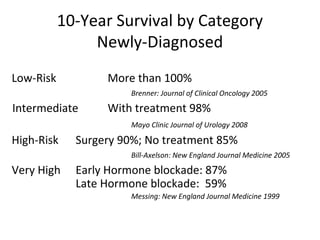
10-Year Survival by Category
                Newly-Diagnosed
Low-Risk          More than 100%
                      Brenner: Journal of Clinical Oncology 2005

Intermediate      With treatment 98%
                      Mayo Clinic Journal of Urology 2008

High-Risk    Surgery 90%; No treatment 85%
                      Bill-Axelson: New England Journal Medicine 2005

Very High    Early Hormone blockade: 87%
             Late Hormone blockade: 59%
                      Messing: New England Journal Medicine 1999
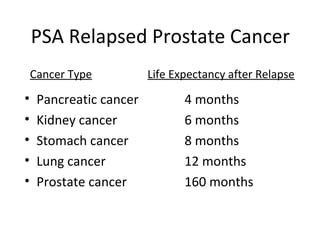
PSA Relapsed Prostate Cancer
    Cancer Type          Life Expectancy after Relapse

•    Pancreatic cancer          4 months
•    Kidney cancer              6 months
•    Stomach cancer             8 months
•    Lung cancer                12 months
•    Prostate cancer            160 months
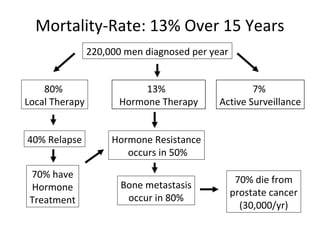
Mortality-Rate: 13% Over 15 Years
                220,000 men diagnosed per year


    80%                    13%                      7%
Local Therapy         Hormone Therapy       Active Surveillance


40% Relapse          Hormone Resistance
                        occurs in 50%

 70% have                                         70% die from
 Hormone               Bone metastasis
                                                 prostate cancer
 Treatment              occur in 80%
                                                   (30,000/yr)
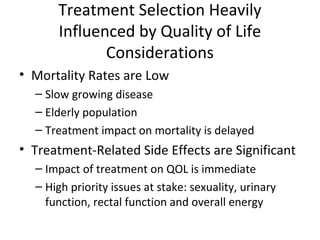
Treatment Selection Heavily
      Influenced by Quality of Life
             Considerations
• Mortality Rates are Low
  – Slow growing disease
  – Elderly population
  – Treatment impact on mortality is delayed
• Treatment-Related Side Effects are Significant
  – Impact of treatment on QOL is immediate
  – High priority issues at stake: sexuality, urinary
    function, rectal function and overall energy
Statistics
• Statistics may be defined as "a body of
  methods for making wise decisions in the face
  of uncertainty." ~W.A. Wallis

• "Maturity is the capacity to endure
  uncertainty." John Finley
Do not put your faith in what statistics say until
you have carefully considered what they do not
            say. ~William W. Watt

• Percentages apply to groups of people. For the
  individual it’s all or none.
• The seriousness of the outcome (death) as well as
  it’s likelihood are both important.
• Think of taking treatmentlike purchasing an
  imperfect insurance policy.
• How much “insurance” (treatment) to buy is
  determined by its “cost” in terms of potential
  side effects
Statistics

• Then there is the man who drowned crossing
  a stream with an average depth of six inches.
  ~W.I.E. Gates

• The average human has one breast and one
  testicle. ~Des McHale
Additional Uncertainties
• Media interpretation of studies
  – Driven by controversy
  – Driven by audience size
• Interpreting scientific studies
  – The challenge of matching studies with patients
  – Extrapolating from scientific studies
• The different types of scientific studies
The Different Types of Studies & the
      Declining Quality of Information
• Phase III Trials
    – Need to be appropriately applied
•   Multiple Phase II Trials that say the same thing
•   A Single Phase II Trial
•   Retrospective Trials
•   Phase I Trials
    – Dose finding / exploratory
•   Animal Trials
•   Laboratory trials
•   Case reports: what happened to Joe next door
•   No trial at all, just a compelling theory or story
Types of Doctors
• Urologists (surgeons): Alpha dogs
• Radiation Therapists: Beta dogs
• Medical Oncologists: Trained to manage
  advanced disease
• The Report doctors:
  – Radiologists: Look at scans and x-rays
  – Pathologists: Look at biopsy and surgical
    specimens
Treatment Influence by Profit Motives


“I believe that when the final chapter of this
   disease is written, which is unlikely to be in my
   lifetime, never in the history of oncology will so
   many men have been so over-treated for one
   disease.”
   Tom Stamey MD
   Chief of Urology, Stanford
   Co-Inventor of the PSA Blood Test
Profit Motives
• Put nejm graph of increasing robotic surgery
  here
Profit Motives
• High adirtizing budgets
  – City of hope
  – Loma Linda
• Payment for seeds vs IMRT
• Referrals from surgeons
  – Radiation docs recommending surgery
Financial conflicts of interest

• Academia
  – Paid to do clinical trials
• Private
  – Paid to give treatment
• HMO
  – Paid to withhold treatment
Numerous Treatment Options and
        Patient Variables
• Newly Diagnosed
  – Low, Intermediate & High
  – A Bitch (and then theirs surgery)
• PSA Relapse
  – Lower and Higher Risk
  – Choir
• Advanced
  – Lower and Higher Risk
  – BITCH
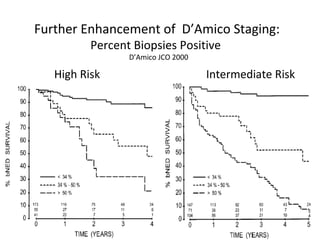
Further Enhancement of D’Amico Staging:
                      Percent Biopsies Positive
                              D’Amico JCO 2000

               High Risk                                         Intermediate Risk


January 2009                Prostate Oncology Specialists Inc.                       25
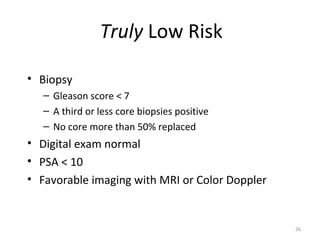
Truly Low Risk

• Biopsy
   – Gleason score < 7
   – A third or less core biopsies positive
   – No core more than 50% replaced
• Digital exam normal
• PSA < 10
• Favorable imaging with MRI or Color Doppler


                                                26
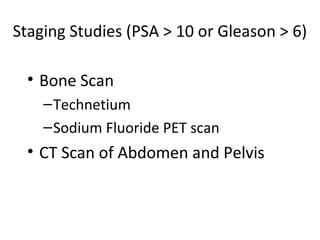
Staging Studies (PSA > 10 or Gleason > 6)

  • Bone Scan
    – Technetium
    – Sodium Fluoride PET scan
  • CT Scan of Abdomen and Pelvis
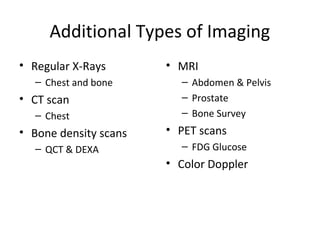
Additional Types of Imaging
• Regular X-Rays       • MRI
  – Chest and bone       – Abdomen & Pelvis
• CT scan                – Prostate
  – Chest                – Bone Survey
• Bone density scans   • PET scans
  – QCT & DEXA           – FDG Glucose
                       • Color Doppler
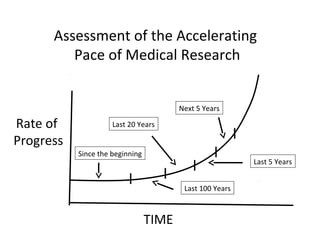
Assessment of the Accelerating
         Pace of Medical Research


                                        Next 5 Years

Rate of              Last 20 Years

Progress
           Since the beginning
                                                          Last 5 Years


                                         Last 100 Years


                                 TIME
Explosive Technological Progress
 •   Staging
 •   Imaging
 •   Pathology
 •   Radiation
 •   Pharmaceuticals
 •   Lab tests
Insurance and Reemburseemnt
•   Medicare
•   Medi-cal / Medi-caid
•   No insurance
•   Pharmaceutical patient assistance
•   Cancer assistance programs
•   Prescription plans
•   Prior authorizations
•   Private insurance
•   PPO insurance
•   HMO insurance
Conclusions
• Prostate cancer is a vast, complex and rapidly
  changing field that interacts dynamically with
  a man’s overall health, his relationships and
  with his quality of life.
• The complexity becomes manageable when
  men are properly staged and then educated
  about all their options
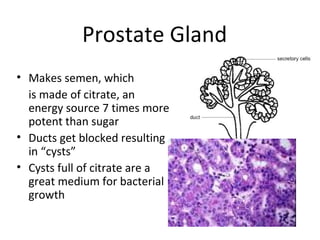
Prostate Gland
• Makes semen, which
  is made of citrate, an
  energy source 7 times more
  potent than sugar
• Ducts get blocked resulting
  in “cysts”
• Cysts full of citrate are a
  great medium for bacterial
  growth
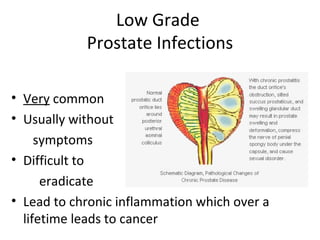
Low Grade
            Prostate Infections

• Very common
• Usually without
     symptoms
• Difficult to
      eradicate
• Lead to chronic inflammation which over a
  lifetime leads to cancer
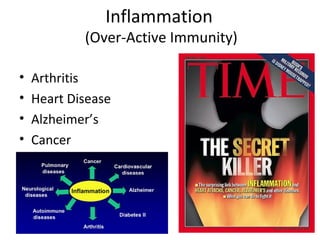
Inflammation
            (Over-Active Immunity)

•   Arthritis
•   Heart Disease
•   Alzheimer’s
•   Cancer
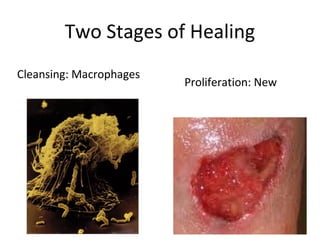
Two Stages of Healing
Cleansing: Macrophages
                         Proliferation: New
cleanse the wound
                         connective
                         tissue is synthesized
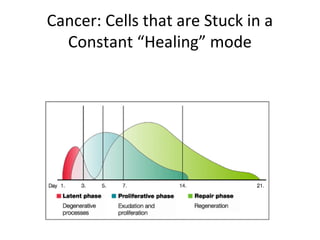
Cancer: Cells that are Stuck in a
  Constant “Healing” mode

      Stages of Wound Healing
Treatment Options and Patient
              Variables
• Newly Diagnosed
  – Low, Intermediate & High
  – A Bitch (and then theirs surgery)
• PSA Relapse
  – Lower and Higher Risk
  – Choir
• Advanced
  – Lower and Higher Risk
  – BITCH

Module 2 Dr Scholz-LandscapePart2

  • 1.
    Prostate Cancer LandscapeII Additional Variables Mark Scholz MD Prostate Oncology Specialists Prostate Cancer Research Institute
  • 2.
    Treatment Options andPatient Variables • Newly Diagnosed – Low, Intermediate & High – A Bitch (and then theirs surgery) • PSA Relapse – Lower and Higher Risk – Choir • Advanced – Lower and Higher Risk – BITCH
  • 3.
    Personality Traits ofSuccessful Leaders • Honest • Collaborative • Knowledgeable • Good listening skills • Perspective vs. depth of knowledge – Knowledge is readily accessible – Perspective is what is really valued • Stay within bounds of your abilities – don’t sacrifice your credibility by guessing
  • 4.
    We are PromotingTreatment Decisions to Be Made by Patients • They are playing in a high-stakes game with a diagnosis that emotionally hits very close to home • We are dealing with amateurs operating outside their usual expertise • Most people are very limited in their understanding of statistics
  • 5.
    Decision-Making Dynamics areoften Interrelated with Significant Others • Recent marriage • Already sexually inactive • Pleasing yourself vs. others • Dealing with ignorance in family members • Who do you tell about the diagnosis?
  • 6.
    People Who Benefitfrom Education • Able to comprehend that prostate cancer is distinctly different from other cancers • Able to grade the quality of different information sources • Able to withhold judgment until all the info is gathered, “Don’t jump to conclusions.” • Able to put in sufficient time to learn • Able to see value in maintaining Quality of Life
  • 7.
    Personality Types ofDifficult Patients • Already know the answers • Over-reliance on case studies – “my next door neighbor Sam…” • Already joined a” fraternity” of specific treatment type • Mentally frozen by fear • Black and white thinking process, i.e. have no clue about statistics.
  • 8.
    Patient Characteristics Vary •Advance age or poor health – High-Risk goes to Intermediate – Intermediate goes to Low-Risk • Absent potency or low libido – Defuses fears about local therapy • Increased prostate size, TURP or increased AUA score (preexisting urinary problems) – Impacts decisions about local therapy with seed implants or IMRT – May suggest the need for hormonal therapy? • Outcome from preexisting treatment
  • 9.
    Landscape II Additional Variables • Getting a handle on the risk of mortality • Limitations of predictive technology – Outcomes reported as percentages (statistics) • Physician limitations – Specialties only educated in part of the picture – Variable skill levels of doctors—Quality control issues – Conflicts of financial interest • Rapidly changing technology – A bad disease today may be very treatable in the future – Medical consensus lags behind technology
  • 10.
    10-Year Survival byCategory Newly-Diagnosed Low-Risk More than 100% Brenner: Journal of Clinical Oncology 2005 Intermediate With treatment 98% Mayo Clinic Journal of Urology 2008 High-Risk Surgery 90%; No treatment 85% Bill-Axelson: New England Journal Medicine 2005 Very High Early Hormone blockade: 87% Late Hormone blockade: 59% Messing: New England Journal Medicine 1999
  • 11.
    PSA Relapsed ProstateCancer Cancer Type Life Expectancy after Relapse • Pancreatic cancer 4 months • Kidney cancer 6 months • Stomach cancer 8 months • Lung cancer 12 months • Prostate cancer 160 months
  • 12.
    Mortality-Rate: 13% Over15 Years 220,000 men diagnosed per year 80% 13% 7% Local Therapy Hormone Therapy Active Surveillance 40% Relapse Hormone Resistance occurs in 50% 70% have 70% die from Hormone Bone metastasis prostate cancer Treatment occur in 80% (30,000/yr)
  • 13.
    Treatment Selection Heavily Influenced by Quality of Life Considerations • Mortality Rates are Low – Slow growing disease – Elderly population – Treatment impact on mortality is delayed • Treatment-Related Side Effects are Significant – Impact of treatment on QOL is immediate – High priority issues at stake: sexuality, urinary function, rectal function and overall energy
  • 14.
    Statistics • Statistics maybe defined as "a body of methods for making wise decisions in the face of uncertainty." ~W.A. Wallis • "Maturity is the capacity to endure uncertainty." John Finley
  • 15.
    Do not putyour faith in what statistics say until you have carefully considered what they do not say. ~William W. Watt • Percentages apply to groups of people. For the individual it’s all or none. • The seriousness of the outcome (death) as well as it’s likelihood are both important. • Think of taking treatmentlike purchasing an imperfect insurance policy. • How much “insurance” (treatment) to buy is determined by its “cost” in terms of potential side effects
  • 16.
    Statistics • Then thereis the man who drowned crossing a stream with an average depth of six inches. ~W.I.E. Gates • The average human has one breast and one testicle. ~Des McHale
  • 17.
    Additional Uncertainties • Mediainterpretation of studies – Driven by controversy – Driven by audience size • Interpreting scientific studies – The challenge of matching studies with patients – Extrapolating from scientific studies • The different types of scientific studies
  • 18.
    The Different Typesof Studies & the Declining Quality of Information • Phase III Trials – Need to be appropriately applied • Multiple Phase II Trials that say the same thing • A Single Phase II Trial • Retrospective Trials • Phase I Trials – Dose finding / exploratory • Animal Trials • Laboratory trials • Case reports: what happened to Joe next door • No trial at all, just a compelling theory or story
  • 19.
    Types of Doctors •Urologists (surgeons): Alpha dogs • Radiation Therapists: Beta dogs • Medical Oncologists: Trained to manage advanced disease • The Report doctors: – Radiologists: Look at scans and x-rays – Pathologists: Look at biopsy and surgical specimens
  • 20.
    Treatment Influence byProfit Motives “I believe that when the final chapter of this disease is written, which is unlikely to be in my lifetime, never in the history of oncology will so many men have been so over-treated for one disease.” Tom Stamey MD Chief of Urology, Stanford Co-Inventor of the PSA Blood Test
  • 21.
    Profit Motives • Putnejm graph of increasing robotic surgery here
  • 22.
    Profit Motives • Highadirtizing budgets – City of hope – Loma Linda • Payment for seeds vs IMRT • Referrals from surgeons – Radiation docs recommending surgery
  • 23.
    Financial conflicts ofinterest • Academia – Paid to do clinical trials • Private – Paid to give treatment • HMO – Paid to withhold treatment
  • 24.
    Numerous Treatment Optionsand Patient Variables • Newly Diagnosed – Low, Intermediate & High – A Bitch (and then theirs surgery) • PSA Relapse – Lower and Higher Risk – Choir • Advanced – Lower and Higher Risk – BITCH
  • 25.
    Further Enhancement ofD’Amico Staging: Percent Biopsies Positive D’Amico JCO 2000 High Risk Intermediate Risk January 2009 Prostate Oncology Specialists Inc. 25
  • 26.
    Truly Low Risk •Biopsy – Gleason score < 7 – A third or less core biopsies positive – No core more than 50% replaced • Digital exam normal • PSA < 10 • Favorable imaging with MRI or Color Doppler 26
  • 27.
    Staging Studies (PSA> 10 or Gleason > 6) • Bone Scan – Technetium – Sodium Fluoride PET scan • CT Scan of Abdomen and Pelvis
  • 28.
    Additional Types ofImaging • Regular X-Rays • MRI – Chest and bone – Abdomen & Pelvis • CT scan – Prostate – Chest – Bone Survey • Bone density scans • PET scans – QCT & DEXA – FDG Glucose • Color Doppler
  • 29.
    Assessment of theAccelerating Pace of Medical Research Next 5 Years Rate of Last 20 Years Progress Since the beginning Last 5 Years Last 100 Years TIME
  • 30.
    Explosive Technological Progress • Staging • Imaging • Pathology • Radiation • Pharmaceuticals • Lab tests
  • 31.
    Insurance and Reemburseemnt • Medicare • Medi-cal / Medi-caid • No insurance • Pharmaceutical patient assistance • Cancer assistance programs • Prescription plans • Prior authorizations • Private insurance • PPO insurance • HMO insurance
  • 32.
    Conclusions • Prostate canceris a vast, complex and rapidly changing field that interacts dynamically with a man’s overall health, his relationships and with his quality of life. • The complexity becomes manageable when men are properly staged and then educated about all their options
  • 33.
    Prostate Gland • Makessemen, which is made of citrate, an energy source 7 times more potent than sugar • Ducts get blocked resulting in “cysts” • Cysts full of citrate are a great medium for bacterial growth
  • 34.
    Low Grade Prostate Infections • Very common • Usually without symptoms • Difficult to eradicate • Lead to chronic inflammation which over a lifetime leads to cancer
  • 35.
    Inflammation (Over-Active Immunity) • Arthritis • Heart Disease • Alzheimer’s • Cancer
  • 36.
    Two Stages ofHealing Cleansing: Macrophages Proliferation: New cleanse the wound connective tissue is synthesized
  • 37.
    Cancer: Cells thatare Stuck in a Constant “Healing” mode Stages of Wound Healing
  • 38.
    Treatment Options andPatient Variables • Newly Diagnosed – Low, Intermediate & High – A Bitch (and then theirs surgery) • PSA Relapse – Lower and Higher Risk – Choir • Advanced – Lower and Higher Risk – BITCH