


ASCO 2020 Updates
DR. R. RAJKUMAR D.M.
MEDICAL ONCOLOGIST VELAMMAL SPECIALITY HOSPITALS
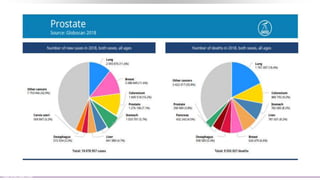
Siegel RL, et al., CA Cancer J Clin 2017;67:7–30. © 2017 American Cancer Society. With permission from
John Wiley and Sons.
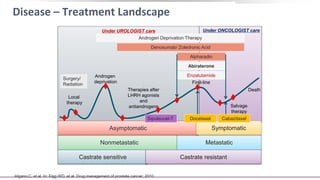
Disease – Treatment Landscape
Nonmetastatic Metastatic
Local
therapy
Androgen
deprivation
Therapies after
LHRH agonists
and
antiandrogens Salvage
therapy
Death
Under ONCOLOGIST care
Higano C, et al. In: Figg WD, et al. Drug management of prostate cancer; 2010.
Asymptomatic Symptomatic
Castrate sensitive Castrate resistant
Under UROLOGIST care
Surgery/
Radiation
Androgen Deprivation Therapy
Denosumab/ Zoledronic Acid
Alpharadin
Abiraterone
Enzalutamide
Sipuleucel-T Cabazitaxel
First-line
Docetaxel
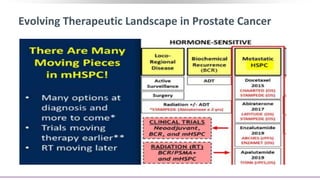
MHSPC
Evolving Therapeutic Landscape in Prostate Cancer
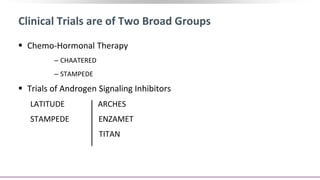
Clinical Trials are of Two Broad Groups
 Chemo-Hormonal Therapy
‒ CHAATERED
‒ STAMPEDE
 Trials of Androgen Signaling Inhibitors
LATITUDE ARCHES
STAMPEDE ENZAMET
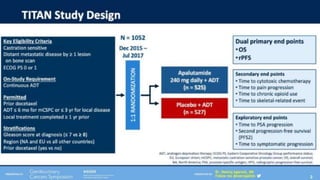
TITAN
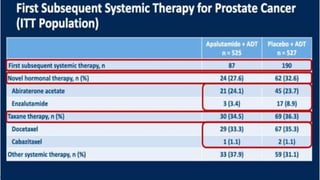
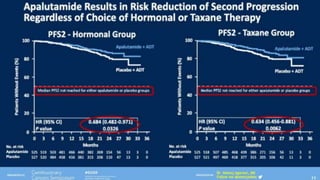
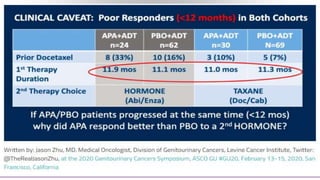
ASCO GU 2020: Time to Second Progression in Patients
with Metastatic Castration-Sensitive Prostate Cancer from
TITAN by First Subsequent Therapy (Hormonal vs. Taxane)
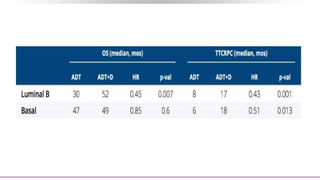
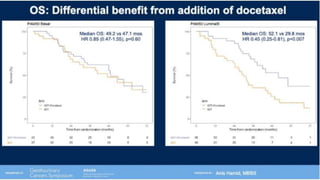
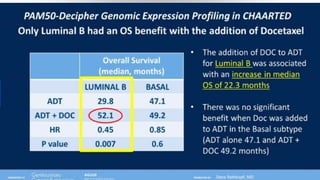
ASCO GU 2020: Luminal B Subtype as a Predictive
Biomarker of Docetaxel Benefit for Newly Diagnosed
Metastatic Hormone-Sensitive Prostate Cancer
(mHSPC): A Correlative Study of E3805 CHAARTED
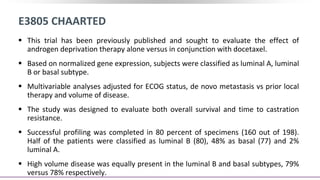
E3805 CHAARTED
 This trial has been previously published and sought to evaluate the effect of
androgen deprivation therapy alone versus in conjunction with docetaxel.
 Based on normalized gene expression, subjects were classified as luminal A, luminal
B or basal subtype.
 Multivariable analyses adjusted for ECOG status, de novo metastasis vs prior local
therapy and volume of disease.
 The study was designed to evaluate both overall survival and time to castration
resistance.
 Successful profiling was completed in 80 percent of specimens (160 out of 198).
Half of the patients were classified as luminal B (80), 48% as basal (77) and 2%
luminal A.
 High volume disease was equally present in the luminal B and basal subtypes, 79%
versus 78% respectively.
ASCO GU 2020: Treatment Selection in CSPC: Considerations
Now and Downstream in an Evolving Therapeutic Landscape
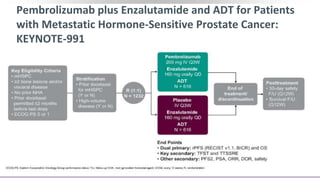
ASCO 2020: Phase III Study of Pembrolizumab plus
Enzalutamide and ADT for Patients with Metastatic
Hormone-Sensitive Prostate Cancer: KEYNOTE-991
Pembrolizumab plus Enzalutamide and ADT for Patients
with Metastatic Hormone-Sensitive Prostate Cancer:
KEYNOTE-991
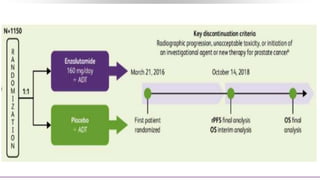
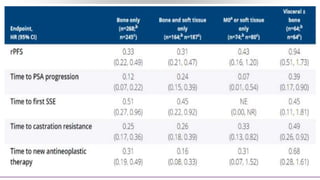
ASCO 2020 GU: Efficacy of Enzalutamide + ADT in
Metastatic Hormone-sensitive Prostate Cancer by
Pattern of Metastatic Spread: ARCHES Post Hoc
Analyses
MCRPC
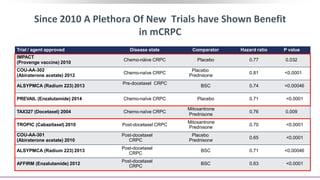
Since 2010 A Plethora Of New Trials have Shown Benefit
in mCRPC
Trial / agent approved Disease state Comparator Hazard ratio P value
IMPACT
(Provenge vaccine) 2010
Chemo-näive CRPC Placebo 0.77 0.032
COU-AA-302
(Abiraterone acetate) 2012
Chemo-naïve CRPC
Placebo
Prednisone
0.81 <0.0001
ALSYPMCA (Radium 223) 2013
Pre-docetaxel CRPC
BSC 0.74 <0.00046
PREVAIL (Enzalutamide) 2014 Chemo-naïve CRPC Placebo 0.71 <0.0001
TAX327 (Docetaxel) 2004 Chemo-naïve CRPC
Mitoxantrone
Prednisone
0.76 0.009
TROPIC (Cabazitaxel) 2010 Post-docetaxel CRPC
Mitoxantrone
Prednisone
0.70 <0.0001
COU-AA-301
(Abiraterone acetate) 2010
Post-docetaxel
CRPC
Placebo
Prednisone
0.65 <0.0001
ALSYPMCA (Radium 223) 2013
Post-docetaxel
CRPC
BSC 0.71 <0.00046
AFFIRM (Enzalutamide) 2012
Post-docetaxel
CRPC
BSC 0.63 <0.0001
ASCO 2020 GU: Pembrolizumab + Enzalutamide for
Enzalutamide-Resistant mCRPC (KEYNOTE-199)
Pembrolizumab + Enzalutamide for Enzalutamide-Resistant
mCRPC (KEYNOTE-199): Background
 Pembrolizumab monotherapy active with durable response in PD-L1+ mCRPC[1,2]
 Phase II study (N = 28): pembrolizumab + enzalutamide active in patients with PD on
enzalutamide[3]
 Phase II KEYNOTE-199 study designed to evaluate pembrolizumab in multiple cohorts
of patients with mCRPC after disease progression on chemotherapy and/or targeted
endocrine therapy
‒ Cohorts 1-3: data previously reported for patients with RECIST-measurable PD-L1+,
PD-L1–negative, or bone-predominant disease previously treated with docetaxel and
≥ 1 targeted endocrine therapy[1]
‒ Cohorts 4 and 5 included in this report: RECIST-measurable disease and bone-
predominant metastatic, RECIST-nonmeasurable disease with progression on
enzalutamide after initial response[4]
1. Antonarakis. JCO. 2020;38:395. 2. Hansen. Ann Oncol. 2018;29:1807. 3. Graff. JCO. ASCO 2018. Abstr 5047. 4. Graff. ASCO GU 2020. Abstr 15.
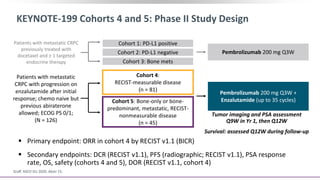
KEYNOTE-199 Cohorts 4 and 5: Phase II Study Design
 Primary endpoint: ORR in cohort 4 by RECIST v1.1 (BICR)
 Secondary endpoints: DCR (RECIST v1.1), PFS (radiographic; RECIST v1.1), PSA response
rate, OS, safety (cohorts 4 and 5), DOR (RECIST v1.1, cohort 4)
Patients with metastatic
CRPC with progression on
enzalutamide after initial
response; chemo naive but
previous abiraterone
allowed; ECOG PS 0/1;
(N = 126)
Cohort 1: PD-L1 positive
Cohort 3: Bone mets
Cohort 2: PD-L1 negative
Cohort 4:
RECIST-measurable disease
(n = 81)
Cohort 5: Bone-only or bone-
predominant, metastatic, RECIST-
nonmeasurable disease
(n = 45)
Graff. ASCO GU 2020. Abstr 15.
Tumor imaging and PSA assessment
Q9W in Yr 1, then Q12W
Survival: assessed Q12W during follow-up
Pembrolizumab 200 mg Q3W +
Enzalutamide (up to 35 cycles)
Patients with metastatic CRPC
previously treated with
docetaxel and ≥ 1 targeted
endocrine therapy
Pembrolizumab 200 mg Q3W
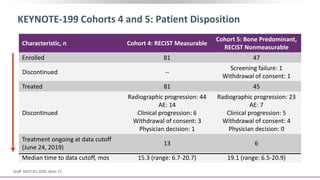
KEYNOTE-199 Cohorts 4 and 5: Patient Disposition
Graff. ASCO GU 2020. Abstr 15.
Characteristic, n Cohort 4: RECIST Measurable
Cohort 5: Bone Predominant,
RECIST Nonmeasurable
Enrolled 81 47
Discontinued --
Screening failure: 1
Withdrawal of consent: 1
Treated 81 45
Discontinued
Radiographic progression: 44
AE: 14
Clinical progression: 6
Withdrawal of consent: 3
Physician decision: 1
Radiographic progression: 23
AE: 7
Clinical progression: 5
Withdrawal of consent: 4
Physician decision: 0
Treatment ongoing at data cutoff
(June 24, 2019)
13 6
Median time to data cutoff, mos 15.3 (range: 6.7-20.7) 19.1 (range: 6.5-20.9)
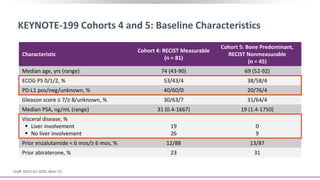
KEYNOTE-199 Cohorts 4 and 5: Baseline Characteristics
Graff. ASCO GU 2020. Abstr 15.
Characteristic
Cohort 4: RECIST Measurable
(n = 81)
Cohort 5: Bone Predominant,
RECIST Nonmeasurable
(n = 45)
Median age, yrs (range) 74 (43-90) 69 (52-92)
ECOG PS 0/1/2, % 53/43/4 38/58/4
PD-L1 pos/neg/unknown, % 40/60/0 20/76/4
Gleason score ≤ 7/≥ 8/unknown, % 30/63/7 31/64/4
Median PSA, ng/mL (range) 31 (0.4-1667) 19 (1.4-1750)
Visceral disease, %
 Liver involvement
 No liver involvement
19
26
0
9
Prior enzalutamide < 6 mos/≥ 6 mos, % 12/88 13/87
Prior abiraterone, % 23 31
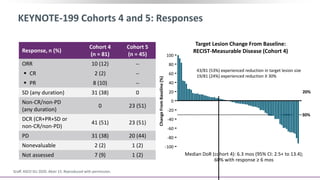
KEYNOTE-199 Cohorts 4 and 5: Responses
Median DoR (cohort 4): 6.3 mos (95% CI: 2.5+ to 13.4);
60% with response ≥ 6 mos
Graff. ASCO GU 2020. Abstr 15. Reproduced with permission.
Response, n (%)
Cohort 4
(n = 81)
Cohort 5
(n = 45)
ORR 10 (12) --
 CR 2 (2) --
 PR 8 (10) --
SD (any duration) 31 (38) 0
Non-CR/non-PD
(any duration)
0 23 (51)
DCR (CR+PR+SD or
non-CR/non-PD)
41 (51) 23 (51)
PD 31 (38) 20 (44)
Nonevaluable 2 (2) 1 (2)
Not assessed 7 (9) 1 (2)
43/81 (53%) experienced reduction in target lesion size
19/81 (24%) experienced reduction ≥ 30%
Target Lesion Change From Baseline:
RECIST-Measurable Disease (Cohort 4)
100
30%
20%
ChangeFromBaseline(%)
80
60
40
20
0
-20
-40
-60
-80
-100
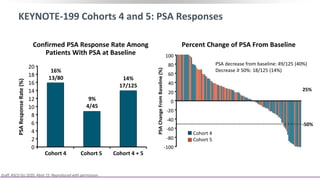
KEYNOTE-199 Cohorts 4 and 5: PSA Responses
Confirmed PSA Response Rate Among
Patients With PSA at Baseline
Percent Change of PSA From Baseline
Graff. ASCO GU 2020. Abstr 15. Reproduced with permission.
PSA decrease from baseline: 49/125 (40%)
Decrease ≥ 50%: 18/125 (14%)
100
-50%
25%
PSAChangeFromBaseline(%)
80
60
40
20
0
-20
-40
-60
-80
-100
Cohort 4
Cohort 5
Cohort 4 Cohort 5 Cohort 4 + 5
16%
13/80
9%
4/45
14%
17/125
PSAResponseRate(%)
20
18
16
14
12
10
8
6
4
2
0
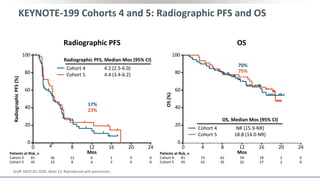
KEYNOTE-199 Cohorts 4 and 5: Radiographic PFS and OS
Radiographic PFS OS
Graff. ASCO GU 2020. Abstr 15. Reproduced with permission.
17%
23%
100
80
60
40
20
0
RadiographicPFS(%)
Patients at Risk, n
Cohort 4
Cohort 5
240 4 8 12 16 20
Mos
81
45
36
23
12
8
6
6
1
3
0
0
0
0
70%
75%
Cohort 4
Cohort 5
NR (15.9-NR)
18.8 (14.0-NR)
OS, Median Mos (95% CI)
100
80
60
40
20
0
Patients at Risk, n
Cohort 4
Cohort 5
240 4 8 12 16 20
Mos
81
45
73
42
62
35
39
32
18
27
2
2
0
0
OS(%)
Cohort 4
Cohort 5
4.2 (2.5-6.0)
4.4 (3.4-6.2)
Radiographic PFS, Median Mos (95% CI)
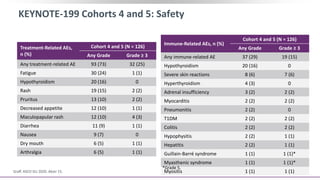
KEYNOTE-199 Cohorts 4 and 5: Safety
Graff. ASCO GU 2020. Abstr 15.
Treatment-Related AEs,
n (%)
Cohort 4 and 5 (N = 126)
Any Grade Grade ≥ 3
Any treatment-related AE 93 (73) 32 (25)
Fatigue 30 (24) 1 (1)
Hypothyroidism 20 (16) 0
Rash 19 (15) 2 (2)
Pruritus 13 (10) 2 (2)
Decreased appetite 12 (10) 1 (1)
Maculopapular rash 12 (10) 4 (3)
Diarrhea 11 (9) 1 (1)
Nausea 9 (7) 0
Dry mouth 6 (5) 1 (1)
Arthralgia 6 (5) 1 (1)
Immune-Related AEs, n (%)
Cohort 4 and 5 (N = 126)
Any Grade Grade ≥ 3
Any immune-related AE 37 (29) 19 (15)
Hypothyroidism 20 (16) 0
Severe skin reactions 8 (6) 7 (6)
Hyperthyroidism 4 (3) 0
Adrenal insufficiency 3 (2) 2 (2)
Myocarditis 2 (2) 2 (2)
Pneumonitis 2 (2) 0
T1DM 2 (2) 2 (2)
Colitis 2 (2) 2 (2)
Hypophysitis 2 (2) 1 (1)
Hepatitis 2 (2) 1 (1)
Guillain-Barré syndrome 1 (1) 1 (1)*
Myasthenic syndrome 1 (1) 1 (1)*
Myositis 1 (1) 1 (1)
*Grade 5.
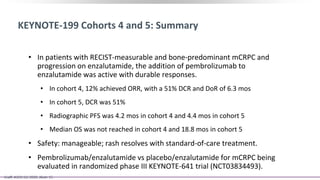
KEYNOTE-199 Cohorts 4 and 5: Summary
• In patients with RECIST-measurable and bone-predominant mCRPC and
progression on enzalutamide, the addition of pembrolizumab to
enzalutamide was active with durable responses.
• In cohort 4, 12% achieved ORR, with a 51% DCR and DoR of 6.3 mos
• In cohort 5, DCR was 51%
• Radiographic PFS was 4.2 mos in cohort 4 and 4.4 mos in cohort 5
• Median OS was not reached in cohort 4 and 18.8 mos in cohort 5
• Safety: manageable; rash resolves with standard-of-care treatment.
• Pembrolizumab/enzalutamide vs placebo/enzalutamide for mCRPC being
evaluated in randomized phase III KEYNOTE-641 trial (NCT03834493).
Graff. ASCO GU 2020. Abstr 15.
ASCO 2020: Genitourinary Cancers Highlights – Prostate,
Testicular, and Penile Cancers
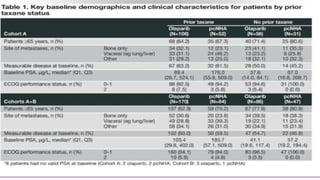
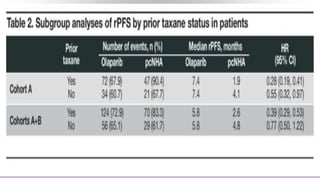
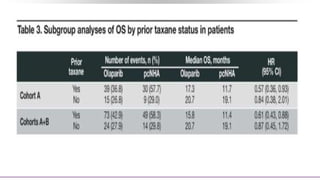
ASCO GU 2020: Efficacy of Olaparib by Prior Taxane Use in
Patients with Metastatic Castration-Resistant Prostate Cancer
and Homologous Recombination Repair Gene Alterations
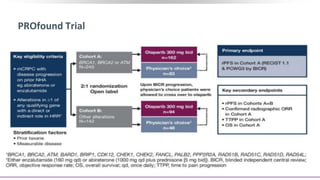
PROfound Trial
ASCO GU 2020: Final overall survival (OS) from
PROSPER: A phase III, randomized, double-blind,
placebo (PBO)-controlled study of enzalutamide (ENZA)
in men with non-metastatic castration resistant
prostate cancer (nmCRPC).
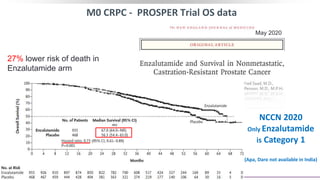
M0 CRPC - PROSPER Trial OS data
27% lower risk of death in
Enzalutamide arm
May 2020
NCCN 2020
Only Enzalutamide
is Category 1
(Apa, Daro not available in India)
ASCO GU 2020: Real world analysis of Prostate Specific
Antigen outcomes among patients with Metastatic
Castrate Resistant patients treated with Enzalutamatide
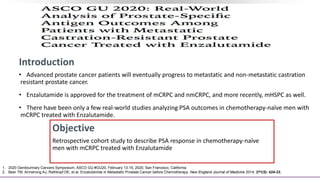
Introduction
• Advanced prostate cancer patients will eventually progress to metastatic and non-metastatic castration
resistant prostate cancer.
• Enzalutamide is approved for the treatment of mCRPC and nmCRPC, and more recently, mHSPC as well.
• There have been only a few real-world studies analyzing PSA outcomes in chemotherapy-naïve men with
mCRPC treated with Enzalutamide.
Objective
Retrospective cohort study to describe PSA response in chemotherapy-naïve
men with mCRPC treated with Enzalutamide
1. 2020 Genitourinary Cancers Symposium, ASCO GU #GU20, February 13-15, 2020, San Francisco, California
2. Beer TM, Armstrong AJ, Rathkopf DE, et al. Enzalutamide in Metastatic Prostate Cancer before Chemotherapy. New England Journal of Medicine 2014; 371(5): 424-33.
Study Design
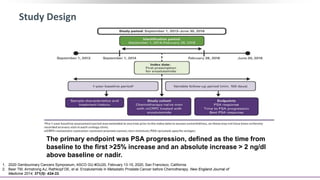
The primary endpoint was PSA progression, defined as the time from
baseline to the first >25% increase and an absolute increase > 2 ng/dl
above baseline or nadir.
1. 2020 Genitourinary Cancers Symposium, ASCO GU #GU20, February 13-15, 2020, San Francisco, California
2. Beer TM, Armstrong AJ, Rathkopf DE, et al. Enzalutamide in Metastatic Prostate Cancer before Chemotherapy. New England Journal of
Medicine 2014; 371(5): 424-33.
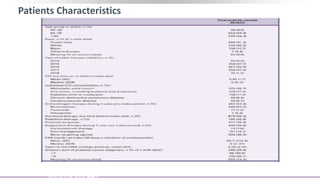
Patients Characteristics
1. 2020 Genitourinary Cancers Symposium, ASCO GU #GU20, February 13-15, 2020, San Francisco, California
2. Beer TM, Armstrong AJ, Rathkopf DE, et al. Enzalutamide in Metastatic Prostate Cancer before Chemotherapy. New England Journal of
Medicine 2014; 371(5): 424-33.
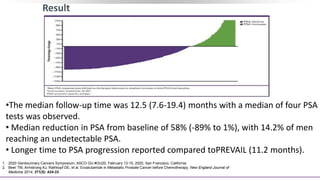
Result
•The median follow-up time was 12.5 (7.6-19.4) months with a median of four PSA
tests was observed.
• Median reduction in PSA from baseline of 58% (-89% to 1%), with 14.2% of men
reaching an undetectable PSA.
• Longer time to PSA progression reported compared toPREVAIL (11.2 months).
1. 2020 Genitourinary Cancers Symposium, ASCO GU #GU20, February 13-15, 2020, San Francisco, California
2. Beer TM, Armstrong AJ, Rathkopf DE, et al. Enzalutamide in Metastatic Prostate Cancer before Chemotherapy. New England Journal of
Medicine 2014; 371(5): 424-33.
Thank you

Prostate cancer asco 2020 updates

  • 1.
    ASCO 2020 Updates DR.R. RAJKUMAR D.M. MEDICAL ONCOLOGIST VELAMMAL SPECIALITY HOSPITALS
  • 2.
    Siegel RL, etal., CA Cancer J Clin 2017;67:7–30. © 2017 American Cancer Society. With permission from John Wiley and Sons.
  • 3.
    Disease – TreatmentLandscape Nonmetastatic Metastatic Local therapy Androgen deprivation Therapies after LHRH agonists and antiandrogens Salvage therapy Death Under ONCOLOGIST care Higano C, et al. In: Figg WD, et al. Drug management of prostate cancer; 2010. Asymptomatic Symptomatic Castrate sensitive Castrate resistant Under UROLOGIST care Surgery/ Radiation Androgen Deprivation Therapy Denosumab/ Zoledronic Acid Alpharadin Abiraterone Enzalutamide Sipuleucel-T Cabazitaxel First-line Docetaxel
  • 4.
  • 5.
  • 6.
    Clinical Trials areof Two Broad Groups  Chemo-Hormonal Therapy ‒ CHAATERED ‒ STAMPEDE  Trials of Androgen Signaling Inhibitors LATITUDE ARCHES STAMPEDE ENZAMET TITAN
  • 7.
    ASCO GU 2020:Time to Second Progression in Patients with Metastatic Castration-Sensitive Prostate Cancer from TITAN by First Subsequent Therapy (Hormonal vs. Taxane)
  • 12.
    ASCO GU 2020:Luminal B Subtype as a Predictive Biomarker of Docetaxel Benefit for Newly Diagnosed Metastatic Hormone-Sensitive Prostate Cancer (mHSPC): A Correlative Study of E3805 CHAARTED
  • 13.
    E3805 CHAARTED  Thistrial has been previously published and sought to evaluate the effect of androgen deprivation therapy alone versus in conjunction with docetaxel.  Based on normalized gene expression, subjects were classified as luminal A, luminal B or basal subtype.  Multivariable analyses adjusted for ECOG status, de novo metastasis vs prior local therapy and volume of disease.  The study was designed to evaluate both overall survival and time to castration resistance.  Successful profiling was completed in 80 percent of specimens (160 out of 198). Half of the patients were classified as luminal B (80), 48% as basal (77) and 2% luminal A.  High volume disease was equally present in the luminal B and basal subtypes, 79% versus 78% respectively.
  • 16.
    ASCO GU 2020:Treatment Selection in CSPC: Considerations Now and Downstream in an Evolving Therapeutic Landscape
  • 18.
    ASCO 2020: PhaseIII Study of Pembrolizumab plus Enzalutamide and ADT for Patients with Metastatic Hormone-Sensitive Prostate Cancer: KEYNOTE-991
  • 19.
    Pembrolizumab plus Enzalutamideand ADT for Patients with Metastatic Hormone-Sensitive Prostate Cancer: KEYNOTE-991
  • 20.
    ASCO 2020 GU:Efficacy of Enzalutamide + ADT in Metastatic Hormone-sensitive Prostate Cancer by Pattern of Metastatic Spread: ARCHES Post Hoc Analyses
  • 23.
  • 24.
    Since 2010 APlethora Of New Trials have Shown Benefit in mCRPC Trial / agent approved Disease state Comparator Hazard ratio P value IMPACT (Provenge vaccine) 2010 Chemo-näive CRPC Placebo 0.77 0.032 COU-AA-302 (Abiraterone acetate) 2012 Chemo-naïve CRPC Placebo Prednisone 0.81 <0.0001 ALSYPMCA (Radium 223) 2013 Pre-docetaxel CRPC BSC 0.74 <0.00046 PREVAIL (Enzalutamide) 2014 Chemo-naïve CRPC Placebo 0.71 <0.0001 TAX327 (Docetaxel) 2004 Chemo-naïve CRPC Mitoxantrone Prednisone 0.76 0.009 TROPIC (Cabazitaxel) 2010 Post-docetaxel CRPC Mitoxantrone Prednisone 0.70 <0.0001 COU-AA-301 (Abiraterone acetate) 2010 Post-docetaxel CRPC Placebo Prednisone 0.65 <0.0001 ALSYPMCA (Radium 223) 2013 Post-docetaxel CRPC BSC 0.71 <0.00046 AFFIRM (Enzalutamide) 2012 Post-docetaxel CRPC BSC 0.63 <0.0001
  • 25.
    ASCO 2020 GU:Pembrolizumab + Enzalutamide for Enzalutamide-Resistant mCRPC (KEYNOTE-199)
  • 26.
    Pembrolizumab + Enzalutamidefor Enzalutamide-Resistant mCRPC (KEYNOTE-199): Background  Pembrolizumab monotherapy active with durable response in PD-L1+ mCRPC[1,2]  Phase II study (N = 28): pembrolizumab + enzalutamide active in patients with PD on enzalutamide[3]  Phase II KEYNOTE-199 study designed to evaluate pembrolizumab in multiple cohorts of patients with mCRPC after disease progression on chemotherapy and/or targeted endocrine therapy ‒ Cohorts 1-3: data previously reported for patients with RECIST-measurable PD-L1+, PD-L1–negative, or bone-predominant disease previously treated with docetaxel and ≥ 1 targeted endocrine therapy[1] ‒ Cohorts 4 and 5 included in this report: RECIST-measurable disease and bone- predominant metastatic, RECIST-nonmeasurable disease with progression on enzalutamide after initial response[4] 1. Antonarakis. JCO. 2020;38:395. 2. Hansen. Ann Oncol. 2018;29:1807. 3. Graff. JCO. ASCO 2018. Abstr 5047. 4. Graff. ASCO GU 2020. Abstr 15.
  • 27.
    KEYNOTE-199 Cohorts 4and 5: Phase II Study Design  Primary endpoint: ORR in cohort 4 by RECIST v1.1 (BICR)  Secondary endpoints: DCR (RECIST v1.1), PFS (radiographic; RECIST v1.1), PSA response rate, OS, safety (cohorts 4 and 5), DOR (RECIST v1.1, cohort 4) Patients with metastatic CRPC with progression on enzalutamide after initial response; chemo naive but previous abiraterone allowed; ECOG PS 0/1; (N = 126) Cohort 1: PD-L1 positive Cohort 3: Bone mets Cohort 2: PD-L1 negative Cohort 4: RECIST-measurable disease (n = 81) Cohort 5: Bone-only or bone- predominant, metastatic, RECIST- nonmeasurable disease (n = 45) Graff. ASCO GU 2020. Abstr 15. Tumor imaging and PSA assessment Q9W in Yr 1, then Q12W Survival: assessed Q12W during follow-up Pembrolizumab 200 mg Q3W + Enzalutamide (up to 35 cycles) Patients with metastatic CRPC previously treated with docetaxel and ≥ 1 targeted endocrine therapy Pembrolizumab 200 mg Q3W
  • 28.
    KEYNOTE-199 Cohorts 4and 5: Patient Disposition Graff. ASCO GU 2020. Abstr 15. Characteristic, n Cohort 4: RECIST Measurable Cohort 5: Bone Predominant, RECIST Nonmeasurable Enrolled 81 47 Discontinued -- Screening failure: 1 Withdrawal of consent: 1 Treated 81 45 Discontinued Radiographic progression: 44 AE: 14 Clinical progression: 6 Withdrawal of consent: 3 Physician decision: 1 Radiographic progression: 23 AE: 7 Clinical progression: 5 Withdrawal of consent: 4 Physician decision: 0 Treatment ongoing at data cutoff (June 24, 2019) 13 6 Median time to data cutoff, mos 15.3 (range: 6.7-20.7) 19.1 (range: 6.5-20.9)
  • 29.
    KEYNOTE-199 Cohorts 4and 5: Baseline Characteristics Graff. ASCO GU 2020. Abstr 15. Characteristic Cohort 4: RECIST Measurable (n = 81) Cohort 5: Bone Predominant, RECIST Nonmeasurable (n = 45) Median age, yrs (range) 74 (43-90) 69 (52-92) ECOG PS 0/1/2, % 53/43/4 38/58/4 PD-L1 pos/neg/unknown, % 40/60/0 20/76/4 Gleason score ≤ 7/≥ 8/unknown, % 30/63/7 31/64/4 Median PSA, ng/mL (range) 31 (0.4-1667) 19 (1.4-1750) Visceral disease, %  Liver involvement  No liver involvement 19 26 0 9 Prior enzalutamide < 6 mos/≥ 6 mos, % 12/88 13/87 Prior abiraterone, % 23 31
  • 30.
    KEYNOTE-199 Cohorts 4and 5: Responses Median DoR (cohort 4): 6.3 mos (95% CI: 2.5+ to 13.4); 60% with response ≥ 6 mos Graff. ASCO GU 2020. Abstr 15. Reproduced with permission. Response, n (%) Cohort 4 (n = 81) Cohort 5 (n = 45) ORR 10 (12) --  CR 2 (2) --  PR 8 (10) -- SD (any duration) 31 (38) 0 Non-CR/non-PD (any duration) 0 23 (51) DCR (CR+PR+SD or non-CR/non-PD) 41 (51) 23 (51) PD 31 (38) 20 (44) Nonevaluable 2 (2) 1 (2) Not assessed 7 (9) 1 (2) 43/81 (53%) experienced reduction in target lesion size 19/81 (24%) experienced reduction ≥ 30% Target Lesion Change From Baseline: RECIST-Measurable Disease (Cohort 4) 100 30% 20% ChangeFromBaseline(%) 80 60 40 20 0 -20 -40 -60 -80 -100
  • 31.
    KEYNOTE-199 Cohorts 4and 5: PSA Responses Confirmed PSA Response Rate Among Patients With PSA at Baseline Percent Change of PSA From Baseline Graff. ASCO GU 2020. Abstr 15. Reproduced with permission. PSA decrease from baseline: 49/125 (40%) Decrease ≥ 50%: 18/125 (14%) 100 -50% 25% PSAChangeFromBaseline(%) 80 60 40 20 0 -20 -40 -60 -80 -100 Cohort 4 Cohort 5 Cohort 4 Cohort 5 Cohort 4 + 5 16% 13/80 9% 4/45 14% 17/125 PSAResponseRate(%) 20 18 16 14 12 10 8 6 4 2 0
  • 32.
    KEYNOTE-199 Cohorts 4and 5: Radiographic PFS and OS Radiographic PFS OS Graff. ASCO GU 2020. Abstr 15. Reproduced with permission. 17% 23% 100 80 60 40 20 0 RadiographicPFS(%) Patients at Risk, n Cohort 4 Cohort 5 240 4 8 12 16 20 Mos 81 45 36 23 12 8 6 6 1 3 0 0 0 0 70% 75% Cohort 4 Cohort 5 NR (15.9-NR) 18.8 (14.0-NR) OS, Median Mos (95% CI) 100 80 60 40 20 0 Patients at Risk, n Cohort 4 Cohort 5 240 4 8 12 16 20 Mos 81 45 73 42 62 35 39 32 18 27 2 2 0 0 OS(%) Cohort 4 Cohort 5 4.2 (2.5-6.0) 4.4 (3.4-6.2) Radiographic PFS, Median Mos (95% CI)
  • 33.
    KEYNOTE-199 Cohorts 4and 5: Safety Graff. ASCO GU 2020. Abstr 15. Treatment-Related AEs, n (%) Cohort 4 and 5 (N = 126) Any Grade Grade ≥ 3 Any treatment-related AE 93 (73) 32 (25) Fatigue 30 (24) 1 (1) Hypothyroidism 20 (16) 0 Rash 19 (15) 2 (2) Pruritus 13 (10) 2 (2) Decreased appetite 12 (10) 1 (1) Maculopapular rash 12 (10) 4 (3) Diarrhea 11 (9) 1 (1) Nausea 9 (7) 0 Dry mouth 6 (5) 1 (1) Arthralgia 6 (5) 1 (1) Immune-Related AEs, n (%) Cohort 4 and 5 (N = 126) Any Grade Grade ≥ 3 Any immune-related AE 37 (29) 19 (15) Hypothyroidism 20 (16) 0 Severe skin reactions 8 (6) 7 (6) Hyperthyroidism 4 (3) 0 Adrenal insufficiency 3 (2) 2 (2) Myocarditis 2 (2) 2 (2) Pneumonitis 2 (2) 0 T1DM 2 (2) 2 (2) Colitis 2 (2) 2 (2) Hypophysitis 2 (2) 1 (1) Hepatitis 2 (2) 1 (1) Guillain-Barré syndrome 1 (1) 1 (1)* Myasthenic syndrome 1 (1) 1 (1)* Myositis 1 (1) 1 (1) *Grade 5.
  • 34.
    KEYNOTE-199 Cohorts 4and 5: Summary • In patients with RECIST-measurable and bone-predominant mCRPC and progression on enzalutamide, the addition of pembrolizumab to enzalutamide was active with durable responses. • In cohort 4, 12% achieved ORR, with a 51% DCR and DoR of 6.3 mos • In cohort 5, DCR was 51% • Radiographic PFS was 4.2 mos in cohort 4 and 4.4 mos in cohort 5 • Median OS was not reached in cohort 4 and 18.8 mos in cohort 5 • Safety: manageable; rash resolves with standard-of-care treatment. • Pembrolizumab/enzalutamide vs placebo/enzalutamide for mCRPC being evaluated in randomized phase III KEYNOTE-641 trial (NCT03834493). Graff. ASCO GU 2020. Abstr 15.
  • 35.
    ASCO 2020: GenitourinaryCancers Highlights – Prostate, Testicular, and Penile Cancers
  • 39.
    ASCO GU 2020:Efficacy of Olaparib by Prior Taxane Use in Patients with Metastatic Castration-Resistant Prostate Cancer and Homologous Recombination Repair Gene Alterations
  • 40.
  • 44.
    ASCO GU 2020:Final overall survival (OS) from PROSPER: A phase III, randomized, double-blind, placebo (PBO)-controlled study of enzalutamide (ENZA) in men with non-metastatic castration resistant prostate cancer (nmCRPC).
  • 45.
    M0 CRPC -PROSPER Trial OS data 27% lower risk of death in Enzalutamide arm May 2020 NCCN 2020 Only Enzalutamide is Category 1 (Apa, Daro not available in India)
  • 46.
    ASCO GU 2020:Real world analysis of Prostate Specific Antigen outcomes among patients with Metastatic Castrate Resistant patients treated with Enzalutamatide
  • 47.
    Introduction • Advanced prostatecancer patients will eventually progress to metastatic and non-metastatic castration resistant prostate cancer. • Enzalutamide is approved for the treatment of mCRPC and nmCRPC, and more recently, mHSPC as well. • There have been only a few real-world studies analyzing PSA outcomes in chemotherapy-naïve men with mCRPC treated with Enzalutamide. Objective Retrospective cohort study to describe PSA response in chemotherapy-naïve men with mCRPC treated with Enzalutamide 1. 2020 Genitourinary Cancers Symposium, ASCO GU #GU20, February 13-15, 2020, San Francisco, California 2. Beer TM, Armstrong AJ, Rathkopf DE, et al. Enzalutamide in Metastatic Prostate Cancer before Chemotherapy. New England Journal of Medicine 2014; 371(5): 424-33.
  • 48.
    Study Design The primaryendpoint was PSA progression, defined as the time from baseline to the first >25% increase and an absolute increase > 2 ng/dl above baseline or nadir. 1. 2020 Genitourinary Cancers Symposium, ASCO GU #GU20, February 13-15, 2020, San Francisco, California 2. Beer TM, Armstrong AJ, Rathkopf DE, et al. Enzalutamide in Metastatic Prostate Cancer before Chemotherapy. New England Journal of Medicine 2014; 371(5): 424-33.
  • 49.
    Patients Characteristics 1. 2020Genitourinary Cancers Symposium, ASCO GU #GU20, February 13-15, 2020, San Francisco, California 2. Beer TM, Armstrong AJ, Rathkopf DE, et al. Enzalutamide in Metastatic Prostate Cancer before Chemotherapy. New England Journal of Medicine 2014; 371(5): 424-33.
  • 50.
    Result •The median follow-uptime was 12.5 (7.6-19.4) months with a median of four PSA tests was observed. • Median reduction in PSA from baseline of 58% (-89% to 1%), with 14.2% of men reaching an undetectable PSA. • Longer time to PSA progression reported compared toPREVAIL (11.2 months). 1. 2020 Genitourinary Cancers Symposium, ASCO GU #GU20, February 13-15, 2020, San Francisco, California 2. Beer TM, Armstrong AJ, Rathkopf DE, et al. Enzalutamide in Metastatic Prostate Cancer before Chemotherapy. New England Journal of Medicine 2014; 371(5): 424-33.
  • 51.

Editor's Notes

  • #4 Typical patient presentation as they move through different stages. We can see that patient moves from urologist care to oncologist care as the disease worsens. Androgen deprivation (ie, serum testosterone less than or equal to 50 ng/dL). The promising results seen with radium-223, enzalutamide, and abiraterone have triggered interest in using these drugs earlier in castration-resistant disease, and they are now approved in both the pre- and postchemotherapy state. The role of chemotherapy— still a good option, especially after progression on androgen pathway drugs—may be shifted far down the road.
  • #27 mCRPC, metastatic castration-resistant prostate cancer; PD, progressive disease; PSA, prostate-specific antigen; RECIST, Response Evaluation Criteria in Solid Tumors.
  • #28 BICR, blinded independent central review; CRPC, castration-resistant prostate cancer; DCR, disease-control rate; ECOG, Eastern Cooperative Oncology Group; PS, performance status; PSA, prostate-specific antigen; RECIST, Response Evaluation Criteria in Solid Tumors.
  • #29 AE, adverse event; RECIST, Response Evaluation Criteria in Solid Tumors.
  • #30 ECOG, Eastern Cooperative Oncology Group; PS, performance status; PSA, prostate-specific antigen; RECIST, Response Evaluation Criteria in Solid Tumors.
  • #31 DCR, disease control rate; DoR, duration of response; PD, progressive disease; RECIST, Response Evaluation Criteria in Solid Tumors; SD, stable disease.
  • #32 PSA, prostate-specific antigen; RECIST, Response Evaluation Criteria in Solid Tumors.
  • #33 NR, not reached.
  • #34 AE, adverse event; T1DM, type 1 diabetes mellitus.
  • #35 DCR, disease control rate; mCRPC, metastatic castration-resistant prostate cancer; RECIST, Response Evaluation Criteria in Solid Tumors.