OPTIMAL SEQUENCING OPTIONS FOR
PATIENTS WITH ADVANCED RENAL CELL
CARCINOMA
CASE DISCUSSION
 64-yr-old man presents with right flank pain, no hematuria
 Past medical history includes:
‒ Mild hypertension (140/85 mmHg, not on medication), hypercholesterolemia, no other
cardiac history
‒ 20 pack-yr smoker
 Family history: negative for cancer
 Physical exam: right flank fullness, otherwise normal
‒ ECOG PS 0
 Labs: hemoglobin: 11.0 g/dL, ANC and platelets normal, creatinine: 1.2 mg/dL, LDH:
287 U/L, calcium normal
WHAT IS THE NEXT STEP FOR THIS
PATIENT ?
1. Radical Nephrectomy
2. Start systemic therapy
CASE DISCUSSION
 Patient undergoes right radical
nephrectomy
 Pathology: grade 3 clear-cell RCC;
margins negative; T3aN0
 Returns 6 wks after nephrectomy;
fully recovered
‒ ECOG PS 0, creatinine 1.5 mg/dL;
all other labs normal
WHAT IS ROLE OF ADJUVANT THERAPY
IN THIS PATIENT..?
 ADJUVANT THERAPY INDICATED
 NO EVIDENCE
 EQUIVOCAL
S-TRAC PHASE III TRIAL: DFS WITH SUNITINIB VS PLACEBO
IN PATIENTS WITH LOCOREGIONAL, HIGH-RISK CCRCC
51.3%
59.5%
5-yr
DFS rate: Median DFS, Yrs (95% CI)
Sunitinib 6.8 (5.8-NR)
Placebo 5.6 (3.8-6.6)
Yrs
Ravaud. NEJM. 2016;375:2246.
HR: 0.761 (95% CI: 0.594-0.975)
2-sided log-rank P = .030 stratified by UISS high-risk group
3-yr
DFS rate:
64.9%
59.3%
1.0
0.8
0.6
0.4
0.2
0
0 1 2 3 4 5 6 7 8 9
Patients at Risk, n
Sunitinib
Placebo
309
306
225
220
173
181
153
150
144
135
119
102
53
37
10
10
3
2
0
0
ProportionDiseaseFree
S-TRAC Phase III Trial: OS With Sunitinib vs
Placebo in Patients With Locoregional,
High-Risk ccRCC
ProportionAlive
Ravaud. NEJM. 2016;375:2246. Slide credit: clinicaloptions.com
Median OS, Yrs
Sunitinib NR
Placebo NR
HR: 1.014 (95% CI: 0.176-1.435)
P = .938
Yrs
1.0
0.8
0.6
0.4
0.2
0
0 1 2 3 4 5 6 7 8 9
Patients at Risk, n
Sunitinib
Placebo
309
306
278
289
258
269
236
250
222
231
196
197
98
96
31
40
4
4
0
0
Published Tyrosine Kinase Inhibitor
Adjuvant Trials
Trial Therapy N Histology Stage
Starting
Dose
Minimum
Dose
DFS OS
ASSURE[1] Sunitinib
Sorafenib
Placebo
1943 79% ccRCC
> pT1b, G3-
4, or N+
50 or
37.5 mg
(Su)/ 400
mg (So)
25 mg
(Su)/40
mg (So)
No No
S-TRAC[2] Sunitinib
Placebo
615 ccRCC
> pT3b or
N+
50 mg 37.5 mg Yes No
PROTECT[3] Pazopanib
Placebo
1538
ccRCC or
mostly
ccRCC
pT2 (G3-4),
≥ pT3, or
N+
600 mg 400 mg No No
1. Haas. Lancet. 2016;387:2008. 2. Ravaud. NEJM. 2016;375:2246. 3. Motzer. JCO. 2017;35:3916.
ONGOING PHASE III ADJUVANT TRIALS:
IMMUNOTHERAPY VS PLACEBO
Parameter
IMmotion010[1]
(NCT03024996)
PROSPER[2] (NCT03055013)
KEYNOTE-564[3]
(NCT03142334)
CheckMate 914[4]
(NCT03138512)
Drug Atezolizumab Nivolumab Pembrolizumab Nivolumab + ipilimumab
Histology
Clear-cell ± sarcomatoid
histology
RCC of any histology
Clear-cell ± sarcomatoid
features
Clear-cell ± sarcomatoid
features
Dose duration 1 yr
2 doses prior to surgery and
adjuvant nivolumab for 9
mos
1 yr 6 mos
Risk
classification
T2 grade 4, T3a grade 3/4,
T3b/c any grade, T4 any grade,
or TxN+ any grade
Clinical stage ≥ T2 or
any N+
pT2, grade 4; pT3/4, any
grade; N+ M0; M1 NED
pT2aN0, grade 3-4; pT2b-T4;
N+
Primary
endpoint
DFS RFS at 5 yrs DFS DFS
BICR Yes Yes Yes Yes
Status Active, recruiting Active, recruiting Active, recruiting Active, recruiting1.
CASE DISCUSSION
 CT scans first reveal small, indeterminate
lung nodules approximately 18 mos after
surgery
CASE DISCUSSION
 Patient undergoes a lung biopsy,
further progression of lung lesions and
development of mediastinal lymph
node involvement
 Pathology consistent with clear-cell RCC
 ECOG PS 0
 Lab results are all within normal limits
 The patient has mild HTN controlled
with amlodipine
 Favorable risk per IMDC criteria
Do you do risk stratification of your
patients in clinical practice..?
 If Yes, which one do you prefer
‒ IMDC
‒ MSKCC
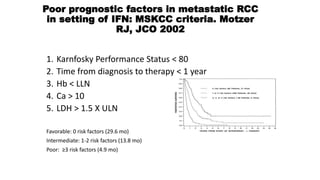
Poor prognostic factors in metastatic RCC
in setting of IFN: MSKCC criteria. Motzer
RJ, JCO 2002
1. Karnfosky Performance Status < 80
2. Time from diagnosis to therapy < 1 year
3. Hb < LLN
4. Ca > 10
5. LDH > 1.5 X ULN
Favorable: 0 risk factors (29.6 mo)
Intermediate: 1-2 risk factors (13.8 mo)
Poor: ≥3 risk factors (4.9 mo)
Heng. JCO. 2009;27:5794.
 Clinical
‒ KPS < 80% (P < .0001)
‒ Time from diagnosis to tx < 1 yr (P = .01)
 Laboratory
‒ Hemoglobin < LLN (P < .0001)
‒ Calcium > ULN (P = .0006)
‒ Neutrophil count > ULN (P < .0001)
‒ Platelet count > ULN (P = .01)
IMDC (Heng) Prognostic Criteria
Favorable: 0 risk factors;
Intermediate: 1-2 risk factors;
Poor: 3+ risk factors
Mos Since Therapy Initiation
ProbabilityofOS
0
0.2
0.4
0.6
0.8
1.0
0 12 24 36 48 60
Favorable
Intermediate
Poor
0.75
0.53
0.07
Is there any role of Active
Surveillance..?
 YES
 NO
 MAY BE
 NOT SURE
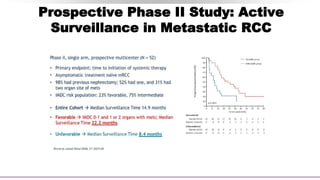
Park J Cancer Res Clin Oncol (2014) 140:1421–1428
During AS, the best overall responses were stable disease for 48 patients (83 %) and progressive
disease (PD) for 10 patients (17 %), and 47 patients
With a median follow-up of 31.4 months, the
median TTP was 12.4 months (95 % confidence interval
8.4–16.5) and median overall survival was not reached
Karnofsky performance status <100 %, liver metastasis, and a
time from diagnosis to AS of less than 1 year were found to be
predictive factors for a shorter TTP
Park J Cancer Res Clin Oncol (2014) 140:1421–1428
Prospective Phase II Study: Active
Surveillance in Metastatic RCC
CASE DISCUSSION
 Lung nodules become more prominent over time, and the patient is
asking about the need to start therapy 3 yrs after nephrectomy
CASE DISCUSSION
CHOICE OF SYSTEMIC THERAPY
 TKI
 IO
 IO+TKI
How to Choose Among
Expanding Systemic Options in mRCC
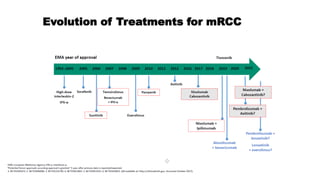
Evolution of Treatments for mRCC
1. National Comprehensive Cancer Network. NCCN Clinical Practice Guidelines in Oncology. Kidney cancer. Version 4.2020. 2020.
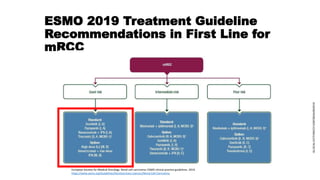
ESMO 2019 Treatment Guideline
Recommendations in First Line for
mRCC
European Society for Medical Oncology. Renal cell carcinoma: ESMO clinical practice guidelines. 2019.
https://www.esmo.org/Guidelines/Genitourinary-Cancers/Renal-Cell-Carcinoma.
GLOCAL/VOT/ONCO/1239726/24/09/2019
EAU 2019 Update
European Association of Urology. RCC guidelines. 2019. https://uroweb.org/guideline/renal-cell-carcinoma/?type=summary-of-
changes.
What are the questions my patients
with metastatic renal cancer ask?
What can patients expect from systemic treatment?
Efficacy
Toxicity
Can we tell if treatment is working?
Do patients always need to start therapy immediately?
RWTVF/TOMPOW/VOT/ONCO/63923/11/AUG/2020
Is TKI followed by IO justifiable in resource
constrained settings?
• CM 214: 39% in Ipi-Nivo vs 54% in Sutent
• 27% in the Sutent arm received Nivo
KN 426: Subsequent therapies
SPAZO: Probability of OS Significantly Decreases Between Risk
Groups, in Line With the IMDC Model
• Median OS: 22.2 mo (95% CI, 16.0–29.0 mo)
• Median PFS: 11.1 mo (95% CI, 9.3–12.9 mo)
• ORR: 30.3% (4.6% CR) Pérez-Valderrama B, et al. Ann Oncol. 2016;27:706-711.
CheckMate 025: Pazopanib Followed by Nivolumab
May Improve OS and ORR in aRCC
1. Escudier B, et al. Eur Urol. 2017;72:962–71; 2. Motzer RJ, et al. N Engl J Med. 2015;373:1803-1813.
In this post-hoc subgroup analysis, OS with nivolumab exceeded the duration of the study for pazopanib
(NR; 95% CI, 19.7–NR) and was 23.6 months (95% CI, 20.4–28.1) with prior sunitinib. Nivolumab ORR
was 28% following pazopanib (95% CI, 20–37) and 23% following sunitinib (95% CI, 18–28)
Emerging potential sequential
treatments after first-line VEGF-TT
Options for the second and third
lines after ipilimumab-nivolumab.
CONCLUSIONS
1. Adjuvant VEGF therapy, when adequately dosed, can offer modest benefit balanced against
toxicity
2. The goal of a patient with newly metastatic RCC is cure; therefore, regimens with the
highest chance of cure/durable response, balanced against acceptable toxicity/time off of
treatment, should be prioritized
3. Single agent TKI still has a role in Ist line therapy
4. Immunotherapy-based regimens offer the best chance of achieving patient goals for
intermediate and poor risk patients.

m rcc optimal sequencing agents

  • 1.
    OPTIMAL SEQUENCING OPTIONSFOR PATIENTS WITH ADVANCED RENAL CELL CARCINOMA
  • 2.
    CASE DISCUSSION  64-yr-oldman presents with right flank pain, no hematuria  Past medical history includes: ‒ Mild hypertension (140/85 mmHg, not on medication), hypercholesterolemia, no other cardiac history ‒ 20 pack-yr smoker  Family history: negative for cancer  Physical exam: right flank fullness, otherwise normal ‒ ECOG PS 0  Labs: hemoglobin: 11.0 g/dL, ANC and platelets normal, creatinine: 1.2 mg/dL, LDH: 287 U/L, calcium normal
  • 4.
    WHAT IS THENEXT STEP FOR THIS PATIENT ? 1. Radical Nephrectomy 2. Start systemic therapy
  • 5.
    CASE DISCUSSION  Patientundergoes right radical nephrectomy  Pathology: grade 3 clear-cell RCC; margins negative; T3aN0  Returns 6 wks after nephrectomy; fully recovered ‒ ECOG PS 0, creatinine 1.5 mg/dL; all other labs normal
  • 6.
    WHAT IS ROLEOF ADJUVANT THERAPY IN THIS PATIENT..?  ADJUVANT THERAPY INDICATED  NO EVIDENCE  EQUIVOCAL
  • 7.
    S-TRAC PHASE IIITRIAL: DFS WITH SUNITINIB VS PLACEBO IN PATIENTS WITH LOCOREGIONAL, HIGH-RISK CCRCC 51.3% 59.5% 5-yr DFS rate: Median DFS, Yrs (95% CI) Sunitinib 6.8 (5.8-NR) Placebo 5.6 (3.8-6.6) Yrs Ravaud. NEJM. 2016;375:2246. HR: 0.761 (95% CI: 0.594-0.975) 2-sided log-rank P = .030 stratified by UISS high-risk group 3-yr DFS rate: 64.9% 59.3% 1.0 0.8 0.6 0.4 0.2 0 0 1 2 3 4 5 6 7 8 9 Patients at Risk, n Sunitinib Placebo 309 306 225 220 173 181 153 150 144 135 119 102 53 37 10 10 3 2 0 0 ProportionDiseaseFree
  • 8.
    S-TRAC Phase IIITrial: OS With Sunitinib vs Placebo in Patients With Locoregional, High-Risk ccRCC ProportionAlive Ravaud. NEJM. 2016;375:2246. Slide credit: clinicaloptions.com Median OS, Yrs Sunitinib NR Placebo NR HR: 1.014 (95% CI: 0.176-1.435) P = .938 Yrs 1.0 0.8 0.6 0.4 0.2 0 0 1 2 3 4 5 6 7 8 9 Patients at Risk, n Sunitinib Placebo 309 306 278 289 258 269 236 250 222 231 196 197 98 96 31 40 4 4 0 0
  • 9.
    Published Tyrosine KinaseInhibitor Adjuvant Trials Trial Therapy N Histology Stage Starting Dose Minimum Dose DFS OS ASSURE[1] Sunitinib Sorafenib Placebo 1943 79% ccRCC > pT1b, G3- 4, or N+ 50 or 37.5 mg (Su)/ 400 mg (So) 25 mg (Su)/40 mg (So) No No S-TRAC[2] Sunitinib Placebo 615 ccRCC > pT3b or N+ 50 mg 37.5 mg Yes No PROTECT[3] Pazopanib Placebo 1538 ccRCC or mostly ccRCC pT2 (G3-4), ≥ pT3, or N+ 600 mg 400 mg No No 1. Haas. Lancet. 2016;387:2008. 2. Ravaud. NEJM. 2016;375:2246. 3. Motzer. JCO. 2017;35:3916.
  • 10.
    ONGOING PHASE IIIADJUVANT TRIALS: IMMUNOTHERAPY VS PLACEBO Parameter IMmotion010[1] (NCT03024996) PROSPER[2] (NCT03055013) KEYNOTE-564[3] (NCT03142334) CheckMate 914[4] (NCT03138512) Drug Atezolizumab Nivolumab Pembrolizumab Nivolumab + ipilimumab Histology Clear-cell ± sarcomatoid histology RCC of any histology Clear-cell ± sarcomatoid features Clear-cell ± sarcomatoid features Dose duration 1 yr 2 doses prior to surgery and adjuvant nivolumab for 9 mos 1 yr 6 mos Risk classification T2 grade 4, T3a grade 3/4, T3b/c any grade, T4 any grade, or TxN+ any grade Clinical stage ≥ T2 or any N+ pT2, grade 4; pT3/4, any grade; N+ M0; M1 NED pT2aN0, grade 3-4; pT2b-T4; N+ Primary endpoint DFS RFS at 5 yrs DFS DFS BICR Yes Yes Yes Yes Status Active, recruiting Active, recruiting Active, recruiting Active, recruiting1.
  • 11.
    CASE DISCUSSION  CTscans first reveal small, indeterminate lung nodules approximately 18 mos after surgery
  • 12.
    CASE DISCUSSION  Patientundergoes a lung biopsy, further progression of lung lesions and development of mediastinal lymph node involvement  Pathology consistent with clear-cell RCC  ECOG PS 0  Lab results are all within normal limits  The patient has mild HTN controlled with amlodipine  Favorable risk per IMDC criteria
  • 13.
    Do you dorisk stratification of your patients in clinical practice..?  If Yes, which one do you prefer ‒ IMDC ‒ MSKCC
  • 14.
    Poor prognostic factorsin metastatic RCC in setting of IFN: MSKCC criteria. Motzer RJ, JCO 2002 1. Karnfosky Performance Status < 80 2. Time from diagnosis to therapy < 1 year 3. Hb < LLN 4. Ca > 10 5. LDH > 1.5 X ULN Favorable: 0 risk factors (29.6 mo) Intermediate: 1-2 risk factors (13.8 mo) Poor: ≥3 risk factors (4.9 mo)
  • 15.
    Heng. JCO. 2009;27:5794. Clinical ‒ KPS < 80% (P < .0001) ‒ Time from diagnosis to tx < 1 yr (P = .01)  Laboratory ‒ Hemoglobin < LLN (P < .0001) ‒ Calcium > ULN (P = .0006) ‒ Neutrophil count > ULN (P < .0001) ‒ Platelet count > ULN (P = .01) IMDC (Heng) Prognostic Criteria Favorable: 0 risk factors; Intermediate: 1-2 risk factors; Poor: 3+ risk factors Mos Since Therapy Initiation ProbabilityofOS 0 0.2 0.4 0.6 0.8 1.0 0 12 24 36 48 60 Favorable Intermediate Poor 0.75 0.53 0.07
  • 16.
    Is there anyrole of Active Surveillance..?  YES  NO  MAY BE  NOT SURE
  • 17.
    Park J CancerRes Clin Oncol (2014) 140:1421–1428
  • 18.
    During AS, thebest overall responses were stable disease for 48 patients (83 %) and progressive disease (PD) for 10 patients (17 %), and 47 patients With a median follow-up of 31.4 months, the median TTP was 12.4 months (95 % confidence interval 8.4–16.5) and median overall survival was not reached Karnofsky performance status <100 %, liver metastasis, and a time from diagnosis to AS of less than 1 year were found to be predictive factors for a shorter TTP Park J Cancer Res Clin Oncol (2014) 140:1421–1428
  • 19.
    Prospective Phase IIStudy: Active Surveillance in Metastatic RCC
  • 20.
    CASE DISCUSSION  Lungnodules become more prominent over time, and the patient is asking about the need to start therapy 3 yrs after nephrectomy
  • 21.
    CASE DISCUSSION CHOICE OFSYSTEMIC THERAPY  TKI  IO  IO+TKI
  • 22.
    How to ChooseAmong Expanding Systemic Options in mRCC
  • 23.
  • 24.
    1. National ComprehensiveCancer Network. NCCN Clinical Practice Guidelines in Oncology. Kidney cancer. Version 4.2020. 2020.
  • 26.
    ESMO 2019 TreatmentGuideline Recommendations in First Line for mRCC European Society for Medical Oncology. Renal cell carcinoma: ESMO clinical practice guidelines. 2019. https://www.esmo.org/Guidelines/Genitourinary-Cancers/Renal-Cell-Carcinoma. GLOCAL/VOT/ONCO/1239726/24/09/2019
  • 27.
    EAU 2019 Update EuropeanAssociation of Urology. RCC guidelines. 2019. https://uroweb.org/guideline/renal-cell-carcinoma/?type=summary-of- changes.
  • 28.
    What are thequestions my patients with metastatic renal cancer ask? What can patients expect from systemic treatment? Efficacy Toxicity Can we tell if treatment is working? Do patients always need to start therapy immediately? RWTVF/TOMPOW/VOT/ONCO/63923/11/AUG/2020
  • 30.
    Is TKI followedby IO justifiable in resource constrained settings? • CM 214: 39% in Ipi-Nivo vs 54% in Sutent • 27% in the Sutent arm received Nivo KN 426: Subsequent therapies
  • 31.
    SPAZO: Probability ofOS Significantly Decreases Between Risk Groups, in Line With the IMDC Model • Median OS: 22.2 mo (95% CI, 16.0–29.0 mo) • Median PFS: 11.1 mo (95% CI, 9.3–12.9 mo) • ORR: 30.3% (4.6% CR) Pérez-Valderrama B, et al. Ann Oncol. 2016;27:706-711.
  • 32.
    CheckMate 025: PazopanibFollowed by Nivolumab May Improve OS and ORR in aRCC 1. Escudier B, et al. Eur Urol. 2017;72:962–71; 2. Motzer RJ, et al. N Engl J Med. 2015;373:1803-1813. In this post-hoc subgroup analysis, OS with nivolumab exceeded the duration of the study for pazopanib (NR; 95% CI, 19.7–NR) and was 23.6 months (95% CI, 20.4–28.1) with prior sunitinib. Nivolumab ORR was 28% following pazopanib (95% CI, 20–37) and 23% following sunitinib (95% CI, 18–28)
  • 33.
  • 34.
    Options for thesecond and third lines after ipilimumab-nivolumab.
  • 35.
    CONCLUSIONS 1. Adjuvant VEGFtherapy, when adequately dosed, can offer modest benefit balanced against toxicity 2. The goal of a patient with newly metastatic RCC is cure; therefore, regimens with the highest chance of cure/durable response, balanced against acceptable toxicity/time off of treatment, should be prioritized 3. Single agent TKI still has a role in Ist line therapy 4. Immunotherapy-based regimens offer the best chance of achieving patient goals for intermediate and poor risk patients.