GUIDELINES FOR
MANAGEMENT
Dr ANKITA SINGH PATEL
MBBS,MD(KGMU)
CONSULTANT
Apex Hospital Cancer Institute
TRAINING AND FELLOWSHIP
Fortis Research Institute ,New Delhi
Tata Memorial Hospital,MUMBAI
Mob. 8765845035,9305421547
Email: dr.ankitapatel.onco@gmail.com
INCIDENCE
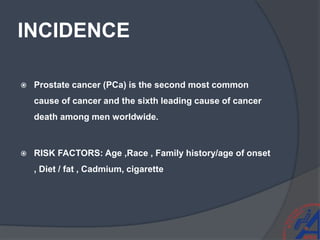
 Prostate cancer (PCa) is the second most common
cause of cancer and the sixth leading cause of cancer
death among men worldwide.
 RISK FACTORS: Age ,Race , Family history/age of onset
, Diet / fat , Cadmium, cigarette
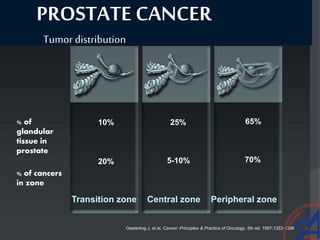
PROSTATE CANCER
Tumor distribution
% of
glandular
tissue in
prostate
% of cancers
in zone
10% 25% 65%
5-10% 70%20%
Oesterling J, et al. Cancer: Principles & Practice of Oncology. 5th ed. 1997;1322-1386.
Transition zone Central zone Peripheral zone
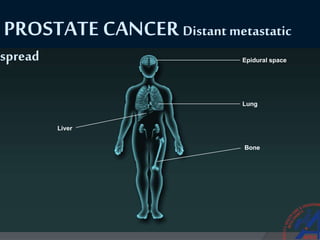
Lung
Bone
Liver
Epidural space
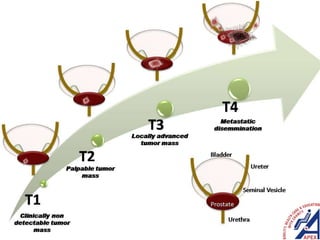
PROSTATE CANCER Distant metastatic
spread
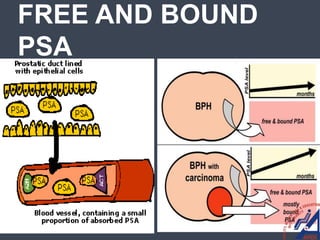
FREE AND BOUND
PSA
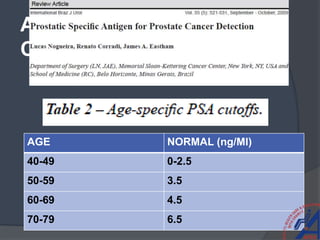
AGE NORMAL (ng/Ml)
40-49 0-2.5
50-59 3.5
60-69 4.5
70-79 6.5
AGE SPECIFIC PSA
CUTOFF
DIGITAL RECTAL
EXAMINATION
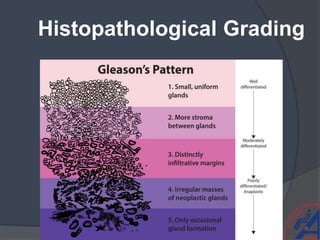
Histopathological Grading
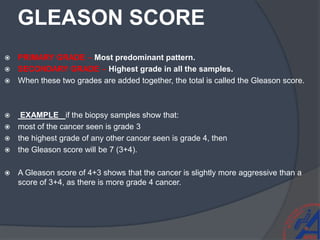
GLEASON SCORE
 PRIMARY GRADE – Most predominant pattern.
 SECONDARY GRADE – Highest grade in all the samples.

 When these two grades are added together, the total is called the Gleason score.
 EXAMPLE if the biopsy samples show that:
 most of the cancer seen is grade 3
 the highest grade of any other cancer seen is grade 4, then
 the Gleason score will be 7 (3+4).
 A Gleason score of 4+3 shows that the cancer is slightly more aggressive than a
score of 3+4, as there is more grade 4 cancer.
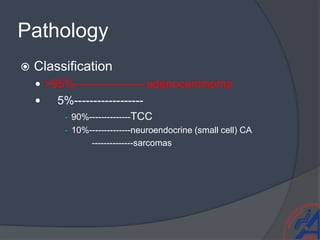
Pathology
 Classification
 >95%------------------ adenocarcinoma
 5%------------------
- 90%--------------TCC
- 10%--------------neuroendocrine (small cell) CA
--------------sarcomas
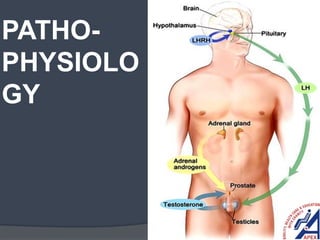
PATHO-
PHYSIOLO
GY
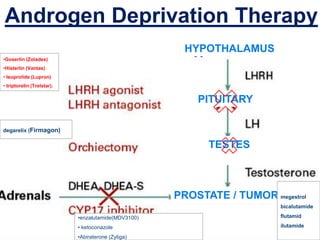
Androgen Deprivation Therapy
degarelix (Firmagon)
•enzalutamide(MDV3100)
• ketoconazole
•Abiraterone (Zytiga)
•Goserlin (Zoladex)
•Histerlin (Vantas)
• leuprolide (Lupron)
• triptorelin (Trelstar).
HYPOTHALAMUS
PITUITARY
TESTES
S
PROSTATE / TUMOR megestrol
bicalutamide
flutamid
ilutamide
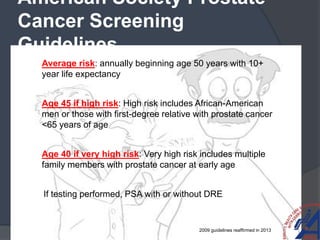
American Society Prostate
Cancer Screening
Guidelines
 Average risk: annually beginning age 50 years with 10+
year life expectancy
 Age 45 if high risk: High risk includes African-American
men or those with first-degree relative with prostate cancer
<65 years of age
 Age 40 if very high risk: Very high risk includes multiple
family members with prostate cancer at early age
 If testing performed, PSA with or without DRE
2009 guidelines reaffirmed in 2013
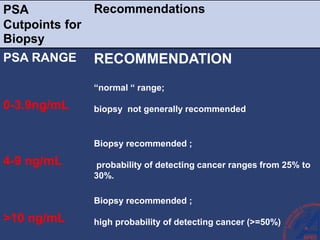
PSA
Cutpoints for
Biopsy
Recommendations
PSA RANGE RECOMMENDATION
0-3.9ng/mL
“normal “ range;
biopsy not generally recommended
4-9 ng/mL
Biopsy recommended ;
probability of detecting cancer ranges from 25% to
30%.
>10 ng/mL
Biopsy recommended ;
high probability of detecting cancer (>=50%)
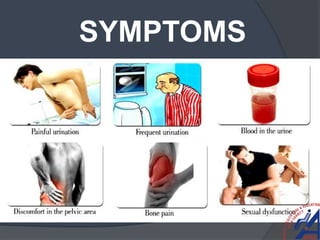
SYMPTOMS
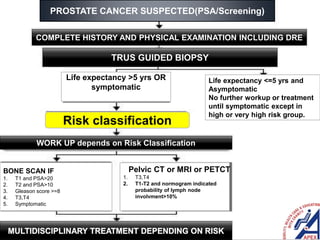
PROSTATE CANCER SUSPECTED(PSA/Screening)
COMPLETE HISTORY AND PHYSICAL EXAMINATION INCLUDING DRE
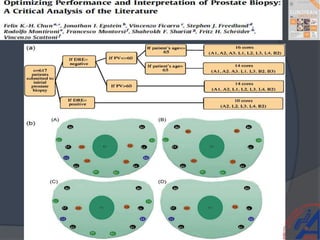
TRUS GUIDED BIOPSY
Life expectancy <=5 yrs and
Asymptomatic
No further workup or treatment
until symptomatic except in
high or very high risk group.
Life expectancy >5 yrs OR
symptomatic
Risk classification
WORK UP depends on Risk Classification
BONE SCAN IF
1. T1 and PSA>20
2. T2 and PSA>10
3. Gleason score >=8
4. T3,T4
5. Symptomatic
1. T3,T4
2. T1-T2 and normogram indicated
probability of lymph node
involvment>10%
Pelvic CT or MRI or PETCT
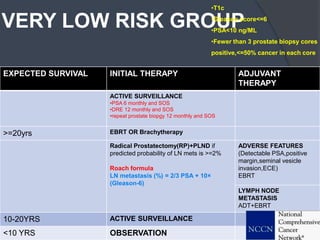
VERY LOW RISK GROUP
EXPECTED SURVIVAL INITIAL THERAPY ADJUVANT
THERAPY
ACTIVE SURVEILLANCE
•PSA 6 monthly and SOS
•DRE 12 monthly and SOS
•repeat prostate biopgy 12 monthly and SOS
>=20yrs EBRT OR Brachytherapy
Radical Prostatectomy(RP)+PLND if
predicted probability of LN mets is >=2%
Roach formula
LN metastasis (%) = 2/3 PSA + 10×
(Gleason-6)
ADVERSE FEATURES
(Detectable PSA,positive
margin,seminal vesicle
invasion,ECE)
EBRT
LYMPH NODE
METASTASIS
ADT+EBRT
10-20YRS ACTIVE SURVEILLANCE
<10 YRS OBSERVATION
•T1c
•Gleason score<=6
•PSA<10 ng/ML
•Fewer than 3 prostate biopsy cores
positive,<=50% cancer in each core
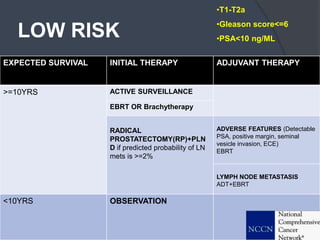
LOW RISK
EXPECTED SURVIVAL INITIAL THERAPY ADJUVANT THERAPY
>=10YRS ACTIVE SURVEILLANCE
EBRT OR Brachytherapy
RADICAL
PROSTATECTOMY(RP)+PLN
D if predicted probability of LN
mets is >=2%
ADVERSE FEATURES (Detectable
PSA, positive margin, seminal
vesicle invasion, ECE)
EBRT
LYMPH NODE METASTASIS
ADT+EBRT
<10YRS OBSERVATION
•T1-T2a
•Gleason score<=6
•PSA<10 ng/ML
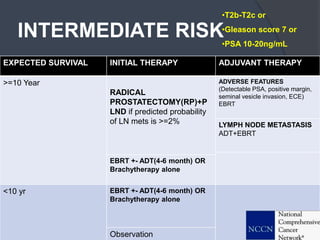
INTERMEDIATE RISK
EXPECTED SURVIVAL INITIAL THERAPY ADJUVANT THERAPY
>=10 Year
RADICAL
PROSTATECTOMY(RP)+P
LND if predicted probability
of LN mets is >=2%
ADVERSE FEATURES
(Detectable PSA, positive margin,
seminal vesicle invasion, ECE)
EBRT
LYMPH NODE METASTASIS
ADT+EBRT
EBRT +- ADT(4-6 month) OR
Brachytherapy alone
<10 yr EBRT +- ADT(4-6 month) OR
Brachytherapy alone
Observation
•T2b-T2c or
•Gleason score 7 or
•PSA 10-20ng/mL
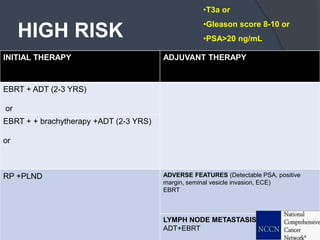
HIGH RISK
INITIAL THERAPY ADJUVANT THERAPY
EBRT + ADT (2-3 YRS)
or
EBRT + + brachytherapy +ADT (2-3 YRS)
or
RP +PLND ADVERSE FEATURES (Detectable PSA, positive
margin, seminal vesicle invasion, ECE)
EBRT
LYMPH NODE METASTASIS
ADT+EBRT
•T3a or
•Gleason score 8-10 or
•PSA>20 ng/mL
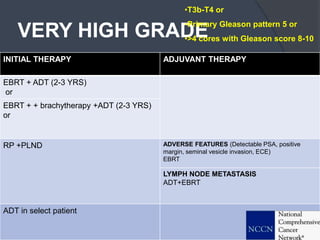
VERY HIGH GRADE
INITIAL THERAPY ADJUVANT THERAPY
EBRT + ADT (2-3 YRS)
or
EBRT + + brachytherapy +ADT (2-3 YRS)
or
RP +PLND ADVERSE FEATURES (Detectable PSA, positive
margin, seminal vesicle invasion, ECE)
EBRT
LYMPH NODE METASTASIS
ADT+EBRT
ADT in select patient
•T3b-T4 or
•Primary Gleason pattern 5 or
•>4 cores with Gleason score 8-10
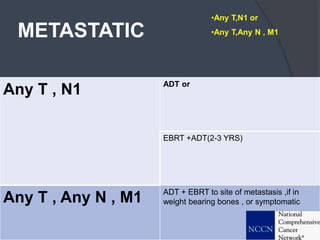
METASTATIC
Any T , N1 ADT or
EBRT +ADT(2-3 YRS)
Any T , Any N , M1 ADT + EBRT to site of metastasis ,if in
weight bearing bones , or symptomatic
•Any T,N1 or
•Any T,Any N , M1
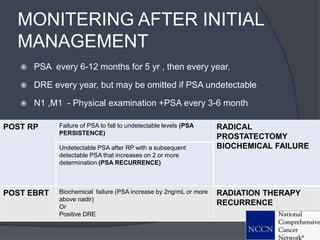
MONITERING AFTER INITIAL
MANAGEMENT
 PSA every 6-12 months for 5 yr , then every year.
 DRE every year, but may be omitted if PSA undetectable
 N1 ,M1 - Physical examination +PSA every 3-6 month
POST RP Failure of PSA to fall to undetectable levels (PSA
PERSISTENCE)
RADICAL
PROSTATECTOMY
BIOCHEMICAL FAILUREUndetectable PSA after RP with a subsequent
detectable PSA that increases on 2 or more
determination (PSA RECURRENCE)
POST EBRT Biochemical failure (PSA increase by 2ng/mL or more
above nadir)
Or
Positive DRE
RADIATION THERAPY
RECURRENCE
RADICAL PROSTATECTOMY
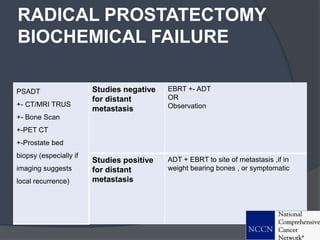
BIOCHEMICAL FAILURE
PSADT
+- CT/MRI TRUS
+- Bone Scan
+-PET CT
+-Prostate bed
biopsy (especially if
imaging suggests
local recurrence)
Studies negative
for distant
metastasis
EBRT +- ADT
OR
Observation
Studies positive
for distant
metastasis
ADT + EBRT to site of metastasis ,if in
weight bearing bones , or symptomatic
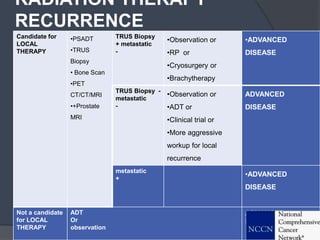
RADIATION THERAPY
RECURRENCE
Candidate for
LOCAL
THERAPY
•PSADT
•TRUS
Biopsy
• Bone Scan
•PET
CT/CT/MRI
•+Prostate
MRI
TRUS Biopsy
+ metastatic
-
•Observation or
•RP or
•Cryosurgery or
•Brachytherapy
•ADVANCED
DISEASE
TRUS Biopsy -
metastatic
-
•Observation or
•ADT or
•Clinical trial or
•More aggressive
workup for local
recurrence
ADVANCED
DISEASE
metastatic
+
•ADVANCED
DISEASE
Not a candidate
for LOCAL
THERAPY
ADT
Or
observation
ADVANCED
DISEASE
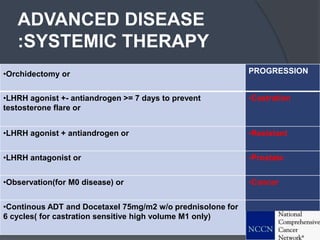
ADVANCED DISEASE
:SYSTEMIC THERAPY
•Orchidectomy or PROGRESSION
•LHRH agonist +- antiandrogen >= 7 days to prevent
testosterone flare or
•Castration
•LHRH agonist + antiandrogen or •Resistant
•LHRH antagonist or •Prostate
•Observation(for M0 disease) or •Cancer
•Continous ADT and Docetaxel 75mg/m2 w/o prednisolone for
6 cycles( for castration sensitive high volume M1 only)
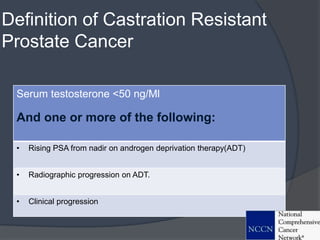
Definition of Castration Resistant
Prostate Cancer
Serum testosterone <50 ng/Ml
And one or more of the following:
• Rising PSA from nadir on androgen deprivation therapy(ADT)
• Radiographic progression on ADT.
• Clinical progression
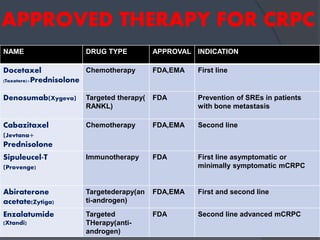
APPROVED THERAPY FOR CRPC
NAME DRUG TYPE APPROVAL INDICATION
Docetaxel
(Taxotere)+Prednisolone
Chemotherapy FDA,EMA First line
Denosumab(Xygeva) Targeted therapy(
RANKL)
FDA Prevention of SREs in patients
with bone metastasis
Cabazitaxel
(Jevtana+
Prednisolone
Chemotherapy FDA,EMA Second line
Sipuleucel-T
(Provenge)
Immunotherapy FDA First line asymptomatic or
minimally symptomatic mCRPC
Abiraterone
acetate(Zytiga)
Targetederapy(an
ti-androgen)
FDA,EMA First and second line
Enzalatumide
(Xtandi)
Targeted
THerapy(anti-
androgen)
FDA Second line advanced mCRPC
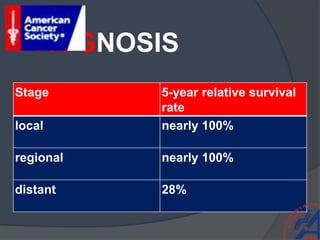
PROGNOSIS
Stage 5-year relative survival
rate
local nearly 100%
regional nearly 100%
distant 28%
 THANKYOU

Ca prostate

  • 2.
    GUIDELINES FOR MANAGEMENT Dr ANKITASINGH PATEL MBBS,MD(KGMU) CONSULTANT Apex Hospital Cancer Institute TRAINING AND FELLOWSHIP Fortis Research Institute ,New Delhi Tata Memorial Hospital,MUMBAI Mob. 8765845035,9305421547 Email: dr.ankitapatel.onco@gmail.com
  • 3.
    INCIDENCE  Prostate cancer(PCa) is the second most common cause of cancer and the sixth leading cause of cancer death among men worldwide.  RISK FACTORS: Age ,Race , Family history/age of onset , Diet / fat , Cadmium, cigarette
  • 4.
    PROSTATE CANCER Tumor distribution %of glandular tissue in prostate % of cancers in zone 10% 25% 65% 5-10% 70%20% Oesterling J, et al. Cancer: Principles & Practice of Oncology. 5th ed. 1997;1322-1386. Transition zone Central zone Peripheral zone
  • 7.
  • 9.
  • 10.
    AGE NORMAL (ng/Ml) 40-490-2.5 50-59 3.5 60-69 4.5 70-79 6.5 AGE SPECIFIC PSA CUTOFF
  • 11.
  • 13.
  • 14.
    GLEASON SCORE  PRIMARYGRADE – Most predominant pattern.  SECONDARY GRADE – Highest grade in all the samples.  When these two grades are added together, the total is called the Gleason score.  EXAMPLE if the biopsy samples show that:  most of the cancer seen is grade 3  the highest grade of any other cancer seen is grade 4, then  the Gleason score will be 7 (3+4).  A Gleason score of 4+3 shows that the cancer is slightly more aggressive than a score of 3+4, as there is more grade 4 cancer.
  • 15.
    Pathology  Classification  >95%------------------adenocarcinoma  5%------------------ - 90%--------------TCC - 10%--------------neuroendocrine (small cell) CA --------------sarcomas
  • 16.
  • 17.
    Androgen Deprivation Therapy degarelix(Firmagon) •enzalutamide(MDV3100) • ketoconazole •Abiraterone (Zytiga) •Goserlin (Zoladex) •Histerlin (Vantas) • leuprolide (Lupron) • triptorelin (Trelstar). HYPOTHALAMUS PITUITARY TESTES S PROSTATE / TUMOR megestrol bicalutamide flutamid ilutamide
  • 19.
    American Society Prostate CancerScreening Guidelines  Average risk: annually beginning age 50 years with 10+ year life expectancy  Age 45 if high risk: High risk includes African-American men or those with first-degree relative with prostate cancer <65 years of age  Age 40 if very high risk: Very high risk includes multiple family members with prostate cancer at early age  If testing performed, PSA with or without DRE 2009 guidelines reaffirmed in 2013
  • 20.
    PSA Cutpoints for Biopsy Recommendations PSA RANGERECOMMENDATION 0-3.9ng/mL “normal “ range; biopsy not generally recommended 4-9 ng/mL Biopsy recommended ; probability of detecting cancer ranges from 25% to 30%. >10 ng/mL Biopsy recommended ; high probability of detecting cancer (>=50%)
  • 21.
  • 22.
    PROSTATE CANCER SUSPECTED(PSA/Screening) COMPLETEHISTORY AND PHYSICAL EXAMINATION INCLUDING DRE TRUS GUIDED BIOPSY Life expectancy <=5 yrs and Asymptomatic No further workup or treatment until symptomatic except in high or very high risk group. Life expectancy >5 yrs OR symptomatic Risk classification WORK UP depends on Risk Classification BONE SCAN IF 1. T1 and PSA>20 2. T2 and PSA>10 3. Gleason score >=8 4. T3,T4 5. Symptomatic 1. T3,T4 2. T1-T2 and normogram indicated probability of lymph node involvment>10% Pelvic CT or MRI or PETCT
  • 23.
    VERY LOW RISKGROUP EXPECTED SURVIVAL INITIAL THERAPY ADJUVANT THERAPY ACTIVE SURVEILLANCE •PSA 6 monthly and SOS •DRE 12 monthly and SOS •repeat prostate biopgy 12 monthly and SOS >=20yrs EBRT OR Brachytherapy Radical Prostatectomy(RP)+PLND if predicted probability of LN mets is >=2% Roach formula LN metastasis (%) = 2/3 PSA + 10× (Gleason-6) ADVERSE FEATURES (Detectable PSA,positive margin,seminal vesicle invasion,ECE) EBRT LYMPH NODE METASTASIS ADT+EBRT 10-20YRS ACTIVE SURVEILLANCE <10 YRS OBSERVATION •T1c •Gleason score<=6 •PSA<10 ng/ML •Fewer than 3 prostate biopsy cores positive,<=50% cancer in each core
  • 24.
    LOW RISK EXPECTED SURVIVALINITIAL THERAPY ADJUVANT THERAPY >=10YRS ACTIVE SURVEILLANCE EBRT OR Brachytherapy RADICAL PROSTATECTOMY(RP)+PLN D if predicted probability of LN mets is >=2% ADVERSE FEATURES (Detectable PSA, positive margin, seminal vesicle invasion, ECE) EBRT LYMPH NODE METASTASIS ADT+EBRT <10YRS OBSERVATION •T1-T2a •Gleason score<=6 •PSA<10 ng/ML
  • 25.
    INTERMEDIATE RISK EXPECTED SURVIVALINITIAL THERAPY ADJUVANT THERAPY >=10 Year RADICAL PROSTATECTOMY(RP)+P LND if predicted probability of LN mets is >=2% ADVERSE FEATURES (Detectable PSA, positive margin, seminal vesicle invasion, ECE) EBRT LYMPH NODE METASTASIS ADT+EBRT EBRT +- ADT(4-6 month) OR Brachytherapy alone <10 yr EBRT +- ADT(4-6 month) OR Brachytherapy alone Observation •T2b-T2c or •Gleason score 7 or •PSA 10-20ng/mL
  • 26.
    HIGH RISK INITIAL THERAPYADJUVANT THERAPY EBRT + ADT (2-3 YRS) or EBRT + + brachytherapy +ADT (2-3 YRS) or RP +PLND ADVERSE FEATURES (Detectable PSA, positive margin, seminal vesicle invasion, ECE) EBRT LYMPH NODE METASTASIS ADT+EBRT •T3a or •Gleason score 8-10 or •PSA>20 ng/mL
  • 27.
    VERY HIGH GRADE INITIALTHERAPY ADJUVANT THERAPY EBRT + ADT (2-3 YRS) or EBRT + + brachytherapy +ADT (2-3 YRS) or RP +PLND ADVERSE FEATURES (Detectable PSA, positive margin, seminal vesicle invasion, ECE) EBRT LYMPH NODE METASTASIS ADT+EBRT ADT in select patient •T3b-T4 or •Primary Gleason pattern 5 or •>4 cores with Gleason score 8-10
  • 28.
    METASTATIC Any T ,N1 ADT or EBRT +ADT(2-3 YRS) Any T , Any N , M1 ADT + EBRT to site of metastasis ,if in weight bearing bones , or symptomatic •Any T,N1 or •Any T,Any N , M1
  • 29.
    MONITERING AFTER INITIAL MANAGEMENT PSA every 6-12 months for 5 yr , then every year.  DRE every year, but may be omitted if PSA undetectable  N1 ,M1 - Physical examination +PSA every 3-6 month POST RP Failure of PSA to fall to undetectable levels (PSA PERSISTENCE) RADICAL PROSTATECTOMY BIOCHEMICAL FAILUREUndetectable PSA after RP with a subsequent detectable PSA that increases on 2 or more determination (PSA RECURRENCE) POST EBRT Biochemical failure (PSA increase by 2ng/mL or more above nadir) Or Positive DRE RADIATION THERAPY RECURRENCE
  • 30.
    RADICAL PROSTATECTOMY BIOCHEMICAL FAILURE PSADT +-CT/MRI TRUS +- Bone Scan +-PET CT +-Prostate bed biopsy (especially if imaging suggests local recurrence) Studies negative for distant metastasis EBRT +- ADT OR Observation Studies positive for distant metastasis ADT + EBRT to site of metastasis ,if in weight bearing bones , or symptomatic
  • 31.
    RADIATION THERAPY RECURRENCE Candidate for LOCAL THERAPY •PSADT •TRUS Biopsy •Bone Scan •PET CT/CT/MRI •+Prostate MRI TRUS Biopsy + metastatic - •Observation or •RP or •Cryosurgery or •Brachytherapy •ADVANCED DISEASE TRUS Biopsy - metastatic - •Observation or •ADT or •Clinical trial or •More aggressive workup for local recurrence ADVANCED DISEASE metastatic + •ADVANCED DISEASE Not a candidate for LOCAL THERAPY ADT Or observation ADVANCED DISEASE
  • 32.
    ADVANCED DISEASE :SYSTEMIC THERAPY •Orchidectomyor PROGRESSION •LHRH agonist +- antiandrogen >= 7 days to prevent testosterone flare or •Castration •LHRH agonist + antiandrogen or •Resistant •LHRH antagonist or •Prostate •Observation(for M0 disease) or •Cancer •Continous ADT and Docetaxel 75mg/m2 w/o prednisolone for 6 cycles( for castration sensitive high volume M1 only)
  • 33.
    Definition of CastrationResistant Prostate Cancer Serum testosterone <50 ng/Ml And one or more of the following: • Rising PSA from nadir on androgen deprivation therapy(ADT) • Radiographic progression on ADT. • Clinical progression
  • 34.
    APPROVED THERAPY FORCRPC NAME DRUG TYPE APPROVAL INDICATION Docetaxel (Taxotere)+Prednisolone Chemotherapy FDA,EMA First line Denosumab(Xygeva) Targeted therapy( RANKL) FDA Prevention of SREs in patients with bone metastasis Cabazitaxel (Jevtana+ Prednisolone Chemotherapy FDA,EMA Second line Sipuleucel-T (Provenge) Immunotherapy FDA First line asymptomatic or minimally symptomatic mCRPC Abiraterone acetate(Zytiga) Targetederapy(an ti-androgen) FDA,EMA First and second line Enzalatumide (Xtandi) Targeted THerapy(anti- androgen) FDA Second line advanced mCRPC
  • 35.
    PROGNOSIS Stage 5-year relativesurvival rate local nearly 100% regional nearly 100% distant 28%
  • 36.