Journal Club
Dr Santosh K
Senior Resident
All India Institute of Medical Sciences , Bhubaneshwar
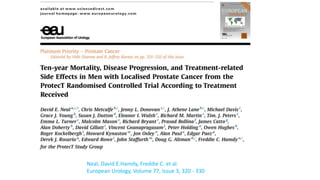
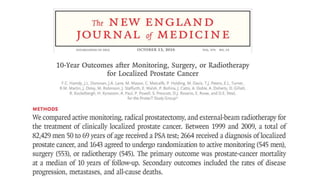
Neal, David E.Hamdy, Freddie C. et al.
European Urology, Volume 77, Issue 3, 320 - 330
Background
• Clinically localized prostate cancer – detected by prostate specific antigen (PSA) screening
• Huge burden on health care(incidence in the US 164690/year)
• Seemingly localized tumors may be of diverse nature
Low malignant potential - left untreated are unlikely to result in morbidity or reduce life expectancy
Intermediate malignant potential -Curable with a single modality directed exclusively to the gland
itself
High risk cases- destined to recur locally or systemically despite optimal local therapy
• Management remain controversial- Many men do not benefit from treatment
Indolent
Disseminated
• Prostate cancer progresses slowly- Many die of competing causes
• Interventions are associated with adverse effects
Data from screening studies - inconsistent
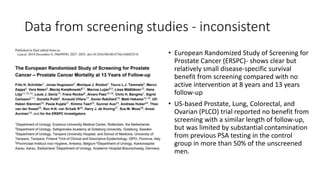
• European Randomized Study of Screening for
Prostate Cancer (ERSPC)- shows clear but
relatively small disease-specific survival
benefit from screening compared with no
active intervention at 8 years and 13 years
follow-up
• US-based Prostate, Lung, Colorectal, and
Ovarian (PLCO) trial reported no benefit from
screening with a similar length of follow-up,
but was limited by substantial contamination
from previous PSA testing in the control
group in more than 50% of the unscreened
men.
Lacunae in available literature
• No evidence that PSA-testing, and treatment of localized prostate cancer improved
survival and quality of life
• Increasing burden to health care providers and society
• Uncertainties for patients over best treatment
• Treatment options not compared previously
Most men diagnosed with PSA-detected prostate cancer tend to
undergo radical treatment
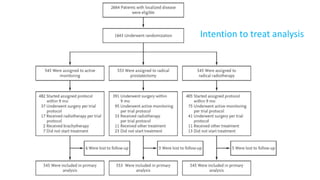
Intention to treat analysis
Present analysis
• Secondary analysis
• According to treatment received
• Includes even those patient did not agree for randomization but
selected their treatment choice
Trial design
• A PSA-testing programme and 3-arm randomised + patient
selected treatment option trial to evaluate effectiveness in
prostate cancer:
• Active Monitoring versus surgery versus radiotherapy
• Primary end-point: prostate cancer-specific survival at 10
years
• All-cause deaths
• Cancer progression
• Patient-reported outcomes
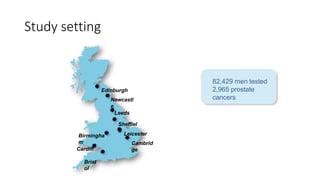
Study setting
Leeds
Sheffiel
d
Birmingha
m
Cardiff
Brist
ol
Leicester
Cambrid
ge
Edinburgh
Newcastl
e
82,429 men tested
2,965 prostate
cancers
Methods
• Recruitment from Primary Care Physicians /GP practices
• Fit men, aged 50-69 years
• Prostate Check Clinics by Research Nurses
– Counseling about prostate cancer
– Obtaining informed consent
– Taking blood for PSA-testing
• Invitation to the hospital for prostate biopsies in men with a raised PSA
• Men with prostate cancer were evaluated by clinicians
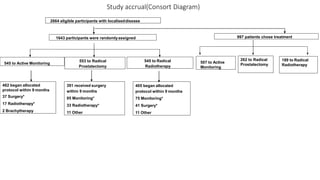
• Men suitable for the trial (localized disease) 2664 -1643(62%)
randomized
- 997(38%) Chose
treatment
Treatment options
Active Monitoring is a surveillance programme. They were offered radical treatments
if the disease appeared to progress.
• PSA measured 3 monthly in the 1st year and 6–12 monthly thereafter
• An increase of 50% or more in PSA over a 12-mo period triggered a clinical review
Purpose - avoid unnecessary treatment, but to keep them in a ‘window-of-curability’ if
treatment became necessary
Surgery was performed as radical prostatectomy with routine follow-up and additional
treatments
• Men with a PSA level of 10 mg/l or a Gleason score of 7 underwent lymphadenectomy
• Adjuvant RT was considered for positive margins or extracapsular disease
Radiotherapy with regular follow-up, and additional interventions as necessary
• RT protocol included neoadjuvant ADT for 3–6 months before and concomitantly with three-
dimensional conformal RT (74 Gy in 37 fractions)
Follow up
• Follow-up was standardized according to treatment-specific pathways
• In all groups, ADT was offered when serum PSA reached a concentration of 20 ng/ml (or
less if clinically indicated)
• Skeletal imaging was carried out if PSA was 10 ng/mll
Outcomes measures
• Cause of death - was determine by a committee.
• Metastatic disease - Bony, visceral, or lymph node metastases
PSA levels above 100 mg/l
Progression - Metastases
Clinical T3 or T4disease
ureteric obstruction, rectal fistula, or need for urinary catheter due local tumour growth
Initiation of ADT - objective marker of disease progression
• Cancer grades were classified into the following Gleason grade groups: (1) 3 + 3 = 6; (2) 3 + 4 = 7;
(3) 4 + 3 = 7; (4) 4 + 4 = 8, 3 + 5 = 8, 5 + 3 = 8; and (5) 9.
• D’ Amico score was used for risk stratification
• Health-related quality of life impacts on urinary, bowel, and sexual function were assessed using
patient-reported outcome measures (PROMs) ( at randomization and then yearly)
-Expanded Prostate Index Composite (EPIC )
-International Continence Society Male Short Form (ICSmaleSF).
Statistical analysis
• Secondary analysis of the randomized cohort as well as treatment choice cohort based
on treatment received
• “Overall test” of event rates across the three groups done initially
• Pairwise tests of RP versus AM and RT versus AM was done if overall test showed
significant difference
• Propensity score approach because it was straightforward generalization for comparisons
between three groups and could use the same method for the randomized and
treatment choice cohorts
• Propensity scores were generated using multinomial logistic
regression, with treatment received as the three-category outcome
variable, and the following covariates: cT stage (1 or 2), Gleason grade
group (1, 2, 3, and >3 [4 and 5 combined]), log-transformed PSA, age
in years, and study center.
• Data from the two cohorts were combined, and survival curves for
prostate cancer mortality and metastasis drawn
• For PROMs data from the cohorts were combined, and all data
after treatment were compared between treatment groups
Study accrual(Consort Diagram)
391 received surgery
within 9 months
95 Monitoring*
33 Radiotherapy*
11 Other
1643 participants were randomlyassigned
553 to Radical
Prostatectomy
545 to Active Monitoring
545 to Radical
Radiotherapy
405 began allocated
protocol within 9 months
75 Monitoring*
41 Surgery*
11 Other
482 began allocated
protocol within 9 months
37 Surgery*
17 Radiotherapy*
2 Brachytherapy
2664 eligible participants with localiseddisease
997 patients chose treatment
507 to Active
Monitoring
262 to Radical
Prostatectomy
189 to Radical
Radiotherapy
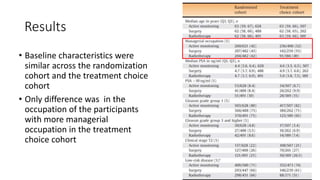
Results
• Baseline characteristics were
similar across the randomization
cohort and the treatment choice
cohort
• Only difference was in the
occupation of the participants
with more managerial
occupation in the treatment
choice cohort
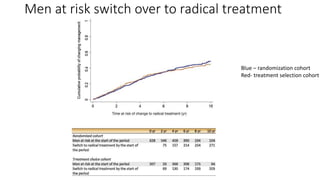
Men at risk switch over to radical treatment
Blue – randomization cohort
Red- treatment selection cohort
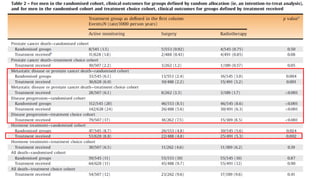
Clinical outcomes
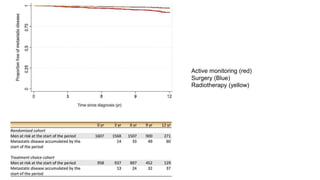
Active monitoring (red)
Surgery (Blue)
Radiotherapy (yellow)
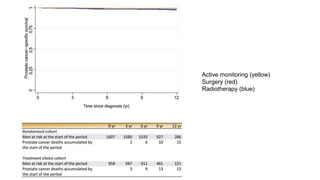
Fig. 2
European Urology 2020 77, 320-330DOI: (10.1016/j.eururo.2019.10.030)
Active monitoring (yellow)
Surgery (red)
Radiotherapy (blue)
• Most progression
• development of a high stage (T3 orT4)
• starting of ADT
• Higher in the AM group (60% [85/142] in the randomized cohort and
57% [45/79] in the treatment choice cohort).
• The presence of stage T3 or T4 did not prevent subsequent radical
treatment in some men, with 20% (22/112) undergoing RP and 35%
(39/112) undergoing RT.
Exploratory ancillary analyses
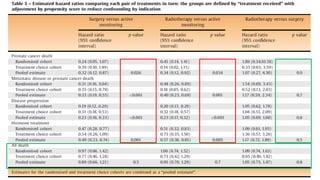
• Combined surgery group + RT group - compared with AM
• Reduction in prostate cancer-specific mortality with radical treatment compared with AM
• Randomised cohort (hazard ratio = 0.34; 95% [CI] 0.13, 0.94)
• Treatment choice cohort (hazard ratio = 0.27; 95% CI 0.08, 0.91)
• Pooling of these two estimates - marked decrease in prostate cancer mortality with
radical treatment (hazard ratio = 0.31; 95% CI 0.14, 0.67; p = 0.003)
• Small number of prostate cancer deaths means that the absolute reduction is modest!!
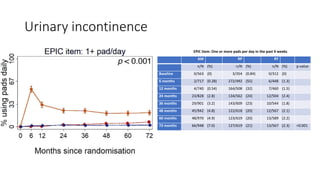
Urinary incontinence
AM RP RT
n/N (%) n/N (%) n/N (%) p-value
Baseline 0/563 (0) 3/354 (0.84) 0/312 (0)
6 months 2/717 (0.28) 272/492 (55) 6/448 (1.3)
12 months 4/740 (0.54) 164/508 (32) 7/460 (1.5)
24 months 23/828 (2.8) 134/562 (24) 12/504 (2.4)
36 months 29/901 (3.2) 143/609 (23) 10/544 (1.8)
48 months 45/942 (4.8) 122/618 (20) 12/567 (2.1)
60 months 48/970 (4.9) 123/619 (20) 13/589 (2.2)
72 months 66/948 (7.0) 127/619 (21) 13/567 (2.3) <0.001
EPIC item: One or more pads per day in the past 4 weeks
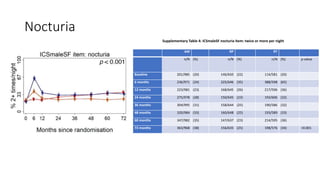
Nocturia
AM RP RT
n/N (%) n/N (%) n/N (%) p-value
Baseline 201/985 (20) 146/650 (22) 114/581 (20)
6 months 236/971 (24) 225/646 (35) 388/598 (65)
12 months 223/981 (23) 168/645 (26) 217/596 (36)
24 months 275/978 (28) 150/645 (23) 193/606 (32)
36 months 304/995 (31) 158/644 (25) 190/586 (32)
48 months 320/984 (33) 160/648 (25) 193/589 (33)
60 months 347/982 (35) 147/637 (23) 214/595 (36)
72 months 363/968 (38) 156/635 (25) 198/576 (34) <0.001
Supplementary Table 4: ICSmaleSF nocturia item: twice or more per night
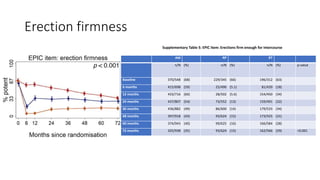
Erection firmness
AM RP RT
n/N (%) n/N (%) n/N (%) p-value
Baseline 370/548 (68) 229/345 (66) 196/312 (63)
6 months 415/698 (59) 25/490 (5.1) 81/439 (18)
12 months 433/716 (60) 28/502 (5.6) 154/450 (34)
24 months 437/807 (54) 73/552 (13) 159/491 (32)
36 months 436/882 (49) 86/600 (14) 179/533 (34)
48 months 397/918 (43) 93/624 (15) 173/555 (31)
60 months 374/943 (40) 99/625 (16) 166/584 (28)
72 months 325/938 (35) 93/624 (15) 162/566 (29) <0.001
Supplementary Table 5: EPIC item: Erections firm enough for intercourse
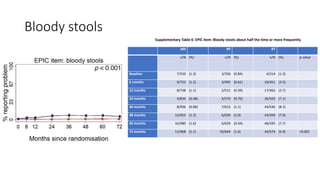
Bloody stools
AM RP RT
n/N (%) n/N (%) n/N (%) p-value
Baseline 7/559 (1.3) 3/356 (0.84) 4/314 (1.3)
6 months 9/722 (1.2) 3/495 (0.61) 16/451 (3.5)
12 months 8/738 (1.1) 2/511 (0.39) 17/462 (3.7)
24 months 4/834 (0.48) 4/570 (0.70) 36/505 (7.1)
36 months 8/906 (0.88) 7/612 (1.1) 44/546 (8.1)
48 months 12/953 (1.3) 6/630 (1.0) 43/569 (7.6)
60 months 16/980 (1.6) 6/639 (0.94) 46/595 (7.7)
72 months 11/968 (1.1) 10/644 (1.6) 34/574 (5.9) <0.001
Supplementary Table 6: EPIC item: Bloody stools about half the time or more frequently
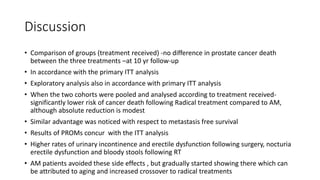
Discussion
• Comparison of groups (treatment received) -no difference in prostate cancer death
between the three treatments –at 10 yr follow-up
• In accordance with the primary ITT analysis
• Exploratory analysis also in accordance with primary ITT analysis
• When the two cohorts were pooled and analysed according to treatment received-
significantly lower risk of cancer death following Radical treatment compared to AM,
although absolute reduction is modest
• Similar advantage was noticed with respect to metastasis free survival
• Results of PROMs concur with the ITT analysis
• Higher rates of urinary incontinence and erectile dysfunction following surgery, nocturia
erectile dysfunction and bloody stools following RT
• AM patients avoided these side effects , but gradually started showing there which can
be attributed to aging and increased crossover to radical treatments
Limitation
• Potential for bias- inherent to the method of analysis
• Evolution of new diagnostic modalities that target biopsies detection
only in significant tumours
• Young and non white population?? Prognosis not known
• Caution while counselling patients- prognosis beyond 10 years not
known.

Protec t trial- Journal club

  • 1.
    Journal Club Dr SantoshK Senior Resident All India Institute of Medical Sciences , Bhubaneshwar
  • 2.
    Neal, David E.Hamdy,Freddie C. et al. European Urology, Volume 77, Issue 3, 320 - 330
  • 3.
    Background • Clinically localizedprostate cancer – detected by prostate specific antigen (PSA) screening • Huge burden on health care(incidence in the US 164690/year) • Seemingly localized tumors may be of diverse nature Low malignant potential - left untreated are unlikely to result in morbidity or reduce life expectancy Intermediate malignant potential -Curable with a single modality directed exclusively to the gland itself High risk cases- destined to recur locally or systemically despite optimal local therapy • Management remain controversial- Many men do not benefit from treatment Indolent Disseminated • Prostate cancer progresses slowly- Many die of competing causes • Interventions are associated with adverse effects
  • 4.
    Data from screeningstudies - inconsistent • European Randomized Study of Screening for Prostate Cancer (ERSPC)- shows clear but relatively small disease-specific survival benefit from screening compared with no active intervention at 8 years and 13 years follow-up • US-based Prostate, Lung, Colorectal, and Ovarian (PLCO) trial reported no benefit from screening with a similar length of follow-up, but was limited by substantial contamination from previous PSA testing in the control group in more than 50% of the unscreened men.
  • 5.
    Lacunae in availableliterature • No evidence that PSA-testing, and treatment of localized prostate cancer improved survival and quality of life • Increasing burden to health care providers and society • Uncertainties for patients over best treatment • Treatment options not compared previously Most men diagnosed with PSA-detected prostate cancer tend to undergo radical treatment
  • 7.
  • 8.
    Present analysis • Secondaryanalysis • According to treatment received • Includes even those patient did not agree for randomization but selected their treatment choice
  • 9.
    Trial design • APSA-testing programme and 3-arm randomised + patient selected treatment option trial to evaluate effectiveness in prostate cancer: • Active Monitoring versus surgery versus radiotherapy • Primary end-point: prostate cancer-specific survival at 10 years • All-cause deaths • Cancer progression • Patient-reported outcomes
  • 10.
  • 11.
    Methods • Recruitment fromPrimary Care Physicians /GP practices • Fit men, aged 50-69 years • Prostate Check Clinics by Research Nurses – Counseling about prostate cancer – Obtaining informed consent – Taking blood for PSA-testing • Invitation to the hospital for prostate biopsies in men with a raised PSA • Men with prostate cancer were evaluated by clinicians • Men suitable for the trial (localized disease) 2664 -1643(62%) randomized - 997(38%) Chose treatment
  • 12.
    Treatment options Active Monitoringis a surveillance programme. They were offered radical treatments if the disease appeared to progress. • PSA measured 3 monthly in the 1st year and 6–12 monthly thereafter • An increase of 50% or more in PSA over a 12-mo period triggered a clinical review Purpose - avoid unnecessary treatment, but to keep them in a ‘window-of-curability’ if treatment became necessary Surgery was performed as radical prostatectomy with routine follow-up and additional treatments • Men with a PSA level of 10 mg/l or a Gleason score of 7 underwent lymphadenectomy • Adjuvant RT was considered for positive margins or extracapsular disease Radiotherapy with regular follow-up, and additional interventions as necessary • RT protocol included neoadjuvant ADT for 3–6 months before and concomitantly with three- dimensional conformal RT (74 Gy in 37 fractions)
  • 13.
    Follow up • Follow-upwas standardized according to treatment-specific pathways • In all groups, ADT was offered when serum PSA reached a concentration of 20 ng/ml (or less if clinically indicated) • Skeletal imaging was carried out if PSA was 10 ng/mll
  • 14.
    Outcomes measures • Causeof death - was determine by a committee. • Metastatic disease - Bony, visceral, or lymph node metastases PSA levels above 100 mg/l Progression - Metastases Clinical T3 or T4disease ureteric obstruction, rectal fistula, or need for urinary catheter due local tumour growth Initiation of ADT - objective marker of disease progression • Cancer grades were classified into the following Gleason grade groups: (1) 3 + 3 = 6; (2) 3 + 4 = 7; (3) 4 + 3 = 7; (4) 4 + 4 = 8, 3 + 5 = 8, 5 + 3 = 8; and (5) 9. • D’ Amico score was used for risk stratification • Health-related quality of life impacts on urinary, bowel, and sexual function were assessed using patient-reported outcome measures (PROMs) ( at randomization and then yearly) -Expanded Prostate Index Composite (EPIC ) -International Continence Society Male Short Form (ICSmaleSF).
  • 15.
    Statistical analysis • Secondaryanalysis of the randomized cohort as well as treatment choice cohort based on treatment received • “Overall test” of event rates across the three groups done initially • Pairwise tests of RP versus AM and RT versus AM was done if overall test showed significant difference • Propensity score approach because it was straightforward generalization for comparisons between three groups and could use the same method for the randomized and treatment choice cohorts
  • 16.
    • Propensity scoreswere generated using multinomial logistic regression, with treatment received as the three-category outcome variable, and the following covariates: cT stage (1 or 2), Gleason grade group (1, 2, 3, and >3 [4 and 5 combined]), log-transformed PSA, age in years, and study center. • Data from the two cohorts were combined, and survival curves for prostate cancer mortality and metastasis drawn • For PROMs data from the cohorts were combined, and all data after treatment were compared between treatment groups
  • 17.
    Study accrual(Consort Diagram) 391received surgery within 9 months 95 Monitoring* 33 Radiotherapy* 11 Other 1643 participants were randomlyassigned 553 to Radical Prostatectomy 545 to Active Monitoring 545 to Radical Radiotherapy 405 began allocated protocol within 9 months 75 Monitoring* 41 Surgery* 11 Other 482 began allocated protocol within 9 months 37 Surgery* 17 Radiotherapy* 2 Brachytherapy 2664 eligible participants with localiseddisease 997 patients chose treatment 507 to Active Monitoring 262 to Radical Prostatectomy 189 to Radical Radiotherapy
  • 18.
    Results • Baseline characteristicswere similar across the randomization cohort and the treatment choice cohort • Only difference was in the occupation of the participants with more managerial occupation in the treatment choice cohort
  • 19.
    Men at riskswitch over to radical treatment Blue – randomization cohort Red- treatment selection cohort
  • 20.
  • 22.
    Active monitoring (red) Surgery(Blue) Radiotherapy (yellow)
  • 23.
    Fig. 2 European Urology2020 77, 320-330DOI: (10.1016/j.eururo.2019.10.030) Active monitoring (yellow) Surgery (red) Radiotherapy (blue)
  • 24.
    • Most progression •development of a high stage (T3 orT4) • starting of ADT • Higher in the AM group (60% [85/142] in the randomized cohort and 57% [45/79] in the treatment choice cohort). • The presence of stage T3 or T4 did not prevent subsequent radical treatment in some men, with 20% (22/112) undergoing RP and 35% (39/112) undergoing RT.
  • 25.
    Exploratory ancillary analyses •Combined surgery group + RT group - compared with AM • Reduction in prostate cancer-specific mortality with radical treatment compared with AM • Randomised cohort (hazard ratio = 0.34; 95% [CI] 0.13, 0.94) • Treatment choice cohort (hazard ratio = 0.27; 95% CI 0.08, 0.91) • Pooling of these two estimates - marked decrease in prostate cancer mortality with radical treatment (hazard ratio = 0.31; 95% CI 0.14, 0.67; p = 0.003) • Small number of prostate cancer deaths means that the absolute reduction is modest!!
  • 26.
    Urinary incontinence AM RPRT n/N (%) n/N (%) n/N (%) p-value Baseline 0/563 (0) 3/354 (0.84) 0/312 (0) 6 months 2/717 (0.28) 272/492 (55) 6/448 (1.3) 12 months 4/740 (0.54) 164/508 (32) 7/460 (1.5) 24 months 23/828 (2.8) 134/562 (24) 12/504 (2.4) 36 months 29/901 (3.2) 143/609 (23) 10/544 (1.8) 48 months 45/942 (4.8) 122/618 (20) 12/567 (2.1) 60 months 48/970 (4.9) 123/619 (20) 13/589 (2.2) 72 months 66/948 (7.0) 127/619 (21) 13/567 (2.3) <0.001 EPIC item: One or more pads per day in the past 4 weeks
  • 27.
    Nocturia AM RP RT n/N(%) n/N (%) n/N (%) p-value Baseline 201/985 (20) 146/650 (22) 114/581 (20) 6 months 236/971 (24) 225/646 (35) 388/598 (65) 12 months 223/981 (23) 168/645 (26) 217/596 (36) 24 months 275/978 (28) 150/645 (23) 193/606 (32) 36 months 304/995 (31) 158/644 (25) 190/586 (32) 48 months 320/984 (33) 160/648 (25) 193/589 (33) 60 months 347/982 (35) 147/637 (23) 214/595 (36) 72 months 363/968 (38) 156/635 (25) 198/576 (34) <0.001 Supplementary Table 4: ICSmaleSF nocturia item: twice or more per night
  • 28.
    Erection firmness AM RPRT n/N (%) n/N (%) n/N (%) p-value Baseline 370/548 (68) 229/345 (66) 196/312 (63) 6 months 415/698 (59) 25/490 (5.1) 81/439 (18) 12 months 433/716 (60) 28/502 (5.6) 154/450 (34) 24 months 437/807 (54) 73/552 (13) 159/491 (32) 36 months 436/882 (49) 86/600 (14) 179/533 (34) 48 months 397/918 (43) 93/624 (15) 173/555 (31) 60 months 374/943 (40) 99/625 (16) 166/584 (28) 72 months 325/938 (35) 93/624 (15) 162/566 (29) <0.001 Supplementary Table 5: EPIC item: Erections firm enough for intercourse
  • 29.
    Bloody stools AM RPRT n/N (%) n/N (%) n/N (%) p-value Baseline 7/559 (1.3) 3/356 (0.84) 4/314 (1.3) 6 months 9/722 (1.2) 3/495 (0.61) 16/451 (3.5) 12 months 8/738 (1.1) 2/511 (0.39) 17/462 (3.7) 24 months 4/834 (0.48) 4/570 (0.70) 36/505 (7.1) 36 months 8/906 (0.88) 7/612 (1.1) 44/546 (8.1) 48 months 12/953 (1.3) 6/630 (1.0) 43/569 (7.6) 60 months 16/980 (1.6) 6/639 (0.94) 46/595 (7.7) 72 months 11/968 (1.1) 10/644 (1.6) 34/574 (5.9) <0.001 Supplementary Table 6: EPIC item: Bloody stools about half the time or more frequently
  • 30.
    Discussion • Comparison ofgroups (treatment received) -no difference in prostate cancer death between the three treatments –at 10 yr follow-up • In accordance with the primary ITT analysis • Exploratory analysis also in accordance with primary ITT analysis • When the two cohorts were pooled and analysed according to treatment received- significantly lower risk of cancer death following Radical treatment compared to AM, although absolute reduction is modest • Similar advantage was noticed with respect to metastasis free survival • Results of PROMs concur with the ITT analysis • Higher rates of urinary incontinence and erectile dysfunction following surgery, nocturia erectile dysfunction and bloody stools following RT • AM patients avoided these side effects , but gradually started showing there which can be attributed to aging and increased crossover to radical treatments
  • 31.
    Limitation • Potential forbias- inherent to the method of analysis • Evolution of new diagnostic modalities that target biopsies detection only in significant tumours • Young and non white population?? Prognosis not known • Caution while counselling patients- prognosis beyond 10 years not known.