Approaches in Researching
Contemporary Art
Techniques and Practices
Most Essential Learning Competency
•Researches on techniques and performance
practices applied to contemporary arts
Specific Objectives
After going through this lesson, you are expected to:
•Cognitive
Describe approaches in researching for techniques
and practices appropriate for contemporary arts
•Affective
Integrate patience throughout the process of looking
for potential technique and practice in making art
•Psychomotor
Devise a personal action plan for art technique
selection and application.
Review
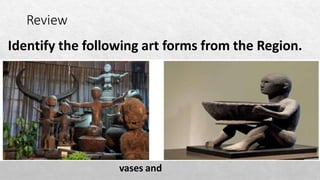
Identify the following art forms from the Region.
Vacul
Review
Identify the following art forms from the Region.
vases and
Review
Identify the following art forms from the Region.
Moriones
Review
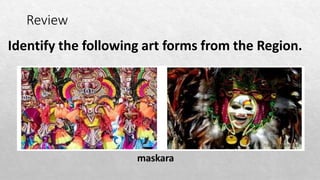
Identify the following art forms from the Region.
maskara
Review
Identify the following art forms from the Region.
pinta
Review
Identify the following art forms from the Region.
Vinta
Review
Identify the following art forms from the Region.
T'nalak
Review
Identify the following art forms from the Region.
Sarimanok
Art is never unreal. Certainly,
there is a masterpiece in the
mind of an artist.
What can you say about the
statement?
Direction: Your task is to state ways on
how you encourage other artists to use the
following medium in creating their artworks.
Typical Approaches in
Accomplishing Art Tasks
1. Brainstorming
• Is effective in looking for central ideas that
will most likely boost interest on the
matter at hand.
• It will also provide direction for art making
since this will kindle flexible thinking.
2. Researching about the task given
• This is best for an artist to clarify what he/she
really wants to accomplish.
• Thus, it simplifies choices and helps achieve
proper understanding about the given task.
3. Deciding on what idea to materialize
•On this step, the artist must have acquired
enough background or information about
his/her target output.
4. Creating a plan of action
• According to Benjamin Franklin, “If you fail to
plan, you plan to fail.”
• to reach success and achieve your goal is to
create a solid plan of action.
5. Making the task
• The artist can now materialize the plan that
he/she has created.
• Appropriate techniques, materials, styles, and
other art elements must be applied as part of
the art making process.
Approaches in
Researching for
Techniques and
Performance Practices
1. Cooperative Learning Approach
• Two heads are better than one.
• Can increase not only an artist’s skill but also
his/her collaborative function with others.
2. Focused Exploration
• This approach instructs artists to take
advantage of what is present in front of their
very eyes.
• Explore the use of this material as your new
medium in art making.
• Doing so will increase your imaginative skill as
well resourcefulness.
3. Discussion
• The more you talk to people, the more relevant
information you will gather.
• Remember, no one learns in isolation so,
better communicate with people in order for
you to grow more as an artist.
4. Free Exploration
• More than experimentation, an artist like you
possesses the full capacity to search on your
own without any reservation.
• If you allow your curiosity to flow naturally,
then everything will follow and expect to
discover more than what you aim for.
5. Experimentation
• This is actually the core of contemporary arts
• Through experimentation, an artist’s decision-
making skill is improve as well as his/her
organization skill.
6. Media Analysis
• Is critical in examining technology-based art
pieces.
• One way of searching for more techniques is by
investigating if not scrutinizing purpose, value,
mood, and socio-political implication of media
arts.
Advantages of
Researching New
Techniques and
Practices
1.It can push artists to aim for better versions of their
works and grab the
opportunity to expand artistic horizons.
2.It is a helpful way to immerse oneself in the culture
of others and thereby allowing own creativity to
design culture-based means of artistic expression.
3.It gives an artist the chance to look for another
window that lets him/her see what’s inside other
artist’s mind.
4.An artist can express his/her own choice combined
with other ideas generated from researches.
5.Best practices of artists are shared to both
professional and aspiring ones.
6.It is a powerful thought-provoking strategy because
the mind is exposed to
new and extensive information.
7.It can be a kick-start for an artist’s inspiration and
ignite a spark to get the passion even more alive.
8.It enables the artist to plan for a multi-faceted,
captivating, and detailed
final output.
9. It exposes one to new discoveries and perspectives.
10.It encourages the artist to spot unusual angles and
try modern art techniques.
11.It teaches new style and additional comfort of
one’s artistic specialization.
12.It adds pro art techniques with a mix of traditional
and contemporary
insights to an artist’s vocabulary.
Application
Generalization
Additional Activity/ Assignment
Thank you for
listening!

Module 6_ CPAR (2).pptx

  • 1.
    Approaches in Researching ContemporaryArt Techniques and Practices
  • 2.
    Most Essential LearningCompetency •Researches on techniques and performance practices applied to contemporary arts
  • 3.
    Specific Objectives After goingthrough this lesson, you are expected to: •Cognitive Describe approaches in researching for techniques and practices appropriate for contemporary arts •Affective Integrate patience throughout the process of looking for potential technique and practice in making art •Psychomotor Devise a personal action plan for art technique selection and application.
  • 4.
    Review Identify the followingart forms from the Region. Vacul
  • 5.
    Review Identify the followingart forms from the Region. vases and
  • 6.
    Review Identify the followingart forms from the Region. Moriones
  • 7.
    Review Identify the followingart forms from the Region. maskara
  • 8.
    Review Identify the followingart forms from the Region. pinta
  • 9.
    Review Identify the followingart forms from the Region. Vinta
  • 10.
    Review Identify the followingart forms from the Region. T'nalak
  • 11.
    Review Identify the followingart forms from the Region. Sarimanok
  • 13.
    Art is neverunreal. Certainly, there is a masterpiece in the mind of an artist.
  • 14.
    What can yousay about the statement?
  • 15.
    Direction: Your taskis to state ways on how you encourage other artists to use the following medium in creating their artworks.
  • 20.
  • 21.
    1. Brainstorming • Iseffective in looking for central ideas that will most likely boost interest on the matter at hand. • It will also provide direction for art making since this will kindle flexible thinking.
  • 22.
    2. Researching aboutthe task given • This is best for an artist to clarify what he/she really wants to accomplish. • Thus, it simplifies choices and helps achieve proper understanding about the given task.
  • 23.
    3. Deciding onwhat idea to materialize •On this step, the artist must have acquired enough background or information about his/her target output.
  • 24.
    4. Creating aplan of action • According to Benjamin Franklin, “If you fail to plan, you plan to fail.” • to reach success and achieve your goal is to create a solid plan of action.
  • 25.
    5. Making thetask • The artist can now materialize the plan that he/she has created. • Appropriate techniques, materials, styles, and other art elements must be applied as part of the art making process.
  • 26.
  • 27.
    1. Cooperative LearningApproach • Two heads are better than one. • Can increase not only an artist’s skill but also his/her collaborative function with others.
  • 28.
    2. Focused Exploration •This approach instructs artists to take advantage of what is present in front of their very eyes. • Explore the use of this material as your new medium in art making. • Doing so will increase your imaginative skill as well resourcefulness.
  • 29.
    3. Discussion • Themore you talk to people, the more relevant information you will gather. • Remember, no one learns in isolation so, better communicate with people in order for you to grow more as an artist.
  • 30.
    4. Free Exploration •More than experimentation, an artist like you possesses the full capacity to search on your own without any reservation. • If you allow your curiosity to flow naturally, then everything will follow and expect to discover more than what you aim for.
  • 31.
    5. Experimentation • Thisis actually the core of contemporary arts • Through experimentation, an artist’s decision- making skill is improve as well as his/her organization skill.
  • 32.
    6. Media Analysis •Is critical in examining technology-based art pieces. • One way of searching for more techniques is by investigating if not scrutinizing purpose, value, mood, and socio-political implication of media arts.
  • 33.
  • 34.
    1.It can pushartists to aim for better versions of their works and grab the opportunity to expand artistic horizons. 2.It is a helpful way to immerse oneself in the culture of others and thereby allowing own creativity to design culture-based means of artistic expression. 3.It gives an artist the chance to look for another window that lets him/her see what’s inside other artist’s mind.
  • 35.
    4.An artist canexpress his/her own choice combined with other ideas generated from researches. 5.Best practices of artists are shared to both professional and aspiring ones. 6.It is a powerful thought-provoking strategy because the mind is exposed to new and extensive information.
  • 36.
    7.It can bea kick-start for an artist’s inspiration and ignite a spark to get the passion even more alive. 8.It enables the artist to plan for a multi-faceted, captivating, and detailed final output. 9. It exposes one to new discoveries and perspectives.
  • 37.
    10.It encourages theartist to spot unusual angles and try modern art techniques. 11.It teaches new style and additional comfort of one’s artistic specialization. 12.It adds pro art techniques with a mix of traditional and contemporary insights to an artist’s vocabulary.
  • 40.
  • 41.
  • 42.
  • 43.
  • 44.
  • 45.

Editor's Notes

  • #21 The sense of “artistic knowing” is the heart of integrative art-based processes. In order to gain understanding on an artist’s work, one must be knowledgeable on how does his/her outputs reveal meaning, unravel message, and establish communication. As such, art-based researches are utilized to examine experiences that are essential in developing understanding on certain art-related phenomena. However, this matter is only an obvious concern for those researchers who use art as means of scientific enquiry. And, not to give light on the act of researching about art technique approaches, and processes. Simply put, our focus in this module will be on the “HOWs” of investigating about contemporary art techniques and performance practices.