Contemporary Philippine
Arts from the Region
Quarter 2 – Module 1:
Local Materials used in Creating
Art
Contemporary Philippine Arts from the Region
Alternative Delivery Mode
Quarter 2 – Module 1: Title
First Edition, 2020
Republic Act 8293, section 176 states that: No copyright shall subsist in any work of
the Government of the Philippines. However, prior approval of the government agency or office
wherein the work is created shall be necessary for exploitation of such work for profit. Such
agency or office may, among other things, impose as a condition the payment of royalties.
Borrowed materials (i.e., songs, stories, poems, pictures, photos, brand names,
trademarks, etc.) included in this module are owned by their respective copyright holders.
Every effort has been exerted to locate and seek permission to use these materials from their
respective copyright owners. The publisher and authors do not represent nor claim ownership
over them.
Published by the Department of Education
Secretary: Leonor Magtolis Briones
Undersecretary: Diosdado M. San Antonio
Printed in the Philippines by ________________________
Department of Education – Region IV-A CALABARZON
Office Address: Gate 2 Karangalan Village, Barangay San Isidro
Cainta, Rizal 1800
Telefax: 02-8682-5773/8684-4914/8647-7487
E-mail Address: region4a@deped.gov.ph
Development Team of the Module
Writers: Jesabel B. Binamira
Editors: Kevin Kerbi A. Villamor/Anold Glenn Bolosan
Reviewers: Leylanie V. Adao
Illustrator:
Layout Artist: Elizalde L. Piol
Management Team: Wilfredo E. Cabral, Regional Director
Job S. Zape Jr., CLMD Chief
Elaine T. Balaogan, Regional ADM Coordinator
Fe M. Ong-ongowan, Regional Librarian
Gemma G. Cortez, CID Chief
Leylanie V. Adao, Division EPS In Charge of LRMS
Contemporary
Philippine Arts from
the Region
Quarter 2 – Module 1:
Local Materials used in
Philippine Contemporary Art
ii
Introductory Message
For the facilitator:
Welcome to the Contemporary Philippine Arts from the Region-Grade 12 Alternative
Delivery Mode (ADM) Module on Local Materials used on Creating Art!
This module was collaboratively designed, developed and reviewed by educators both
from public and private institutions to assist you, the teacher or facilitator in helping
the learners meet the standards set by the K to 12 Curriculum while overcoming
their personal, social, and economic constraints in schooling.
This learning resource hopes to engage the learners into guided and independent
learning activities at their own pace and time. Furthermore, this also aims to help
learners acquire the needed 21st century skills while taking into consideration their
needs and circumstances.
In addition to the material in the main text, you will also see this box in the body of
the module:
As a facilitator you are expected to orient the learners on how to use this module.
You also need to keep track of the learners' progress while allowing them to manage
their own learning. Furthermore, you are expected to encourage and assist the
learners as they do the tasks included in the module.
Notes to the Teacher
This contains helpful tips or strategies that
will help you in guiding the learners.
iii
For the learner:
Welcome to the Contemporary Philippine Arts from the Region-Grade 12 Alternative
Delivery Mode (ADM) Module on Local Materials use in Creating Art!
The hand is one of the most symbolized part of the human body. It is often used to
depict skill, action and purpose. Through our hands we may learn, create and
accomplish. Hence, the hand in this learning resource signifies that you as a learner
is capable and empowered to successfully achieve the relevant competencies and
skills at your own pace and time. Your academic success lies in your own hands!
This module was designed to provide you with fun and meaningful opportunities for
guided and independent learning at your own pace and time. You will be enabled to
process the contents of the learning resource while being an active learner.
This module has the following parts and corresponding icons:
What I Need to Know This will give you an idea of the skills or
competencies you are expected to learn in the
module.
What I Know This part includes an activity that aims to
check what you already know about the
lesson to take. If you get all the answers
correct (100%), you may decide to skip this
module.
What’s In This is a brief drill or review to help you link
the current lesson with the previous one.
What’s New In this portion, the new lesson will be
introduced to you in various ways such as a
story, a song, a poem, a problem opener, an
activity or a situation.
What is It This section provides a brief discussion of the
lesson. This aims to help you discover and
understand new concepts and skills.
What’s More This comprises activities for independent
practice to solidify your understanding and
skills of the topic. You may check the
answers to the exercises using the Answer
Key at the end of the module.
What I Have Learned This includes questions or blank
sentence/paragraph to be filled in to process
what you learned from the lesson.
What I Can Do This section provides an activity which will
help you transfer your new knowledge or skill
into real life situations or concerns.
iv
Assessment This is a task which aims to evaluate your
level of mastery in achieving the learning
competency.
Additional Activities In this portion, another activity will be given
to you to enrich your knowledge or skill of the
lesson learned. This also tends retention of
learned concepts.
Answer Key This contains answers to all activities in the
module.
At the end of this module you will also find:
The following are some reminders in using this module:
1. Use the module with care. Do not put unnecessary mark/s on any part of the
module. Use a separate sheet of paper in answering the exercises.
2. Don’t forget to answer What I Know before moving on to the other activities
included in the module.
3. Read the instruction carefully before doing each task.
4. Observe honesty and integrity in doing the tasks and checking your answers.
5. Finish the task at hand before proceeding to the next.
6. Return this module to your teacher/facilitator once you are through with it.
If you encounter any difficulty in answering the tasks in this module, do not
hesitate to consult your teacher or facilitator. Always bear in mind that you are
not alone.
We hope that through this material, you will experience meaningful learning and
gain deep understanding of the relevant competencies. You can do it!
References This is a list of all sources used in developing
this module.
1
What I Need to Know
Artworks is made from the different materials that is found in the environment. Each
artist becomes unique from other artist because of how they used and manipulate
the materials they have chosen in creating their art.
The materials used in creating the artwork is considered in choosing the technique
or the manner the artwork is to be made.
The module is divided into three lessons, namely:
 Lesson 1 – Local Materials Used in Philippine Contemporary Art
 Lesson 2 – Traditional Techniques Used in Philippine Contemporary Art
 Lesson 3 – Contemporary Materials and Techniques Used in Philippine Arts
After going through this module, you are expected to:
1. discuss the local materials in creating art
2. Identify the materials used by different artists
3. Recognize local materials found in your community that can be used in
creating art
2
What I Know
Compare and Contrast
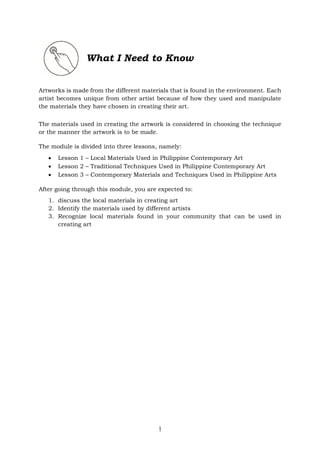
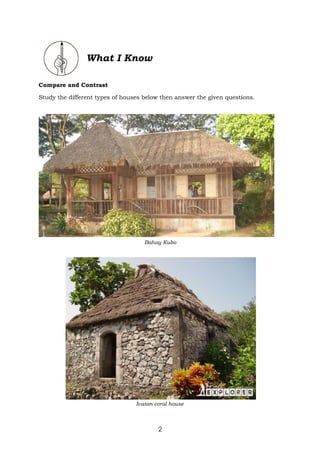
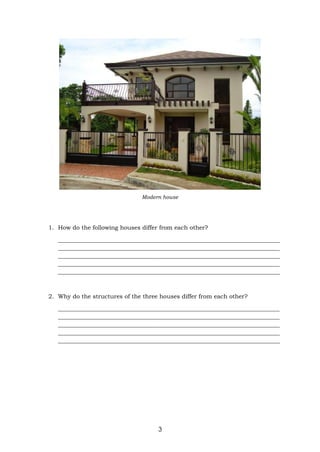
Study the different types of houses below then answer the given questions.
Bahay Kubo
Ivatan coral house
3
1. How do the following houses differ from each other?
___________________________________________________________________________
___________________________________________________________________________
___________________________________________________________________________
___________________________________________________________________________
___________________________________________________________________________
2. Why do the structures of the three houses differ from each other?
___________________________________________________________________________
___________________________________________________________________________
___________________________________________________________________________
___________________________________________________________________________
___________________________________________________________________________
Modern house
4
Lesson
1
Local Materials Used in
Contemporary Arts
Material, or the substance are the things in which the art is made off. Through these
materials, the artists express and communicate feelings and ideas. Some
contemporary artists used found materials like old bottles, scraps, and unusual
materials in creating their artwork.
In Sculpture, the sculptor uses metal, wood, stone, clay and glass.
The architect uses wood, bamboo, bricks, stone, concrete and various building
materials.
The painter uses pigments (eg. watercolor, oil, tempera, textile paint, acrylic, ink,
etc.) on a usually flat ground (wood, canvas, paper, stone wall such as in a cave
painting.
The printmaker uses ink printed or transferred on a surface (wood, metal, plates, or
silk screen that is in keeping with a duplicating o reproducing process. While
paintings are unique and one of a kind, prints can be reproduced in several pre-
determined editions.
Musician uses sound and instruments (including the human voice) A T’boli chanter
sings creation stories in a way that is different from a classical singer or pop singer
influenced by the Western music scale.
The dancer uses body and its movements. Dance is often accompanied by music,
but there are dances that do not rely on musical accompaniment to be realized.
Dance can tell stories, but at other times, they convey abstract ideas that do not rely
on a narrative.
Theater artist integrates all the arts and uses stage, production design, performance
elements and script to enable the visual, musical, dance and other aspects to come
together as a whole work.
The photographer and film maker use the camera to record the outside world. The
film maker uses cinematographic camera to record and put together production
design, sound engineering, performance, and screenplay. In digital photography and
film, the images can be assimilated into the computer, thus eliminating the need for
celluloid or negatives, processing chemicals or print.
The writer of a novel, poetry, nonfiction and fiction uses words.
The Designer, the performance artist, and the installation artist combine use of
the range of different materials.
5
What’s In
Notes to the Teacher
The examples given in this module are some of the common
materials used in creating contemporary art. You may explore
more on other materials that are available in your locality or
community.
6
What’s New
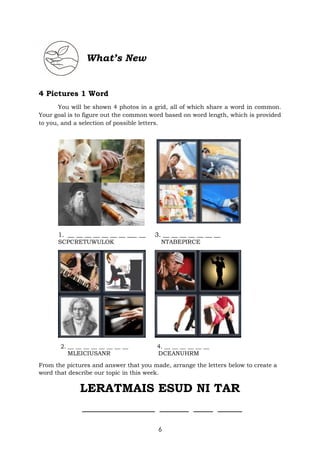
4 Pictures 1 Word
You will be shown 4 photos in a grid, all of which share a word in common.
Your goal is to figure out the common word based on word length, which is provided
to you, and a selection of possible letters.
1. __ __ __ __ __ __ __ ___ __ 3. __ __ __ __ __ __ __
SCPCRETUWULOK NTABEPIRCE
2. __ __ __ __ __ __ __ __ 4. __ __ __ __ __ __
MLEICIUSANR DCEANUHRM
From the pictures and answer that you made, arrange the letters below to create a
word that describe our topic in this week.
LERATMAIS ESUD NI TAR
_______________ ______ ____ _____
7
What is It
Philippines is rich in natural resources. From the mountain to the sea, we have
unlimited materials that can be used to create different artworks.
Local Materials in the Philippines that is used for arts and craft
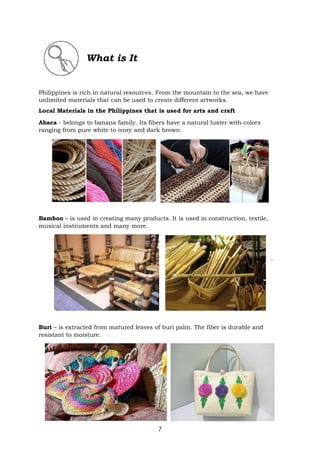
Abaca - belongs to banana family. Its fibers have a natural luster with colors
ranging from pure white to ivory and dark brown.
Bamboo – is used in creating many products. It is used in construction, textile,
musical instruments and many more.
`
Buri – is extracted from matured leaves of buri palm. The fiber is durable and
resistant to moisture.
8
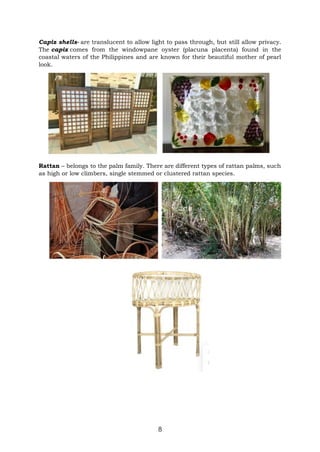
Capiz shells- are translucent to allow light to pass through, but still allow privacy.
The capiz comes from the windowpane oyster (placuna placenta) found in the
coastal waters of the Philippines and are known for their beautiful mother of pearl
look.
Rattan – belongs to the palm family. There are different types of rattan palms, such
as high or low climbers, single stemmed or clustered rattan species.
9
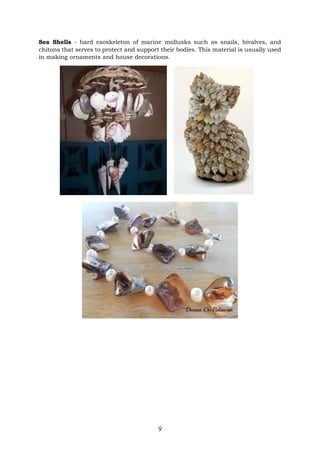
Sea Shells - hard exoskeleton of marine mollusks such as snails, bivalves, and
chitons that serves to protect and support their bodies. This material is usually used
in making ornaments and house decorations.
10
What’s More
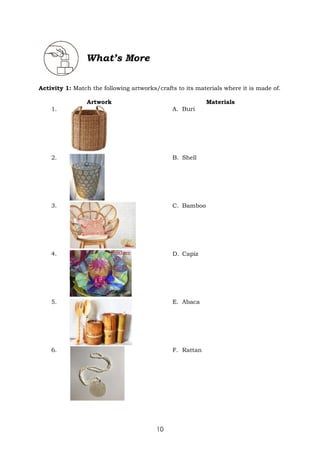
Activity 1: Match the following artworks/crafts to its materials where it is made of.
Artwork Materials
1. A. Buri
2. B. Shell
3. C. Bamboo
4. D. Capiz
5. E. Abaca
6. F. Rattan
11
What I Have Learned
Answer the short quiz below.
Part 1: Multiple Choice
Choose the best answer from the choices given
1. The material that is best used in making furniture
A. Rattan
B. Abaca
C. Capiz Shell
D. Buri grass
2. This material is used for making windowpane for it reflects the sunlight
through it.
A. Bamboo
B. Shell
C. Capiz
D. Abaca
3. The mattress or banig may be made by these materials except
A. Buri grass
B. Abaca fiber
C. Coconut leaves
D. Rattan
4. The material that is best used in making body ornaments and décor.
A. Abaca
B. Seashell
C. Bamboo
D. Capiz
5. The material that can be used in in making basket are the following except
A. Bamboo
B. Shell
C. Abaca fiber
D. Rattan
12
Part 2: Short Answer Test
Answer the question briefly and concisely
1. What is the importance of using locally available resources in creating art?
___________________________________________________________________________
___________________________________________________________________________
___________________________________________________________________________
___________________________________________________________________________
___________________________________________________________________________
___________________________________________________________________________
___________________________________________________________________________
___________________________________________________________________________
2. How do materials affect in the way the art is made?
___________________________________________________________________________
___________________________________________________________________________
___________________________________________________________________________
___________________________________________________________________________
___________________________________________________________________________
___________________________________________________________________________
___________________________________________________________________________
___________________________________________________________________________
3. What resources are available in your locality and what art product can you
make out of these available materials?
___________________________________________________________________________
___________________________________________________________________________
___________________________________________________________________________
___________________________________________________________________________
___________________________________________________________________________
___________________________________________________________________________
___________________________________________________________________________
___________________________________________________________________________
13
What I Can Do
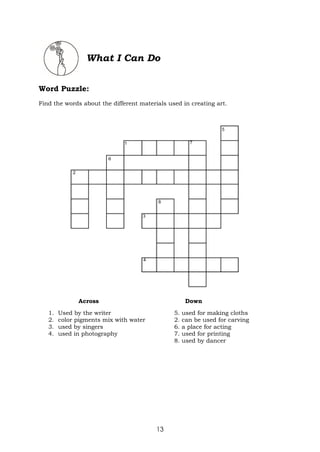
Word Puzzle:
Find the words about the different materials used in creating art.
Across Down
1. Used by the writer 5. used for making cloths
2. color pigments mix with water 2. can be used for carving
3. used by singers 6. a place for acting
4. used in photography 7. used for printing
8. used by dancer
14
Assessment
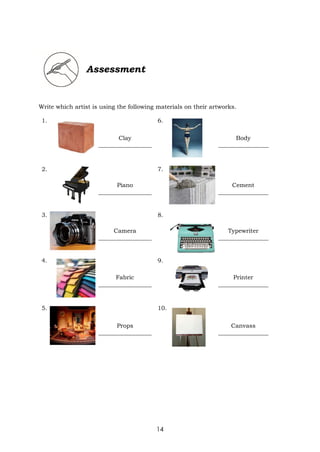
Write which artist is using the following materials on their artworks.
1.
Clay
__________________
6.
Body
_________________
2.
Piano
__________________
7.
Cement
_________________
3.
Camera
__________________
8.
Typewriter
_________________
4.
Fabric
__________________
9.
Printer
_________________
5.
Props
__________________
10.
Canvass
_________________
15
Additional Activities
Look for other local materials that are available in your environment that you can
use in creating art. List it down and identify what art work can you make out of
that materials.
16
Answer Key
Assessment
1.
Sculptor
2.
Musician
3.
Photographer
4.
Fashion
designer
5.
Stage
actor
6.
Dancer
7.
Architect
8.
Writer
9.
Printmaker
10.Painter
What
I
Have
Learned
Part
1:
Multiple
Choice
1.
A
2.
C
3.
D
4.
B
5.
B
Part
2:
Short
Answer
(students’
answer
may
vary)
What
is
New?
1.
Sculpture
2.
Musician
3.
Painter
4.
Dancer
What
is
More:
Activity
1
1.
E
2.
D
3.
B
4.
A
5.
C
17
References
Articles:
https://kulturedeco.com/blogs/news/types-of-rattan-material-used-in-furniture
Images:
https://explorefilipino.com/2019/01/02/architecture-bahay-kubo/
https://www.thepinoyexplorer.com/2011/12/eureka-batanes-oldest-ivatan-
house.html
https://www.lakadpilipinas.com/2014/09/pagburnayan-vigan-ilocos-sur.html
https://medium.com/@jordangasparr/up-oblation-f54390639e10
https://paetecraft.wixsite.com/paetecraft?lightbox=dataItem-iljr2s0n
https://thecitemblog.wordpress.com/2013/10/20/a-closer-look-at-the-abaca-
through-the-craft-spots/
https://davesgarden.com/guides/pf/showimage/322943/#b
https://missmnativecrafts.com/large-buri-fans-wedding-favors/
https://www.grandinroad.com/blog/decorate/indoor-rattan-furniture-a-natural-
art-form/
https://missmnativecrafts.com/customized-umbrella-buri-hat/
http://missmnativecrafts.com/bamboo-candles-wholesale-different-sizes/
http://seashellscraftphilippines.weebly.com/#/
https://4pics1word-answers.com/level-3528/
https://www.chrisvenables.co.uk/venables-and-son-pianos/venables-and-son-
grand-pianos/venables-son-studio-152-baby-grand-piano/
https://www.pcmag.com/picks/the-best-digital-cameras
https://www.housebeautiful.com/shopping/g26813260/best-online-fabric-stores/
http://prophandbook.com
https://www.pinterest.ph/pin/484770347382253774/
https://www.azobuild.com/article.aspx?ArticleID=7959
https://yannerzzz.wordpress.com/2010/12/22/blank-canvass/
For inquiries or feedback, please write or call:
Department of Education - Bureau of Learning Resources (DepEd-BLR)
Ground Floor, Bonifacio Bldg., DepEd Complex
Meralco Avenue, Pasig City, Philippines 1600
Telefax: (632) 8634-1072; 8634-1054; 8631-4985
Email Address: blr.lrqad@deped.gov.ph * blr.lrpd@deped.gov.ph

QTR 2, MODULE 1- LOCAL MATERIALS USED.pdf

  • 1.
    Contemporary Philippine Arts fromthe Region Quarter 2 – Module 1: Local Materials used in Creating Art
  • 2.
    Contemporary Philippine Artsfrom the Region Alternative Delivery Mode Quarter 2 – Module 1: Title First Edition, 2020 Republic Act 8293, section 176 states that: No copyright shall subsist in any work of the Government of the Philippines. However, prior approval of the government agency or office wherein the work is created shall be necessary for exploitation of such work for profit. Such agency or office may, among other things, impose as a condition the payment of royalties. Borrowed materials (i.e., songs, stories, poems, pictures, photos, brand names, trademarks, etc.) included in this module are owned by their respective copyright holders. Every effort has been exerted to locate and seek permission to use these materials from their respective copyright owners. The publisher and authors do not represent nor claim ownership over them. Published by the Department of Education Secretary: Leonor Magtolis Briones Undersecretary: Diosdado M. San Antonio Printed in the Philippines by ________________________ Department of Education – Region IV-A CALABARZON Office Address: Gate 2 Karangalan Village, Barangay San Isidro Cainta, Rizal 1800 Telefax: 02-8682-5773/8684-4914/8647-7487 E-mail Address: region4a@deped.gov.ph Development Team of the Module Writers: Jesabel B. Binamira Editors: Kevin Kerbi A. Villamor/Anold Glenn Bolosan Reviewers: Leylanie V. Adao Illustrator: Layout Artist: Elizalde L. Piol Management Team: Wilfredo E. Cabral, Regional Director Job S. Zape Jr., CLMD Chief Elaine T. Balaogan, Regional ADM Coordinator Fe M. Ong-ongowan, Regional Librarian Gemma G. Cortez, CID Chief Leylanie V. Adao, Division EPS In Charge of LRMS
  • 3.
    Contemporary Philippine Arts from theRegion Quarter 2 – Module 1: Local Materials used in Philippine Contemporary Art
  • 4.
    ii Introductory Message For thefacilitator: Welcome to the Contemporary Philippine Arts from the Region-Grade 12 Alternative Delivery Mode (ADM) Module on Local Materials used on Creating Art! This module was collaboratively designed, developed and reviewed by educators both from public and private institutions to assist you, the teacher or facilitator in helping the learners meet the standards set by the K to 12 Curriculum while overcoming their personal, social, and economic constraints in schooling. This learning resource hopes to engage the learners into guided and independent learning activities at their own pace and time. Furthermore, this also aims to help learners acquire the needed 21st century skills while taking into consideration their needs and circumstances. In addition to the material in the main text, you will also see this box in the body of the module: As a facilitator you are expected to orient the learners on how to use this module. You also need to keep track of the learners' progress while allowing them to manage their own learning. Furthermore, you are expected to encourage and assist the learners as they do the tasks included in the module. Notes to the Teacher This contains helpful tips or strategies that will help you in guiding the learners.
  • 5.
    iii For the learner: Welcometo the Contemporary Philippine Arts from the Region-Grade 12 Alternative Delivery Mode (ADM) Module on Local Materials use in Creating Art! The hand is one of the most symbolized part of the human body. It is often used to depict skill, action and purpose. Through our hands we may learn, create and accomplish. Hence, the hand in this learning resource signifies that you as a learner is capable and empowered to successfully achieve the relevant competencies and skills at your own pace and time. Your academic success lies in your own hands! This module was designed to provide you with fun and meaningful opportunities for guided and independent learning at your own pace and time. You will be enabled to process the contents of the learning resource while being an active learner. This module has the following parts and corresponding icons: What I Need to Know This will give you an idea of the skills or competencies you are expected to learn in the module. What I Know This part includes an activity that aims to check what you already know about the lesson to take. If you get all the answers correct (100%), you may decide to skip this module. What’s In This is a brief drill or review to help you link the current lesson with the previous one. What’s New In this portion, the new lesson will be introduced to you in various ways such as a story, a song, a poem, a problem opener, an activity or a situation. What is It This section provides a brief discussion of the lesson. This aims to help you discover and understand new concepts and skills. What’s More This comprises activities for independent practice to solidify your understanding and skills of the topic. You may check the answers to the exercises using the Answer Key at the end of the module. What I Have Learned This includes questions or blank sentence/paragraph to be filled in to process what you learned from the lesson. What I Can Do This section provides an activity which will help you transfer your new knowledge or skill into real life situations or concerns.
  • 6.
    iv Assessment This isa task which aims to evaluate your level of mastery in achieving the learning competency. Additional Activities In this portion, another activity will be given to you to enrich your knowledge or skill of the lesson learned. This also tends retention of learned concepts. Answer Key This contains answers to all activities in the module. At the end of this module you will also find: The following are some reminders in using this module: 1. Use the module with care. Do not put unnecessary mark/s on any part of the module. Use a separate sheet of paper in answering the exercises. 2. Don’t forget to answer What I Know before moving on to the other activities included in the module. 3. Read the instruction carefully before doing each task. 4. Observe honesty and integrity in doing the tasks and checking your answers. 5. Finish the task at hand before proceeding to the next. 6. Return this module to your teacher/facilitator once you are through with it. If you encounter any difficulty in answering the tasks in this module, do not hesitate to consult your teacher or facilitator. Always bear in mind that you are not alone. We hope that through this material, you will experience meaningful learning and gain deep understanding of the relevant competencies. You can do it! References This is a list of all sources used in developing this module.
  • 7.
    1 What I Needto Know Artworks is made from the different materials that is found in the environment. Each artist becomes unique from other artist because of how they used and manipulate the materials they have chosen in creating their art. The materials used in creating the artwork is considered in choosing the technique or the manner the artwork is to be made. The module is divided into three lessons, namely:  Lesson 1 – Local Materials Used in Philippine Contemporary Art  Lesson 2 – Traditional Techniques Used in Philippine Contemporary Art  Lesson 3 – Contemporary Materials and Techniques Used in Philippine Arts After going through this module, you are expected to: 1. discuss the local materials in creating art 2. Identify the materials used by different artists 3. Recognize local materials found in your community that can be used in creating art
  • 8.
    2 What I Know Compareand Contrast Study the different types of houses below then answer the given questions. Bahay Kubo Ivatan coral house
  • 9.
    3 1. How dothe following houses differ from each other? ___________________________________________________________________________ ___________________________________________________________________________ ___________________________________________________________________________ ___________________________________________________________________________ ___________________________________________________________________________ 2. Why do the structures of the three houses differ from each other? ___________________________________________________________________________ ___________________________________________________________________________ ___________________________________________________________________________ ___________________________________________________________________________ ___________________________________________________________________________ Modern house
  • 10.
    4 Lesson 1 Local Materials Usedin Contemporary Arts Material, or the substance are the things in which the art is made off. Through these materials, the artists express and communicate feelings and ideas. Some contemporary artists used found materials like old bottles, scraps, and unusual materials in creating their artwork. In Sculpture, the sculptor uses metal, wood, stone, clay and glass. The architect uses wood, bamboo, bricks, stone, concrete and various building materials. The painter uses pigments (eg. watercolor, oil, tempera, textile paint, acrylic, ink, etc.) on a usually flat ground (wood, canvas, paper, stone wall such as in a cave painting. The printmaker uses ink printed or transferred on a surface (wood, metal, plates, or silk screen that is in keeping with a duplicating o reproducing process. While paintings are unique and one of a kind, prints can be reproduced in several pre- determined editions. Musician uses sound and instruments (including the human voice) A T’boli chanter sings creation stories in a way that is different from a classical singer or pop singer influenced by the Western music scale. The dancer uses body and its movements. Dance is often accompanied by music, but there are dances that do not rely on musical accompaniment to be realized. Dance can tell stories, but at other times, they convey abstract ideas that do not rely on a narrative. Theater artist integrates all the arts and uses stage, production design, performance elements and script to enable the visual, musical, dance and other aspects to come together as a whole work. The photographer and film maker use the camera to record the outside world. The film maker uses cinematographic camera to record and put together production design, sound engineering, performance, and screenplay. In digital photography and film, the images can be assimilated into the computer, thus eliminating the need for celluloid or negatives, processing chemicals or print. The writer of a novel, poetry, nonfiction and fiction uses words. The Designer, the performance artist, and the installation artist combine use of the range of different materials.
  • 11.
    5 What’s In Notes tothe Teacher The examples given in this module are some of the common materials used in creating contemporary art. You may explore more on other materials that are available in your locality or community.
  • 12.
    6 What’s New 4 Pictures1 Word You will be shown 4 photos in a grid, all of which share a word in common. Your goal is to figure out the common word based on word length, which is provided to you, and a selection of possible letters. 1. __ __ __ __ __ __ __ ___ __ 3. __ __ __ __ __ __ __ SCPCRETUWULOK NTABEPIRCE 2. __ __ __ __ __ __ __ __ 4. __ __ __ __ __ __ MLEICIUSANR DCEANUHRM From the pictures and answer that you made, arrange the letters below to create a word that describe our topic in this week. LERATMAIS ESUD NI TAR _______________ ______ ____ _____
  • 13.
    7 What is It Philippinesis rich in natural resources. From the mountain to the sea, we have unlimited materials that can be used to create different artworks. Local Materials in the Philippines that is used for arts and craft Abaca - belongs to banana family. Its fibers have a natural luster with colors ranging from pure white to ivory and dark brown. Bamboo – is used in creating many products. It is used in construction, textile, musical instruments and many more. ` Buri – is extracted from matured leaves of buri palm. The fiber is durable and resistant to moisture.
  • 14.
    8 Capiz shells- aretranslucent to allow light to pass through, but still allow privacy. The capiz comes from the windowpane oyster (placuna placenta) found in the coastal waters of the Philippines and are known for their beautiful mother of pearl look. Rattan – belongs to the palm family. There are different types of rattan palms, such as high or low climbers, single stemmed or clustered rattan species.
  • 15.
    9 Sea Shells -hard exoskeleton of marine mollusks such as snails, bivalves, and chitons that serves to protect and support their bodies. This material is usually used in making ornaments and house decorations.
  • 16.
    10 What’s More Activity 1:Match the following artworks/crafts to its materials where it is made of. Artwork Materials 1. A. Buri 2. B. Shell 3. C. Bamboo 4. D. Capiz 5. E. Abaca 6. F. Rattan
  • 17.
    11 What I HaveLearned Answer the short quiz below. Part 1: Multiple Choice Choose the best answer from the choices given 1. The material that is best used in making furniture A. Rattan B. Abaca C. Capiz Shell D. Buri grass 2. This material is used for making windowpane for it reflects the sunlight through it. A. Bamboo B. Shell C. Capiz D. Abaca 3. The mattress or banig may be made by these materials except A. Buri grass B. Abaca fiber C. Coconut leaves D. Rattan 4. The material that is best used in making body ornaments and décor. A. Abaca B. Seashell C. Bamboo D. Capiz 5. The material that can be used in in making basket are the following except A. Bamboo B. Shell C. Abaca fiber D. Rattan
  • 18.
    12 Part 2: ShortAnswer Test Answer the question briefly and concisely 1. What is the importance of using locally available resources in creating art? ___________________________________________________________________________ ___________________________________________________________________________ ___________________________________________________________________________ ___________________________________________________________________________ ___________________________________________________________________________ ___________________________________________________________________________ ___________________________________________________________________________ ___________________________________________________________________________ 2. How do materials affect in the way the art is made? ___________________________________________________________________________ ___________________________________________________________________________ ___________________________________________________________________________ ___________________________________________________________________________ ___________________________________________________________________________ ___________________________________________________________________________ ___________________________________________________________________________ ___________________________________________________________________________ 3. What resources are available in your locality and what art product can you make out of these available materials? ___________________________________________________________________________ ___________________________________________________________________________ ___________________________________________________________________________ ___________________________________________________________________________ ___________________________________________________________________________ ___________________________________________________________________________ ___________________________________________________________________________ ___________________________________________________________________________
  • 19.
    13 What I CanDo Word Puzzle: Find the words about the different materials used in creating art. Across Down 1. Used by the writer 5. used for making cloths 2. color pigments mix with water 2. can be used for carving 3. used by singers 6. a place for acting 4. used in photography 7. used for printing 8. used by dancer
  • 20.
    14 Assessment Write which artistis using the following materials on their artworks. 1. Clay __________________ 6. Body _________________ 2. Piano __________________ 7. Cement _________________ 3. Camera __________________ 8. Typewriter _________________ 4. Fabric __________________ 9. Printer _________________ 5. Props __________________ 10. Canvass _________________
  • 21.
    15 Additional Activities Look forother local materials that are available in your environment that you can use in creating art. List it down and identify what art work can you make out of that materials.
  • 22.
  • 23.
    17 References Articles: https://kulturedeco.com/blogs/news/types-of-rattan-material-used-in-furniture https://kulturedeco.com/blogs/news/types-of-rattan-material-used-in-furniture Images: https://explorefilipino.com/2019/01/02/architecture-bahay-kubo/ https://www.thepinoyexplorer.com/2011/12/eureka-batanes-oldest-ivatan- house.html https://www.lakadpilipinas.com/2014/09/pagburnayan-vigan-ilocos-sur.html https://medium.com/@jordangasparr/up-oblation-f54390639e10 https://paetecraft.wixsite.com/paetecraft?lightbox=dataItem-iljr2s0n https://thecitemblog.wordpress.com/2013/10/20/a-closer-look-at-the-abaca- through-the-craft-spots/ https://davesgarden.com/guides/pf/showimage/322943/#b https://missmnativecrafts.com/large-buri-fans-wedding-favors/ https://www.grandinroad.com/blog/decorate/indoor-rattan-furniture-a-natural- art-form/ https://missmnativecrafts.com/customized-umbrella-buri-hat/ http://missmnativecrafts.com/bamboo-candles-wholesale-different-sizes/ http://seashellscraftphilippines.weebly.com/#/ https://4pics1word-answers.com/level-3528/ https://www.chrisvenables.co.uk/venables-and-son-pianos/venables-and-son- grand-pianos/venables-son-studio-152-baby-grand-piano/ https://www.pcmag.com/picks/the-best-digital-cameras https://www.housebeautiful.com/shopping/g26813260/best-online-fabric-stores/ http://prophandbook.com https://www.pinterest.ph/pin/484770347382253774/ https://www.azobuild.com/article.aspx?ArticleID=7959 https://yannerzzz.wordpress.com/2010/12/22/blank-canvass/
  • 24.
    For inquiries orfeedback, please write or call: Department of Education - Bureau of Learning Resources (DepEd-BLR) Ground Floor, Bonifacio Bldg., DepEd Complex Meralco Avenue, Pasig City, Philippines 1600 Telefax: (632) 8634-1072; 8634-1054; 8631-4985 Email Address: blr.lrqad@deped.gov.ph * blr.lrpd@deped.gov.ph