Contemporary
Philippine Arts From
The Regions
(CAR11/12TPP-0c -e-11)
Different Art
Forms
Look at them closely…
Picture Guessing Game!
Guess what’s in the following pictures!
LATBUN ACABA
Picture Guessing Game!
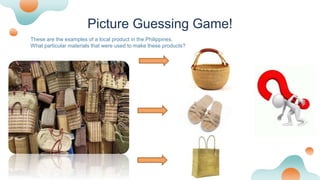
These are the examples of a local product in the Philippines.
What particular materials that were used to make these products?
ANALYSIS!
1. What are the materials or objects used by the artist?
2. Do these materials bring out the intended effect of
the artist?
3. If you are the artist, will you used the same materials
or you will use another? Why?
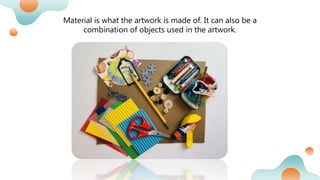
Material is what the artwork is made of. It can also be a
combination of objects used in the artwork.
Contemporary artists salvage materials that can be
recycled and made into creative forms. They can make
artworks that combine structure and wood and interact
with the wind to make music.
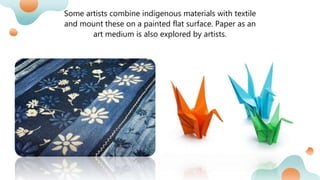
Some artists combine indigenous materials with textile
and mount these on a painted flat surface. Paper as an
art medium is also explored by artists.
In outdoor sculpture, there is a lot of use of brass welded
together and mounted on concrete. Wood and glass are
used for indoor sculpture. Found objects are combined
and are covered with resin.
Painting is no longer confined to canvass hung on the
wall. They can also be found on ceilings and floors. Some
are done outdoors. Many local artists lead the
community or students in painting murals on walls to
make a more pleasant environment and raise
consciousness towards environmental protection.
In architecture, there is an extensive use of glass and
steel. Color combination is either complementary or
strong contrasting, such as orange and blue, red and
white. In performance art, artists use variety of props
such as rope, plastic, textile, and found objects. Paint is
also used in body art.
Local materials in the Philippines are materials that are
naturally and locally found in a specific place.
MATERIALS PRODUCTS
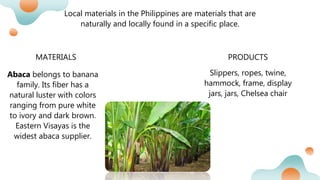
Abaca belongs to banana
family. Its fiber has a
natural luster with colors
ranging from pure white
to ivory and dark brown.
Eastern Visayas is the
widest abaca supplier.
Slippers, ropes, twine,
hammock, frame, display
jars, jars, Chelsea chair
Local materials in the Philippines are materials that are
naturally and locally found in a specific place.
MATERIALS PRODUCTS
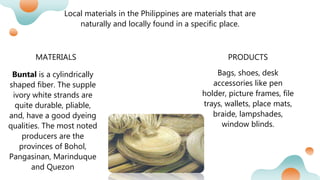
Buntal is a cylindrically
shaped fiber. The supple
ivory white strands are
quite durable, pliable,
and, have a good dyeing
qualities. The most noted
producers are the
provinces of Bohol,
Pangasinan, Marinduque
and Quezon
Bags, shoes, desk
accessories like pen
holder, picture frames, file
trays, wallets, place mats,
braide, lampshades,
window blinds.
Local materials in the Philippines are materials that are
naturally and locally found in a specific place.
MATERIALS PRODUCTS
Buri is extracted from the
matured leaves of the buri
palm. The fiber is durable
and resistant to moisture.
Hats, bags, basket,
memorabilia baskets,
perfume tray, & other
woven products.
Local materials in the Philippines are materials that are
naturally and locally found in a specific place.
MATERIALS PRODUCTS
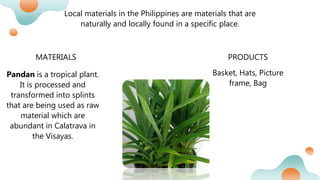
Pandan is a tropical plant.
It is processed and
transformed into splints
that are being used as raw
material which are
abundant in Calatrava in
the Visayas.
Basket, Hats, Picture
frame, Bag
Local materials in the Philippines are materials that are
naturally and locally found in a specific place.
MATERIALS PRODUCTS
Rattan belongs to the
palm family. There are
different types of rattan
palms, such as high or low
climbers, single stemmed
or clustered rattan
species.
Basket, Picture Frame,
Furniture
Local Materials found in the
Philippines
Look at them closely…
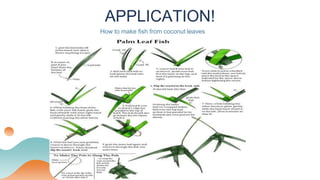
APPLICATION!
How to make fish from coconut leaves
EVALUATION
Identify the local materials found
in the Philippines
1. ______________
2. ______________ 3. ______________
EVALUATION
Identify the local materials found
in the Philippines
4. ______________ 5. ______________ 6. ______________
ASSIGNMENT!
Write a reflection on the
importance of making use of
localized materials in your
life? Write your answer in a
½ crosswise.
THANK YOU!

CPAR PPT.pptx

  • 1.
    Contemporary Philippine Arts From TheRegions (CAR11/12TPP-0c -e-11)
  • 2.
  • 3.
    Picture Guessing Game! Guesswhat’s in the following pictures! LATBUN ACABA
  • 4.
    Picture Guessing Game! Theseare the examples of a local product in the Philippines. What particular materials that were used to make these products?
  • 5.
    ANALYSIS! 1. What arethe materials or objects used by the artist? 2. Do these materials bring out the intended effect of the artist? 3. If you are the artist, will you used the same materials or you will use another? Why?
  • 6.
    Material is whatthe artwork is made of. It can also be a combination of objects used in the artwork.
  • 7.
    Contemporary artists salvagematerials that can be recycled and made into creative forms. They can make artworks that combine structure and wood and interact with the wind to make music.
  • 8.
    Some artists combineindigenous materials with textile and mount these on a painted flat surface. Paper as an art medium is also explored by artists.
  • 9.
    In outdoor sculpture,there is a lot of use of brass welded together and mounted on concrete. Wood and glass are used for indoor sculpture. Found objects are combined and are covered with resin.
  • 10.
    Painting is nolonger confined to canvass hung on the wall. They can also be found on ceilings and floors. Some are done outdoors. Many local artists lead the community or students in painting murals on walls to make a more pleasant environment and raise consciousness towards environmental protection.
  • 11.
    In architecture, thereis an extensive use of glass and steel. Color combination is either complementary or strong contrasting, such as orange and blue, red and white. In performance art, artists use variety of props such as rope, plastic, textile, and found objects. Paint is also used in body art.
  • 12.
    Local materials inthe Philippines are materials that are naturally and locally found in a specific place. MATERIALS PRODUCTS Abaca belongs to banana family. Its fiber has a natural luster with colors ranging from pure white to ivory and dark brown. Eastern Visayas is the widest abaca supplier. Slippers, ropes, twine, hammock, frame, display jars, jars, Chelsea chair
  • 13.
    Local materials inthe Philippines are materials that are naturally and locally found in a specific place. MATERIALS PRODUCTS Buntal is a cylindrically shaped fiber. The supple ivory white strands are quite durable, pliable, and, have a good dyeing qualities. The most noted producers are the provinces of Bohol, Pangasinan, Marinduque and Quezon Bags, shoes, desk accessories like pen holder, picture frames, file trays, wallets, place mats, braide, lampshades, window blinds.
  • 14.
    Local materials inthe Philippines are materials that are naturally and locally found in a specific place. MATERIALS PRODUCTS Buri is extracted from the matured leaves of the buri palm. The fiber is durable and resistant to moisture. Hats, bags, basket, memorabilia baskets, perfume tray, & other woven products.
  • 15.
    Local materials inthe Philippines are materials that are naturally and locally found in a specific place. MATERIALS PRODUCTS Pandan is a tropical plant. It is processed and transformed into splints that are being used as raw material which are abundant in Calatrava in the Visayas. Basket, Hats, Picture frame, Bag
  • 16.
    Local materials inthe Philippines are materials that are naturally and locally found in a specific place. MATERIALS PRODUCTS Rattan belongs to the palm family. There are different types of rattan palms, such as high or low climbers, single stemmed or clustered rattan species. Basket, Picture Frame, Furniture
  • 17.
    Local Materials foundin the Philippines Look at them closely…
  • 18.
    APPLICATION! How to makefish from coconut leaves
  • 19.
    EVALUATION Identify the localmaterials found in the Philippines 1. ______________ 2. ______________ 3. ______________
  • 20.
    EVALUATION Identify the localmaterials found in the Philippines 4. ______________ 5. ______________ 6. ______________
  • 21.
    ASSIGNMENT! Write a reflectionon the importance of making use of localized materials in your life? Write your answer in a ½ crosswise.
  • 22.