CONTEMPORARY ARTS FROM THE
REGIONS
CONTEMPORARY ARTS
VS
MODERN ART
WHAT CAME FIRST?
CONTEMPORARY ART
OR
MODERN ART?
What comes into your
mind when you read
or encounter the word
MODERN?
5
confused, but each refers to its
own distinct period in art history.
When we hear the word ‘modern’
we often think of that which is
current, or ‘of the moment,’ but in
art historical terms the word is
usually associated with
modernism, which spanned
roughly the late-19th to mid-20th
century.
MODERN ERA.
It was Edouard Manet in the early
1860s along with the French
Impressionists, whose revolutionary
subjective style of painting ushered in the
era of Modern Art.
7
This period witnessed a succession
of modern art movements - including
Expressionism, Cubism, Surrealism,
Abstract Expressionism and Op-Art, to
name but a tiny few.
8
During the 1960s, however, this
optimism among artists began to fade, and
it is this loss of optimism which marks the
beginning of Postmodernism and the
emergence of Contemporary Art.
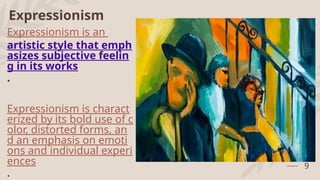
Expressionism
Expressionism is an
artistic style that emph
asizes subjective feelin
g in its works
.
Expressionism is charact
erized by its bold use of c
olor, distorted forms, an
d an emphasis on emoti
ons and individual experi
ences
.
9
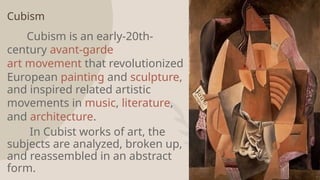
Cubism
Cubism is an early-20th-
century avant-garde
art movement that revolutionized
European painting and sculpture,
and inspired related artistic
movements in music, literature,
and architecture.
In Cubist works of art, the
subjects are analyzed, broken up,
and reassembled in an abstract
form. 10
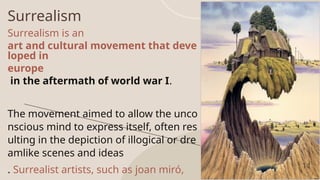
Surrealism
Surrealism is an
art and cultural movement that deve
loped in
europe
in the aftermath of world war I.
The movement aimed to allow the unco
nscious mind to express itself, often res
ulting in the depiction of illogical or dre
amlike scenes and ideas
. Surrealist artists, such as joan miró, 11
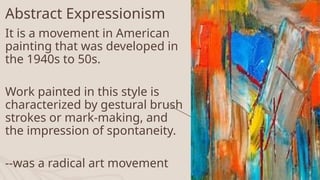
Abstract Expressionism
It is a movement in American
painting that was developed in
the 1940s to 50s.
Work painted in this style is
characterized by gestural brush
strokes or mark-making, and
the impression of spontaneity.
--was a radical art movement 12
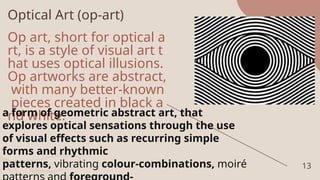
Optical Art (op-art)
Op art, short for optical a
rt, is a style of visual art t
hat uses optical illusions.
Op artworks are abstract,
with many better-known
pieces created in black a
nd white.
13
a form of geometric abstract art, that
explores optical sensations through the use
of visual effects such as recurring simple
forms and rhythmic
patterns, vibrating colour-combinations, moiré
14
15
CONTEMPORARY ERA
16
Contemporary Era
In their attempt to popularize and
broaden access to visual art, they introduced
(or refined) a series of new art forms, such as
Conceptualism, Performance,
Happenings, Installation, Earthworks,
Projection art, and in the process took full
advantage of new media like video,
computers and digital technology.
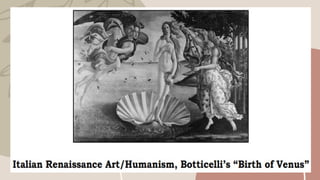
RENAISSANCE
Renaissance art established the
basis for Western art after the
Medieval era.
Renaissance ideas and rules were
disseminated across Europe through
various Academies of Fine Arts.
18
These academies taught art
according to an unvarying set of
canons, which artists had to follow
in order to earn a living. By the
early 19th century, this academic
approach had ceased to be
relevant.
19
Here's how to add more personal
style to everything you create
with your hands.
1. Google and Explore. Visit the
local art gallery in your area. You
will discover more artsy
masterpieces at your Provincial
Capitol or private museums.
2. Learn the Basics. Understand
the rules of creating a visual art.
Learning the basics of drawing,
such as pen-stroke techniques,
shading and drawing with
perspective, will set you on your
path. That way, when your own
style starts to emerge, you'll have
the skills to back it up.
3. Be Inspired. Let's be clear:
Plagiarism is a crime. But when
you're just starting out, copying
other artists just for practice
stretches your skills as you explore
your own ways of expressing
yourself. What might start out as
mimicking can evolve into a style
that's uniquely yours.
4. Flex Your Art Muscle. Learning
how to draw is like working out: If
you want to be fit, you need to
exercise regularly. Daily drawing
practice will strengthen your skills
and bring out your style
5. Leave the Comfort Zone. If you
are a fan of line drawing or fond of
using charcoal, start exploring
other medium like water color or
mixed media (a combination of
everything you wish to use in your
artwork).
6. Clear the Canvas. Mistakes do
happen. When things didn’t turn out
the way you expect to, you can
always clear the canvas and start
from zero. Draw the same thing again
and again. Whether you're drawing
wildflowers or a specific character
you're obsessed with, your personal
style will start peeking out.
7. Seek the inner voice. Even if you
start out a drawing with a certain idea
in mind, give yourself the freedom to
change course. Pause for a minute, and
be honest about what's working and
what's not. Often, that little voice that
says "Stop now" or "Draw a row of
flowers here" is your personal style
trying to be heard. Turn up the volume.
8. Evolve. Now that you pick a style
that is artistically comfortable for
you, you will be tempted to stick
with it forever and ever. That may
be great for some artists, but many
others develop their styles over
time. See where your instincts lead
you. Continue to evolve in style,
colors and in your subjects.
9. Stick to it. Sometimes you might get
frustrated and this piece of artwork is
going nowhere, don’t give up. It’s totally
normal to feel that especially for
beginners like you. For some people,
developing a personal style will come
quickly and naturally; for others, it can
take lots of time and experimentation.
And you might have more than one style
in you. Stick with the process.
VARIOUS WALL ARTS
CONTEMPO MODULE 8 Senior High School.pptx

CONTEMPO MODULE 8 Senior High School.pptx

  • 1.
  • 3.
  • 4.
  • 5.
    What comes intoyour mind when you read or encounter the word MODERN? 5
  • 6.
    confused, but eachrefers to its own distinct period in art history. When we hear the word ‘modern’ we often think of that which is current, or ‘of the moment,’ but in art historical terms the word is usually associated with modernism, which spanned roughly the late-19th to mid-20th century.
  • 7.
    MODERN ERA. It wasEdouard Manet in the early 1860s along with the French Impressionists, whose revolutionary subjective style of painting ushered in the era of Modern Art. 7
  • 8.
    This period witnesseda succession of modern art movements - including Expressionism, Cubism, Surrealism, Abstract Expressionism and Op-Art, to name but a tiny few. 8 During the 1960s, however, this optimism among artists began to fade, and it is this loss of optimism which marks the beginning of Postmodernism and the emergence of Contemporary Art.
  • 9.
    Expressionism Expressionism is an artisticstyle that emph asizes subjective feelin g in its works . Expressionism is charact erized by its bold use of c olor, distorted forms, an d an emphasis on emoti ons and individual experi ences . 9
  • 10.
    Cubism Cubism is anearly-20th- century avant-garde art movement that revolutionized European painting and sculpture, and inspired related artistic movements in music, literature, and architecture. In Cubist works of art, the subjects are analyzed, broken up, and reassembled in an abstract form. 10
  • 11.
    Surrealism Surrealism is an artand cultural movement that deve loped in europe in the aftermath of world war I. The movement aimed to allow the unco nscious mind to express itself, often res ulting in the depiction of illogical or dre amlike scenes and ideas . Surrealist artists, such as joan miró, 11
  • 12.
    Abstract Expressionism It isa movement in American painting that was developed in the 1940s to 50s. Work painted in this style is characterized by gestural brush strokes or mark-making, and the impression of spontaneity. --was a radical art movement 12
  • 13.
    Optical Art (op-art) Opart, short for optical a rt, is a style of visual art t hat uses optical illusions. Op artworks are abstract, with many better-known pieces created in black a nd white. 13 a form of geometric abstract art, that explores optical sensations through the use of visual effects such as recurring simple forms and rhythmic patterns, vibrating colour-combinations, moiré
  • 14.
  • 15.
  • 16.
    16 Contemporary Era In theirattempt to popularize and broaden access to visual art, they introduced (or refined) a series of new art forms, such as Conceptualism, Performance, Happenings, Installation, Earthworks, Projection art, and in the process took full advantage of new media like video, computers and digital technology.
  • 18.
    RENAISSANCE Renaissance art establishedthe basis for Western art after the Medieval era. Renaissance ideas and rules were disseminated across Europe through various Academies of Fine Arts. 18
  • 19.
    These academies taughtart according to an unvarying set of canons, which artists had to follow in order to earn a living. By the early 19th century, this academic approach had ceased to be relevant. 19
  • 21.
    Here's how toadd more personal style to everything you create with your hands.
  • 22.
    1. Google andExplore. Visit the local art gallery in your area. You will discover more artsy masterpieces at your Provincial Capitol or private museums.
  • 23.
    2. Learn theBasics. Understand the rules of creating a visual art. Learning the basics of drawing, such as pen-stroke techniques, shading and drawing with perspective, will set you on your path. That way, when your own style starts to emerge, you'll have the skills to back it up.
  • 24.
    3. Be Inspired.Let's be clear: Plagiarism is a crime. But when you're just starting out, copying other artists just for practice stretches your skills as you explore your own ways of expressing yourself. What might start out as mimicking can evolve into a style that's uniquely yours.
  • 25.
    4. Flex YourArt Muscle. Learning how to draw is like working out: If you want to be fit, you need to exercise regularly. Daily drawing practice will strengthen your skills and bring out your style
  • 26.
    5. Leave theComfort Zone. If you are a fan of line drawing or fond of using charcoal, start exploring other medium like water color or mixed media (a combination of everything you wish to use in your artwork).
  • 27.
    6. Clear theCanvas. Mistakes do happen. When things didn’t turn out the way you expect to, you can always clear the canvas and start from zero. Draw the same thing again and again. Whether you're drawing wildflowers or a specific character you're obsessed with, your personal style will start peeking out.
  • 28.
    7. Seek theinner voice. Even if you start out a drawing with a certain idea in mind, give yourself the freedom to change course. Pause for a minute, and be honest about what's working and what's not. Often, that little voice that says "Stop now" or "Draw a row of flowers here" is your personal style trying to be heard. Turn up the volume.
  • 29.
    8. Evolve. Nowthat you pick a style that is artistically comfortable for you, you will be tempted to stick with it forever and ever. That may be great for some artists, but many others develop their styles over time. See where your instincts lead you. Continue to evolve in style, colors and in your subjects.
  • 30.
    9. Stick toit. Sometimes you might get frustrated and this piece of artwork is going nowhere, don’t give up. It’s totally normal to feel that especially for beginners like you. For some people, developing a personal style will come quickly and naturally; for others, it can take lots of time and experimentation. And you might have more than one style in you. Stick with the process.
  • 32.

Editor's Notes

  • #6 Modern art is a term that refers to artistic work produced between the 1860s and the 1970s1
  • #9 It emphasizes subjective feeling and emotional experience, often in reaction to the changing world.
  • #10 instead of depicting objects from a single perspective, the artist depicts the subject from multiple perspectives to represent the subject in a greater context. has been considered the most influential art movement of the 20th century. It is also a representation of 3D form of arts
  • #12 Radical art movement—Radical art is characterized by a marked departure from prevailing methods, practices, or ideas, particularly in the arts1. It is an act of uncompromising passionate resistance2to any imposition of form or content by any economic system, artistic academy, or political status quo Abstract Expressionism is profoundly energetic, powerful and expressive.