MARIA ELENA V. RODRIGUEZ
MASTER TEACHER 1, SHS ARTS AND DESIGN
REGIONAL LEAD SCHOOL FOR THE ARTS IN
ANGONO
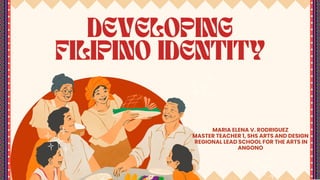
DEVELOPING
FILIPINO IDENTITY
CULTURAL MAPPING
LESSON 1:
LESSON OBJECTIVES
AT THE END OF WEEK, THE LEARNERS ARE EXPECTED TO:
 DISCUSS THE MEANING OF CULTURAL MAPPING.
 EXPLAIN HOW TO CREATE A CULTURAL MAP OF THEIR
COMMUNITY.
 CREATE A CULTURAL MAP OF THEIR COMMUNITY.
 VALUE THE IMPORTANCE OF KNOWING ONE’S CULTURAL
COMMUNITY.
LEARNING TASK 1:
Direction: In your notebook, list down things,
events, activities of your town inside the box.
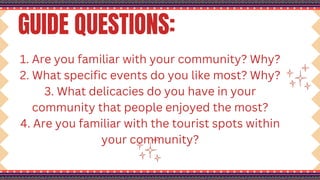
GUIDE QUESTIONS:
1. Are you familiar with your community? Why?
2. What specific events do you like most? Why?
3. What delicacies do you have in your
community that people enjoyed the most?
4. Are you familiar with the tourist spots within
your community?
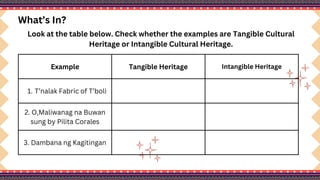
Example Tangible Heritage Intangible Heritage
T’nalak Fabric of T’boli
1.
2. O,Maliwanag na Buwan
sung by Pilita Corales
3. Dambana ng Kagitingan
What’s In?
Look at the table below. Check whether the examples are Tangible Cultural
Heritage or Intangible Cultural Heritage.
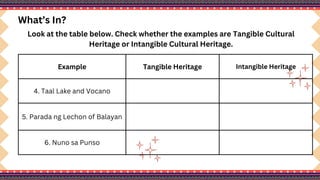
Example Tangible Heritage Intangible Heritage
4. Taal Lake and Vocano
5. Parada ng Lechon of Balayan
6. Nuno sa Punso
What’s In?
Look at the table below. Check whether the examples are Tangible Cultural
Heritage or Intangible Cultural Heritage.
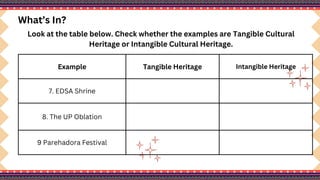
Example Tangible Heritage Intangible Heritage
7. EDSA Shrine
8. The UP Oblation
9 Parehadora Festival
What’s In?
Look at the table below. Check whether the examples are Tangible Cultural
Heritage or Intangible Cultural Heritage.
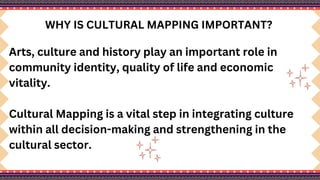
WHY IS CULTURAL MAPPING IMPORTANT?
Arts, culture and history play an important role in
community identity, quality of life and economic
vitality.
Cultural Mapping is a vital step in integrating culture
within all decision-making and strengthening in the
cultural sector.
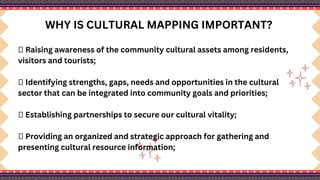
WHY IS CULTURAL MAPPING IMPORTANT?
 Raising awareness of the community cultural assets among residents,
visitors and tourists;
 Identifying strengths, gaps, needs and opportunities in the cultural
sector that can be integrated into community goals and priorities;
 Establishing partnerships to secure our cultural vitality;
 Providing an organized and strategic approach for gathering and
presenting cultural resource information;
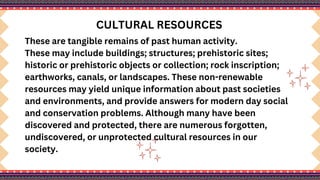
CULTURAL RESOURCES
These are tangible remains of past human activity.
These may include buildings; structures; prehistoric sites;
historic or prehistoric objects or collection; rock inscription;
earthworks, canals, or landscapes. These non-renewable
resources may yield unique information about past societies
and environments, and provide answers for modern day social
and conservation problems. Although many have been
discovered and protected, there are numerous forgotten,
undiscovered, or unprotected cultural resources in our
society.
CULTURAL RESOURCES
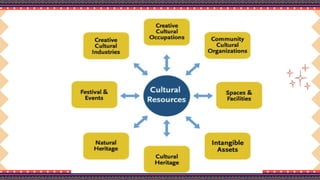
Community Cultural Organizations
This resource includes organizations that represent arts, heritage
and ethno-cultural interests in the community. These are usually non-
profits that are essential to the cultural vitality of the community and
can include committees, associations, councils, dance schools and
boards. Cultural Events and Festivals This resource represents recurring
cultural activities. Festivals and events contribute to the animation of
public and natural spaces by bringing entertainment, new experiences,
and economic impacts to the community. These can include performing
arts events, tours of culturally significant places, seasonal celebrations
and many others.
CULTURAL RESOURCES
Cultural Events and Festivals
This resource represents recurring cultural activities.
Festivals and events contribute to the animation of public and
natural spaces by bringing entertainment, new experiences,
and economic impacts to the community. These can include
performing arts events, tours of culturally significant places,
seasonal celebrations and many others.
CULTURAL RESOURCES
Cultural Facilities and Spaces
This resource represents facilities, spaces and sites where
cultural activities take place. These can include spaces in the
public, private and non-profit sectors, and include everything
from purpose-built facilities to facilities that include cultural
programming.
Assets can include: Art galleries, art studios, dance studios, farms/
orchards and gardens and forests, green space and parks, leisure centers
and community halls, libraries, museums, theatres/performing centers.
CULTURAL RESOURCES
Cultural Heritage
This resource represents significant cultural heritage sites or
resources. It can include exhibition of objects, buildings and
sites of historical, cultural and educational value, and archive
collections that help pay tribute to the community’s past.
Assets Include: Provincial historic sites and buildings,
heritage villages and museums, monuments and memorials,
plaques, scenic destinations. Listing a Cultural Heritage
Asset on the Culture Map does not provide protection,
preservation or designation.
CULTURAL RESOURCES
Cultural Industries
This resource represents a wide range of cultural businesses
and non-profit groups engaged in the creation and production
of cultural goods or services. It can include creative design,
radio broadcasting, book and music stores and many others.
Assets can include: Art Galleries and dealers, book,
periodical and music stores, graphic design, advertising and
related services, libraries and heritage institutions, educational
institutions, performing arts, publishing, radio and television
broadcasting.
CULTURAL RESOURCES
Natural Heritage
This resource represents significant natural areas in the
community. Assets such as trails, rivers, parks, botanical and
community gardens and conservation areas offer rich
cultural, recreational and community experiences.
Assets can include: local parks, trails and waterways.
CULTURAL RESOURCES
Creative Cultural Occupations
Occupations that involve creative and artistic production, and
heritage collection and preservation. They involve tasks and
duties that are carried out. They generate, develop, preserve
or reflect cultural or symbolic and spiritual meaning. They
create, produce and disseminate cultural goods and services,
which generally contain intellectual property rights and for the
purpose of artistic expression (visual, music, writing, dance or
dramatic arts).
CULTURAL RESOURCES
Intangible Assets are the traditions and living expressions
inherited from ancestors and passed on to descendants.
Intangible heritage includes cultural practices, oral traditions
and language, skills, techniques and knowledges including dance,
stories, crafts, medicines, designs and even digital heritage.
Intangible cultural heritage is commonly defined as not
having a physical presence. Removing this important
information can be disrespectful to the people to whom the
object belongs.
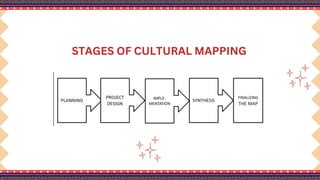
STAGES OF CULTURAL MAPPING
Stage I – Planning
• determining objectives with the group
• discussing the steps in doing cultural mapping
• setting a budget
• identifying and assembling mapping resources – these
can be human, financial or technical
STAGES OF CULTURAL MAPPING
Stage II – Project Design
• designing the conduct of the project
• drafting survey questionnaires and interview
questions
• setting the dates for distribution of
questionnaire/interview
STAGES OF CULTURAL MAPPING
Stage III – Implementation
• survey
• interviews
• collecting the data
STAGES OF CULTURAL MAPPING
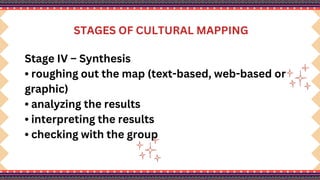
Stage IV – Synthesis
• roughing out the map (text-based, web-based or
graphic)
• analyzing the results
• interpreting the results
• checking with the group
STAGES OF CULTURAL MAPPING
Stage V – Finalizing the Map
• Finalization of the map feature and content.
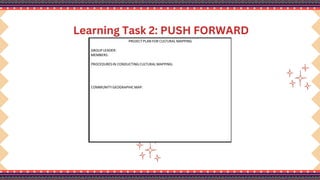
Learning Task 2: PUSH FORWARD
The learners will be divided into groups. Each
group must have five members. They are task to
make a project Plan based on the given standard.
Learning Task 2: PUSH FORWARD
Learning Task 3: THINK IT OVER
Learners are tasked to identify the cultural
resources of
their community. They need to fill-out the given
table.
developing filipino identity (1).pdf NBVHJFB

developing filipino identity (1).pdf NBVHJFB

  • 1.
    MARIA ELENA V.RODRIGUEZ MASTER TEACHER 1, SHS ARTS AND DESIGN REGIONAL LEAD SCHOOL FOR THE ARTS IN ANGONO DEVELOPING FILIPINO IDENTITY
  • 2.
  • 3.
    LESSON OBJECTIVES AT THEEND OF WEEK, THE LEARNERS ARE EXPECTED TO:  DISCUSS THE MEANING OF CULTURAL MAPPING.  EXPLAIN HOW TO CREATE A CULTURAL MAP OF THEIR COMMUNITY.  CREATE A CULTURAL MAP OF THEIR COMMUNITY.  VALUE THE IMPORTANCE OF KNOWING ONE’S CULTURAL COMMUNITY.
  • 4.
    LEARNING TASK 1: Direction:In your notebook, list down things, events, activities of your town inside the box.
  • 5.
    GUIDE QUESTIONS: 1. Areyou familiar with your community? Why? 2. What specific events do you like most? Why? 3. What delicacies do you have in your community that people enjoyed the most? 4. Are you familiar with the tourist spots within your community?
  • 6.
    Example Tangible HeritageIntangible Heritage T’nalak Fabric of T’boli 1. 2. O,Maliwanag na Buwan sung by Pilita Corales 3. Dambana ng Kagitingan What’s In? Look at the table below. Check whether the examples are Tangible Cultural Heritage or Intangible Cultural Heritage.
  • 7.
    Example Tangible HeritageIntangible Heritage 4. Taal Lake and Vocano 5. Parada ng Lechon of Balayan 6. Nuno sa Punso What’s In? Look at the table below. Check whether the examples are Tangible Cultural Heritage or Intangible Cultural Heritage.
  • 8.
    Example Tangible HeritageIntangible Heritage 7. EDSA Shrine 8. The UP Oblation 9 Parehadora Festival What’s In? Look at the table below. Check whether the examples are Tangible Cultural Heritage or Intangible Cultural Heritage.
  • 9.
    WHY IS CULTURALMAPPING IMPORTANT? Arts, culture and history play an important role in community identity, quality of life and economic vitality. Cultural Mapping is a vital step in integrating culture within all decision-making and strengthening in the cultural sector.
  • 10.
    WHY IS CULTURALMAPPING IMPORTANT?  Raising awareness of the community cultural assets among residents, visitors and tourists;  Identifying strengths, gaps, needs and opportunities in the cultural sector that can be integrated into community goals and priorities;  Establishing partnerships to secure our cultural vitality;  Providing an organized and strategic approach for gathering and presenting cultural resource information;
  • 11.
    CULTURAL RESOURCES These aretangible remains of past human activity. These may include buildings; structures; prehistoric sites; historic or prehistoric objects or collection; rock inscription; earthworks, canals, or landscapes. These non-renewable resources may yield unique information about past societies and environments, and provide answers for modern day social and conservation problems. Although many have been discovered and protected, there are numerous forgotten, undiscovered, or unprotected cultural resources in our society.
  • 13.
    CULTURAL RESOURCES Community CulturalOrganizations This resource includes organizations that represent arts, heritage and ethno-cultural interests in the community. These are usually non- profits that are essential to the cultural vitality of the community and can include committees, associations, councils, dance schools and boards. Cultural Events and Festivals This resource represents recurring cultural activities. Festivals and events contribute to the animation of public and natural spaces by bringing entertainment, new experiences, and economic impacts to the community. These can include performing arts events, tours of culturally significant places, seasonal celebrations and many others.
  • 14.
    CULTURAL RESOURCES Cultural Eventsand Festivals This resource represents recurring cultural activities. Festivals and events contribute to the animation of public and natural spaces by bringing entertainment, new experiences, and economic impacts to the community. These can include performing arts events, tours of culturally significant places, seasonal celebrations and many others.
  • 15.
    CULTURAL RESOURCES Cultural Facilitiesand Spaces This resource represents facilities, spaces and sites where cultural activities take place. These can include spaces in the public, private and non-profit sectors, and include everything from purpose-built facilities to facilities that include cultural programming. Assets can include: Art galleries, art studios, dance studios, farms/ orchards and gardens and forests, green space and parks, leisure centers and community halls, libraries, museums, theatres/performing centers.
  • 16.
    CULTURAL RESOURCES Cultural Heritage Thisresource represents significant cultural heritage sites or resources. It can include exhibition of objects, buildings and sites of historical, cultural and educational value, and archive collections that help pay tribute to the community’s past. Assets Include: Provincial historic sites and buildings, heritage villages and museums, monuments and memorials, plaques, scenic destinations. Listing a Cultural Heritage Asset on the Culture Map does not provide protection, preservation or designation.
  • 17.
    CULTURAL RESOURCES Cultural Industries Thisresource represents a wide range of cultural businesses and non-profit groups engaged in the creation and production of cultural goods or services. It can include creative design, radio broadcasting, book and music stores and many others. Assets can include: Art Galleries and dealers, book, periodical and music stores, graphic design, advertising and related services, libraries and heritage institutions, educational institutions, performing arts, publishing, radio and television broadcasting.
  • 18.
    CULTURAL RESOURCES Natural Heritage Thisresource represents significant natural areas in the community. Assets such as trails, rivers, parks, botanical and community gardens and conservation areas offer rich cultural, recreational and community experiences. Assets can include: local parks, trails and waterways.
  • 19.
    CULTURAL RESOURCES Creative CulturalOccupations Occupations that involve creative and artistic production, and heritage collection and preservation. They involve tasks and duties that are carried out. They generate, develop, preserve or reflect cultural or symbolic and spiritual meaning. They create, produce and disseminate cultural goods and services, which generally contain intellectual property rights and for the purpose of artistic expression (visual, music, writing, dance or dramatic arts).
  • 20.
    CULTURAL RESOURCES Intangible Assetsare the traditions and living expressions inherited from ancestors and passed on to descendants. Intangible heritage includes cultural practices, oral traditions and language, skills, techniques and knowledges including dance, stories, crafts, medicines, designs and even digital heritage. Intangible cultural heritage is commonly defined as not having a physical presence. Removing this important information can be disrespectful to the people to whom the object belongs.
  • 21.
  • 22.
    STAGES OF CULTURALMAPPING Stage I – Planning • determining objectives with the group • discussing the steps in doing cultural mapping • setting a budget • identifying and assembling mapping resources – these can be human, financial or technical
  • 23.
    STAGES OF CULTURALMAPPING Stage II – Project Design • designing the conduct of the project • drafting survey questionnaires and interview questions • setting the dates for distribution of questionnaire/interview
  • 24.
    STAGES OF CULTURALMAPPING Stage III – Implementation • survey • interviews • collecting the data
  • 25.
    STAGES OF CULTURALMAPPING Stage IV – Synthesis • roughing out the map (text-based, web-based or graphic) • analyzing the results • interpreting the results • checking with the group
  • 26.
    STAGES OF CULTURALMAPPING Stage V – Finalizing the Map • Finalization of the map feature and content.
  • 27.
    Learning Task 2:PUSH FORWARD The learners will be divided into groups. Each group must have five members. They are task to make a project Plan based on the given standard.
  • 28.
    Learning Task 2:PUSH FORWARD
  • 29.
    Learning Task 3:THINK IT OVER Learners are tasked to identify the cultural resources of their community. They need to fill-out the given table.