KHIRKI MASJID
KHIRKI VILLAGE
SOUTH DELHI
• Khirki Mosque, approachedfrom the Khirki Village in South Delh and close to the Satpulorr the seven arched
bridge on the edge of southern wall of Jahapanah(the fourth city of Medieval Delhi), was a mosque built by Khan-
i-JahanJunan Shah, the Prime Ministe of Feroz Shah Tughlaq(1351–1388) of the TughlaqDynasty.
• The word 'Khirki' prefixed to mosqu is an Urdu word that means “window” and hence is also called “The Mosque
of Windows”.
District SouthDelhi
Year consecrated 14th century
Status Monument
Location
Location Khirki Village,Delhi
Municipality SDMC
State Delhi
Country India
Architect(s) Khan-i-Jahan Junan Shah
Type Mosque
Style Tughluqid, Indo Islamic Architecture
Completed 1351-54
Specifications
Length 52 m (170.6 ft)
Width 52 m (170.6 ft)
Dome(s) 81
Minaret(s) Four, one each corner
Materials Rubble Masonry
ARCHITECTURAL FEATURES.
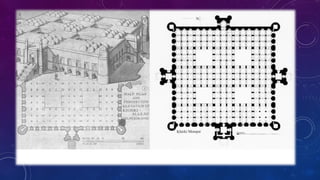
• The Mosque has a 52 m (170.6 ft)x52 m (170.6 ft) square plan in an area of 87 m2 (936.5 sq ft).
• It is raised on a plinthof 3 m (9.8 ft). There are four open courtyards (square in size of 9.14 m (30.0 ft)
on each side) encircled by arcades built with 180 square structural columns and 60 pilasters,which run
in north–south direction and divides into aisles.
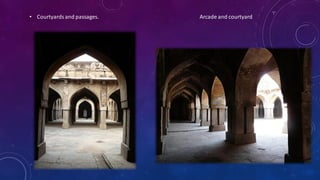
• The open courtyardsare the source of light and ventilation tothe internalprayer spaces.
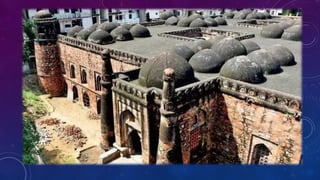
• The roof is partitionedinto 25 squares of equalsize with 9 small domes in each square (totaling to 81
domes) and alternatedby 12 flat roofs to cover the roof.
• The four courtyardsprovide light and ventilation.
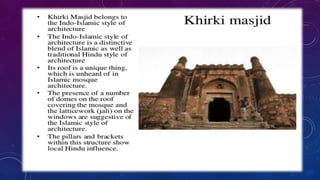
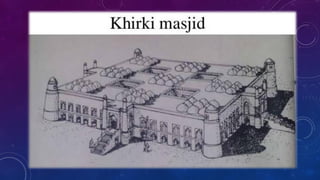
• The four corners of the mosque are adorned with towers with three protruding gateways,one in the
middle of each face, with tapering turrets flanking each gate.
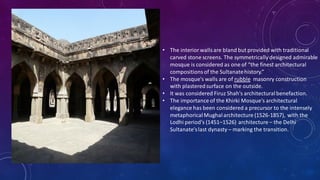
• The interiorwallsare bland but provided with traditional
carved stone screens. The symmetrically designed admirable
mosque is considered as one of “the finest architectural
compositionsof the Sultanatehistory.”
• The mosque's walls are of rubble masonry construction
with plasteredsurface on the outside.
• It was considered Firuz Shah's architecturalbenefaction.
• The importance of the Khirki Mosque's architectural
elegance has been considered a precursor to the intensely
metaphoricalMughalarchitecture (1526-1857), with the
Lodhi period's (1451–1526) architecture – the Delhi
Sultanate'slast dynasty – marking the transition.
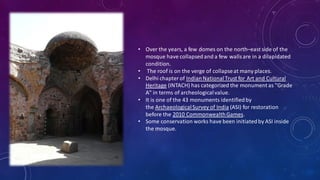
• Over the years, a few domes on the north–east side of the
mosque have collapsedand a few walls are in a dilapidated
condition.
• The roof is on the verge of collapseat many places.
• Delhi chapter of IndianNationalTrust for Art and Cultural
Heritage (INTACH) has categorized the monument as "Grade
A" in terms of archeologicalvalue.
• It is one of the 43 monuments identifiedby
the ArchaeologicalSurvey of India (ASI) for restoration
before the 2010 CommonwealthGames.
• Some conservation works have been initiatedby ASI inside
the mosque.
GALLERY
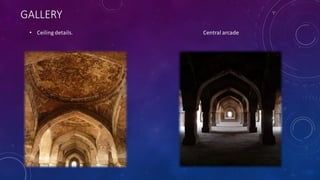
• Ceiling details. Central arcade
• Courtyards and passages. Arcade and courtyard
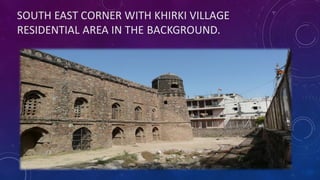
SOUTH EAST CORNER WITH KHIRKI VILLAGE
RESIDENTIAL AREA IN THE BACKGROUND.
THANK YOU

Khirki masjid

  • 1.
  • 2.
    • Khirki Mosque,approachedfrom the Khirki Village in South Delh and close to the Satpulorr the seven arched bridge on the edge of southern wall of Jahapanah(the fourth city of Medieval Delhi), was a mosque built by Khan- i-JahanJunan Shah, the Prime Ministe of Feroz Shah Tughlaq(1351–1388) of the TughlaqDynasty. • The word 'Khirki' prefixed to mosqu is an Urdu word that means “window” and hence is also called “The Mosque of Windows”. District SouthDelhi Year consecrated 14th century Status Monument Location Location Khirki Village,Delhi Municipality SDMC State Delhi Country India Architect(s) Khan-i-Jahan Junan Shah Type Mosque Style Tughluqid, Indo Islamic Architecture Completed 1351-54 Specifications Length 52 m (170.6 ft) Width 52 m (170.6 ft) Dome(s) 81 Minaret(s) Four, one each corner Materials Rubble Masonry
  • 5.
    ARCHITECTURAL FEATURES. • TheMosque has a 52 m (170.6 ft)x52 m (170.6 ft) square plan in an area of 87 m2 (936.5 sq ft). • It is raised on a plinthof 3 m (9.8 ft). There are four open courtyards (square in size of 9.14 m (30.0 ft) on each side) encircled by arcades built with 180 square structural columns and 60 pilasters,which run in north–south direction and divides into aisles. • The open courtyardsare the source of light and ventilation tothe internalprayer spaces. • The roof is partitionedinto 25 squares of equalsize with 9 small domes in each square (totaling to 81 domes) and alternatedby 12 flat roofs to cover the roof. • The four courtyardsprovide light and ventilation. • The four corners of the mosque are adorned with towers with three protruding gateways,one in the middle of each face, with tapering turrets flanking each gate.
  • 7.
    • The interiorwallsarebland but provided with traditional carved stone screens. The symmetrically designed admirable mosque is considered as one of “the finest architectural compositionsof the Sultanatehistory.” • The mosque's walls are of rubble masonry construction with plasteredsurface on the outside. • It was considered Firuz Shah's architecturalbenefaction. • The importance of the Khirki Mosque's architectural elegance has been considered a precursor to the intensely metaphoricalMughalarchitecture (1526-1857), with the Lodhi period's (1451–1526) architecture – the Delhi Sultanate'slast dynasty – marking the transition.
  • 8.
    • Over theyears, a few domes on the north–east side of the mosque have collapsedand a few walls are in a dilapidated condition. • The roof is on the verge of collapseat many places. • Delhi chapter of IndianNationalTrust for Art and Cultural Heritage (INTACH) has categorized the monument as "Grade A" in terms of archeologicalvalue. • It is one of the 43 monuments identifiedby the ArchaeologicalSurvey of India (ASI) for restoration before the 2010 CommonwealthGames. • Some conservation works have been initiatedby ASI inside the mosque.
  • 9.
  • 10.
    • Courtyards andpassages. Arcade and courtyard
  • 11.
    SOUTH EAST CORNERWITH KHIRKI VILLAGE RESIDENTIAL AREA IN THE BACKGROUND.
  • 13.