Module 2 Lesson 16 Even and Odd Numbers.notebook

January 10, 2014


MODULE 2 Arithmec Operaons Including 
Division of Fracons
Topic D: Number Theory ‐ Thinking Logically 
About Mulplicave Arithmec 
Lesson 16:  Odd & Even Numbers
Student Outcomes
§ Students apply odd and even numbers to understand factors and mulples.

1
Module 2 Lesson 16 Even and Odd Numbers.notebook

January 10, 2014

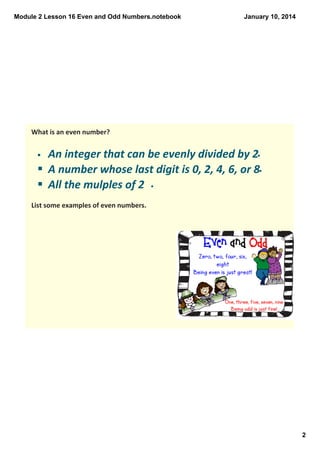
What is an even number? 

An integer that can be evenly divided by 2.
§ A number whose last digit is 0, 2, 4, 6, or 8.
§ All the mulples of 2 .
§

List some examples of even numbers.

2
Module 2 Lesson 16 Even and Odd Numbers.notebook

January 10, 2014

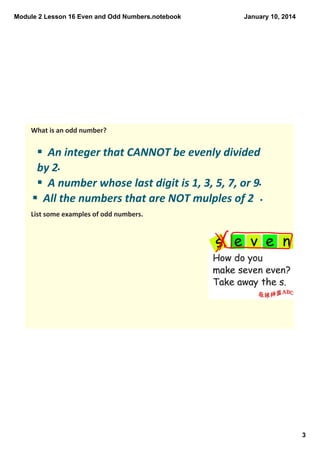
What is an odd number?

§ An integer that CANNOT be evenly divided 
by 2.
§ A number whose last digit is 1, 3, 5, 7, or 9.
§ All the numbers that are NOT mulples of 2 .
List some examples of odd numbers.

3
Module 2 Lesson 16 Even and Odd Numbers.notebook

January 10, 2014

What happens when we add two even numbers?  Will we always get an even 
number?  Write  your predicon.

4
Module 2 Lesson 16 Even and Odd Numbers.notebook

January 10, 2014

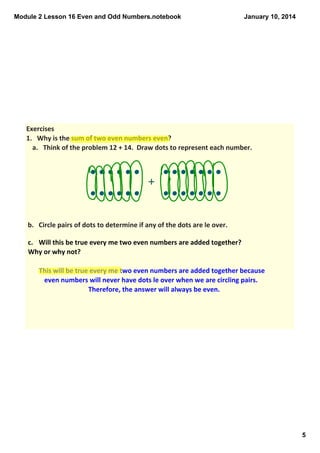
Exercises
1. Why is the sum of two even numbers even? 
a. Think of the problem 12 + 14.  Draw dots to represent each number.

• • • • • •        • • • • • • •
+
• • • • • •        • • • • • • •
b.   Circle pairs of dots to determine if any of the dots are le over. 
c. Will this be true every me two even numbers are added together?  
Why or why not?
This will be true every me two even numbers are added together because 
even numbers will never have dots le over when we are circling pairs.  
Therefore, the answer will always be even. 

5
Module 2 Lesson 16 Even and Odd Numbers.notebook

January 10, 2014

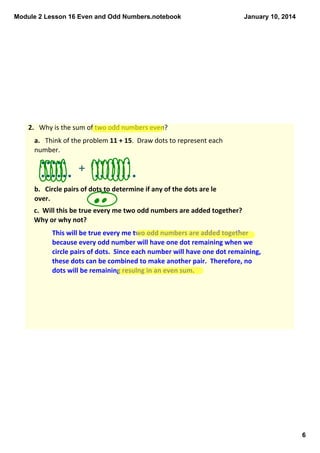
2. Why is the sum of two odd numbers even?
a. Think of the problem 11 + 15.  Draw dots to represent each 
number.
• • • • • 
• • • • • •

+

• • • • • • •
• • • • • • • •

b. Circle pairs of dots to determine if any of the dots are le 
over. 
c.  Will this be true every me two odd numbers are added together?  
Why or why not?
This will be true every me two odd numbers are added together 
because every odd number will have one dot remaining when we 
circle pairs of dots.  Since each number will have one dot remaining, 
these dots can be combined to make another pair.  Therefore, no 
dots will be remaining resulng in an even sum.

6
Module 2 Lesson 16 Even and Odd Numbers.notebook

January 10, 2014

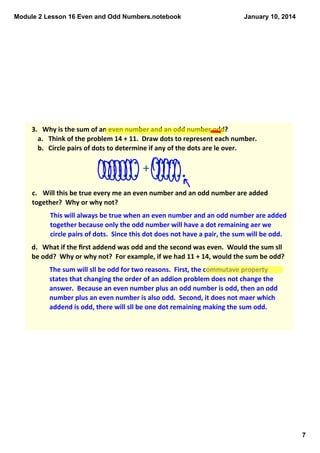
3. Why is the sum of an even number and an odd number odd?
a. Think of the problem 14 + 11.  Draw dots to represent each number.
b. Circle pairs of dots to determine if any of the dots are le over.

• • • • • • •   
• • • • • • •

+

• • • • • 
• • • • • • 

c. Will this be true every me an even number and an odd number are added 
together?  Why or why not?
This will always be true when an even number and an odd number are added 
together because only the odd number will have a dot remaining aer we 
circle pairs of dots.  Since this dot does not have a pair, the sum will be odd.
d. What if the first addend was odd and the second was even.  Would the sum sll 
be odd?  Why or why not?  For example, if we had 11 + 14, would the sum be odd?
The sum will sll be odd for two reasons.  First, the commutave property 
states that changing the order of an addion problem does not change the 
answer.  Because an even number plus an odd number is odd, then an odd 
number plus an even number is also odd.  Second, it does not maer which 
addend is odd, there will sll be one dot remaining making the sum odd. 

7
Module 2 Lesson 16 Even and Odd Numbers.notebook

January 10, 2014

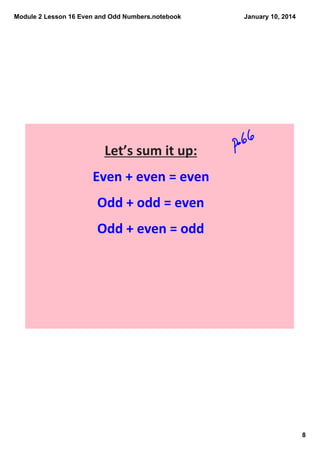
Let’s sum it up:
Even + even = even
Odd + odd = even
Odd + even = odd

8
Module 2 Lesson 16 Even and Odd Numbers.notebook

January 10, 2014

Exploratory Challenge
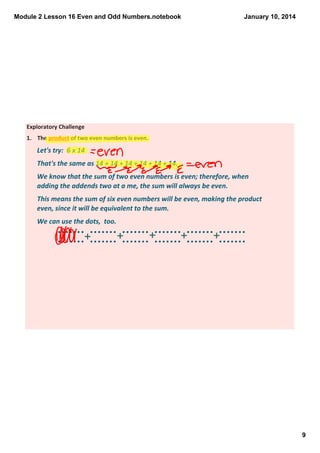
1. The product of two even numbers is even.

Let's try:  6 x 14
That's the same as 14 + 14 + 14 + 14 + 14 + 14.  
We know that the sum of two even numbers is even; therefore, when 
adding the addends two at a me, the sum will always be even.  
This means the sum of six even numbers will be even, making the product 
even, since it will be equivalent to the sum.
We can use the dots,  too.
• • • • • • •

• • • • • • • • • • • • • • • • • • • • • • • • • • • • • • • • • • •
+• • • • • • • +• • • • • • • +• • • • • • •+• • • • • • •+• • • • • • •
• • • • • • •

9
Module 2 Lesson 16 Even and Odd Numbers.notebook

January 10, 2014

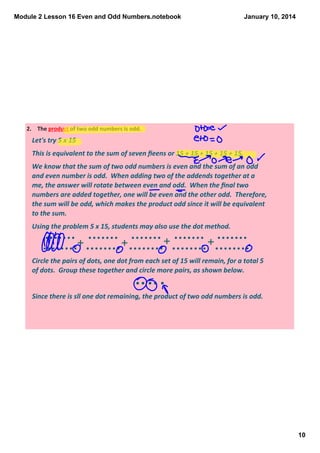
2. The product of two odd numbers is odd.

Let's try 5 x 15
This is equivalent to the sum of seven fieens or 15 + 15 + 15 + 15 + 15.  
We know that the sum of two odd numbers is even and the sum of an odd 
and even number is odd.  When adding two of the addends together at a 
me, the answer will rotate between even and odd.  When the final two 
numbers are added together, one will be even and the other odd.  Therefore, 
the sum will be odd, which makes the product odd since it will be equivalent 
to the sum.  
Using the problem 5 x 15, students may also use the dot method.
• • • • • • •

• • • • • • •

• • • • • • •

• • • • • • •

• • • • • • •

+ • • • • • • • • + • • • • • • • • + • • • • • • • • + • • • • • • • •
• • • • • • • •
Circle the pairs of dots, one dot from each set of 15 will remain, for a total 5 
of dots.  Group these together and circle more pairs, as shown below.
• •  • •  •
Since there is sll one dot remaining, the product of two odd numbers is odd.

10
Module 2 Lesson 16 Even and Odd Numbers.notebook

January 10, 2014

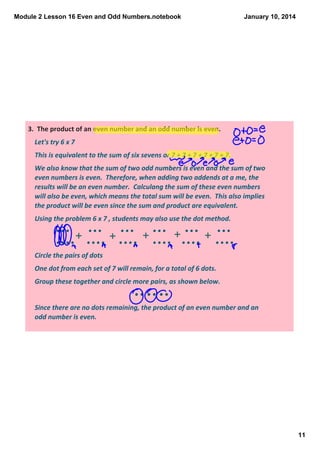
3.  The product of an even number and an odd number is even. 
Let's try 6 x 7
This is equivalent to the sum of six sevens or 7 + 7 + 7 + 7 + 7 + 7.  
We also know that the sum of two odd numbers is even and the sum of two 
even numbers is even.  Therefore, when adding two addends at a me, the 
results will be an even number.  Calculang the sum of these even numbers 
will also be even, which means the total sum will be even.  This also implies 
the product will be even since the sum and product are equivalent.
Using the problem 6 x 7 , students may also use the dot method.
• • •

• • •
• • •
• • •
• • •
• • •
+
+ • • • • +
+
+
• • • •       • • • •       • • • •
     • • • •       • • • •

Circle the pairs of dots
One dot from each set of 7 will remain, for a total of 6 dots.  
Group these together and circle more pairs, as shown below.
• •  • •  • •
Since there are no dots remaining, the product of an even number and an 
odd number is even.

11
Module 2 Lesson 16 Even and Odd Numbers.notebook

January 10, 2014

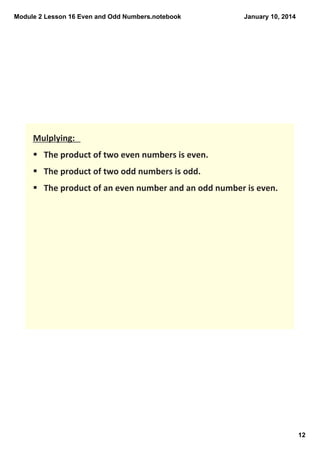
Mulplying:
§ The product of two even numbers is even.
§ The product of two odd numbers is odd.
§ The product of an even number and an odd number is even.

12
Module 2 Lesson 16 Even and Odd Numbers.notebook

January 10, 2014

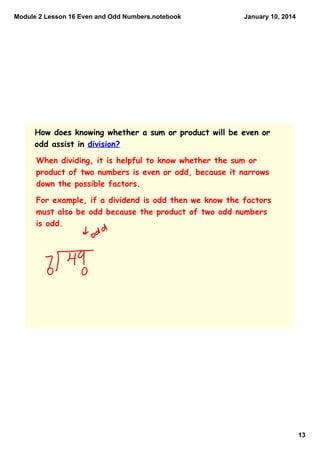
How does knowing whether a sum or product will be even or
odd assist in division?
When dividing, it is helpful to know whether the sum or
product of two numbers is even or odd, because it narrows
down the possible factors.
For example, if a dividend is odd then we know the factors
must also be odd because the product of two odd numbers
is odd.

13
Module 2 Lesson 16 Even and Odd Numbers.notebook

January 10, 2014

Closing

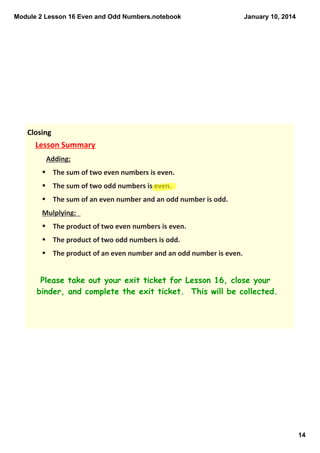
Lesson Summary
Adding:
§ The sum of two even numbers is even.
§ The sum of two odd numbers is even.
§ The sum of an even number and an odd number is odd.
Mulplying:
§ The product of two even numbers is even.
§ The product of two odd numbers is odd.
§ The product of an even number and an odd number is even.

Please take out your exit ticket for Lesson 16, close your
binder, and complete the exit ticket. This will be collected.

14
Module 2 Lesson 16 Even and Odd Numbers.notebook

January 10, 2014

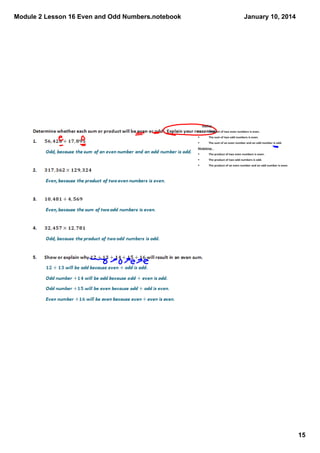
Lesson Summary
Adding:
§

The sum of two even numbers is even.

§

The sum of two odd numbers is even.

§

The sum of an even number and an odd number is odd.

Mulplying:
§

The product of two even numbers is even.

§

The product of two odd numbers is odd.

§

The product of an even number and an odd number is even.

15

Module 2 lesson 16