ODD NUMBERS
ALAN S. ABERILLA
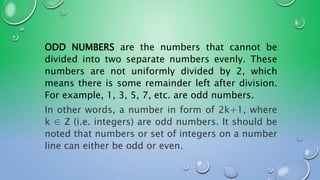
ODD NUMBERS are the numbers that cannot be
divided into two separate numbers evenly. These
numbers are not uniformly divided by 2, which
means there is some remainder left after division.
For example, 1, 3, 5, 7, etc. are odd numbers.
In other words, a number in form of 2k+1, where
k ∈ Z (i.e. integers) are odd numbers. It should be
noted that numbers or set of integers on a number
line can either be odd or even.
A few more key points:
 An odd number is an integer which is not a
multiple of 2
 If these numbers are divided by 2, then there will
remainder left
 In the number line, 1 is the first positive odd
number
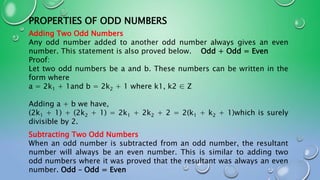
Adding Two Odd Numbers
Any odd number added to another odd number always gives an even
number. This statement is also proved below. Odd + Odd = Even
Proof:
Let two odd numbers be a and b. These numbers can be written in the
form where
a = 2k1 + 1and b = 2k2 + 1 where k1, k2 ∈ Z
Adding a + b we have,
(2k1 + 1) + (2k2 + 1) = 2k1 + 2k2 + 2 = 2(k1 + k2 + 1)which is surely
divisible by 2.
Subtracting Two Odd Numbers
When an odd number is subtracted from an odd number, the resultant
number will always be an even number. This is similar to adding two
odd numbers where it was proved that the resultant was always an even
number. Odd – Odd = Even
PROPERTIES OF ODD NUMBERS
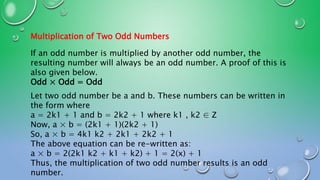
Multiplication of Two Odd Numbers
If an odd number is multiplied by another odd number, the
resulting number will always be an odd number. A proof of this is
also given below.
Odd × Odd = Odd
Let two odd number be a and b. These numbers can be written in
the form where
a = 2k1 + 1 and b = 2k2 + 1 where k1 , k2 ∈ Z
Now, a × b = (2k1 + 1)(2k2 + 1)
So, a × b = 4k1 k2 + 2k1 + 2k2 + 1
The above equation can be re-written as:
a × b = 2(2k1 k2 + k1 + k2) + 1 = 2(x) + 1
Thus, the multiplication of two odd number results is an odd
number.
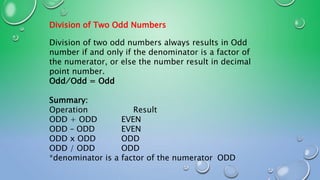
Division of Two Odd Numbers
Division of two odd numbers always results in Odd
number if and only if the denominator is a factor of
the numerator, or else the number result in decimal
point number.
Odd ⁄ Odd = Odd
Summary:
Operation Result
ODD + ODD EVEN
ODD – ODD EVEN
ODD x ODD ODD
ODD / ODD ODD
*denominator is a factor of the numerator ODD
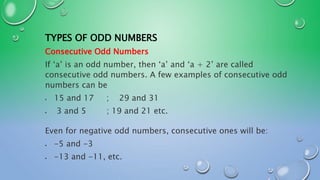
Consecutive Odd Numbers
If ‘a’ is an odd number, then ‘a’ and ‘a + 2’ are called
consecutive odd numbers. A few examples of consecutive odd
numbers can be
 15 and 17 ; 29 and 31
 3 and 5 ; 19 and 21 etc.
Even for negative odd numbers, consecutive ones will be:
 -5 and -3
 -13 and -11, etc.
TYPES OF ODD NUMBERS
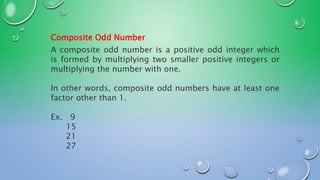
Composite Odd Number
A composite odd number is a positive odd integer which
is formed by multiplying two smaller positive integers or
multiplying the number with one.
In other words, composite odd numbers have at least one
factor other than 1.
Ex. 9
15
21
27
ACTIVITY 2:
Answer the following:
1. How do you determine if a number is odd or even?
2. Mention all the odd numbers which are greater than 60 and
smaller than 120.
3. List all the odd numbers which are greater than -4 and smaller
than 20.
4. Is zero an odd number? Why?
5. Enumerate the composite odd numbers between 1-100?
Use short bond paper (handwritten or computerized) – utilize the
folder of assignment 1
ASSIGNMENT 2:
What is difference between a prime number and a composite
number? Give 5 example of prime numbers.
Lesson 3   odd numbers

Lesson 3 odd numbers

  • 1.
  • 2.
    ODD NUMBERS arethe numbers that cannot be divided into two separate numbers evenly. These numbers are not uniformly divided by 2, which means there is some remainder left after division. For example, 1, 3, 5, 7, etc. are odd numbers. In other words, a number in form of 2k+1, where k ∈ Z (i.e. integers) are odd numbers. It should be noted that numbers or set of integers on a number line can either be odd or even.
  • 3.
    A few morekey points:  An odd number is an integer which is not a multiple of 2  If these numbers are divided by 2, then there will remainder left  In the number line, 1 is the first positive odd number
  • 4.
    Adding Two OddNumbers Any odd number added to another odd number always gives an even number. This statement is also proved below. Odd + Odd = Even Proof: Let two odd numbers be a and b. These numbers can be written in the form where a = 2k1 + 1and b = 2k2 + 1 where k1, k2 ∈ Z Adding a + b we have, (2k1 + 1) + (2k2 + 1) = 2k1 + 2k2 + 2 = 2(k1 + k2 + 1)which is surely divisible by 2. Subtracting Two Odd Numbers When an odd number is subtracted from an odd number, the resultant number will always be an even number. This is similar to adding two odd numbers where it was proved that the resultant was always an even number. Odd – Odd = Even PROPERTIES OF ODD NUMBERS
  • 5.
    Multiplication of TwoOdd Numbers If an odd number is multiplied by another odd number, the resulting number will always be an odd number. A proof of this is also given below. Odd × Odd = Odd Let two odd number be a and b. These numbers can be written in the form where a = 2k1 + 1 and b = 2k2 + 1 where k1 , k2 ∈ Z Now, a × b = (2k1 + 1)(2k2 + 1) So, a × b = 4k1 k2 + 2k1 + 2k2 + 1 The above equation can be re-written as: a × b = 2(2k1 k2 + k1 + k2) + 1 = 2(x) + 1 Thus, the multiplication of two odd number results is an odd number.
  • 6.
    Division of TwoOdd Numbers Division of two odd numbers always results in Odd number if and only if the denominator is a factor of the numerator, or else the number result in decimal point number. Odd ⁄ Odd = Odd Summary: Operation Result ODD + ODD EVEN ODD – ODD EVEN ODD x ODD ODD ODD / ODD ODD *denominator is a factor of the numerator ODD
  • 7.
    Consecutive Odd Numbers If‘a’ is an odd number, then ‘a’ and ‘a + 2’ are called consecutive odd numbers. A few examples of consecutive odd numbers can be  15 and 17 ; 29 and 31  3 and 5 ; 19 and 21 etc. Even for negative odd numbers, consecutive ones will be:  -5 and -3  -13 and -11, etc. TYPES OF ODD NUMBERS
  • 8.
    Composite Odd Number Acomposite odd number is a positive odd integer which is formed by multiplying two smaller positive integers or multiplying the number with one. In other words, composite odd numbers have at least one factor other than 1. Ex. 9 15 21 27
  • 9.
    ACTIVITY 2: Answer thefollowing: 1. How do you determine if a number is odd or even? 2. Mention all the odd numbers which are greater than 60 and smaller than 120. 3. List all the odd numbers which are greater than -4 and smaller than 20. 4. Is zero an odd number? Why? 5. Enumerate the composite odd numbers between 1-100? Use short bond paper (handwritten or computerized) – utilize the folder of assignment 1 ASSIGNMENT 2: What is difference between a prime number and a composite number? Give 5 example of prime numbers.