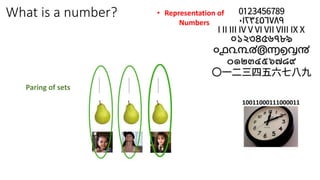
5 ? What does the number 5 mean?
How could you explain the meaning
of the word „five“ to someone who
doesn‘t know it? (e.g. a child or an alien)
5 ?
What is a number? • Representation of
Numbers
Paring of sets
10011000111000011
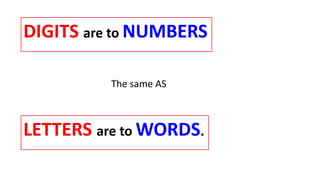
DIGITS are to _ _ _ _ _ _ _
LETTERS are to _ _ _ _ _.
The same AS
DIGITS are to NUMBERS
LETTERS are to WORDS.
The same AS
DIGITS are the symbols,
with which we write NUMBERS.
LETTERS are the symbols,
with which we write WORDS.
JUST AS
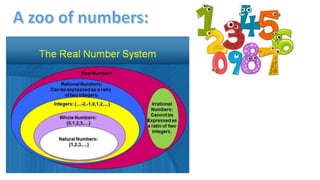
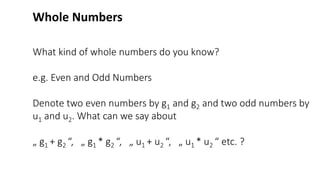
What kind of whole numbers do you know?
e.g. Even and Odd Numbers
Denote two even numbers by g1 and g2 and two odd numbers by
u1 and u2. What can we say about
„ g1 + g2 “, „ g1 * g2 “, „ u1 + u2 “, „ u1 * u2 “ etc. ?
Whole Numbers
Even+Even = Even – why?
• Every even number can be written as 2m, i.e. it is a double of some whole
number m (e.g. 8=2∙4, here m = 4)…. and vice versa - every number that can
written as 2m is even
• So every two even numbers g1 und g2, can be represented by 2m und 2n,
respectively (z.B. 8, 14 sind 2∙4, 2∙7)
• Now let‘s add these two even numbers: g1 + g2 = 2m+2n
• g1 + g2 =2m+2n=2(m+n) - > we obtain 2∙(whole number), i.e. an even number
Even ∙ Even = Even – why?
• This time we multiply two arbitrary even numbers:
g1∙ g2 =2m ∙ 2n e.g. 8∙14 = 2∙4 ∙ 2∙7 = 2∙(4∙2∙7)
• In general, g1∙ g2 = 2m ∙ 2n = 2∙(m∙2∙n) What have we obtained?
And what about dividing two even numbers?
• odd + odd = even – why??
• How can we represent an arbitrary odd number?
• u = 2m+1 (e.g. 9=2∙4+1)
• Any two odd numbers u1 und u2 can be written as
u1 =2m+1 and u2 =2n +1 (e.g. 9, 15 can be written as 2∙4+1, 2∙7+1)
• Now we add these two arbitrary odd numbers:
u1 + u2 = 2m+1+2n+1 = 2m+2n+2 = even + even + even = even !
e.g. 2∙4+1+ 2∙7+1 = 2∙4+2∙7+2
The set of even numbers is closed under the operations of addition and
multiplication.
The set of odd numbers is closed under multiplication but not under
addition.
What about other operations? − , ÷ ?? Investigate to see if the set of even
numbers and the set of odd numbers are closed under them.
The Game of Lockers: Intro to Prime Factorisation
One hundred students are assigned 100 lockers.
In the beginning all the lockers are closed.
The Student #1 runs through and opens all the lockers. Then the Student
#2 runs through, closes her locker and every second locker after that. The
Student #3 similarly goes and changes every third locker. That means if he
finds Locker #3 open, he closes it, and if he finds it closed, he opens it. And
the same with Locker #6, #9, etc.
Then comes Student #4 and she does the same for Locker #4 and every
4th locker after that.
All the way up until Student #100.
Which lockers are open and which are closed at the end?

What are Numbers.pptx

  • 2.
    5 ? Whatdoes the number 5 mean? How could you explain the meaning of the word „five“ to someone who doesn‘t know it? (e.g. a child or an alien)
  • 3.
  • 4.
    What is anumber? • Representation of Numbers Paring of sets 10011000111000011
  • 5.
    DIGITS are to_ _ _ _ _ _ _ LETTERS are to _ _ _ _ _. The same AS
  • 6.
    DIGITS are toNUMBERS LETTERS are to WORDS. The same AS
  • 7.
    DIGITS are thesymbols, with which we write NUMBERS. LETTERS are the symbols, with which we write WORDS. JUST AS
  • 9.
    What kind ofwhole numbers do you know? e.g. Even and Odd Numbers Denote two even numbers by g1 and g2 and two odd numbers by u1 and u2. What can we say about „ g1 + g2 “, „ g1 * g2 “, „ u1 + u2 “, „ u1 * u2 “ etc. ? Whole Numbers
  • 10.
    Even+Even = Even– why? • Every even number can be written as 2m, i.e. it is a double of some whole number m (e.g. 8=2∙4, here m = 4)…. and vice versa - every number that can written as 2m is even • So every two even numbers g1 und g2, can be represented by 2m und 2n, respectively (z.B. 8, 14 sind 2∙4, 2∙7) • Now let‘s add these two even numbers: g1 + g2 = 2m+2n • g1 + g2 =2m+2n=2(m+n) - > we obtain 2∙(whole number), i.e. an even number
  • 11.
    Even ∙ Even= Even – why? • This time we multiply two arbitrary even numbers: g1∙ g2 =2m ∙ 2n e.g. 8∙14 = 2∙4 ∙ 2∙7 = 2∙(4∙2∙7) • In general, g1∙ g2 = 2m ∙ 2n = 2∙(m∙2∙n) What have we obtained? And what about dividing two even numbers?
  • 12.
    • odd +odd = even – why?? • How can we represent an arbitrary odd number? • u = 2m+1 (e.g. 9=2∙4+1) • Any two odd numbers u1 und u2 can be written as u1 =2m+1 and u2 =2n +1 (e.g. 9, 15 can be written as 2∙4+1, 2∙7+1) • Now we add these two arbitrary odd numbers: u1 + u2 = 2m+1+2n+1 = 2m+2n+2 = even + even + even = even ! e.g. 2∙4+1+ 2∙7+1 = 2∙4+2∙7+2
  • 13.
    The set ofeven numbers is closed under the operations of addition and multiplication. The set of odd numbers is closed under multiplication but not under addition. What about other operations? − , ÷ ?? Investigate to see if the set of even numbers and the set of odd numbers are closed under them.
  • 14.
    The Game ofLockers: Intro to Prime Factorisation One hundred students are assigned 100 lockers. In the beginning all the lockers are closed. The Student #1 runs through and opens all the lockers. Then the Student #2 runs through, closes her locker and every second locker after that. The Student #3 similarly goes and changes every third locker. That means if he finds Locker #3 open, he closes it, and if he finds it closed, he opens it. And the same with Locker #6, #9, etc. Then comes Student #4 and she does the same for Locker #4 and every 4th locker after that. All the way up until Student #100. Which lockers are open and which are closed at the end?