



Job
“A job is a pattern of tasks,
duties and responsibilities that
can be done by a person.”
Job analysis
“Job Analysis seeks to study
these patterns of activity to
determine the tasks, duties and
responsibilities needed for each
job.”
Hris
   An HRIS, the abbreviation for Human
    Resources Information System, is a
    system that lets you keep track of all
    your employees and information about
    them. It is usually done in a database or,
    more often, in a series of inter-related
    databases.
   department,
   job title,
   grade,
   salary,
   salary history,
   position history,
   supervisor,
   training completed,
   special qualifications,
   ethnicity,
   date of birth,
   disabilities,
   veterans status,
   visa status,
   benefits selected,
   and more
Major HRM Activities that Rely
on Job Analysis Information
1.   Improve productivity levels through careful study of
     jobs.
2.   Eliminate unneeded job requirements that can
     cause discrimination in employment
3.   Match job applicants to job requirements
4.   Plan for future human resource requirements
5.   Determine training needs for employees
6.   Compensate employees fairly and equitably
7.   Improve overall quality of work life
8.   Set realistic performance standards
9.   Redesign jobs to improve performance and/or
     employee morale
Role of Job Analysts


 1.   Identify the jobs to be analyzed

 2.   Develop data collection approaches
      including questionnaire construction

 3.   Collect job analysis information
Job Identification
   Small organizations: process is simple
    because there are few jobs

   Large organizations: analysts may have to
    construct list of jobs from payroll records,
    organization charts, or discussion with
    workers and supervisors. Previous
    records may also be used.
Data Collection Instrument
Design
    To study jobs, analysts develop
     questionnaires that are sometimes called
     checklists or job analysis schedules. These
     questionnaires seek to collect job
     information uniformly. They uncover the
     duties, responsibilities, human abilities and
     performance standards of the jobs
     investigated. E.g job analysis
     questionnaire
Job Analysis Questionnaire
   Status refers to whether the job is
    exempt or not exempt from overtime
    laws.

   Identification information includes job
    title, division and title of supervisors and
    a unique job identification number.
Job Analysis Questionnaire
   Duties and Responsibilities- outlines the
    purpose of job, what the job accomplishes
    and how the job is performed.

   Human Characteristics and Working
    conditions-
     checklist uncovers the particular skills, abilities,
      training, education, experience and other
      characteristics.
     Working conditions may explain the need for
      particular skills, training, knowledge or a particular
      job design.
Collecting Job Analysis Information
 1.    Interviews
      Face to face interviews are effective
 2.    Mail Questionnaires
      Survey employees through mailed questionnaire
          sent by inter-office mail or by post.
       Position Analysis Questionnaire
       Management Position Description Questionnaire
 3.    Employee Log
      Workers periodically summarize their tasks and
          activities in the log. They are time consuming.
 4.    Observation
      Direct observation is slow, costly and potentially less
          accurate. Language barrier may necessitate
          observation.
 5.    Combinations
      2-3 methods. High accuracy low cost.
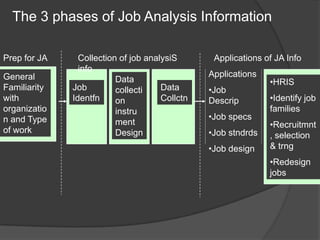
The 3 phases of Job Analysis Information

Prep for JA     Collection of job analysiS       Applications of JA Info
                info
General                                         Applications
                          Data                                 •HRIS
Familiarity   Job         collecti    Data      •Job
with          Identfn     on          Collctn   Descrip        •Identify job
organizatio               instru                               families
n and Type                                      •Job specs
                          ment                                 •Recruitmnt
of work                   Design                •Job stndrds   , selection
                                                •Job design    & trng
                                                               •Redesign
                                                               jobs
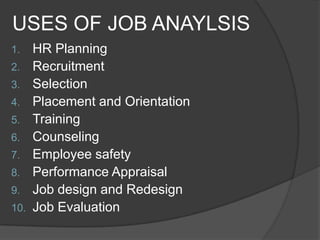
USES OF JOB ANAYLSIS
1.    HR Planning
2.    Recruitment
3.    Selection
4.    Placement and Orientation
5.    Training
6.    Counseling
7.    Employee safety
8.    Performance Appraisal
9.    Job design and Redesign
10.   Job Evaluation
Job description
       A list of a job’s duties, responsibilities,
    reporting relationships, working conditions, and
    supervisory responsibilities, one product of a
    job analysis
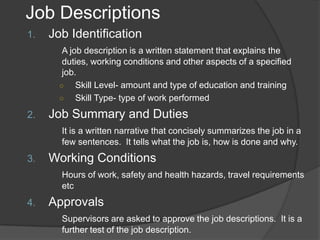
Job Descriptions
1.   Job Identification
        A job description is a written statement that explains the
        duties, working conditions and other aspects of a specified
        job.
       ○    Skill Level- amount and type of education and training
       ○    Skill Type- type of work performed
2.   Job Summary and Duties
       It is a written narrative that concisely summarizes the job in a
       few sentences. It tells what the job is, how is done and why.
3.   Working Conditions
       Hours of work, safety and health hazards, travel requirements
       etc
4.   Approvals
       Supervisors are asked to approve the job descriptions. It is a
       further test of the job description.
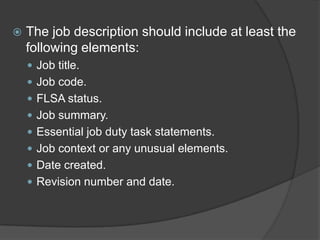
   The job description should include at least the
    following elements:
     Job title.
     Job code.
     FLSA status.
     Job summary.
     Essential job duty task statements.
     Job context or any unusual elements.
     Date created.
     Revision number and date.
   Job specifications
      A list of a job’s “human requirements,”
     that is, the requisite education, skills,
     personality, and so on, another product of
     a job analysis.
   The job specification should include at least the
    following elements:
     Job title.
     Job code.
     Job summary.
     Knowledge required to perform job.
     Skills required to perform job.
     Abilities required to perform job.
     Education required.
     Experience required.
     Licensure required or certification desired to perform
      the job.
     Date created.
     Revision number and date.
Job analysis
Job analysis

Job analysis

  • 3.
    Job “A job isa pattern of tasks, duties and responsibilities that can be done by a person.”
  • 4.
    Job analysis “Job Analysisseeks to study these patterns of activity to determine the tasks, duties and responsibilities needed for each job.”
  • 5.
    Hris  An HRIS, the abbreviation for Human Resources Information System, is a system that lets you keep track of all your employees and information about them. It is usually done in a database or, more often, in a series of inter-related databases.
  • 6.
    department,  job title,  grade,  salary,  salary history,  position history,  supervisor,  training completed,  special qualifications,  ethnicity,  date of birth,  disabilities,  veterans status,  visa status,  benefits selected,  and more
  • 7.
    Major HRM Activitiesthat Rely on Job Analysis Information 1. Improve productivity levels through careful study of jobs. 2. Eliminate unneeded job requirements that can cause discrimination in employment 3. Match job applicants to job requirements 4. Plan for future human resource requirements 5. Determine training needs for employees 6. Compensate employees fairly and equitably 7. Improve overall quality of work life 8. Set realistic performance standards 9. Redesign jobs to improve performance and/or employee morale
  • 8.
    Role of JobAnalysts 1. Identify the jobs to be analyzed 2. Develop data collection approaches including questionnaire construction 3. Collect job analysis information
  • 9.
    Job Identification  Small organizations: process is simple because there are few jobs  Large organizations: analysts may have to construct list of jobs from payroll records, organization charts, or discussion with workers and supervisors. Previous records may also be used.
  • 10.
    Data Collection Instrument Design  To study jobs, analysts develop questionnaires that are sometimes called checklists or job analysis schedules. These questionnaires seek to collect job information uniformly. They uncover the duties, responsibilities, human abilities and performance standards of the jobs investigated. E.g job analysis questionnaire
  • 11.
    Job Analysis Questionnaire  Status refers to whether the job is exempt or not exempt from overtime laws.  Identification information includes job title, division and title of supervisors and a unique job identification number.
  • 12.
    Job Analysis Questionnaire  Duties and Responsibilities- outlines the purpose of job, what the job accomplishes and how the job is performed.  Human Characteristics and Working conditions-  checklist uncovers the particular skills, abilities, training, education, experience and other characteristics.  Working conditions may explain the need for particular skills, training, knowledge or a particular job design.
  • 13.
    Collecting Job AnalysisInformation 1. Interviews Face to face interviews are effective 2. Mail Questionnaires Survey employees through mailed questionnaire sent by inter-office mail or by post.  Position Analysis Questionnaire  Management Position Description Questionnaire 3. Employee Log Workers periodically summarize their tasks and activities in the log. They are time consuming. 4. Observation Direct observation is slow, costly and potentially less accurate. Language barrier may necessitate observation. 5. Combinations 2-3 methods. High accuracy low cost.
  • 14.
    The 3 phasesof Job Analysis Information Prep for JA Collection of job analysiS Applications of JA Info info General Applications Data •HRIS Familiarity Job collecti Data •Job with Identfn on Collctn Descrip •Identify job organizatio instru families n and Type •Job specs ment •Recruitmnt of work Design •Job stndrds , selection •Job design & trng •Redesign jobs
  • 15.
    USES OF JOBANAYLSIS 1. HR Planning 2. Recruitment 3. Selection 4. Placement and Orientation 5. Training 6. Counseling 7. Employee safety 8. Performance Appraisal 9. Job design and Redesign 10. Job Evaluation
  • 16.
    Job description  A list of a job’s duties, responsibilities, reporting relationships, working conditions, and supervisory responsibilities, one product of a job analysis
  • 17.
    Job Descriptions 1. Job Identification A job description is a written statement that explains the duties, working conditions and other aspects of a specified job. ○ Skill Level- amount and type of education and training ○ Skill Type- type of work performed 2. Job Summary and Duties It is a written narrative that concisely summarizes the job in a few sentences. It tells what the job is, how is done and why. 3. Working Conditions Hours of work, safety and health hazards, travel requirements etc 4. Approvals Supervisors are asked to approve the job descriptions. It is a further test of the job description.
  • 18.
    The job description should include at least the following elements:  Job title.  Job code.  FLSA status.  Job summary.  Essential job duty task statements.  Job context or any unusual elements.  Date created.  Revision number and date.
  • 19.
    Job specifications A list of a job’s “human requirements,” that is, the requisite education, skills, personality, and so on, another product of a job analysis.
  • 20.
    The job specification should include at least the following elements:  Job title.  Job code.  Job summary.  Knowledge required to perform job.  Skills required to perform job.  Abilities required to perform job.  Education required.  Experience required.  Licensure required or certification desired to perform the job.  Date created.  Revision number and date.