Straight ranking method of performance appraisal
In this file, you can ref useful information about straight ranking method of performance
appraisal such as straight ranking method of performance appraisal methods, straight ranking
method of performance appraisal tips, straight ranking method of performance appraisal forms,
straight ranking method of performance appraisal phrases … If you need more assistant for
straight ranking method of performance appraisal, please leave your comment at the end of file.
Other useful material for you:
• performanceappraisal123.com/1125-free-performance-review-phrases
• performanceappraisal123.com/free-28-performance-appraisal-forms
• performanceappraisal123.com/free-ebook-11-methods-for-performance-appraisal
I. Contents of getting straight ranking method of performance appraisal
==================
Employee appraisal systems help managers evaluate employee job performance and develop a
fair system of pay increases and promotions. Appraisals in turn can help staff members improve
performance, and assist companies in devising or reorganizing job functions to better fit the
position or the employee. In addition, employee appraisals may reveal outdated or inefficient
business practices. Effective employee appraisal systems incorporate goals to help improve the
employer as well as the employee, through the application of appropriate and timely feedback
and training.
Trait-Focused Performance Appraisal
The trait-focused system centers on attributes such as helpfulness, dependability and punctuality.
Supervisors rate employees by indicating specific traits each employee exhibits. Most trait-
focused systems use a simple checklist with ratings of “excellent,”
“satisfactory” or “needs improvement,” or similar options. This
system is traditionally popular with customer service departments. These types of evaluations are
subject to the supervisor’s personal bias, however, and the majority of employees end up
with marks of “satisfactory,” which limits this system’s reliability and
accuracy.
Behavior-Focused Performance Appraisal
The behaviorally anchored rating system (BARS) judges your employees' actions using a
rating scale to measure specific behaviors. Four rating scales are used in behavior-focused
evaluations: graphic rating scales, behaviorally anchored rating scales, forced choice scales and
mixed standards scales.
Graphic rating judges behaviors on a sliding scale from "excellent" to "poor;" average
employees' results should cluster in the middle, with poor employees near the bottom and
exceptional employees near the top.
Behaviorally anchored scales rely on very specific evaluators to score the employee’s
actions as pass or fail. For example, “Does the employee answer the telephone with the
correct greeting?” or “Does s/he verify all customer information in the correct
order?”
The forced-choice scale lists rankings of performance such as "poor," "needs improvement,"
"average," "above average" or "excellent," with no other options; a mixed standards scale is a
forced-choice scale with room for administrator comments.
Unstructured Method
Many older performance evaluations relied on the employee’s personal qualities as
reported by a supervisor. The unstructured method relies directly on the superior’s
subjective opinion without an objective rating scale. An unstructured evaluation might simply be
a statement or description from a manager to a question such as, “What is Jane
like?” The unstructured method is unreliable because it is contingent on personality
chemistry, says the Community for Human Resource Management (CHRM).
Straight Ranking
The straight ranking method compares employees to each other, ranking them from best to worst.
While it's often easy to point out the top and bottom performers, those in the middle can
prove harder to put in order. An example of straight ranking would be a customer service center
that gave points for completed service tickets. Employers often post ranks anonymously by
employee number. Although the ranking criteria are specific, they also are subjective due to the
customer input where ticket completion would not always be in the employee’s hands.
This subjectivity, says CHRM, makes straight ranking unreliable as a tool for evaluating specific
employees.
Paired Comparison
The paired comparison method compares each employee with every other employee in a group.
According to CHRM, paired comparison “is considered more reliable as it is based on a
systematic method of comparison and evaluation.” Paired comparisons work best in
situations where only one employee will be promoted; each is compared and ranked against the
others on various factors until one stands out.
Grading and Checklist
The grading method uses standard A to F letter grades in different categories to rate each
employee, while the checklist method relies on a list of yes or no questions such as, “Is
the employee helpful to his peers?” In each of these evaluation types, the specific
standards are set in advance and defined as categories to evaluate.
Management By Objective
Modern evaluation methods try to remove some the subjectivity and bias inherent in traditional
methods. MBO, or management by objective, appraisals require the employee and supervisor to
agree on a set of objectives before the evaluation. The process relies on goal setting and
constructive feedback to be successful.
Psychological Appraisals
Psychological appraisals assess the employee’s intellectual ability, emotional stability,
analytical skills and other psychological traits using objective psychological evaluation
processes. These evaluations are useful in preparing and developing training methods, and for
placing employees on appropriate teams.
360-Degree Feedback
360-degree feedback requires the employer to survey co-workers, supervisors, subordinates and
even customers about each employee’s actions. The multiple feedback channels offer
objective perspectives of behavioral traits and actions. "From [360-degree] feedback, the worker
is able to set goals for self-development, which will advance their career and benefit the
organization," according to Terri Linmann, author of "360-degree Feedback: Weighing the Pros
and Cons."
==================
III. Performance appraisal methods
1.Ranking Method
The ranking system requires the rater to rank his
subordinates on overall performance. This consists in
simply putting a man in a rank order. Under this method,
the ranking of an employee in a work group is done
against that of another employee. The relative position of
each employee is tested in terms of his numerical rank. It
may also be done by ranking a person on his job
performance against another member of the competitive
group.
Advantages of Ranking Method
i. Employees are ranked according to their performance
levels.
ii. It is easier to rank the best and the worst employee.
Limitations of Ranking Method
i. The “whole man” is compared with another “whole man”
in this method. In practice, it is very difficult to compare
individuals possessing various individual traits.
ii. This method speaks only of the position where an
employee stands in his group. It does not test anything
about how much better or how much worse an employee
is when compared to another employee.
iii. When a large number of employees are working, ranking
of individuals become a difficult issue.
iv. There is no systematic procedure for ranking individuals
in the organization. The ranking system does not eliminate
the possibility of snap judgements.
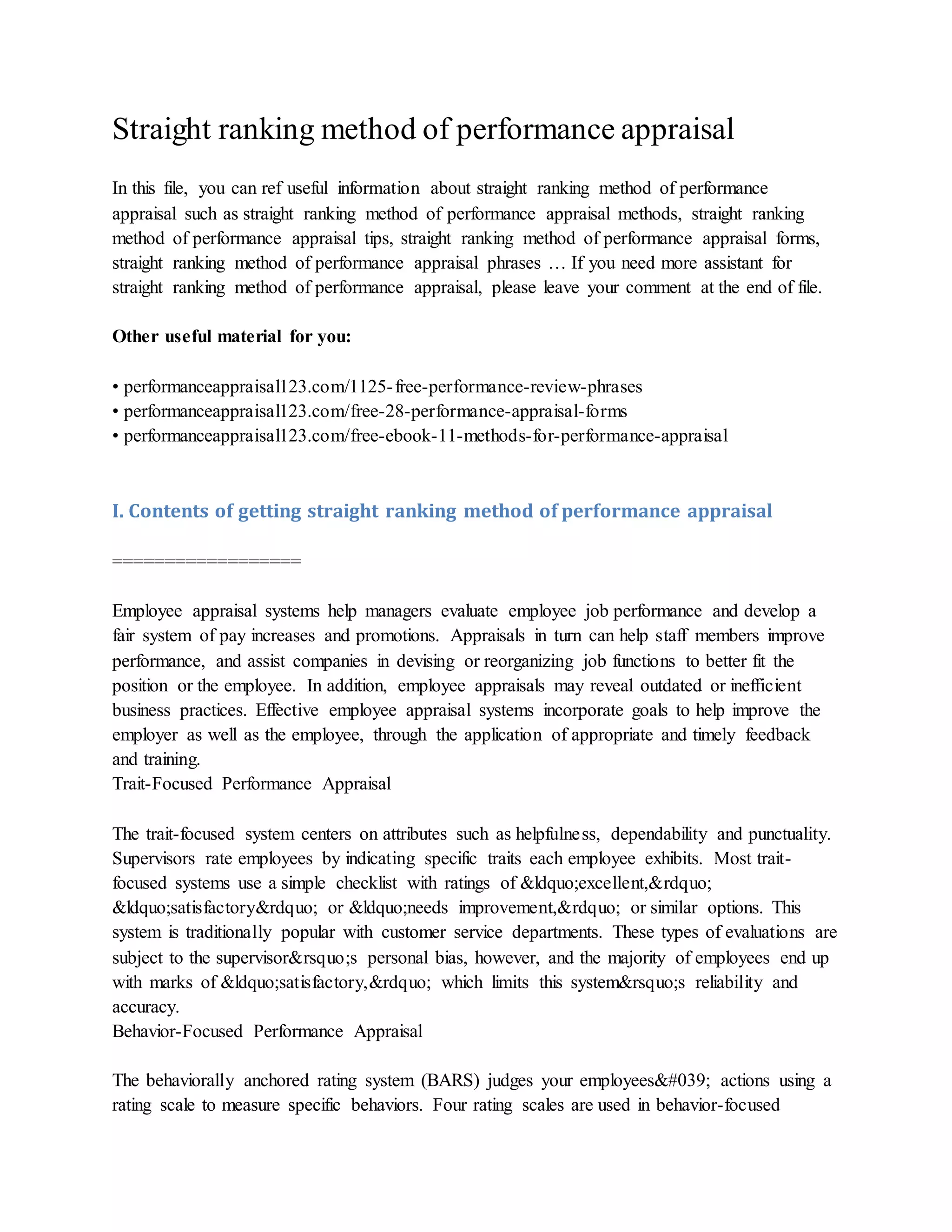
2. Rating Scale
Rating scales consists of several numerical scales
representing job related performance criterions such as
dependability, initiative, output, attendance, attitude etc.
Each scales ranges from excellent to poor. The total
numerical scores are computed and final conclusions are
derived. Advantages – Adaptability, easy to use, low cost,
every type of job can be evaluated, large number of
employees covered, no formal training required.
Disadvantages – Rater’s biases
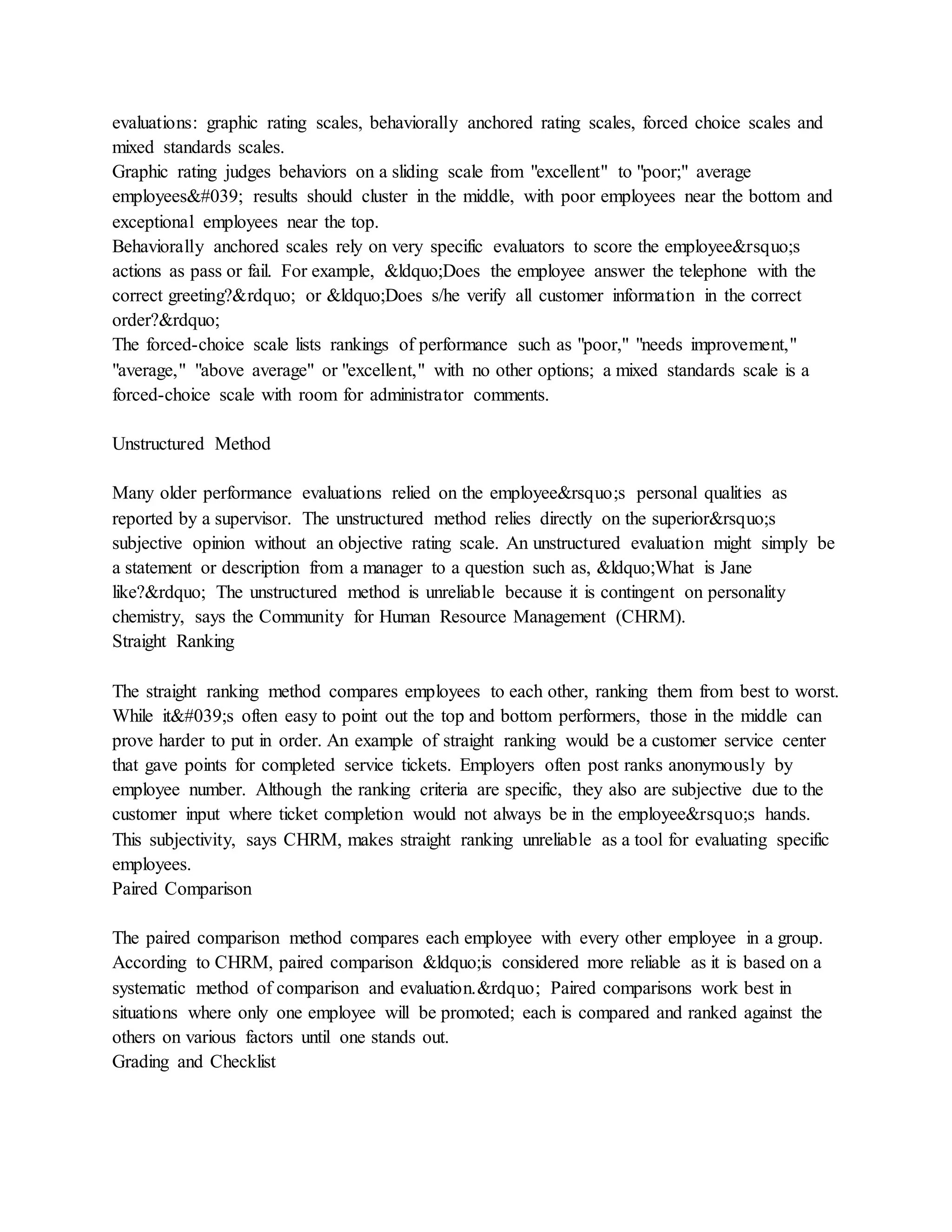
3. Checklist method
Under this method, checklist of statements of traits of
employee in the form of Yes or No based questions is
prepared. Here the rater only does the reporting or
checking and HR department does the actual evaluation.
Advantages – economy, ease of administration, limited
training required, standardization. Disadvantages – Raters
biases, use of improper weighs by HR, does not allow
rater to give relative ratings
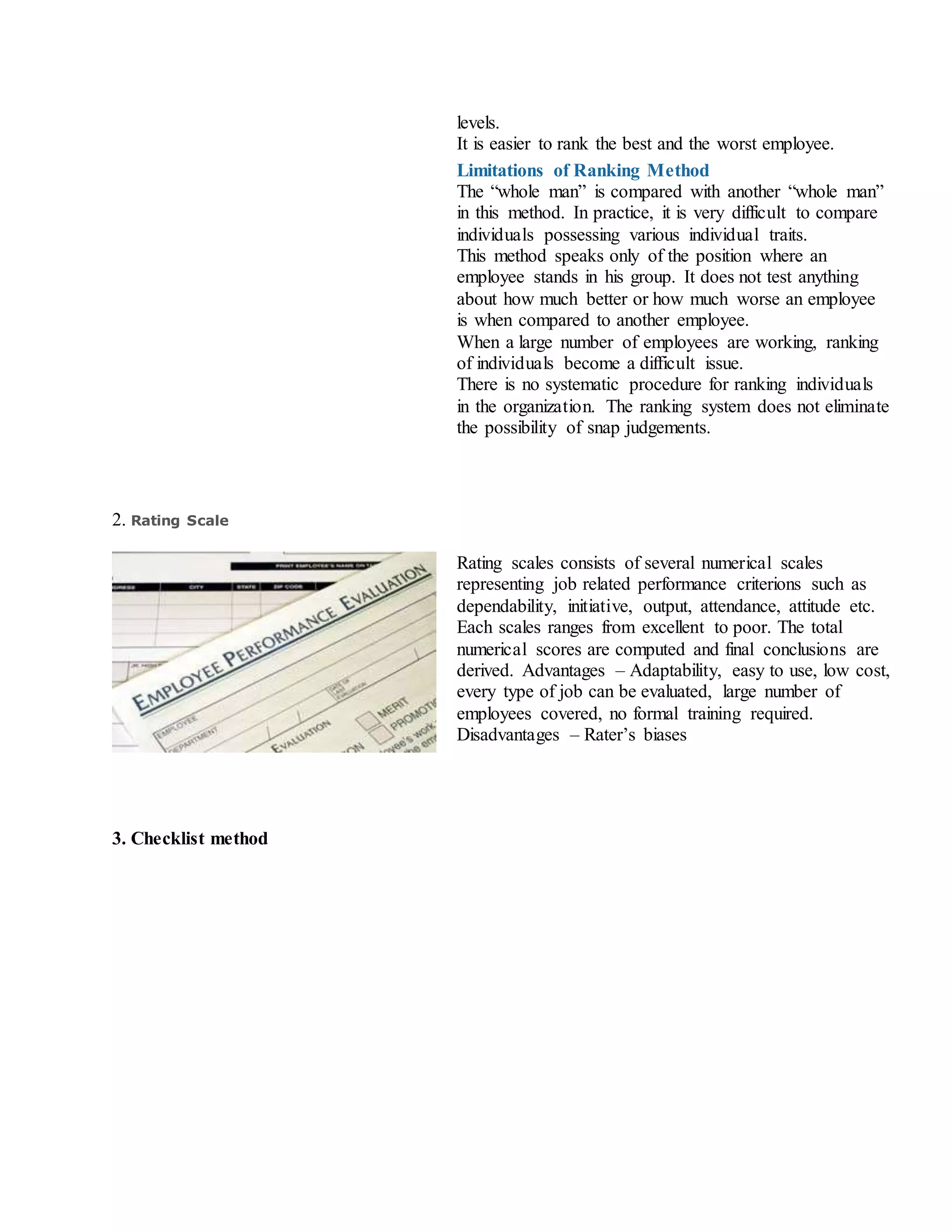
4. Critical Incidents Method
The approach is focused on certain critical behaviors of
employee that makes all the difference in the
performance. Supervisors as and when they occur record
such incidents. Advantages – Evaluations are based on
actual job behaviors, ratings are supported by
descriptions, feedback is easy, reduces recency biases,
chances of subordinate improvement are high.
Disadvantages – Negative incidents can be prioritized,
forgetting incidents, overly close supervision; feedback
may be too much and may appear to be punishment.
5. Essay Method
In this method the rater writes down the employee
description in detail within a number of broad categories
like, overall impression of performance, promoteability
of employee, existing capabilities and qualifications of
performing jobs, strengths and weaknesses and training
needs of the employee. Advantage – It is extremely
useful in filing information gaps about the employees
that often occur in a better-structured checklist.
Disadvantages – It its highly dependent upon the writing
skills of rater and most of them are not good writers.
They may get confused success depends on the memory
power of raters.
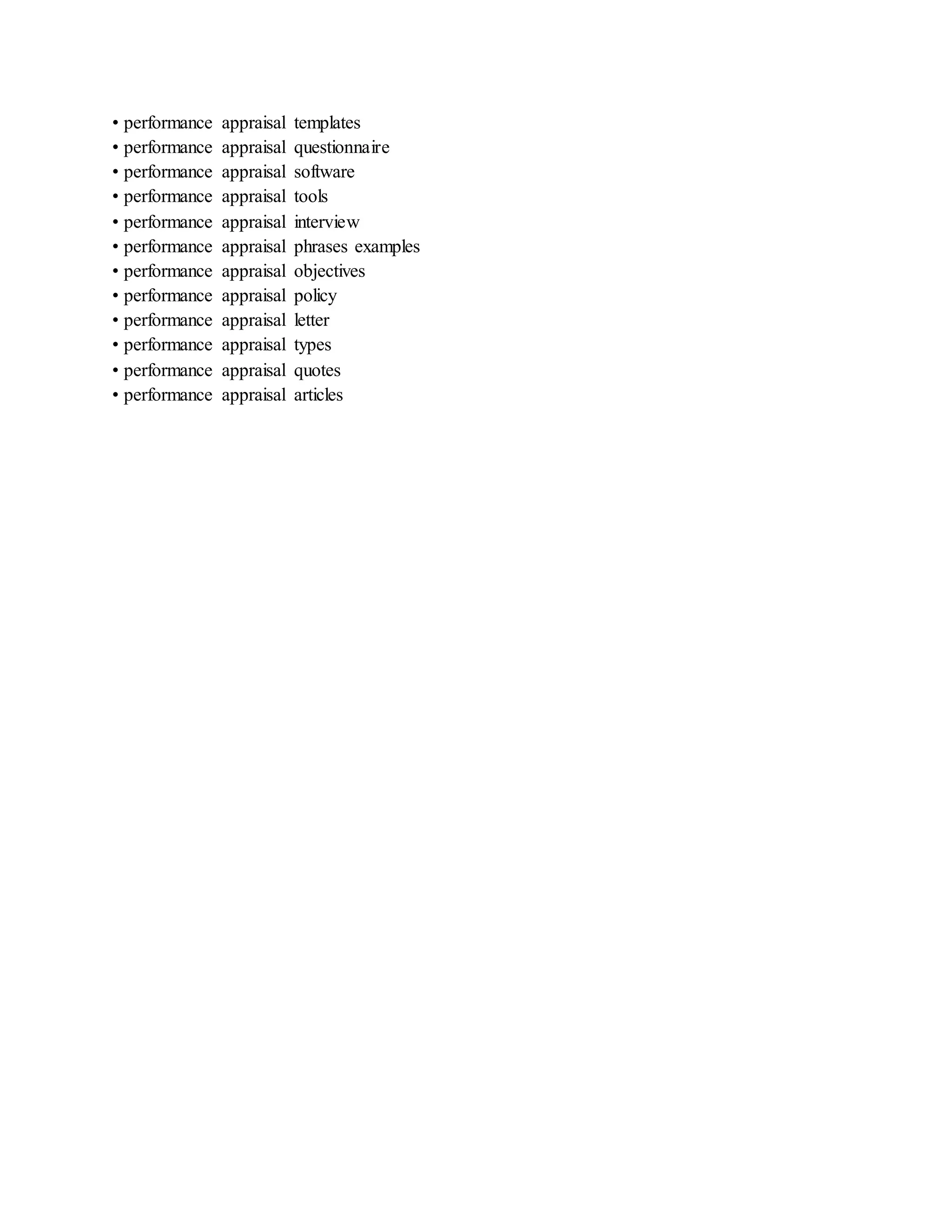
6. Behaviorally Anchored Rating Scales
statements of effective and ineffective behaviors
determine the points. They are said to be
behaviorally anchored. The rater is supposed to
say, which behavior describes the employee
performance. Advantages – helps overcome rating
errors. Disadvantages – Suffers from distortions
inherent in most rating techniques.
III. Other topics related to Straight ranking method of performance appraisal
(pdf download)
• Top 28 performance appraisal forms
• performance appraisal comments
• 11 performance appraisal methods
• 25 performance appraisal examples
• performance appraisal phrases
• performance appraisal process
• performance appraisal template
• performance appraisal system
• performance appraisal answers
• performance appraisal questions
• performance appraisal techniques
• performance appraisal format
• performance appraisal templates
• performance appraisal questionnaire
• performance appraisal software
• performance appraisal tools
• performance appraisal interview
• performance appraisal phrases examples
• performance appraisal objectives
• performance appraisal policy
• performance appraisal letter
• performance appraisal types
• performance appraisal quotes
• performance appraisal articles

Straight ranking method of performance appraisal

  • 1.
    Straight ranking methodof performance appraisal In this file, you can ref useful information about straight ranking method of performance appraisal such as straight ranking method of performance appraisal methods, straight ranking method of performance appraisal tips, straight ranking method of performance appraisal forms, straight ranking method of performance appraisal phrases … If you need more assistant for straight ranking method of performance appraisal, please leave your comment at the end of file. Other useful material for you: • performanceappraisal123.com/1125-free-performance-review-phrases • performanceappraisal123.com/free-28-performance-appraisal-forms • performanceappraisal123.com/free-ebook-11-methods-for-performance-appraisal I. Contents of getting straight ranking method of performance appraisal ================== Employee appraisal systems help managers evaluate employee job performance and develop a fair system of pay increases and promotions. Appraisals in turn can help staff members improve performance, and assist companies in devising or reorganizing job functions to better fit the position or the employee. In addition, employee appraisals may reveal outdated or inefficient business practices. Effective employee appraisal systems incorporate goals to help improve the employer as well as the employee, through the application of appropriate and timely feedback and training. Trait-Focused Performance Appraisal The trait-focused system centers on attributes such as helpfulness, dependability and punctuality. Supervisors rate employees by indicating specific traits each employee exhibits. Most trait- focused systems use a simple checklist with ratings of “excellent,” “satisfactory” or “needs improvement,” or similar options. This system is traditionally popular with customer service departments. These types of evaluations are subject to the supervisor’s personal bias, however, and the majority of employees end up with marks of “satisfactory,” which limits this system’s reliability and accuracy. Behavior-Focused Performance Appraisal The behaviorally anchored rating system (BARS) judges your employees' actions using a rating scale to measure specific behaviors. Four rating scales are used in behavior-focused
  • 2.
    evaluations: graphic ratingscales, behaviorally anchored rating scales, forced choice scales and mixed standards scales. Graphic rating judges behaviors on a sliding scale from "excellent" to "poor;" average employees' results should cluster in the middle, with poor employees near the bottom and exceptional employees near the top. Behaviorally anchored scales rely on very specific evaluators to score the employee’s actions as pass or fail. For example, “Does the employee answer the telephone with the correct greeting?” or “Does s/he verify all customer information in the correct order?” The forced-choice scale lists rankings of performance such as "poor," "needs improvement," "average," "above average" or "excellent," with no other options; a mixed standards scale is a forced-choice scale with room for administrator comments. Unstructured Method Many older performance evaluations relied on the employee’s personal qualities as reported by a supervisor. The unstructured method relies directly on the superior’s subjective opinion without an objective rating scale. An unstructured evaluation might simply be a statement or description from a manager to a question such as, “What is Jane like?” The unstructured method is unreliable because it is contingent on personality chemistry, says the Community for Human Resource Management (CHRM). Straight Ranking The straight ranking method compares employees to each other, ranking them from best to worst. While it's often easy to point out the top and bottom performers, those in the middle can prove harder to put in order. An example of straight ranking would be a customer service center that gave points for completed service tickets. Employers often post ranks anonymously by employee number. Although the ranking criteria are specific, they also are subjective due to the customer input where ticket completion would not always be in the employee’s hands. This subjectivity, says CHRM, makes straight ranking unreliable as a tool for evaluating specific employees. Paired Comparison The paired comparison method compares each employee with every other employee in a group. According to CHRM, paired comparison “is considered more reliable as it is based on a systematic method of comparison and evaluation.” Paired comparisons work best in situations where only one employee will be promoted; each is compared and ranked against the others on various factors until one stands out. Grading and Checklist
  • 3.
    The grading methoduses standard A to F letter grades in different categories to rate each employee, while the checklist method relies on a list of yes or no questions such as, “Is the employee helpful to his peers?” In each of these evaluation types, the specific standards are set in advance and defined as categories to evaluate. Management By Objective Modern evaluation methods try to remove some the subjectivity and bias inherent in traditional methods. MBO, or management by objective, appraisals require the employee and supervisor to agree on a set of objectives before the evaluation. The process relies on goal setting and constructive feedback to be successful. Psychological Appraisals Psychological appraisals assess the employee’s intellectual ability, emotional stability, analytical skills and other psychological traits using objective psychological evaluation processes. These evaluations are useful in preparing and developing training methods, and for placing employees on appropriate teams. 360-Degree Feedback 360-degree feedback requires the employer to survey co-workers, supervisors, subordinates and even customers about each employee’s actions. The multiple feedback channels offer objective perspectives of behavioral traits and actions. "From [360-degree] feedback, the worker is able to set goals for self-development, which will advance their career and benefit the organization," according to Terri Linmann, author of "360-degree Feedback: Weighing the Pros and Cons." ================== III. Performance appraisal methods 1.Ranking Method The ranking system requires the rater to rank his subordinates on overall performance. This consists in simply putting a man in a rank order. Under this method, the ranking of an employee in a work group is done against that of another employee. The relative position of each employee is tested in terms of his numerical rank. It may also be done by ranking a person on his job performance against another member of the competitive group. Advantages of Ranking Method i. Employees are ranked according to their performance
  • 4.
    levels. ii. It iseasier to rank the best and the worst employee. Limitations of Ranking Method i. The “whole man” is compared with another “whole man” in this method. In practice, it is very difficult to compare individuals possessing various individual traits. ii. This method speaks only of the position where an employee stands in his group. It does not test anything about how much better or how much worse an employee is when compared to another employee. iii. When a large number of employees are working, ranking of individuals become a difficult issue. iv. There is no systematic procedure for ranking individuals in the organization. The ranking system does not eliminate the possibility of snap judgements. 2. Rating Scale Rating scales consists of several numerical scales representing job related performance criterions such as dependability, initiative, output, attendance, attitude etc. Each scales ranges from excellent to poor. The total numerical scores are computed and final conclusions are derived. Advantages – Adaptability, easy to use, low cost, every type of job can be evaluated, large number of employees covered, no formal training required. Disadvantages – Rater’s biases 3. Checklist method
  • 5.
    Under this method,checklist of statements of traits of employee in the form of Yes or No based questions is prepared. Here the rater only does the reporting or checking and HR department does the actual evaluation. Advantages – economy, ease of administration, limited training required, standardization. Disadvantages – Raters biases, use of improper weighs by HR, does not allow rater to give relative ratings 4. Critical Incidents Method The approach is focused on certain critical behaviors of employee that makes all the difference in the performance. Supervisors as and when they occur record such incidents. Advantages – Evaluations are based on actual job behaviors, ratings are supported by descriptions, feedback is easy, reduces recency biases, chances of subordinate improvement are high. Disadvantages – Negative incidents can be prioritized, forgetting incidents, overly close supervision; feedback may be too much and may appear to be punishment. 5. Essay Method
  • 6.
    In this methodthe rater writes down the employee description in detail within a number of broad categories like, overall impression of performance, promoteability of employee, existing capabilities and qualifications of performing jobs, strengths and weaknesses and training needs of the employee. Advantage – It is extremely useful in filing information gaps about the employees that often occur in a better-structured checklist. Disadvantages – It its highly dependent upon the writing skills of rater and most of them are not good writers. They may get confused success depends on the memory power of raters. 6. Behaviorally Anchored Rating Scales statements of effective and ineffective behaviors determine the points. They are said to be behaviorally anchored. The rater is supposed to say, which behavior describes the employee performance. Advantages – helps overcome rating errors. Disadvantages – Suffers from distortions inherent in most rating techniques. III. Other topics related to Straight ranking method of performance appraisal (pdf download) • Top 28 performance appraisal forms • performance appraisal comments • 11 performance appraisal methods • 25 performance appraisal examples • performance appraisal phrases • performance appraisal process • performance appraisal template • performance appraisal system • performance appraisal answers • performance appraisal questions • performance appraisal techniques • performance appraisal format
  • 7.
    • performance appraisaltemplates • performance appraisal questionnaire • performance appraisal software • performance appraisal tools • performance appraisal interview • performance appraisal phrases examples • performance appraisal objectives • performance appraisal policy • performance appraisal letter • performance appraisal types • performance appraisal quotes • performance appraisal articles