Developing a Strategy for the
Implementation of ICT in Energy Efficient
Neighbourhoods
ICT for Sustainability, ETH Zurich, February 14-16 2013
A3: Smart Energy Solutions


Jessen Page, Max Blöchle
AIT Austrian Institute of Technology, Energy Department
Table of contents


                 Introducing IREEN (Overview, Scope, Partners)

                 Methodology

                 First Results (Use Cases, Future Scenarios, Roadmap)

                 Participation
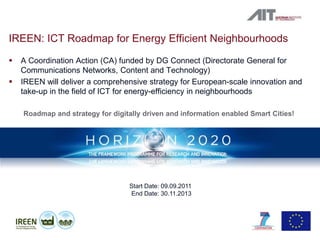
IREEN: ICT Roadmap for Energy Efficient Neighbourhoods
   A Coordination Action (CA) funded by DG Connect (Directorate General for
    Communications Networks, Content and Technology)
   IREEN will deliver a comprehensive strategy for European-scale innovation and
    take-up in the field of ICT for energy-efficiency in neighbourhoods

    Roadmap and strategy for digitally driven and information enabled Smart Cities!


                                  Start Date: 09.09.2011
                                  End Date: 30.11.2013


                                                                                      3
IREEN Partners
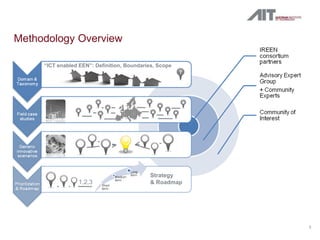
Methodology Overview

     “ICT enabled EEN”: Definition, Boundaries, Scope


                                            Strategy
                  1,2,3                     & Roadmap


                                                        5
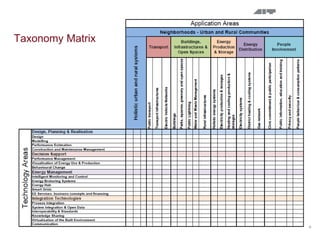
Taxonomy Matrix


                  6
Case Studies - one example of 82 selected
 Project Title                West Orange
 Project web-site             www.amsterdamsmartcity.com
 Funding Context and Theme    ERDF: European Regional Development Fund
 Starting Date and Duration   2 years (2009/2012)
 Budget                       3 million euros
 Partnership                  NUON, IBM, Cisco, Far West, Ymere, Home Automation Europe, AIM
 Location                     Amsterdam
                              Nuon, IBM and Cisco initiated the West Orange project in which 500 Amsterdam households
                              test an innovative energy management system. Home Automation Europe is supplier of the
                              display, Far West and Ymere are housing cooperations and partner in the project: their tenants
                              will participate in the test. Grid operator Liander is responsible for the implementation of the
 Abstract
                              smart meters. From an earlier small scale pilot it is expected that the energy management
                              system will yield energy and CO2 savings of about 14 percent. The displays and smart meters
                              were implemented in the period between October 2010 and March 2011. The measuring
                              programme will run for almost a year to incorporate the seasonal effects. […]
 Type of Community            Urban
                              Implementation of smart meters
                              Energy display: the energy display is a user-friendly display with the size of a small picture
                              frame. The display is wireless connected to a digital gas and electricity meter of Liander and is
                              therefore able to show real-time information of the total energy consumption. By entering
 Relevant ICT results
                              personal energy saving targets in the display, the user is continuously stimulated and stays
                              keen on their gas and electricity usage. This makes it easier for households to monitor and
                              realize their energy saving objectives.


                                                                                                                                  7
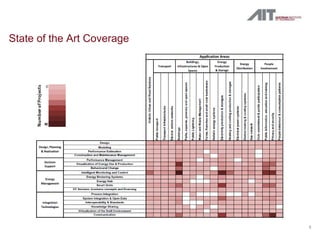
State of the Art Coverage


                            8
Innovative Scenarios – one example
  Urban area retrofitting
  Visionary           John is an urban planner at the “EPCOT” City Administration. […]
  description         The City has signed up to the Green Digital Charter and is engaged in a pluriannual
                      programme to reduce its carbon footprint and improve the energy efficiency of the city
                      with the use of ICT. […]
  Impacts             In a first step, John, with the assistance of his technical team, launches the urban GIS
                      platform of the city where he can visualize the location of the different components
                      (network energy nodes) of the neighbourhood, and the energy balance for each of
                      them. Indeed, during a previous campaign, all buildings of the neighbourhood, as well
  Stakeholders and    as the street lighting system, have been equipped with energy meters to inform in real-
  Beneficiaries       time on the energy consumption (or production) of the nodes. This energy information
                      has been integrated in the city GIS. […]

  Progress beyond
  State-of-the-Art


  Technology /
  Application Areas


                                                                                                                 9
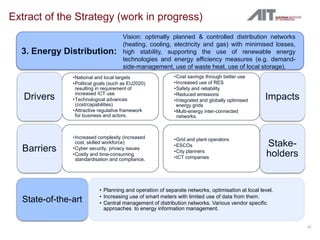
Extract of the Strategy (work in progress)
                                     Vision: optimally planned & controlled distribution networks
                                     (heating, cooling, electricity and gas) with minimised losses,
  3. Energy Distribution:            high stability, supporting the use of renewable energy
                                     technologies and energy efficiency measures (e.g. demand-
                                     side-management, use of waste heat, use of local storage).
               •National and local targets                 •Cost savings through better use
               •Political goals (such as EU2020)           •Increased use of RES
                resulting in requirement of                •Safety and reliability
                increased ICT use                          •Reduced emissions
   Drivers     •Technological advances                     •Integrated and globally optimised     Impacts
                (cost/capabilities)                         energy grids
               •Attractive regulative framework            •Multi-energy inter-connected
                for business and actors.                    networks.


               •Increased complexity (increased            •Grid and plant operators
                cost, skilled workforce)
                                                           •ESCOs                                  Stake-
  Barriers     •Cyber security, privacy issues
                                                           •City planners
               •Costly and time-consuming
                standardisation and compliance.            •ICT companies                          holders


                           • Planning and operation of separate networks, optimisation at local level.
                           • Increasing use of smart meters with limited use of data from them.
  State-of-the-art         • Central management of distribution networks. Various vendor specific
                             approaches to energy information management.


                                                                                                             10
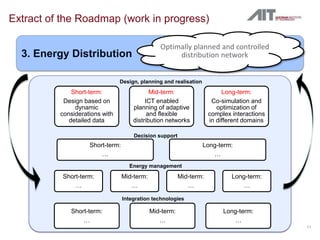
Extract of the Roadmap (work in progress)

                                                 Optimally planned and controlled
  3. Energy Distribution                              distribution network


                                Design, planning and realisation
              Short-term:                    Mid-term:                     Long-term:
           Design based on                 ICT enabled                 Co-simulation and
               dynamic                planning of adaptive               optimization of
          considerations with               and flexible              complex interactions
             detailed data            distribution networks           in different domains

                                      Decision support
                    Short-term:                                    Long-term:
                        …                                             …
                                    Energy management

           Short-term:            Mid-term:               Mid-term:           Long-term:
               …                     …                       …                   …

                                  Integration technologies

             Short-term:                      Mid-term:                    Long-term:
                 …                               …                            …
                                                                                             11
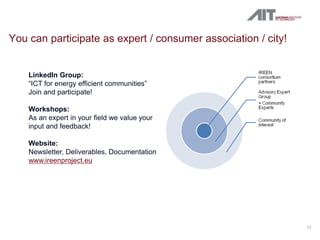
You can participate as expert / consumer association / city!


    LinkedIn Group:
    “ICT for energy efficient communities”
    Join and participate!

    Workshops:
    As an expert in your field we value your
    input and feedback!

    Website:
    Newsletter, Deliverables, Documentation
    www.ireenproject.eu


                                                               12
Thank you for your attention


Jessen Page: jessen.page@ait.ac.at
Max Blöchle: max.bloechle@ait.ac.at

The research leading to these results has received funding from the European Union's Seventh
Framework Programme (FP7/2007-2013) under grant agreement No 285627. Additionally the author
thanks in particular the consortium partners for their valuable inputs.

Ict4s_conference_ireen_project_page_blöchle

  • 1.
    Developing a Strategyfor the Implementation of ICT in Energy Efficient Neighbourhoods ICT for Sustainability, ETH Zurich, February 14-16 2013 A3: Smart Energy Solutions Jessen Page, Max Blöchle AIT Austrian Institute of Technology, Energy Department
  • 2.
    Table of contents  Introducing IREEN (Overview, Scope, Partners)  Methodology  First Results (Use Cases, Future Scenarios, Roadmap)  Participation
  • 3.
    IREEN: ICT Roadmapfor Energy Efficient Neighbourhoods  A Coordination Action (CA) funded by DG Connect (Directorate General for Communications Networks, Content and Technology)  IREEN will deliver a comprehensive strategy for European-scale innovation and take-up in the field of ICT for energy-efficiency in neighbourhoods Roadmap and strategy for digitally driven and information enabled Smart Cities! Start Date: 09.09.2011 End Date: 30.11.2013 3
  • 4.
  • 5.
    Methodology Overview “ICT enabled EEN”: Definition, Boundaries, Scope Strategy 1,2,3 & Roadmap 5
  • 6.
  • 7.
    Case Studies -one example of 82 selected Project Title West Orange Project web-site www.amsterdamsmartcity.com Funding Context and Theme ERDF: European Regional Development Fund Starting Date and Duration 2 years (2009/2012) Budget 3 million euros Partnership NUON, IBM, Cisco, Far West, Ymere, Home Automation Europe, AIM Location Amsterdam Nuon, IBM and Cisco initiated the West Orange project in which 500 Amsterdam households test an innovative energy management system. Home Automation Europe is supplier of the display, Far West and Ymere are housing cooperations and partner in the project: their tenants will participate in the test. Grid operator Liander is responsible for the implementation of the Abstract smart meters. From an earlier small scale pilot it is expected that the energy management system will yield energy and CO2 savings of about 14 percent. The displays and smart meters were implemented in the period between October 2010 and March 2011. The measuring programme will run for almost a year to incorporate the seasonal effects. […] Type of Community Urban Implementation of smart meters Energy display: the energy display is a user-friendly display with the size of a small picture frame. The display is wireless connected to a digital gas and electricity meter of Liander and is therefore able to show real-time information of the total energy consumption. By entering Relevant ICT results personal energy saving targets in the display, the user is continuously stimulated and stays keen on their gas and electricity usage. This makes it easier for households to monitor and realize their energy saving objectives. 7
  • 8.
    State of theArt Coverage 8
  • 9.
    Innovative Scenarios –one example Urban area retrofitting Visionary John is an urban planner at the “EPCOT” City Administration. […] description The City has signed up to the Green Digital Charter and is engaged in a pluriannual programme to reduce its carbon footprint and improve the energy efficiency of the city with the use of ICT. […] Impacts In a first step, John, with the assistance of his technical team, launches the urban GIS platform of the city where he can visualize the location of the different components (network energy nodes) of the neighbourhood, and the energy balance for each of them. Indeed, during a previous campaign, all buildings of the neighbourhood, as well Stakeholders and as the street lighting system, have been equipped with energy meters to inform in real- Beneficiaries time on the energy consumption (or production) of the nodes. This energy information has been integrated in the city GIS. […] Progress beyond State-of-the-Art Technology / Application Areas 9
  • 10.
    Extract of theStrategy (work in progress) Vision: optimally planned & controlled distribution networks (heating, cooling, electricity and gas) with minimised losses, 3. Energy Distribution: high stability, supporting the use of renewable energy technologies and energy efficiency measures (e.g. demand- side-management, use of waste heat, use of local storage). •National and local targets •Cost savings through better use •Political goals (such as EU2020) •Increased use of RES resulting in requirement of •Safety and reliability increased ICT use •Reduced emissions Drivers •Technological advances •Integrated and globally optimised Impacts (cost/capabilities) energy grids •Attractive regulative framework •Multi-energy inter-connected for business and actors. networks. •Increased complexity (increased •Grid and plant operators cost, skilled workforce) •ESCOs Stake- Barriers •Cyber security, privacy issues •City planners •Costly and time-consuming standardisation and compliance. •ICT companies holders • Planning and operation of separate networks, optimisation at local level. • Increasing use of smart meters with limited use of data from them. State-of-the-art • Central management of distribution networks. Various vendor specific approaches to energy information management. 10
  • 11.
    Extract of theRoadmap (work in progress) Optimally planned and controlled 3. Energy Distribution distribution network Design, planning and realisation Short-term: Mid-term: Long-term: Design based on ICT enabled Co-simulation and dynamic planning of adaptive optimization of considerations with and flexible complex interactions detailed data distribution networks in different domains Decision support Short-term: Long-term: … … Energy management Short-term: Mid-term: Mid-term: Long-term: … … … … Integration technologies Short-term: Mid-term: Long-term: … … … 11
  • 12.
    You can participateas expert / consumer association / city! LinkedIn Group: “ICT for energy efficient communities” Join and participate! Workshops: As an expert in your field we value your input and feedback! Website: Newsletter, Deliverables, Documentation www.ireenproject.eu 12
  • 13.
    Thank you foryour attention Jessen Page: jessen.page@ait.ac.at Max Blöchle: max.bloechle@ait.ac.at The research leading to these results has received funding from the European Union's Seventh Framework Programme (FP7/2007-2013) under grant agreement No 285627. Additionally the author thanks in particular the consortium partners for their valuable inputs.