Grid Modernization
Initiatives at ComEd
Peter Tyschenko
Manager, Distribution Capacity Planning
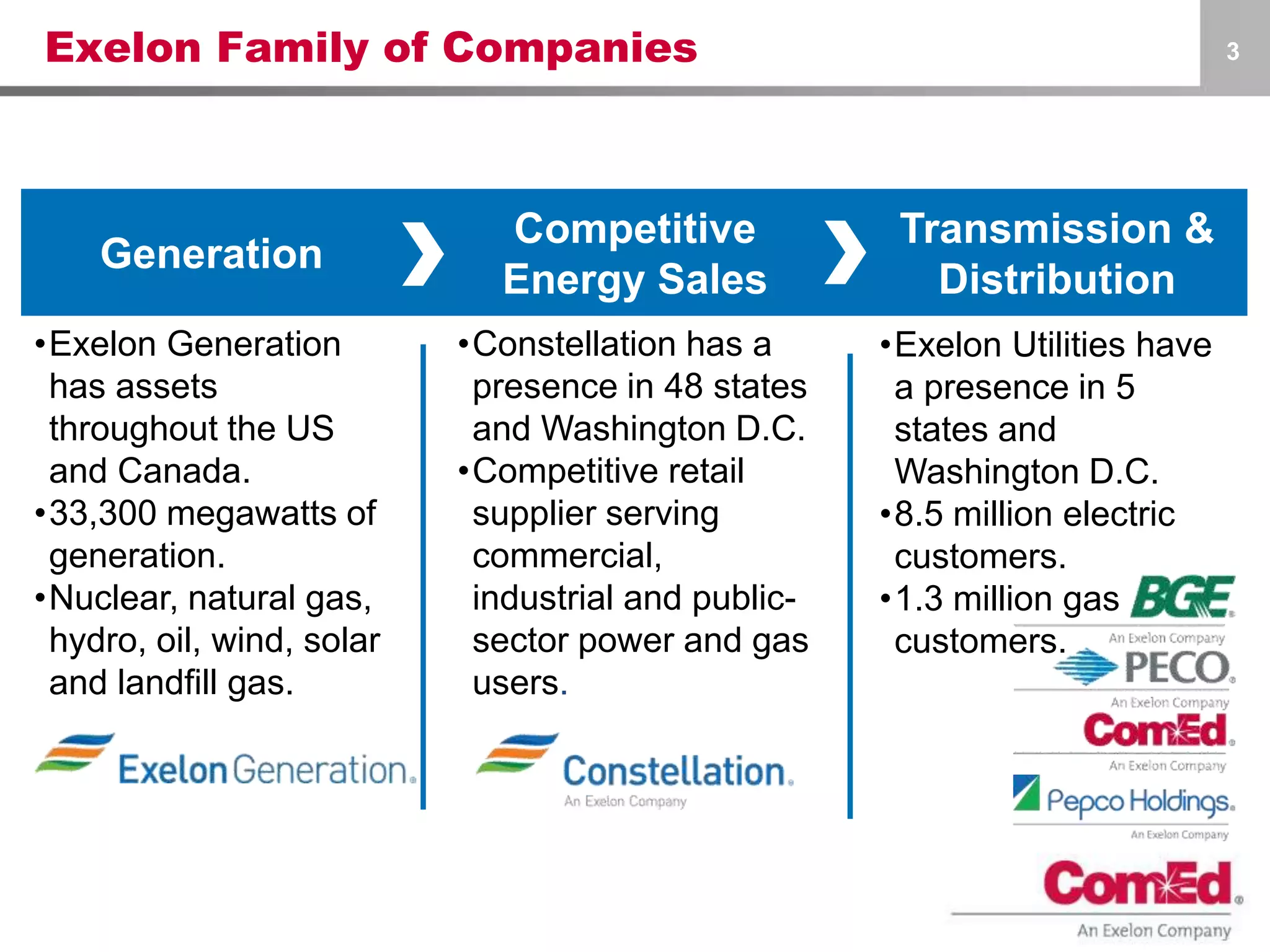
Exelon Family of Companies 3
Generation
Competitive
Energy Sales
Transmission &
Distribution
•Exelon Generation
has assets
throughout the US
and Canada.
•33,300 megawatts of
generation.
•Nuclear, natural gas,
hydro, oil, wind, solar
and landfill gas.
•Constellation has a
presence in 48 states
and Washington D.C.
•Competitive retail
supplier serving
commercial,
industrial and public-
sector power and gas
users.
•Exelon Utilities have
a presence in 5
states and
Washington D.C.
•8.5 million electric
customers.
•1.3 million gas
customers.
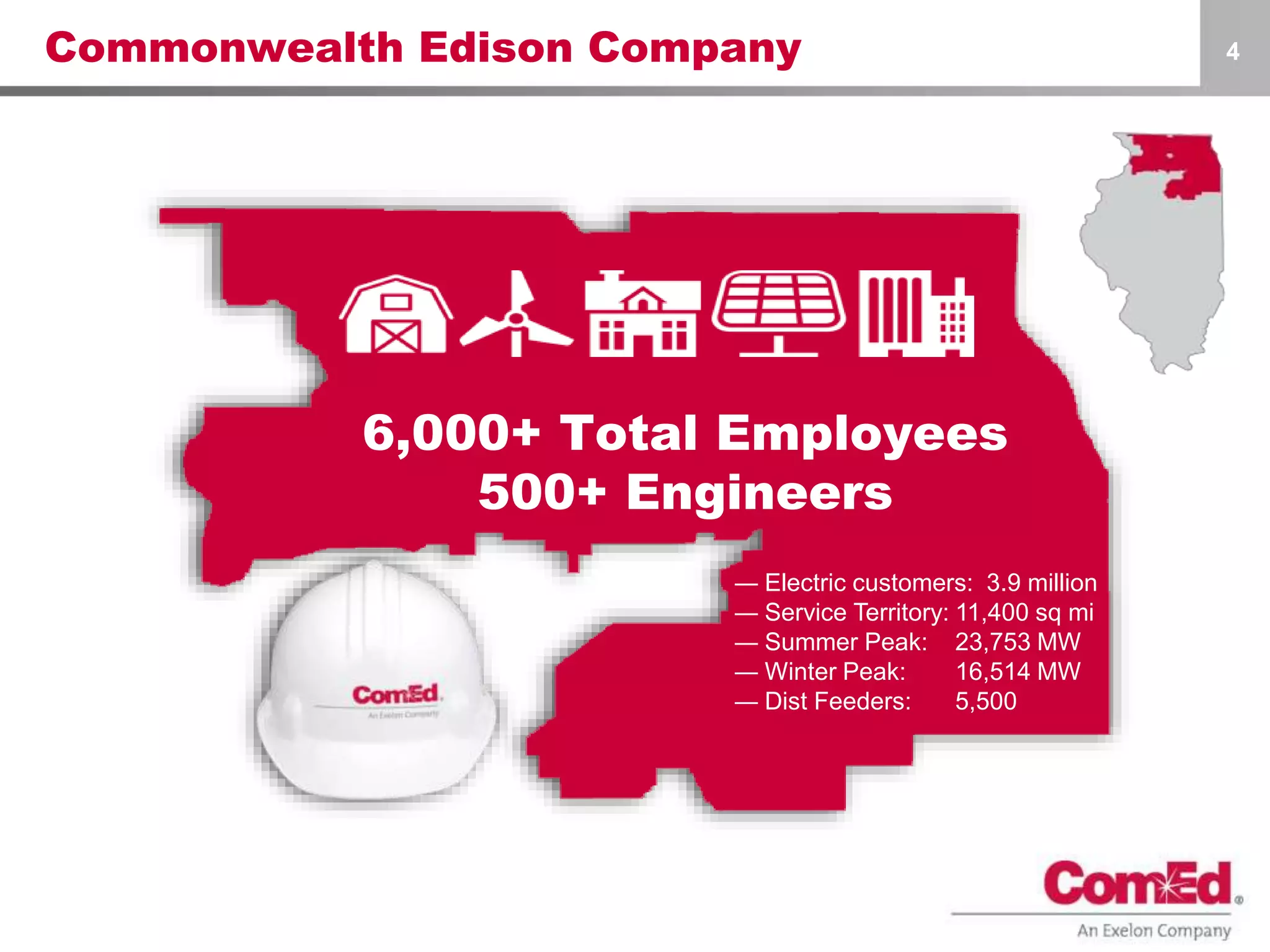
Commonwealth Edison Company 4
6,000+ Total Employees
500+ Engineers
― Electric customers: 3.9 million
― Service Territory: 11,400 sq mi
― Summer Peak: 23,753 MW
― Winter Peak: 16,514 MW
― Dist Feeders: 5,500
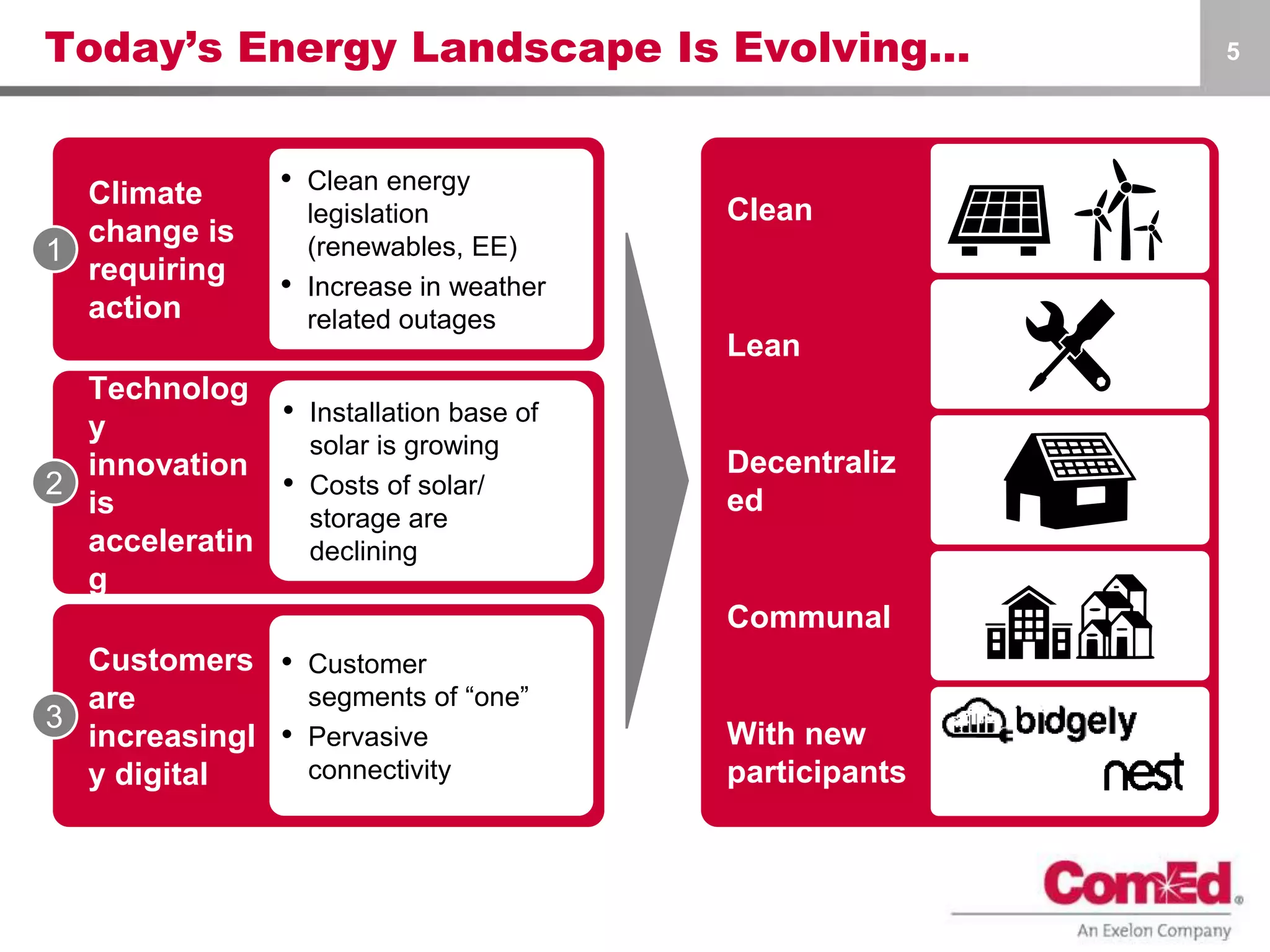
Today’s Energy Landscape Is Evolving… 5
Customers
are
increasingl
y digital
Climate
change is
requiring
action
Technolog
y
innovation
is
acceleratin
g
Lean
Decentraliz
ed
Communal
With new
participants
Clean
• Customer
segments of “one”
• Pervasive
connectivity
• Installation base of
solar is growing
• Costs of solar/
storage are
declining
• Clean energy
legislation
(renewables, EE)
• Increase in weather
related outages
1
2
3
Our Strategic Focus…
Putting in place the regulatory policies, the technologies,
and the operational system that will meet the consumer
and energy system goals for the future: clean, lean,
reliable, resilient, secure, safe, customizable, and
affordable.
• How to design operate a system that will require increasing technical
and process sophistication to integrate renewable resources?
• How to design and operate a system to address increasing
weather volatility and security threats?
• How to design a business model to meets increasing consumer
expectation?
• How to optimize the new digital communications network to
deliver consumer value and create infrastructure efficiencies?
• How to develop a regulatory model or policy that supports this
evolution - by spurring innovation and maintaining financial stability
for industry - and maintains affordability and equitable allocation of
benefits and costs?
6
Modernization Enabled by Legislation 7
Future Energy Jobs Act
(FEJA) – 2016
• $1.3B in Reliability Investments
• $1.3B in Smart Grid Investments
• 2,000 full time jobs
• Smart Grid Test Bed
• $50M for customer assistance
• Annual filing and reconciliation
• ROE formula
• Reliability targets
• Customer service improvement targets
• Sunsets in 2019
• Average rates increase < 2.5%
$
• Support for 2 at risk nuclear plants
• Saving 4,000 jobs across Illinois
• Zero Emission Standard
• Job training for clean energy jobs
• $180M-$220M for renewables energy
• Enhanced grid security and reliability
• Strengthen Renewable Portfolio
Standard (RPS)
• $750M in low income assistance
• Expand energy efficiency programs
• Voltage optimization
• Preservation of competitive rates
Energy Infrastructure Modernization Act
(EIMA) – 2011
Investing in Illinois Energy Infrastructure
Stabilizing the Regulatory Environment
Value For Our Customers Customer Savings & Low Income Assistance
Investing in Renewables
Keeping the Grid up and Running
From Pipeline to Platform Model 8
Platform Model
Focus On The Interaction
Production Assembly Distribution
Pipe Model
Focus On The Product
Consumers ProducersPlatform
• Companies produce, assemble, and
distribute goods and services to end
customers through a process.
• Value is created through the
optimization of the process.
• Companies enable interactions
between both producers and
consumers, with parties potentially
shifting between roles.
• Value is generated through creation,
curation, and consumption of
content.
Value = number
of transactions
Value = quantity
of final products
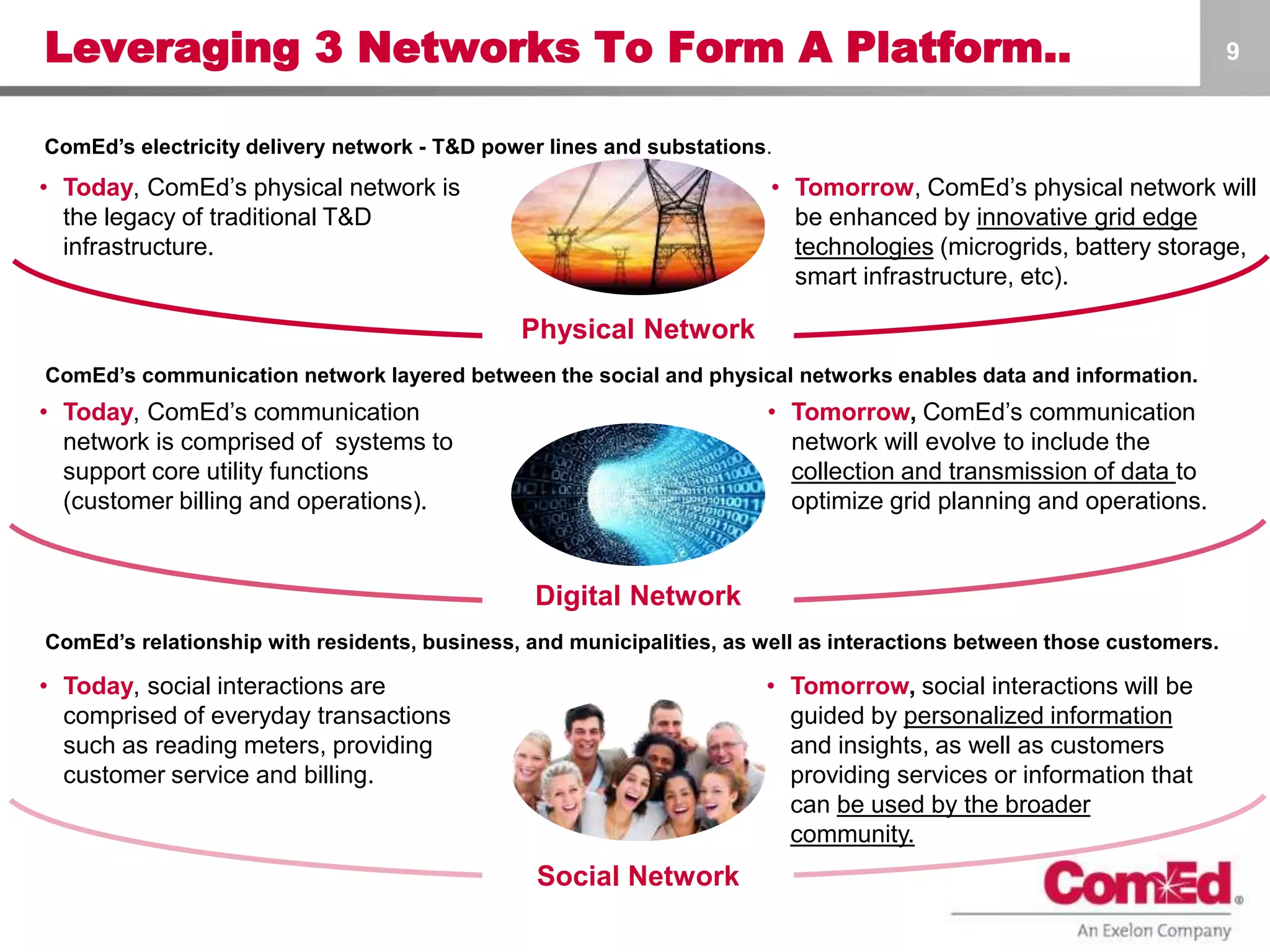
Leveraging 3 Networks To Form A Platform.. 9
Social Network
Digital Network
Physical Network
• Today, ComEd’s physical network is
the legacy of traditional T&D
infrastructure.
• Today, ComEd’s communication
network is comprised of systems to
support core utility functions
(customer billing and operations).
• Today, social interactions are
comprised of everyday transactions
such as reading meters, providing
customer service and billing.
• Tomorrow, ComEd’s physical network will
be enhanced by innovative grid edge
technologies (microgrids, battery storage,
smart infrastructure, etc).
• Tomorrow, ComEd’s communication
network will evolve to include the
collection and transmission of data to
optimize grid planning and operations.
• Tomorrow, social interactions will be
guided by personalized information
and insights, as well as customers
providing services or information that
can be used by the broader
community.
ComEd’s relationship with residents, business, and municipalities, as well as interactions between those customers.
ComEd’s communication network layered between the social and physical networks enables data and information.
ComEd’s electricity delivery network - T&D power lines and substations.
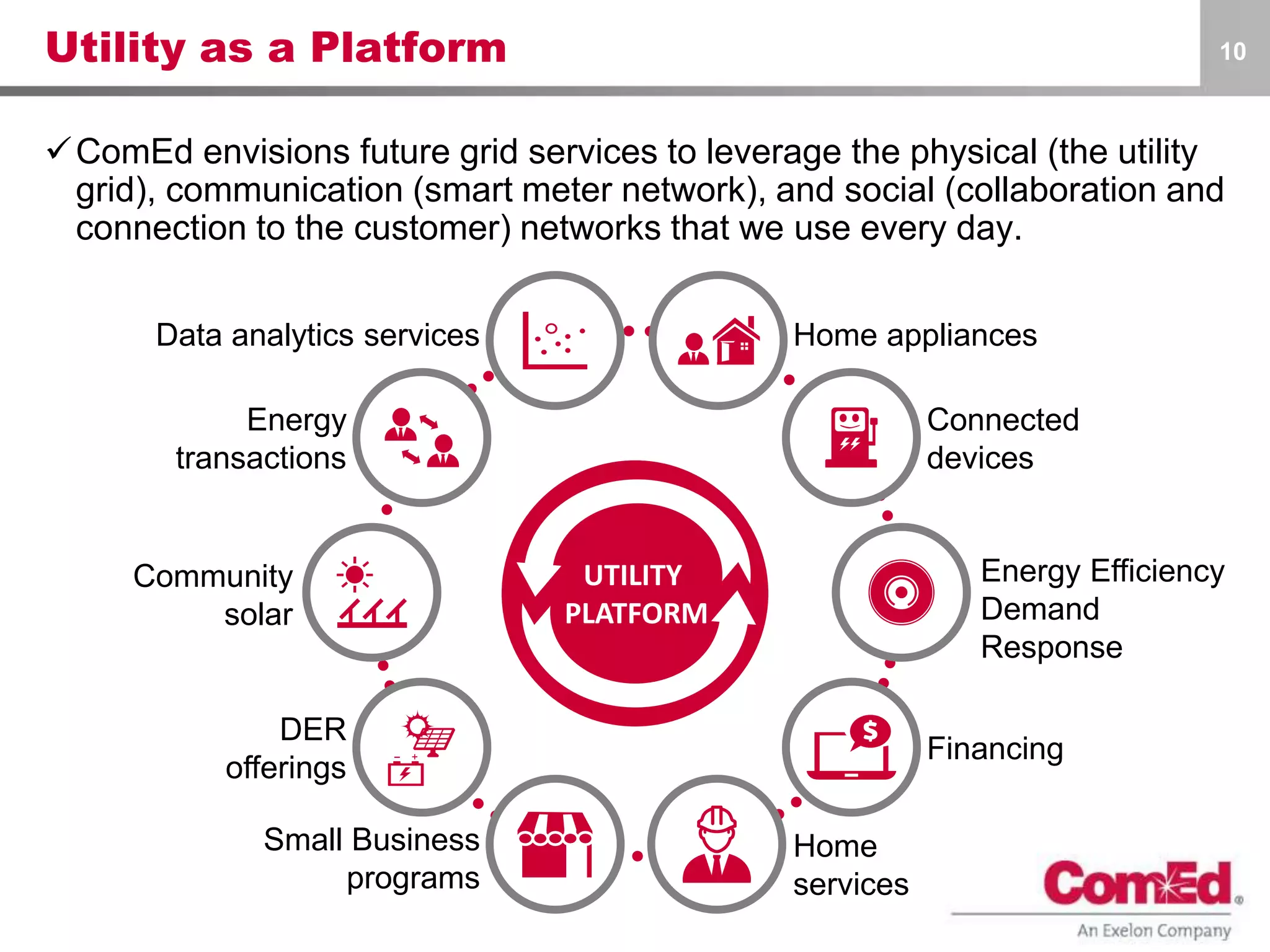
Utility as a Platform
ComEd envisions future grid services to leverage the physical (the utility
grid), communication (smart meter network), and social (collaboration and
connection to the customer) networks that we use every day.
10
UTILITY
PLATFORM
Home appliancesData analytics services
Connected
devices
Energy
transactions
Energy Efficiency
Demand
Response
Community
solar
Financing
DER
offerings
Home
services
Small Business
programs
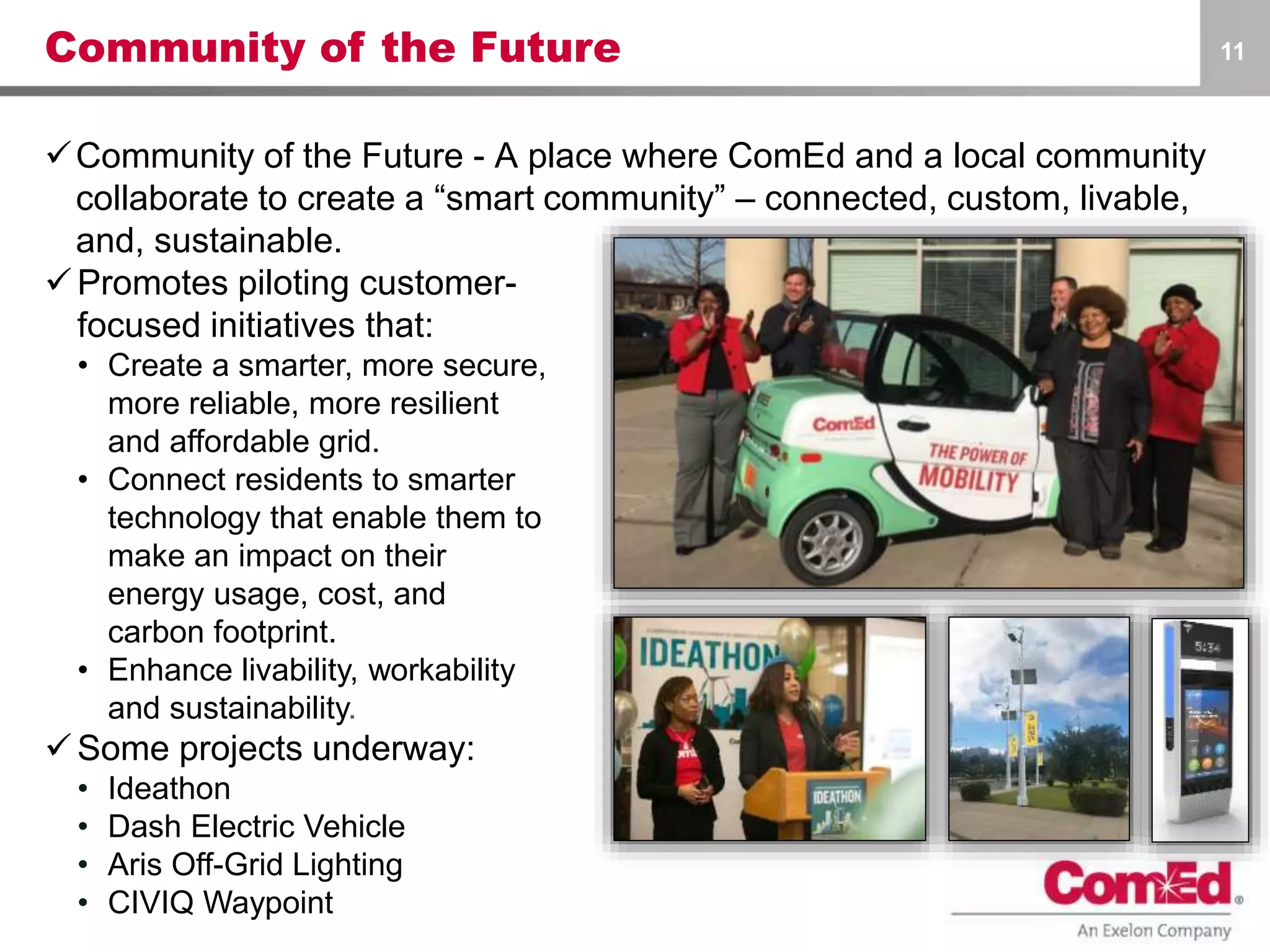
Community of the Future
Community of the Future - A place where ComEd and a local community
collaborate to create a “smart community” – connected, custom, livable,
and, sustainable.
11
Promotes piloting customer-
focused initiatives that:
• Create a smarter, more secure,
more reliable, more resilient
and affordable grid.
• Connect residents to smarter
technology that enable them to
make an impact on their
energy usage, cost, and
carbon footprint.
• Enhance livability, workability
and sustainability.
Some projects underway:
• Ideathon
• Dash Electric Vehicle
• Aris Off-Grid Lighting
• CIVIQ Waypoint
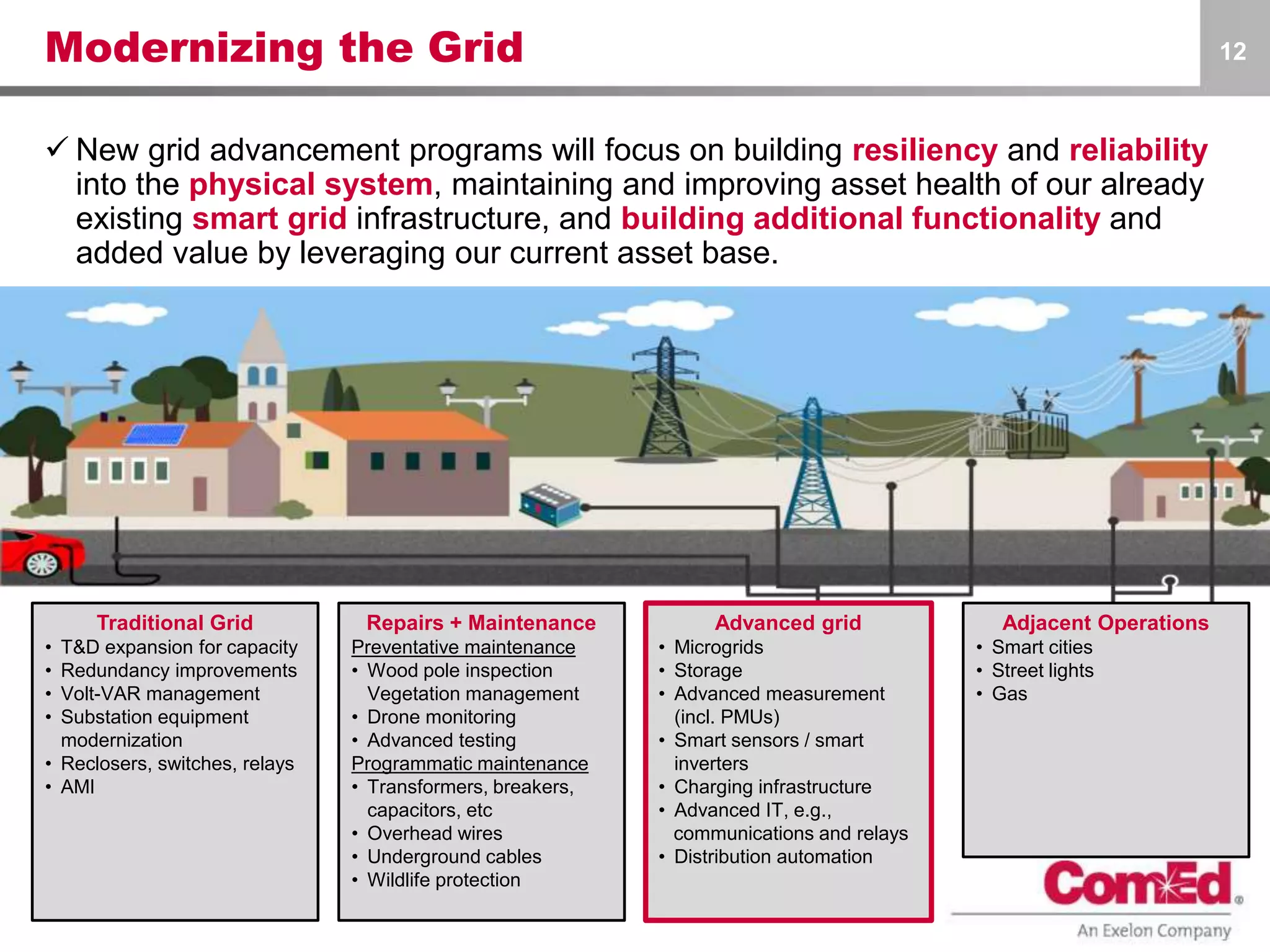
Modernizing the Grid
 New grid advancement programs will focus on building resiliency and reliability
into the physical system, maintaining and improving asset health of our already
existing smart grid infrastructure, and building additional functionality and
added value by leveraging our current asset base.
12
Traditional Grid
• T&D expansion for capacity
• Redundancy improvements
• Volt-VAR management
• Substation equipment
modernization
• Reclosers, switches, relays
• AMI
Repairs + Maintenance
Preventative maintenance
• Wood pole inspection
Vegetation management
• Drone monitoring
• Advanced testing
Programmatic maintenance
• Transformers, breakers,
capacitors, etc
• Overhead wires
• Underground cables
• Wildlife protection
Advanced grid
• Microgrids
• Storage
• Advanced measurement
(incl. PMUs)
• Smart sensors / smart
inverters
• Charging infrastructure
• Advanced IT, e.g.,
communications and relays
• Distribution automation
Adjacent Operations
• Smart cities
• Street lights
• Gas
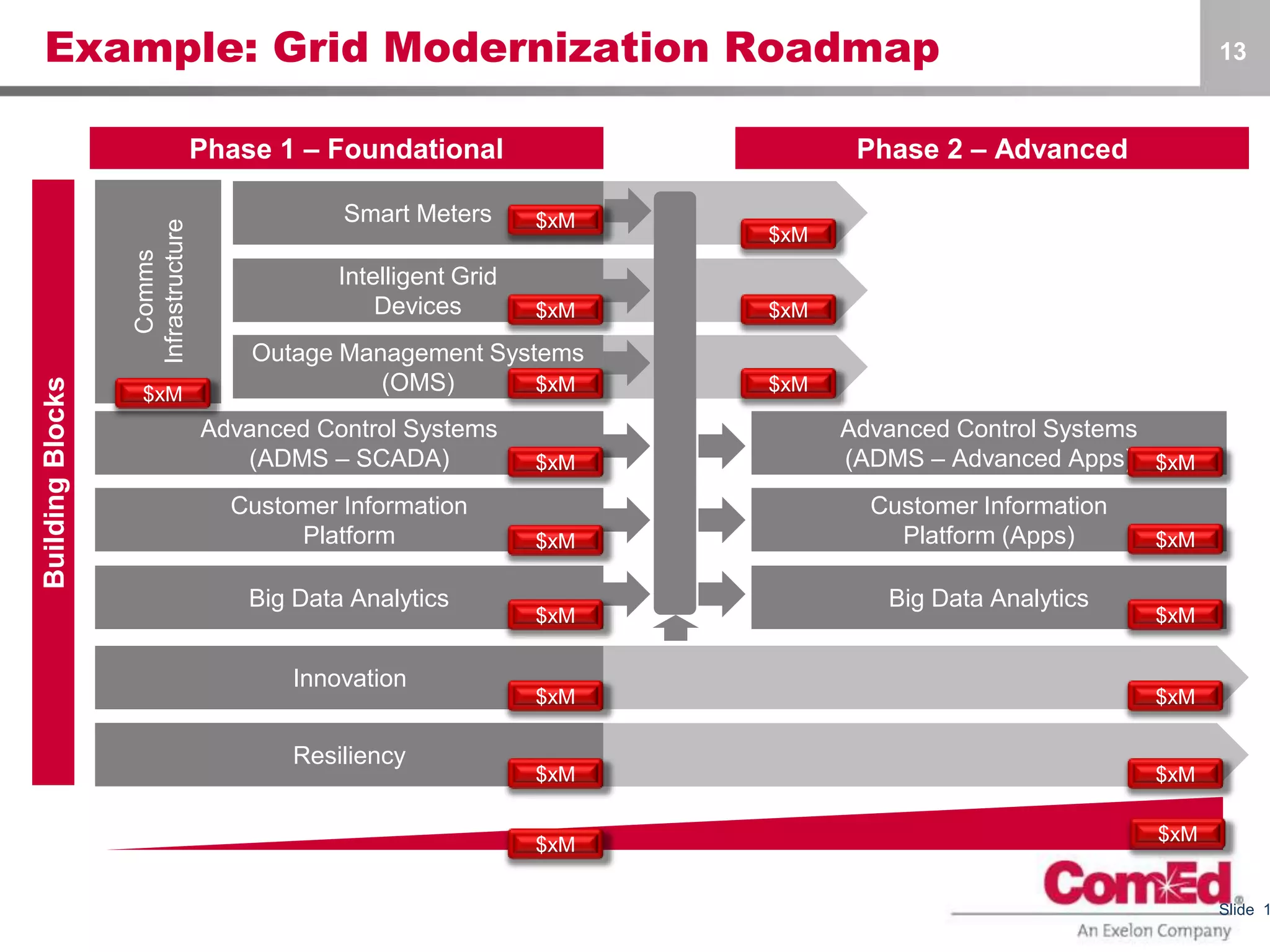
Example: Grid Modernization Roadmap 13
Phase 1 – FoundationalComms
Infrastructure
BuildingBlocks
Phase 2 – Advanced
Intelligent Grid
Devices
Outage Management Systems
(OMS)
Advanced Control Systems
(ADMS – SCADA)
Customer Information
Platform
Big Data Analytics
Innovation
Advanced Control Systems
(ADMS – Advanced Apps)
Customer Information
Platform (Apps)
Big Data Analytics
Smart Meters
$xM
$xM
$xM
$xM
$xM
$xM $xM
$xM
$xM
$xM
Resiliency
$xM
$xM
$xM
$xM
$xM
$xM
$xM
$xM
$xM
Slide 1
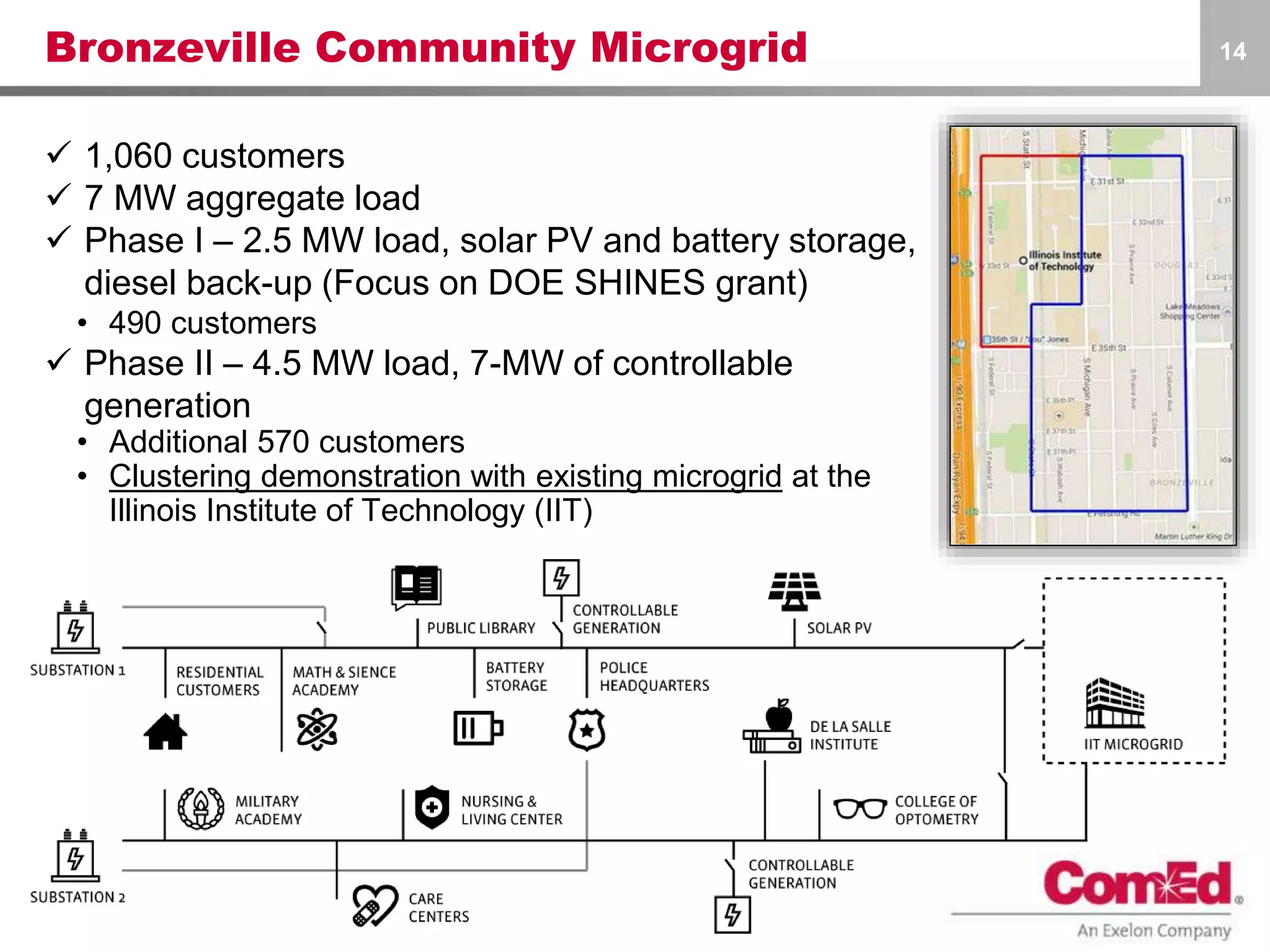
Bronzeville Community Microgrid
 1,060 customers
 7 MW aggregate load
 Phase I – 2.5 MW load, solar PV and battery storage,
diesel back-up (Focus on DOE SHINES grant)
• 490 customers
 Phase II – 4.5 MW load, 7-MW of controllable
generation
• Additional 570 customers
• Clustering demonstration with existing microgrid at the
Illinois Institute of Technology (IIT)
14
NextGrid: Illinois Utility of the Future Study
NextGrid is an approximately 18-month consumer-focused study initiated
by the Illinois Commerce Commission (ICC) and launched on Sept. 28,
2017.
NextGrid will be managed by the ICC, with the Power and Energy System
Area of the Electrical and Computer Engineering Department at the
University of Illinois at Urbana-Champaign (UIUC/ECE) serving as an
independent third-party facilitator.
The study will examine the use of new technologies to improve the state’s
electric grid while minimizing energy costs to consumers.
• New Technology Deployment and Grid Integration
• Metering, Communications and Data
• Reliability, Resiliency and Security
• Customer and Community Participation
• Electricity Markets
• Regulatory and Environmental Policy Issues
• Ratemaking
 The public is invited and encouraged to participate in the study.
15
Mike Bull, Director
Policy and External Affairs
Grid Modernization in
Minnesota
and the
April 24, 2018
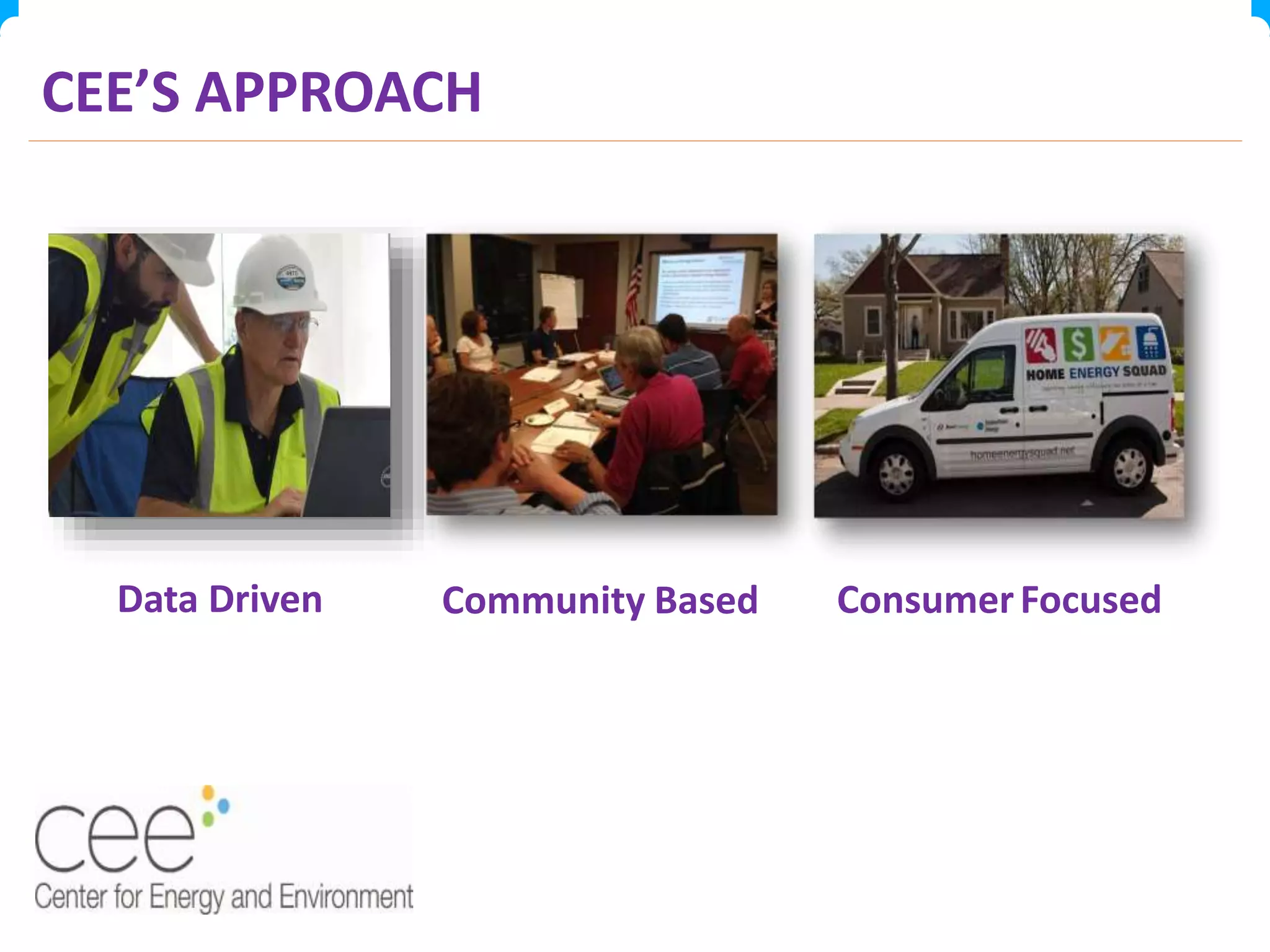
CEE’S APPROACH
Data Driven Community Based ConsumerFocused
Pg. 19
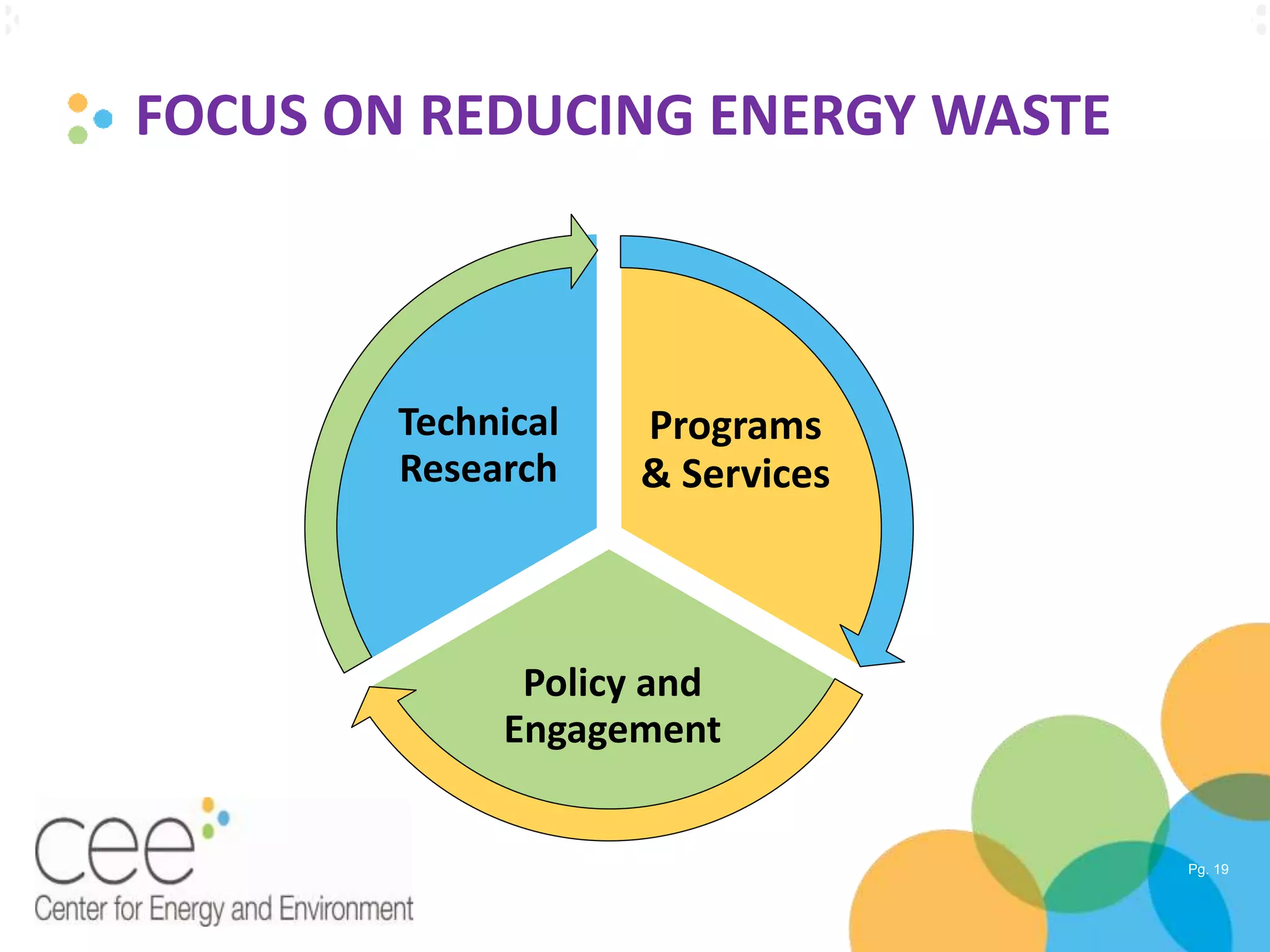
FOCUS ON REDUCING ENERGY WASTE
Programs
& Services
Policy and
Engagement
Technical
Research
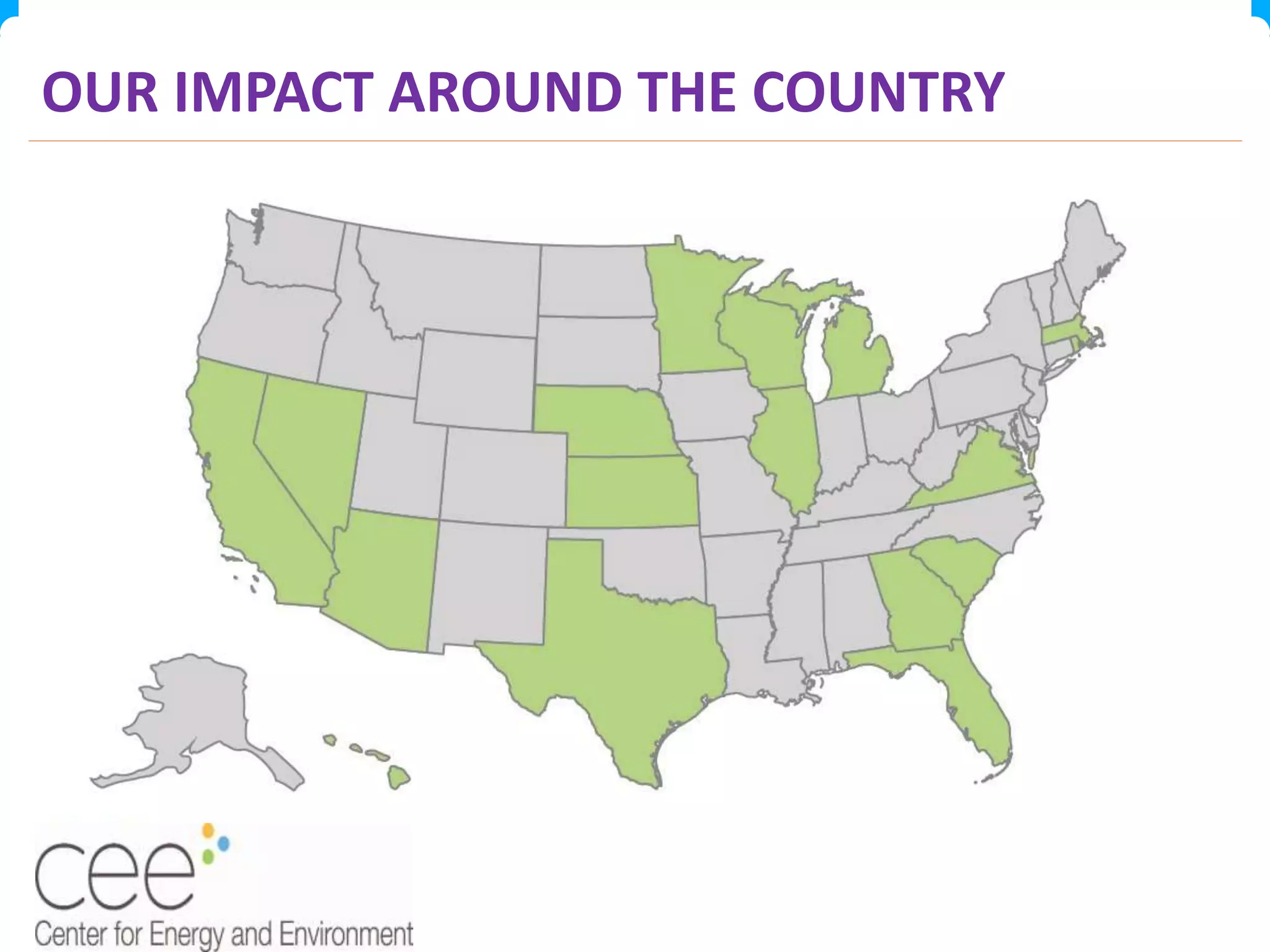
OUR IMPACT AROUND THE COUNTRY
Phase I: Founded in 2014
Conveners: Project Team for Phases 1 and 2:
Analog & Manual
Centralized
One-way flow
Cleaner
More Distributed
Multi-directional
Little
consumer
choice
More
consumer
choice
Digital & Automated
e21 = Response to Changing Electric System
e21’s Distinguishing Features
Proactive
Multi-interest &
Collaborative
Voluntary
Done in advance of
crisis
Agreement could
reduce transaction costs
& improve outcomes
Consensus-oriented
Safe space outside
of formal regulatory
process
Arose from mutual
interest among
participants
Opportunity for diverse
interests to travel
common learning curve
Phase I (2014): Broad Consensus
MN Regulators Should Be More
Proactive In Addressing Key Issues
Regulatory Process Must Evolve
Early and Sustained
Stakeholder Engagement is
Critical
Utility Business Model and
Regulatory Framework Must Evolve
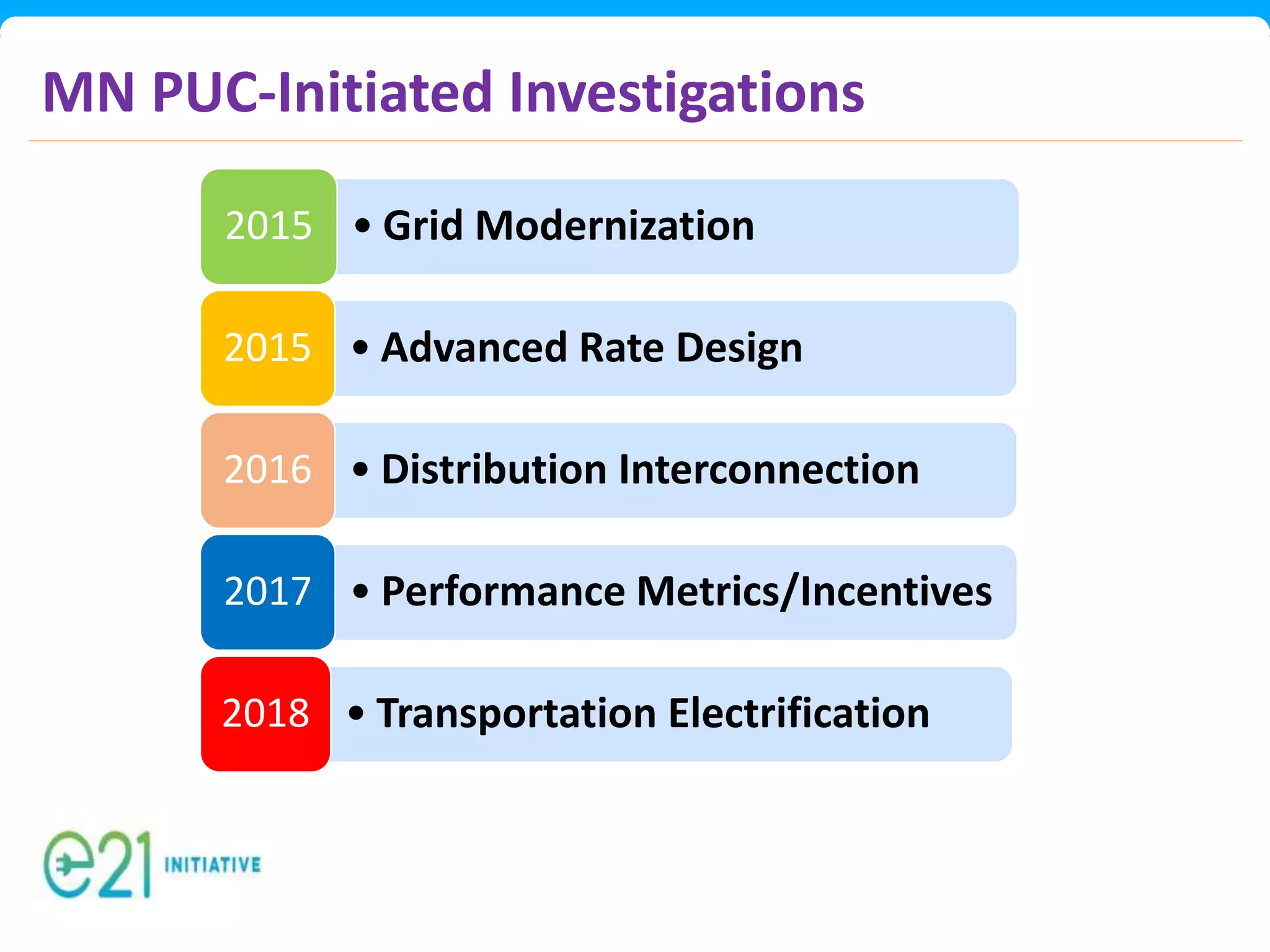
MN PUC-Initiated Investigations
• Grid Modernization2015
• Advanced Rate Design2015
• Distribution Interconnection2016
• Performance Metrics/Incentives2017
• Transportation Electrification2018
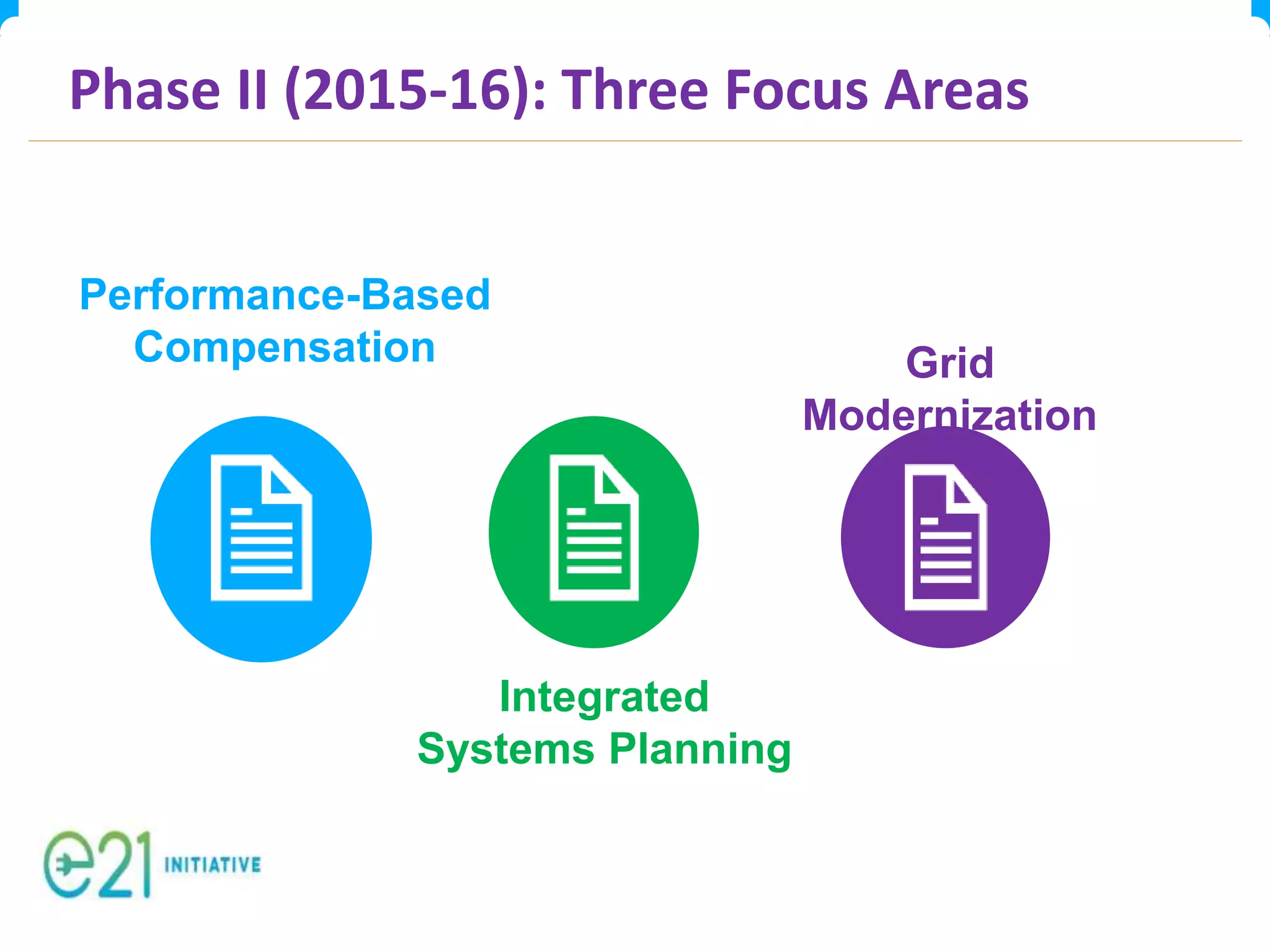
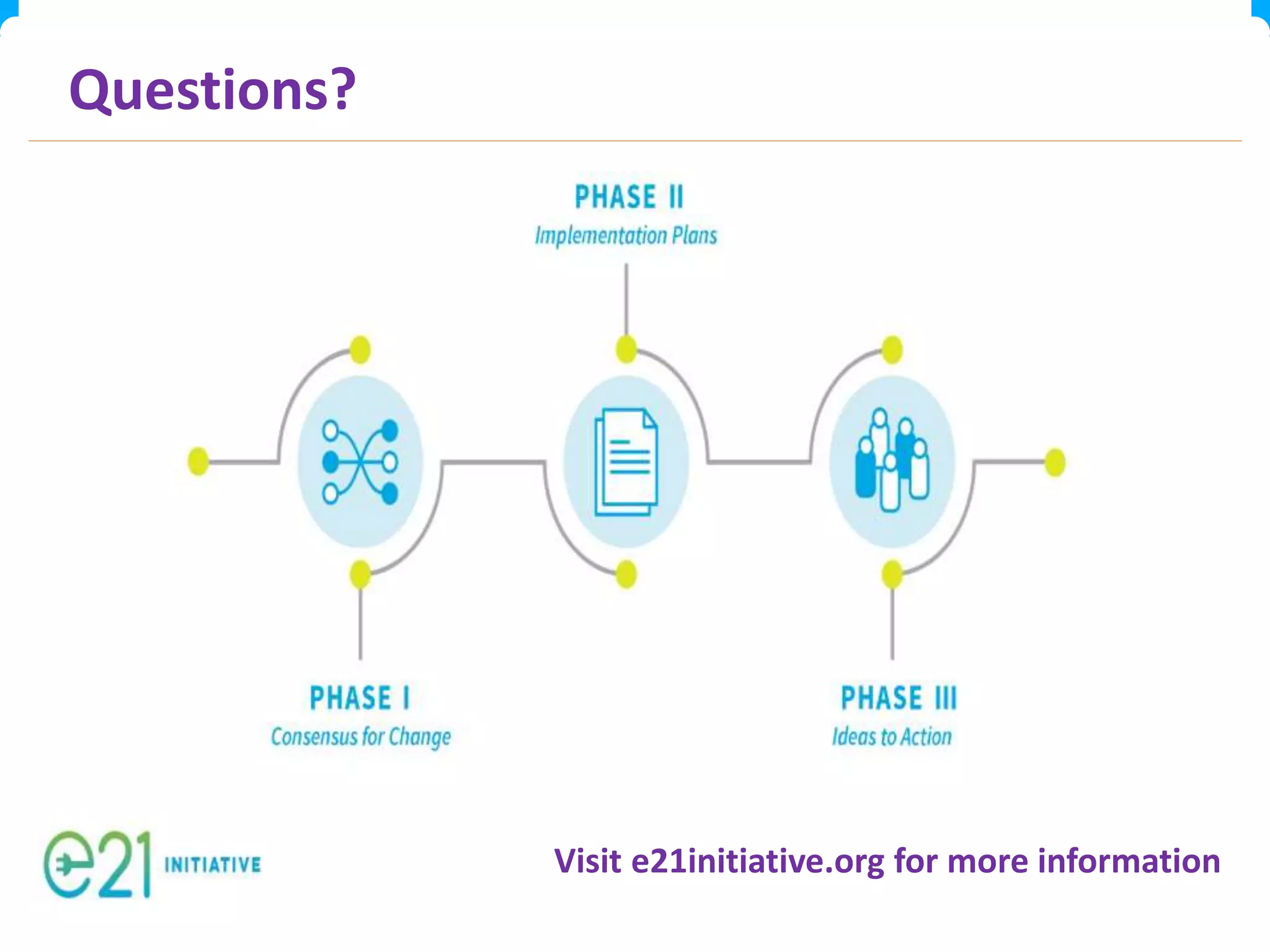
Phase II (2015-16): Three Focus Areas
Performance-Based
Compensation
Integrated
Systems Planning
Grid
Modernization
Phase III (2017-now): Ideas to Action
Forums Roundtables
Project
Workgroups
National Speakers on
e21-Related Topics
Convene Parties to
an e21-Related
Docket
Stakeholder
Engagement Prior to
Filing of e21-Related
Project
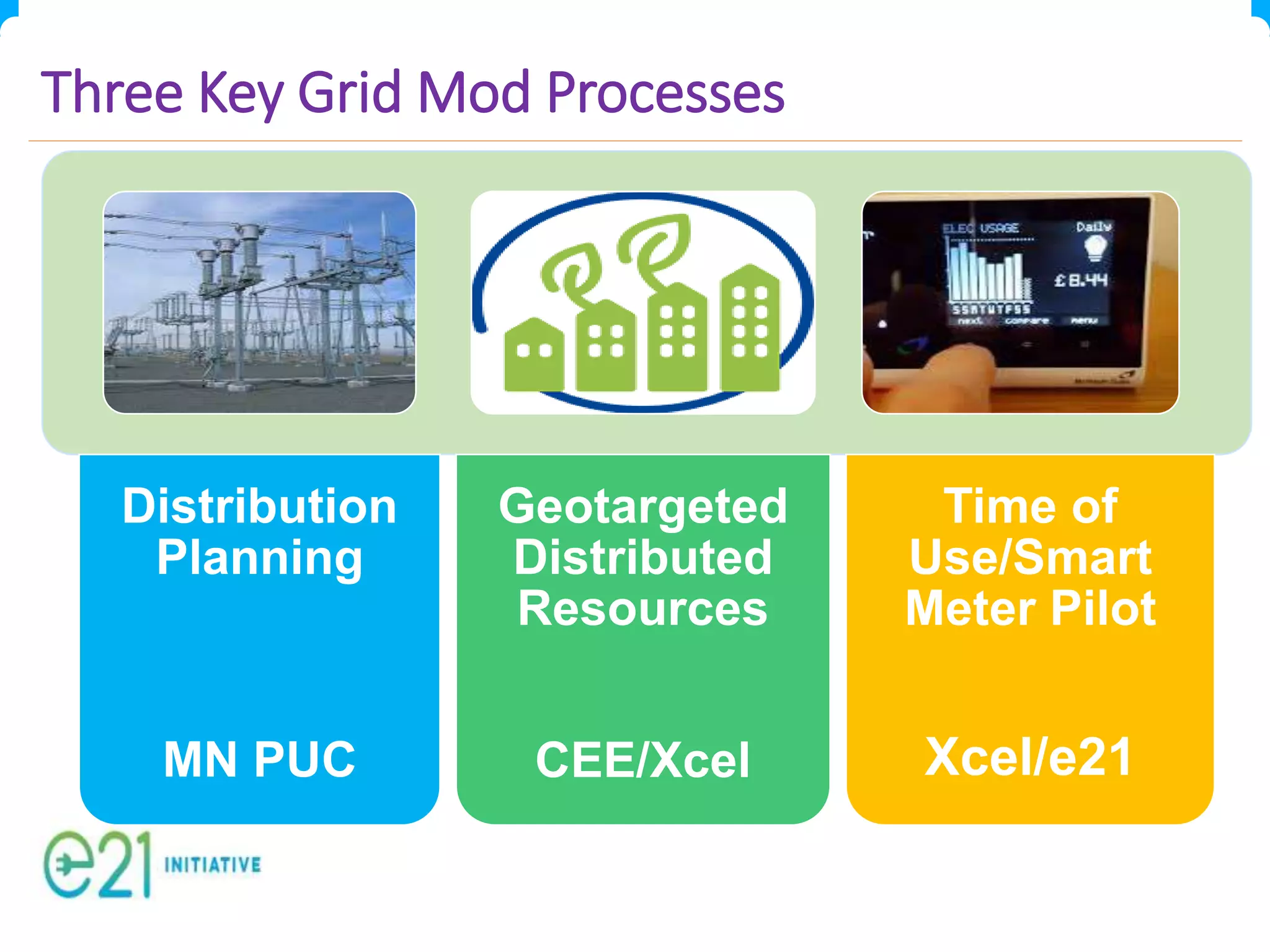
Distribution
Planning
MN PUC
Geotargeted
Distributed
Resources
CEE/Xcel
Time of
Use/Smart
Meter Pilot
Xcel/e21
Three Key Grid Mod Processes
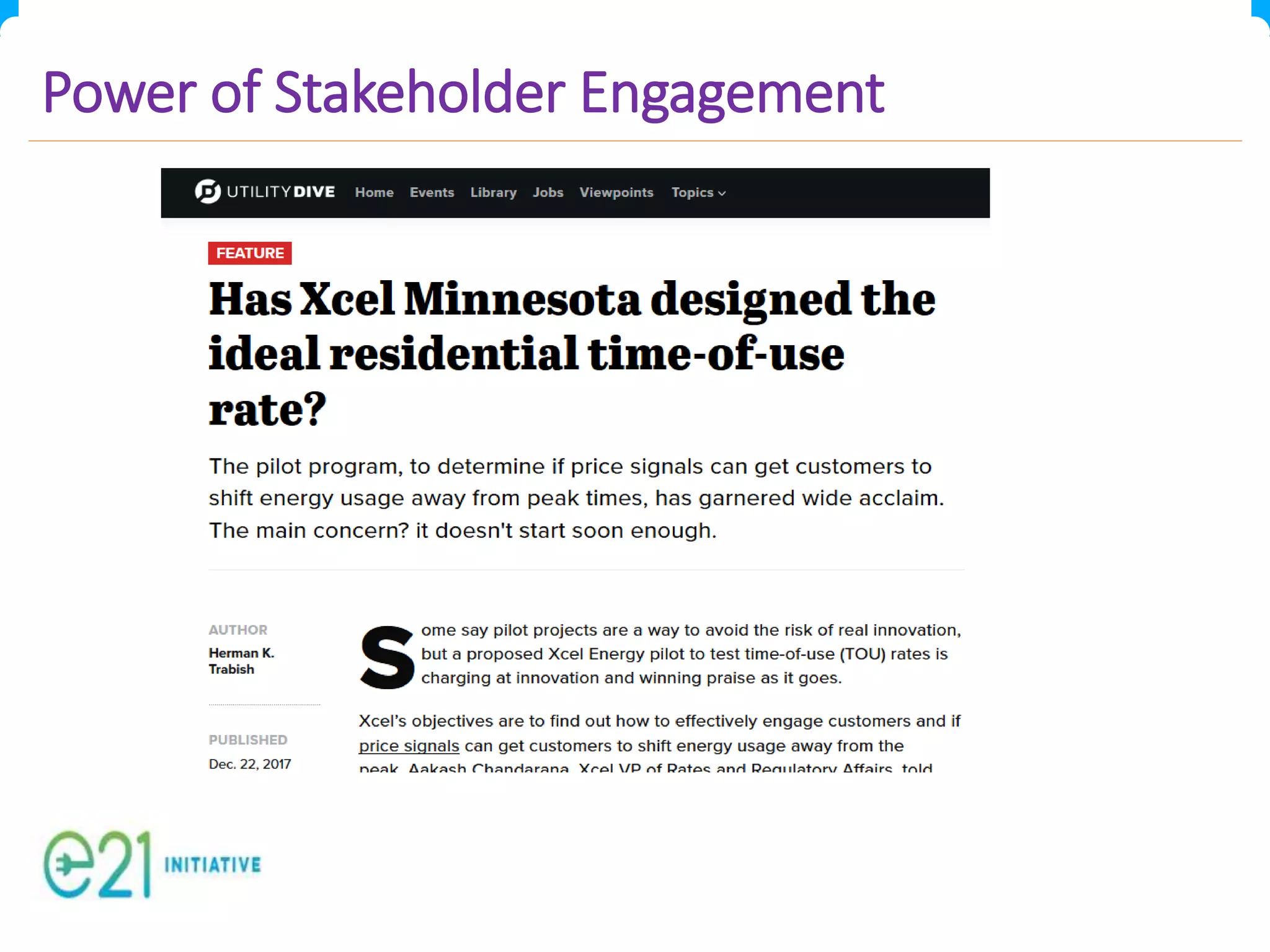
Power of Stakeholder Engagement
Questions?
Visit e21initiative.org for more information
Grid Modernization
The foundation for climate change progress
Presented by:
Ronny Sandoval, Director, Grid Modernization
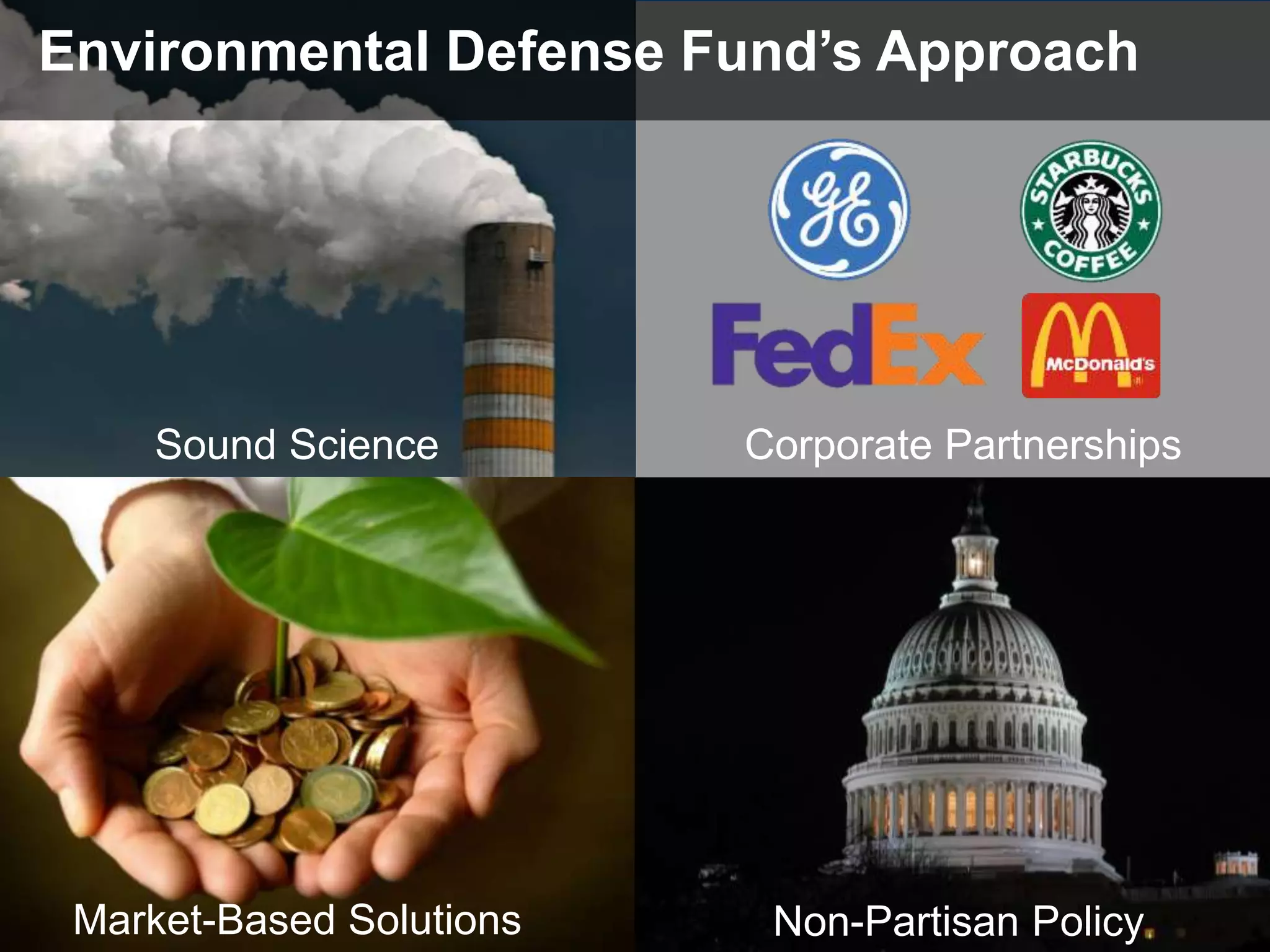
Sound Science
Market-Based Solutions
Corporate Partnerships
Non-Partisan Policy
Environmental Defense Fund’s Approach
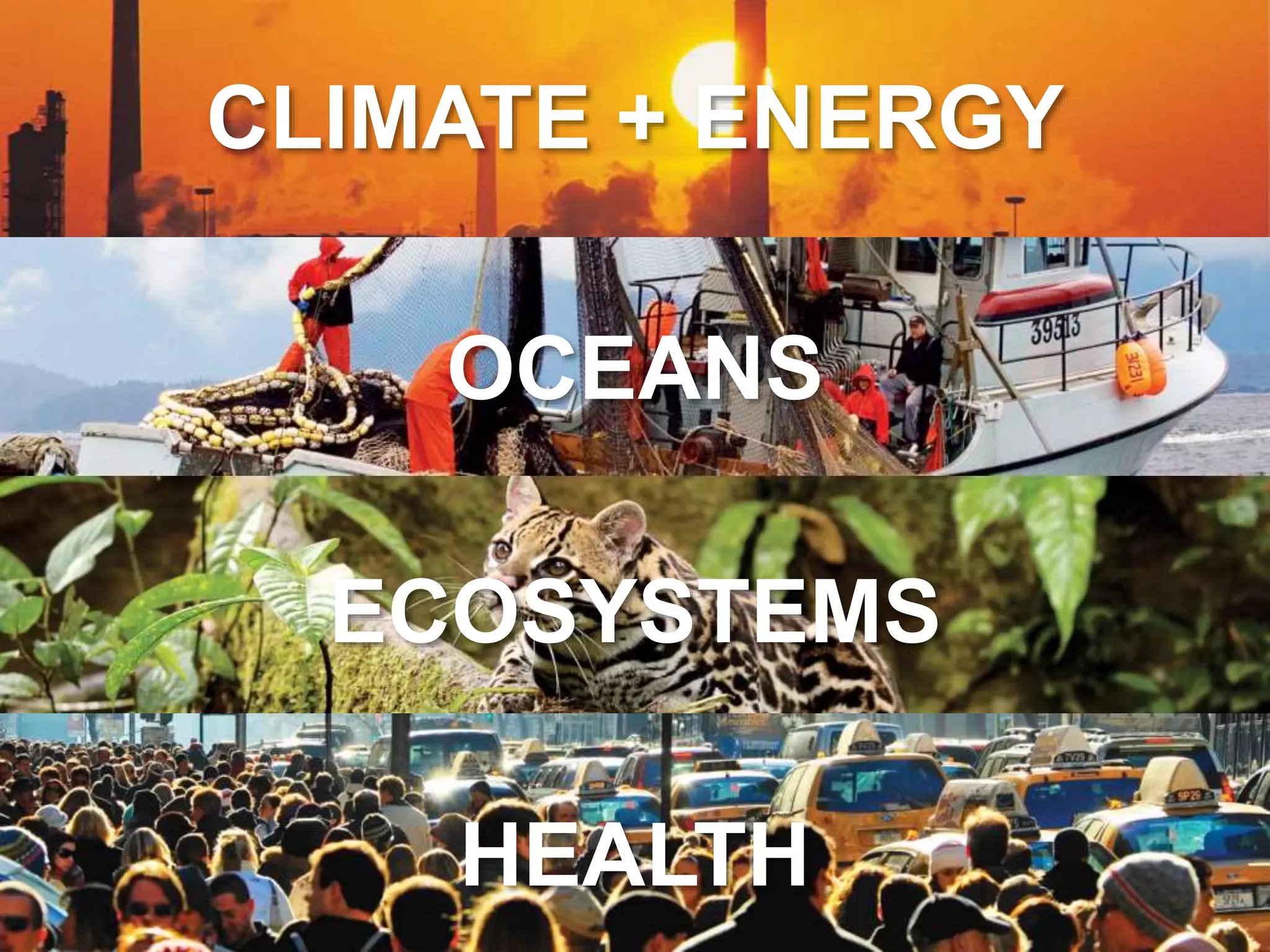
CLIMATE + ENERGY
OCEANS
ECOSYSTEMS
HEALTH
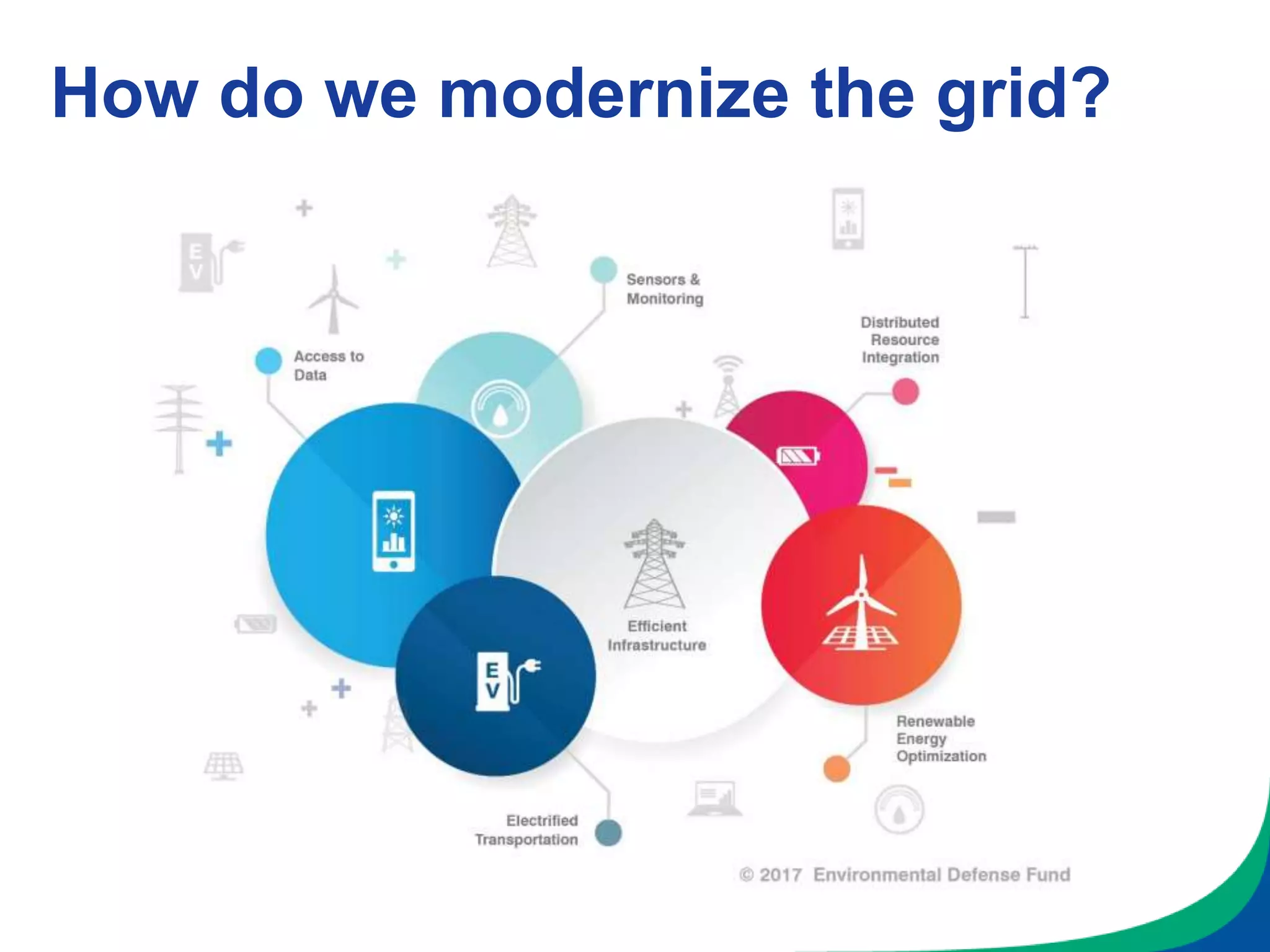
How do we modernize the grid?
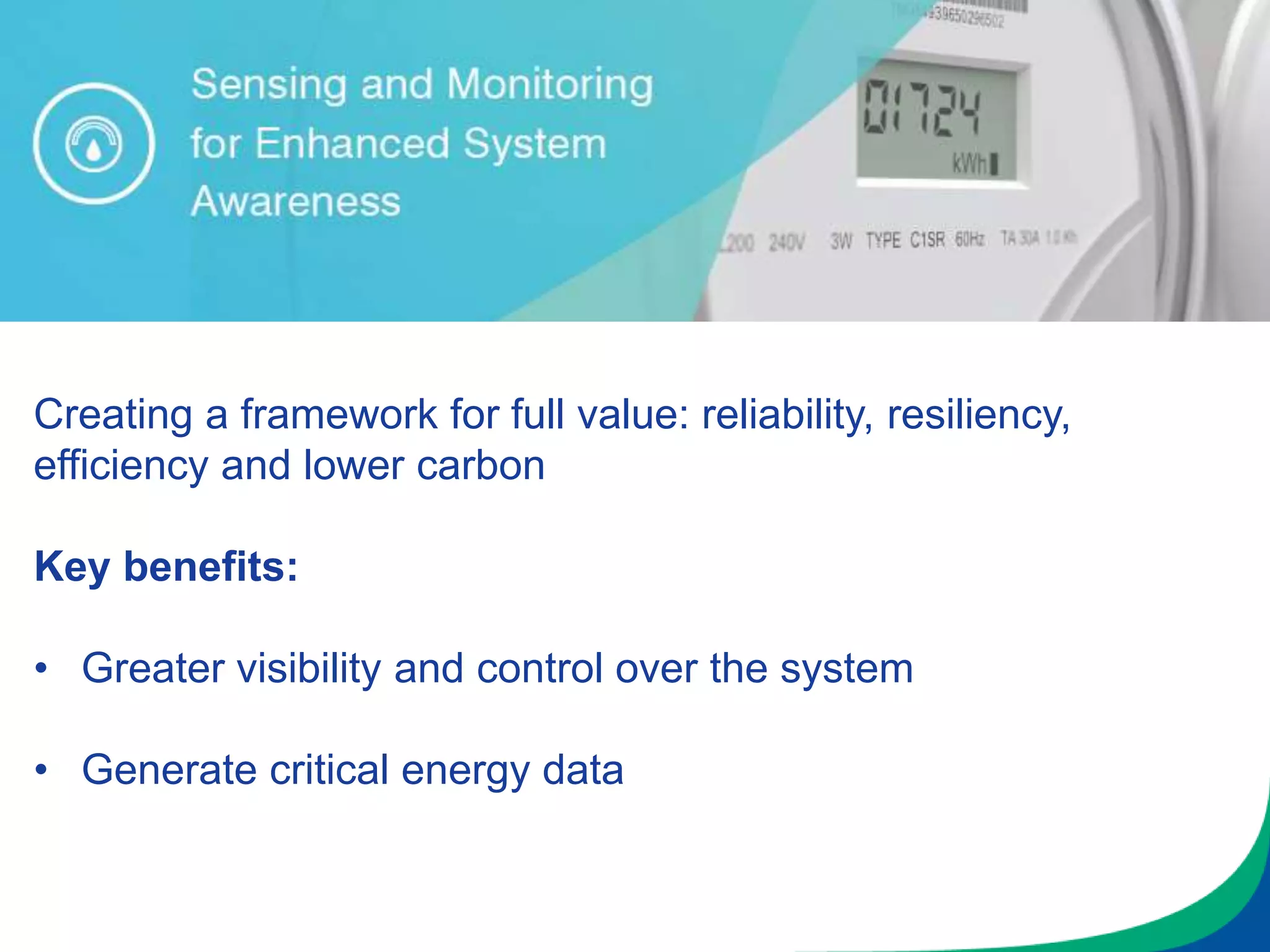
Creating a framework for full value: reliability, resiliency,
efficiency and lower carbon
Key benefits:
• Greater visibility and control over the system
• Generate critical energy data
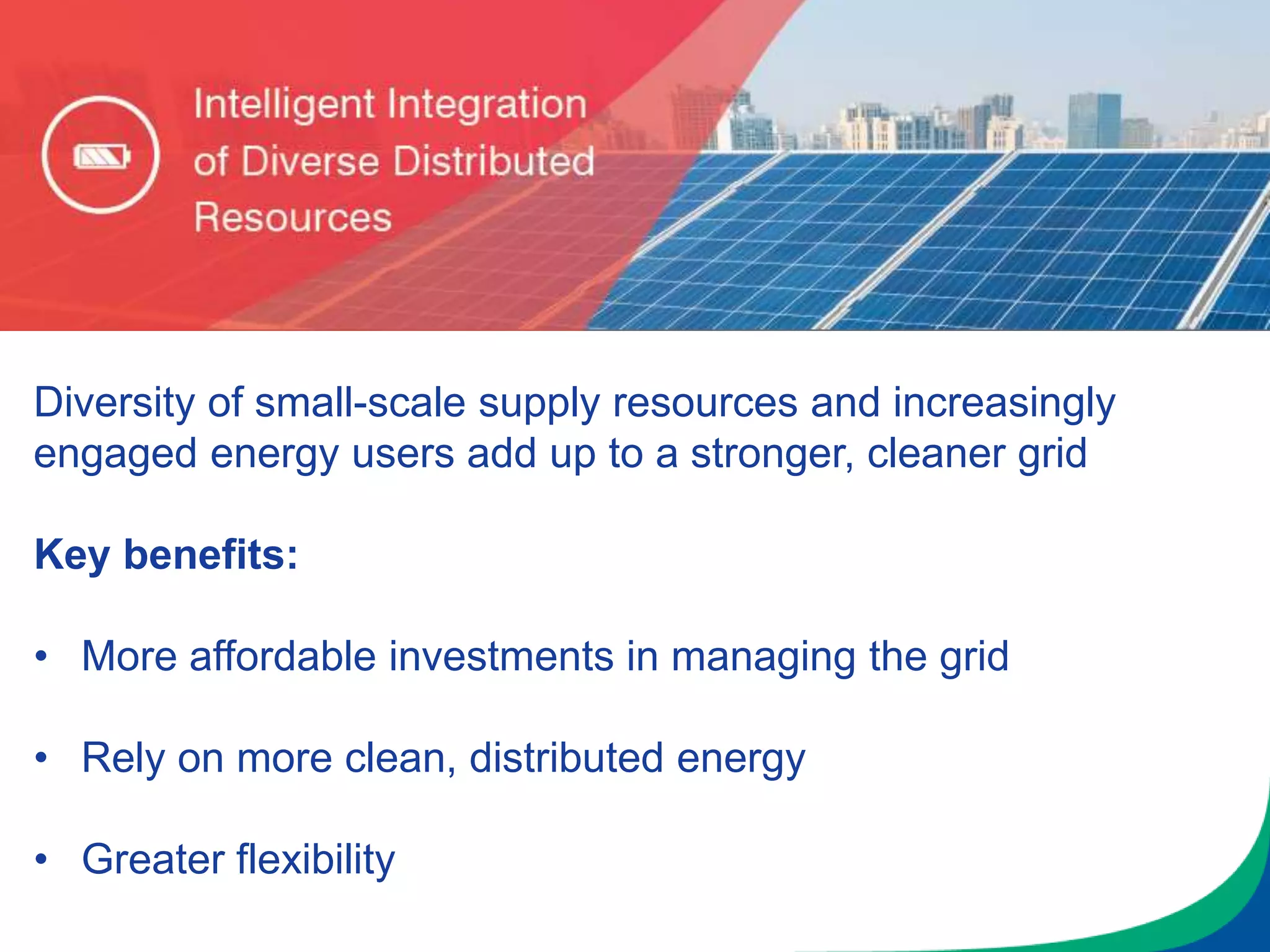
Diversity of small-scale supply resources and increasingly
engaged energy users add up to a stronger, cleaner grid
Key benefits:
• More affordable investments in managing the grid
• Rely on more clean, distributed energy
• Greater flexibility
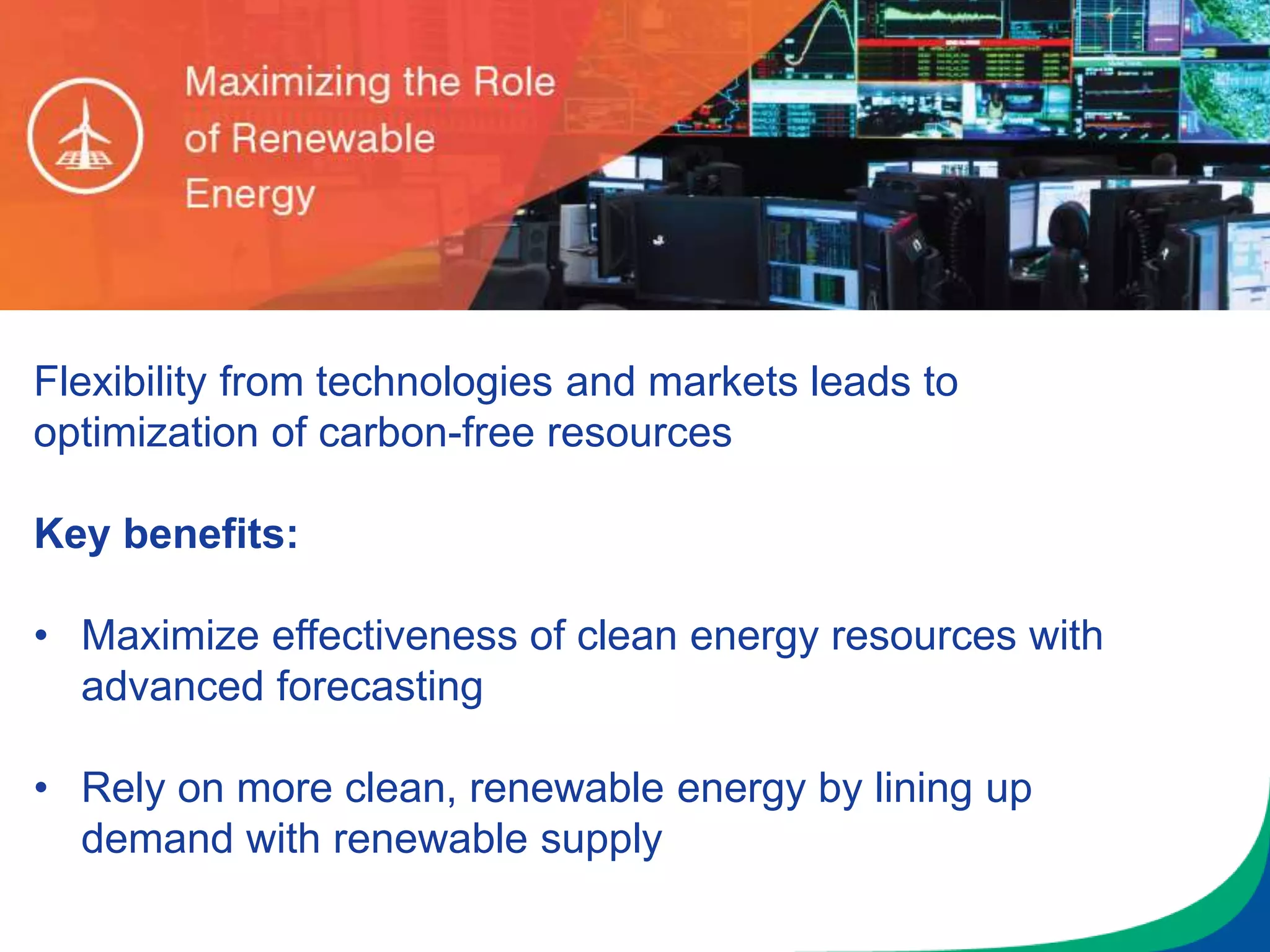
Flexibility from technologies and markets leads to
optimization of carbon-free resources
Key benefits:
• Maximize effectiveness of clean energy resources with
advanced forecasting
• Rely on more clean, renewable energy by lining up
demand with renewable supply
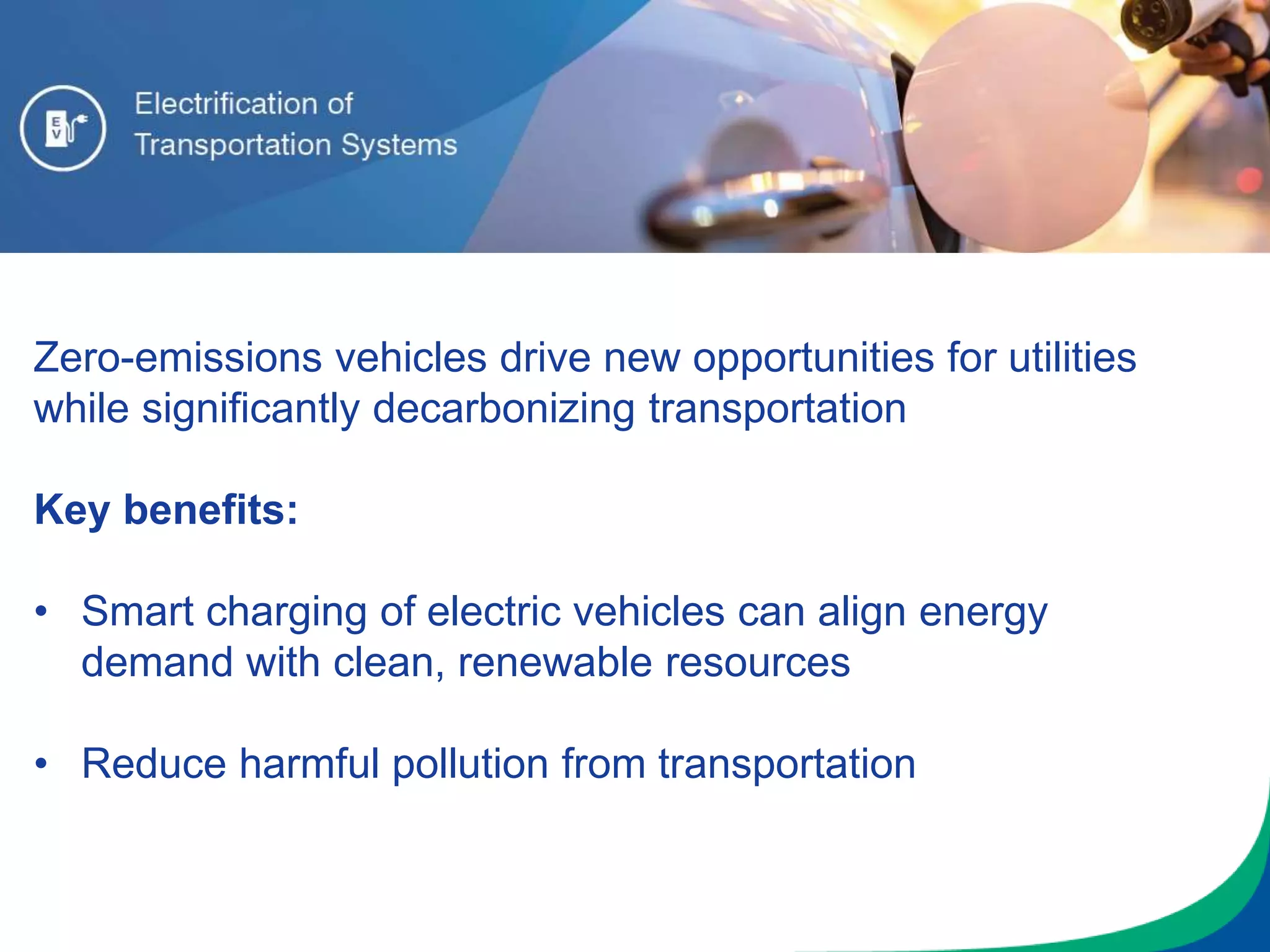
Zero-emissions vehicles drive new opportunities for utilities
while significantly decarbonizing transportation
Key benefits:
• Smart charging of electric vehicles can align energy
demand with clean, renewable resources
• Reduce harmful pollution from transportation
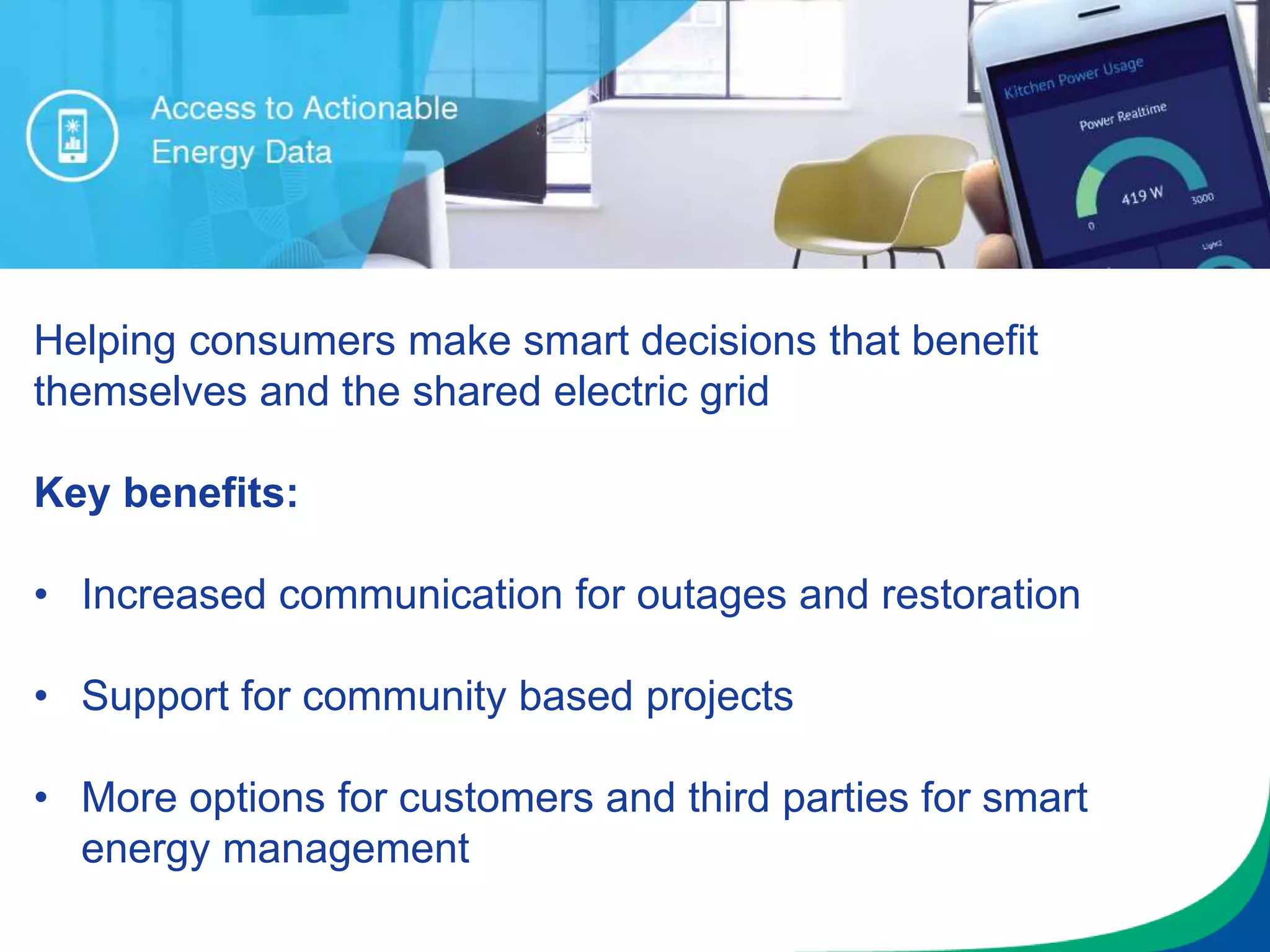
Helping consumers make smart decisions that benefit
themselves and the shared electric grid
Key benefits:
• Increased communication for outages and restoration
• Support for community based projects
• More options for customers and third parties for smart
energy management
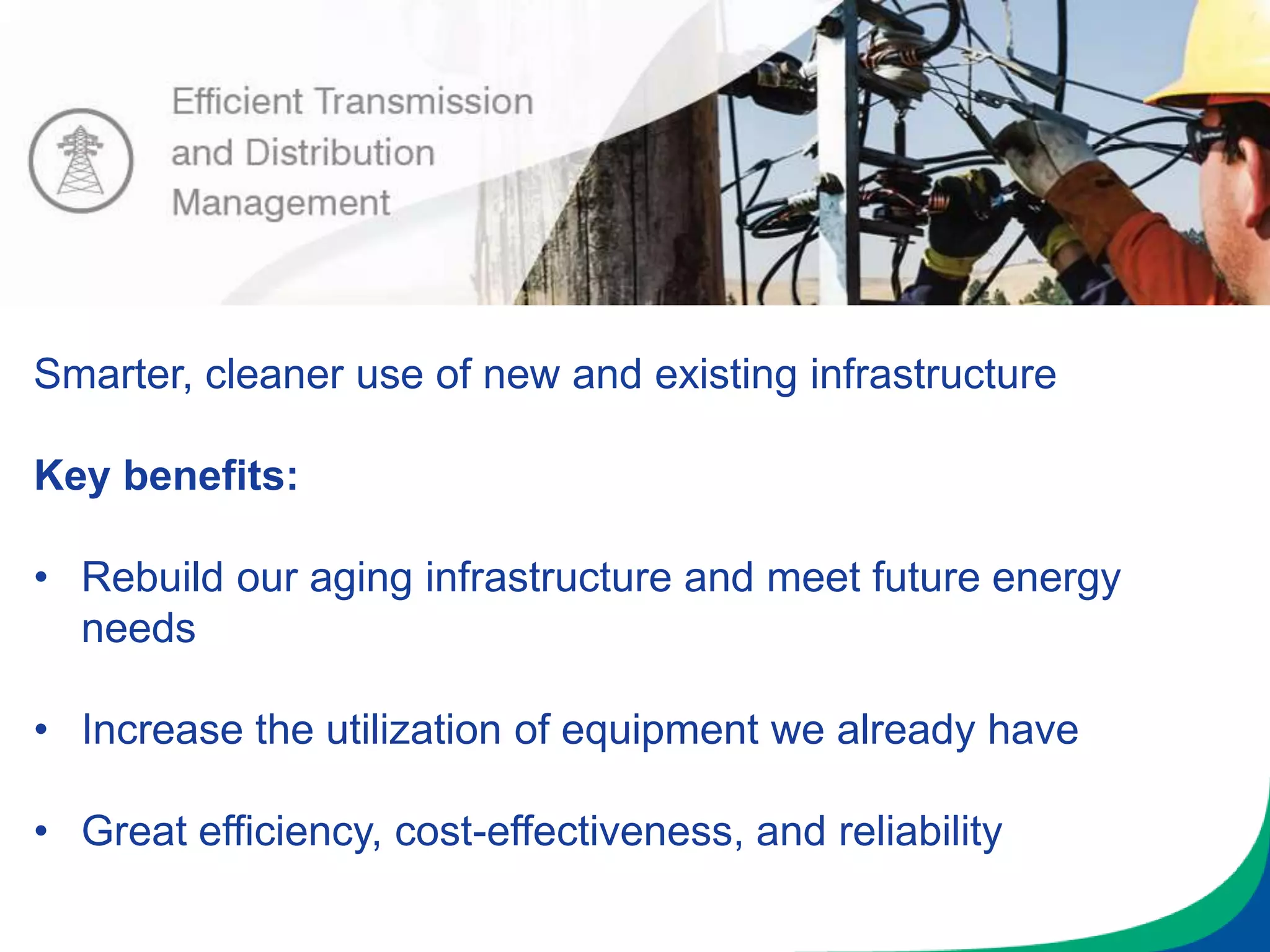
Smarter, cleaner use of new and existing infrastructure
Key benefits:
• Rebuild our aging infrastructure and meet future energy
needs
• Increase the utilization of equipment we already have
• Great efficiency, cost-effectiveness, and reliability
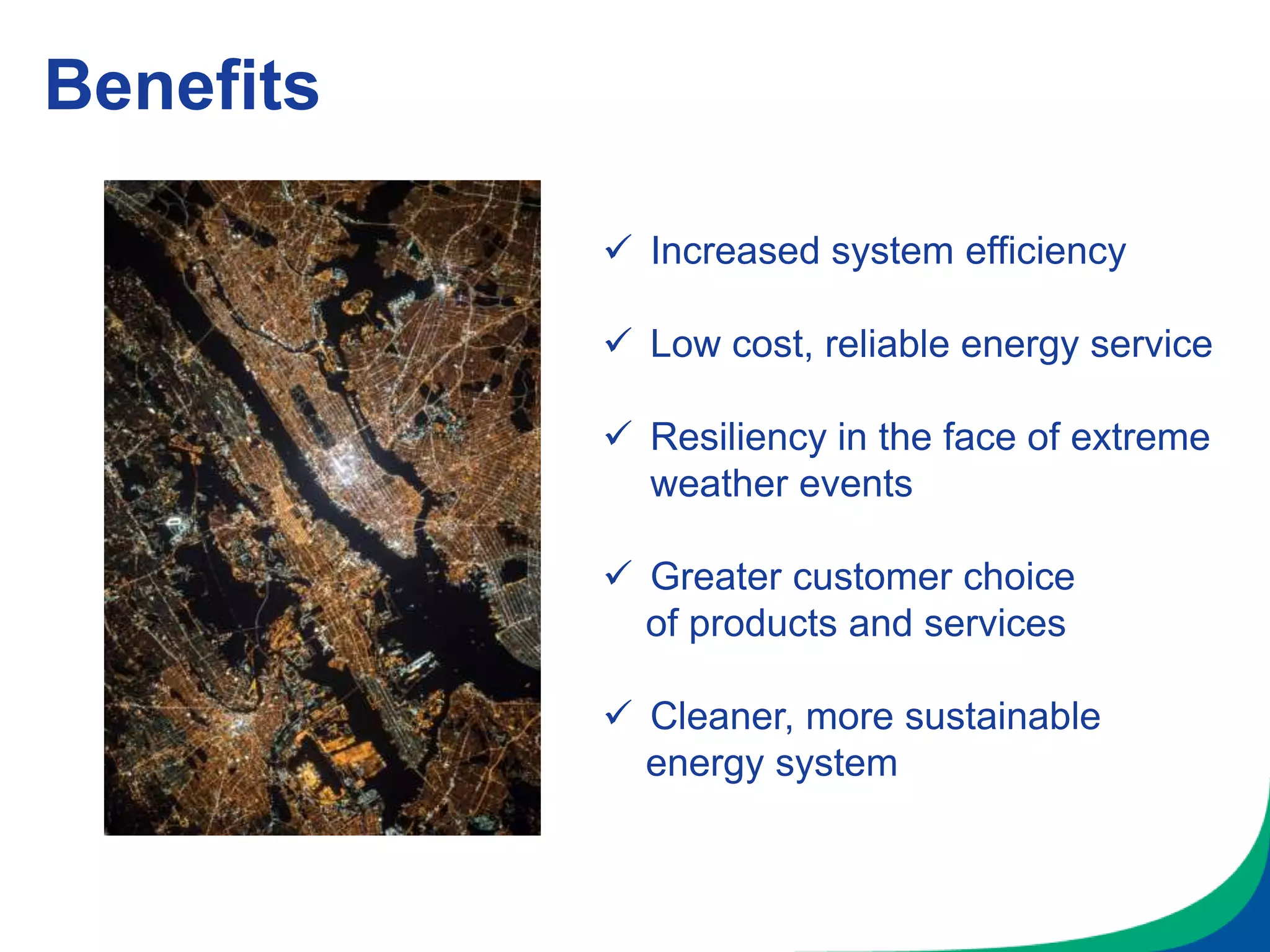
Benefits
 Increased system efficiency
 Low cost, reliable energy service
 Resiliency in the face of extreme
weather events
 Greater customer choice
of products and services
 Cleaner, more sustainable
energy system
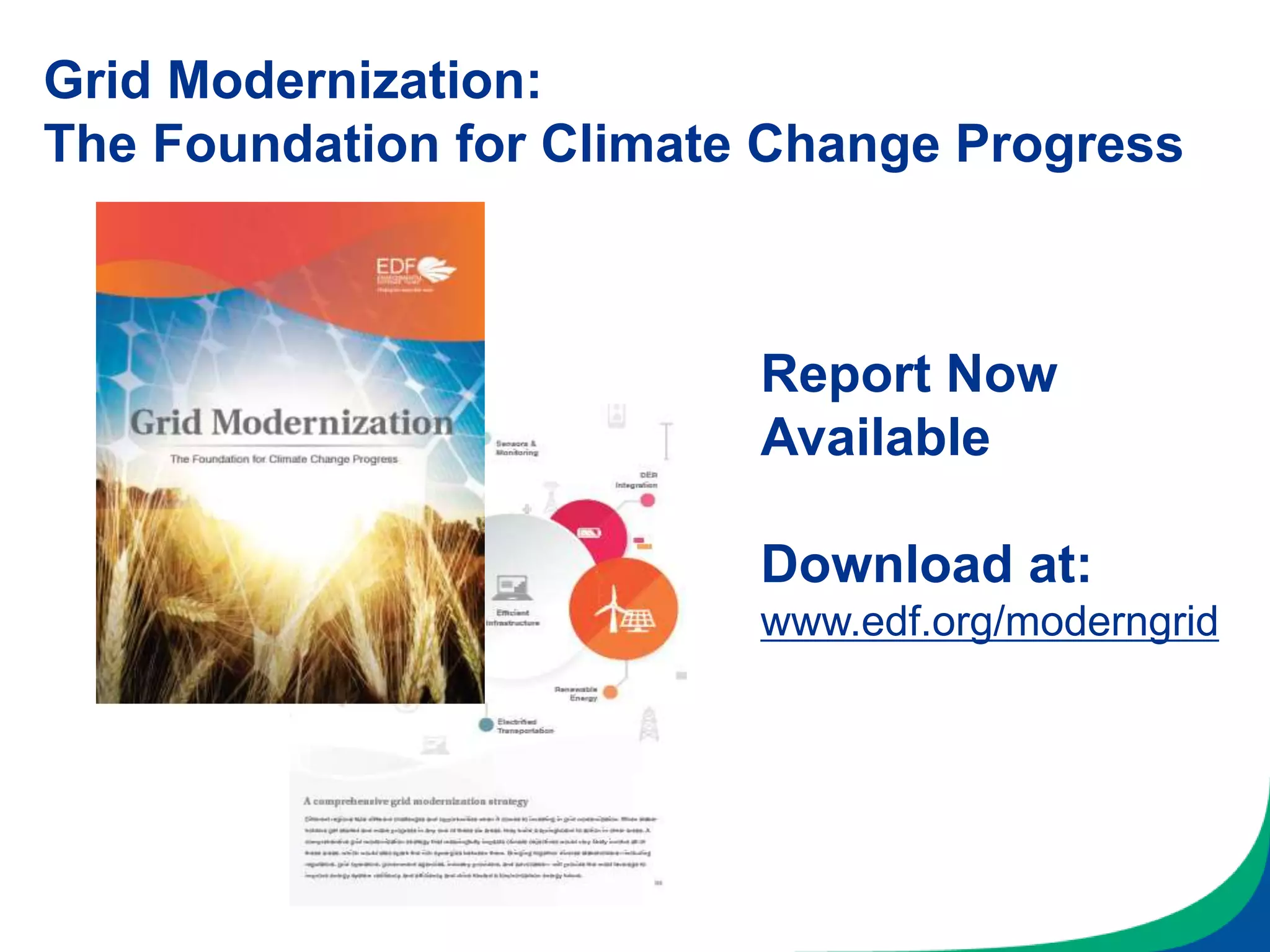
Grid Modernization:
The Foundation for Climate Change Progress
Report Now
Available
Download at:
www.edf.org/moderngrid
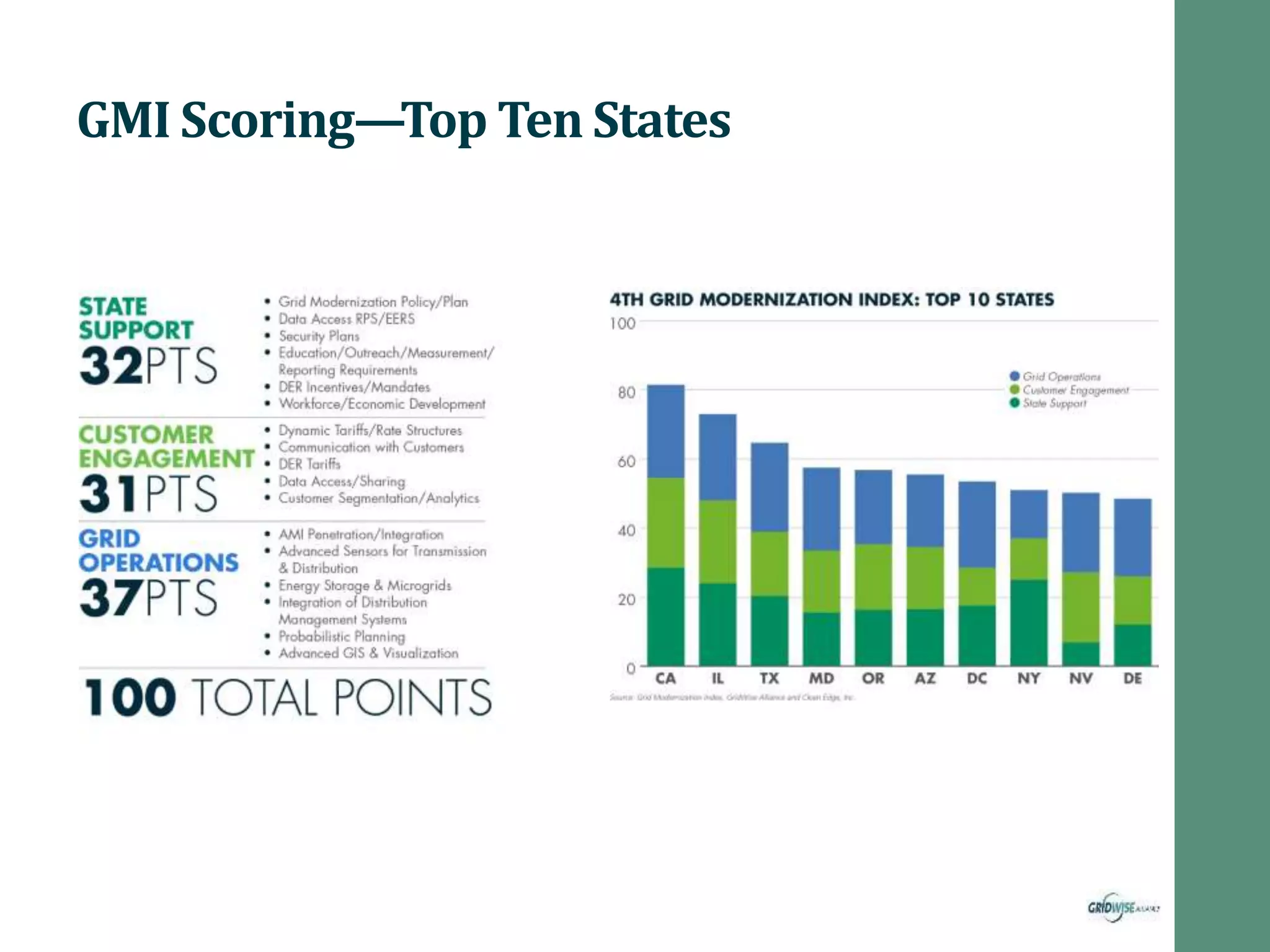
GMI Scoring—Top Ten States
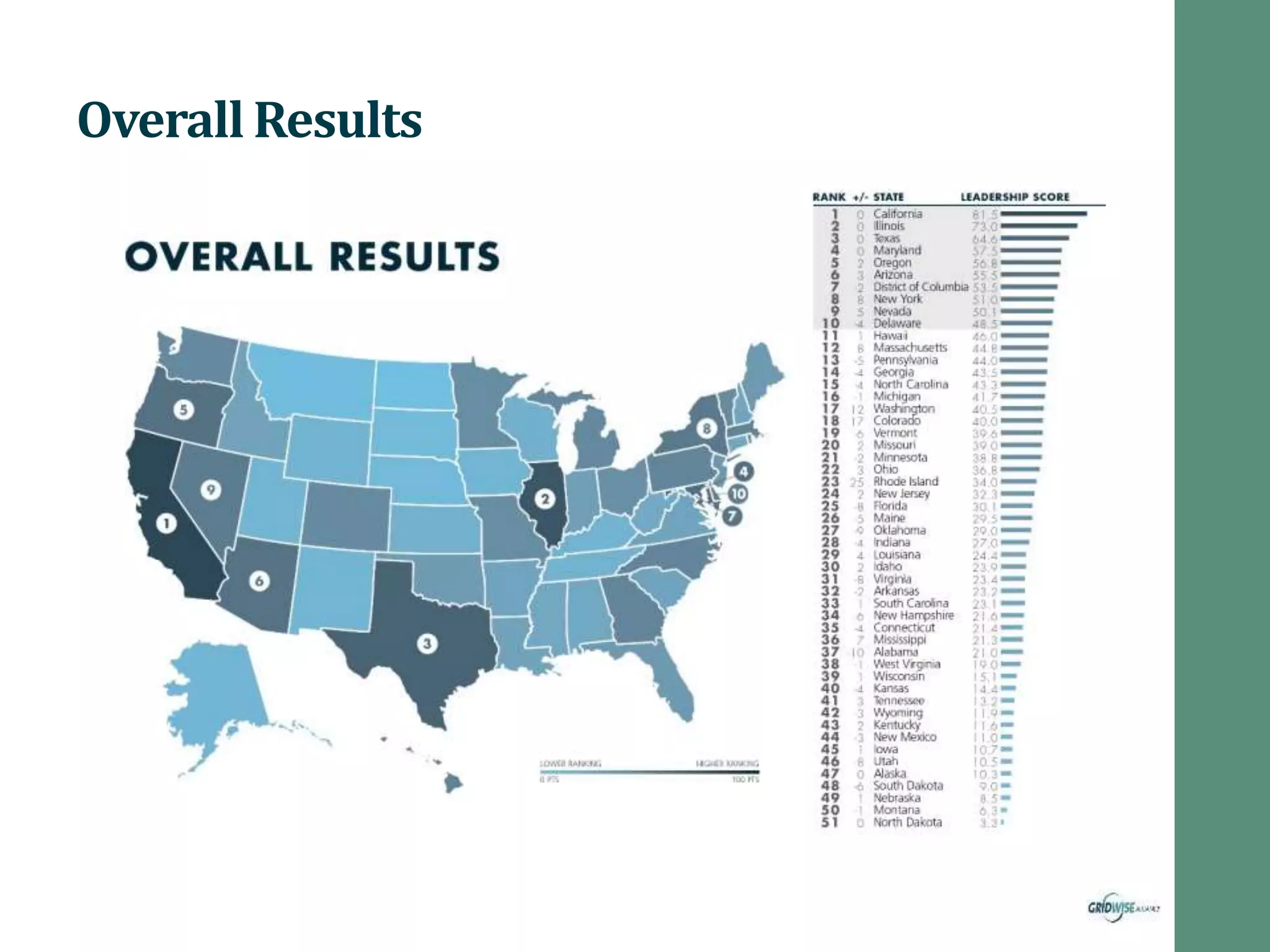
Overall Results
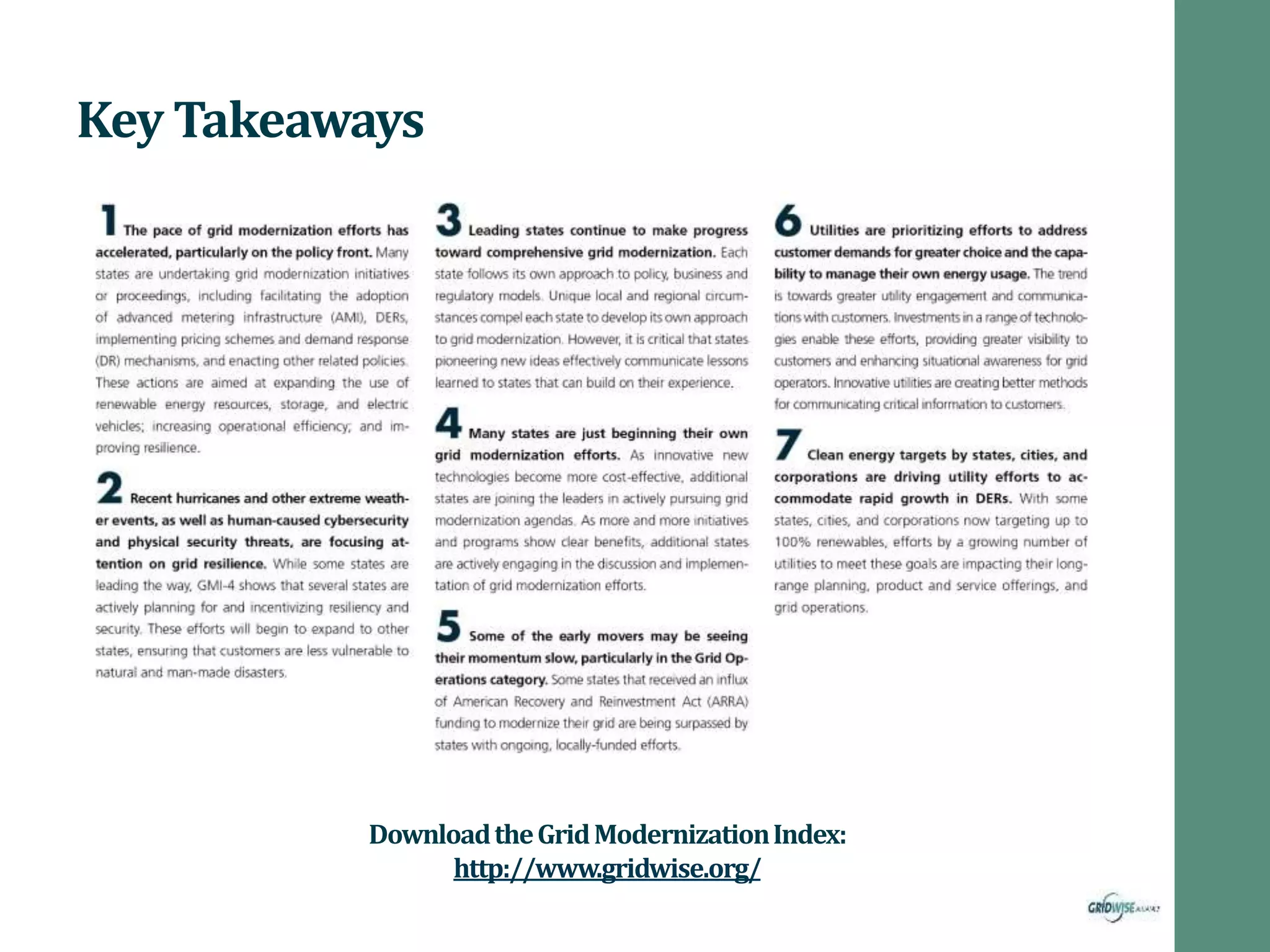
Key Takeaways
DownloadtheGridModernizationIndex:
http://www.gridwise.org/
Thank You
State Grid Modernization presentation from SEPA's 2018 Utility Conference

State Grid Modernization presentation from SEPA's 2018 Utility Conference

  • 2.
    Grid Modernization Initiatives atComEd Peter Tyschenko Manager, Distribution Capacity Planning
  • 3.
    Exelon Family ofCompanies 3 Generation Competitive Energy Sales Transmission & Distribution •Exelon Generation has assets throughout the US and Canada. •33,300 megawatts of generation. •Nuclear, natural gas, hydro, oil, wind, solar and landfill gas. •Constellation has a presence in 48 states and Washington D.C. •Competitive retail supplier serving commercial, industrial and public- sector power and gas users. •Exelon Utilities have a presence in 5 states and Washington D.C. •8.5 million electric customers. •1.3 million gas customers.
  • 4.
    Commonwealth Edison Company4 6,000+ Total Employees 500+ Engineers ― Electric customers: 3.9 million ― Service Territory: 11,400 sq mi ― Summer Peak: 23,753 MW ― Winter Peak: 16,514 MW ― Dist Feeders: 5,500
  • 5.
    Today’s Energy LandscapeIs Evolving… 5 Customers are increasingl y digital Climate change is requiring action Technolog y innovation is acceleratin g Lean Decentraliz ed Communal With new participants Clean • Customer segments of “one” • Pervasive connectivity • Installation base of solar is growing • Costs of solar/ storage are declining • Clean energy legislation (renewables, EE) • Increase in weather related outages 1 2 3
  • 6.
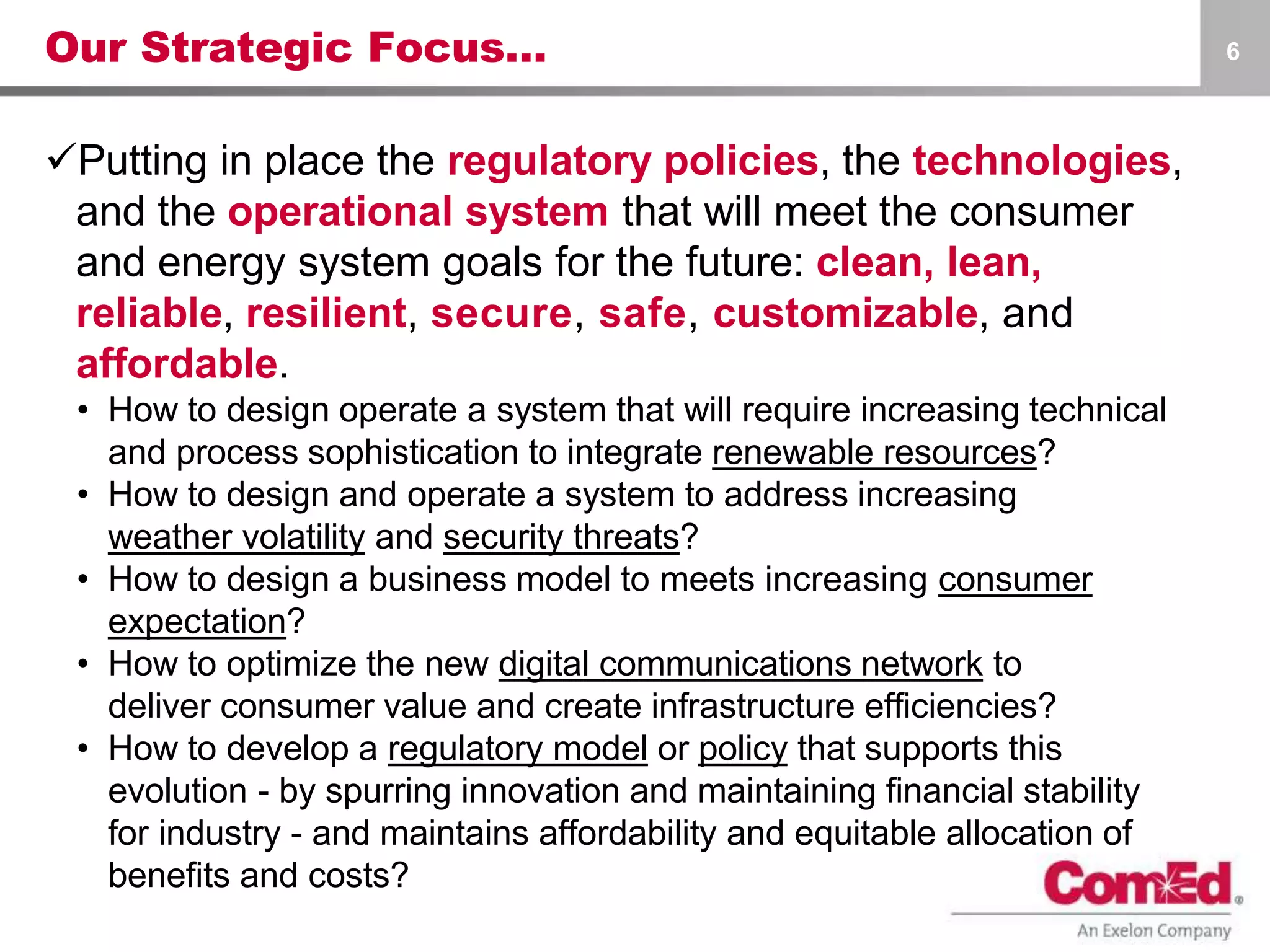
    Our Strategic Focus… Puttingin place the regulatory policies, the technologies, and the operational system that will meet the consumer and energy system goals for the future: clean, lean, reliable, resilient, secure, safe, customizable, and affordable. • How to design operate a system that will require increasing technical and process sophistication to integrate renewable resources? • How to design and operate a system to address increasing weather volatility and security threats? • How to design a business model to meets increasing consumer expectation? • How to optimize the new digital communications network to deliver consumer value and create infrastructure efficiencies? • How to develop a regulatory model or policy that supports this evolution - by spurring innovation and maintaining financial stability for industry - and maintains affordability and equitable allocation of benefits and costs? 6
  • 7.
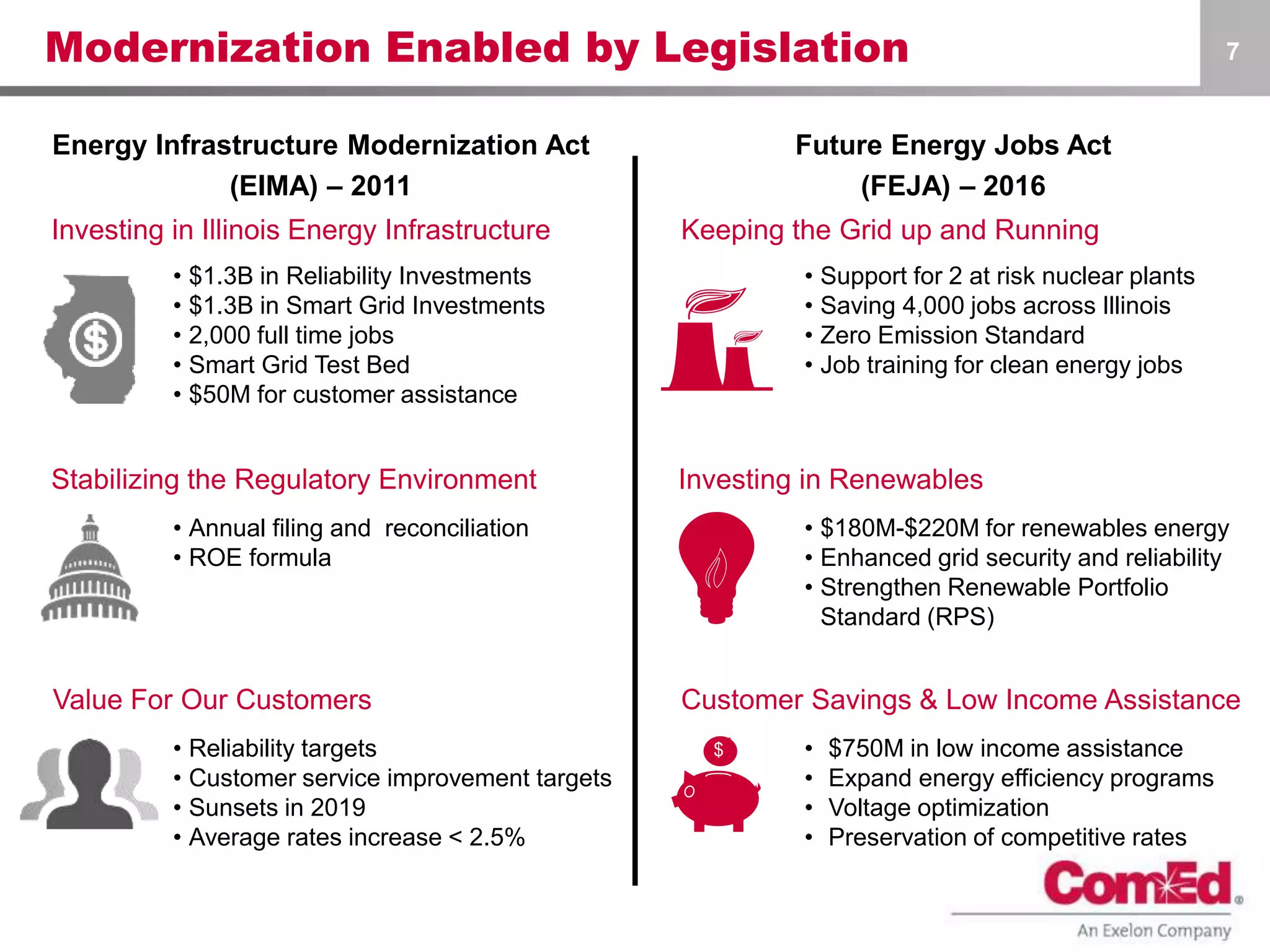
    Modernization Enabled byLegislation 7 Future Energy Jobs Act (FEJA) – 2016 • $1.3B in Reliability Investments • $1.3B in Smart Grid Investments • 2,000 full time jobs • Smart Grid Test Bed • $50M for customer assistance • Annual filing and reconciliation • ROE formula • Reliability targets • Customer service improvement targets • Sunsets in 2019 • Average rates increase < 2.5% $ • Support for 2 at risk nuclear plants • Saving 4,000 jobs across Illinois • Zero Emission Standard • Job training for clean energy jobs • $180M-$220M for renewables energy • Enhanced grid security and reliability • Strengthen Renewable Portfolio Standard (RPS) • $750M in low income assistance • Expand energy efficiency programs • Voltage optimization • Preservation of competitive rates Energy Infrastructure Modernization Act (EIMA) – 2011 Investing in Illinois Energy Infrastructure Stabilizing the Regulatory Environment Value For Our Customers Customer Savings & Low Income Assistance Investing in Renewables Keeping the Grid up and Running
  • 8.
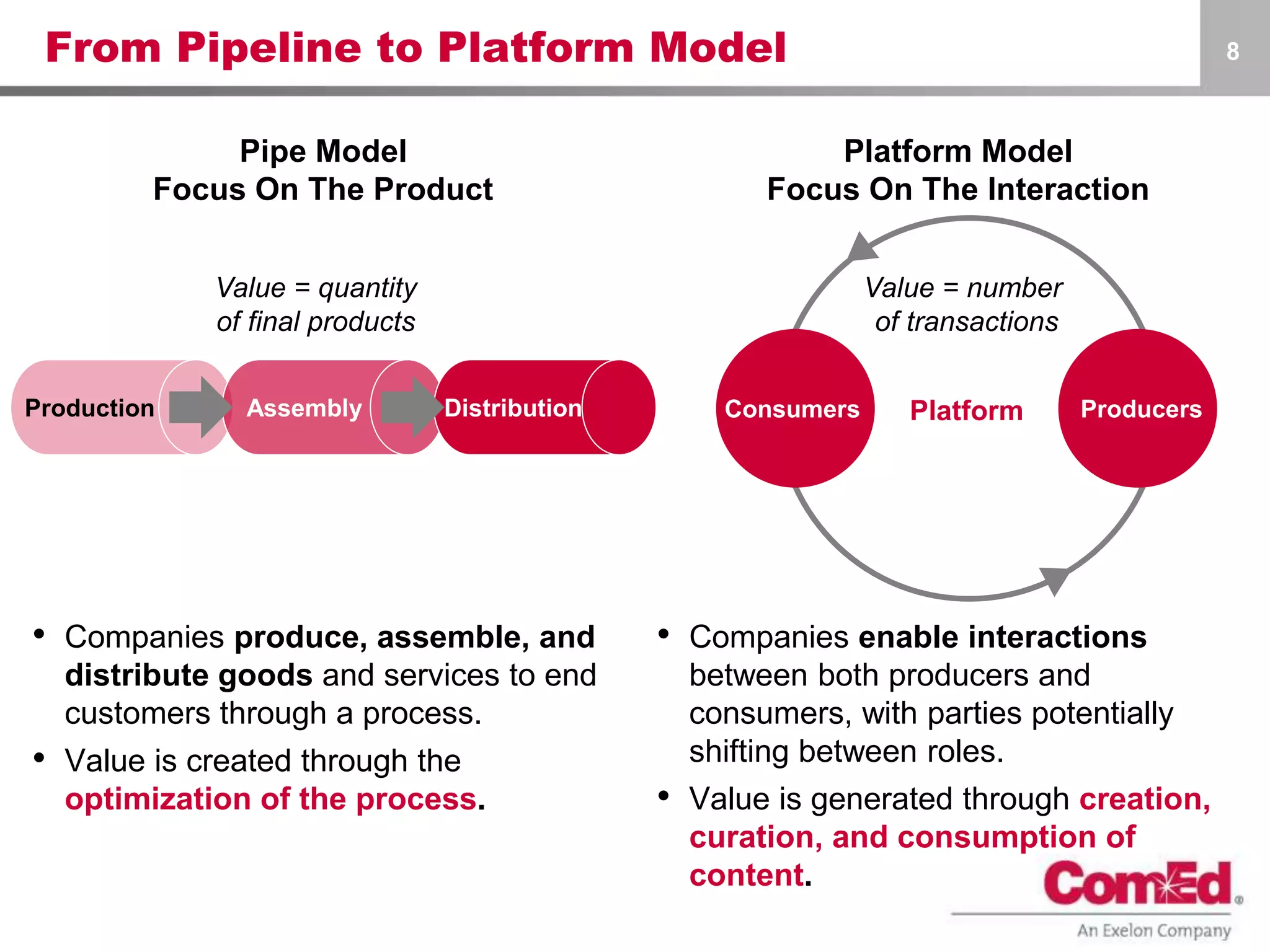
    From Pipeline toPlatform Model 8 Platform Model Focus On The Interaction Production Assembly Distribution Pipe Model Focus On The Product Consumers ProducersPlatform • Companies produce, assemble, and distribute goods and services to end customers through a process. • Value is created through the optimization of the process. • Companies enable interactions between both producers and consumers, with parties potentially shifting between roles. • Value is generated through creation, curation, and consumption of content. Value = number of transactions Value = quantity of final products
  • 9.
    Leveraging 3 NetworksTo Form A Platform.. 9 Social Network Digital Network Physical Network • Today, ComEd’s physical network is the legacy of traditional T&D infrastructure. • Today, ComEd’s communication network is comprised of systems to support core utility functions (customer billing and operations). • Today, social interactions are comprised of everyday transactions such as reading meters, providing customer service and billing. • Tomorrow, ComEd’s physical network will be enhanced by innovative grid edge technologies (microgrids, battery storage, smart infrastructure, etc). • Tomorrow, ComEd’s communication network will evolve to include the collection and transmission of data to optimize grid planning and operations. • Tomorrow, social interactions will be guided by personalized information and insights, as well as customers providing services or information that can be used by the broader community. ComEd’s relationship with residents, business, and municipalities, as well as interactions between those customers. ComEd’s communication network layered between the social and physical networks enables data and information. ComEd’s electricity delivery network - T&D power lines and substations.
  • 10.
    Utility as aPlatform ComEd envisions future grid services to leverage the physical (the utility grid), communication (smart meter network), and social (collaboration and connection to the customer) networks that we use every day. 10 UTILITY PLATFORM Home appliancesData analytics services Connected devices Energy transactions Energy Efficiency Demand Response Community solar Financing DER offerings Home services Small Business programs
  • 11.
    Community of theFuture Community of the Future - A place where ComEd and a local community collaborate to create a “smart community” – connected, custom, livable, and, sustainable. 11 Promotes piloting customer- focused initiatives that: • Create a smarter, more secure, more reliable, more resilient and affordable grid. • Connect residents to smarter technology that enable them to make an impact on their energy usage, cost, and carbon footprint. • Enhance livability, workability and sustainability. Some projects underway: • Ideathon • Dash Electric Vehicle • Aris Off-Grid Lighting • CIVIQ Waypoint
  • 12.
    Modernizing the Grid New grid advancement programs will focus on building resiliency and reliability into the physical system, maintaining and improving asset health of our already existing smart grid infrastructure, and building additional functionality and added value by leveraging our current asset base. 12 Traditional Grid • T&D expansion for capacity • Redundancy improvements • Volt-VAR management • Substation equipment modernization • Reclosers, switches, relays • AMI Repairs + Maintenance Preventative maintenance • Wood pole inspection Vegetation management • Drone monitoring • Advanced testing Programmatic maintenance • Transformers, breakers, capacitors, etc • Overhead wires • Underground cables • Wildlife protection Advanced grid • Microgrids • Storage • Advanced measurement (incl. PMUs) • Smart sensors / smart inverters • Charging infrastructure • Advanced IT, e.g., communications and relays • Distribution automation Adjacent Operations • Smart cities • Street lights • Gas
  • 13.
    Example: Grid ModernizationRoadmap 13 Phase 1 – FoundationalComms Infrastructure BuildingBlocks Phase 2 – Advanced Intelligent Grid Devices Outage Management Systems (OMS) Advanced Control Systems (ADMS – SCADA) Customer Information Platform Big Data Analytics Innovation Advanced Control Systems (ADMS – Advanced Apps) Customer Information Platform (Apps) Big Data Analytics Smart Meters $xM $xM $xM $xM $xM $xM $xM $xM $xM $xM Resiliency $xM $xM $xM $xM $xM $xM $xM $xM $xM Slide 1
  • 14.
    Bronzeville Community Microgrid 1,060 customers  7 MW aggregate load  Phase I – 2.5 MW load, solar PV and battery storage, diesel back-up (Focus on DOE SHINES grant) • 490 customers  Phase II – 4.5 MW load, 7-MW of controllable generation • Additional 570 customers • Clustering demonstration with existing microgrid at the Illinois Institute of Technology (IIT) 14
  • 15.
    NextGrid: Illinois Utilityof the Future Study NextGrid is an approximately 18-month consumer-focused study initiated by the Illinois Commerce Commission (ICC) and launched on Sept. 28, 2017. NextGrid will be managed by the ICC, with the Power and Energy System Area of the Electrical and Computer Engineering Department at the University of Illinois at Urbana-Champaign (UIUC/ECE) serving as an independent third-party facilitator. The study will examine the use of new technologies to improve the state’s electric grid while minimizing energy costs to consumers. • New Technology Deployment and Grid Integration • Metering, Communications and Data • Reliability, Resiliency and Security • Customer and Community Participation • Electricity Markets • Regulatory and Environmental Policy Issues • Ratemaking  The public is invited and encouraged to participate in the study. 15
  • 17.
    Mike Bull, Director Policyand External Affairs Grid Modernization in Minnesota and the April 24, 2018
  • 18.
    CEE’S APPROACH Data DrivenCommunity Based ConsumerFocused
  • 19.
    Pg. 19 FOCUS ONREDUCING ENERGY WASTE Programs & Services Policy and Engagement Technical Research
  • 20.
    OUR IMPACT AROUNDTHE COUNTRY
  • 21.
    Phase I: Foundedin 2014 Conveners: Project Team for Phases 1 and 2:
  • 22.
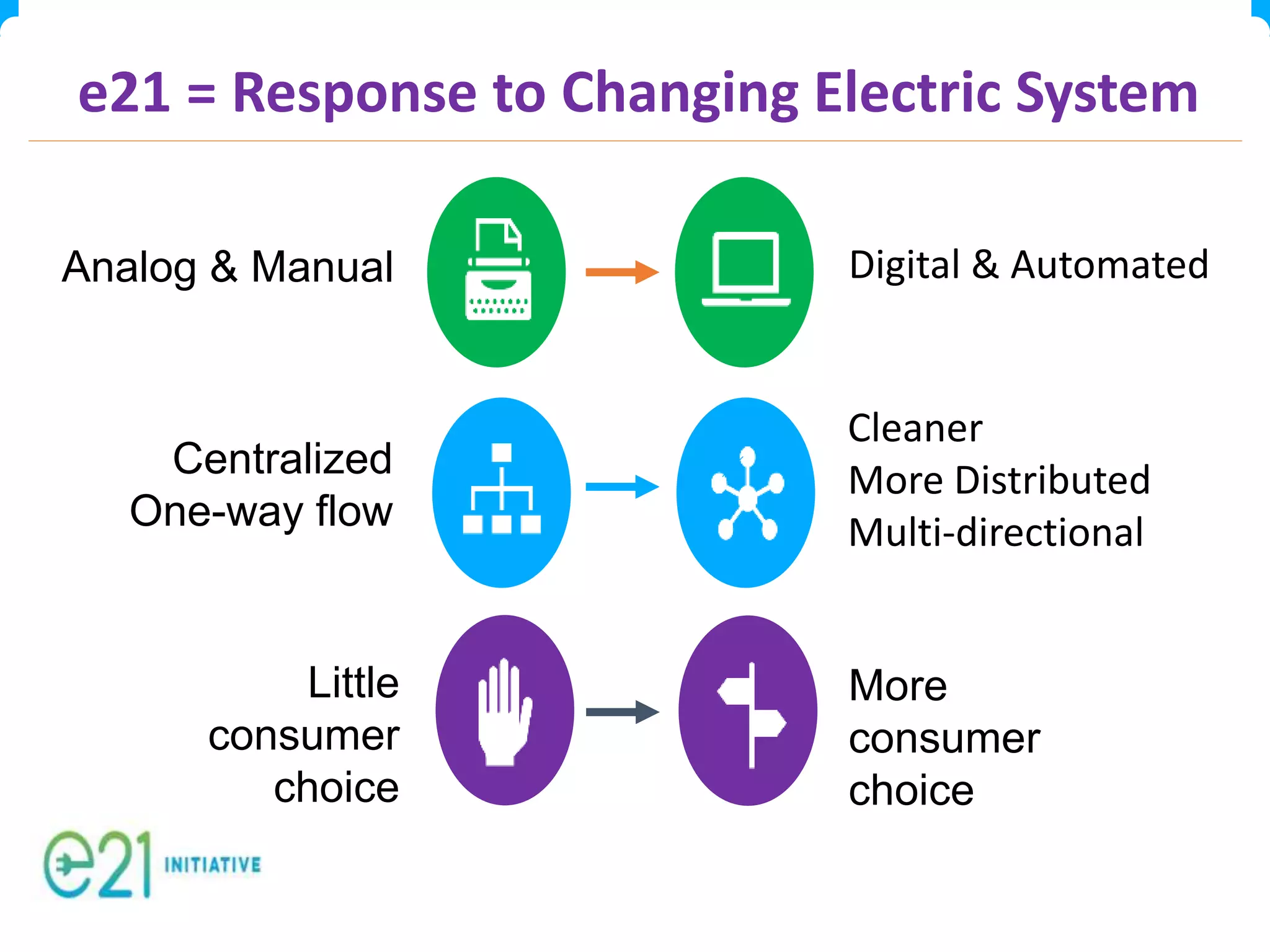
    Analog & Manual Centralized One-wayflow Cleaner More Distributed Multi-directional Little consumer choice More consumer choice Digital & Automated e21 = Response to Changing Electric System
  • 23.
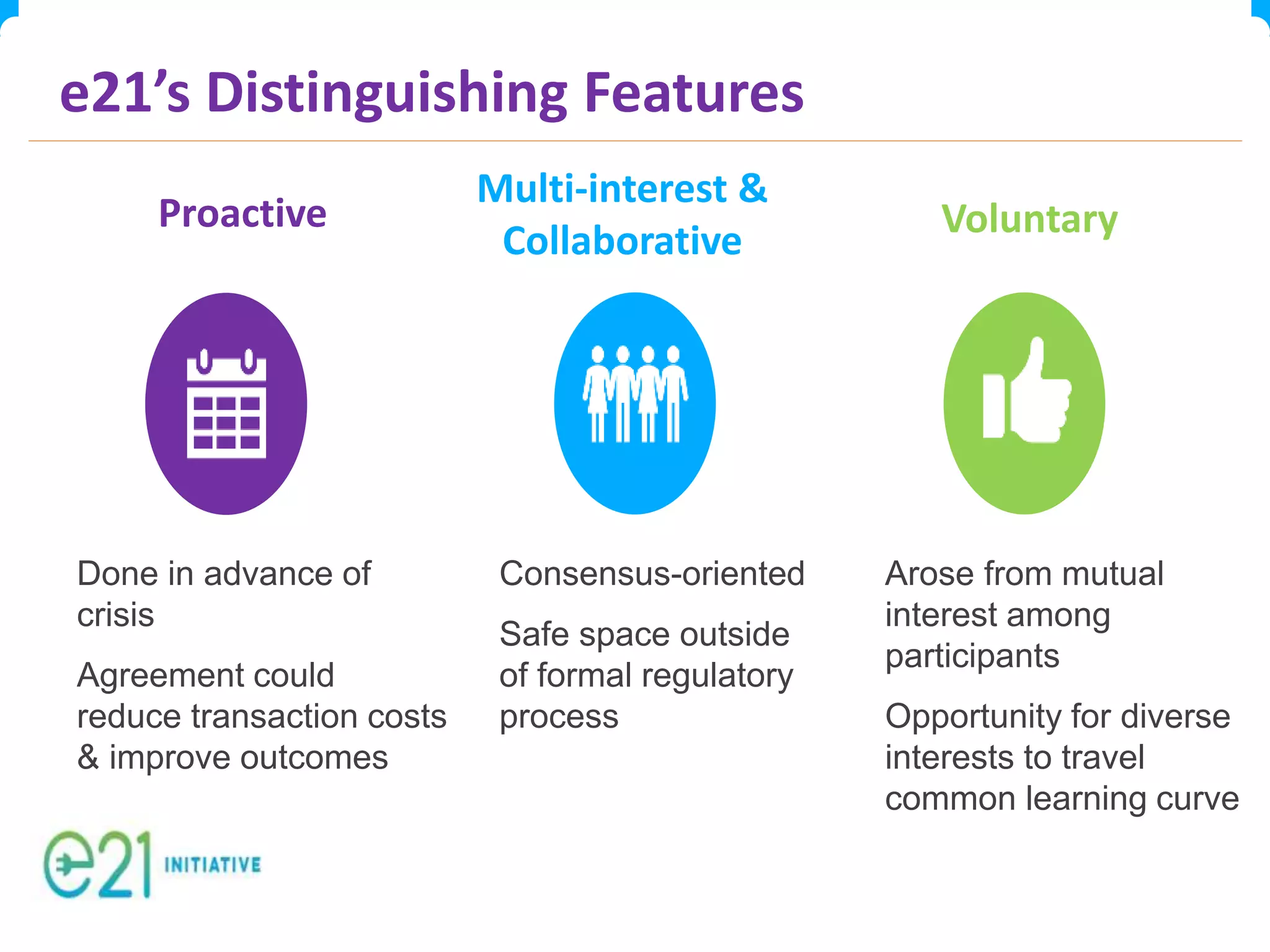
    e21’s Distinguishing Features Proactive Multi-interest& Collaborative Voluntary Done in advance of crisis Agreement could reduce transaction costs & improve outcomes Consensus-oriented Safe space outside of formal regulatory process Arose from mutual interest among participants Opportunity for diverse interests to travel common learning curve
  • 24.
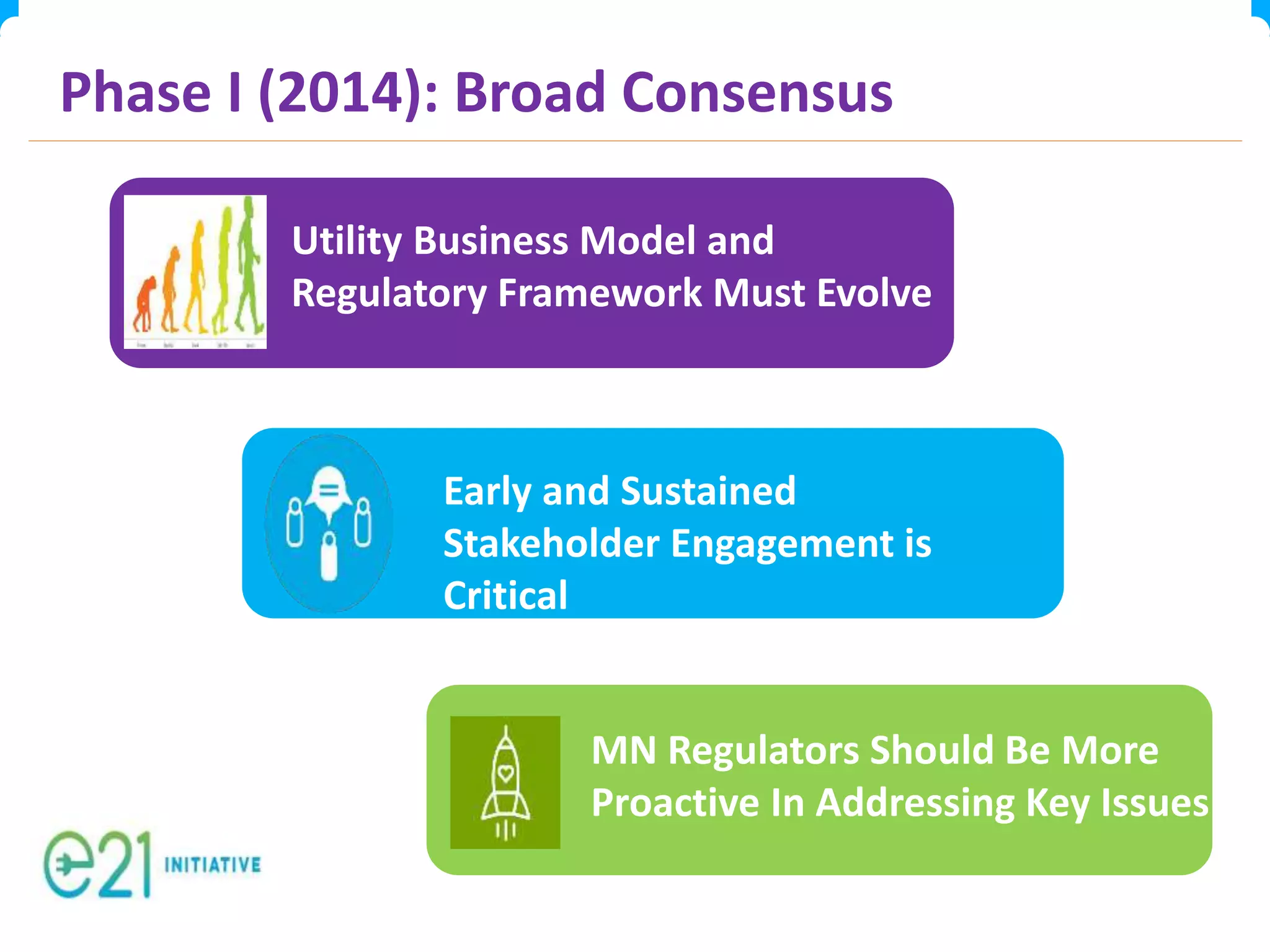
    Phase I (2014):Broad Consensus MN Regulators Should Be More Proactive In Addressing Key Issues Regulatory Process Must Evolve Early and Sustained Stakeholder Engagement is Critical Utility Business Model and Regulatory Framework Must Evolve
  • 25.
    MN PUC-Initiated Investigations •Grid Modernization2015 • Advanced Rate Design2015 • Distribution Interconnection2016 • Performance Metrics/Incentives2017 • Transportation Electrification2018
  • 26.
    Phase II (2015-16):Three Focus Areas Performance-Based Compensation Integrated Systems Planning Grid Modernization
  • 27.
    Phase III (2017-now):Ideas to Action Forums Roundtables Project Workgroups National Speakers on e21-Related Topics Convene Parties to an e21-Related Docket Stakeholder Engagement Prior to Filing of e21-Related Project
  • 28.
  • 29.
  • 30.
  • 32.
    Grid Modernization The foundationfor climate change progress Presented by: Ronny Sandoval, Director, Grid Modernization
  • 33.
    Sound Science Market-Based Solutions CorporatePartnerships Non-Partisan Policy Environmental Defense Fund’s Approach
  • 34.
  • 35.
    How do wemodernize the grid?
  • 36.
    Creating a frameworkfor full value: reliability, resiliency, efficiency and lower carbon Key benefits: • Greater visibility and control over the system • Generate critical energy data
  • 37.
    Diversity of small-scalesupply resources and increasingly engaged energy users add up to a stronger, cleaner grid Key benefits: • More affordable investments in managing the grid • Rely on more clean, distributed energy • Greater flexibility
  • 38.
    Flexibility from technologiesand markets leads to optimization of carbon-free resources Key benefits: • Maximize effectiveness of clean energy resources with advanced forecasting • Rely on more clean, renewable energy by lining up demand with renewable supply
  • 39.
    Zero-emissions vehicles drivenew opportunities for utilities while significantly decarbonizing transportation Key benefits: • Smart charging of electric vehicles can align energy demand with clean, renewable resources • Reduce harmful pollution from transportation
  • 40.
    Helping consumers makesmart decisions that benefit themselves and the shared electric grid Key benefits: • Increased communication for outages and restoration • Support for community based projects • More options for customers and third parties for smart energy management
  • 41.
    Smarter, cleaner useof new and existing infrastructure Key benefits: • Rebuild our aging infrastructure and meet future energy needs • Increase the utilization of equipment we already have • Great efficiency, cost-effectiveness, and reliability
  • 42.
    Benefits  Increased systemefficiency  Low cost, reliable energy service  Resiliency in the face of extreme weather events  Greater customer choice of products and services  Cleaner, more sustainable energy system
  • 43.
    Grid Modernization: The Foundationfor Climate Change Progress Report Now Available Download at: www.edf.org/moderngrid
  • 44.
  • 45.
  • 46.
  • 47.

Editor's Notes

  • #3 Tuesday 4/24/18 2:00 PM - 3:00 PM Ambassador Ballroom 5 & 6 BUSINESS MODELS State Grid Modernization Trends A majority of states have undertaken efforts to modernize the grid with hopes to capture operational and system efficiency, increase resiliency and reliability to integrate increasing levels of renewable and distributed resources, decarbonize, and offer customers more choices and new products and services. But how are we doing in actualizing these benefits? Hear perspectives from across the US on where they started in the process, how they prioritized possible benefits, where they focused investments, and what benefits have been realized. In the real world of tough trade offs hear lessons learned on how to arrive at a low regrets investment strategy that is executable and "good enough." MODERATORS Christine Stearn Senior Manager, 51st State, Smart Electric Power Alliance SPEAKERS Mike Bull Director, Policy and External Affairs, Center for Energy and Environment Ronny Sandoval Director, Grid Modernization, Climate & Energy Program, Environmental Defense Fund
  • #6 Changing Energy Landscape Today’s energy landscape is evolving and energy companies are being confronted with an uncertain operating environment driven by climate change, regulatory policy, security, rapidly changing technology, and increasing customer expectations for reliable and quality power. “The end game is clear for economic prosperity and security and quality of life. We need an energy system that is cleaner, leaner and ultra reliable, as well as service which must ultimately respond to the clarion call of the digital age – customized, connected, and communal,”
  • #8 In October 2011, the Illinois General Assembly enacted the Energy Infrastructure Modernization Act (EIMA), setting in motion a $2.6 billion, ten-year investment plan by ComEd to strengthen and modernize the state’s electric grid. The Future Energy Jobs Act (FEJA) was passed in December 2016. The bill includes provisions for energy efficiency, low income assistance, distributed generation, and allows for enhanced grid reliability programs. ComEd has been most affected by two recent pieces of legislation passed in Illinois, EIMA and FEJA Highlights include: EIMA has allowed ComEd to install nearly 4 million smart meters by this year; we have already installed more than 2600 DA devices and made 16 substations “smart.” This has already helped ComEd reach more than 7.6 million avoided outages, a reduction in 44% of the frequency of service interruptions, and 48% in the duration of these outages FEJA will not only promote the increased penetration of solar energy onto the distribution grid, but recognizes the value of smart inverters in mitigating their impact, and provides a tariff of $250/kW in exchange for utility control. For five years, ComEd has been working to rebuild their energy system by storm-proofing infrastructure and adding digital technologies, such as smart meters to homes. Smart meters can be read remotely and automatically tell the electric company you’ve lost electricity in a power outage. ComEd is now implementing phase two of an energy transformation “by adding clean to smart”.
  • #9 The new model envisioned by energy executives involves shifting their business model from “the pipeline business of the 20th century” that pushed products out from the top-down to platforms that create value by creating interactions. Like Facebook, Airbnb, Uber and Ebay, the electric utility business could shift from a pipeline model of companies pushing out goods to open market options where consumers could also sell back excess energy they generate without meters, shifting the value downstream to them. In our view the electric grid that is being redesigned through digital and other technological breakthroughs has the capacity to be one of the most impactful platform architectures in the economy, facilitating the migration of power across the grid in an efficient manner. The challenge for ComEd and others in the industry are the regulations. State regulations can be a barrier to innovation The FEJA legislation increases the energy efficiency programs. It provides a platform for solar coming into our state
  • #14 Much of these capabilities are dependent on having the communications infrastructure necessary to transmit, analyze and then respond to the data that is being collected by the various devices installed on the grid In the longer term, we hope to provide customers more ability to make their won decisions, by giving them the information that we are providing about their energy use in an app where they can conveniently respond to it.
  • #15 The demonstration microgrid project will be located within the Bronzeville neighborhood on Chicago's South Side, in an area bounded from 33rd Street to the North, 38th Street to the South, State Street to the West, and South Dr. Martin L. King Jr. Drive to the East. Bronzeville was selected following a comprehensive study to evaluate locations where a microgrid could be located. The study developed an overall resiliency metric for small sections of ComEd's northern Illinois service territory and identified locations where a microgrid could best address both security and resiliency, with a focus on public good. The project will serve an area that includes 10 facilities providing critical services, including the Chicago Public Safety Headquarters, the De La Salle Institute and the Math & Science Academy, a library, public works buildings, restaurants, health clinics, public transportation, educational facilities, and churches.
  • #18 Tuesday 4/24/18 2:00 PM - 3:00 PM Ambassador Ballroom 5 & 6 BUSINESS MODELS State Grid Modernization Trends A majority of states have undertaken efforts to modernize the grid with hopes to capture operational and system efficiency, increase resiliency and reliability to integrate increasing levels of renewable and distributed resources, decarbonize, and offer customers more choices and new products and services. But how are we doing in actualizing these benefits? Hear perspectives from across the US on where they started in the process, how they prioritized possible benefits, where they focused investments, and what benefits have been realized. In the real world of tough trade offs hear lessons learned on how to arrive at a low regrets investment strategy that is executable and "good enough." MODERATORS Christine Stearn Senior Manager, 51st State, Smart Electric Power Alliance SPEAKERS Mike Bull Director, Policy and External Affairs, Center for Energy and Environment Ronny Sandoval Director, Grid Modernization, Climate & Energy Program, Environmental Defense Fund
  • #19  Thanks Chris, and thank you all for joining us today for what I think will be a really important conversation about electrification, both the technologies we’ll be relying on and the policies that will ensure that customers benefit. But first a little about CEE – we’re a 40 year old clean energy non-profit located here in the Twin Cities, with a special expertise in energy efficiency. We are data-driven, community-based and consumer focused, with a passion for discovering and deploying the most effective solutions for healthy, low-carbon economy.
  • #20  We have about 135 or so staff, working in one of three integrated areas of focus – Technical Research, Programs and Services, and Policy and Engagement.
  • #21 And, although we’re mainly focused here in Minnesota, we’ve done work all around the country as shown here on this slide.
  • #23 There are really THREE BIG SHIFTS happening simultaneously that are re-making the electric sector. These shifts are similar in some ways to the forces that re-shaped the TELECOM INDUSTRY and moved us from LARGE MAIN-FRAME COMPUTERS to the COMPUTERS WE HAVE ON OUR DESKS AND CARRY WITH US.
  • #34 EDF tackles the most serious environmental problems with: A commitment to sound science Efficient, market-based solutions Transformative business partnerships Smart, non-partisan policy
  • #35 Four focus areas: climate and energy, oceans, ecosystems and health Around 700 staff in 12 offices across the world Team of scientists, attorneys, policymakers, business leaders, engineers and economists
  • #36 There are 6 main capabilities – each are connected, no “most important” section.