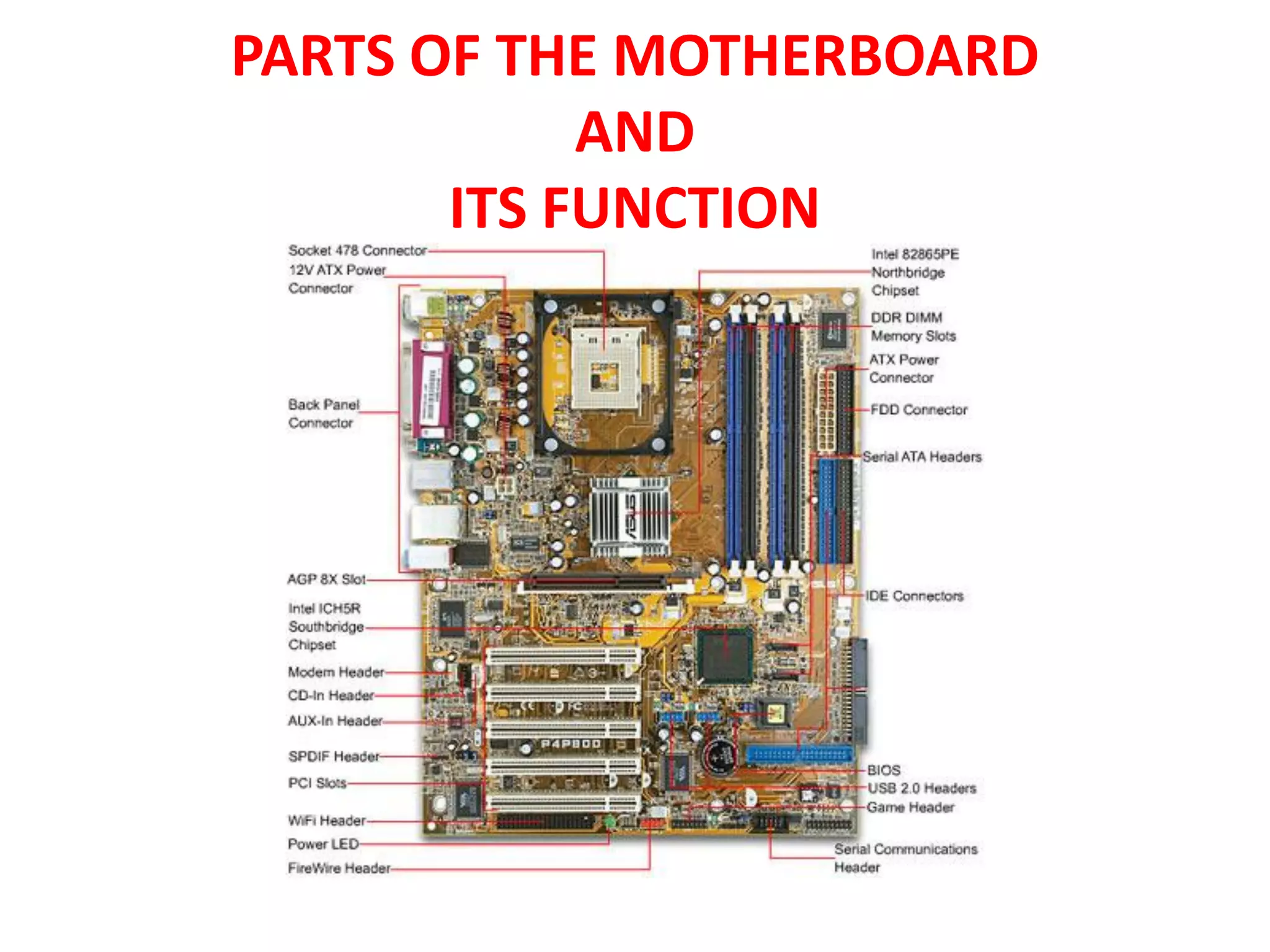

PARTS OF THE MOTHERBOARD
AND
ITS FUNCTION
MOTHERBOARD
• Alternatively referred to as the mb, mainboard, mobo, mobd,
backplane board, base board, planar board, system board, or
logic board on Apple computers.
• The motherboard is a printed circuit board that is the foundation of
a computer and allows the CPU, RAM, and all other computer
hardware components to function and communicate with each other.
4 pin CPU Fan pin-out
4-pin connectors are usually used by CPU fans
with higher power consumption.
12v 4 pin CPU Power Connector
This device senses the CPU voltage requirements
(usually via sense pins on the processor) and calibrates
itself to provide the proper voltage to run the CPU.
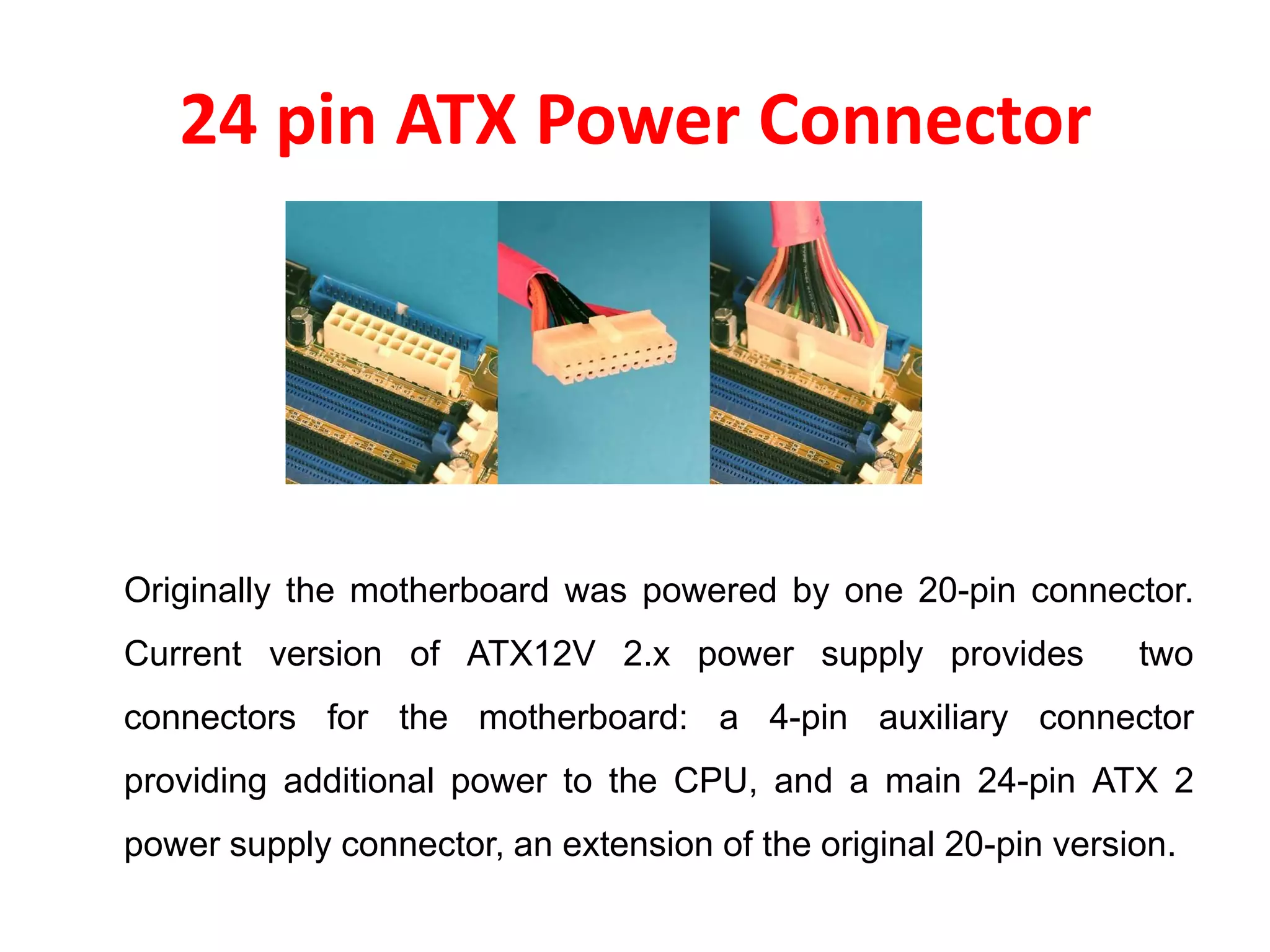
24 pin ATX Power Connector
Originally the motherboard was powered by one 20-pin connector.
Current version of ATX12V 2.x power supply provides two
connectors for the motherboard: a 4-pin auxiliary connector
providing additional power to the CPU, and a main 24-pin ATX 2
power supply connector, an extension of the original 20-pin version.
FRONT PANEL CONNECTORS
The front panel connector is where the connectors of hard disk drive
activity lights, case speaker, reset button, power on/off button,
computer power on light, and key lock, are connected to make them
function smoothly.
TYPES OF SYSTEM PANEL CABLES
• HDD LED (IDE LED) – The LED activity light for the hard
disk drive. This is the LED that flashes as information is
being written and read from the hard drive.
• POWER LED (PLED) – The LED power light, which
indicates when the computer is on, off, or in standby.
• POWER SW (PWRSW) – controls the power button that
allows you to turn on and off the computer.
• RESET SW – handles the reset button to restart the
computer
BIOS
Short for Basic Input/Output System, the BIOS,
ROM BIOS, or System BIOS is a chip located on all
motherboards that contain instructions and setup for
how your system should boot and how it operate.
CMOS BATTERY
To keep the clock chip running
even when power is of.
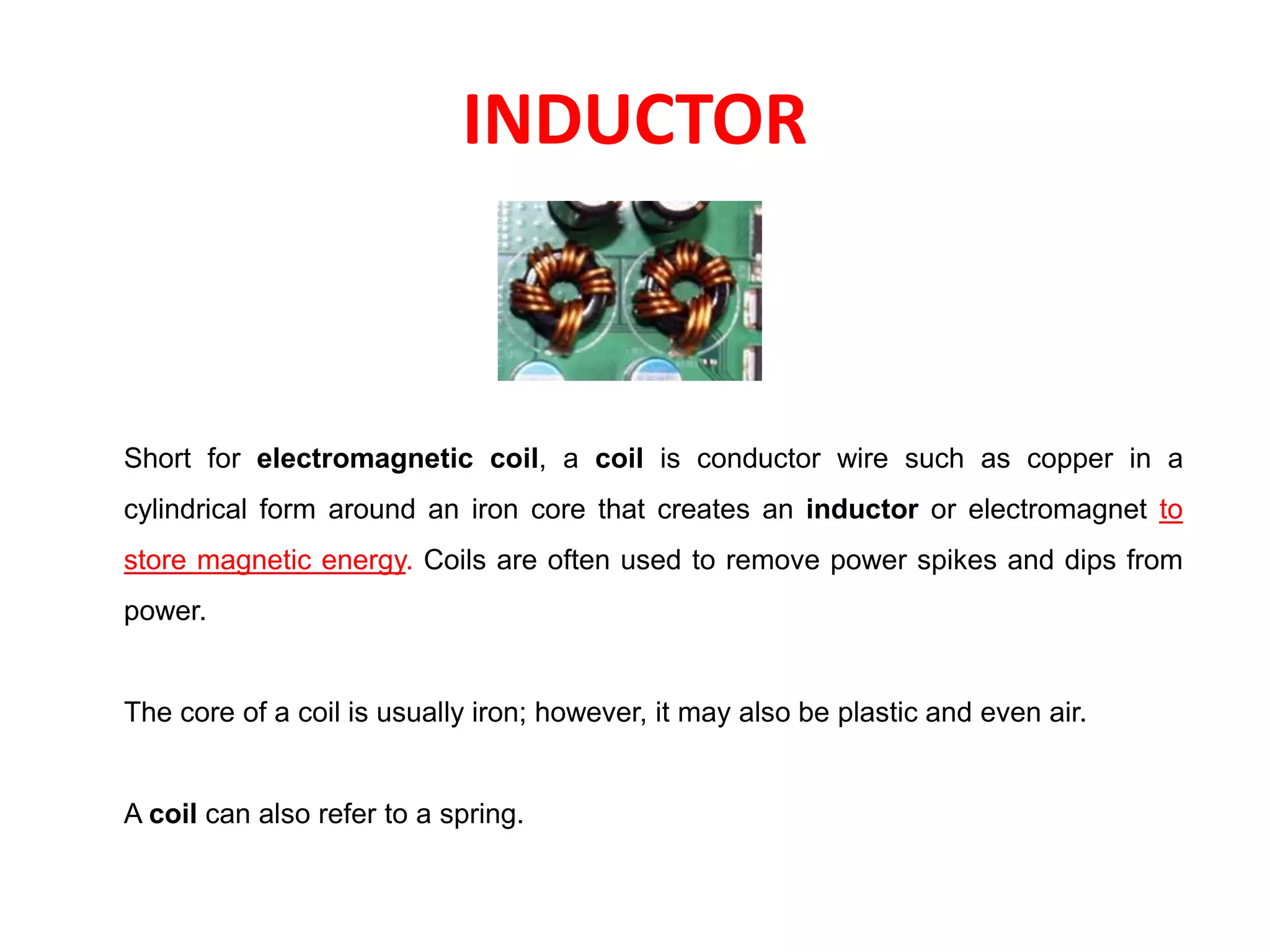
INDUCTOR
Short for electromagnetic coil, a coil is conductor wire such as copper in a
cylindrical form around an iron core that creates an inductor or electromagnet to
store magnetic energy. Coils are often used to remove power spikes and dips from
power.
The core of a coil is usually iron; however, it may also be plastic and even air.
A coil can also refer to a spring.
NORTH BRIDGE
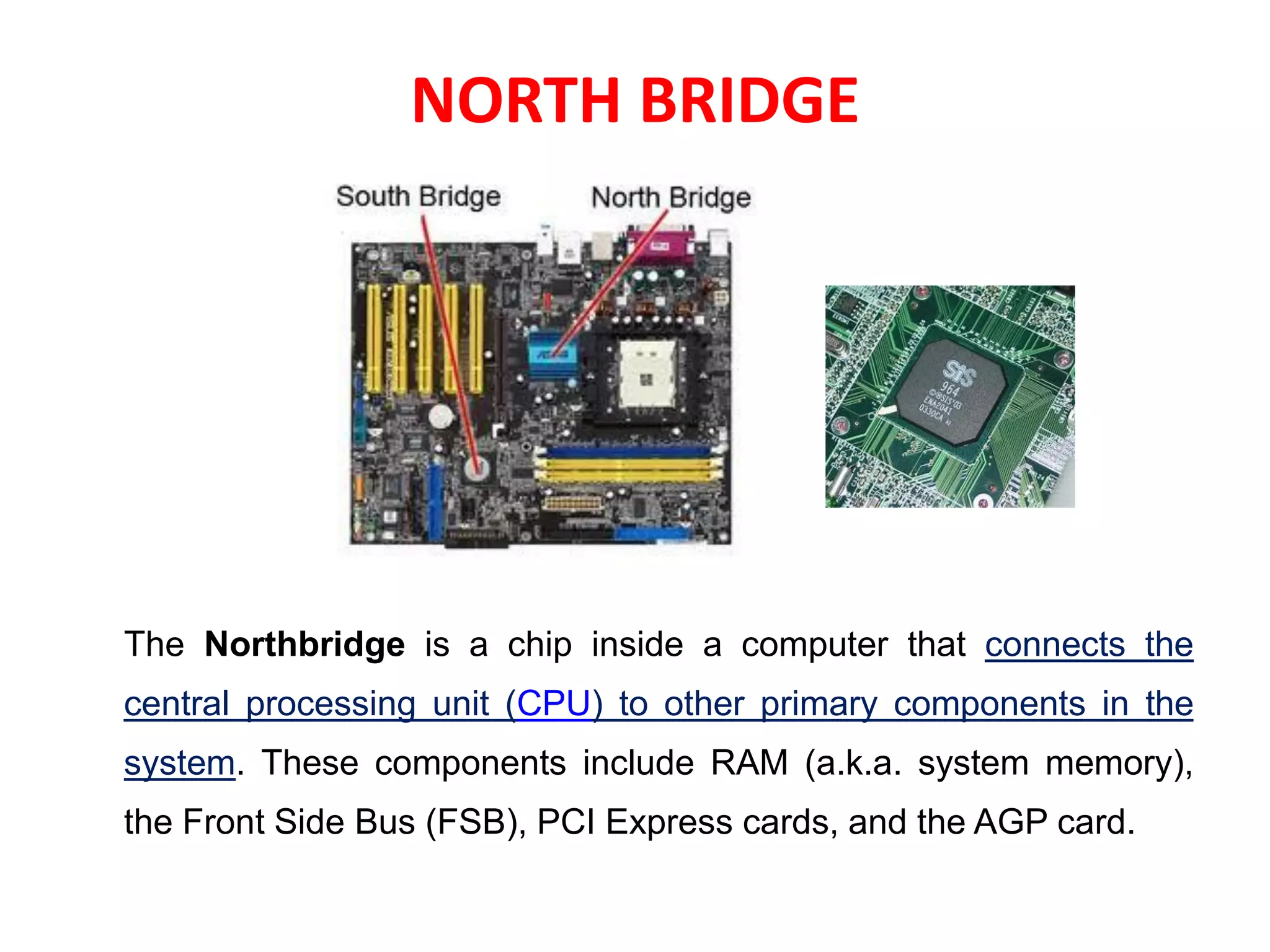
The Northbridge is a chip inside a computer that connects the
central processing unit (CPU) to other primary components in the
system. These components include RAM (a.k.a. system memory),
the Front Side Bus (FSB), PCI Express cards, and the AGP card.
SOUTH BRIDGE
A Southbridge chipset handles all of a computer's I/O
functions, such as USB, audio, serial, the system BIOS, the
ISA bus, the interrupt controller and the IDE channels
SUPER I/O Controller
Super I/O is a class of I/O controller integrated circuits that began to be used on personal
computer motherboards in the late 1980s, originally as add-in cards, later embedded on the
motherboards. A super I/O chip combines interfaces for a variety of low-bandwidth devices. The
functions provided usually include:
• A floppy disk controller
• A parallel port (commonly used for printers)
• One or more serial ports
• A PS/2 keyboard and mouse interface.
• Temperature sensor and fan speed monitoring
SCREW HOLE
A hole through which to bolt.
INTEGRATED CIRCUIT
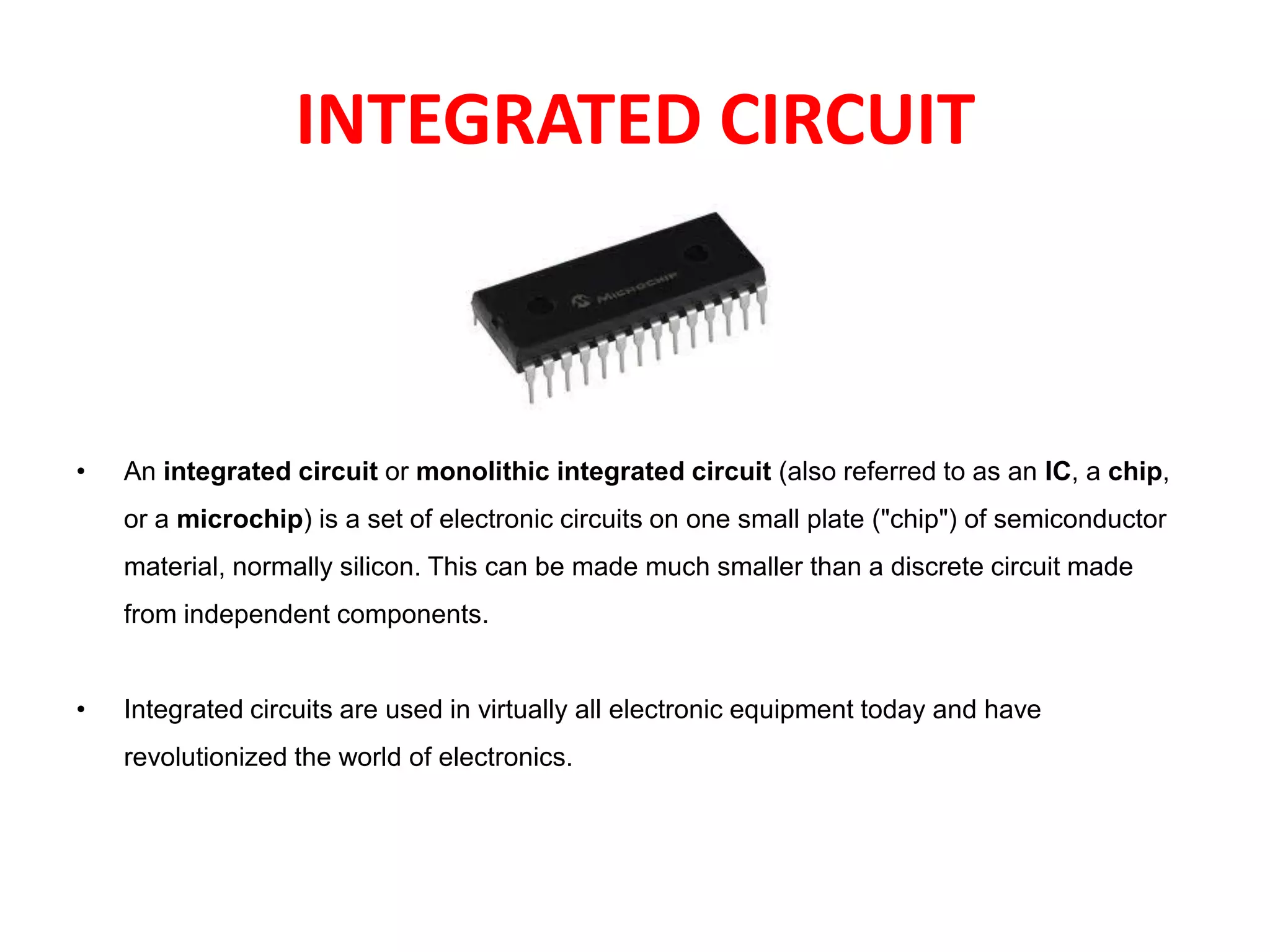
• An integrated circuit or monolithic integrated circuit (also referred to as an IC, a chip,
or a microchip) is a set of electronic circuits on one small plate ("chip") of semiconductor
material, normally silicon. This can be made much smaller than a discrete circuit made
from independent components.
• Integrated circuits are used in virtually all electronic equipment today and have
revolutionized the world of electronics.
JUMPERS
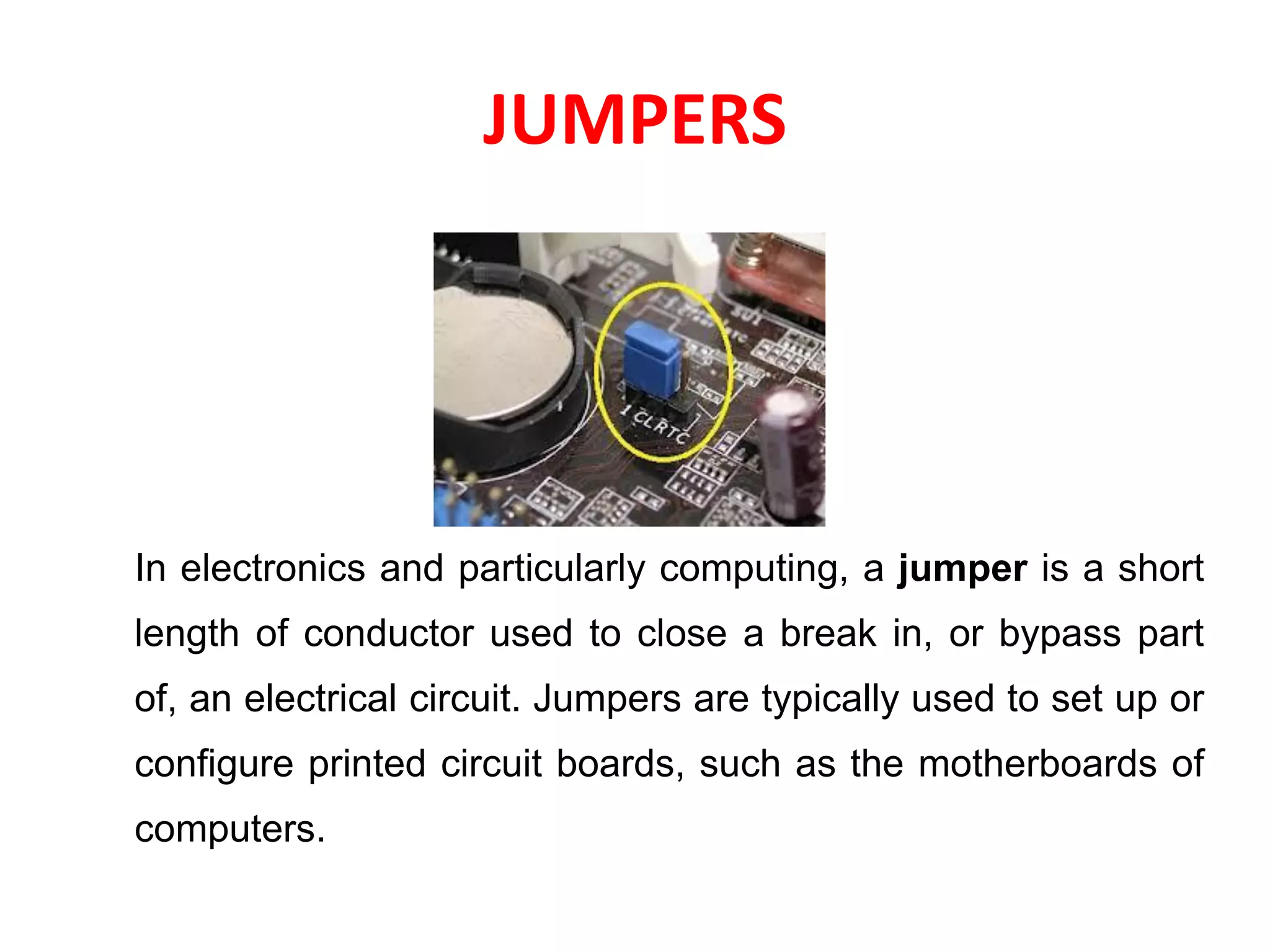
In electronics and particularly computing, a jumper is a short
length of conductor used to close a break in, or bypass part
of, an electrical circuit. Jumpers are typically used to set up or
configure printed circuit boards, such as the motherboards of
computers.
FWH IN PLCC
Short for Plastic Leadless Chip Carrier, PLCC is a cheaper
version of the Leadless chip carrier socket. Although similar, PLCC
and LCC are not compatible with one another. In the picture to the
right, is an example of a FWH chip in a PLCC.
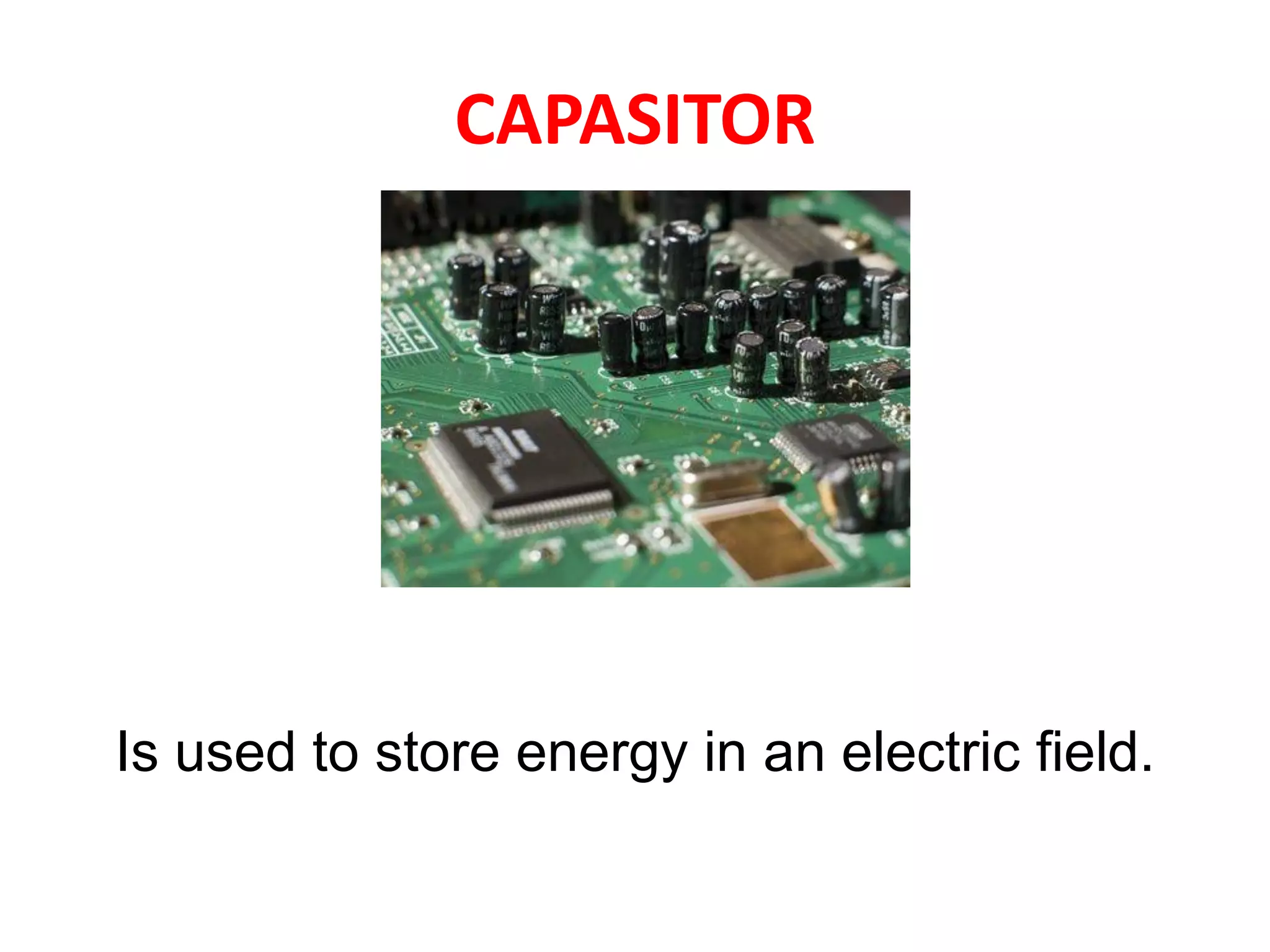
CAPASITOR
Is used to store energy in an electric field.
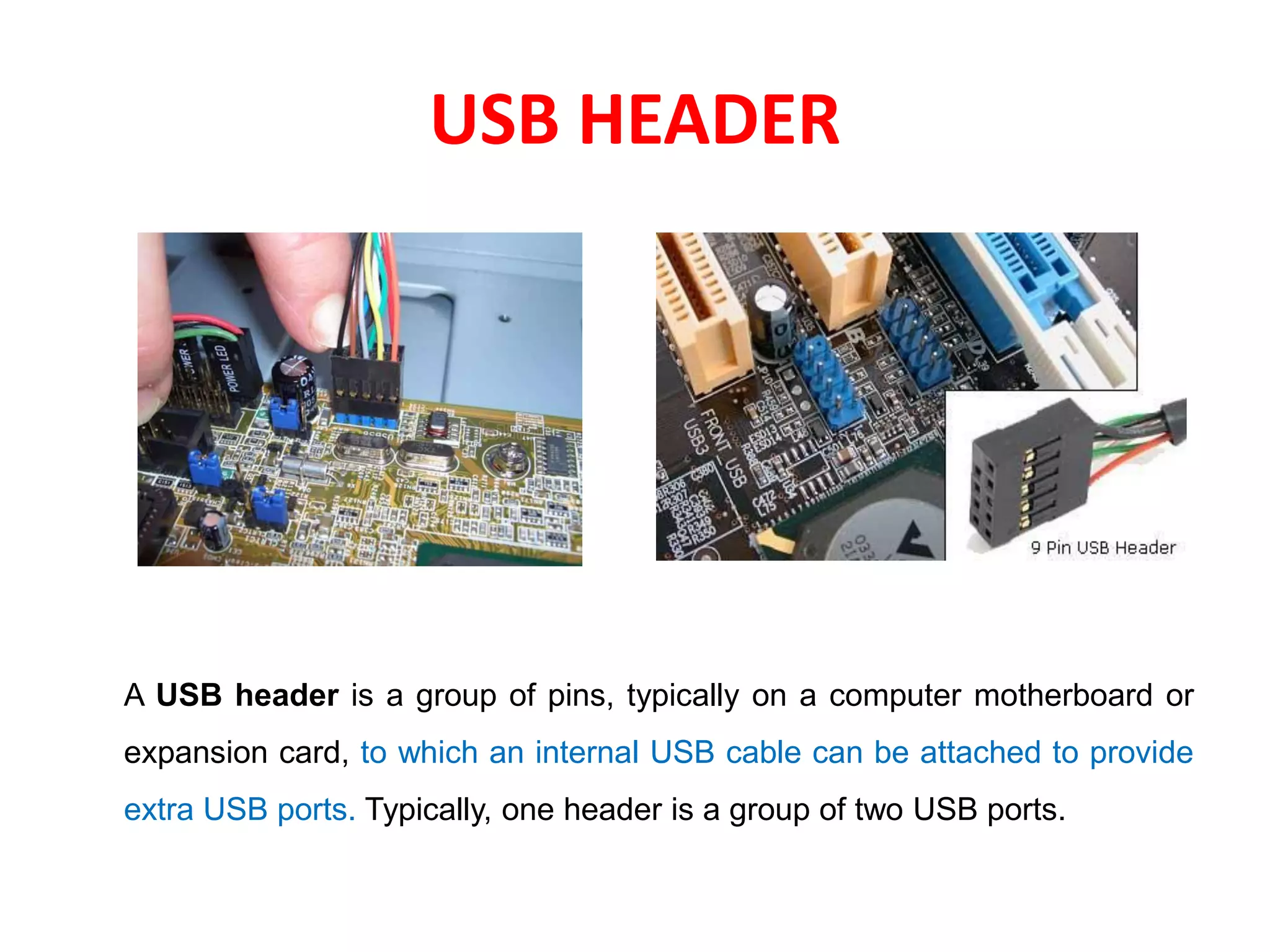
USB HEADER
A USB header is a group of pins, typically on a computer motherboard or
expansion card, to which an internal USB cable can be attached to provide
extra USB ports. Typically, one header is a group of two USB ports.
IDE SLOT
Integrated Drive Electronics (or PATA) is a drive controller on
your motherboard that supports both Hard drives and CD-
ROM and DVD-ROM devices (and all their different varieties).
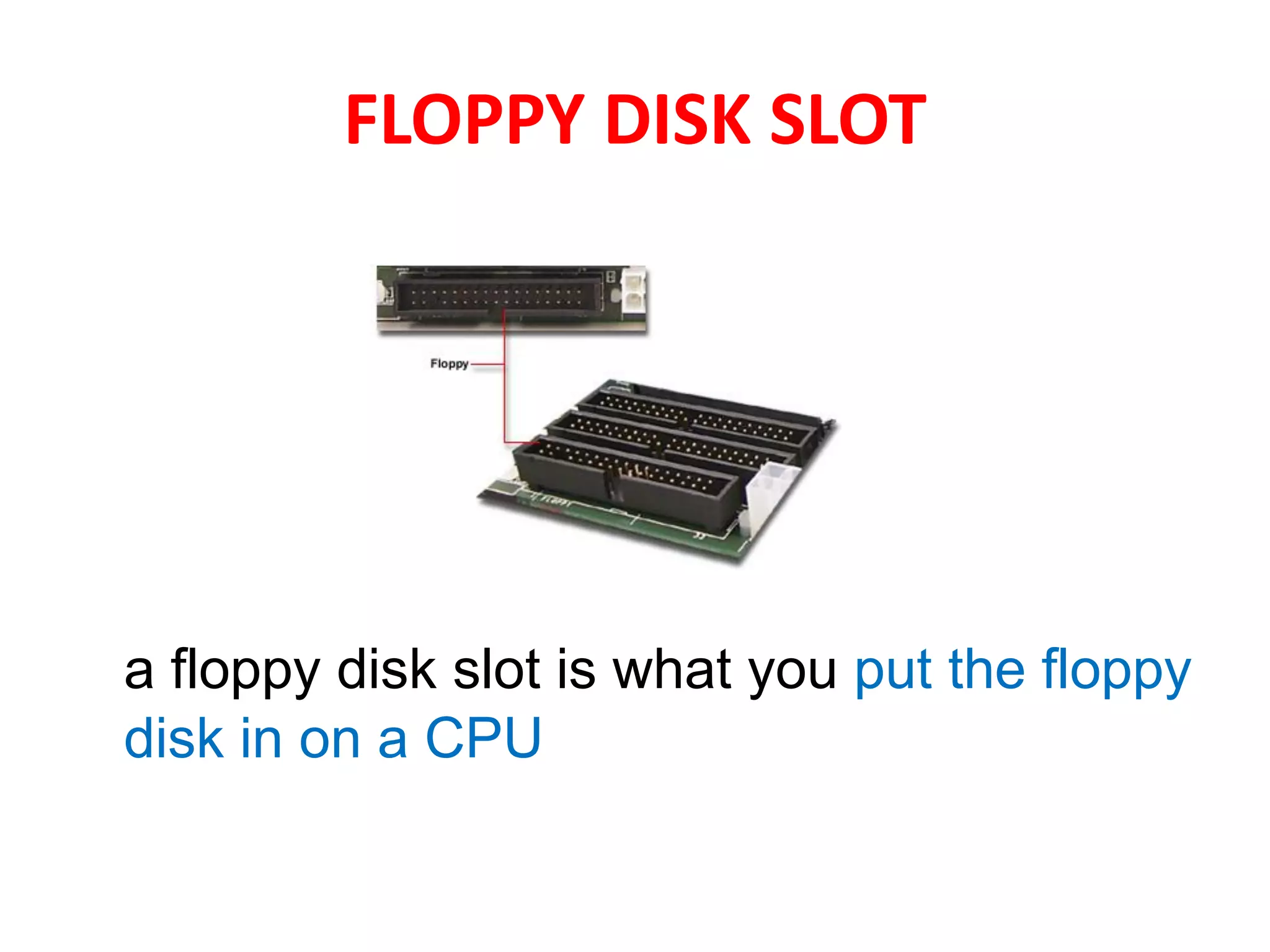
FLOPPY DISK SLOT
a floppy disk slot is what you put the floppy
disk in on a CPU
MEMORY SLOT
A memory slot, memory socket, or RAM slot is
what allows computer memory (RAM) to be inserted
into the computer
PCI SLOT
Provides a medium to expand the capabilities of the
PC, by adding like modems cards, audio cards,
Ethernet cards.
Ethernet Card
Sound Card
Modem Card
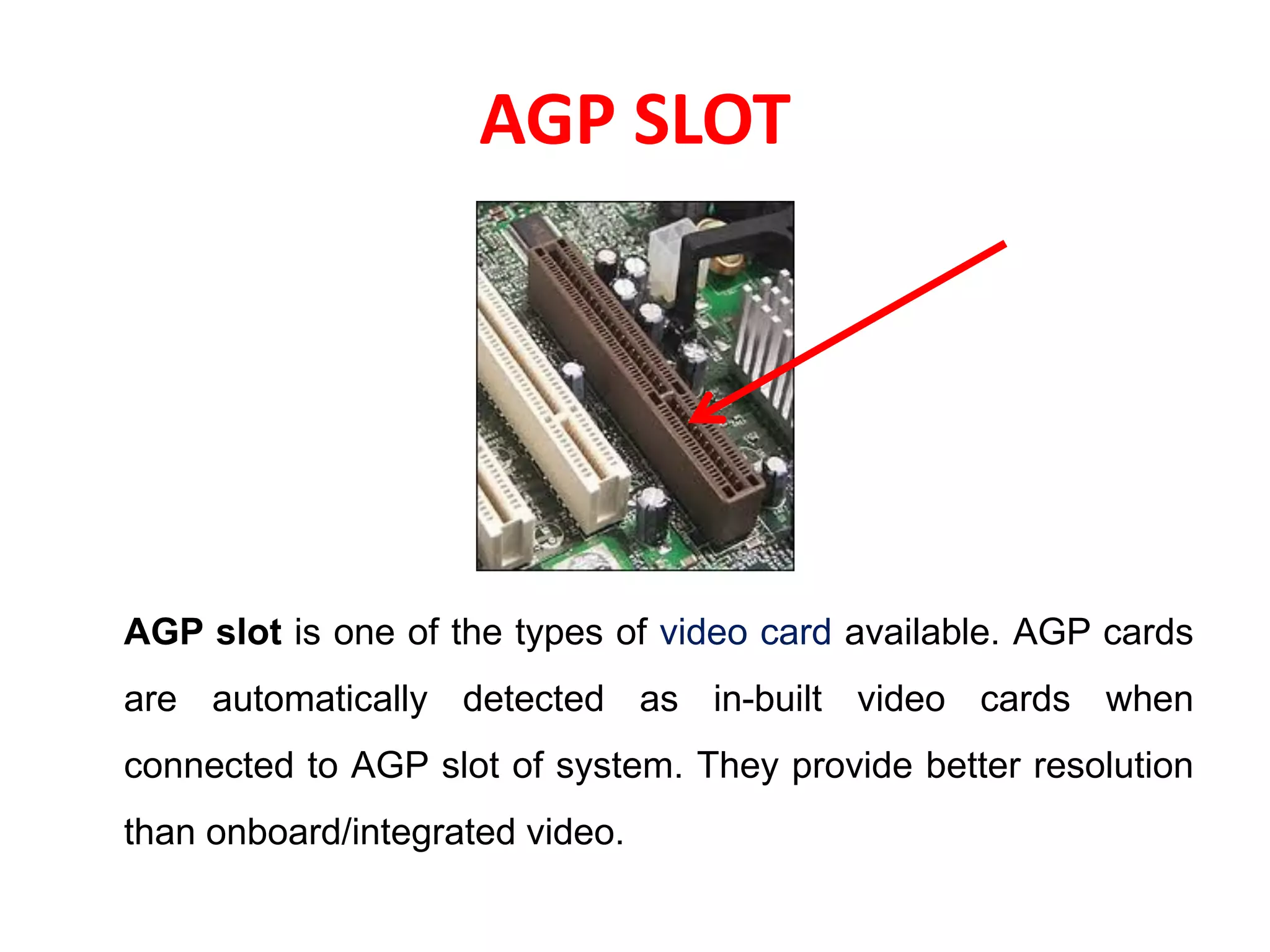
AGP SLOT
AGP slot is one of the types of video card available. AGP cards
are automatically detected as in-built video cards when
connected to AGP slot of system. They provide better resolution
than onboard/integrated video.
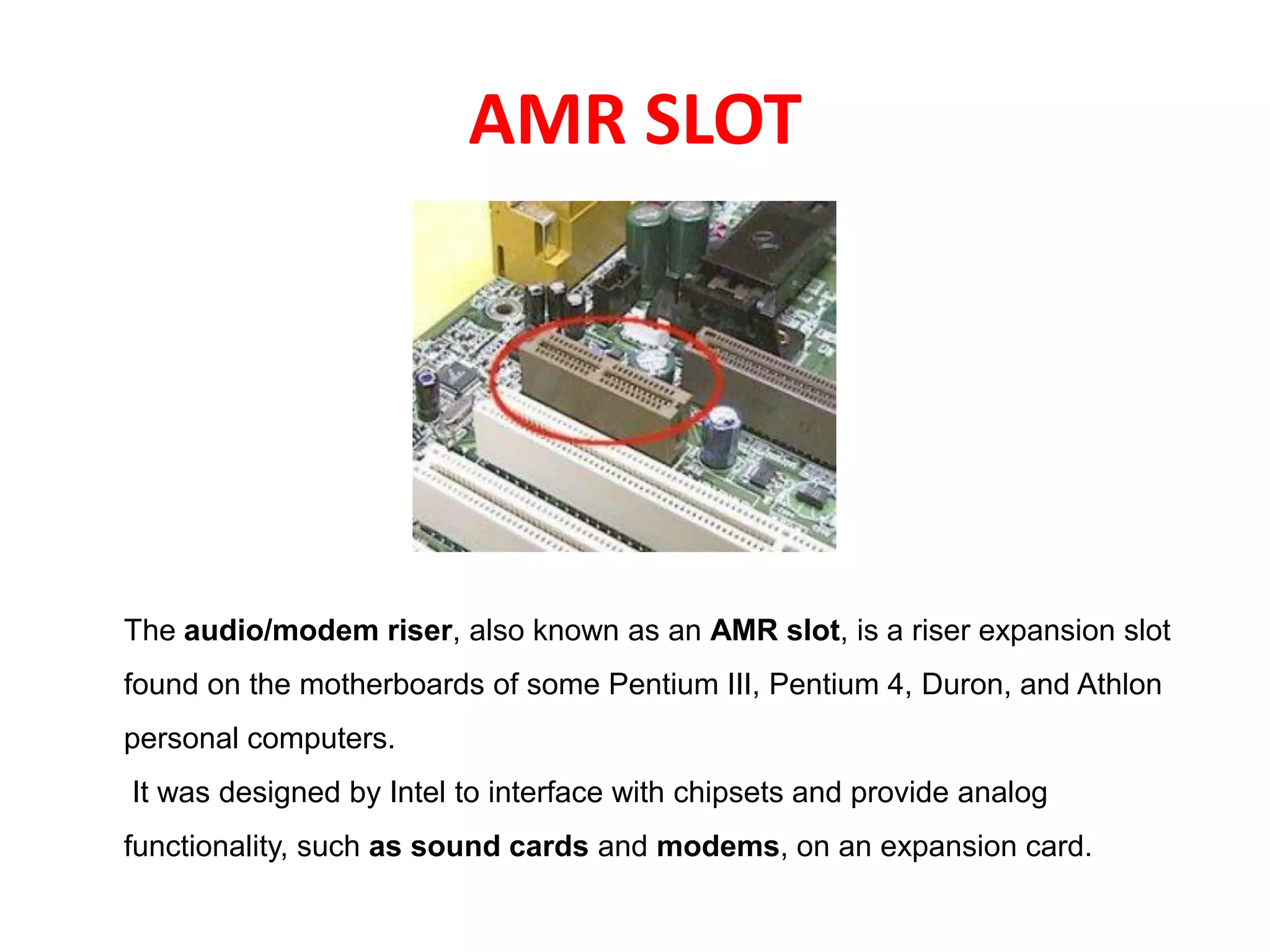
AMR SLOT
The audio/modem riser, also known as an AMR slot, is a riser expansion slot
found on the motherboards of some Pentium III, Pentium 4, Duron, and Athlon
personal computers.
It was designed by Intel to interface with chipsets and provide analog
functionality, such as sound cards and modems, on an expansion card.
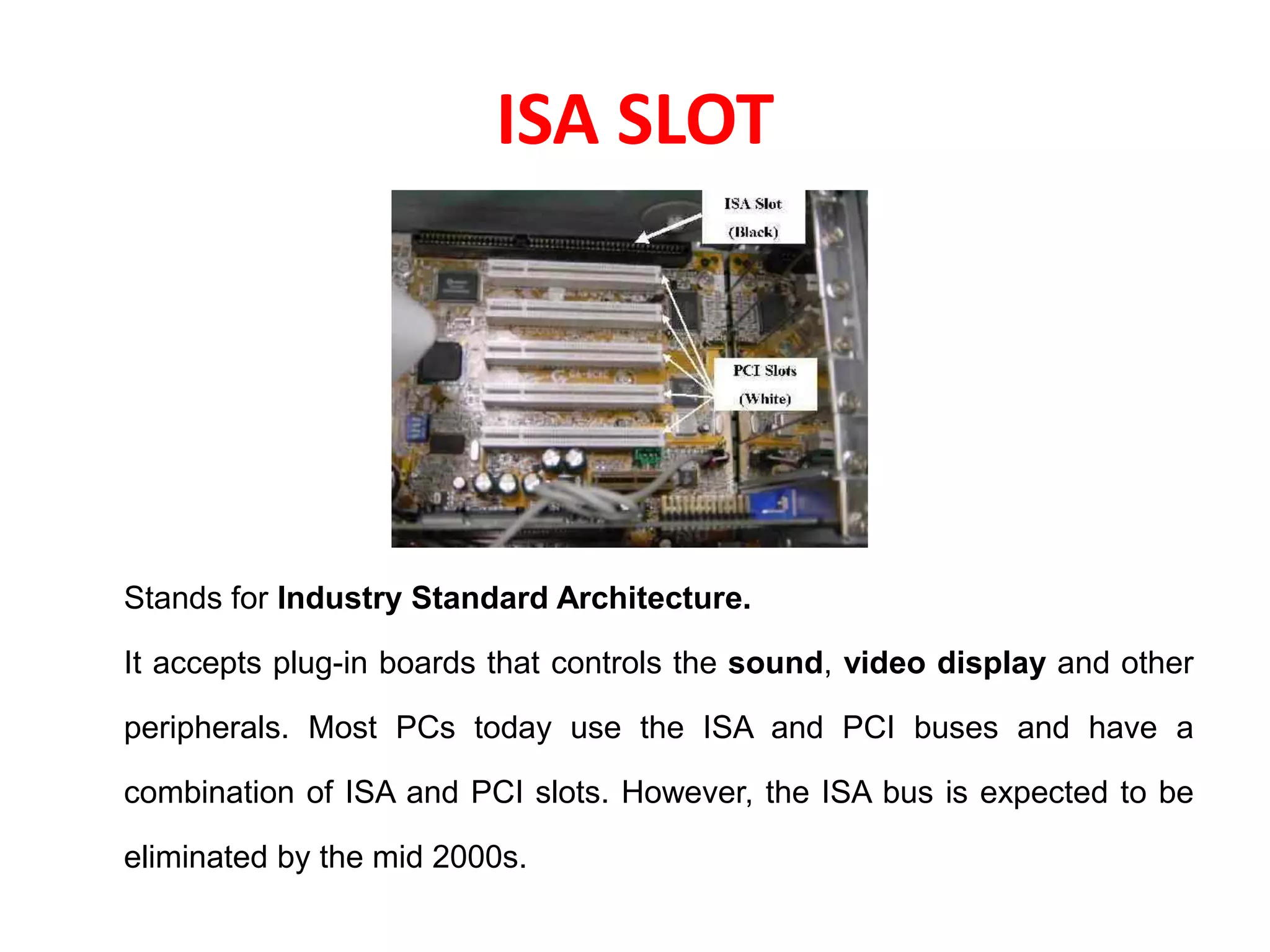
ISA SLOT
Stands for Industry Standard Architecture.
It accepts plug-in boards that controls the sound, video display and other
peripherals. Most PCs today use the ISA and PCI buses and have a
combination of ISA and PCI slots. However, the ISA bus is expected to be
eliminated by the mid 2000s.
GAME PORT
The game port is a device port found on IBM PC compatible
systems throughout the 1980s and 1990s. It was the traditional
connector for joystick input devices until superseded by USB in
the 21st century.
Originally located on a dedicated expansion card, the game port
was later integrated with PC sound cards.
PCI EXPRESS X1
PCIe 1x is the replacement for lower
bandwidth devices.
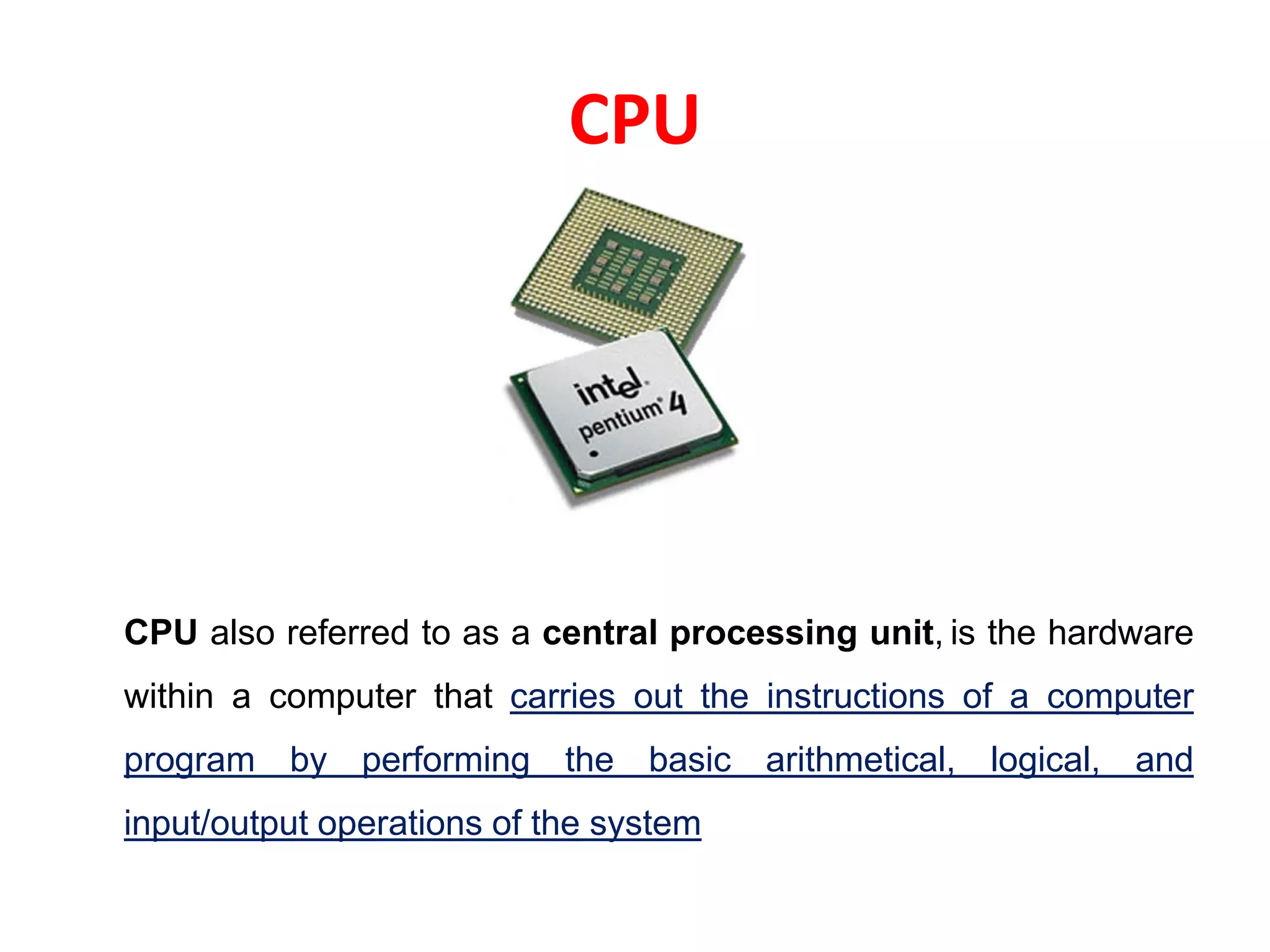
CPU
CPU also referred to as a central processing unit, is the hardware
within a computer that carries out the instructions of a computer
program by performing the basic arithmetical, logical, and
input/output operations of the system
CPU SOCKET
A CPU socket or CPU slot is a mechanical component(s) that
provides mechanical and electrical connections between a
microprocessor and a printed circuit board (PCB).
CPU FAN
CPU fan is attached together with a heat sink on
the mother board, CPU fan is used to prevent
overheating of the processor on the motherboard.
HEAT SINK
Heat sink is a passive heat exchanger component
that cools a device by dissipating heat into the
surrounding air. It is used to cool central
processing units or graphic processors.
BACK PANEL & I/O CONNECTORS
PS/2
Mouse
PS/2
Keyboard
Parallel
Port
Serial
Port
VGA
Port
USB
Port
LAN
Port
Mic-in/
Digital I/O
Jack
Line-in
Jack
Line-out
Jack
PARALLEL PORT
A parallel port is a type of interface found on computers
(personal and otherwise) for connecting peripherals. It is
also known as a printer port or Centronics port.
PS/2 connector
is a 6-pin Mini-DIN connector used for
connecting some keyboards and mice to a
PC compatible computer system.
SERIAL PORT
A serial port can be connected to numerous devices; pretty much any device that has
another serial port. It is a serial communication physical interface through which
information transfers in or out one bit at a time
Examples include: Modems, serial mice, serial printers, bar code readers, digital
scales, data acquisition equipment, pumps, flow monitors, radios, etc.
Serial Port
Female
Serial Port
Male
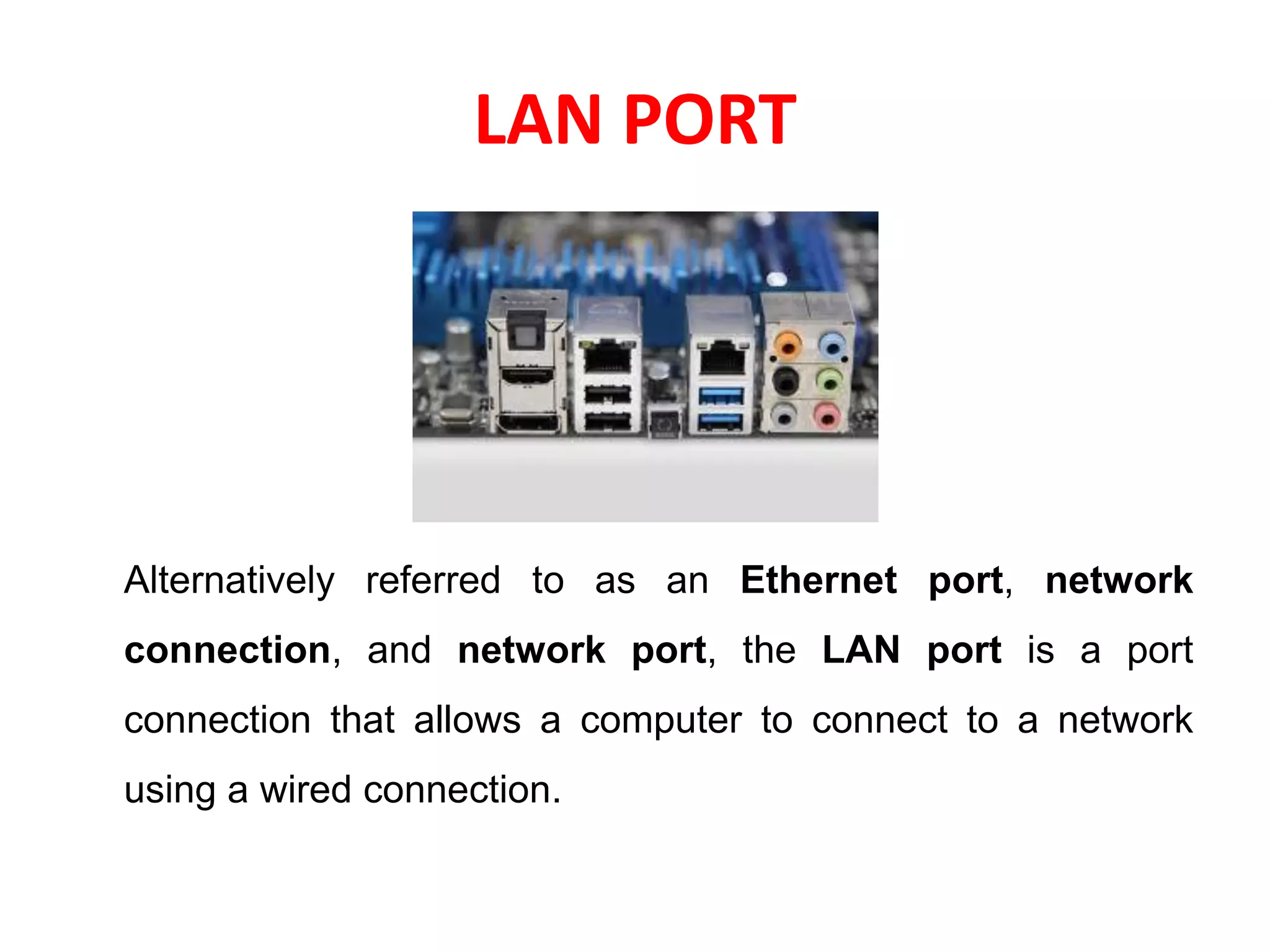
LAN PORT
Alternatively referred to as an Ethernet port, network
connection, and network port, the LAN port is a port
connection that allows a computer to connect to a network
using a wired connection.
USB PORT
Universal Serial Bus, is a device system designed for the
accessories of the computer system, it allows you to hot swap any
devices that is designed for the port. Some of these devices include:
Keyboard, Mouse, Game Controllers, Lights, Fans and a slew of
other things.
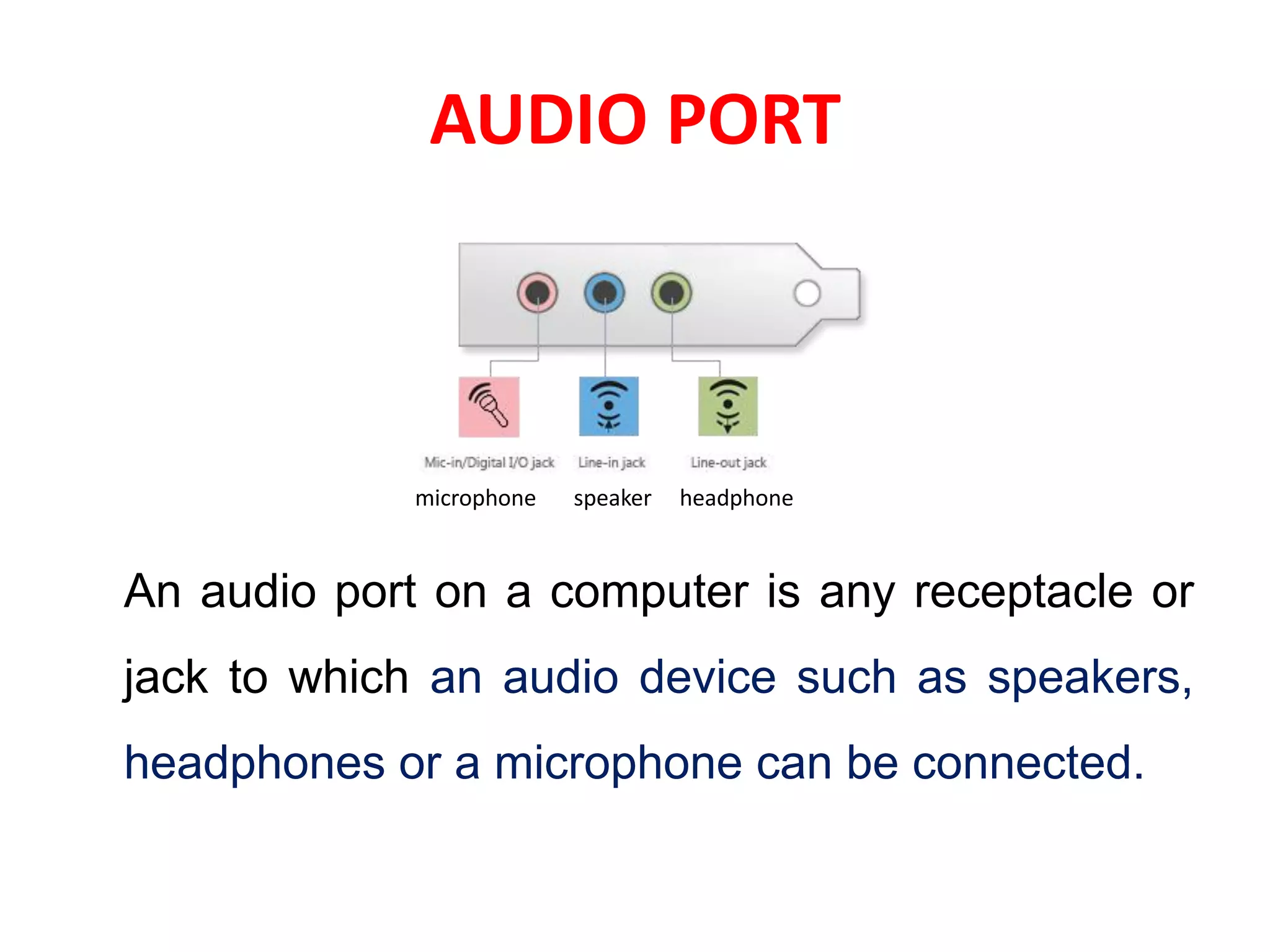
AUDIO PORT
An audio port on a computer is any receptacle or
jack to which an audio device such as speakers,
headphones or a microphone can be connected.
headphonespeakermicrophone
VGA PORT
A Video Graphics Array (VGA) connector is a three-row 15-pin
DE-15 connector. The 15-pin VGA connector is found on many video
cards, computer monitors, and high definition television sets.
VGA
Connector
Female
VGA
Connector
Male
THANK YOU

Motherboard parts & functions

  • 1.
    PARTS OF THEMOTHERBOARD AND ITS FUNCTION
  • 2.
    MOTHERBOARD • Alternatively referredto as the mb, mainboard, mobo, mobd, backplane board, base board, planar board, system board, or logic board on Apple computers. • The motherboard is a printed circuit board that is the foundation of a computer and allows the CPU, RAM, and all other computer hardware components to function and communicate with each other.
  • 3.
    4 pin CPUFan pin-out 4-pin connectors are usually used by CPU fans with higher power consumption.
  • 4.
    12v 4 pinCPU Power Connector This device senses the CPU voltage requirements (usually via sense pins on the processor) and calibrates itself to provide the proper voltage to run the CPU.
  • 5.
    24 pin ATXPower Connector Originally the motherboard was powered by one 20-pin connector. Current version of ATX12V 2.x power supply provides two connectors for the motherboard: a 4-pin auxiliary connector providing additional power to the CPU, and a main 24-pin ATX 2 power supply connector, an extension of the original 20-pin version.
  • 6.
    FRONT PANEL CONNECTORS Thefront panel connector is where the connectors of hard disk drive activity lights, case speaker, reset button, power on/off button, computer power on light, and key lock, are connected to make them function smoothly.
  • 7.
    TYPES OF SYSTEMPANEL CABLES • HDD LED (IDE LED) – The LED activity light for the hard disk drive. This is the LED that flashes as information is being written and read from the hard drive. • POWER LED (PLED) – The LED power light, which indicates when the computer is on, off, or in standby. • POWER SW (PWRSW) – controls the power button that allows you to turn on and off the computer. • RESET SW – handles the reset button to restart the computer
  • 8.
    BIOS Short for BasicInput/Output System, the BIOS, ROM BIOS, or System BIOS is a chip located on all motherboards that contain instructions and setup for how your system should boot and how it operate.
  • 9.
    CMOS BATTERY To keepthe clock chip running even when power is of.
  • 10.
    INDUCTOR Short for electromagneticcoil, a coil is conductor wire such as copper in a cylindrical form around an iron core that creates an inductor or electromagnet to store magnetic energy. Coils are often used to remove power spikes and dips from power. The core of a coil is usually iron; however, it may also be plastic and even air. A coil can also refer to a spring.
  • 11.
    NORTH BRIDGE The Northbridgeis a chip inside a computer that connects the central processing unit (CPU) to other primary components in the system. These components include RAM (a.k.a. system memory), the Front Side Bus (FSB), PCI Express cards, and the AGP card.
  • 12.
    SOUTH BRIDGE A Southbridgechipset handles all of a computer's I/O functions, such as USB, audio, serial, the system BIOS, the ISA bus, the interrupt controller and the IDE channels
  • 13.
    SUPER I/O Controller SuperI/O is a class of I/O controller integrated circuits that began to be used on personal computer motherboards in the late 1980s, originally as add-in cards, later embedded on the motherboards. A super I/O chip combines interfaces for a variety of low-bandwidth devices. The functions provided usually include: • A floppy disk controller • A parallel port (commonly used for printers) • One or more serial ports • A PS/2 keyboard and mouse interface. • Temperature sensor and fan speed monitoring
  • 14.
    SCREW HOLE A holethrough which to bolt.
  • 15.
    INTEGRATED CIRCUIT • Anintegrated circuit or monolithic integrated circuit (also referred to as an IC, a chip, or a microchip) is a set of electronic circuits on one small plate ("chip") of semiconductor material, normally silicon. This can be made much smaller than a discrete circuit made from independent components. • Integrated circuits are used in virtually all electronic equipment today and have revolutionized the world of electronics.
  • 16.
    JUMPERS In electronics andparticularly computing, a jumper is a short length of conductor used to close a break in, or bypass part of, an electrical circuit. Jumpers are typically used to set up or configure printed circuit boards, such as the motherboards of computers.
  • 17.
    FWH IN PLCC Shortfor Plastic Leadless Chip Carrier, PLCC is a cheaper version of the Leadless chip carrier socket. Although similar, PLCC and LCC are not compatible with one another. In the picture to the right, is an example of a FWH chip in a PLCC.
  • 18.
    CAPASITOR Is used tostore energy in an electric field.
  • 19.
    USB HEADER A USBheader is a group of pins, typically on a computer motherboard or expansion card, to which an internal USB cable can be attached to provide extra USB ports. Typically, one header is a group of two USB ports.
  • 20.
    IDE SLOT Integrated DriveElectronics (or PATA) is a drive controller on your motherboard that supports both Hard drives and CD- ROM and DVD-ROM devices (and all their different varieties).
  • 21.
    FLOPPY DISK SLOT afloppy disk slot is what you put the floppy disk in on a CPU
  • 22.
    MEMORY SLOT A memoryslot, memory socket, or RAM slot is what allows computer memory (RAM) to be inserted into the computer
  • 23.
    PCI SLOT Provides amedium to expand the capabilities of the PC, by adding like modems cards, audio cards, Ethernet cards.
  • 24.
  • 25.
    AGP SLOT AGP slotis one of the types of video card available. AGP cards are automatically detected as in-built video cards when connected to AGP slot of system. They provide better resolution than onboard/integrated video.
  • 26.
    AMR SLOT The audio/modemriser, also known as an AMR slot, is a riser expansion slot found on the motherboards of some Pentium III, Pentium 4, Duron, and Athlon personal computers. It was designed by Intel to interface with chipsets and provide analog functionality, such as sound cards and modems, on an expansion card.
  • 27.
    ISA SLOT Stands forIndustry Standard Architecture. It accepts plug-in boards that controls the sound, video display and other peripherals. Most PCs today use the ISA and PCI buses and have a combination of ISA and PCI slots. However, the ISA bus is expected to be eliminated by the mid 2000s.
  • 28.
    GAME PORT The gameport is a device port found on IBM PC compatible systems throughout the 1980s and 1990s. It was the traditional connector for joystick input devices until superseded by USB in the 21st century. Originally located on a dedicated expansion card, the game port was later integrated with PC sound cards.
  • 29.
    PCI EXPRESS X1 PCIe1x is the replacement for lower bandwidth devices.
  • 30.
    CPU CPU also referredto as a central processing unit, is the hardware within a computer that carries out the instructions of a computer program by performing the basic arithmetical, logical, and input/output operations of the system
  • 31.
    CPU SOCKET A CPUsocket or CPU slot is a mechanical component(s) that provides mechanical and electrical connections between a microprocessor and a printed circuit board (PCB).
  • 32.
    CPU FAN CPU fanis attached together with a heat sink on the mother board, CPU fan is used to prevent overheating of the processor on the motherboard.
  • 33.
    HEAT SINK Heat sinkis a passive heat exchanger component that cools a device by dissipating heat into the surrounding air. It is used to cool central processing units or graphic processors.
  • 34.
    BACK PANEL &I/O CONNECTORS PS/2 Mouse PS/2 Keyboard Parallel Port Serial Port VGA Port USB Port LAN Port Mic-in/ Digital I/O Jack Line-in Jack Line-out Jack
  • 35.
    PARALLEL PORT A parallelport is a type of interface found on computers (personal and otherwise) for connecting peripherals. It is also known as a printer port or Centronics port.
  • 36.
    PS/2 connector is a6-pin Mini-DIN connector used for connecting some keyboards and mice to a PC compatible computer system.
  • 37.
    SERIAL PORT A serialport can be connected to numerous devices; pretty much any device that has another serial port. It is a serial communication physical interface through which information transfers in or out one bit at a time Examples include: Modems, serial mice, serial printers, bar code readers, digital scales, data acquisition equipment, pumps, flow monitors, radios, etc. Serial Port Female Serial Port Male
  • 38.
    LAN PORT Alternatively referredto as an Ethernet port, network connection, and network port, the LAN port is a port connection that allows a computer to connect to a network using a wired connection.
  • 39.
    USB PORT Universal SerialBus, is a device system designed for the accessories of the computer system, it allows you to hot swap any devices that is designed for the port. Some of these devices include: Keyboard, Mouse, Game Controllers, Lights, Fans and a slew of other things.
  • 40.
    AUDIO PORT An audioport on a computer is any receptacle or jack to which an audio device such as speakers, headphones or a microphone can be connected. headphonespeakermicrophone
  • 41.
    VGA PORT A VideoGraphics Array (VGA) connector is a three-row 15-pin DE-15 connector. The 15-pin VGA connector is found on many video cards, computer monitors, and high definition television sets. VGA Connector Female VGA Connector Male
  • 42.