Mechanisms with Lower pairs
Department of Mechanical Engineering
JSS Academy of Technical Education, Bangalore-560060
Kinematics of Machines
(Course Code:17ME42)
• Quick return motion Mechanisms
• Drag link Mechanism
• Whitworth Mechanism
• Crank and slotted lever Mechanism
• Straight line motion Mechanisms (Approx. & Exact St. Line)
• Peaucellier's Mechanism
• Robert's Mechanism
• Watt’s Mechanism
Content
• Intermittent Motion mechanisms
• Geneva wheel Mechanism
• Ratchet and Pawl Mechanism
• Toggle mechanism
• Pantograph.
• Ackerman steering gear mechanism.
Content
• Straight line motion Mechanisms
1. Peaucellier's mechanism
2. Robert's mechanism
3. Watt’s mechanism
Peaucellier's mechanism
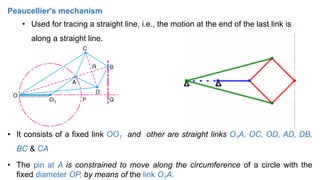
• It consists of a fixed link OO1 and other are straight links O1A, OC, OD, AD, DB,
BC & CA
• The pin at A is constrained to move along the circumference of a circle with the
fixed diameter OP, by means of the link O1A.
• Used for tracing a straight line, i.e., the motion at the end of the last link is
along a straight line.
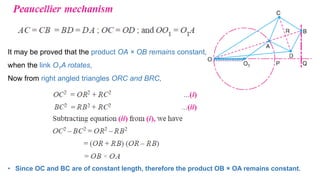
It may be proved that the product OA × OB remains constant,
when the link O1A rotates,
Now from right angled triangles ORC and BRC,
• Since OC and BC are of constant length, therefore the product OB × OA remains constant.
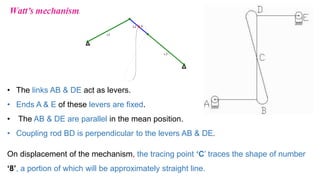
• The links AB & DE act as levers.
• Ends A & E of these levers are fixed.
• The AB & DE are parallel in the mean position.
• Coupling rod BD is perpendicular to the levers AB & DE.
On displacement of the mechanism, the tracing point ‘C’ traces the shape of number
‘8’, a portion of which will be approximately straight line.
Robert's mechanism
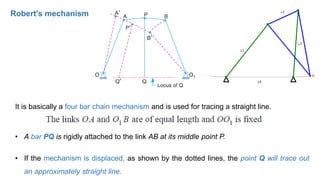
• A bar PQ is rigidly attached to the link AB at its middle point P.
• If the mechanism is displaced, as shown by the dotted lines, the point Q will trace out
an approximately straight line.
It is basically a four bar chain mechanism and is used for tracing a straight line.
Intermittent Motion Mechanisms
1.Geneva wheel mechanism
2.Ratchet and Pawl mechanism
Geneva wheel
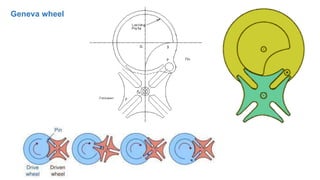
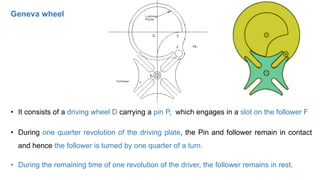
• It consists of a driving wheel D carrying a pin P, which engages in a slot on the follower F
• During one quarter revolution of the driving plate, the Pin and follower remain in contact
and hence the follower is turned by one quarter of a turn.
• During the remaining time of one revolution of the driver, the follower remains in rest.
Geneva wheel
Ratchet and Pawl mechanism
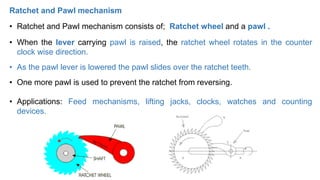
• Ratchet and Pawl mechanism consists of; Ratchet wheel and a pawl .
• When the lever carrying pawl is raised, the ratchet wheel rotates in the counter
clock wise direction.
• As the pawl lever is lowered the pawl slides over the ratchet teeth.
• One more pawl is used to prevent the ratchet from reversing.
• Applications: Feed mechanisms, lifting jacks, clocks, watches and counting
devices.
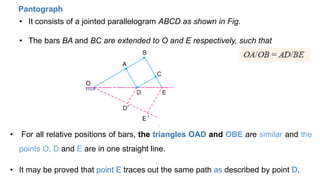
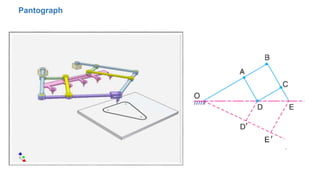
• It consists of a jointed parallelogram ABCD as shown in Fig.
• The bars BA and BC are extended to O and E respectively, such that
• For all relative positions of bars, the triangles OAD and OBE are similar and the
points O, D and E are in one straight line.
• It may be proved that point E traces out the same path as described by point D.
Pantograph
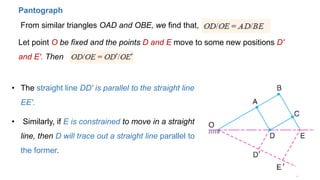
From similar triangles OAD and OBE, we find that,
Let point O be fixed and the points D and E move to some new positions D′
and E′. Then
• The straight line DD′ is parallel to the straight line
EE′.
• Similarly, if E is constrained to move in a straight
line, then D will trace out a straight line parallel to
the former.
Pantograph
Pantograph
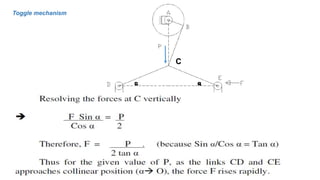
Toggle mechanism
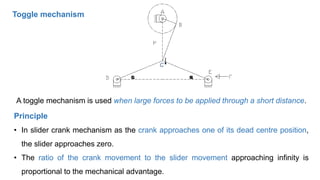
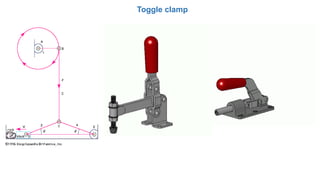
A toggle mechanism is used when large forces to be applied through a short distance.
Principle
• In slider crank mechanism as the crank approaches one of its dead centre position,
the slider approaches zero.
• The ratio of the crank movement to the slider movement approaching infinity is
proportional to the mechanical advantage.
C
C
Toggle mechanism
Toggle clamp
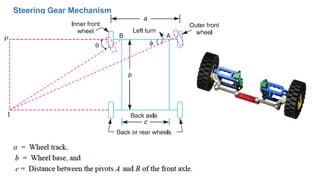
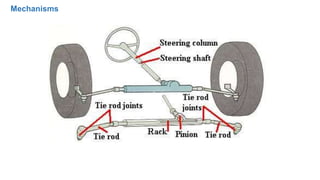
Steering Gear Mechanism
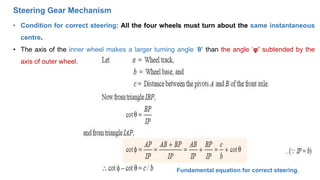
• In automobile, the front wheels are mounted over the front axles.
• The wheels are pivoted at the points A and B. These points are fixed to the chassis.
• Rear wheels are placed over the back axle, at the two ends of the differential tube.
• When the vehicle makes a turn, the front wheels along with the respective axles
turn about the respective pivoted points.
• The rear wheels remain straight and do not turn. Therefore, steering is done by
means of front wheels only.
• In order to avoid skidding (i.e. slipping), the two front wheels must turn about the
same instantaneous center “I” which lies on the axis of the back wheels.
Steering Gear Mechanism
• Condition for correct steering: All the four wheels must turn about the same instantaneous
centre.
• The axis of the inner wheel makes a larger turning angle ‘θ’ than the angle ‘φ’ subtended by the
axis of outer wheel.
Steering Gear Mechanism
Fundamental equation for correct steering.
Ackermann Steering Gear
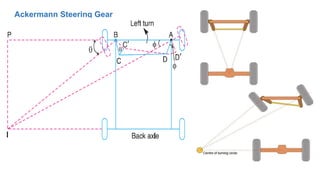
• In Ackerman steering gear, the mechanism ABCD is a four bar crank chain.
• Shorter links BC and AD are of equal length and are connected by hinge joints with front
wheel axles.
• Longer links AB and CD are of unequal length.
Ackermann Steering Gear
• When the vehicle moves along a straight path, the longer links AB and CD are
parallel and shorter links BC and AD are equally inclined to the longitudinal axis of
the vehicle, as shown by continuous lines
• When the vehicle is steering to the left, the position of the mechanism is shown by
dotted lines. In this position, the lines (axes) of the front wheel axle intersect on
the axes of the back wheel axle at I, for correct steering.
• When the vehicle is steering to the right, the similar position may be obtained.
The following are the only three positions for correct steering.
Ackermann Steering Gear
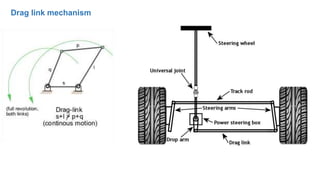
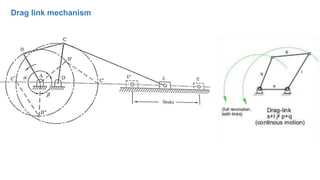
Drag link mechanism
A drag link converts rotary motion from a crank to a second crank or link in a
different plane or axis.
• The term is commonly used in automotive technology for the link in a four bar
steering linkage.
• Converts rotation of a steering arm to a center link (Linear motion) and
eventually to tie rod links which pivot the wheels to be steered.
• A drag link is used when the steering arm operates in a plane above the other
links.
Drag link mechanism
Drag link mechanism
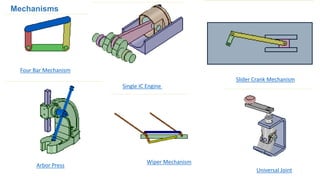
Four Bar Mechanism
Single IC Engine
Slider Crank Mechanism
Arbor Press
Wiper Mechanism
Universal Joint
Mechanisms
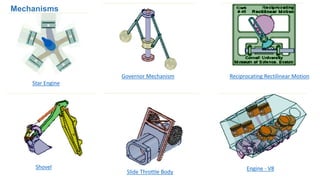
Reciprocating Rectilinear Motion
Star Engine
Governor Mechanism
Shovel
Slide Throttle Body
Engine - V8
Mechanisms
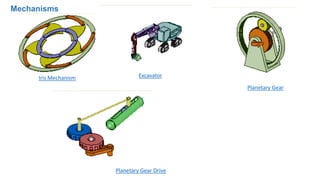
Iris Mechanism Excavator
Planetary Gear
Planetary Gear Drive
Mechanisms
Mechanisms
End of Module

Module 1 mechanisms

  • 1.
    Mechanisms with Lowerpairs Department of Mechanical Engineering JSS Academy of Technical Education, Bangalore-560060 Kinematics of Machines (Course Code:17ME42)
  • 2.
    • Quick returnmotion Mechanisms • Drag link Mechanism • Whitworth Mechanism • Crank and slotted lever Mechanism • Straight line motion Mechanisms (Approx. & Exact St. Line) • Peaucellier's Mechanism • Robert's Mechanism • Watt’s Mechanism Content
  • 3.
    • Intermittent Motionmechanisms • Geneva wheel Mechanism • Ratchet and Pawl Mechanism • Toggle mechanism • Pantograph. • Ackerman steering gear mechanism. Content
  • 4.
    • Straight linemotion Mechanisms 1. Peaucellier's mechanism 2. Robert's mechanism 3. Watt’s mechanism
  • 5.
    Peaucellier's mechanism • Itconsists of a fixed link OO1 and other are straight links O1A, OC, OD, AD, DB, BC & CA • The pin at A is constrained to move along the circumference of a circle with the fixed diameter OP, by means of the link O1A. • Used for tracing a straight line, i.e., the motion at the end of the last link is along a straight line.
  • 6.
    It may beproved that the product OA × OB remains constant, when the link O1A rotates, Now from right angled triangles ORC and BRC, • Since OC and BC are of constant length, therefore the product OB × OA remains constant.
  • 7.
    • The linksAB & DE act as levers. • Ends A & E of these levers are fixed. • The AB & DE are parallel in the mean position. • Coupling rod BD is perpendicular to the levers AB & DE. On displacement of the mechanism, the tracing point ‘C’ traces the shape of number ‘8’, a portion of which will be approximately straight line.
  • 8.
    Robert's mechanism • Abar PQ is rigidly attached to the link AB at its middle point P. • If the mechanism is displaced, as shown by the dotted lines, the point Q will trace out an approximately straight line. It is basically a four bar chain mechanism and is used for tracing a straight line.
  • 9.
    Intermittent Motion Mechanisms 1.Genevawheel mechanism 2.Ratchet and Pawl mechanism
  • 10.
  • 11.
    • It consistsof a driving wheel D carrying a pin P, which engages in a slot on the follower F • During one quarter revolution of the driving plate, the Pin and follower remain in contact and hence the follower is turned by one quarter of a turn. • During the remaining time of one revolution of the driver, the follower remains in rest. Geneva wheel
  • 12.
    Ratchet and Pawlmechanism • Ratchet and Pawl mechanism consists of; Ratchet wheel and a pawl . • When the lever carrying pawl is raised, the ratchet wheel rotates in the counter clock wise direction. • As the pawl lever is lowered the pawl slides over the ratchet teeth. • One more pawl is used to prevent the ratchet from reversing. • Applications: Feed mechanisms, lifting jacks, clocks, watches and counting devices.
  • 13.
    • It consistsof a jointed parallelogram ABCD as shown in Fig. • The bars BA and BC are extended to O and E respectively, such that • For all relative positions of bars, the triangles OAD and OBE are similar and the points O, D and E are in one straight line. • It may be proved that point E traces out the same path as described by point D. Pantograph
  • 14.
    From similar trianglesOAD and OBE, we find that, Let point O be fixed and the points D and E move to some new positions D′ and E′. Then • The straight line DD′ is parallel to the straight line EE′. • Similarly, if E is constrained to move in a straight line, then D will trace out a straight line parallel to the former. Pantograph
  • 15.
  • 16.
    Toggle mechanism A togglemechanism is used when large forces to be applied through a short distance. Principle • In slider crank mechanism as the crank approaches one of its dead centre position, the slider approaches zero. • The ratio of the crank movement to the slider movement approaching infinity is proportional to the mechanical advantage. C
  • 17.
  • 18.
  • 19.
  • 20.
    • In automobile,the front wheels are mounted over the front axles. • The wheels are pivoted at the points A and B. These points are fixed to the chassis. • Rear wheels are placed over the back axle, at the two ends of the differential tube. • When the vehicle makes a turn, the front wheels along with the respective axles turn about the respective pivoted points. • The rear wheels remain straight and do not turn. Therefore, steering is done by means of front wheels only. • In order to avoid skidding (i.e. slipping), the two front wheels must turn about the same instantaneous center “I” which lies on the axis of the back wheels. Steering Gear Mechanism
  • 21.
    • Condition forcorrect steering: All the four wheels must turn about the same instantaneous centre. • The axis of the inner wheel makes a larger turning angle ‘θ’ than the angle ‘φ’ subtended by the axis of outer wheel. Steering Gear Mechanism Fundamental equation for correct steering.
  • 22.
  • 23.
    • In Ackermansteering gear, the mechanism ABCD is a four bar crank chain. • Shorter links BC and AD are of equal length and are connected by hinge joints with front wheel axles. • Longer links AB and CD are of unequal length. Ackermann Steering Gear
  • 24.
    • When thevehicle moves along a straight path, the longer links AB and CD are parallel and shorter links BC and AD are equally inclined to the longitudinal axis of the vehicle, as shown by continuous lines • When the vehicle is steering to the left, the position of the mechanism is shown by dotted lines. In this position, the lines (axes) of the front wheel axle intersect on the axes of the back wheel axle at I, for correct steering. • When the vehicle is steering to the right, the similar position may be obtained. The following are the only three positions for correct steering. Ackermann Steering Gear
  • 25.
    Drag link mechanism Adrag link converts rotary motion from a crank to a second crank or link in a different plane or axis. • The term is commonly used in automotive technology for the link in a four bar steering linkage. • Converts rotation of a steering arm to a center link (Linear motion) and eventually to tie rod links which pivot the wheels to be steered. • A drag link is used when the steering arm operates in a plane above the other links.
  • 26.
  • 27.
  • 28.
    Four Bar Mechanism SingleIC Engine Slider Crank Mechanism Arbor Press Wiper Mechanism Universal Joint Mechanisms
  • 29.
    Reciprocating Rectilinear Motion StarEngine Governor Mechanism Shovel Slide Throttle Body Engine - V8 Mechanisms
  • 30.
    Iris Mechanism Excavator PlanetaryGear Planetary Gear Drive Mechanisms
  • 31.
  • 32.