Modulation,
Equivalence
and
Adaptation
Modulation:
 Means using a word or phrase that is different in
source language and target language.
 Technique of shaping or regulating the words of
source text.
 Used within same language.
 Exact way of saying things.
Types of modulation::
Recorded modulation:
Called as Standard modulation
Used in bilingual dictionaries.
Free modulation:
Secondary type of modulation.
Practical in case of TL rejects the literal translation.
What is Equivalence?
A word or a phrase that means exactly the
same thing in both languages.
An expression from a language which has the
same meaning in the other language.
Ex: English-I don’t understand.
French – Je ne comprends pas.
Anton popovic- a slovak translation
scientist and text theoretician
classified equivalence into four types:
 Linguistic equivalence
 Paradigmatic equivalence
 Stylistic equivalence
 Textual equivalence/Syntagmatic
equivalence
Eugene Nida the American linguist
• Formal equivalence
• Dynamic equivalence
Formal equivalence:
 Formal equivalence focuses attention on the
message itself, in both form and content.
 Also called “Structural equivalence” and “gloss
translation”.
 Makes reader understand the customs,
thoughts and expression.
Dynamic equivalence:
• Quality of a translation occurs when
prototext meaning is conveyed to the
receptor language.
• Similar relation between the reader or
the listener and the text.
• Aims to complete expression in a
natural way.
Adaptation:
Also called “cultural substitution” or “cultural
equivalence”.
Shift in culture environment.
Adaptation – as a tool
Known as “free translations”
Where it can be seen?
On TV shows or movies
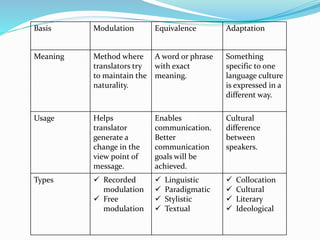
Basis Modulation Equivalence Adaptation
Meaning Method where
translators try
to maintain the
naturality.
A word or phrase
with exact
meaning.
Something
specific to one
language culture
is expressed in a
different way.
Usage Helps
translator
generate a
change in the
view point of
message.
Enables
communication.
Better
communication
goals will be
achieved.
Cultural
difference
between
speakers.
Types  Recorded
modulation
 Free
modulation
 Linguistic
 Paradigmatic
 Stylistic
 Textual
 Collocation
 Cultural
 Literary
 Ideological

Modulation,equivalence and Adaptation.pptx

  • 1.
  • 2.
    Modulation:  Means usinga word or phrase that is different in source language and target language.  Technique of shaping or regulating the words of source text.  Used within same language.  Exact way of saying things.
  • 3.
    Types of modulation:: Recordedmodulation: Called as Standard modulation Used in bilingual dictionaries. Free modulation: Secondary type of modulation. Practical in case of TL rejects the literal translation.
  • 4.
    What is Equivalence? Aword or a phrase that means exactly the same thing in both languages. An expression from a language which has the same meaning in the other language. Ex: English-I don’t understand. French – Je ne comprends pas.
  • 5.
    Anton popovic- aslovak translation scientist and text theoretician classified equivalence into four types:  Linguistic equivalence  Paradigmatic equivalence  Stylistic equivalence  Textual equivalence/Syntagmatic equivalence
  • 6.
    Eugene Nida theAmerican linguist • Formal equivalence • Dynamic equivalence Formal equivalence:  Formal equivalence focuses attention on the message itself, in both form and content.  Also called “Structural equivalence” and “gloss translation”.  Makes reader understand the customs, thoughts and expression.
  • 7.
    Dynamic equivalence: • Qualityof a translation occurs when prototext meaning is conveyed to the receptor language. • Similar relation between the reader or the listener and the text. • Aims to complete expression in a natural way.
  • 8.
    Adaptation: Also called “culturalsubstitution” or “cultural equivalence”. Shift in culture environment. Adaptation – as a tool Known as “free translations” Where it can be seen? On TV shows or movies
  • 10.
    Basis Modulation EquivalenceAdaptation Meaning Method where translators try to maintain the naturality. A word or phrase with exact meaning. Something specific to one language culture is expressed in a different way. Usage Helps translator generate a change in the view point of message. Enables communication. Better communication goals will be achieved. Cultural difference between speakers. Types  Recorded modulation  Free modulation  Linguistic  Paradigmatic  Stylistic  Textual  Collocation  Cultural  Literary  Ideological