Communication Devices
Communication History The Telegraph - Samuel Morse The Telephone - A. Bell Teletypewriter Networks
Computers & Communication In the 1960’s people were allowed to connect their own equipment to the Public  Telephone Network.
RS-232C Interface High speed computer communications operate on the principle of switching voltage on and off. To enable devices to communicate a standard was developed to define the electrical signalling.
RS-232C Interface The RS-232C standard defines the function of signals as well as the physical connection.
RS-232C Interface The standard is for two categories of serial connection one for terminals (DTE  - Data Terminal Equipment) one for communications equipment (DCE - Data Communications Equipment)
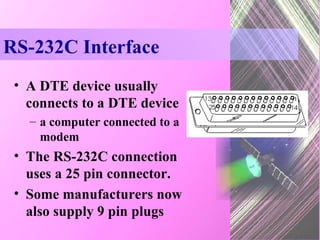
RS-232C Interface A DTE device usually connects to a DTE device a computer connected to a modem The RS-232C connection uses a 25 pin connector. Some manufacturers now also supply 9 pin plugs
The Modem The public telephone system was designed to transmit the human voice which is an analog signal. Computers exchange information using digital signals.
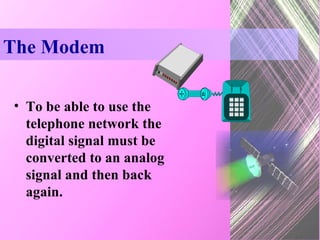
The Modem To be able to use the telephone network the digital signal must be converted to an analog signal and then back again.
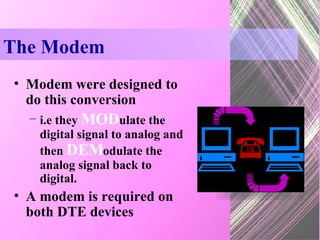
The Modem Modem were designed to do this conversion i.e they  MOD ulate the digital signal to analog and then  DEM odulate the analog signal back to digital. A modem is required on both DTE devices
The Modem Transmission involves data compression techniques which increase the rates, error detection and error correction for more reliability. The computer is connected to the modem via an RS-232C connection.
Types of Modems Voice/Data some modems can switch  between voice and data modes. In voice mode it acts likes a normal telephone, while in data mode it operates like a modem.
Types of Modems Cable Modem A cable modem is a device that enables the connection of a computer to a local cable TV line and receive data at a much higher rate that a normal modem.
Types of Modems Auto-Answer Modem An auto-answer modem enables your computer to receive calls in your absence. Fax/Modem These types of modems can both send and receive faxes
Network Interface Card This device acts an interface between the computer and network cabling. Its function is to control data in and out of the network cabling and also moves data in and out of memory.
Network Interface Card It also re-arranges and buffers the data. It is an expansion card that must inserted inside the computer.
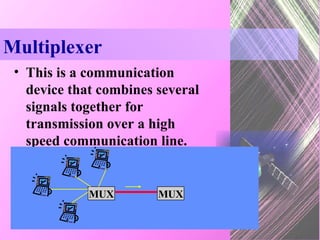
Multiplexer This is a communication device that combines several signals together for transmission over a high speed communication line. MUX MUX
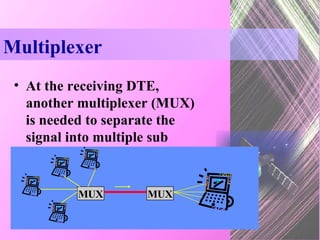
Multiplexer At the receiving DTE, another multiplexer (MUX) is needed to separate the signal into multiple sub channels. MUX MUX
Types of Multiplexing Frequency Division a single frequency channel is sub-divided into two or more sub-channels used in TV broadcasting and FM radio transmission
Types of Multiplexing Time Division Each node is allocated a small time frame for communication. Each node is checked on a round-robin basis.

Communication System Devices

  • 1.
  • 2.
    Communication History TheTelegraph - Samuel Morse The Telephone - A. Bell Teletypewriter Networks
  • 3.
    Computers & CommunicationIn the 1960’s people were allowed to connect their own equipment to the Public Telephone Network.
  • 4.
    RS-232C Interface Highspeed computer communications operate on the principle of switching voltage on and off. To enable devices to communicate a standard was developed to define the electrical signalling.
  • 5.
    RS-232C Interface TheRS-232C standard defines the function of signals as well as the physical connection.
  • 6.
    RS-232C Interface Thestandard is for two categories of serial connection one for terminals (DTE - Data Terminal Equipment) one for communications equipment (DCE - Data Communications Equipment)
  • 7.
    RS-232C Interface ADTE device usually connects to a DTE device a computer connected to a modem The RS-232C connection uses a 25 pin connector. Some manufacturers now also supply 9 pin plugs
  • 8.
    The Modem Thepublic telephone system was designed to transmit the human voice which is an analog signal. Computers exchange information using digital signals.
  • 9.
    The Modem Tobe able to use the telephone network the digital signal must be converted to an analog signal and then back again.
  • 10.
    The Modem Modemwere designed to do this conversion i.e they MOD ulate the digital signal to analog and then DEM odulate the analog signal back to digital. A modem is required on both DTE devices
  • 11.
    The Modem Transmissioninvolves data compression techniques which increase the rates, error detection and error correction for more reliability. The computer is connected to the modem via an RS-232C connection.
  • 12.
    Types of ModemsVoice/Data some modems can switch between voice and data modes. In voice mode it acts likes a normal telephone, while in data mode it operates like a modem.
  • 13.
    Types of ModemsCable Modem A cable modem is a device that enables the connection of a computer to a local cable TV line and receive data at a much higher rate that a normal modem.
  • 14.
    Types of ModemsAuto-Answer Modem An auto-answer modem enables your computer to receive calls in your absence. Fax/Modem These types of modems can both send and receive faxes
  • 15.
    Network Interface CardThis device acts an interface between the computer and network cabling. Its function is to control data in and out of the network cabling and also moves data in and out of memory.
  • 16.
    Network Interface CardIt also re-arranges and buffers the data. It is an expansion card that must inserted inside the computer.
  • 17.
    Multiplexer This isa communication device that combines several signals together for transmission over a high speed communication line. MUX MUX
  • 18.
    Multiplexer At thereceiving DTE, another multiplexer (MUX) is needed to separate the signal into multiple sub channels. MUX MUX
  • 19.
    Types of MultiplexingFrequency Division a single frequency channel is sub-divided into two or more sub-channels used in TV broadcasting and FM radio transmission
  • 20.
    Types of MultiplexingTime Division Each node is allocated a small time frame for communication. Each node is checked on a round-robin basis.