Improving Learning Penetration & Impact at
Pa-telecom Customer Care
A presentation delivered by Olofinlade, Olufunso Steve, 2013.
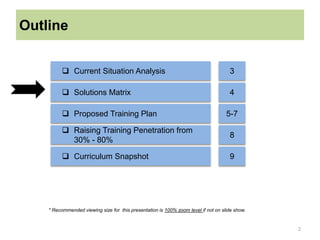
Outline
2
 Current Situation Analysis 3
 Solutions Matrix 4
 Proposed Training Plan 5-7
 Raising Training Penetration from
30% - 80%
8
 Curriculum Snapshot 9
* Recommended viewing size for this presentation is 100% zoom level if not on slide show.
Customer Care : Current Situation Analysis
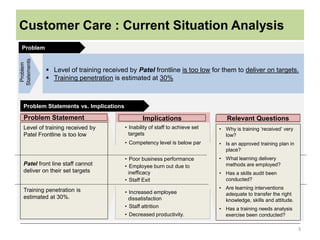
 Level of training received by Patel frontline is too low for them to deliver on targets.
 Training penetration is estimated at 30%
Problem
Statements
• Inability of staff to achieve set
targets
• Competency level is below par
• Poor business performance
• Employee burn out due to
inefficacy
• Staff Exit
• Increased employee
dissatisfaction
• Staff attrition
• Decreased productivity.
Problem Statement
Level of training received by
Patel Frontline is too low
Patel front line staff cannot
deliver on their set targets
Training penetration is
estimated at 30%.
Relevant Questions
• Why is training ‘received’ very
low?
• Is an approved training plan in
place?
• What learning delivery
methods are employed?
• Has a skills audit been
conducted?
• Are learning interventions
adequate to transfer the right
knowledge, skills and attitude.
• Has a training needs analysis
exercise been conducted?
Implications
Problem
Problem Statements vs. Implications
3
Solutions Matrix
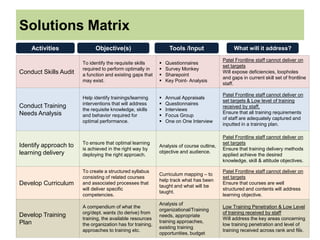
Conduct Skills Audit
To identify the requisite skills
required to perform optimally in
a function and existing gaps that
may exist.
 Questionnaires
 Survey Monkey
 Sharepoint
 Key Point- Analysis
Patel Frontline staff cannot deliver on
set targets
Will expose deficiencies, loopholes
and gaps in current skill set of frontline
staff.
Conduct Training
Needs Analysis
Help identify trainings/learning
interventions that will address
the requisite knowledge, skills
and behavior required for
optimal performance.
 Annual Appraisals
 Questionnaires
 Interviews
 Focus Group
 One on One Interview
Patel Frontline staff cannot deliver on
set targets & Low level of training
received by staff,
Ensure that all training requirements
of staff are adequately captured and
inputted in a training plan.
Identify approach to
learning delivery
To ensure that optimal learning
is achieved in the right way by
deploying the right approach.
Analysis of course outline,
objective and audience.
Patel Frontline staff cannot deliver on
set targets
Ensure that training delivery methods
applied achieve the desired
knowledge, skill & attitude objectives.
Develop Curriculum
To create a structured syllabus
consisting of related courses
and associated processes that
will deliver specific
competencies.
Curriculum mapping – to
help track what has been
taught and what will be
taught.
Patel Frontline staff cannot deliver on
set targets
Ensure that courses are well
structured and contents will address
learning objective.
Develop Training
Plan
A compendium of what the
org/dept. wants (to derive) from
training, the available resources
the organization has for training,
approaches to training etc.
Analysis of
organizational/Training
needs, appropriate
training approaches,
existing training
opportunities, budget
Low Training Penetration & Low Level
of training received by staff
Will address the key areas concerning
low training penetration and level of
training received across rank and file.
Objective(s) Tools /Input What will it address?Activities
4
Training Plan Snapshot
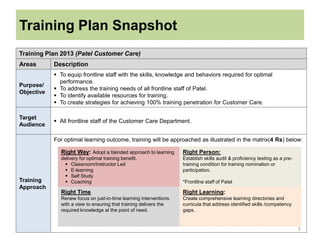
Training Plan 2013 (Patel Customer Care)
Areas Description
Purpose/
Objective
 To equip frontline staff with the skills, knowledge and behaviors required for optimal
performance.
 To address the training needs of all frontline staff of Patel.
 To identify available resources for training.
 To create strategies for achieving 100% training penetration for Customer Care.
Target
Audience
 All frontline staff of the Customer Care Department.
Training
Approach
For optimal learning outcome, training will be approached as illustrated in the matrix(4 Rs) below:
Right Way: Adopt a blended approach to learning
delivery for optimal training benefit.
 Classroom/Instructor Led
 E-learning
 Self Study
 Coaching
Right Time
Renew focus on just-in-time learning interventions
with a view to ensuring that training delivers the
required knowledge at the point of need.
Right Person:
Establish skills audit & proficiency testing as a pre-
training condition for training nomination or
participation.
*Frontline staff of Patel
Right Learning:
Create comprehensive learning directories and
curricula that address identified skills /competency
gaps.
5
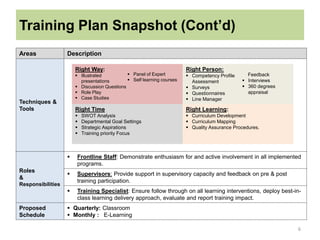
Training Plan Snapshot (Cont’d)
Areas Description
Techniques &
Tools
Roles
&
Responsibilities
 Frontline Staff: Demonstrate enthusiasm for and active involvement in all implemented
programs.
 Supervisors: Provide support in supervisory capacity and feedback on pre & post
training participation.
 Training Specialist: Ensure follow through on all learning interventions, deploy best-in-
class learning delivery approach, evaluate and report training impact.
Proposed
Schedule
 Quarterly: Classroom
 Monthly : E-Learning
Right Way:
 Illustrated
presentations
 Discussion Questions
 Role Play
 Case Studies
 Panel of Expert
 Self learning courses
Right Time
 SWOT Analysis
 Departmental Goal Settings
 Strategic Aspirations
 Training priority Focus
Right Person:
 Competency Profile
Assessment
 Surveys
 Questionnaires
 Line Manager
Feedback
 Interviews
 360 degrees
appraisal
Right Learning:
 Curriculum Development
 Curriculum Mapping
 Quality Assurance Procedures.
6
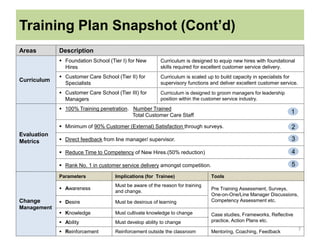
Training Plan Snapshot (Cont’d)
Areas Description
Curriculum
 Foundation School (Tier I) for New
Hires
Curriculum is designed to equip new hires with foundational
skills required for excellent customer service delivery.
 Customer Care School (Tier II) for
Specialists
Curriculum is scaled up to build capacity in specialists for
supervisory functions and deliver excellent customer service.
 Customer Care School (Tier III) for
Managers
Curriculum is designed to groom managers for leadership
position within the customer service industry.
Evaluation
Metrics
 100% Training penetration. Number Trained
Total Customer Care Staff
 Minimum of 90% Customer (External) Satisfaction through surveys.
 Direct feedback from line manager/ supervisor.
 Reduce Time to Competency of New Hires.(50% reduction)
 Rank No. 1 in customer service delivery amongst competition.
Change
Management
Parameters Implications (for Trainee) Tools
 Awareness
Must be aware of the reason for training
and change.
Pre Training Assessment, Surveys,
One-on-One/Line Manager Discussions,
Competency Assessment etc. Desire Must be desirous of learning
 Knowledge Must cultivate knowledge to change Case studies, Frameworks, Reflective
practice, Action Plans etc. Ability Must develop ability to change
 Reinforcement Reinforcement outside the classroom Mentoring, Coaching, Feedback
1
2
3
4
5
7
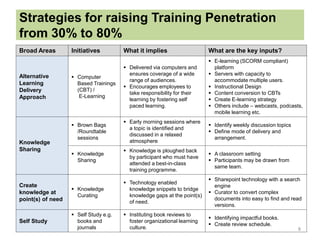
Strategies for raising Training Penetration
from 30% to 80%
Broad Areas Initiatives What it implies What are the key inputs?
Alternative
Learning
Delivery
Approach
 Computer
Based Trainings
(CBT) /
E-Learning
 Delivered via computers and
ensures coverage of a wide
range of audiences.
 Encourages employees to
take responsibility for their
learning by fostering self
paced learning.
 E-learning (SCORM compliant)
platform
 Servers with capacity to
accommodate multiple users.
 Instructional Design
 Content conversion to CBTs
 Create E-learning strategy
 Others include – webcasts, podcasts,
mobile learning etc.
Knowledge
Sharing
 Brown Bags
/Roundtable
sessions
 Early morning sessions where
a topic is identified and
discussed in a relaxed
atmosphere
 Identify weekly discussion topics
 Define mode of delivery and
arrangement.
 Knowledge
Sharing
 Knowledge is ploughed back
by participant who must have
attended a best-in-class
training programme.
 A classroom setting
 Participants may be drawn from
same team.
Create
knowledge at
point(s) of need
 Knowledge
Curating
 Technology enabled
knowledge snippets to bridge
knowledge gaps at the point(s)
of need.
 Sharepoint technology with a search
engine
 Curator to convert complex
documents into easy to find and read
versions.
Self Study
 Self Study e.g.
books and
journals
 Instituting book reviews to
foster organizational learning
culture.
 Identifying impactful books.
 Create review schedule.
8
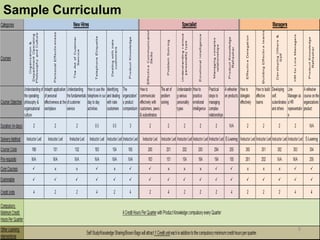
Sample Curriculum
9
Thank you.
10

Improving learning implementation & impact telecoms

  • 1.
    Improving Learning Penetration& Impact at Pa-telecom Customer Care A presentation delivered by Olofinlade, Olufunso Steve, 2013.
  • 2.
    Outline 2  Current SituationAnalysis 3  Solutions Matrix 4  Proposed Training Plan 5-7  Raising Training Penetration from 30% - 80% 8  Curriculum Snapshot 9 * Recommended viewing size for this presentation is 100% zoom level if not on slide show.
  • 3.
    Customer Care :Current Situation Analysis  Level of training received by Patel frontline is too low for them to deliver on targets.  Training penetration is estimated at 30% Problem Statements • Inability of staff to achieve set targets • Competency level is below par • Poor business performance • Employee burn out due to inefficacy • Staff Exit • Increased employee dissatisfaction • Staff attrition • Decreased productivity. Problem Statement Level of training received by Patel Frontline is too low Patel front line staff cannot deliver on their set targets Training penetration is estimated at 30%. Relevant Questions • Why is training ‘received’ very low? • Is an approved training plan in place? • What learning delivery methods are employed? • Has a skills audit been conducted? • Are learning interventions adequate to transfer the right knowledge, skills and attitude. • Has a training needs analysis exercise been conducted? Implications Problem Problem Statements vs. Implications 3
  • 4.
    Solutions Matrix Conduct SkillsAudit To identify the requisite skills required to perform optimally in a function and existing gaps that may exist.  Questionnaires  Survey Monkey  Sharepoint  Key Point- Analysis Patel Frontline staff cannot deliver on set targets Will expose deficiencies, loopholes and gaps in current skill set of frontline staff. Conduct Training Needs Analysis Help identify trainings/learning interventions that will address the requisite knowledge, skills and behavior required for optimal performance.  Annual Appraisals  Questionnaires  Interviews  Focus Group  One on One Interview Patel Frontline staff cannot deliver on set targets & Low level of training received by staff, Ensure that all training requirements of staff are adequately captured and inputted in a training plan. Identify approach to learning delivery To ensure that optimal learning is achieved in the right way by deploying the right approach. Analysis of course outline, objective and audience. Patel Frontline staff cannot deliver on set targets Ensure that training delivery methods applied achieve the desired knowledge, skill & attitude objectives. Develop Curriculum To create a structured syllabus consisting of related courses and associated processes that will deliver specific competencies. Curriculum mapping – to help track what has been taught and what will be taught. Patel Frontline staff cannot deliver on set targets Ensure that courses are well structured and contents will address learning objective. Develop Training Plan A compendium of what the org/dept. wants (to derive) from training, the available resources the organization has for training, approaches to training etc. Analysis of organizational/Training needs, appropriate training approaches, existing training opportunities, budget Low Training Penetration & Low Level of training received by staff Will address the key areas concerning low training penetration and level of training received across rank and file. Objective(s) Tools /Input What will it address?Activities 4
  • 5.
    Training Plan Snapshot TrainingPlan 2013 (Patel Customer Care) Areas Description Purpose/ Objective  To equip frontline staff with the skills, knowledge and behaviors required for optimal performance.  To address the training needs of all frontline staff of Patel.  To identify available resources for training.  To create strategies for achieving 100% training penetration for Customer Care. Target Audience  All frontline staff of the Customer Care Department. Training Approach For optimal learning outcome, training will be approached as illustrated in the matrix(4 Rs) below: Right Way: Adopt a blended approach to learning delivery for optimal training benefit.  Classroom/Instructor Led  E-learning  Self Study  Coaching Right Time Renew focus on just-in-time learning interventions with a view to ensuring that training delivers the required knowledge at the point of need. Right Person: Establish skills audit & proficiency testing as a pre- training condition for training nomination or participation. *Frontline staff of Patel Right Learning: Create comprehensive learning directories and curricula that address identified skills /competency gaps. 5
  • 6.
    Training Plan Snapshot(Cont’d) Areas Description Techniques & Tools Roles & Responsibilities  Frontline Staff: Demonstrate enthusiasm for and active involvement in all implemented programs.  Supervisors: Provide support in supervisory capacity and feedback on pre & post training participation.  Training Specialist: Ensure follow through on all learning interventions, deploy best-in- class learning delivery approach, evaluate and report training impact. Proposed Schedule  Quarterly: Classroom  Monthly : E-Learning Right Way:  Illustrated presentations  Discussion Questions  Role Play  Case Studies  Panel of Expert  Self learning courses Right Time  SWOT Analysis  Departmental Goal Settings  Strategic Aspirations  Training priority Focus Right Person:  Competency Profile Assessment  Surveys  Questionnaires  Line Manager Feedback  Interviews  360 degrees appraisal Right Learning:  Curriculum Development  Curriculum Mapping  Quality Assurance Procedures. 6
  • 7.
    Training Plan Snapshot(Cont’d) Areas Description Curriculum  Foundation School (Tier I) for New Hires Curriculum is designed to equip new hires with foundational skills required for excellent customer service delivery.  Customer Care School (Tier II) for Specialists Curriculum is scaled up to build capacity in specialists for supervisory functions and deliver excellent customer service.  Customer Care School (Tier III) for Managers Curriculum is designed to groom managers for leadership position within the customer service industry. Evaluation Metrics  100% Training penetration. Number Trained Total Customer Care Staff  Minimum of 90% Customer (External) Satisfaction through surveys.  Direct feedback from line manager/ supervisor.  Reduce Time to Competency of New Hires.(50% reduction)  Rank No. 1 in customer service delivery amongst competition. Change Management Parameters Implications (for Trainee) Tools  Awareness Must be aware of the reason for training and change. Pre Training Assessment, Surveys, One-on-One/Line Manager Discussions, Competency Assessment etc. Desire Must be desirous of learning  Knowledge Must cultivate knowledge to change Case studies, Frameworks, Reflective practice, Action Plans etc. Ability Must develop ability to change  Reinforcement Reinforcement outside the classroom Mentoring, Coaching, Feedback 1 2 3 4 5 7
  • 8.
    Strategies for raisingTraining Penetration from 30% to 80% Broad Areas Initiatives What it implies What are the key inputs? Alternative Learning Delivery Approach  Computer Based Trainings (CBT) / E-Learning  Delivered via computers and ensures coverage of a wide range of audiences.  Encourages employees to take responsibility for their learning by fostering self paced learning.  E-learning (SCORM compliant) platform  Servers with capacity to accommodate multiple users.  Instructional Design  Content conversion to CBTs  Create E-learning strategy  Others include – webcasts, podcasts, mobile learning etc. Knowledge Sharing  Brown Bags /Roundtable sessions  Early morning sessions where a topic is identified and discussed in a relaxed atmosphere  Identify weekly discussion topics  Define mode of delivery and arrangement.  Knowledge Sharing  Knowledge is ploughed back by participant who must have attended a best-in-class training programme.  A classroom setting  Participants may be drawn from same team. Create knowledge at point(s) of need  Knowledge Curating  Technology enabled knowledge snippets to bridge knowledge gaps at the point(s) of need.  Sharepoint technology with a search engine  Curator to convert complex documents into easy to find and read versions. Self Study  Self Study e.g. books and journals  Instituting book reviews to foster organizational learning culture.  Identifying impactful books.  Create review schedule. 8
  • 9.
  • 10.