



Lecture 02 
Architecture
Agenda 
 Building blocks (recap) 
 Architecture 
 Monolithic Architecture 
 Service Oriented Architecture 
 Layering
Reading 
 Brown 1, 2, 3 og 4 
 Pattern: Monolithic Architecture 
 Decomposing applications for scalability and 
deployability 
 The Scale Cube
Building Blocks
Building Enterprise Applications 
 Building computer systems is hard 
Design 
Pattern 
Architecture 
Middleware 
Frameworks 
OO 
Programming
Architecture 
 Shared understanding of system’s design by the expert 
developers on a project 
– Highest-level breakdown of a system into its parts 
– Decisions that are hard to change 
 Architecture influences design 
of components, technology, 
performance and middleware 
 There are always options
Object Oriented Programming 
 OO is key to development of systems 
– Design for reusability, flexibility and performance 
“OO design is more important than specific technologies, such as J2EE. We 
should try to avoid letting our technology choices, such as J2EE, constrain 
our ability to use true OO design” 
– Rod Johnson “If the design is good, there is no code” 
– Jónas Þór, Senior Betware developer 
 One of the biggest hurdles for developers 
– Each component should be simple with simple task 
– Involves understanding of interaction of parts
Design Patterns 
 Design using known ideas 
– Design patterns are standard solutions to common problems 
in software design 
– Systematic approach for problems that reoccur in software 
development 
– Patterns have name and definitions - not language dependant 
 History 
– Landmark book from 1995: Design Patterns: Elements of 
Reusable Object-Oriented Software Gang of Four (GoF)
Middleware 
 Enterprise system are built on middleware 
– Can cover a broad spectrum of software and generally sits 
between an application and an operating system 
– For example, databases, application servers, web servers, 
messaging systems, transaction monitors 
– “The plumbing” – the infrastructure 
 Horizontal market 
– Solves common problems – not specific business requirements 
– Low-level system
Frameworks 
 Frameworks define the support structure for how to 
organize and build systems 
– Can improve productivity 
– We can use existing frameworks or build our own 
 Frameworks implement common problems 
– Developers extend and add their business requirements 
 Framework design 
– Use inheritance, inversion of control, interfaces and helper 
classes 
– Implement design patterns
QUIZ 
Which of the following statement is not true? 
A) Design patterns are solutions to common problems 
B) Object oriented programing is good for general problems 
C) Frameworks are used to increase productivity 
D) Middleware can solve business related problems
QUIZ 
Which of the following statement is not true? 
A) Design patterns are solutions to common problems 
B) Object oriented programing is good for general problems 
C) Frameworks are used to increase productivity 
D) Middleware can solve business related problems 
✔
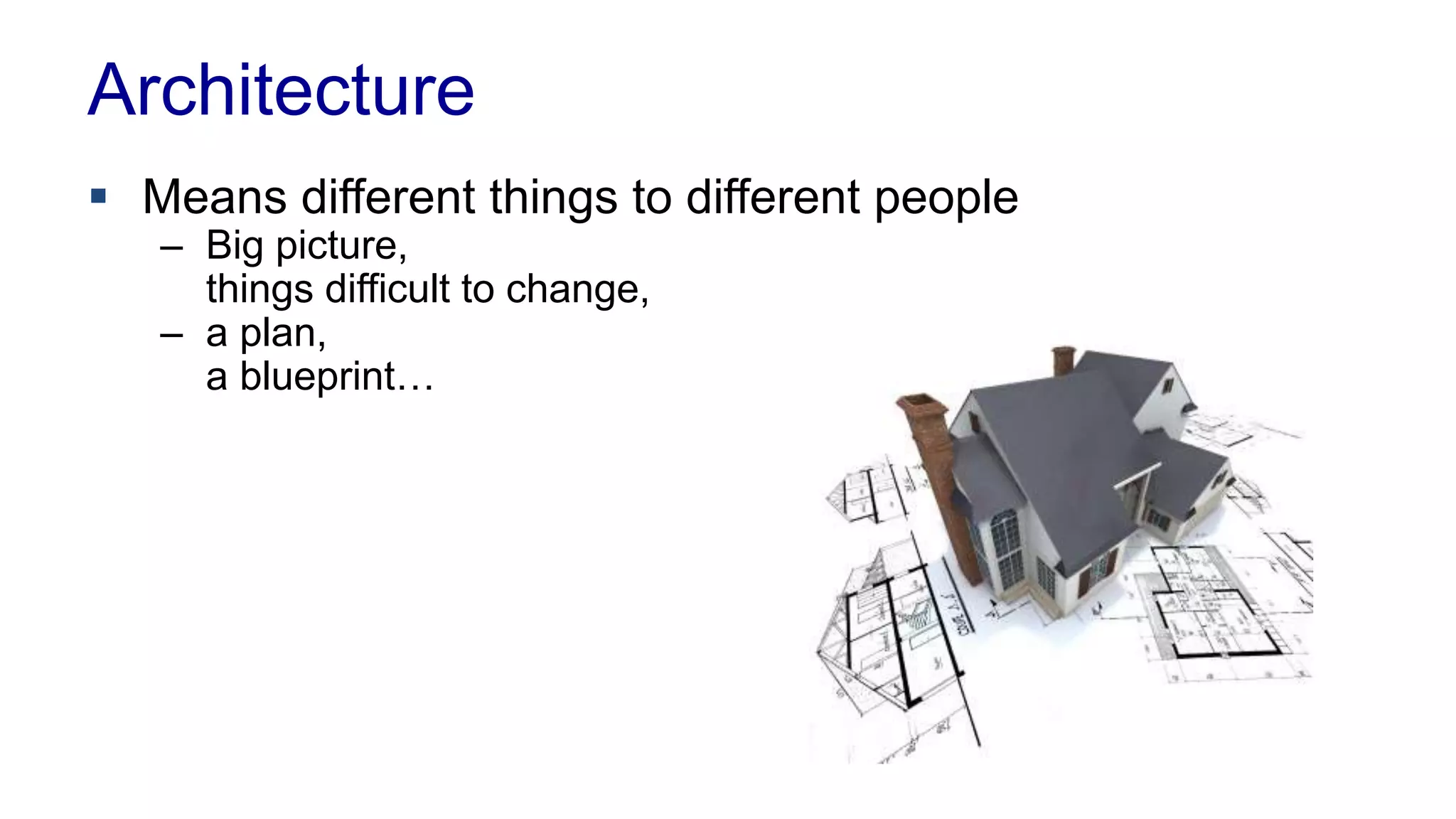
Architecture
Architecture 
 Means different things to different people 
– Big picture, 
things difficult to change, 
– a plan, 
a blueprint…
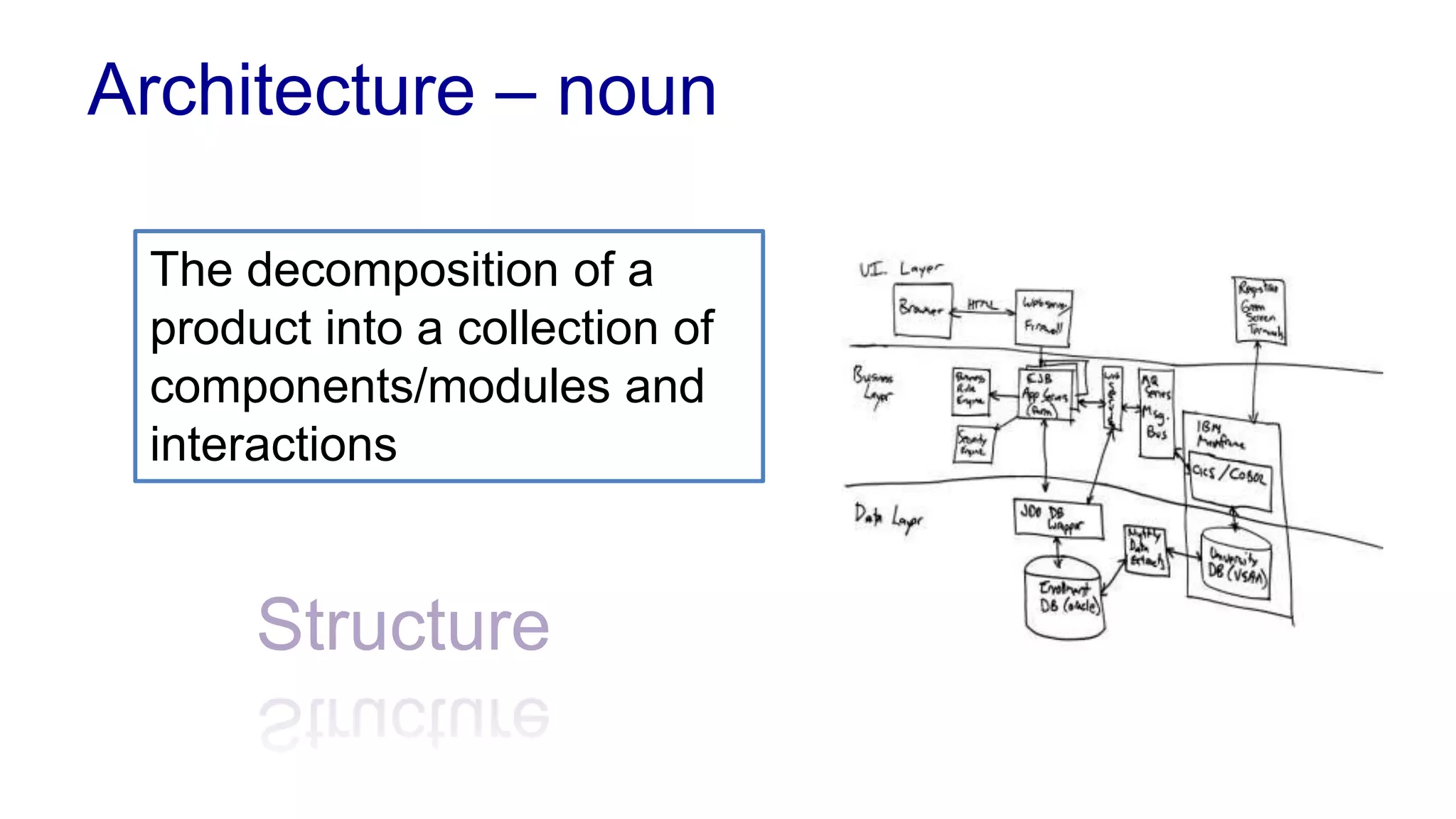
Architecture – noun 
The decomposition of a 
product into a collection of 
components/modules and 
interactions 
Structure
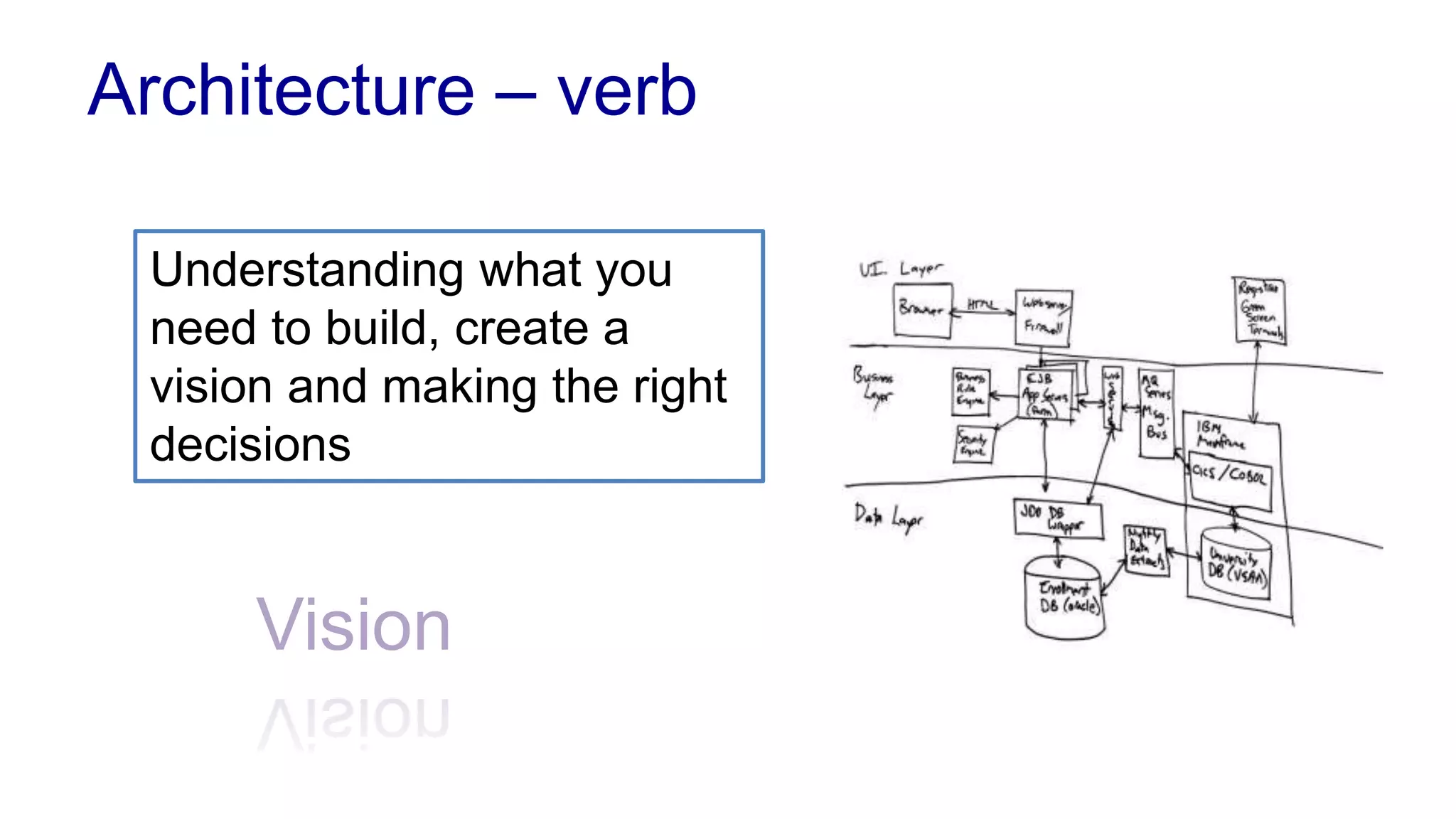
Architecture – verb 
Understanding what you 
need to build, create a 
vision and making the right 
decisions 
Vision
Types of Architecture 
 There are many different architectures 
– Network, security, data, hardware, enterprise… 
 All have structure and vision 
– All have multiple constraints such as cost, time, legal, regulatory
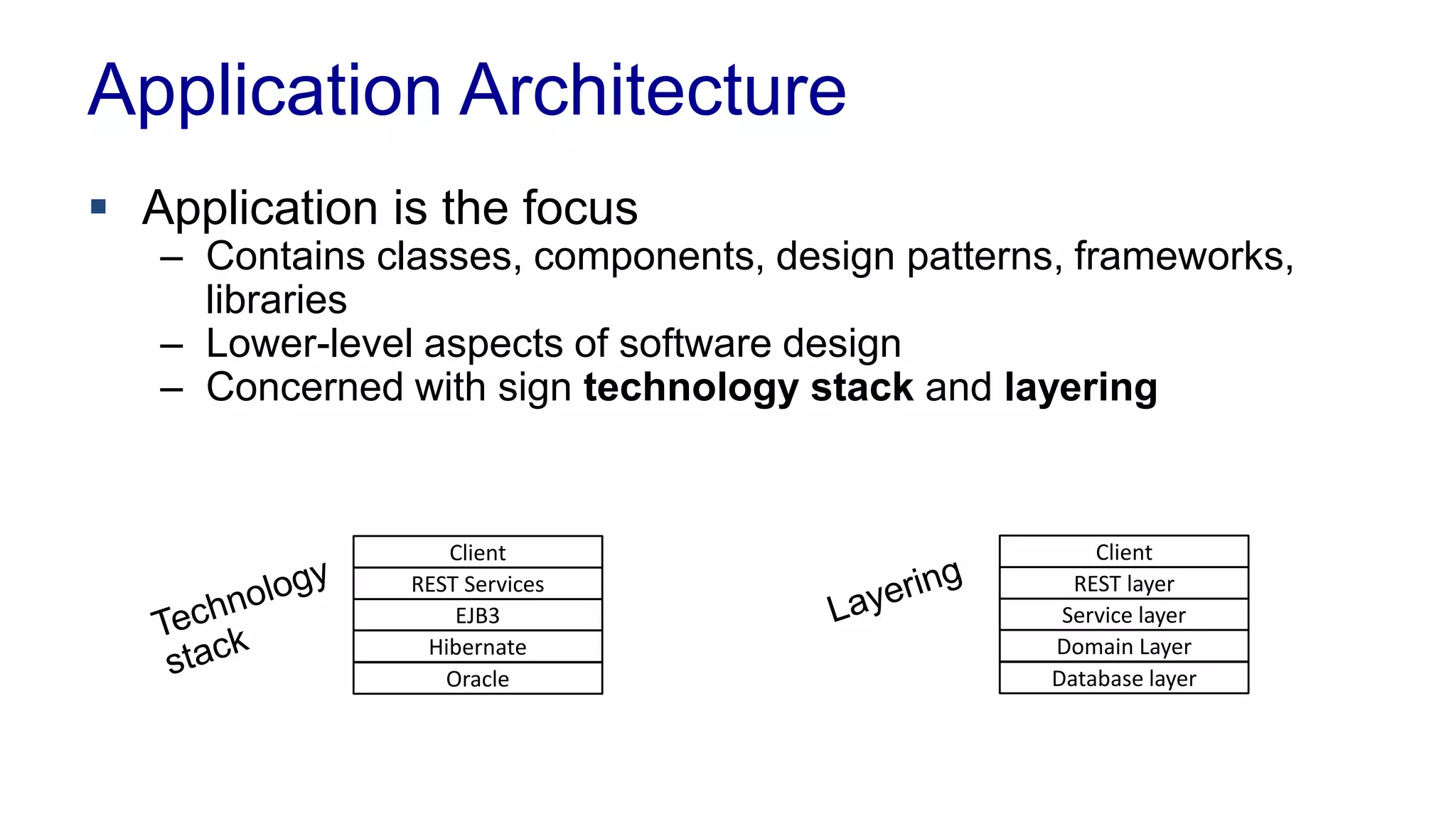
Application Architecture 
 Application is the focus 
– Contains classes, components, design patterns, frameworks, 
libraries 
– Lower-level aspects of software design 
– Concerned with sign technology stack and layering 
Client 
REST Services 
EJB3 
Hibernate 
Oracle 
Client 
REST layer 
Service layer 
Domain Layer 
Database layer
System Architecture 
 Focus on multiple applications across a number of tiers 
and technologies 
 Interactions between applications 
 Overall structure of the end-to-end software system at 
high-level 
 Mix of software and hardware
Software Architecture 
 The combination of application and system architecture 
 Includes the technical practices to build the software 
– Design Principles, Programming language 
Design patterns, Unit testing 
and much more… 
 Must also include aspects like 
– Cross-cutting concerns such as logging and exception handling 
Security, Performance, Audit Requirements, constraints, 
and much more…
Enterprise Architecture 
 How the enterprise is broken up in groups/departments 
 Business processes used 
 Workflows used 
 May not look at technology in detail rather how to us 
technology across the organization to get work done
Agile Architecture 
 Agile refers to a methodology of building software 
– moving fast, embracing change, release often, feedback cycles 
etc. 
Does agile development team then build agile 
architectures? 
 Agile architecture means it can react to change, is easy 
to change, is extendable
Agility 
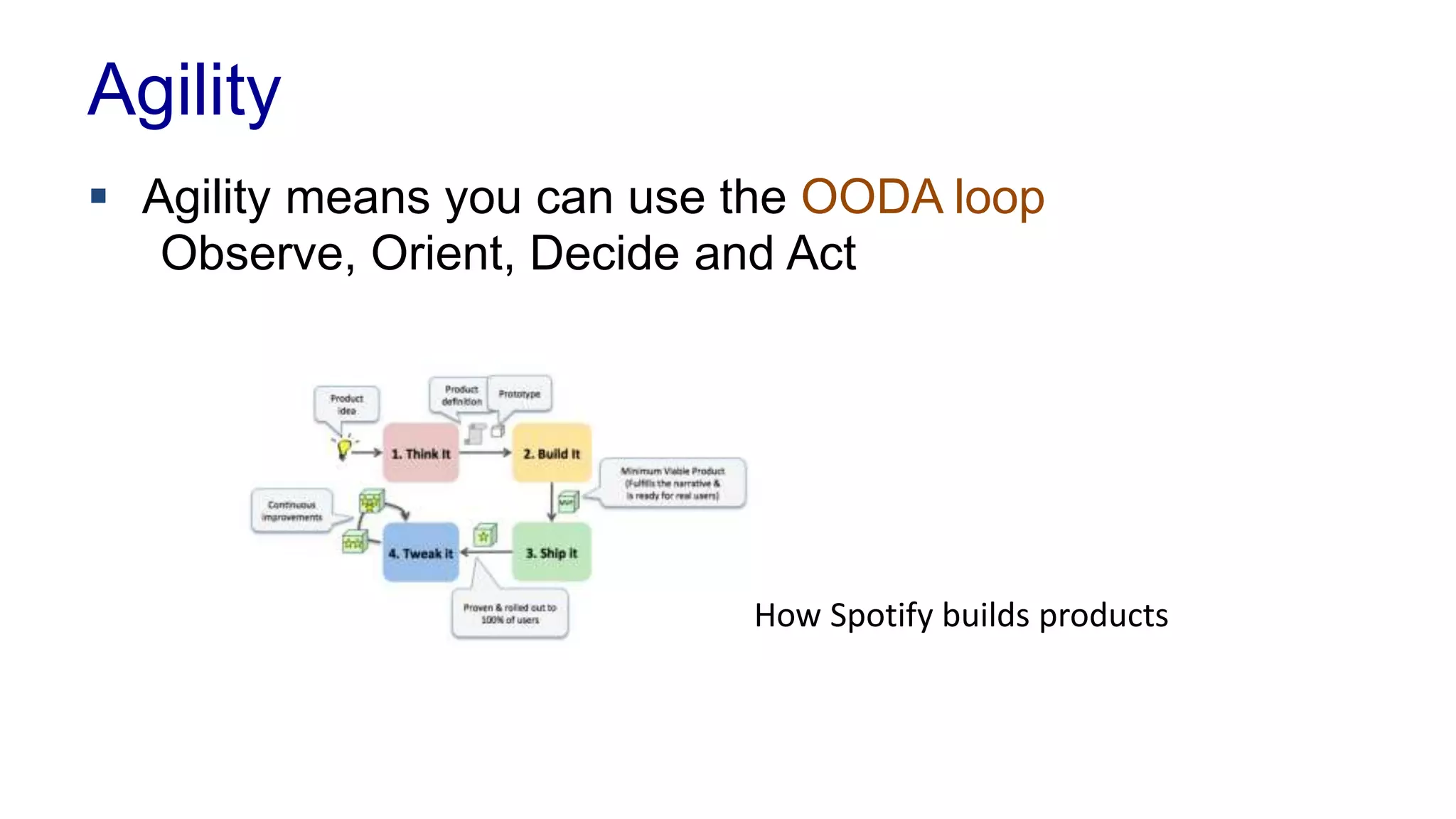
 Agility means you can use the OODA loop 
Observe, Orient, Decide and Act 
How Spotify builds products
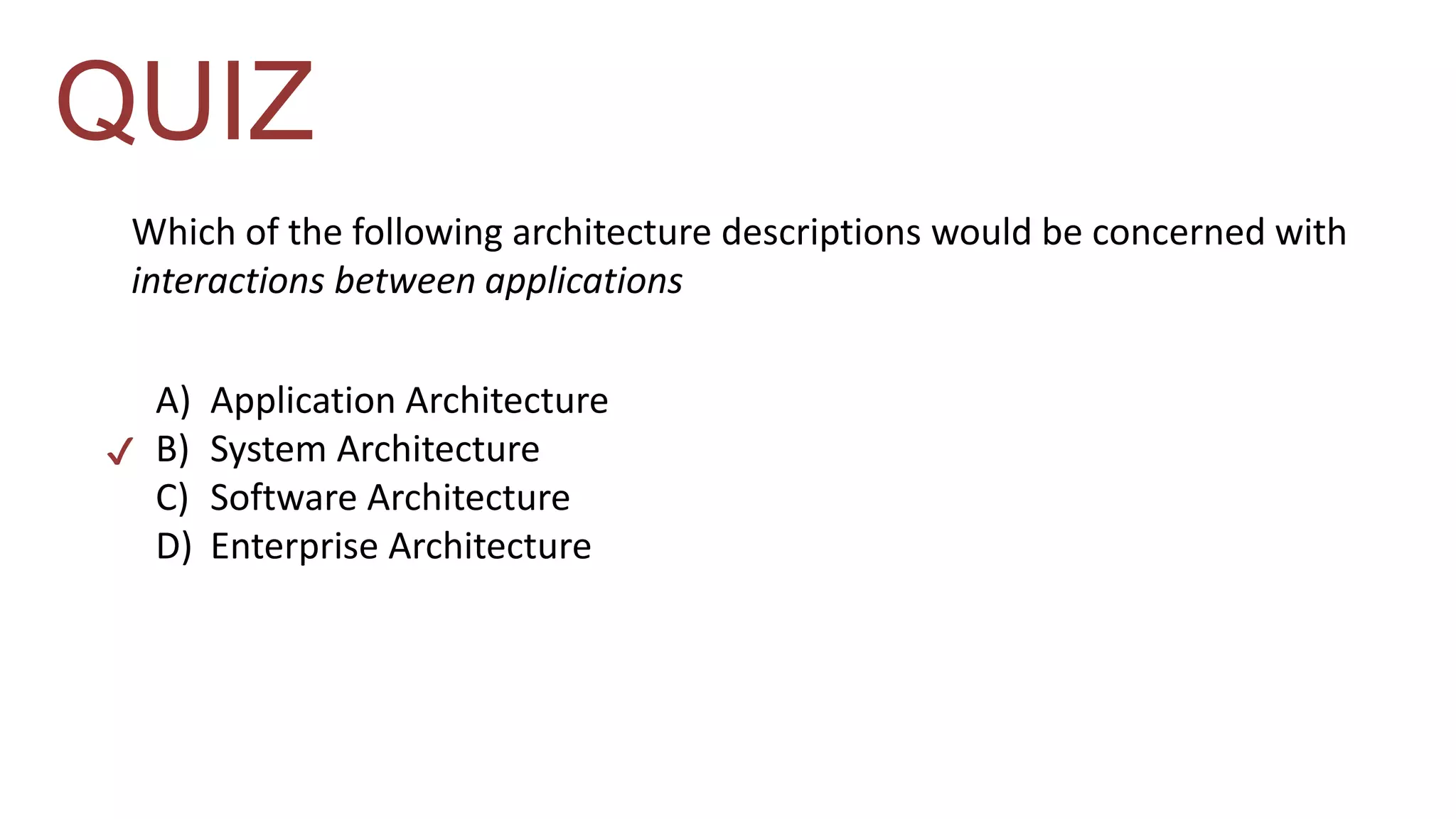
QUIZ 
Which of the following architecture descriptions would be concerned with 
interactions between applications 
A) Application Architecture 
B) System Architecture 
C) Software Architecture 
D) Enterprise Architecture
QUIZ 
Which of the following architecture descriptions would be concerned with 
interactions between applications 
A) Application Architecture 
B) System Architecture 
C) Software Architecture 
D) Enterprise Architecture 
✔
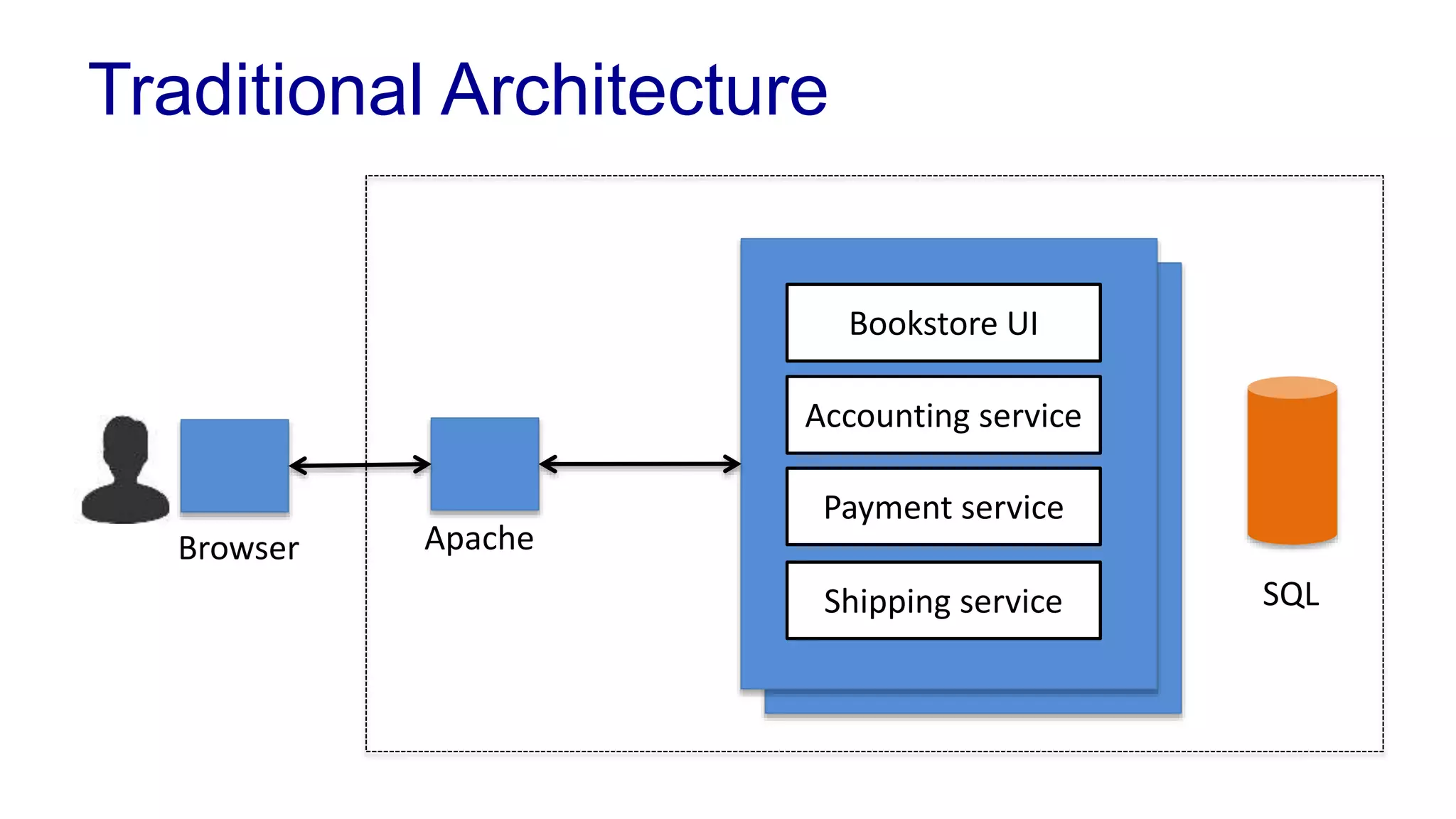
Monolithic Architecture
Monolith Architecture 
 Traditional approach to building applications 
 Chris Richardson: Decomposing applications for 
scalability and deployability
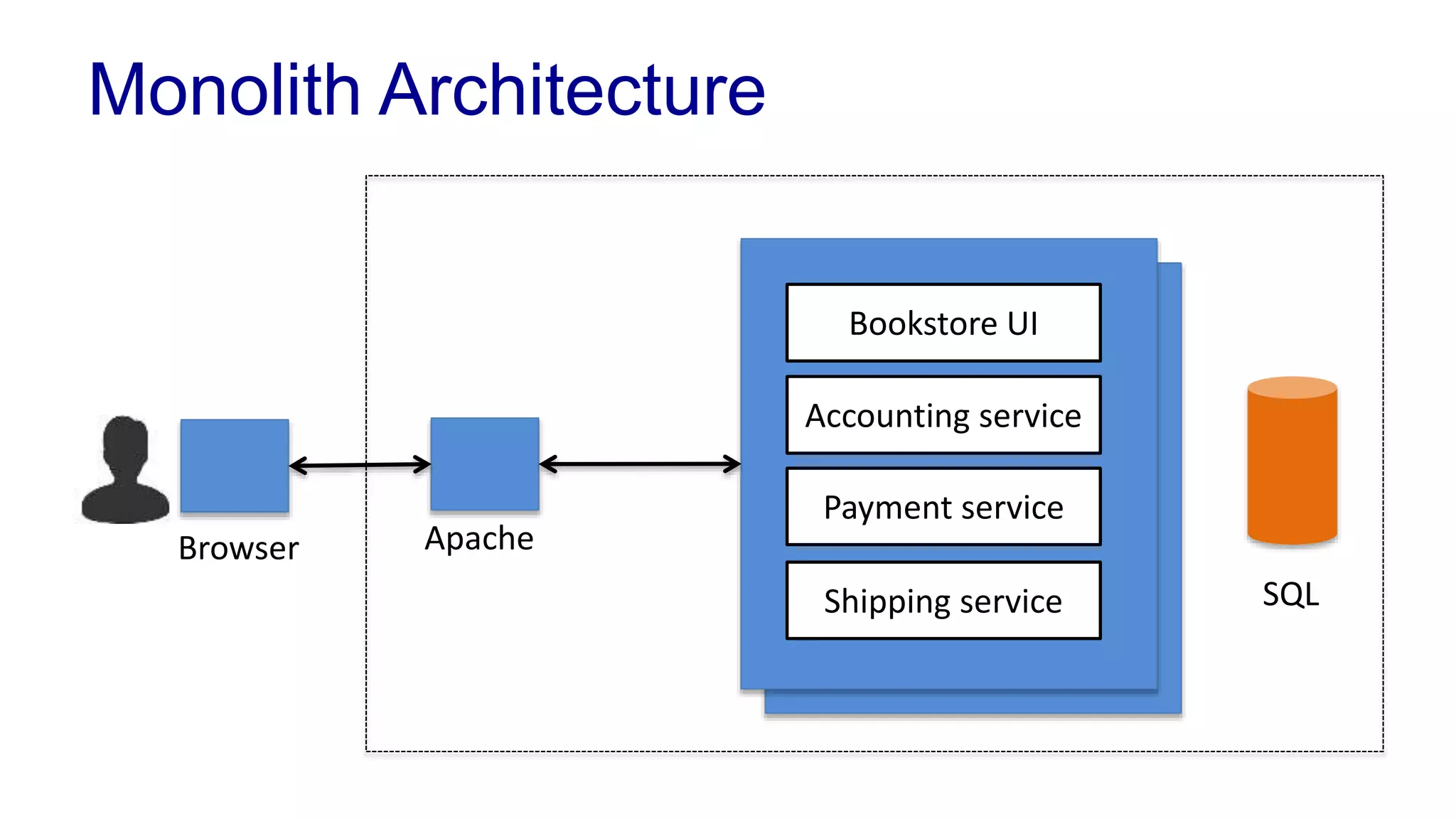
Monolith Architecture 
Bookstore UI 
Accounting service 
Payment service 
Shipping service SQL 
Browser Apache
Monolith Architecture 
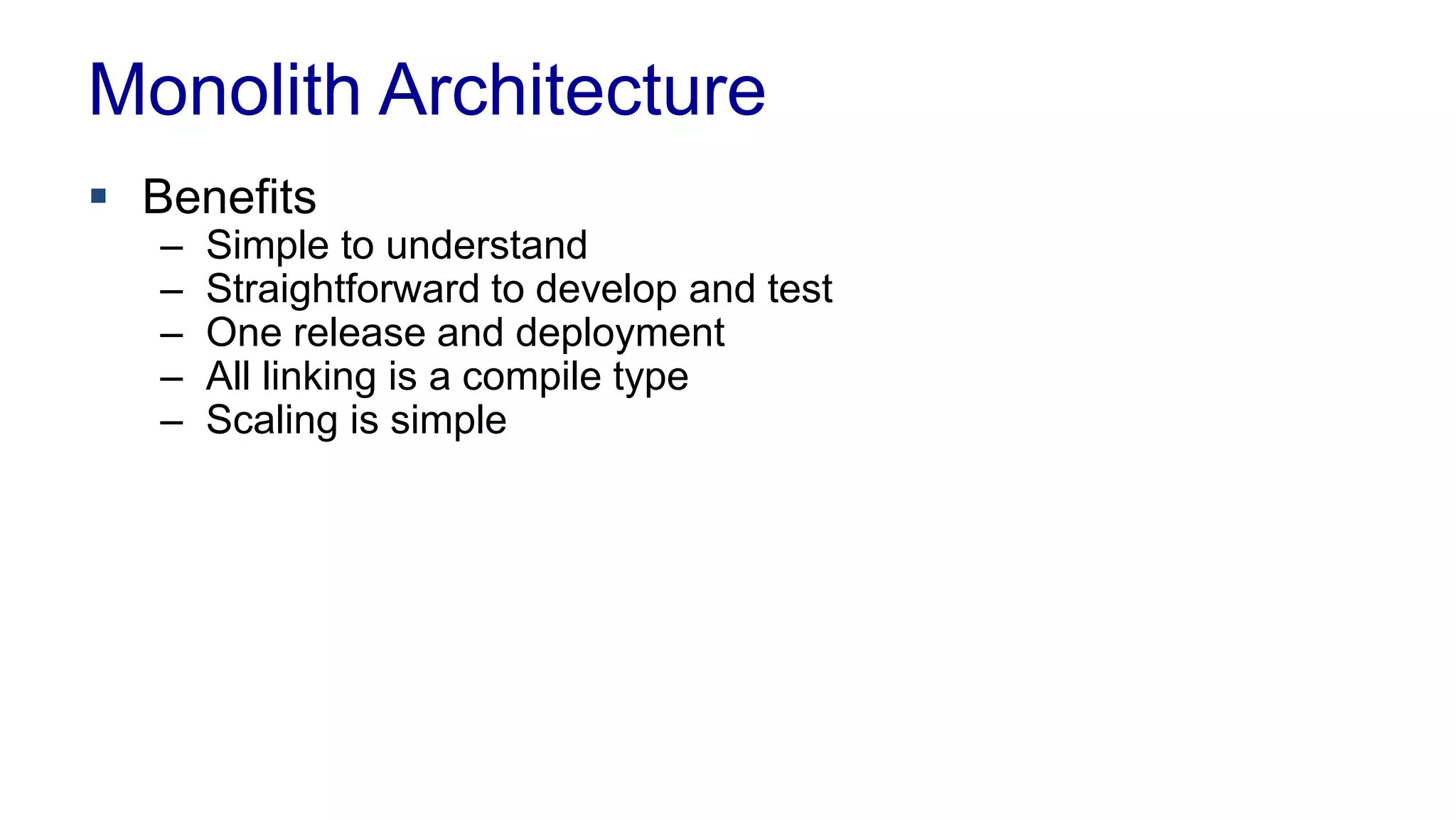
 Benefits 
– Simple to understand 
– Straightforward to develop and test 
– One release and deployment 
– All linking is a compile type 
– Scaling is simple
Monolithic Architecture 
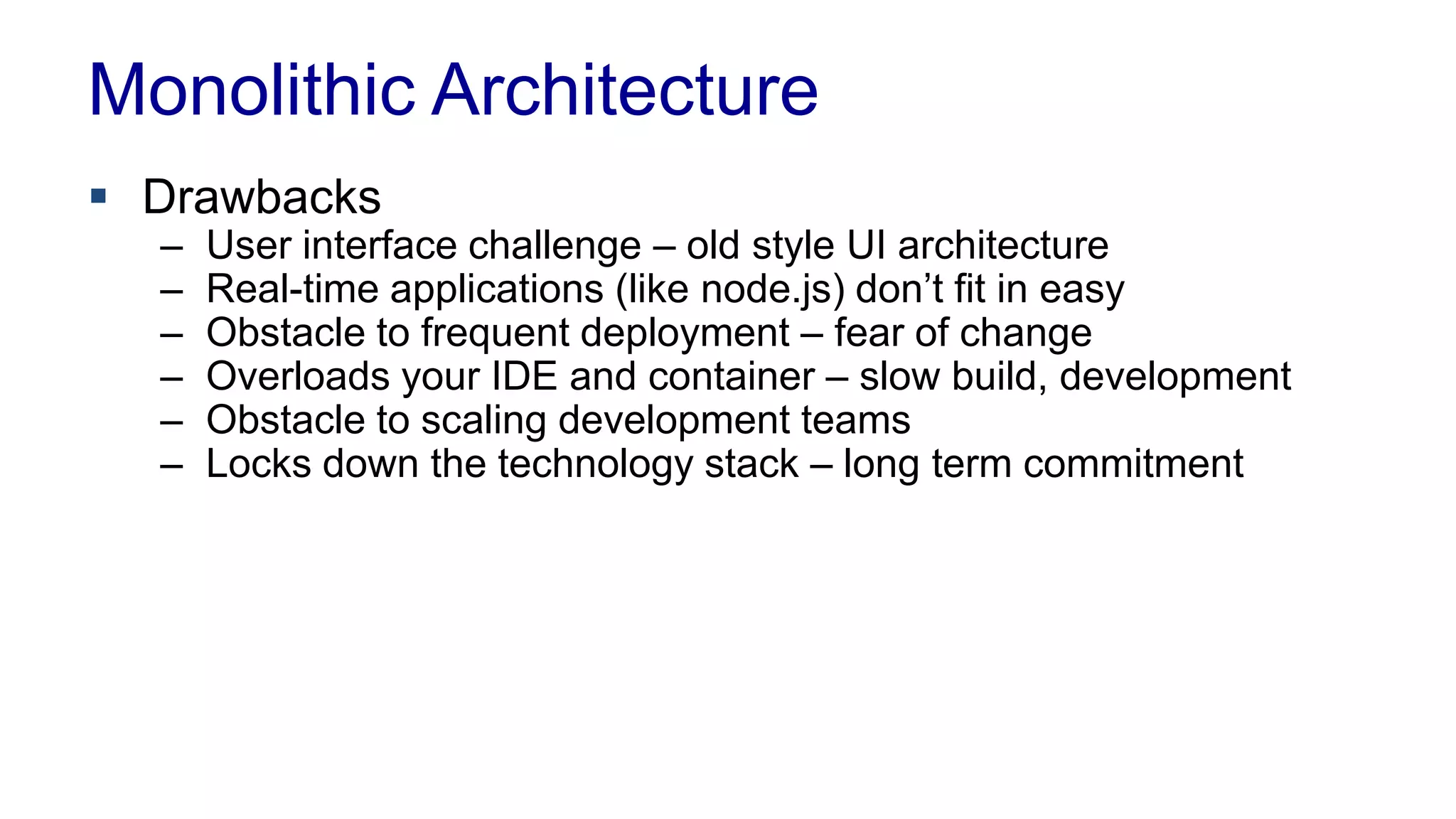
 Drawbacks 
– User interface challenge – old style UI architecture 
– Real-time applications (like node.js) don’t fit in easy 
– Obstacle to frequent deployment – fear of change 
– Overloads your IDE and container – slow build, development 
– Obstacle to scaling development teams 
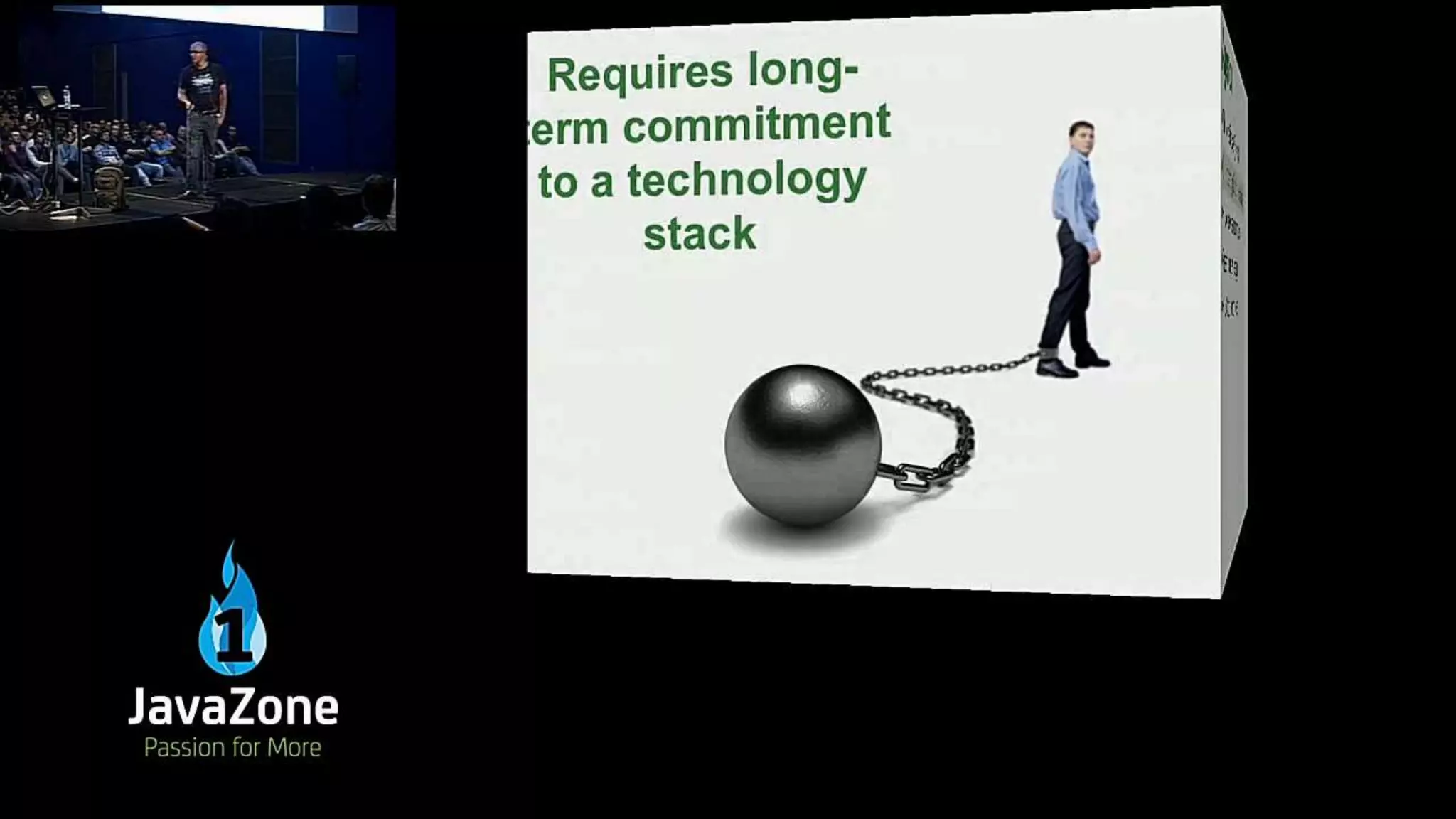
– Locks down the technology stack – long term commitment
Service Oriented Architecture
SOA 
 Overload term 
– Means different things to different people 
– Implies Web Services using SOAP 
SOA actually means that components of an 
application act as interoperable services, and 
can be used independently and recombined into 
other applications 
Engineering Software as a Service 
by David Patterson and Armando Fox
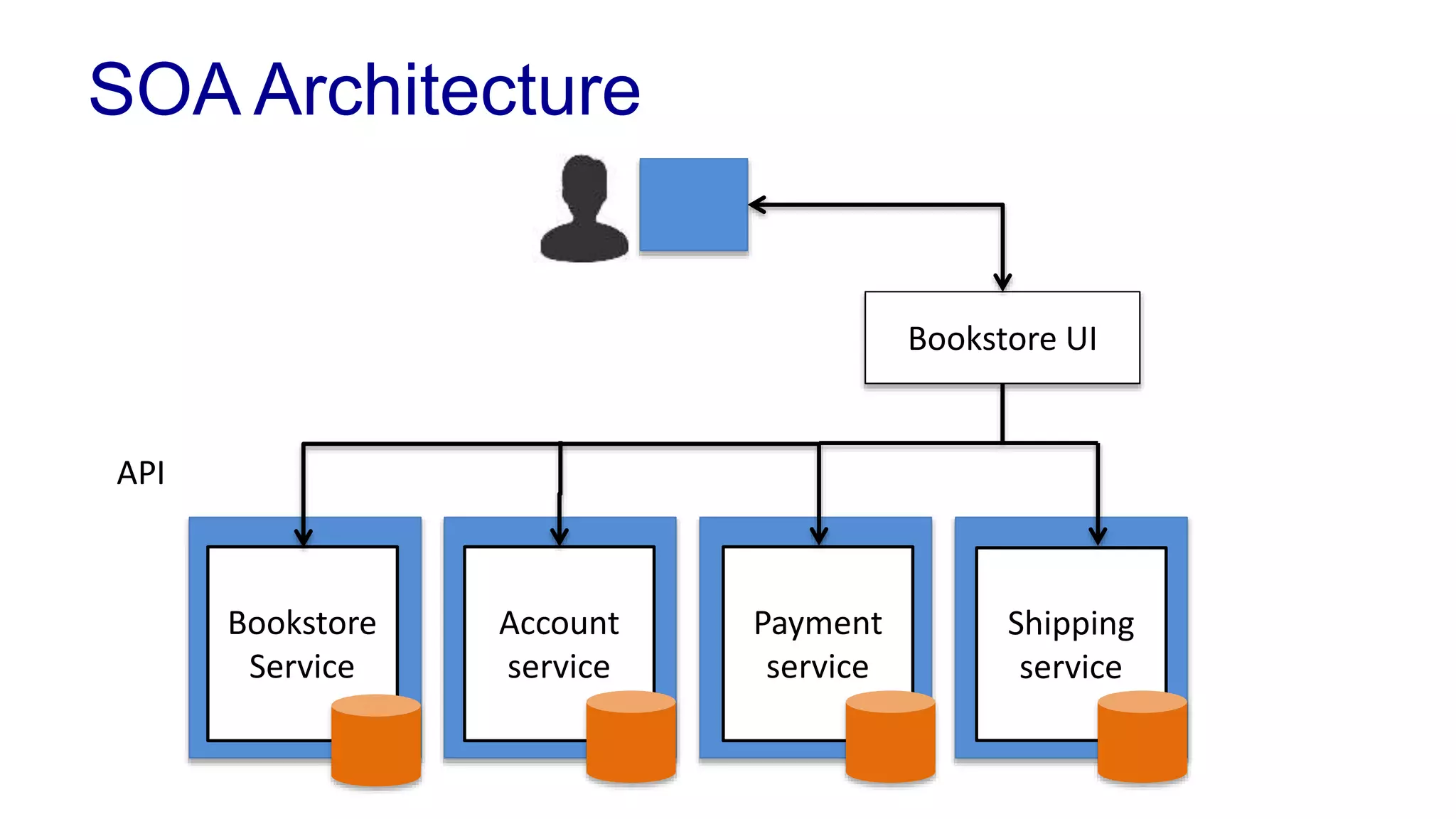
Service Oriented Architecture 
 Software Architecture where all components are 
designed to be services 
 Applications composed of interoperable services 
– Easy to build new services 
– Easy to change 
 Parts of the systems need to change more than others
Traditional Architecture 
Bookstore UI 
Accounting service 
Payment service 
Shipping service SQL 
Browser Apache
SOA Architecture 
Bookstore 
Service 
Account 
service 
Payment 
service 
Bookstore UI 
Shipping 
service 
API
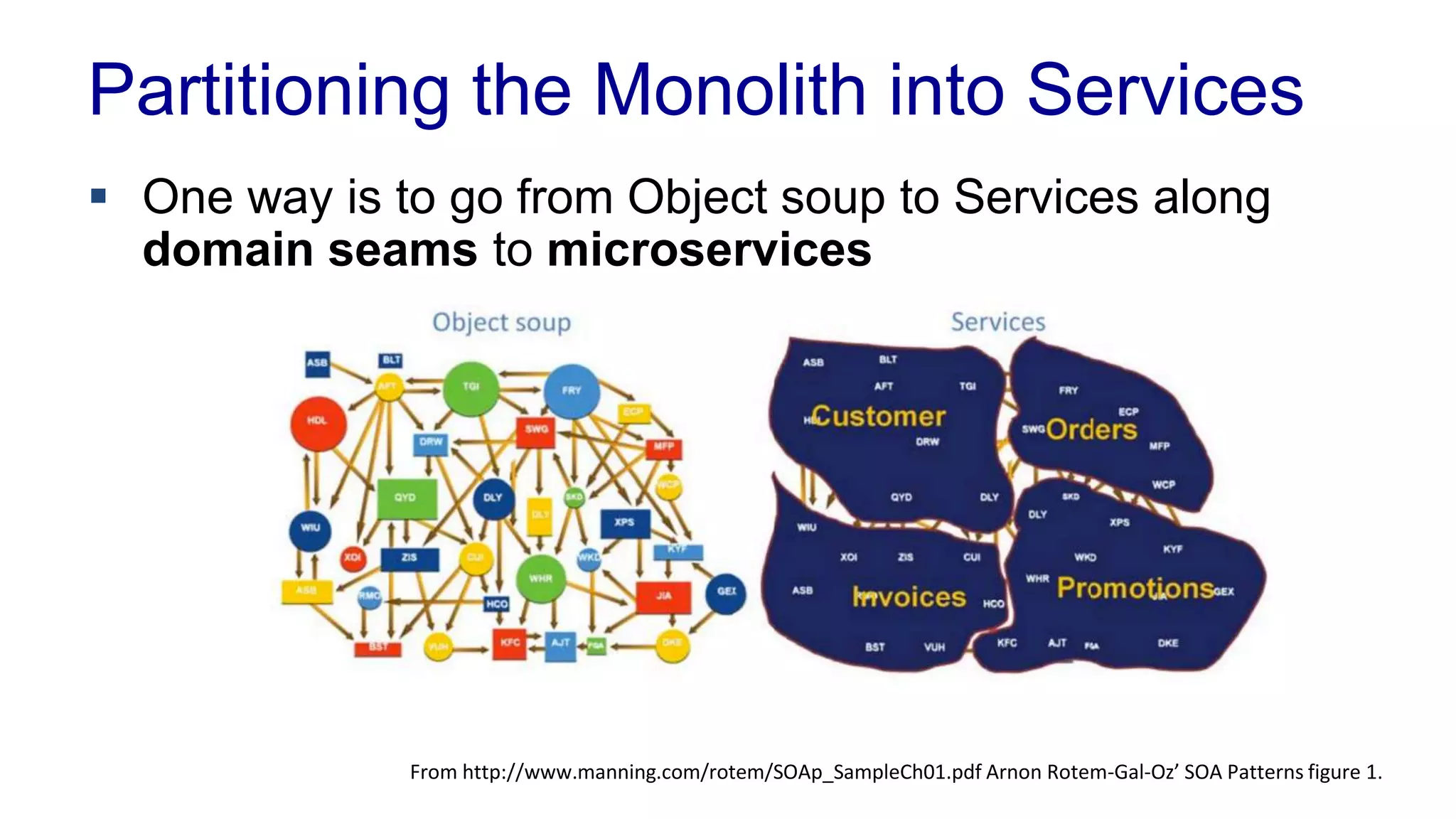
Partitioning the Monolith into Services 
 One way is to go from Object soup to Services along 
domain seams to microservices 
From http://www.manning.com/rotem/SOAp_SampleCh01.pdf Arnon Rotem-Gal-Oz’ SOA Patterns figure 1.
Microservices or microapps 
 Each service can be around 100-200 LOC (lines of code) 
– Size not the deterministic factor 
– Single Responsibility Principle 
– Don’t fix it – rewrite it 
 Microservice can have embedded web server 
– Totally independent
The Scale Cube
QUIZ 
Which statement is not true about SOA? 
A) SOA does not affect performance 
B) No service can access other service data except using APIs 
C) SOA improves productivity though reuse 
D) Monoliths system must deploy all components
QUIZ 
Which statement is not true about SOA? 
A) SOA does not affect performance 
B) No service can access other service data except using APIs 
C) SOA improves productivity though reuse 
D) Monoliths system must deploy all components 
✔
Bezos’ Mandate (from Yegge’s Rant) 
1. All teams will henceforth expose their data and 
functionality through service interfaces 
2. Teams must communicate with each other through 
these interfaces 
3. There will be no other form of interprocess 
communication allowed
Bezos’ Mandate (from Yegge’s Rant) 
4. It doesn't matter what technology they use 
5. All service interfaces, without exception, must be 
designed from the ground up to be externalizable. No 
exceptions. 
6. Anyone who doesn't do this will be fired.
Layering
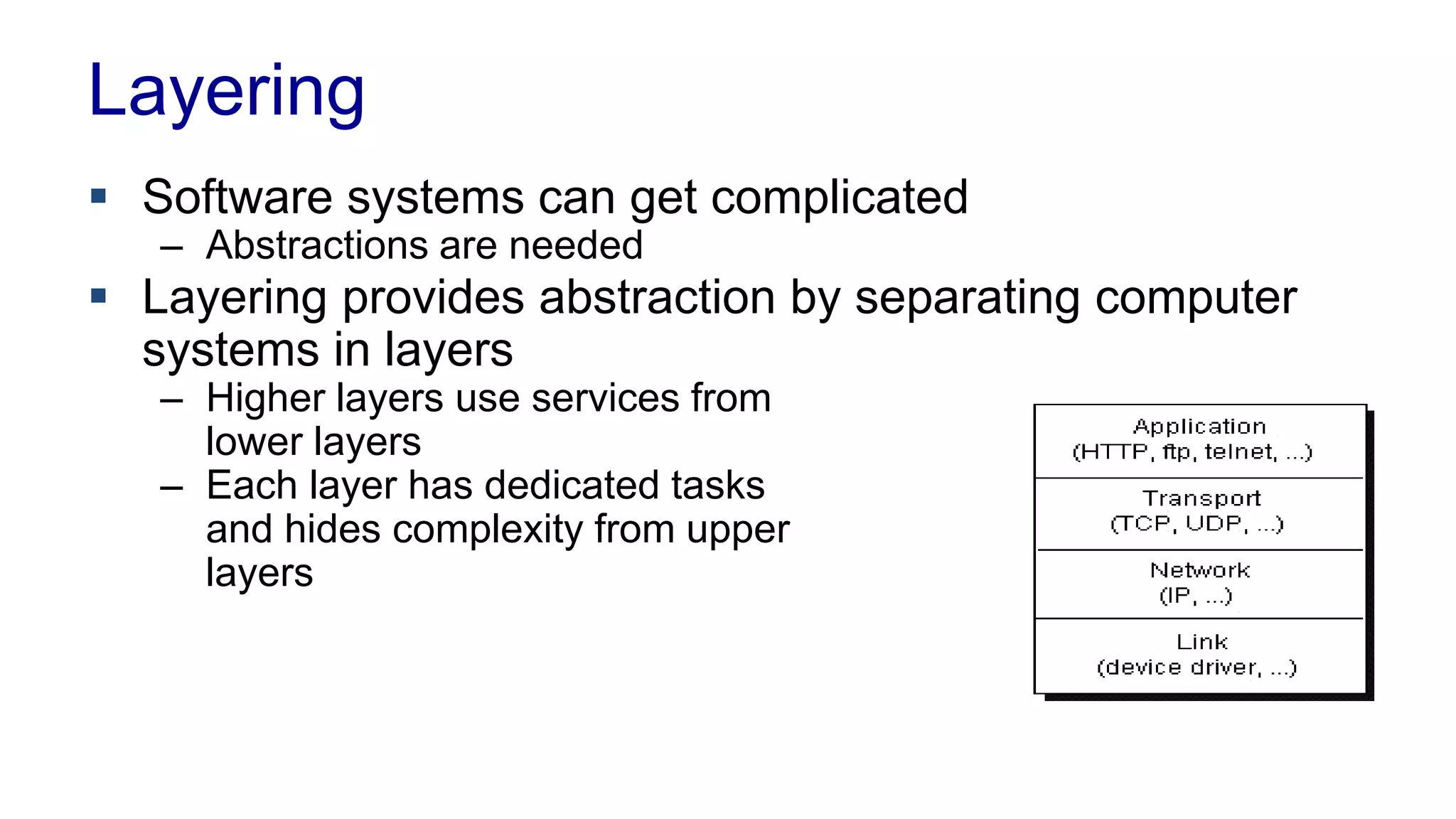
Layering 
 Software systems can get complicated 
– Abstractions are needed 
 Layering provides abstraction by separating computer 
systems in layers 
– Higher layers use services from 
lower layers 
– Each layer has dedicated tasks 
and hides complexity from upper 
layers
Benefits of Layering 
 You can understand a single layer as a coherent whole 
without knowing much about other layers 
 You can substitute layers with alternative 
implementation of the same basic service 
 You minimize dependencies between layers 
 Layers make good places for standardization 
 Once you have a layer built, you can use it for many 
higher-level services
Downsides 
 Layers encapsulate some, but not all, things well 
– Cascading changes 
– For example adding a field in the UI requires changes on each 
layer 
 Extra layers can harm performance 
– At every layer things typically need to be transformed from one 
presentation to another
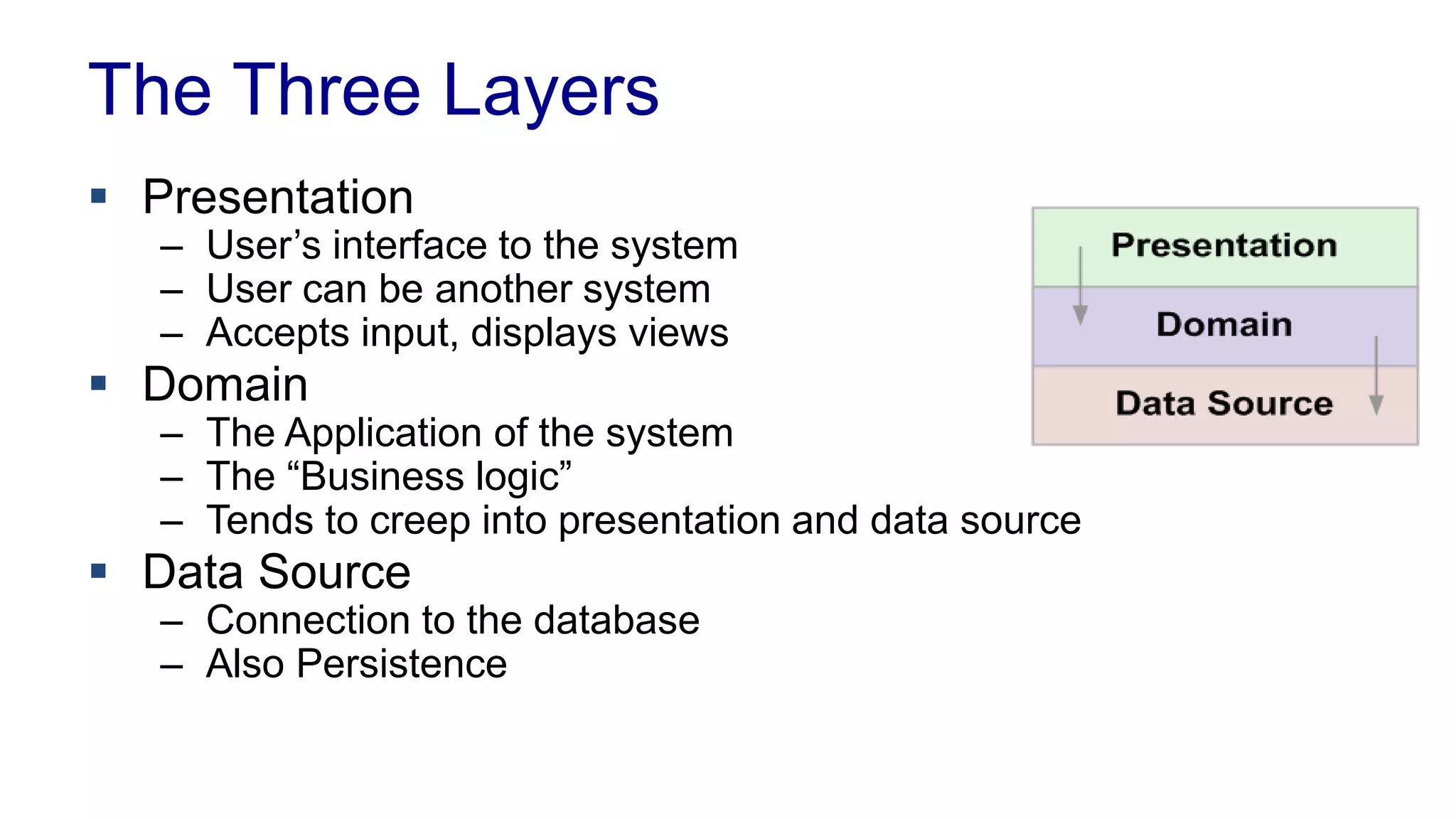
The Three Layers 
 Presentation 
– User’s interface to the system 
– User can be another system 
– Accepts input, displays views 
 Domain 
– The Application of the system 
– The “Business logic” 
– Tends to creep into presentation and data source 
 Data Source 
– Connection to the database 
– Also Persistence
Summary 
 Building blocks can help you 
 Architecture comes in many forms 
– Application, System, Software, Enterprise 
 Monolithic Architecture 
– Traditional approach, but getting difficult to scale 
 Service Oriented Architecture 
– Lightweight SOA, microservices 
 Layering 
– The oldest trick in the book

L02 Architecture

  • 1.
  • 2.
    Agenda  Buildingblocks (recap)  Architecture  Monolithic Architecture  Service Oriented Architecture  Layering
  • 3.
    Reading  Brown1, 2, 3 og 4  Pattern: Monolithic Architecture  Decomposing applications for scalability and deployability  The Scale Cube
  • 4.
  • 5.
    Building Enterprise Applications  Building computer systems is hard Design Pattern Architecture Middleware Frameworks OO Programming
  • 6.
    Architecture  Sharedunderstanding of system’s design by the expert developers on a project – Highest-level breakdown of a system into its parts – Decisions that are hard to change  Architecture influences design of components, technology, performance and middleware  There are always options
  • 7.
    Object Oriented Programming  OO is key to development of systems – Design for reusability, flexibility and performance “OO design is more important than specific technologies, such as J2EE. We should try to avoid letting our technology choices, such as J2EE, constrain our ability to use true OO design” – Rod Johnson “If the design is good, there is no code” – Jónas Þór, Senior Betware developer  One of the biggest hurdles for developers – Each component should be simple with simple task – Involves understanding of interaction of parts
  • 8.
    Design Patterns Design using known ideas – Design patterns are standard solutions to common problems in software design – Systematic approach for problems that reoccur in software development – Patterns have name and definitions - not language dependant  History – Landmark book from 1995: Design Patterns: Elements of Reusable Object-Oriented Software Gang of Four (GoF)
  • 9.
    Middleware  Enterprisesystem are built on middleware – Can cover a broad spectrum of software and generally sits between an application and an operating system – For example, databases, application servers, web servers, messaging systems, transaction monitors – “The plumbing” – the infrastructure  Horizontal market – Solves common problems – not specific business requirements – Low-level system
  • 10.
    Frameworks  Frameworksdefine the support structure for how to organize and build systems – Can improve productivity – We can use existing frameworks or build our own  Frameworks implement common problems – Developers extend and add their business requirements  Framework design – Use inheritance, inversion of control, interfaces and helper classes – Implement design patterns
  • 11.
    QUIZ Which ofthe following statement is not true? A) Design patterns are solutions to common problems B) Object oriented programing is good for general problems C) Frameworks are used to increase productivity D) Middleware can solve business related problems
  • 12.
    QUIZ Which ofthe following statement is not true? A) Design patterns are solutions to common problems B) Object oriented programing is good for general problems C) Frameworks are used to increase productivity D) Middleware can solve business related problems ✔
  • 13.
  • 14.
    Architecture  Meansdifferent things to different people – Big picture, things difficult to change, – a plan, a blueprint…
  • 15.
    Architecture – noun The decomposition of a product into a collection of components/modules and interactions Structure
  • 16.
    Architecture – verb Understanding what you need to build, create a vision and making the right decisions Vision
  • 17.
    Types of Architecture  There are many different architectures – Network, security, data, hardware, enterprise…  All have structure and vision – All have multiple constraints such as cost, time, legal, regulatory
  • 18.
    Application Architecture Application is the focus – Contains classes, components, design patterns, frameworks, libraries – Lower-level aspects of software design – Concerned with sign technology stack and layering Client REST Services EJB3 Hibernate Oracle Client REST layer Service layer Domain Layer Database layer
  • 19.
    System Architecture Focus on multiple applications across a number of tiers and technologies  Interactions between applications  Overall structure of the end-to-end software system at high-level  Mix of software and hardware
  • 20.
    Software Architecture The combination of application and system architecture  Includes the technical practices to build the software – Design Principles, Programming language Design patterns, Unit testing and much more…  Must also include aspects like – Cross-cutting concerns such as logging and exception handling Security, Performance, Audit Requirements, constraints, and much more…
  • 21.
    Enterprise Architecture How the enterprise is broken up in groups/departments  Business processes used  Workflows used  May not look at technology in detail rather how to us technology across the organization to get work done
  • 22.
    Agile Architecture Agile refers to a methodology of building software – moving fast, embracing change, release often, feedback cycles etc. Does agile development team then build agile architectures?  Agile architecture means it can react to change, is easy to change, is extendable
  • 23.
    Agility  Agilitymeans you can use the OODA loop Observe, Orient, Decide and Act How Spotify builds products
  • 24.
    QUIZ Which ofthe following architecture descriptions would be concerned with interactions between applications A) Application Architecture B) System Architecture C) Software Architecture D) Enterprise Architecture
  • 25.
    QUIZ Which ofthe following architecture descriptions would be concerned with interactions between applications A) Application Architecture B) System Architecture C) Software Architecture D) Enterprise Architecture ✔
  • 26.
  • 27.
    Monolith Architecture Traditional approach to building applications  Chris Richardson: Decomposing applications for scalability and deployability
  • 29.
    Monolith Architecture BookstoreUI Accounting service Payment service Shipping service SQL Browser Apache
  • 30.
    Monolith Architecture Benefits – Simple to understand – Straightforward to develop and test – One release and deployment – All linking is a compile type – Scaling is simple
  • 31.
    Monolithic Architecture Drawbacks – User interface challenge – old style UI architecture – Real-time applications (like node.js) don’t fit in easy – Obstacle to frequent deployment – fear of change – Overloads your IDE and container – slow build, development – Obstacle to scaling development teams – Locks down the technology stack – long term commitment
  • 33.
  • 34.
    SOA  Overloadterm – Means different things to different people – Implies Web Services using SOAP SOA actually means that components of an application act as interoperable services, and can be used independently and recombined into other applications Engineering Software as a Service by David Patterson and Armando Fox
  • 35.
    Service Oriented Architecture  Software Architecture where all components are designed to be services  Applications composed of interoperable services – Easy to build new services – Easy to change  Parts of the systems need to change more than others
  • 36.
    Traditional Architecture BookstoreUI Accounting service Payment service Shipping service SQL Browser Apache
  • 37.
    SOA Architecture Bookstore Service Account service Payment service Bookstore UI Shipping service API
  • 38.
    Partitioning the Monolithinto Services  One way is to go from Object soup to Services along domain seams to microservices From http://www.manning.com/rotem/SOAp_SampleCh01.pdf Arnon Rotem-Gal-Oz’ SOA Patterns figure 1.
  • 39.
    Microservices or microapps  Each service can be around 100-200 LOC (lines of code) – Size not the deterministic factor – Single Responsibility Principle – Don’t fix it – rewrite it  Microservice can have embedded web server – Totally independent
  • 41.
  • 42.
    QUIZ Which statementis not true about SOA? A) SOA does not affect performance B) No service can access other service data except using APIs C) SOA improves productivity though reuse D) Monoliths system must deploy all components
  • 43.
    QUIZ Which statementis not true about SOA? A) SOA does not affect performance B) No service can access other service data except using APIs C) SOA improves productivity though reuse D) Monoliths system must deploy all components ✔
  • 45.
    Bezos’ Mandate (fromYegge’s Rant) 1. All teams will henceforth expose their data and functionality through service interfaces 2. Teams must communicate with each other through these interfaces 3. There will be no other form of interprocess communication allowed
  • 46.
    Bezos’ Mandate (fromYegge’s Rant) 4. It doesn't matter what technology they use 5. All service interfaces, without exception, must be designed from the ground up to be externalizable. No exceptions. 6. Anyone who doesn't do this will be fired.
  • 47.
  • 48.
    Layering  Softwaresystems can get complicated – Abstractions are needed  Layering provides abstraction by separating computer systems in layers – Higher layers use services from lower layers – Each layer has dedicated tasks and hides complexity from upper layers
  • 49.
    Benefits of Layering  You can understand a single layer as a coherent whole without knowing much about other layers  You can substitute layers with alternative implementation of the same basic service  You minimize dependencies between layers  Layers make good places for standardization  Once you have a layer built, you can use it for many higher-level services
  • 50.
    Downsides  Layersencapsulate some, but not all, things well – Cascading changes – For example adding a field in the UI requires changes on each layer  Extra layers can harm performance – At every layer things typically need to be transformed from one presentation to another
  • 51.
    The Three Layers  Presentation – User’s interface to the system – User can be another system – Accepts input, displays views  Domain – The Application of the system – The “Business logic” – Tends to creep into presentation and data source  Data Source – Connection to the database – Also Persistence
  • 52.
    Summary  Buildingblocks can help you  Architecture comes in many forms – Application, System, Software, Enterprise  Monolithic Architecture – Traditional approach, but getting difficult to scale  Service Oriented Architecture – Lightweight SOA, microservices  Layering – The oldest trick in the book

Editor's Notes