www.eleven-labs.com
SOFTWARE
ARCHITECTURE
@vcomposieux
… all you need to know
Vincent Composieux
WE WILL NOT TALK ABOUT
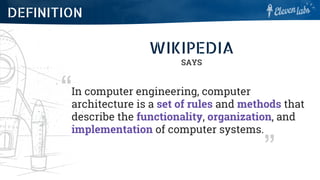
In computer engineering, computer
architecture is a set of rules and methods that
describe the functionality, organization, and
implementation of computer systems.
WIKIPEDIA
SAYS
“
”
DEFINITION
PROJECT TEAM
TECH LEAD
BUSINESS TEAM
ENGINEERS
OPS TEAM
ARCHITECTS
ENGINEERS
PRODUCT
OWNER
SERVICES
TALK
TO EVERYONE
ARCHITECT
BRINGS
ANSWERS TO QUESTIONS
WHAT IS ITS POSITION?
START ONGOING RESEARCHNEXT
AUDIT / FOLLOWDEFINE PREPARE
DOCUMENT
COMMUNICATE
DOCUMENT
COMMUNICATE
DOCUMENT
COMMUNICATE
PROJECTS
WORKFLOW
Present at all key moments of a
project.
WHAT IS ITS JOB EVERYDAY?
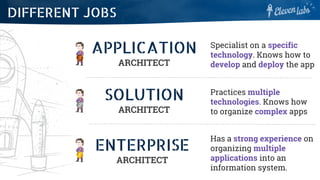
APPLICATION
ARCHITECT
Specialist on a specific
technology. Knows how to
develop and deploy the app
SOLUTION
ARCHITECT
Practices multiple
technologies. Knows how
to organize complex apps
ENTERPRISE
ARCHITECT
Has a strong experience on
organizing multiple
applications into an
information system.
DIFFERENT JOBS
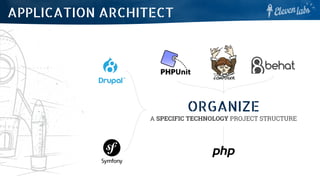
APPLICATION
ARCHITECT
ORGANIZE
A SPECIFIC TECHNOLOGY PROJECT STRUCTURE
APPLICATION ARCHITECT
DEFINE
STANDARDS
PROCEDURES
Ensure that everyone is able
to understand quickly and
use the application in a
normalized way.
● Define best practices to follow on the project (PHP’S PSRs, Symfony
best practices, etc…),
● Define procedures and tools for project integration (tests), deliver
(deploy) the application,
● Ensure that each developer understand and use the best practices,
● Ensure that there is no issue with procedures.
START ONGOING NEXT
APPLICATION ARCHITECT
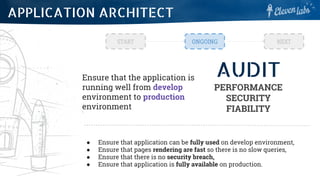
AUDIT
PERFORMANCE
SECURITY
FIABILITY
Ensure that the application is
running well from develop
environment to production
environment
● Ensure that application can be fully used on develop environment,
● Ensure that pages rendering are fast so there is no slow queries,
● Ensure that there is no security breach,
● Ensure that application is fully available on production.
START ONGOING NEXT
APPLICATION ARCHITECT
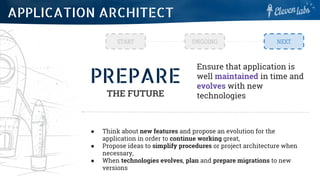
PREPARE
THE FUTURE
Ensure that application is
well maintained in time and
evolves with new
technologies
● Think about new features and propose an evolution for the
application in order to continue working great,
● Propose ideas to simplify procedures or project architecture when
necessary,
● When technologies evolves, plan and prepare migrations to new
versions
START ONGOING NEXT
APPLICATION ARCHITECT
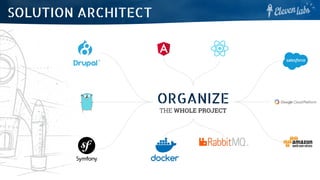
SOLUTION
ARCHITECT
ORGANIZE
THE WHOLE PROJECT
SOLUTION ARCHITECT
DESIGN
COMPONENTS
EQUIPMENTS
Design whole components
(cross-technologies) that will
compose the architecture of the
application
● Chooses the best technologies and tools for answering the needs of
the application
● Prepares material specifications for running the application on
servers
● Writes and communicate on both software and technical
specifications
START ONGOING NEXT
SOLUTION ARCHITECT
ANALYZE
DYSFUNCTIONS
OPTIMIZATIONS
Ensure that the whole
application components are
working properly and search
for optimizations.
● Ensure that there is no issue on all the application components
● Listens for feedbacks from application architect and/or technical
teams
● Investigates on how the whole application can be optimized
(reliability, data exchanges, security, ...)
START ONGOING NEXT
SOLUTION ARCHITECT
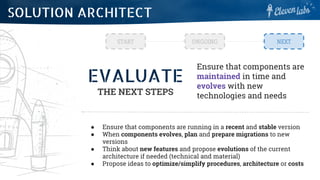
EVALUATE
THE NEXT STEPS
Ensure that components are
maintained in time and
evolves with new
technologies and needs
● Ensure that components are running in a recent and stable version
● When components evolves, plan and prepare migrations to new
versions
● Think about new features and propose evolutions of the current
architecture if needed (technical and material)
● Propose ideas to optimize/simplify procedures, architecture or costs
START ONGOING NEXT
SOLUTION ARCHITECT
ENTERPRISE
ARCHITECT
ORGANIZE
THE ENTERPRISE IT PROJECTS
TOGETHER
PROJECT1PROJECT2
PROJECT 3 PROJECT 4
ENTERPRISE ARCHITECT
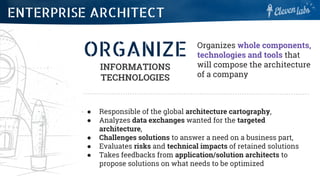
ORGANIZE
INFORMATIONS
TECHNOLOGIES
Organizes whole components,
technologies and tools that
will compose the architecture
of a company
● Responsible of the global architecture cartography,
● Analyzes data exchanges wanted for the targeted
architecture,
● Challenges solutions to answer a need on a business part,
● Evaluates risks and technical impacts of retained solutions
● Takes feedbacks from application/solution architects to
propose solutions on what needs to be optimized
ENTERPRISE ARCHITECT
APPLICATION
ARCHITECTURE PATTERNS
OBSERVER PATTERN
SERVICE 1
SERVICE 3
EVENT
CONTROLLER
MOVE
LOGIC INTO DEDICATED SERVICES
Notify
Listens
SERVICE 2
Listens
APPLICATION
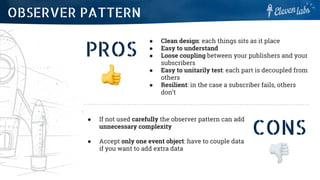
PROS
● Clean design: each things sits as it place
● Easy to understand
● Loose coupling between your publishers and your
subscribers
● Easy to unitarily test: each part is decoupled from
others
● Resilient: in the case a subscriber fails, others
don’t
OBSERVER PATTERN
CONS
● If not used carefully the observer pattern can add
unnecessary complexity
● Accept only one event object: have to couple data
if you want to add extra data
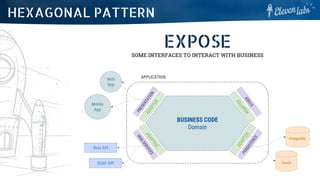
HEXAGONAL PATTERN
EXPOSE
SOME INTERFACES TO INTERACT WITH BUSINESS
APPLICATION
BUSINESS CODE
Domain
ADAPTER
ADAPTER
ADAPTER
ADAPTER
PRESENTATION
PERSISTENCE
PostgreSQL
Oracle
Web
App
Mobile
App
WEBSERVICESRest API
SOAP API
OTHER
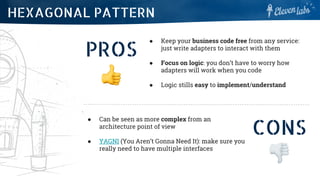
PROS
● Keep your business code free from any service:
just write adapters to interact with them
● Focus on logic: you don’t have to worry how
adapters will work when you code
● Logic stills easy to implement/understand
HEXAGONAL PATTERN
CONS
● Can be seen as more complex from an
architecture point of view
● YAGNI (You Aren’t Gonna Need It): make sure you
really need to have multiple interfaces
SOLUTION
ARCHITECTURE PATTERNS
MICROSERVICES
SERVICE 1 SERVICE 2 SERVICE 3
API API API
MOBILE
UI
WEB
UI
DECOUPLE
SERVICES BY BUSINESS
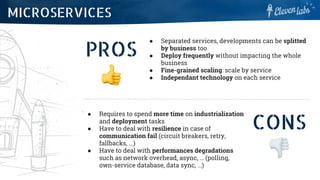
PROS
● Separated services, developments can be splitted
by business too
● Deploy frequently without impacting the whole
business
● Fine-grained scaling: scale by service
● Independant technology on each service
MICROSERVICES
CONS
● Requires to spend more time on industrialization
and deployment tasks
● Have to deal with resilience in case of
communication fail (circuit breakers, retry,
fallbacks, ...)
● Have to deal with performances degradations
such as network overhead, async, … (polling,
own-service database, data sync, ...)
EVENT-DRIVEN
SERVICE 1 SERVICE 2
EVENT
BUS
REACT
TO APPLICATION EVENTS
Publish an event
React to an event
Publish an event
React to an event
DatabaseWEB
UI
PROS
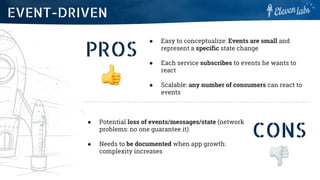
● Easy to conceptualize: Events are small and
represent a specific state change
● Each service subscribes to events he wants to
react
● Scalable: any number of consumers can react to
events
EVENT-DRIVEN
CONS
● Potential loss of events/messages/state (network
problems: no one guarantee it)
● Needs to be documented when app growth:
complexity increases
MICRO FRONTENDS
WEB UI
INCLUDE
MULTIPLE SEPARATED FRONTEND SERVICES
Frontend
1
Frontend
2
Frontend
3
Back-end
1
Back-end
2
Back-end
3
DB 1 DB 2 DB 3
HTML 5
CustomEvents
Server
Sides
Includes
PROS
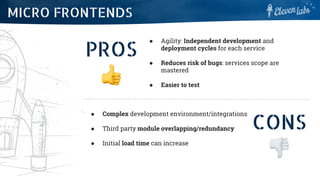
● Agility: Independent development and
deployment cycles for each service
● Reduces risk of bugs: services scope are
mastered
● Easier to test
MICRO FRONTENDS
CONS
● Complex development environment/integrations
● Third party module overlapping/redundancy
● Initial load time can increase
SERVERLESS
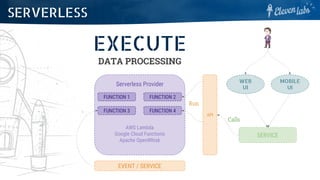
SERVICE
MOBILE
UI
WEB
UI
Serverless Provider
AWS Lambda
Google Cloud Functions
Apache OpenWhisk
EXECUTE
DATA PROCESSING
FUNCTION 1 FUNCTION 2
FUNCTION 3 FUNCTION 4
API
Calls
Run
EVENT / SERVICE
PROS
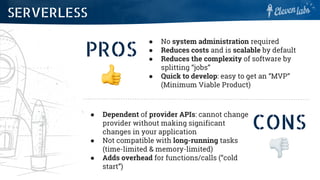
● No system administration required
● Reduces costs and is scalable by default
● Reduces the complexity of software by
splitting “jobs”
● Quick to develop: easy to get an “MVP”
(Minimum Viable Product)
SERVERLESS
CONS
● Dependent of provider APIs: cannot change
provider without making significant
changes in your application
● Not compatible with long-running tasks
(time-limited & memory-limited)
● Adds overhead for functions/calls (“cold
start”)
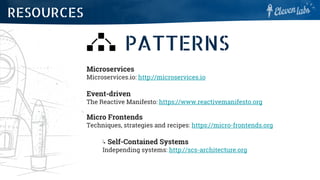
PATTERNS
Microservices
Microservices.io: http://microservices.io
Event-driven
The Reactive Manifesto: https://www.reactivemanifesto.org
Micro Frontends
Techniques, strategies and recipes: https://micro-frontends.org
↳ Self-Contained Systems
Independing systems: http://scs-architecture.org
RESOURCES
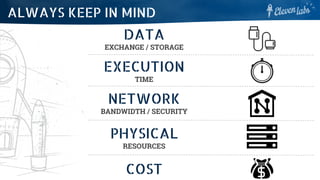
ALWAYS KEEP IN MIND
DATA
EXCHANGE / STORAGE
EXECUTION
TIME
NETWORK
BANDWIDTH / SECURITY
PHYSICAL
RESOURCES
COST
ONE MORE THING
KISS
* Keep it simple, stupid
* Keep it stupidly simple
* Keep it simple, silly
* Keep it small and simple
* Keep it sweet and simple
* Keep it simple and straightforward
* Keep it short and simple
* Keep it simple and smart
* Keep it strictly simple
* Keep it speckless and sane
* Keep it super-simple
* Keep it sober and significant
* Keep it short and sweet
* Keep information security simple
* Keep it safe and simple
THANK YOU
Happy Architecting
Images
https://www.eleven-labs.com
https://www.16personalities.com
CREDITS

Software Architecture - All you need to know

  • 1.
  • 2.
    WE WILL NOTTALK ABOUT
  • 3.
    In computer engineering,computer architecture is a set of rules and methods that describe the functionality, organization, and implementation of computer systems. WIKIPEDIA SAYS “ ” DEFINITION
  • 4.
    PROJECT TEAM TECH LEAD BUSINESSTEAM ENGINEERS OPS TEAM ARCHITECTS ENGINEERS PRODUCT OWNER SERVICES TALK TO EVERYONE ARCHITECT BRINGS ANSWERS TO QUESTIONS WHAT IS ITS POSITION?
  • 5.
    START ONGOING RESEARCHNEXT AUDIT/ FOLLOWDEFINE PREPARE DOCUMENT COMMUNICATE DOCUMENT COMMUNICATE DOCUMENT COMMUNICATE PROJECTS WORKFLOW Present at all key moments of a project. WHAT IS ITS JOB EVERYDAY?
  • 6.
    APPLICATION ARCHITECT Specialist on aspecific technology. Knows how to develop and deploy the app SOLUTION ARCHITECT Practices multiple technologies. Knows how to organize complex apps ENTERPRISE ARCHITECT Has a strong experience on organizing multiple applications into an information system. DIFFERENT JOBS
  • 7.
  • 8.
    ORGANIZE A SPECIFIC TECHNOLOGYPROJECT STRUCTURE APPLICATION ARCHITECT
  • 9.
    DEFINE STANDARDS PROCEDURES Ensure that everyoneis able to understand quickly and use the application in a normalized way. ● Define best practices to follow on the project (PHP’S PSRs, Symfony best practices, etc…), ● Define procedures and tools for project integration (tests), deliver (deploy) the application, ● Ensure that each developer understand and use the best practices, ● Ensure that there is no issue with procedures. START ONGOING NEXT APPLICATION ARCHITECT
  • 10.
    AUDIT PERFORMANCE SECURITY FIABILITY Ensure that theapplication is running well from develop environment to production environment ● Ensure that application can be fully used on develop environment, ● Ensure that pages rendering are fast so there is no slow queries, ● Ensure that there is no security breach, ● Ensure that application is fully available on production. START ONGOING NEXT APPLICATION ARCHITECT
  • 11.
    PREPARE THE FUTURE Ensure thatapplication is well maintained in time and evolves with new technologies ● Think about new features and propose an evolution for the application in order to continue working great, ● Propose ideas to simplify procedures or project architecture when necessary, ● When technologies evolves, plan and prepare migrations to new versions START ONGOING NEXT APPLICATION ARCHITECT
  • 12.
  • 13.
  • 14.
    DESIGN COMPONENTS EQUIPMENTS Design whole components (cross-technologies)that will compose the architecture of the application ● Chooses the best technologies and tools for answering the needs of the application ● Prepares material specifications for running the application on servers ● Writes and communicate on both software and technical specifications START ONGOING NEXT SOLUTION ARCHITECT
  • 15.
    ANALYZE DYSFUNCTIONS OPTIMIZATIONS Ensure that thewhole application components are working properly and search for optimizations. ● Ensure that there is no issue on all the application components ● Listens for feedbacks from application architect and/or technical teams ● Investigates on how the whole application can be optimized (reliability, data exchanges, security, ...) START ONGOING NEXT SOLUTION ARCHITECT
  • 16.
    EVALUATE THE NEXT STEPS Ensurethat components are maintained in time and evolves with new technologies and needs ● Ensure that components are running in a recent and stable version ● When components evolves, plan and prepare migrations to new versions ● Think about new features and propose evolutions of the current architecture if needed (technical and material) ● Propose ideas to optimize/simplify procedures, architecture or costs START ONGOING NEXT SOLUTION ARCHITECT
  • 17.
  • 18.
    ORGANIZE THE ENTERPRISE ITPROJECTS TOGETHER PROJECT1PROJECT2 PROJECT 3 PROJECT 4 ENTERPRISE ARCHITECT
  • 19.
    ORGANIZE INFORMATIONS TECHNOLOGIES Organizes whole components, technologiesand tools that will compose the architecture of a company ● Responsible of the global architecture cartography, ● Analyzes data exchanges wanted for the targeted architecture, ● Challenges solutions to answer a need on a business part, ● Evaluates risks and technical impacts of retained solutions ● Takes feedbacks from application/solution architects to propose solutions on what needs to be optimized ENTERPRISE ARCHITECT
  • 20.
  • 21.
    OBSERVER PATTERN SERVICE 1 SERVICE3 EVENT CONTROLLER MOVE LOGIC INTO DEDICATED SERVICES Notify Listens SERVICE 2 Listens APPLICATION
  • 22.
    PROS ● Clean design:each things sits as it place ● Easy to understand ● Loose coupling between your publishers and your subscribers ● Easy to unitarily test: each part is decoupled from others ● Resilient: in the case a subscriber fails, others don’t OBSERVER PATTERN CONS ● If not used carefully the observer pattern can add unnecessary complexity ● Accept only one event object: have to couple data if you want to add extra data
  • 23.
    HEXAGONAL PATTERN EXPOSE SOME INTERFACESTO INTERACT WITH BUSINESS APPLICATION BUSINESS CODE Domain ADAPTER ADAPTER ADAPTER ADAPTER PRESENTATION PERSISTENCE PostgreSQL Oracle Web App Mobile App WEBSERVICESRest API SOAP API OTHER
  • 24.
    PROS ● Keep yourbusiness code free from any service: just write adapters to interact with them ● Focus on logic: you don’t have to worry how adapters will work when you code ● Logic stills easy to implement/understand HEXAGONAL PATTERN CONS ● Can be seen as more complex from an architecture point of view ● YAGNI (You Aren’t Gonna Need It): make sure you really need to have multiple interfaces
  • 25.
  • 26.
    MICROSERVICES SERVICE 1 SERVICE2 SERVICE 3 API API API MOBILE UI WEB UI DECOUPLE SERVICES BY BUSINESS
  • 27.
    PROS ● Separated services,developments can be splitted by business too ● Deploy frequently without impacting the whole business ● Fine-grained scaling: scale by service ● Independant technology on each service MICROSERVICES CONS ● Requires to spend more time on industrialization and deployment tasks ● Have to deal with resilience in case of communication fail (circuit breakers, retry, fallbacks, ...) ● Have to deal with performances degradations such as network overhead, async, … (polling, own-service database, data sync, ...)
  • 28.
    EVENT-DRIVEN SERVICE 1 SERVICE2 EVENT BUS REACT TO APPLICATION EVENTS Publish an event React to an event Publish an event React to an event DatabaseWEB UI
  • 29.
    PROS ● Easy toconceptualize: Events are small and represent a specific state change ● Each service subscribes to events he wants to react ● Scalable: any number of consumers can react to events EVENT-DRIVEN CONS ● Potential loss of events/messages/state (network problems: no one guarantee it) ● Needs to be documented when app growth: complexity increases
  • 30.
    MICRO FRONTENDS WEB UI INCLUDE MULTIPLESEPARATED FRONTEND SERVICES Frontend 1 Frontend 2 Frontend 3 Back-end 1 Back-end 2 Back-end 3 DB 1 DB 2 DB 3 HTML 5 CustomEvents Server Sides Includes
  • 31.
    PROS ● Agility: Independentdevelopment and deployment cycles for each service ● Reduces risk of bugs: services scope are mastered ● Easier to test MICRO FRONTENDS CONS ● Complex development environment/integrations ● Third party module overlapping/redundancy ● Initial load time can increase
  • 32.
    SERVERLESS SERVICE MOBILE UI WEB UI Serverless Provider AWS Lambda GoogleCloud Functions Apache OpenWhisk EXECUTE DATA PROCESSING FUNCTION 1 FUNCTION 2 FUNCTION 3 FUNCTION 4 API Calls Run EVENT / SERVICE
  • 33.
    PROS ● No systemadministration required ● Reduces costs and is scalable by default ● Reduces the complexity of software by splitting “jobs” ● Quick to develop: easy to get an “MVP” (Minimum Viable Product) SERVERLESS CONS ● Dependent of provider APIs: cannot change provider without making significant changes in your application ● Not compatible with long-running tasks (time-limited & memory-limited) ● Adds overhead for functions/calls (“cold start”)
  • 34.
    PATTERNS Microservices Microservices.io: http://microservices.io Event-driven The ReactiveManifesto: https://www.reactivemanifesto.org Micro Frontends Techniques, strategies and recipes: https://micro-frontends.org ↳ Self-Contained Systems Independing systems: http://scs-architecture.org RESOURCES
  • 35.
    ALWAYS KEEP INMIND DATA EXCHANGE / STORAGE EXECUTION TIME NETWORK BANDWIDTH / SECURITY PHYSICAL RESOURCES COST
  • 36.
    ONE MORE THING KISS *Keep it simple, stupid * Keep it stupidly simple * Keep it simple, silly * Keep it small and simple * Keep it sweet and simple * Keep it simple and straightforward * Keep it short and simple * Keep it simple and smart * Keep it strictly simple * Keep it speckless and sane * Keep it super-simple * Keep it sober and significant * Keep it short and sweet * Keep information security simple * Keep it safe and simple
  • 37.
  • 38.