Cloud computing:  Cloud Computing: Implications for Project Management Methodologies.ROB LIVINGSTONE- PRINCIPAL, Rob Livingstone Advisory Pty Ltd, and- Fellow, University of Technology, SydneyBrisbane, 11th October 2011
Cloud computing:  Cloud Computing: Implications for Project Management Methodologies.What I’ll be covering:Cloud computing basic definition and attributes Overview: Public, Private and Hybrid CloudNext few years – from confusion to calmThe consumerisation of IT effect in the enterpriseProject Management implicationsCloud: Some key considerations for organisationsThe future is nowQuestions and discussion
1. Cloud computing basic definition and attributes:Cloud is a very broad term for IT systems accessed via the Internet or your browser.
In public cloud, the various components are all run by an external party, and you do not own anything, other than the data that you load into the system.The primary attributes of public Cloud systems are:You subscribe to the service (never own)The system is accessed via the InternetYou neither have control or title over the Cloud systemYou have limited to full title over the data that you upload
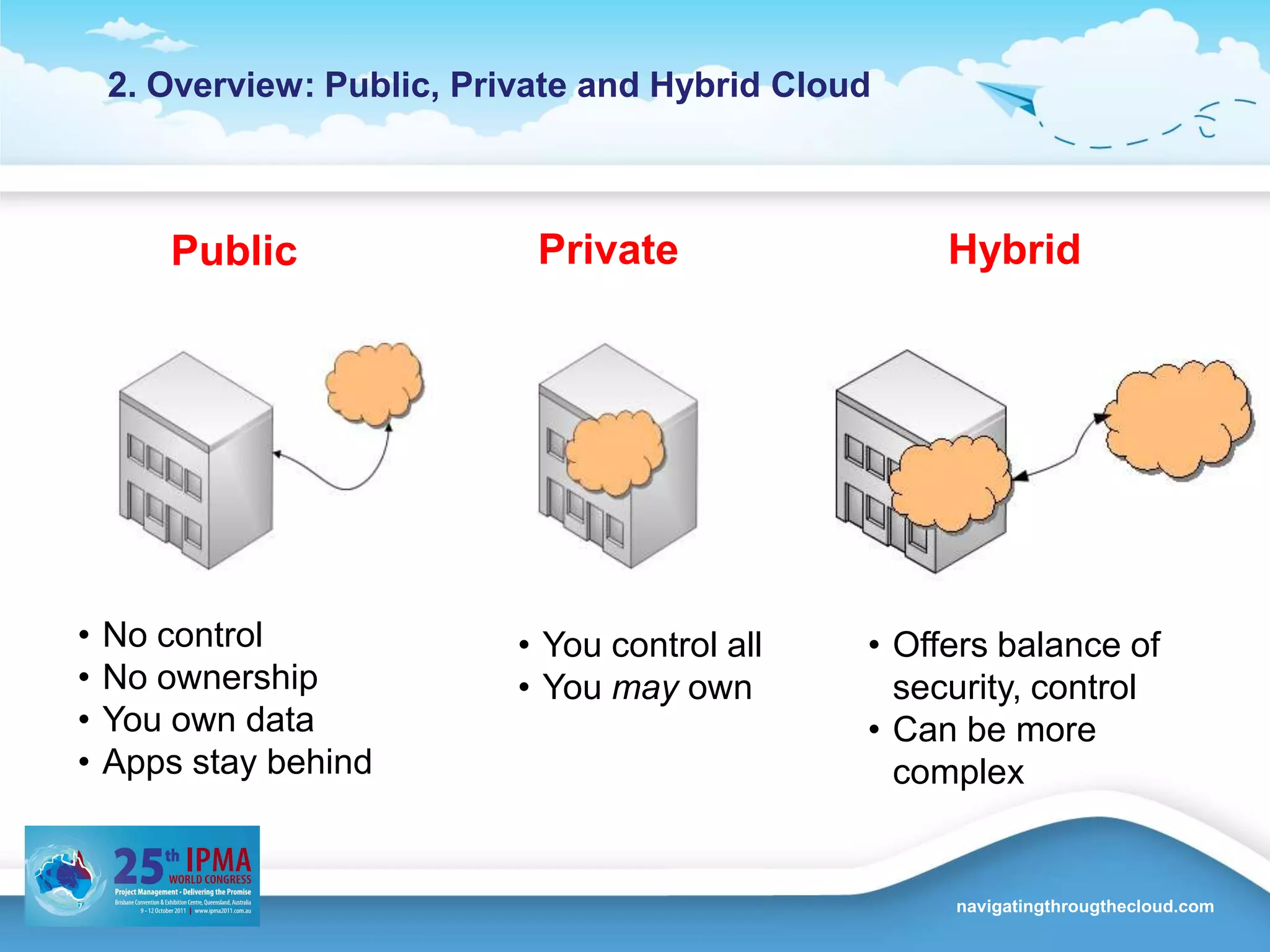
2. Overview: Public, Private and Hybrid CloudPrivateHybridPublicNo control
No ownership
You own data
Apps stay behind
You control all
You may own
Offers balance of security, control
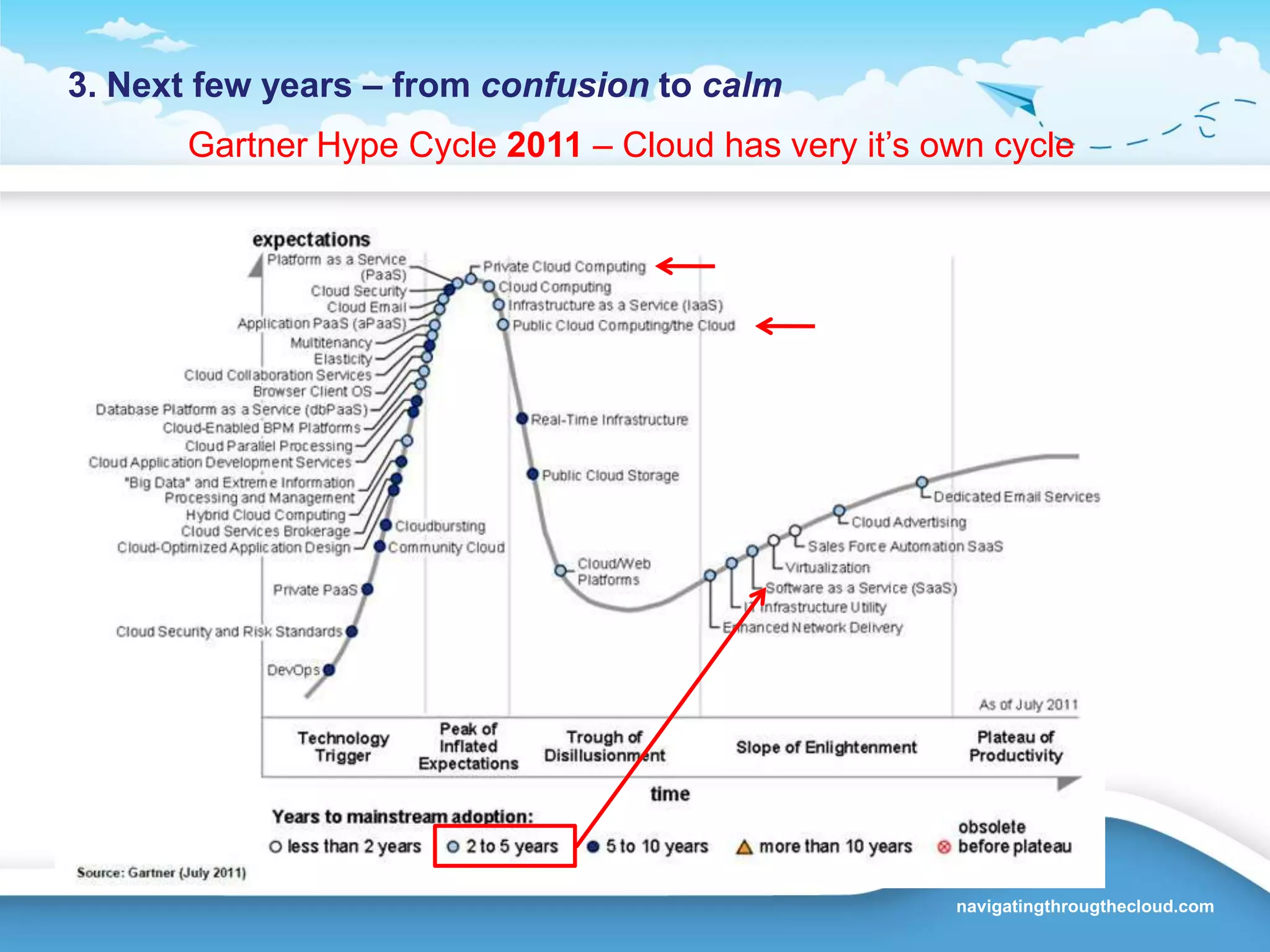
Can be more complex3. Next few years – from confusion to calmGartner Hype Cycle 2011 – Cloud has very it’s own cycle
4. The consumerisation of IT effect in the enterprise… also known as the ‘democratisation’ of ITFuelled by Cloud and pervasively accessible web based applications as an individual ….I see it, I like it, I want it, I buy it (or it’s free!), I use it – Now!
4. The consumerisation of IT effect in the enterpriseIndividuals have unprecedented access to all type of IT systems, from email, file storage, accounting, CRM, banking, shipping, social networking (eg Facebook™ )..  The list is almost endless.What is meant by ‘consumerisation’ of IT?Individuals can use / buy systems as they see fit.
Personal choice and immediacy reigns supreme
Buy it / use it without necessarily a long term in mind
‘Apps’ – for iPhone™, Android™, etcFor enterprises, however, this presents a number of challenges for the unwary, and have potentially serious implications for the PMO
5. Project Management implicationsInconsistency in understanding of ‘Cloud’Cloud: Compression of timeReversal of the traditional business case: ‘buy before you try’Cloud, pilot projects and driving innovation‘The viral cloud’ phenomenonManaging project boundary conditionsChallenges for standard methodologies such as PRINCE2Use of cloud technologies BY project managers
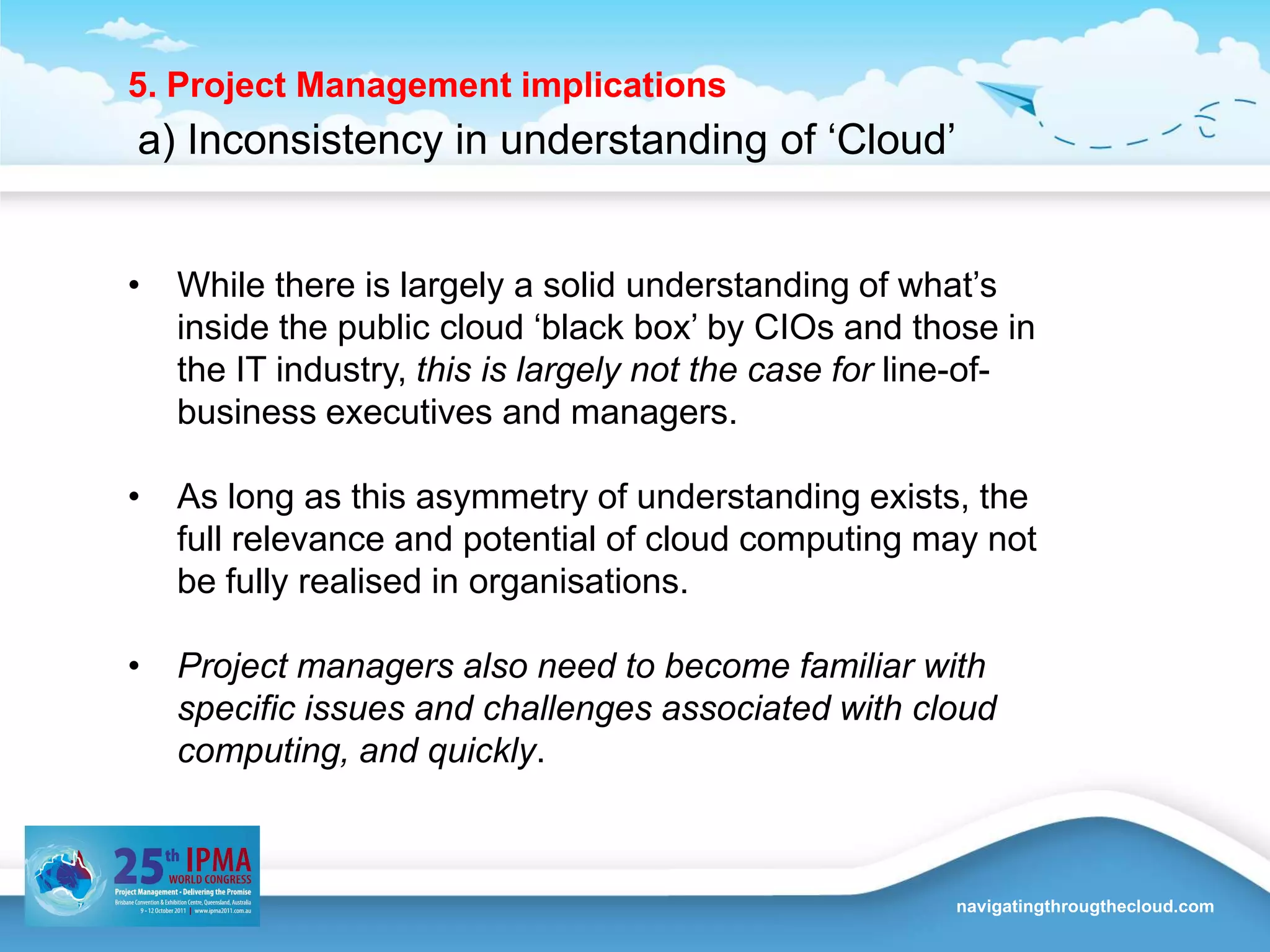
5. Project Management implicationsa) Inconsistency in understanding of ‘Cloud’While there is largely a solid understanding of what’s inside the public cloud ‘black box’ by CIOs and those in the IT industry, this is largely not the case for line-of-business executives and managers.
As long as this asymmetry of understanding exists, the full relevance and potential of cloud computing may not be fully realised in organisations.
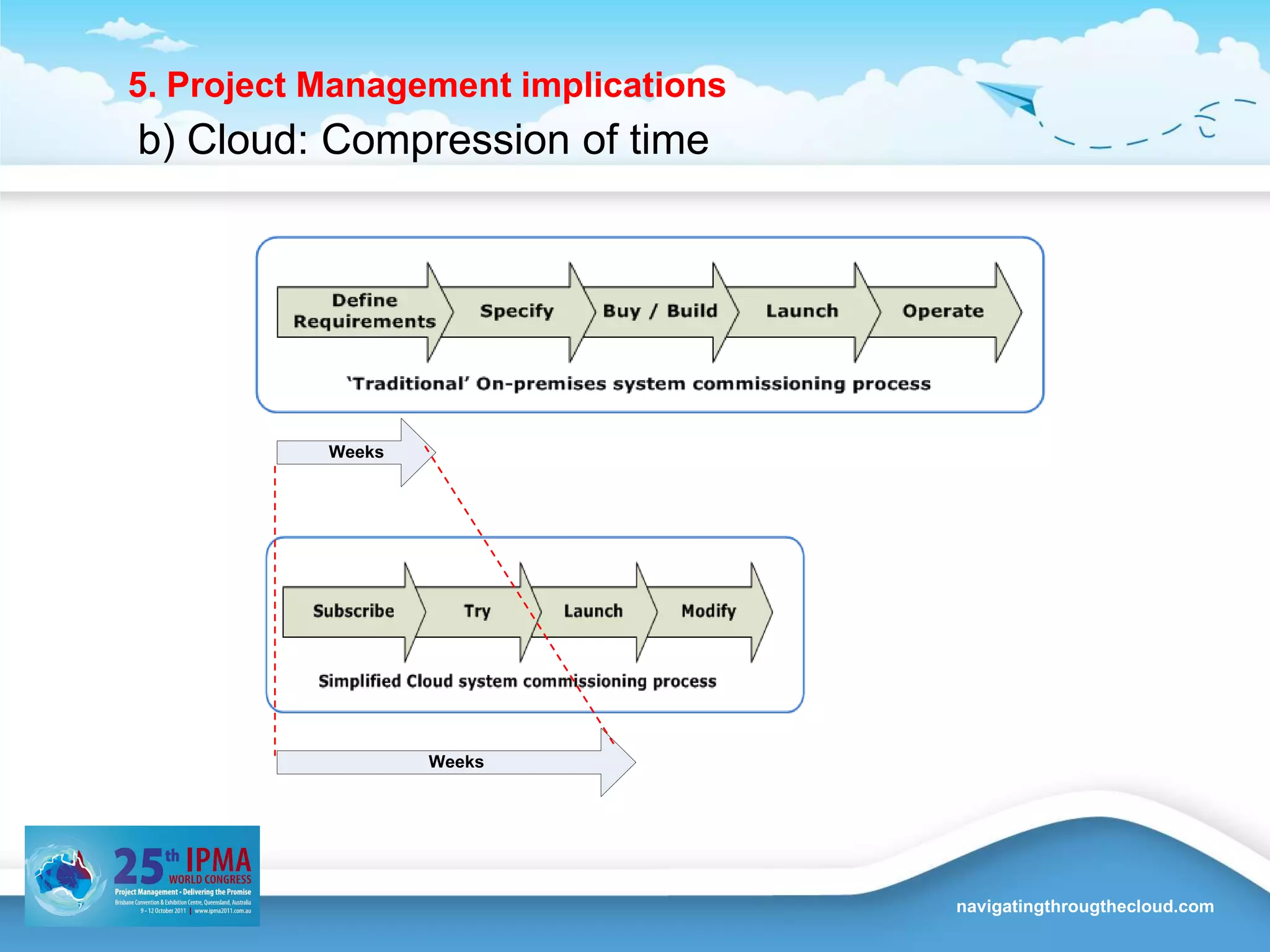
Project managers also need to become familiar with specific issues and challenges associated with cloud computing, and quickly.5. Project Management implicationsb) Cloud: Compression of time
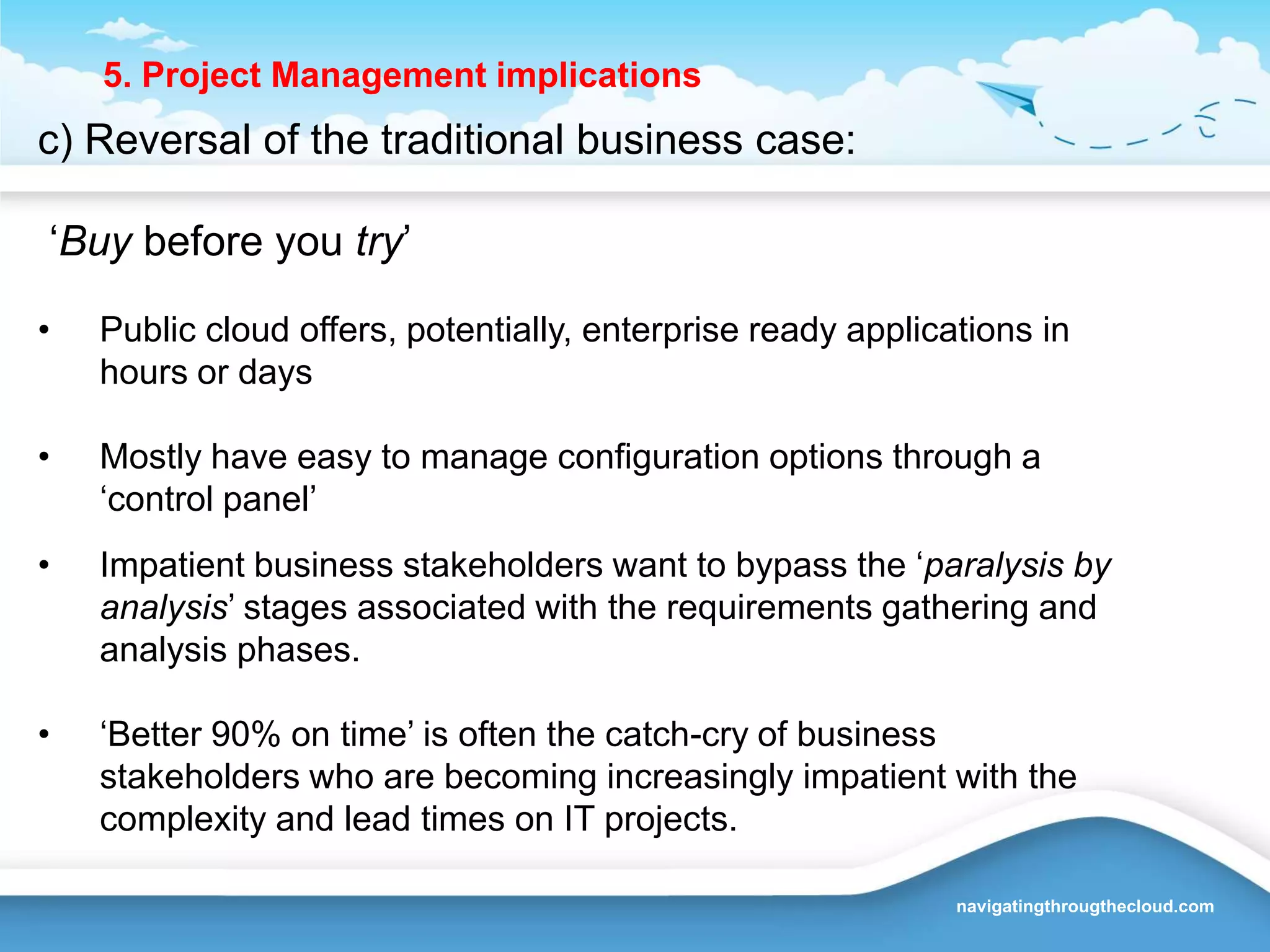
5. Project Management implicationsc) Reversal of the traditional business case:  ‘Buy before you try’Public cloud offers, potentially, enterprise ready applications in hours or days
Mostly have easy to manage configuration options through a ‘control panel’
Impatient business stakeholders want to bypass the ‘paralysis by analysis’ stages associated with the requirements gathering and analysis phases.
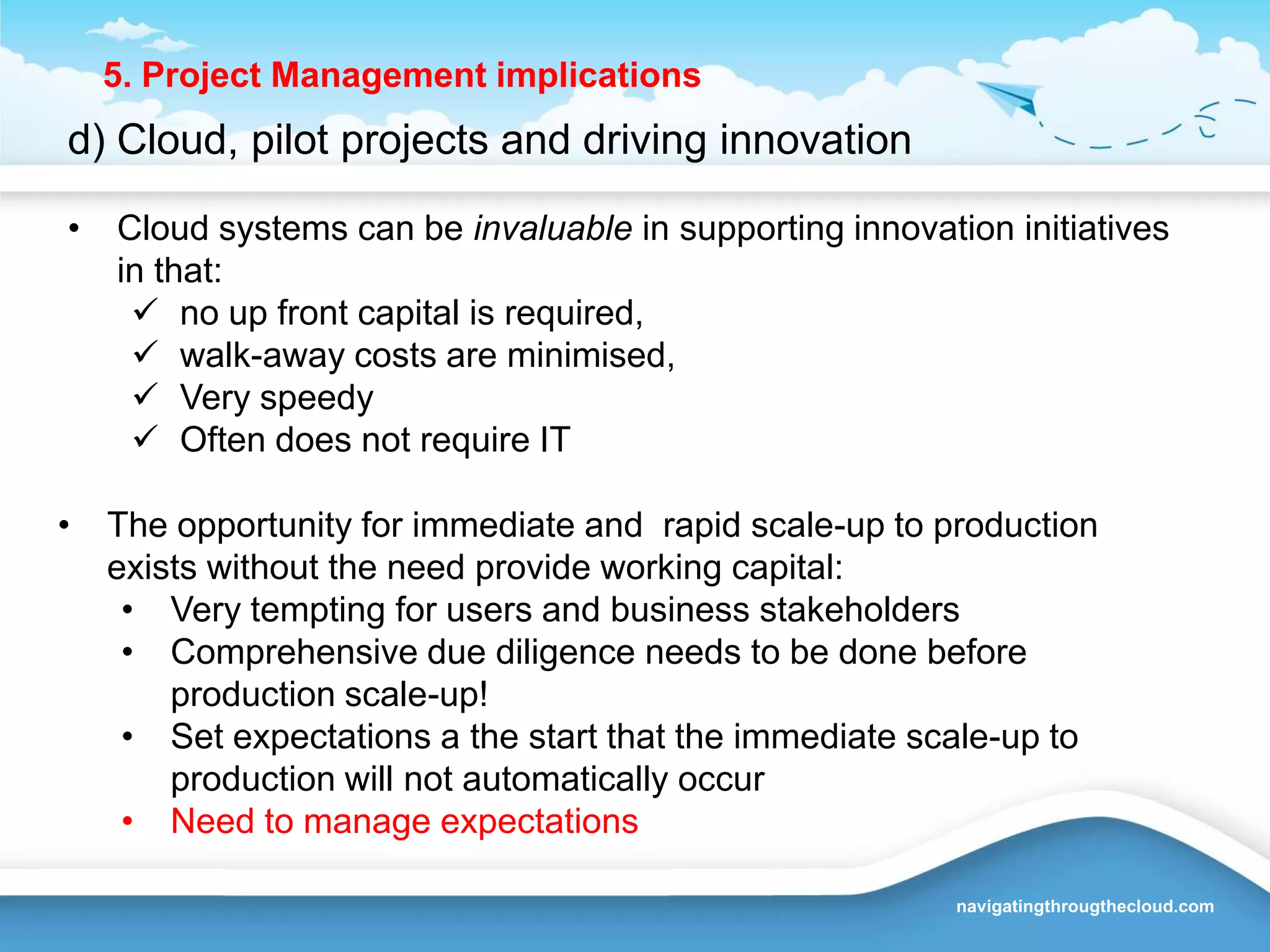
‘Better 90% on time’ is often the catch-cry of business stakeholders who are becoming increasingly impatient with the complexity and lead times on IT projects.5. Project Management implicationsd) Cloud, pilot projects and driving innovationCloud systems can be invaluable in supporting innovation initiatives in that:
no up front capital is required,
walk-away costs are minimised,
Very speedy
Often does not require IT
The opportunity for immediate and  rapid scale-up to production exists without the need provide working capital:
Very tempting for users and business stakeholders

Cloud computing implications for project management methodologies

  • 1.
    Cloud computing: Cloud Computing: Implications for Project Management Methodologies.ROB LIVINGSTONE- PRINCIPAL, Rob Livingstone Advisory Pty Ltd, and- Fellow, University of Technology, SydneyBrisbane, 11th October 2011
  • 2.
    Cloud computing: Cloud Computing: Implications for Project Management Methodologies.What I’ll be covering:Cloud computing basic definition and attributes Overview: Public, Private and Hybrid CloudNext few years – from confusion to calmThe consumerisation of IT effect in the enterpriseProject Management implicationsCloud: Some key considerations for organisationsThe future is nowQuestions and discussion
  • 3.
    1. Cloud computingbasic definition and attributes:Cloud is a very broad term for IT systems accessed via the Internet or your browser.
  • 4.
    In public cloud,the various components are all run by an external party, and you do not own anything, other than the data that you load into the system.The primary attributes of public Cloud systems are:You subscribe to the service (never own)The system is accessed via the InternetYou neither have control or title over the Cloud systemYou have limited to full title over the data that you upload
  • 5.
    2. Overview: Public,Private and Hybrid CloudPrivateHybridPublicNo control
  • 6.
  • 7.
  • 8.
  • 9.
  • 10.
  • 11.
    Offers balance ofsecurity, control
  • 12.
    Can be morecomplex3. Next few years – from confusion to calmGartner Hype Cycle 2011 – Cloud has very it’s own cycle
  • 13.
    4. The consumerisationof IT effect in the enterprise… also known as the ‘democratisation’ of ITFuelled by Cloud and pervasively accessible web based applications as an individual ….I see it, I like it, I want it, I buy it (or it’s free!), I use it – Now!
  • 14.
    4. The consumerisationof IT effect in the enterpriseIndividuals have unprecedented access to all type of IT systems, from email, file storage, accounting, CRM, banking, shipping, social networking (eg Facebook™ ).. The list is almost endless.What is meant by ‘consumerisation’ of IT?Individuals can use / buy systems as they see fit.
  • 15.
    Personal choice andimmediacy reigns supreme
  • 16.
    Buy it /use it without necessarily a long term in mind
  • 17.
    ‘Apps’ – foriPhone™, Android™, etcFor enterprises, however, this presents a number of challenges for the unwary, and have potentially serious implications for the PMO
  • 18.
    5. Project ManagementimplicationsInconsistency in understanding of ‘Cloud’Cloud: Compression of timeReversal of the traditional business case: ‘buy before you try’Cloud, pilot projects and driving innovation‘The viral cloud’ phenomenonManaging project boundary conditionsChallenges for standard methodologies such as PRINCE2Use of cloud technologies BY project managers
  • 19.
    5. Project Managementimplicationsa) Inconsistency in understanding of ‘Cloud’While there is largely a solid understanding of what’s inside the public cloud ‘black box’ by CIOs and those in the IT industry, this is largely not the case for line-of-business executives and managers.
  • 20.
    As long asthis asymmetry of understanding exists, the full relevance and potential of cloud computing may not be fully realised in organisations.
  • 21.
    Project managers alsoneed to become familiar with specific issues and challenges associated with cloud computing, and quickly.5. Project Management implicationsb) Cloud: Compression of time
  • 22.
    5. Project Managementimplicationsc) Reversal of the traditional business case: ‘Buy before you try’Public cloud offers, potentially, enterprise ready applications in hours or days
  • 23.
    Mostly have easyto manage configuration options through a ‘control panel’
  • 24.
    Impatient business stakeholderswant to bypass the ‘paralysis by analysis’ stages associated with the requirements gathering and analysis phases.
  • 25.
    ‘Better 90% ontime’ is often the catch-cry of business stakeholders who are becoming increasingly impatient with the complexity and lead times on IT projects.5. Project Management implicationsd) Cloud, pilot projects and driving innovationCloud systems can be invaluable in supporting innovation initiatives in that:
  • 26.
    no up frontcapital is required,
  • 27.
  • 28.
  • 29.
    Often does notrequire IT
  • 30.
    The opportunity forimmediate and rapid scale-up to production exists without the need provide working capital:
  • 31.
    Very tempting forusers and business stakeholders
  • 32.
    Comprehensive due diligenceneeds to be done before production scale-up!
  • 33.
    Set expectations athe start that the immediate scale-up to production will not automatically occur
  • 34.
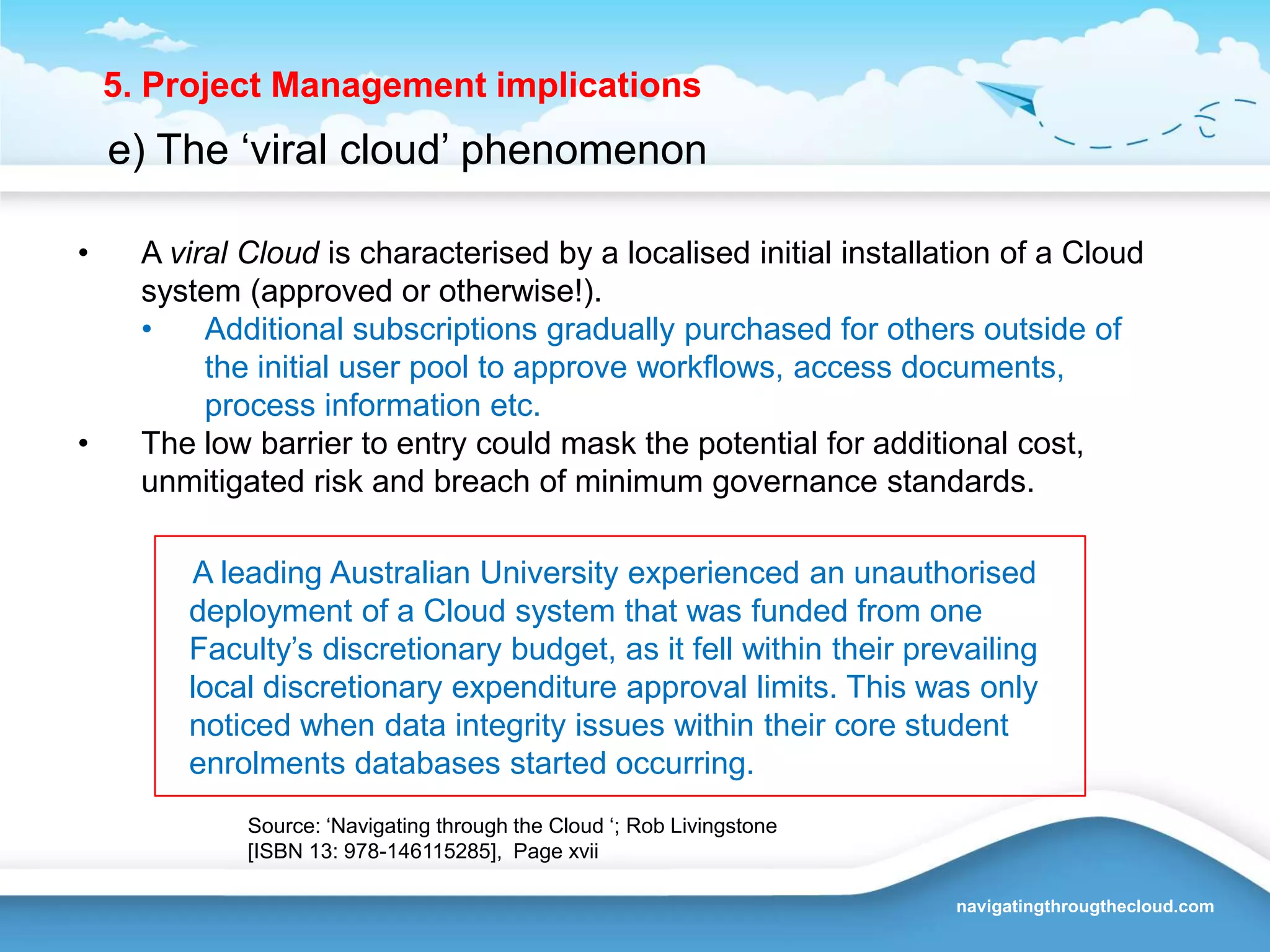
    Need to manageexpectations5. Project Management implicationse) The ‘viral cloud’ phenomenonA viral Cloud is characterised by a localised initial installation of a Cloud system (approved or otherwise!).
  • 35.
    Additional subscriptions graduallypurchased for others outside of the initial user pool to approve workflows, access documents, process information etc.
  • 36.
    The low barrierto entry could mask the potential for additional cost, unmitigated risk and breach of minimum governance standards.A leading Australian University experienced an unauthorised deployment of a Cloud system that was funded from one Faculty’s discretionary budget, as it fell within their prevailing local discretionary expenditure approval limits. This was only noticed when data integrity issues within their core student enrolments databases started occurring.Source: ‘Navigating through the Cloud ‘; Rob Livingstone[ISBN 13: 978-146115285], Page xvii
  • 37.
    5. Project Managementimplicationsf) Managing project boundary conditionsWith the increasing availability of development APIs, as well as vendor ‘applications markets’, there are a large array of satellite applications written by third parties, the quality of which may be variable.
  • 38.
    The Salesforce AppExchange, Android Market and the Apple iStore are examples of such eco-systems.
  • 39.
    Some of theseapplications can be implemented by ends users, and extend the boundary of projects in an uncontrolled manner
  • 40.
    What project governancecontrols can be implemented to mitigate adverse consequences?5. Project Management implicationsg) Challenges for standard methodologies such as PRINCE2The comprehensive use of rigorous, large scale project methodologies such as Prince2™ are often not appropriate for all but the largest of enterprise IT projects, although key elements are universally applicable to all projects.
  • 41.
    The interpretation andadaptation of the various large scale project methodologies to volatile ‘implement first and modify as you go’ environments needs some careful consideration
  • 42.
    This is likelyto present a large challenge to organisations that are impatient to get results5. Project Management implicationsh) Use of cloud technologies BY project managersNo need to buy PM software – just use it for the life of the project
  • 43.
    One of thecompelling value propositions in cloud computing is universal access, and the opportunity of lowering the barrier to entry for applications by using handheld applications using iPhone and Android devices, for example.
  • 44.
    This could havevery positive implications for geographically distributed projects, where information sharing and timely updates of project activities and status’ are important to mobile project stakeholders
  • 45.
  • 46.
    Can you scaledown to a single user at the end of the project?
  • 47.
    Can you ‘park’your PM data and electronic artifacts that are stored in the cloud for later use if needed?
  • 48.
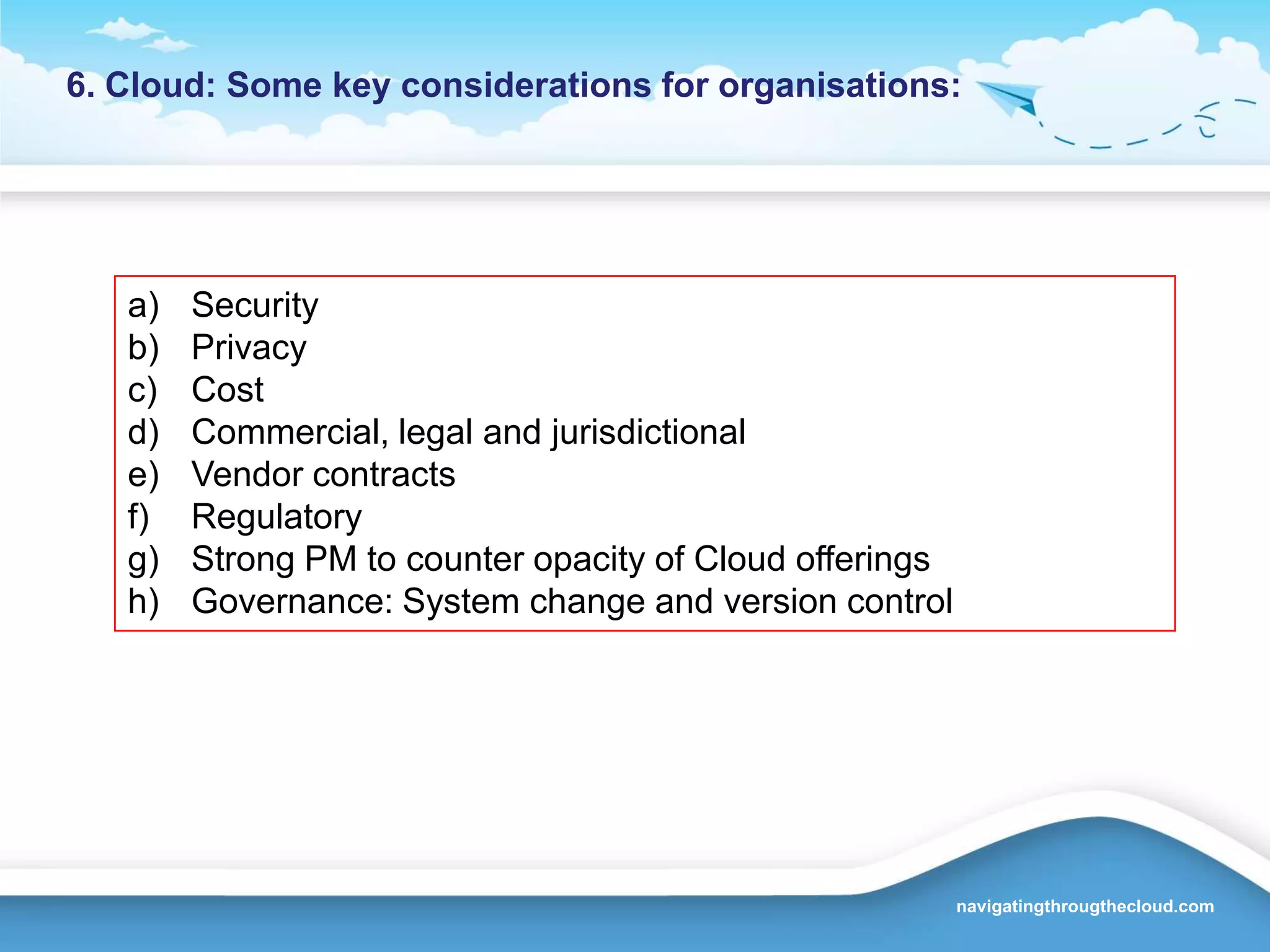
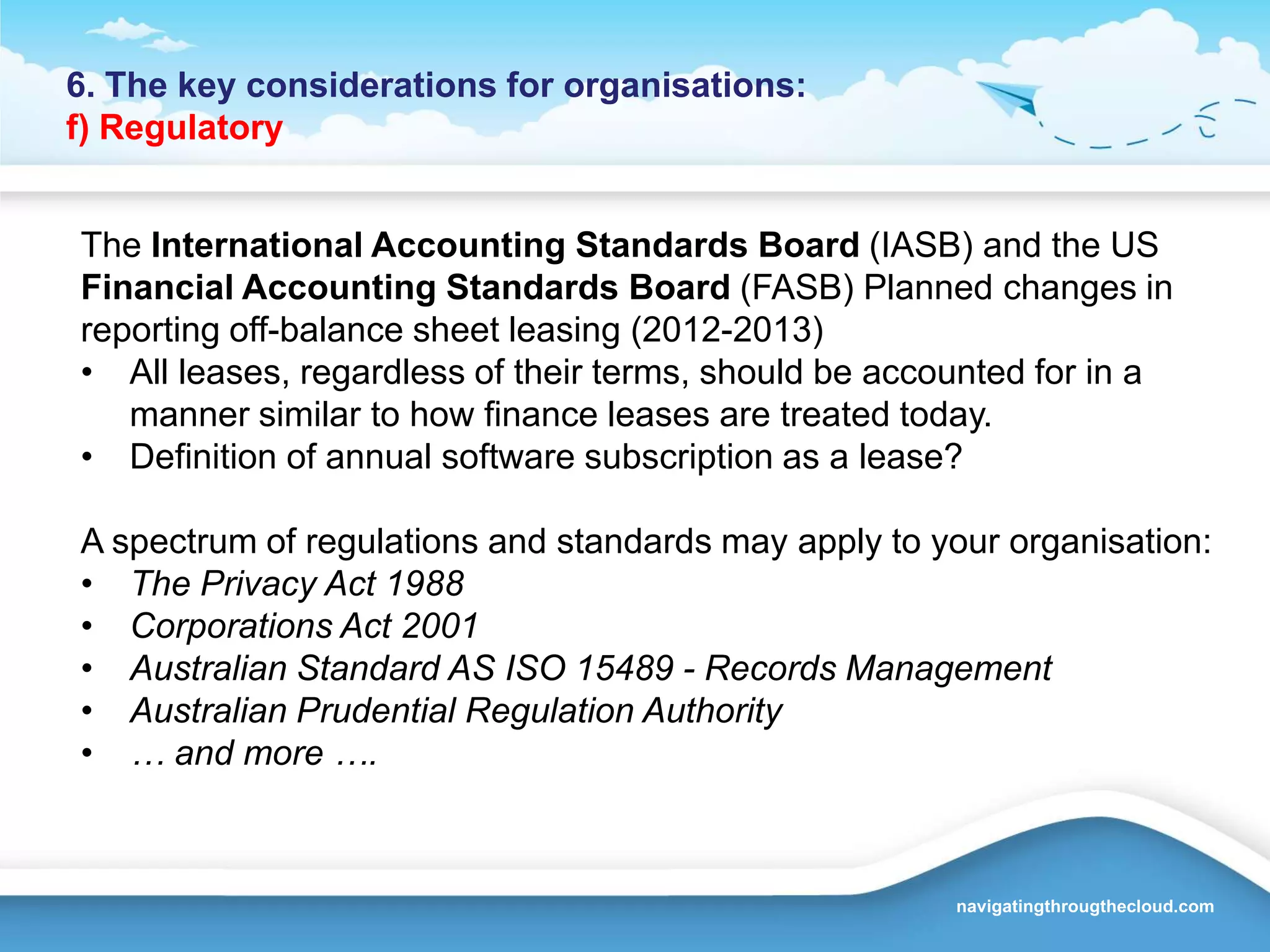
    What happens tothe data if you leave the cloud? Can you extract it in a useful form?6. Cloud: Some key considerations for organisations: SecurityPrivacyCostCommercial, legal and jurisdictionalVendor contractsRegulatoryStrong PM to counter opacity of Cloud offeringsGovernance: System change and version control
  • 49.
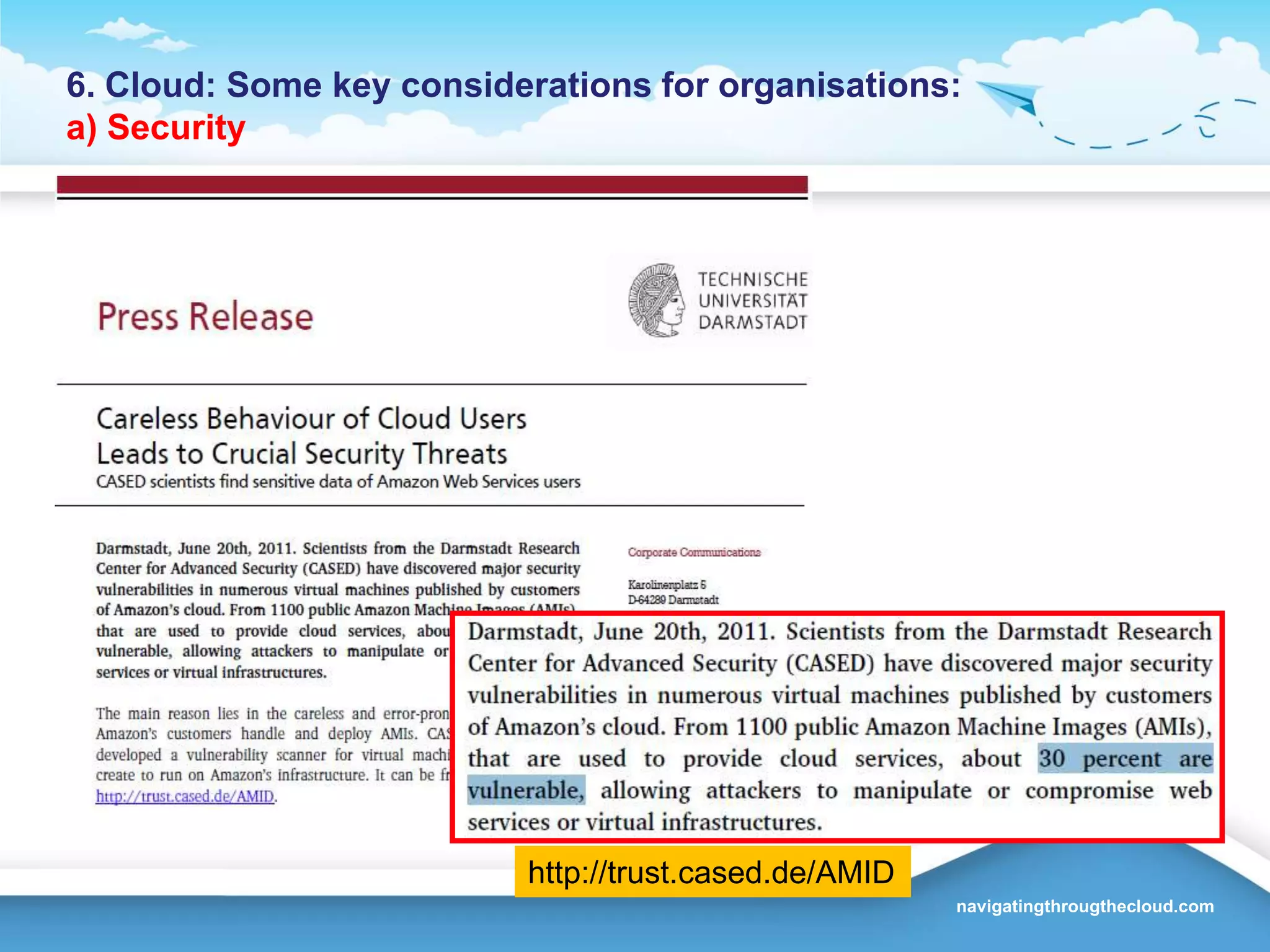
    6. Cloud: Somekey considerations for organisations: a) Securityhttp://trust.cased.de/AMID
  • 50.
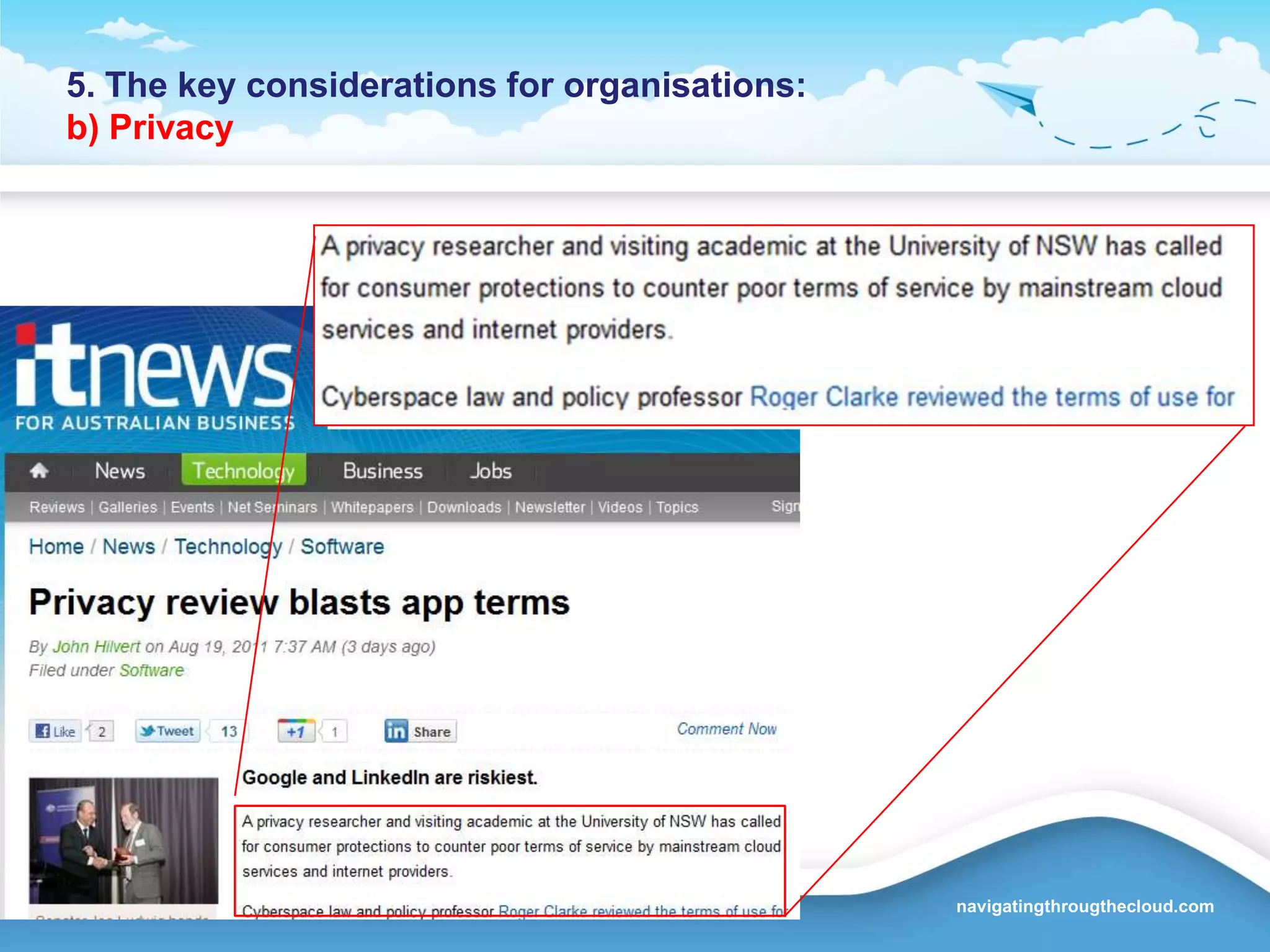
    5. The keyconsiderations for organisations: b) Privacy
  • 51.
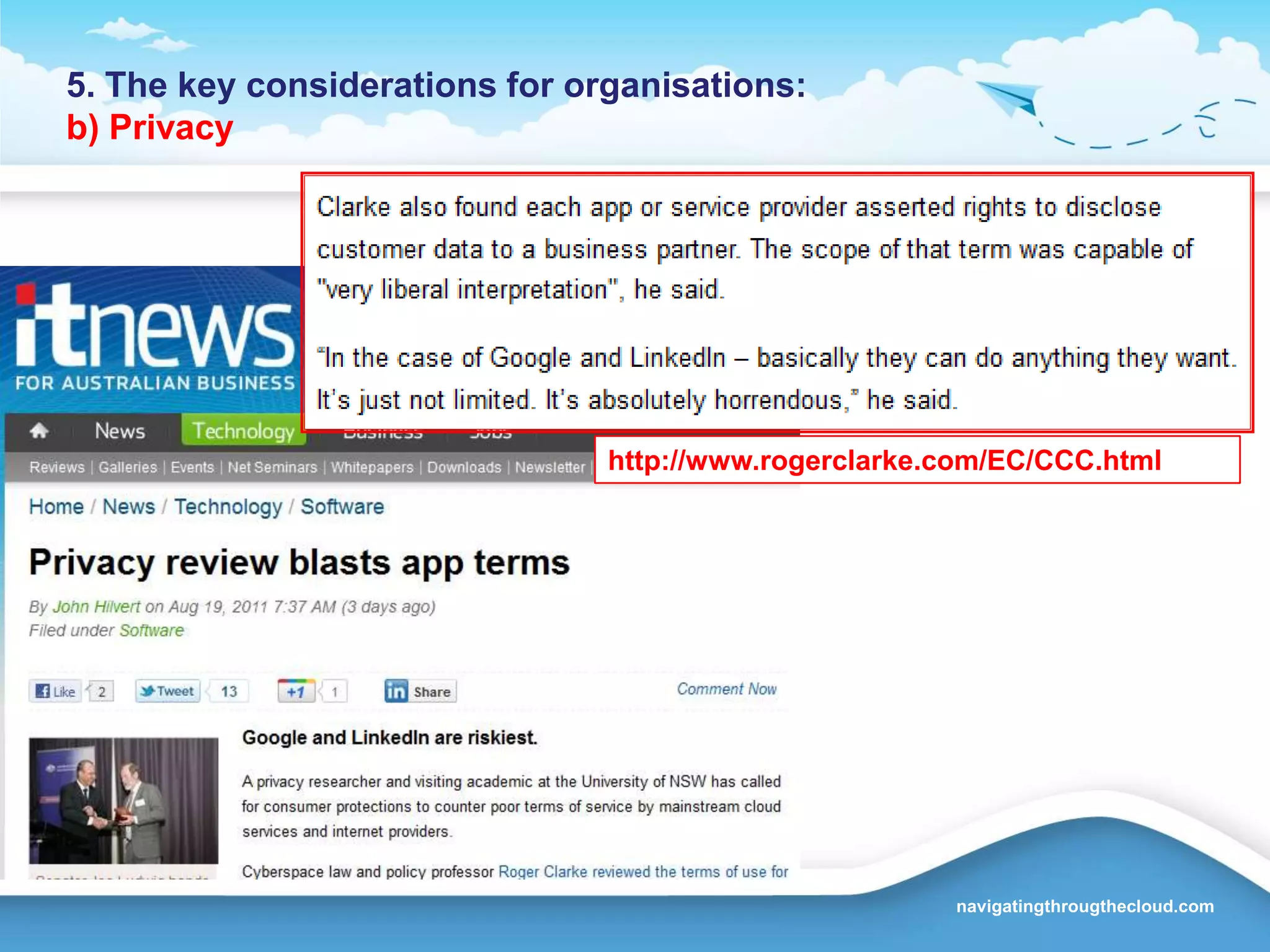
    5. The keyconsiderations for organisations: b) Privacyhttp://www.rogerclarke.com/EC/CCC.html
  • 52.
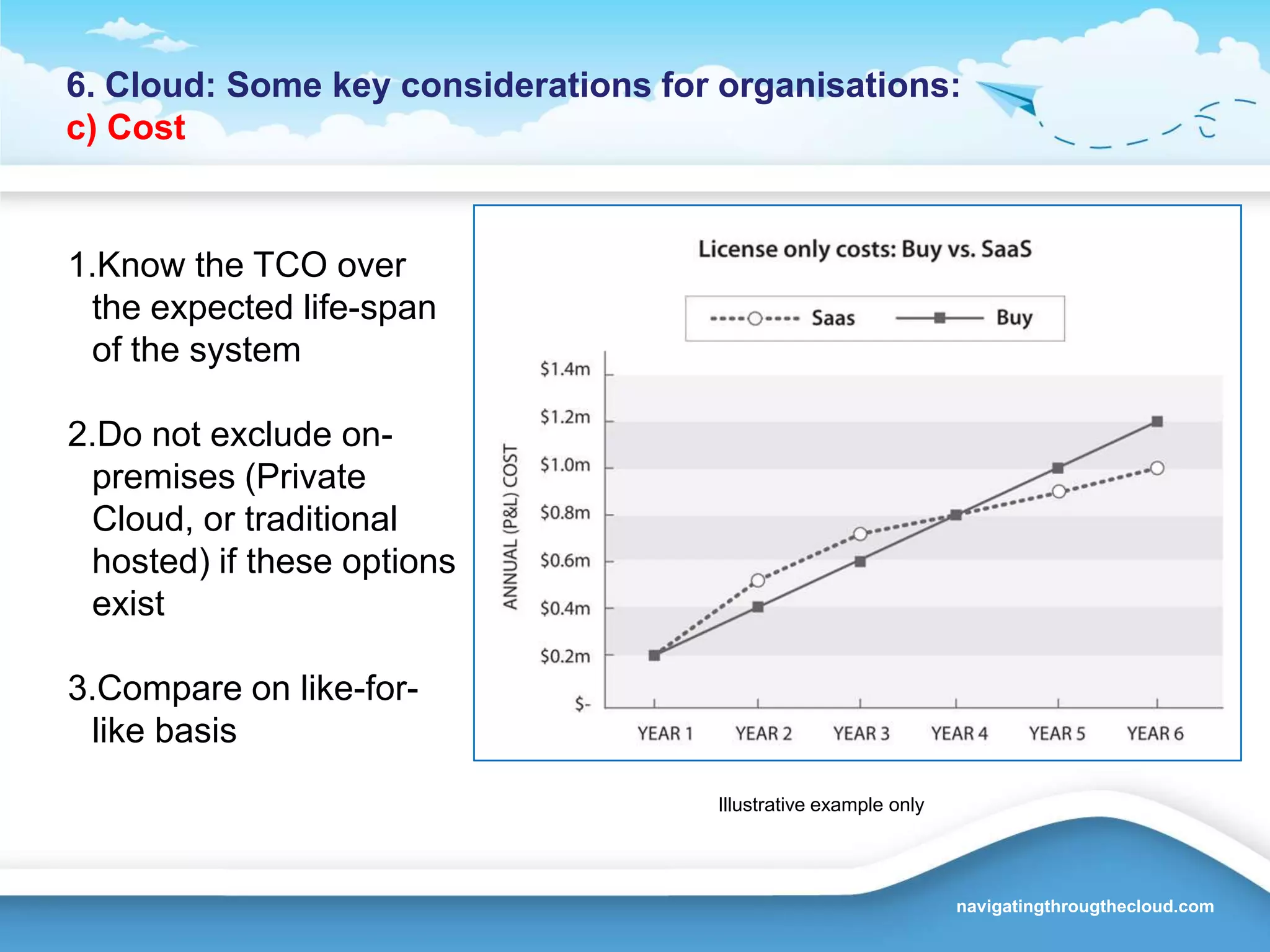
    6. Cloud: Somekey considerations for organisations: c) CostKnow the TCO over the expected life-span of the systemDo not exclude on-premises (Private Cloud, or traditional hosted) if these options existCompare on like-for-like basisIllustrative example only
  • 53.
    6. The keyconsiderations for organisations:d) Commercial, legal and jurisdictionalWhat are your key drivers behind the adoption of Cloud?Drive innovation?
  • 54.
  • 55.
    Increase flexibility?Level ofprotection under the contractDo the remedies for service outages make commercial sense?
  • 56.
    Have you readand understood your vendor contractWhat is the cost of seeking legal recourse?If you provider’s contract is in an overseas legal jurisdiction, how practical will it be to seek damages?6. The key considerations for organisations: e) Vendor contracts
  • 57.
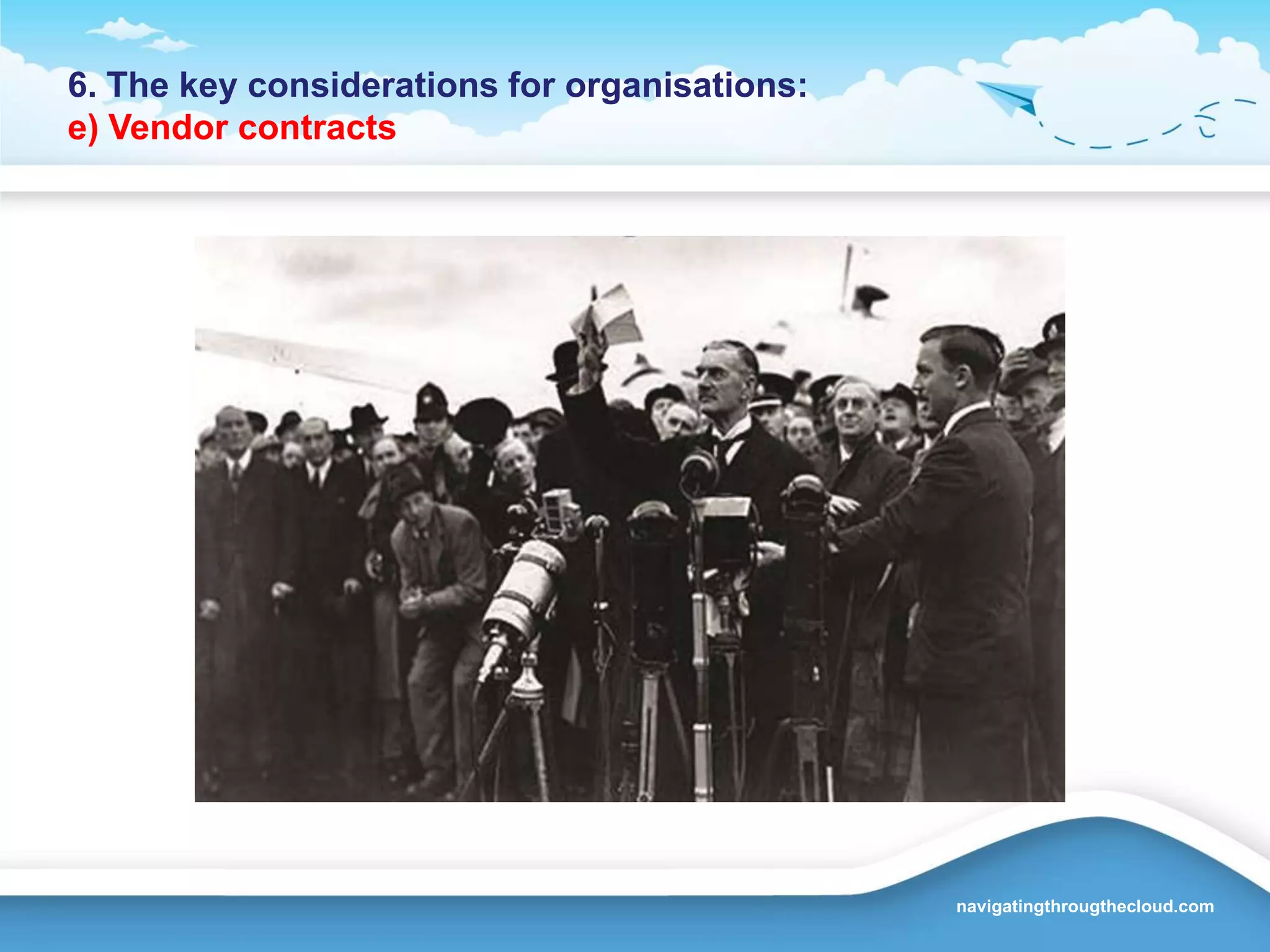
    6. The keyconsiderations for organisations: e) Vendor contractsWhat’s your Cloud contract duration?If this is truly utility Cloud, why commit to a contract for a long period of time? If marketed on ‘per user per month’ pay on that basis. Some request annual pre-payment. You are then the vendor’s banker.Request a copy of the draft contract earlyThe procurement cycle can be time consuming for large projects.
  • 58.
    All that effortcould be wasted if there is a major sticking point in the contract.
  • 59.
    Read your contractand understand what ie means!Global Cloud providers are reluctant to change standard contracts Standardisation is the cornerstone of Cloud
  • 60.
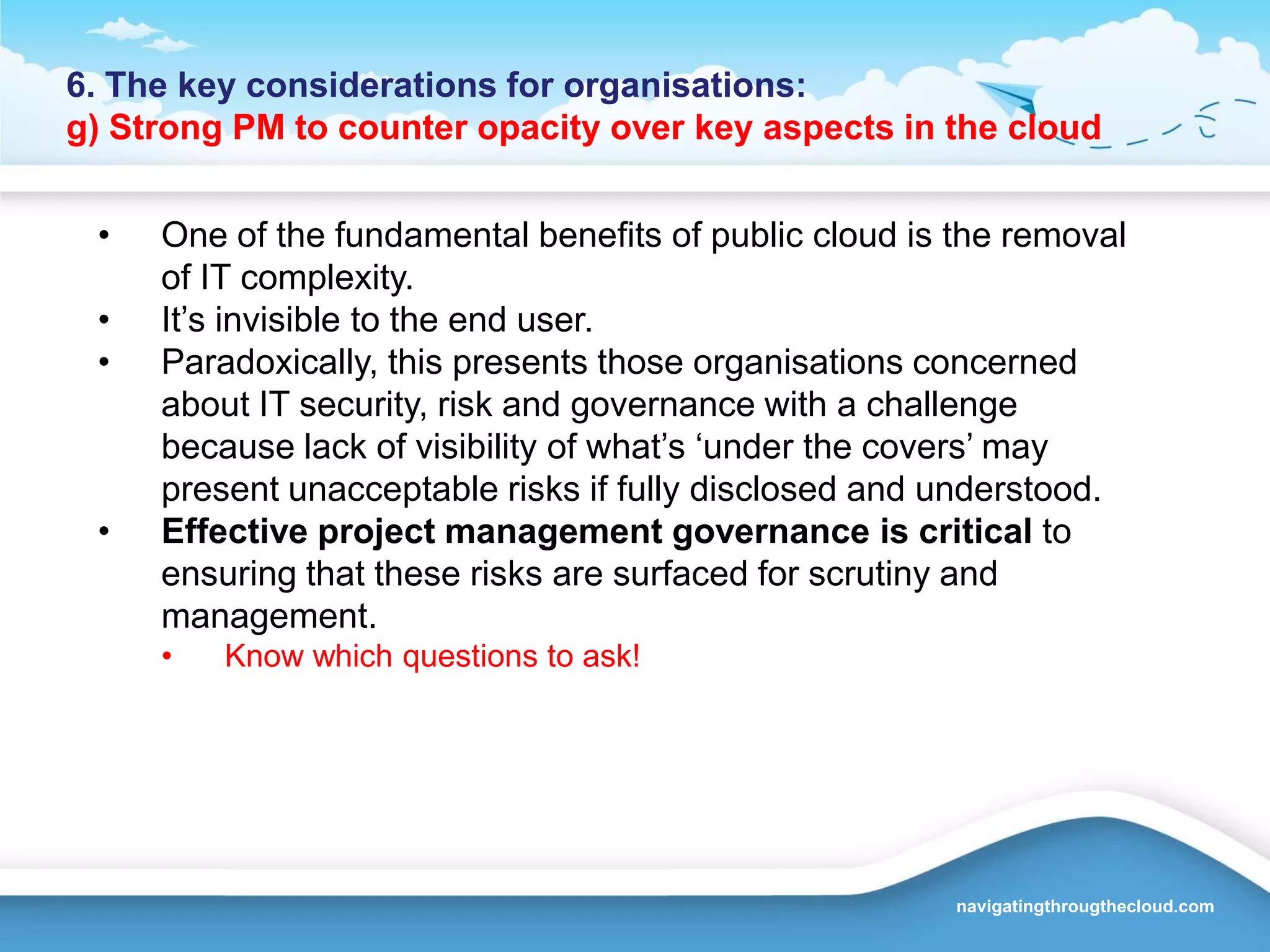
    Some vendors willamend terms if you have large buying influence6. The key considerations for organisations: f) RegulatoryThe International Accounting Standards Board (IASB) and the US Financial Accounting Standards Board (FASB) Planned changes in reporting off-balance sheet leasing (2012-2013)All leases, regardless of their terms, should be accounted for in a manner similar to how finance leases are treated today.
  • 61.
    Definition of annualsoftware subscription as a lease?A spectrum of regulations and standards may apply to your organisation:The Privacy Act 1988
  • 62.
  • 63.
    Australian Standard ASISO 15489 - Records Management
  • 64.
  • 65.
    … and more….6. The key considerations for organisations: g) Strong PM to counter opacity over key aspects in the cloudOne of the fundamental benefits of public cloud is the removal of IT complexity.
  • 66.
    It’s invisible tothe end user.
  • 67.
    Paradoxically, this presentsthose organisations concerned about IT security, risk and governance with a challenge because lack of visibility of what’s ‘under the covers’ may present unacceptable risks if fully disclosed and understood.
  • 68.
    Effective project managementgovernance is critical to ensuring that these risks are surfaced for scrutiny and management.
  • 69.
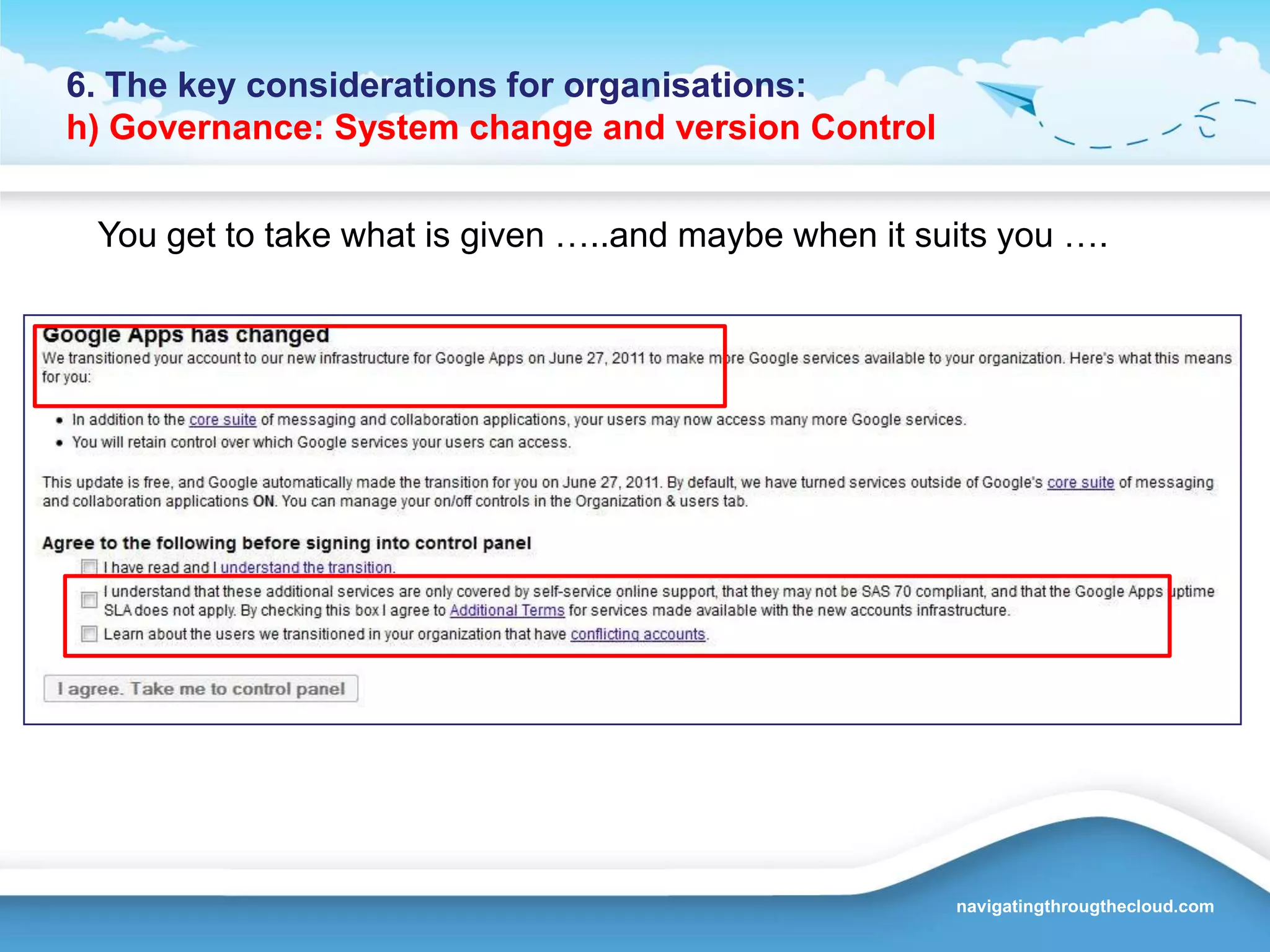
    Know which questionsto ask!6. The key considerations for organisations: h) Governance: System change and version ControlYou get to take what is given …..and maybe when it suits you ….
  • 70.
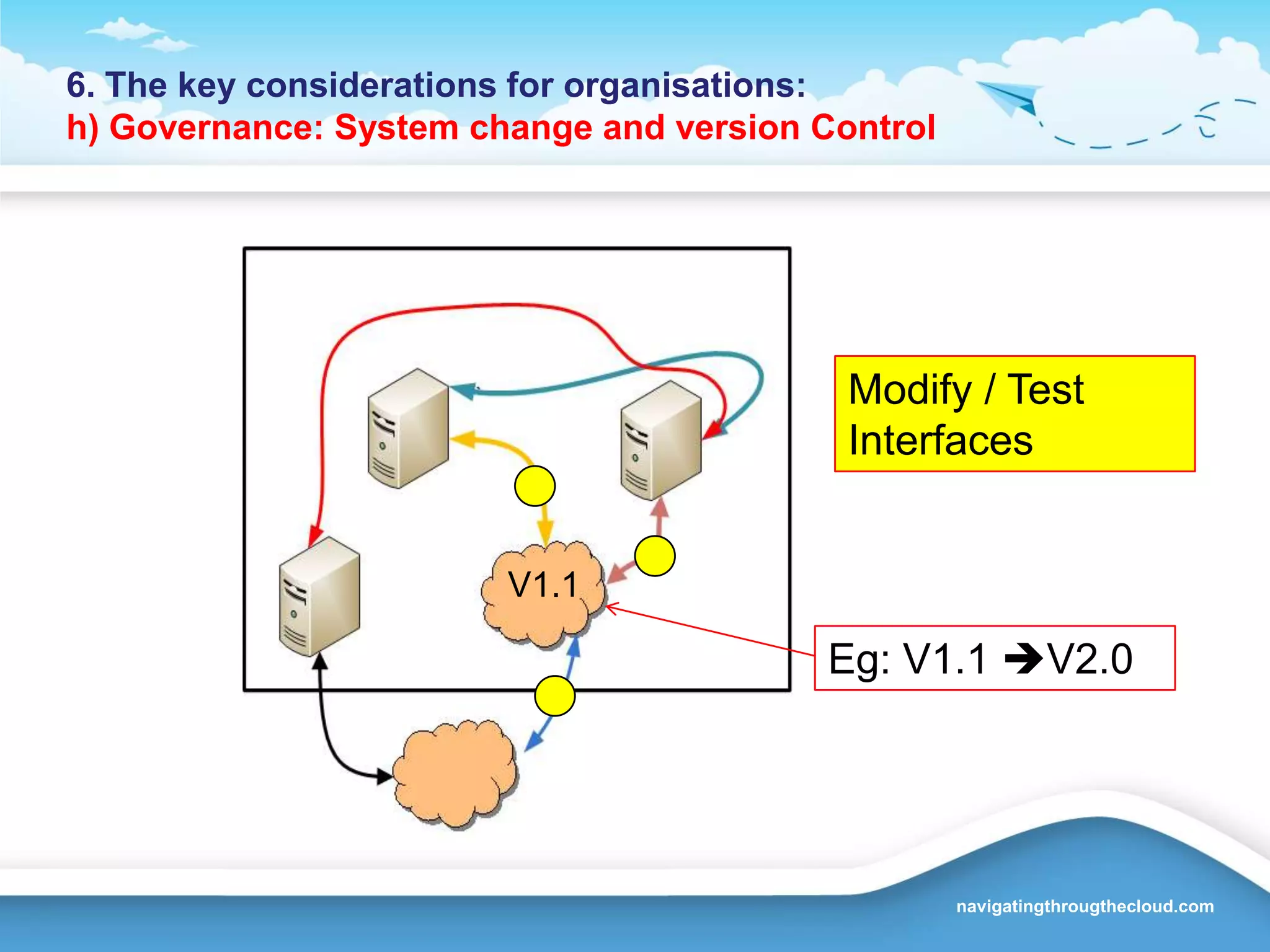
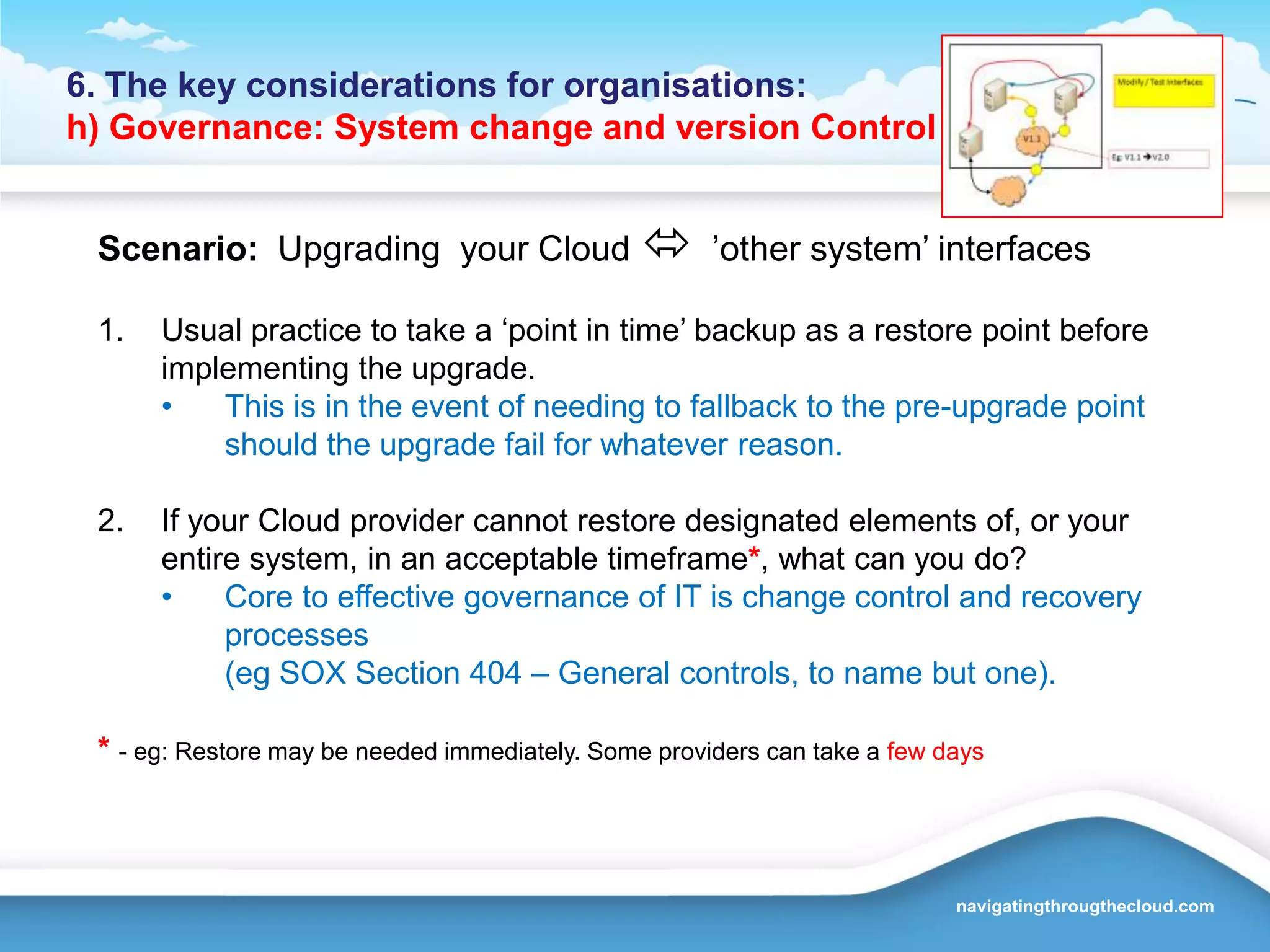
    6. The keyconsiderations for organisations: h) Governance: System change and version ControlModify / Test Interfaces V1.1Eg: V1.1 èV2.0
  • 71.
    6. The keyconsiderations for organisations: h) Governance: System change and version ControlScenario: Upgrading your Cloud ó’other system’ interfacesUsual practice to take a ‘point in time’ backup as a restore point before implementing the upgrade. This is in the event of needing to fallback to the pre-upgrade point should the upgrade fail for whatever reason.If your Cloud provider cannot restore designated elements of, or your entire system, in an acceptable timeframe*, what can you do? Core to effective governance of IT is change control and recovery processes(eg SOX Section 404 – General controls, to name but one).* - eg: Restore may be needed immediately. Some providers can take a few days
  • 72.
    7. Cloud –The future is nowCloud technology, as with any other innovation, has the potential to do things cheaper, faster and better.This has significant implications for both CIOs, IT Departments and Project managersCloud has the potential to be a real game changer for the astuteOrganisations need to deliberately define their strategy now:Be an early adopter, or
  • 73.
    A fast follower,and leap-frog the early adopters be capitalising on their experiencesTo achieve the real benefits of Cloud technologies, understand:the true cost
  • 74.
  • 75.
  • 76.
  • 77.
  • 78.
    when to exitthe technology and/or switch horses.8. Discussions and questionsRob Livingstone Advisory Pty LtdABN 41 146 643 165W1:www.rob-livingstone.comW2:www.navigatingthroughthecloud.comE:rob@rob-livingstone.comP: +61 2 8005 1972P: +1 609 843 0349M : +61 419 632 673 F: +61 2 9879 5004rladvisory© All rights reserved. Unauthorised redistribution not without prior approval