INTRODUCTION TO
EPIDEMIOLOGY
DR. PENIAS TEMBO (MD)
(MPH.MBChB,BSc HB,Dip
Med,Cert TM)
EPIDEMIOLOGY
• Objectives
• At the end of the course, students should be
able to demonstrate knowledge of:
• describe the nature and main uses of
epidemiology
• the epidemiology approach to defining and
measuring the occurrence of health related
states in population
• In addition, students are expected to have gained a
variety of skills, including ability to:
describe the common cause of death, disease
and disability in their respective communities
 outline appropriate study designs to answer
specific questions concerning disease causation,
natural history prognosis, prevention and
evaluation of therapy and other interventions to
prevent and control disease
WHAT IS EPIDEMIOLOGY
Key messages (Things to remember)
• Epidemiology is a fundamental science of
public health
• Epidemiology has made major contributions to
improving population health
• Epidemiology is essential to the process of
identifying and mapping emerging diseases
Historical context
Origins
• Epidemiology’s roots are nearly 2500 years old.
• Epidemiology originates from Hippocrates observations more
than 2000 years ago that environmental factors influence the
occurrence of disease.
•
•
•
•
•
•
• Circa 400 B.C.
Hippocrates attempted to explain disease
occurrence from a rational rather than a
supernatural viewpoint. In his essay entitled
“On Airs, Waters, and Places,”
• Hippocrates suggested that environmental and
host factors such as behaviors might influence the
development of disease.
• 1662
Another early contributor to epidemiology
was John Graunt, a London haberdasher and
councilman who published a landmark
analysis of mortality data in 1662.
• This publication was the first to quantify
patterns of birth, death, and disease
occurrence, noting disparities between males
and females, high infant mortality,
urban/rural differences, and seasonal
variations.
• 1800
William Farr built upon Graunt’s work by
systematically collecting
and analyzing Britain’s mortality statistics.
• Farr, considered the father of modern vital statistics
and surveillance, developed many
of the basic practices used today in vital statistics
and disease classification
• He concentrated his efforts on collecting vital
statistics, assembling and evaluating those
data, and reporting to responsible health
authorities and the general public.
• However, it was not until the 19th
Century that the distribution of disease
in specific human population groups
was measured to any large extent.
• This wok not only marked the formal
beginnings of epidemiology but also
Some of its most spectacular achievements
• The findings by John snow that the risk of
cholera in London was related to the drinking
water supplied by a particular company
provides a well-known example
• Snow’s epidemiology studies were one aspect
of a wide ranging series of investigations that
examined related physical, chemical,
biological, sociological and political processes.
• Comparing rates of disease in subgroups of the
human population became common practice in
the late C19th
and early C20th
.
• This approach was initially applied to the control
of communicable diseases but proved to be useful
way of linking environmental conditions or
agents to specific diseases.
• In the second half of the twentieth century,
These methods were applied to chronic non
communicable diseases such as heart diseases
and cancer, especially in the middle and high-
income countries.
Recent developments in Epidemiology
• Epidemiology in modern form is a relatively
new discipline and uses quantitative methods
to study diseases in human populations, to
form prevention and control efforts.e.g.
Richard Doll and Andrew Hill studied the
relation between tobacco use and lung cancer
beginning in the 1950s.
• In the 1980s, epidemiology was extended to
the studies of injuries and violence.
• In the 1990s, the related fields of molecular and
genetic epidemiology (expansion of
epidemiology to look at specific pathways,
molecules and genes that influence risk of
developing disease) took root.
• Beginning in the 1990s and accelerating after
the terrorist attacks of September 11, 2001,
epidemiologists have had to consider not only
natural transmission of infectious organisms
but also deliberate spread through biologic
warfare and bioterrorism.
Definition of Epidemiology
• The word “epidemiology “ is derived from
Greek words: epi:“ upon”,demo “people”
lagos“study”
• Epidemiology as defined by Last is’ the study
of the distribution and determinants of
health- related states or events in a specified
population, and the application of the study to
the prevention and control of health
problems.
• This broad definition of epidemiology can be
further elaborated as follows;
• Study: includes-surveillance, observations,
hypothesis testing, analytic research and
experiments
• Distribution: refers to frequency and
pattern of occurrence of disease analysis
• Frequency refers not only to the number of
health events such as the number of cases of
meningitis or diabetes in a population, but
also to the relationship of that number to the
size of the population.
• The resulting rate allows epidemiologists to
compare disease occurrence across different
populations
• Pattern refers to the occurrence of health-
related events by:
 time
 place
 person.
• Time patterns may be :
Annual
 seasonal
 weekly
Daily
 hourly,
 weekday versus weekend, or any other breakdown
of time that may influence disease or injury
occurrence.
• Place patterns include:
 geographic variation,
 urban/rural differences
 and location of work sites or schools.
• Personal characteristics include demographic
factors which may be related to risk of illness,
injury, or disability such as age, sex, marital
status, and socioeconomic status, as well as
behaviors and environmental exposures.
• Determinants :includes factors that influence
health-biological, chemical, physical, socioal,
cultural, economic, genetic and behavioural.
• Health related states and events: refers to –
diseases, causes of death,behaviours such as
use of tobacco, positive health status, reaction
to preventive regimes and provision and use
of health services
• Specified population: include those with
identifiable characteristics, such as
occupational groups.
• Application to prevention and control-The
aims of public health- to promote, protect and
restore health.
Concerns of Epidemiology
• Epidemiologists are concerned not only with
deaths, illnesses and disability, but also with
more positive health states and most
importantly with the means to improve health
• The term ‘disease ‘encompasses all
unfavorable health changes, including injuries
and mental health.
Uses of epidemiology
• Assessing the community’s health
• Making individual decisions
• Completing the clinical picture
• Searching for causes-to searching for causal
factors that influence one’s risk of disease
Epidemiological approach
• The epidemiological approach to problems of
health and disease is based on two major
foundation
Ask questions and getting answers that lead to
further questions
Making comparisons and draw inferences
Questions related To health events
• What is the event(problem)?
• What is the magnitude?
• Where did it happen?
• When did it happen?
• Who are affected?
• Why did it happen/
Questions Related to Health Action
• What can be done to reduce this problem and
it’s consequences?
• How can it be prevented in the future?
• What action should be taken by the
community ?
• Who should carry out these activities?
Health services, other sectors, where and for
whom these activities be carried out?
• What resources are required?
• How are these activities be organized?
• What difficult may arise, and how might they
be overcomed?
EPIDEMIOLOGY &CLINICAL MEDICINE
EPIDEMIOLOGY
• Population as unit of study
• Concerned with disease
pattern in the entire
population
• Epidemiologists confronted
with relevant data derived
fro particular epidemiological
study-to identify a particular
source of infection, mode of
spread,
CLINICAL MEDICINE
• Cases/ case with a disease as
unity of study
• Physician is concerned with
disease in a individual patients
• Concerned with both the sick
and the healthy
• Physicians seeks diagnosis
from which he derives a
prognosis and prescribes
specific treatment
Epidemiology
or an etiological factor in order
to determine a future trend
and recommend specific
control measures
• Epidemiologist evaluates the
outcome of preventive and
therapeutic measures
instituted which provides the
necessary guidance and feed-
back to the health care
administrator for effective
Clinical Medicine
• Patient comes to a doctor
• Is based on biomedical
concepts with an ever-
increasing concern for
refining the technique of
diagnosis and treatment at
individual level
Epidemiology
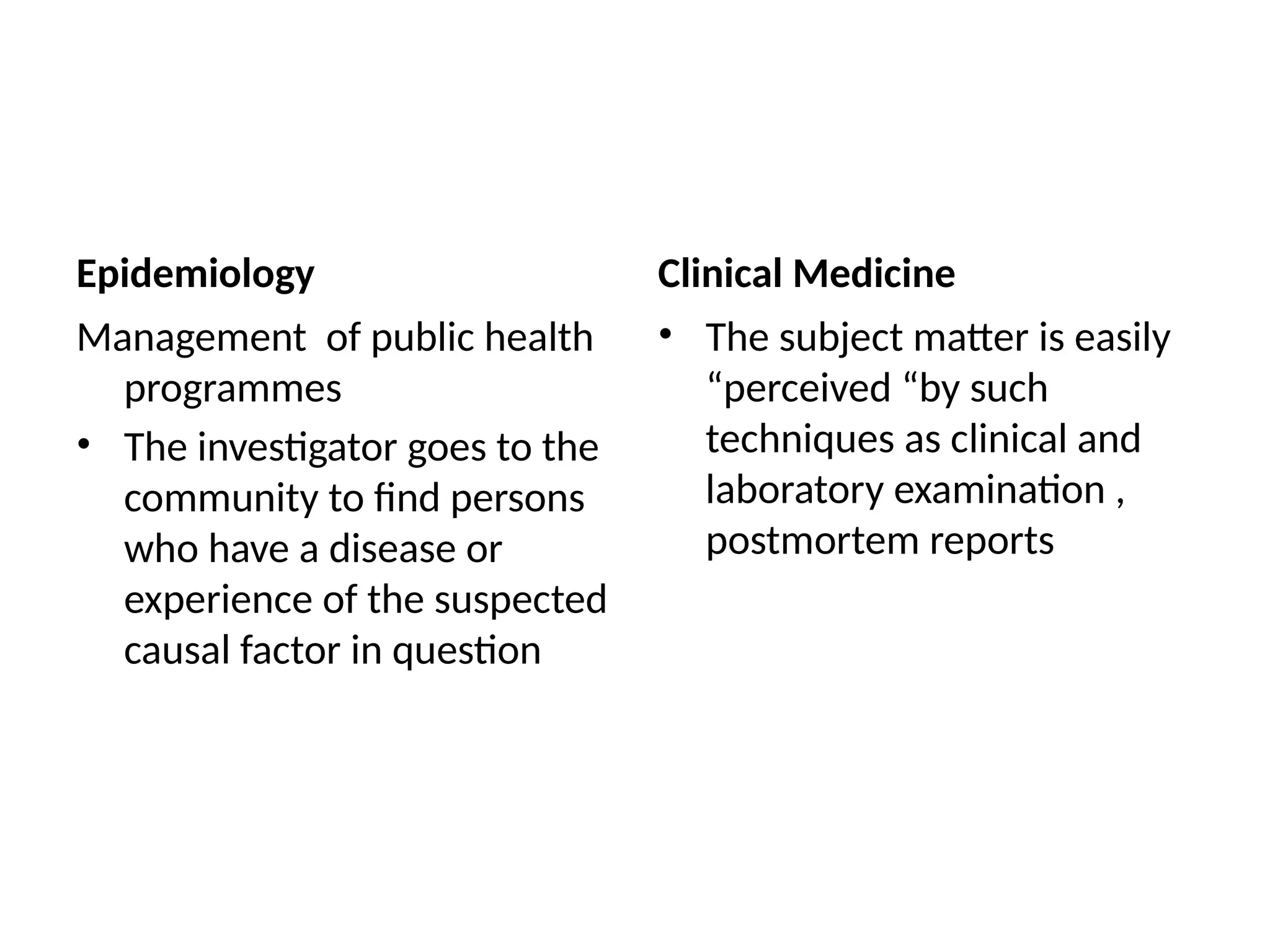
Management of public health
programmes
• The investigator goes to the
community to find persons
who have a disease or
experience of the suspected
causal factor in question
Clinical Medicine
• The subject matter is easily
“perceived “by such
techniques as clinical and
laboratory examination ,
postmortem reports
• Clinical medicine and epidemiology are not
antagonistic.
• Both are closely related, co-existent and
mutually helpful
• Epidemiological enquiries depends on
appropriate clinical considerations such as how
the disease in question can be identified among
individuals comprising the group under scrutiny
• Likewise, a knowledge of prevalence and
prognosis derived from epidemiological
research is important to the clinician for the
diagnosis and management of individual
patients and their families
NATURAL HISTORY OF A DISEASE
• Definition-Natural history of a disease refers
to systematic description of the course of
disease over time, un affected by treatment.
(The course and outcome of disease in
individuals and groups)
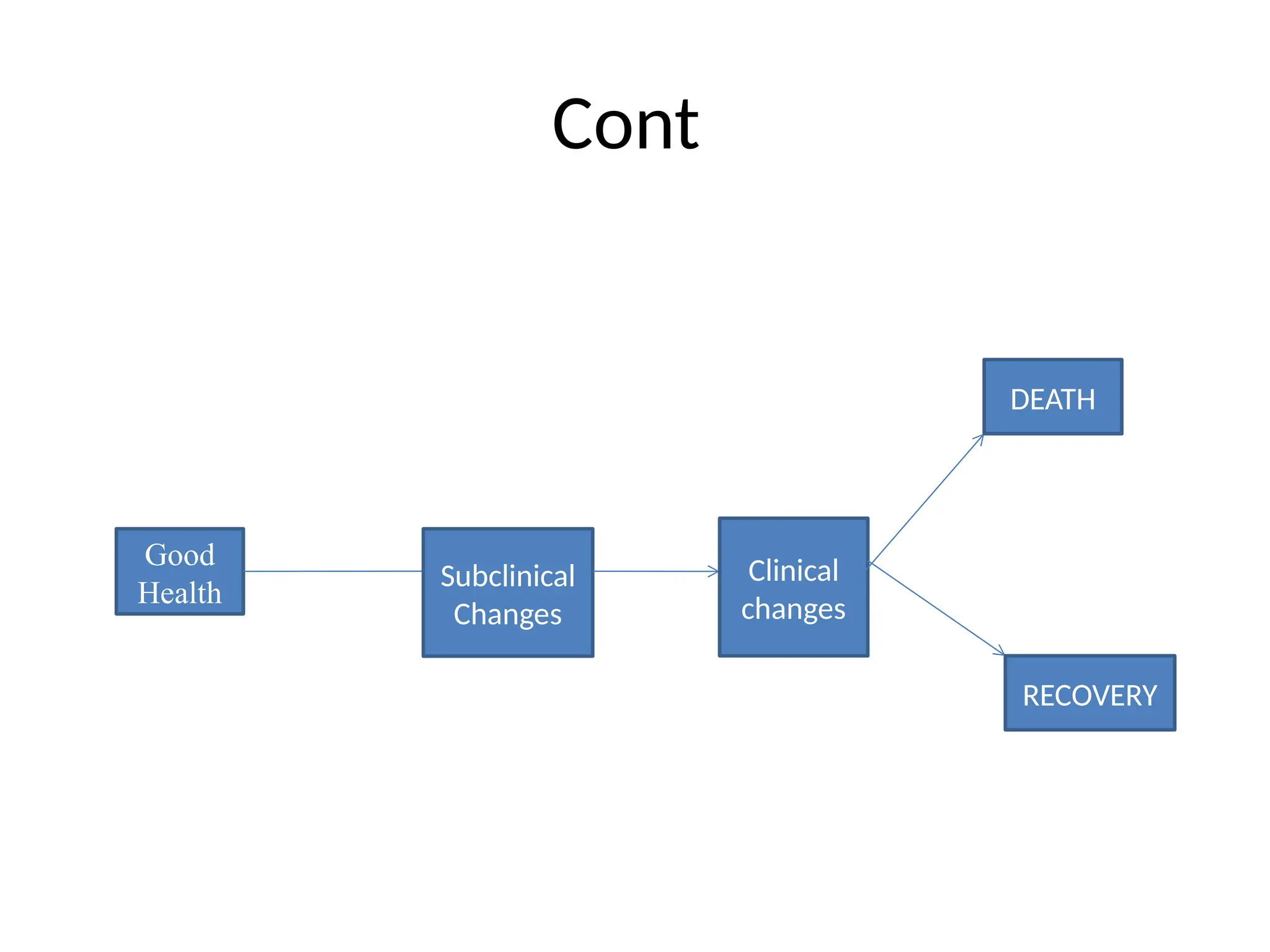
Cont
Good
Health
Subclinical
Changes
Clinical
changes
DEATH
RECOVERY
• During the susceptible phase, risk factors are
only present or there is accumulation of
factors sufficient for the disease process to
begin in a susceptible host.
• During the preclinical or pre symptomatic
phase, pathological changes of the disease has
started.
• extending from the time of exposure to onset of
disease symptoms, is usually called:
The incubation period for infectious diseases
 the latency period for chronic diseases.
• There are some physical manifestations, but NO
obvious disease is present
This period may be as brief as seconds for
hypersensitivity and toxic reactions to as long as
decades for certain chronic diseases.
 The onset of symptoms marks the transition from
subclinical to clinical disease.
• In the clinical disease phase, signs and symptoms of
diseases are present.
• In some people, however, the disease process may
never progress to clinically apparent illness.
• In others, the disease process may result in illness
that ranges from mild to severe or fatal.
• This range is called the spectrum of disease.
• Ultimately, the disease process ends either in
recovery, disability or death
Chain of infection
• According to traditional triad model, it holds
that infectious diseases result from the
interaction of :
Agent
Host
 environment
• Transmission occurs when the agent leaves its reservoir
or host through a portal of
exit, is conveyed by some mode of transmission, and
enters through an appropriate portal of entry to infect a
susceptible host.
• This sequence is sometimes called the chain of infection.
• Reservoir
The reservoir of an infectious agent is the habitat in which the
agent normally lives, grows and multiplies.
• Reservoirs include:
 Human –transmission of person to person(mumps, chicken pox)
 Animals reservoirs (vertebrae animals to human (beings
zoonosis -plague)
 Environment reservoirs( Plants, soil, and water)
• Portal of exit
Portal of exit is the path by which a pathogen
leaves its host.
 The portal of exit usually corresponds to the site
where the pathogen is localized. For example:
- influenza viruses and Mycobacterium tuberculosis
exit the respiratory tract
- schistosomes through urine
- cholera vibrios in feces
- Sarcoptes scabiei in scabies skin lesions
- enterovirus 70, a cause of hemorrhagic conjunctivitis,
in conjunctival secretions
- Some bloodborne agents can exit by crossing the
placenta from mother to fetus (rubella, syphilis,
toxoplasmosis),
- while others exit through cuts or needles in the skin
(hepatitis B) or blood-sucking arthropods (malaria).
Mode of transmission: An infectious agent may be
transmitted from its natural reservoir to a susceptible host in
different ways
• Direct
-direct contact(skin to skin, kissing and sexual intercourse
− droplet spread(refers to spray with relatively large,
short-range aerosols produced by sneezing, coughing, or
even talking.e.g. Pertussis and meningococcal)
• Indirect
− Air borne through dust or droplet nuclei
suspended in the air( measles virus)
− Vehicle borne can be contaminated by
contaminated food, water, biologic products
(blood), and fomites (inanimate objects such as
handkerchiefs, bedding, or surgical scalpels).
− Vectorborne (mechanical or biologic)
mosquitoes, fleas, and ticks may carry an
infectious agent through purely mechanical
means or may support growth or changes in the
agent
• Port of entry
The portal of entry refers to the manner in which a
pathogen enters a susceptible host
The portal of entry must provide access to tissues in
which the pathogen can multiply or a toxin can act.
Often, infectious agents use the same portal to enter
a new host that they used to exit the source host.
*Knowledge of chain of infection is important as
put Interventions that are directed
at:
-Controlling or eliminating agent at source of
transmission
- Protecting portals of entry
- Increasing host’s defenses
Factors which can influence the
development of disease are:
• Strain of agent
• Dose of agent
• Route of infection
• Host characteristics
• Treatment
Levels of disease prevention
• Primary prevention of a disease
These are actions that removes the possibility
that a disease will occur. Actions precedes
disease or dysfunction(the individuals
/population are health)
Generalized health promotion and specific
protection against diseases
The activities are both preventive and promotive
Examples of primary prevation
• Health education about accidents and
poisoning prevention,standared of nutrition
and growth and development for each stage of
life, exercise requirements ,stress management
,protection against occupational hazards,etc
• Immunizations
• Risk assessment for disease
• Family planning services and marriage
counseling
• Environmental sanitation and provision of
adequate housing,recreation,and work
conditions
• Removal of any noxious Agents (Toxic
agents)in the environment or any agents in the
environment that would cause disease-refuse
disposal.
• Preventing agents from being in contact with
the host e.g., mosquito nets- to prevent
infected mosquitoes.
Secondary prevention
• This is pre clinical / clinical disease stage.
• It emphasize on early detection/ diagnosis,
prompt treatment/ intervention and health
maintenance for individuals experiencing health
problems.
• Measures are aimed at people who have a disease.
• It includes, prevention of progression of a clinical
disease( halt),prevention of complications and
disabilities.
• Reduces disease prevalence
• Level of curative stage to prevent
disability( happens in district hospitals )
Examples of secondary prevention
• Screening surveys- DHS-R.P.R
• Screening tests e.g. early screening and
treatment for T.B. to prevent chronocity.
Stool for m/c/s to rule out worms.
• Encouraging medical and dental check ups
• Teaching self - examination for breast and
testicular cancer
Tertiary prevention
• This is the level of disability limitation and
rehabilitation .
• It begins after an illness, when a defect or
disability is fixed, stabilized , or irreversible .
• Usually a point of NO RETURN
• Its focus is to help rehabilitate individuals and
restore them optimum level of functioning within
the constraints of disability to try to prevent
• Hopelessness
• Helplessness
• Workelessness
• Dependence
• Suicidal tendencies
Examples of tertiary prevention
• Should be helped or request help from clubs
• Referring a client who has had a colostomy to a
support group
• Use of prosthesis for amputees and also change
hobbies e.g. from golfer to dart player
• Palliative care of terminally ill patients to prevent
undignified or painful death
• Rehabilitation by- Retraining remaining capacities-
retrain maximal independence including employment.

EPIDEMIOLOGY LATEST.pptx notes on aid of learning

  • 1.
    INTRODUCTION TO EPIDEMIOLOGY DR. PENIASTEMBO (MD) (MPH.MBChB,BSc HB,Dip Med,Cert TM)
  • 2.
    EPIDEMIOLOGY • Objectives • Atthe end of the course, students should be able to demonstrate knowledge of: • describe the nature and main uses of epidemiology • the epidemiology approach to defining and measuring the occurrence of health related states in population
  • 3.
    • In addition,students are expected to have gained a variety of skills, including ability to: describe the common cause of death, disease and disability in their respective communities  outline appropriate study designs to answer specific questions concerning disease causation, natural history prognosis, prevention and evaluation of therapy and other interventions to prevent and control disease
  • 4.
    WHAT IS EPIDEMIOLOGY Keymessages (Things to remember) • Epidemiology is a fundamental science of public health • Epidemiology has made major contributions to improving population health • Epidemiology is essential to the process of identifying and mapping emerging diseases
  • 5.
    Historical context Origins • Epidemiology’sroots are nearly 2500 years old. • Epidemiology originates from Hippocrates observations more than 2000 years ago that environmental factors influence the occurrence of disease. • • • • • •
  • 6.
    • Circa 400B.C. Hippocrates attempted to explain disease occurrence from a rational rather than a supernatural viewpoint. In his essay entitled “On Airs, Waters, and Places,” • Hippocrates suggested that environmental and host factors such as behaviors might influence the development of disease.
  • 7.
    • 1662 Another earlycontributor to epidemiology was John Graunt, a London haberdasher and councilman who published a landmark analysis of mortality data in 1662.
  • 8.
    • This publicationwas the first to quantify patterns of birth, death, and disease occurrence, noting disparities between males and females, high infant mortality, urban/rural differences, and seasonal variations.
  • 9.
    • 1800 William Farrbuilt upon Graunt’s work by systematically collecting and analyzing Britain’s mortality statistics. • Farr, considered the father of modern vital statistics and surveillance, developed many of the basic practices used today in vital statistics and disease classification
  • 10.
    • He concentratedhis efforts on collecting vital statistics, assembling and evaluating those data, and reporting to responsible health authorities and the general public.
  • 11.
    • However, itwas not until the 19th Century that the distribution of disease in specific human population groups was measured to any large extent. • This wok not only marked the formal beginnings of epidemiology but also Some of its most spectacular achievements
  • 12.
    • The findingsby John snow that the risk of cholera in London was related to the drinking water supplied by a particular company provides a well-known example • Snow’s epidemiology studies were one aspect of a wide ranging series of investigations that examined related physical, chemical, biological, sociological and political processes.
  • 13.
    • Comparing ratesof disease in subgroups of the human population became common practice in the late C19th and early C20th . • This approach was initially applied to the control of communicable diseases but proved to be useful way of linking environmental conditions or agents to specific diseases. • In the second half of the twentieth century,
  • 14.
    These methods wereapplied to chronic non communicable diseases such as heart diseases and cancer, especially in the middle and high- income countries.
  • 15.
    Recent developments inEpidemiology • Epidemiology in modern form is a relatively new discipline and uses quantitative methods to study diseases in human populations, to form prevention and control efforts.e.g. Richard Doll and Andrew Hill studied the relation between tobacco use and lung cancer beginning in the 1950s.
  • 16.
    • In the1980s, epidemiology was extended to the studies of injuries and violence. • In the 1990s, the related fields of molecular and genetic epidemiology (expansion of epidemiology to look at specific pathways, molecules and genes that influence risk of developing disease) took root.
  • 17.
    • Beginning inthe 1990s and accelerating after the terrorist attacks of September 11, 2001, epidemiologists have had to consider not only natural transmission of infectious organisms but also deliberate spread through biologic warfare and bioterrorism.
  • 18.
    Definition of Epidemiology •The word “epidemiology “ is derived from Greek words: epi:“ upon”,demo “people” lagos“study”
  • 19.
    • Epidemiology asdefined by Last is’ the study of the distribution and determinants of health- related states or events in a specified population, and the application of the study to the prevention and control of health problems.
  • 20.
    • This broaddefinition of epidemiology can be further elaborated as follows; • Study: includes-surveillance, observations, hypothesis testing, analytic research and experiments • Distribution: refers to frequency and pattern of occurrence of disease analysis
  • 21.
    • Frequency refersnot only to the number of health events such as the number of cases of meningitis or diabetes in a population, but also to the relationship of that number to the size of the population.
  • 22.
    • The resultingrate allows epidemiologists to compare disease occurrence across different populations
  • 23.
    • Pattern refersto the occurrence of health- related events by:  time  place  person.
  • 24.
    • Time patternsmay be : Annual  seasonal  weekly Daily  hourly,  weekday versus weekend, or any other breakdown of time that may influence disease or injury occurrence.
  • 25.
    • Place patternsinclude:  geographic variation,  urban/rural differences  and location of work sites or schools.
  • 26.
    • Personal characteristicsinclude demographic factors which may be related to risk of illness, injury, or disability such as age, sex, marital status, and socioeconomic status, as well as behaviors and environmental exposures.
  • 27.
    • Determinants :includesfactors that influence health-biological, chemical, physical, socioal, cultural, economic, genetic and behavioural. • Health related states and events: refers to – diseases, causes of death,behaviours such as use of tobacco, positive health status, reaction to preventive regimes and provision and use of health services
  • 28.
    • Specified population:include those with identifiable characteristics, such as occupational groups. • Application to prevention and control-The aims of public health- to promote, protect and restore health.
  • 29.
    Concerns of Epidemiology •Epidemiologists are concerned not only with deaths, illnesses and disability, but also with more positive health states and most importantly with the means to improve health • The term ‘disease ‘encompasses all unfavorable health changes, including injuries and mental health.
  • 30.
    Uses of epidemiology •Assessing the community’s health • Making individual decisions • Completing the clinical picture • Searching for causes-to searching for causal factors that influence one’s risk of disease
  • 31.
    Epidemiological approach • Theepidemiological approach to problems of health and disease is based on two major foundation Ask questions and getting answers that lead to further questions Making comparisons and draw inferences
  • 32.
    Questions related Tohealth events • What is the event(problem)? • What is the magnitude? • Where did it happen? • When did it happen? • Who are affected? • Why did it happen/
  • 33.
    Questions Related toHealth Action • What can be done to reduce this problem and it’s consequences? • How can it be prevented in the future? • What action should be taken by the community ? • Who should carry out these activities? Health services, other sectors, where and for whom these activities be carried out?
  • 34.
    • What resourcesare required? • How are these activities be organized? • What difficult may arise, and how might they be overcomed?
  • 35.
    EPIDEMIOLOGY &CLINICAL MEDICINE EPIDEMIOLOGY •Population as unit of study • Concerned with disease pattern in the entire population • Epidemiologists confronted with relevant data derived fro particular epidemiological study-to identify a particular source of infection, mode of spread, CLINICAL MEDICINE • Cases/ case with a disease as unity of study • Physician is concerned with disease in a individual patients • Concerned with both the sick and the healthy • Physicians seeks diagnosis from which he derives a prognosis and prescribes specific treatment
  • 36.
    Epidemiology or an etiologicalfactor in order to determine a future trend and recommend specific control measures • Epidemiologist evaluates the outcome of preventive and therapeutic measures instituted which provides the necessary guidance and feed- back to the health care administrator for effective Clinical Medicine • Patient comes to a doctor • Is based on biomedical concepts with an ever- increasing concern for refining the technique of diagnosis and treatment at individual level
  • 37.
    Epidemiology Management of publichealth programmes • The investigator goes to the community to find persons who have a disease or experience of the suspected causal factor in question Clinical Medicine • The subject matter is easily “perceived “by such techniques as clinical and laboratory examination , postmortem reports
  • 38.
    • Clinical medicineand epidemiology are not antagonistic. • Both are closely related, co-existent and mutually helpful • Epidemiological enquiries depends on appropriate clinical considerations such as how the disease in question can be identified among individuals comprising the group under scrutiny
  • 39.
    • Likewise, aknowledge of prevalence and prognosis derived from epidemiological research is important to the clinician for the diagnosis and management of individual patients and their families
  • 40.
    NATURAL HISTORY OFA DISEASE • Definition-Natural history of a disease refers to systematic description of the course of disease over time, un affected by treatment. (The course and outcome of disease in individuals and groups)
  • 41.
  • 42.
    • During thesusceptible phase, risk factors are only present or there is accumulation of factors sufficient for the disease process to begin in a susceptible host.
  • 43.
    • During thepreclinical or pre symptomatic phase, pathological changes of the disease has started. • extending from the time of exposure to onset of disease symptoms, is usually called: The incubation period for infectious diseases  the latency period for chronic diseases. • There are some physical manifestations, but NO obvious disease is present
  • 44.
    This period maybe as brief as seconds for hypersensitivity and toxic reactions to as long as decades for certain chronic diseases.  The onset of symptoms marks the transition from subclinical to clinical disease. • In the clinical disease phase, signs and symptoms of diseases are present.
  • 45.
    • In somepeople, however, the disease process may never progress to clinically apparent illness. • In others, the disease process may result in illness that ranges from mild to severe or fatal. • This range is called the spectrum of disease. • Ultimately, the disease process ends either in recovery, disability or death
  • 46.
    Chain of infection •According to traditional triad model, it holds that infectious diseases result from the interaction of : Agent Host  environment
  • 47.
    • Transmission occurswhen the agent leaves its reservoir or host through a portal of exit, is conveyed by some mode of transmission, and enters through an appropriate portal of entry to infect a susceptible host. • This sequence is sometimes called the chain of infection.
  • 48.
    • Reservoir The reservoirof an infectious agent is the habitat in which the agent normally lives, grows and multiplies. • Reservoirs include:  Human –transmission of person to person(mumps, chicken pox)  Animals reservoirs (vertebrae animals to human (beings zoonosis -plague)  Environment reservoirs( Plants, soil, and water)
  • 49.
    • Portal ofexit Portal of exit is the path by which a pathogen leaves its host.  The portal of exit usually corresponds to the site where the pathogen is localized. For example: - influenza viruses and Mycobacterium tuberculosis exit the respiratory tract - schistosomes through urine - cholera vibrios in feces
  • 50.
    - Sarcoptes scabieiin scabies skin lesions - enterovirus 70, a cause of hemorrhagic conjunctivitis, in conjunctival secretions - Some bloodborne agents can exit by crossing the placenta from mother to fetus (rubella, syphilis, toxoplasmosis), - while others exit through cuts or needles in the skin (hepatitis B) or blood-sucking arthropods (malaria).
  • 51.
    Mode of transmission:An infectious agent may be transmitted from its natural reservoir to a susceptible host in different ways • Direct -direct contact(skin to skin, kissing and sexual intercourse − droplet spread(refers to spray with relatively large, short-range aerosols produced by sneezing, coughing, or even talking.e.g. Pertussis and meningococcal)
  • 52.
    • Indirect − Airborne through dust or droplet nuclei suspended in the air( measles virus) − Vehicle borne can be contaminated by contaminated food, water, biologic products (blood), and fomites (inanimate objects such as handkerchiefs, bedding, or surgical scalpels).
  • 53.
    − Vectorborne (mechanicalor biologic) mosquitoes, fleas, and ticks may carry an infectious agent through purely mechanical means or may support growth or changes in the agent
  • 54.
    • Port ofentry The portal of entry refers to the manner in which a pathogen enters a susceptible host The portal of entry must provide access to tissues in which the pathogen can multiply or a toxin can act. Often, infectious agents use the same portal to enter a new host that they used to exit the source host.
  • 55.
    *Knowledge of chainof infection is important as put Interventions that are directed at: -Controlling or eliminating agent at source of transmission - Protecting portals of entry - Increasing host’s defenses
  • 56.
    Factors which caninfluence the development of disease are: • Strain of agent • Dose of agent • Route of infection • Host characteristics • Treatment
  • 57.
    Levels of diseaseprevention • Primary prevention of a disease These are actions that removes the possibility that a disease will occur. Actions precedes disease or dysfunction(the individuals /population are health) Generalized health promotion and specific protection against diseases The activities are both preventive and promotive
  • 58.
    Examples of primaryprevation • Health education about accidents and poisoning prevention,standared of nutrition and growth and development for each stage of life, exercise requirements ,stress management ,protection against occupational hazards,etc • Immunizations • Risk assessment for disease
  • 59.
    • Family planningservices and marriage counseling • Environmental sanitation and provision of adequate housing,recreation,and work conditions • Removal of any noxious Agents (Toxic agents)in the environment or any agents in the environment that would cause disease-refuse disposal.
  • 60.
    • Preventing agentsfrom being in contact with the host e.g., mosquito nets- to prevent infected mosquitoes.
  • 61.
    Secondary prevention • Thisis pre clinical / clinical disease stage. • It emphasize on early detection/ diagnosis, prompt treatment/ intervention and health maintenance for individuals experiencing health problems. • Measures are aimed at people who have a disease. • It includes, prevention of progression of a clinical disease( halt),prevention of complications and disabilities.
  • 62.
    • Reduces diseaseprevalence • Level of curative stage to prevent disability( happens in district hospitals )
  • 63.
    Examples of secondaryprevention • Screening surveys- DHS-R.P.R • Screening tests e.g. early screening and treatment for T.B. to prevent chronocity. Stool for m/c/s to rule out worms. • Encouraging medical and dental check ups • Teaching self - examination for breast and testicular cancer
  • 64.
    Tertiary prevention • Thisis the level of disability limitation and rehabilitation . • It begins after an illness, when a defect or disability is fixed, stabilized , or irreversible . • Usually a point of NO RETURN • Its focus is to help rehabilitate individuals and restore them optimum level of functioning within the constraints of disability to try to prevent
  • 65.
    • Hopelessness • Helplessness •Workelessness • Dependence • Suicidal tendencies
  • 66.
    Examples of tertiaryprevention • Should be helped or request help from clubs • Referring a client who has had a colostomy to a support group • Use of prosthesis for amputees and also change hobbies e.g. from golfer to dart player • Palliative care of terminally ill patients to prevent undignified or painful death • Rehabilitation by- Retraining remaining capacities- retrain maximal independence including employment.