1
MODELLING TECHNIQUES
DRUG EXCRETION
ACTIVE TRANSPORT
P-gp
BCRP
NUCLEOSIDE TRANSPORTERS
PRESENTED BY:
VINU GOPAKUMAR
PRESENTED TO:
DR. ROMA MATHEW
H PEPTI
ASDT
OCT
OATP
BBB- CHOLINE TRNSPORTER
COMPUTER AIDED DRUG DEVELOPMENT
2
INTRODUCTION to
computational modelling
COMPUTER AIDED DRUG DEVELOPMENT
3
INTRODUCTION
Computational modeling is the use of computers to simulate and study the
behavior of complex systems using mathematics, physics and computer science.
Drug disposition is a general term that encompasses the 4 processes that
determine drug and metabolite concentration in plasma, tissue and within the cells
( absorption, distribution, metabolism, excretion)
Drug disposition comprises of 2 : distribution and eliminaton.
Computational modeling of drug disposition is the integral part of computer aided
drug design.
Different kinds of tools being used in the prediction of drug disposition in human
body.
4
drug excretion
COMPUTER AIDED DRUG DEVELOPMENT
5
DRUG EXCRETION
The excretion or clearance of a drug is quantified by plasma clearance, which is defined as
plasma volume that has been cleared completely free of drug per unit of time.
Together with Vd, it can assist in the calculation of drug half-life, thus determining the
dosage regimen.
Hepatic and renal clearances are the two main components of phasma clearance.
No model has been reported that is capable of predicting plasma clearance solely from
computed drug structures.
Current modeling efforts are mainly focused on estimating in vivo clearance from in vitro
data.
Just like other pharmacokinetic aspects, the hepatic and renal clearance process is also
complicated by presence of active transporters.
6
ACTIVE TRANSPORT
COMPUTER AIDED DRUG DEVELOPMENT
7
ACTIVE TRANSPORT
Transporters are the integral part of an ADMET modeling program .
Since they are ubiquitous on barrier membranes and the substantial overlap between their
substrates and many drugs.
They has resulted in a relatively large amount of in vitro data, which in turn have enabled
the generation of pharmacophore and QSAR models.
These models have been assisted in the understanding of the complex effects of
transporters on drug disposition including absorption, distribution and excretion.
Their incorporation into current modeling would result in more accurate prediction of drug
disposition behavior.
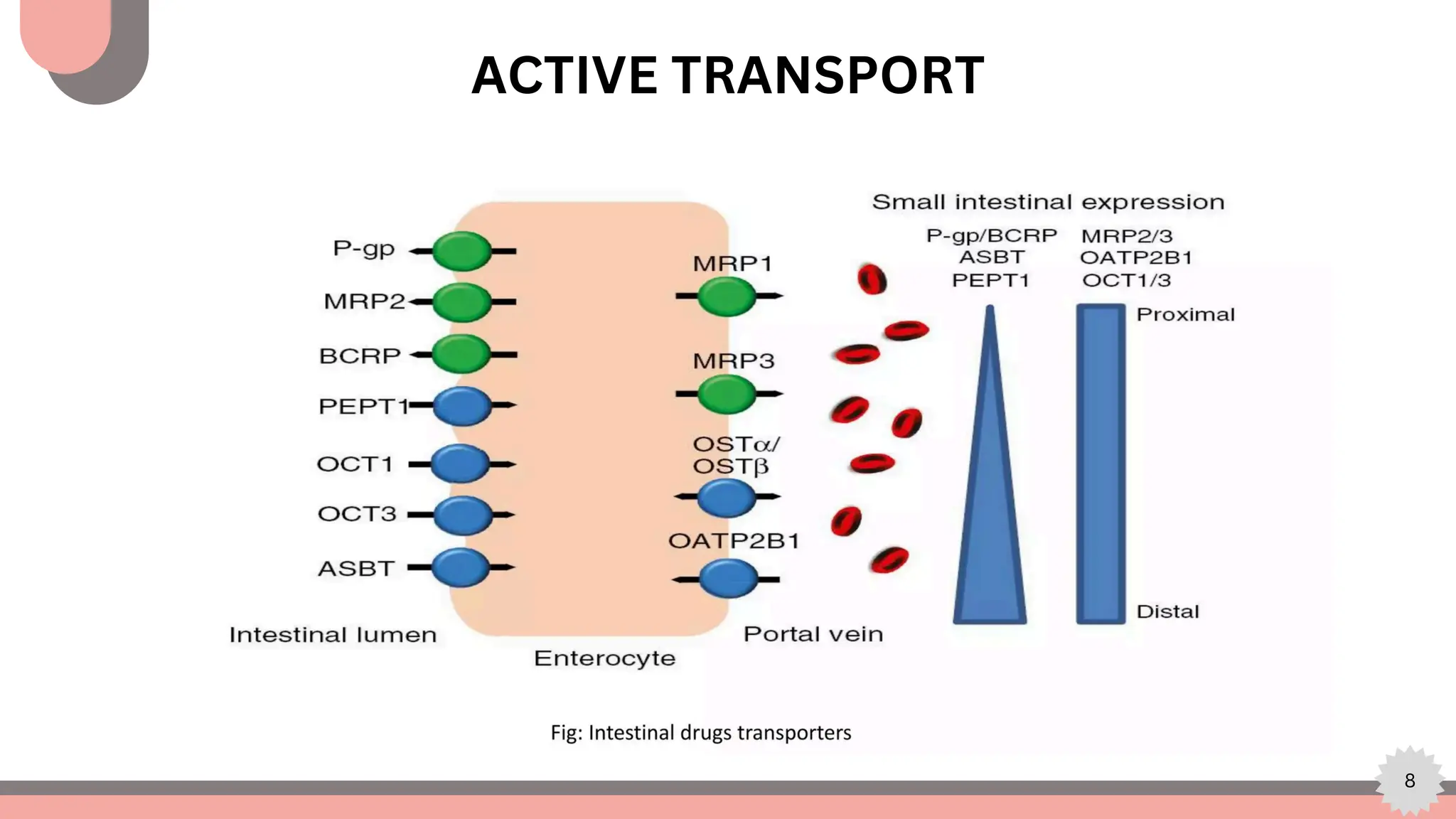
8
ACTIVE TRANSPORT
9
P-gp (P-GLYCOPROTEIN)
COMPUTER AIDED DRUG DEVELOPMENT
10
P-gp (P- GLYCOPROTEIN)
An ATP- dependent efflux transporter that transports a broad range of substrates out of
the cell. It affects drug disposition by reducing absorption and enhancing renal and
hepatic excretion.
For eg; P-gp is known to limit the intestinal absorption of the anticancer drug Paclitaxel
and restricts the CNS penetration of human immunodeficiency virus protease inhibitor.
Also responsible for multidrug resistance in cancer chemotherapy. Because of its
significance in drug disposition and effective cancer treatment, P-gp attracted numerous
efforts and has become the most extensively studied transporter, with abundant
experimental data.
11
Ekins and colleagues generated 5 computational pharmacophore models to predict the
inhibition of P-gp from in vitro data on a diverse set of inhibitors with several cell systems.
It includes inhibition of digoxin transport and verapamil binding in Caco-2 cells; vinblastine
and calcein accumulation in P-gp expressing LLC-PK1(L-MDR1) cells [cell exhibiting
epithelial morphology was isolated from kidney of male 3-4 week pig] and vinblastine
binding in vesicles derived from CEM/VLB 100 cells[cellosaurus cell line- is a cytogenetic
characterization of chromosomal rearrangement in human vinblastine resistant CEM cell
line]
By comparing and merging all P-gp pharmacophore models, common areas of identical
chemical features as well as their geometric arrangement were identified to the substrate
requirements for P-gp.
12
Using a diverse set of 129 compounds, the authors derived a robust QSAR model that
revealed two hydrophobic features, two hydrogen bond acceptors and the molecular
dimension to be essential determinants of P-gp mediated transport.
These identified transport requirements not only to help screen compounds with potential
efflux related bioavailability problems but also to assist the identification of novel P-gp
inhibitors, which when co administered with target drugs would optimize their
pharmacokinetic profile by increasing bioavailability.
13
BCRP (BREAST CANCER
RESISTANCE PROTEIN)
COMPUTER AIDED DRUG DEVELOPMENT
14
BCRP(BREAST CANCER RESISTANCE PROTEIN)
Another ATP-dependent efflux transporter that confers resistance to a variety of
anticancer agents, including anthracyclines and mitoxantrone.
In addition to high level of expression in hematological malignancies and solid tumors,
BCRP is also expressed in intestine, liver, and brain.
Thus implicating its intricate role in drug disposition behavior.
Recently, Zhang and colleagues generated a BCRP 3D-QSAR model by analyzing structure
and activity of 25 flavonoid analogs.
Special structural feature requirements for BCRP: Presence of a 2,3- double bond in ring C
Hydroxylation at position 5.
The model is only based on a set of closely related structures instead of diverse set, it
should be applied with caution.
15
NUCLEOSIDE TRANSPORTERS
COMPUTER AIDED DRUG DEVELOPMENT
16
NUCLEOSIDE TRANSPORTERS
They transport both naturally occurring nucleosides and synthetic nucleoside analogs that
are used as anticancer drugs(eg; cladribine) and antiviral drugs(eg; zalcitabine).
There are different types of nucleoside transporters, including concentrative nucleoside
transporters (CNT1, CNT2, CNT3) and equilibriative nucleoside transporters (ENT1,ENT2),
each having different substrate specificities.
The broad affinity, low selective ENTs are ubiquitously located, whereas the high affinity,
selective CNTs are mainly located in liver, kidney, intestine and brain, indicating their
involvement in drug absorption, distribution, and excretion.
17
A more comprehensive study generated distinctive models for CNT1, CNT2, and ENT1with
both pharmacophore and 3D QSAR modeling techniques.
All models show the common features, required for nucleoside transporter-mediated
transport; two hydrophobic features and one hydrogen bond acceptor on the pentose
ring.
18
hPEPT1
COMPUTER AIDED DRUG DEVELOPMENT
19
hPEPT1
Human peptide transporter is a low affinity high capacity oligopeptide transport system .
It transports a diverse range of substrates including β-lactam antibiotics and angiotensin-
converting enzyme (ACE) inhibitors.
Mainly expressed in intestine and kidney affecting drug absorption and excretion.
A pharmacophore model based on three high affinity substrates (Gly-Sar, bestatin, and
enalapril) recognized two hydrophobic features, one hydrogen bond donor, one hydrogen
bond acceptor and one negative ionizable feature to be hPEPT1 transport requirements.
This pharmacophore model applied to screen the CMC database with over 8000 drug like
molecules.
The antidiabetic repaglinide and HMG-CoA reductase inhibitor fluvastatin were suggested
by the model and later verified to inhibit hPEPT1 with submillimolar potency.
20
ASBT
COMPUTER AIDED DRUG DEVELOPMENT
21
ASBT
Human apical sodium-dependent bile acid transporter
Is a high-efficacy, high capacity transporter expressed on the apical membrane of
intestinal epithelial cells and cholangiocytes.
It assists absorption of bile acids and their analogs, thus providing an additional intestinal
target for improving drug absorption.
Baringhaus and colleagues developed a pharmacophore model based on a training set of
17 chemically diverse inhibitors of ASBT.
The model revealed ASBT transport requirements as;
One hydrogen bond donor
1.
One hydrogen bond acceptor
2.
One negative charge
3.
3 hydrophobic centers
4.
22
OCT
COMPUTER AIDED DRUG DEVELOPMENT
23
OCT
Organic cation transporters
Facilitates the uptake of many cationic drugs across different barrier membranes from
kidney, liver, and intestine epithelia.
A broad range of drugs and their metabolites fall into the chemical class of organic cation (
carrying a positive charge at physiological pH) including antiarrhythmics, β-
adrenoreceptor blocking agents, antihistamines, antiviral agents, and skeletal muscle
relaxing agents.
3 OCTs have been cloned from different species, OCT1,OCT2, OCT3.
A human OCT1 pharmacophore model was developed by analyzing the extent of inhibition
of TEA uptake in HeLa cells of 22 diverse molecules.
24
The model suggests the transport requirements of human OCT1 as
3 hydrophobic features
1.
One positive ionizable feature.
2.
Molecular determinants of substrate binding to human OCT2 and rabbit OCT2 were
recently reported.
Both 2 D and 3D QSAR analyzes were performed to identify and discriminate the binding
requirements of the two orthologs.
25
OATP
COMPUTER AIDED DRUG DEVELOPMENT
26
Organic anion transporting polypeptides
They influence the plasma concentration of many drugs by actively transporting them
across the diverse range of tissue membranes such as liver, intestine, lung, and brain.
Because of their broad substrate specificity, OATPs transport not only organic anionic
drugs, but also organic cationic drugs.
Currently 11 human OATPs have identified, and the substrate binding requirements of
the best studied-OATP1B1 were successfully modeled with metapharmacophore
approach recently. Through assessing a training set of 18 diverse molecules, the
metapharmacophore model identified three hydrophobic features flanked by 2
hydrogen bond acceptor features to be the essential requirement for OATP1B1
transport.
OATP
27
BBB-CHOLINE
TRANSPORTER
COMPUTER AIDED DRUG DEVELOPMENT
28
BBB-CHOLINE TRANSPORTER
Is a native nutrient transporter that transports choline, a charged cation, across the BBB
into CNS.
Its active transport assists the BBB penetration of choline like compounds, and
understanding its structural requirements should afford a more accurate prediction of
BBB permeation.
Even though it has not been cloned, Geldenhuys and colleagues applied a combination
of empirical and theoretical methodologies to study its binding requirements.
The 3D-QSAR models were built with empirical ki data obtained from in situ rat brain
perfusion experiments with structurally diverse set of compounds.
29
Three hydrophobic interactions and one hydrogen bonding interaction surrounding the
positively charged ammonium moiety were identified to be important for BBB-choline
transporter recognition.
Since the model statistical significance is not optimal (q² < 0.5) , it does provide a useful
estimation of BBB-choline transporter binding requirements.
More accurate in silico models could be generated once high quality data from the
cloned BBB-choline transporter are available.
30
PREVIOUS YEAR QUESTIONS
Narrate the computational modeling of drug disposition (10) jan 2019/ feb 2021
Nucleoside transporter(5) jan 2019/ may 2022
Nucleoside transporter and BBB-choline transporter(5) aug 2018
OCT transporter(5) jan 2020
BBB-choline transpoter(5) jan 2020
31
REFERENCES
Ekins S. Computer Applications in pharmaceutical research and development.
Hoboken, NJ: Wiley-Interscience; 2006;pgno:495-509

MODELLING TECHNIQUES in Computer Aided drug development

  • 1.
    1 MODELLING TECHNIQUES DRUG EXCRETION ACTIVETRANSPORT P-gp BCRP NUCLEOSIDE TRANSPORTERS PRESENTED BY: VINU GOPAKUMAR PRESENTED TO: DR. ROMA MATHEW H PEPTI ASDT OCT OATP BBB- CHOLINE TRNSPORTER COMPUTER AIDED DRUG DEVELOPMENT
  • 2.
  • 3.
    3 INTRODUCTION Computational modeling isthe use of computers to simulate and study the behavior of complex systems using mathematics, physics and computer science. Drug disposition is a general term that encompasses the 4 processes that determine drug and metabolite concentration in plasma, tissue and within the cells ( absorption, distribution, metabolism, excretion) Drug disposition comprises of 2 : distribution and eliminaton. Computational modeling of drug disposition is the integral part of computer aided drug design. Different kinds of tools being used in the prediction of drug disposition in human body.
  • 4.
  • 5.
    5 DRUG EXCRETION The excretionor clearance of a drug is quantified by plasma clearance, which is defined as plasma volume that has been cleared completely free of drug per unit of time. Together with Vd, it can assist in the calculation of drug half-life, thus determining the dosage regimen. Hepatic and renal clearances are the two main components of phasma clearance. No model has been reported that is capable of predicting plasma clearance solely from computed drug structures. Current modeling efforts are mainly focused on estimating in vivo clearance from in vitro data. Just like other pharmacokinetic aspects, the hepatic and renal clearance process is also complicated by presence of active transporters.
  • 6.
  • 7.
    7 ACTIVE TRANSPORT Transporters arethe integral part of an ADMET modeling program . Since they are ubiquitous on barrier membranes and the substantial overlap between their substrates and many drugs. They has resulted in a relatively large amount of in vitro data, which in turn have enabled the generation of pharmacophore and QSAR models. These models have been assisted in the understanding of the complex effects of transporters on drug disposition including absorption, distribution and excretion. Their incorporation into current modeling would result in more accurate prediction of drug disposition behavior.
  • 8.
  • 9.
  • 10.
    10 P-gp (P- GLYCOPROTEIN) AnATP- dependent efflux transporter that transports a broad range of substrates out of the cell. It affects drug disposition by reducing absorption and enhancing renal and hepatic excretion. For eg; P-gp is known to limit the intestinal absorption of the anticancer drug Paclitaxel and restricts the CNS penetration of human immunodeficiency virus protease inhibitor. Also responsible for multidrug resistance in cancer chemotherapy. Because of its significance in drug disposition and effective cancer treatment, P-gp attracted numerous efforts and has become the most extensively studied transporter, with abundant experimental data.
  • 11.
    11 Ekins and colleaguesgenerated 5 computational pharmacophore models to predict the inhibition of P-gp from in vitro data on a diverse set of inhibitors with several cell systems. It includes inhibition of digoxin transport and verapamil binding in Caco-2 cells; vinblastine and calcein accumulation in P-gp expressing LLC-PK1(L-MDR1) cells [cell exhibiting epithelial morphology was isolated from kidney of male 3-4 week pig] and vinblastine binding in vesicles derived from CEM/VLB 100 cells[cellosaurus cell line- is a cytogenetic characterization of chromosomal rearrangement in human vinblastine resistant CEM cell line] By comparing and merging all P-gp pharmacophore models, common areas of identical chemical features as well as their geometric arrangement were identified to the substrate requirements for P-gp.
  • 12.
    12 Using a diverseset of 129 compounds, the authors derived a robust QSAR model that revealed two hydrophobic features, two hydrogen bond acceptors and the molecular dimension to be essential determinants of P-gp mediated transport. These identified transport requirements not only to help screen compounds with potential efflux related bioavailability problems but also to assist the identification of novel P-gp inhibitors, which when co administered with target drugs would optimize their pharmacokinetic profile by increasing bioavailability.
  • 13.
    13 BCRP (BREAST CANCER RESISTANCEPROTEIN) COMPUTER AIDED DRUG DEVELOPMENT
  • 14.
    14 BCRP(BREAST CANCER RESISTANCEPROTEIN) Another ATP-dependent efflux transporter that confers resistance to a variety of anticancer agents, including anthracyclines and mitoxantrone. In addition to high level of expression in hematological malignancies and solid tumors, BCRP is also expressed in intestine, liver, and brain. Thus implicating its intricate role in drug disposition behavior. Recently, Zhang and colleagues generated a BCRP 3D-QSAR model by analyzing structure and activity of 25 flavonoid analogs. Special structural feature requirements for BCRP: Presence of a 2,3- double bond in ring C Hydroxylation at position 5. The model is only based on a set of closely related structures instead of diverse set, it should be applied with caution.
  • 15.
  • 16.
    16 NUCLEOSIDE TRANSPORTERS They transportboth naturally occurring nucleosides and synthetic nucleoside analogs that are used as anticancer drugs(eg; cladribine) and antiviral drugs(eg; zalcitabine). There are different types of nucleoside transporters, including concentrative nucleoside transporters (CNT1, CNT2, CNT3) and equilibriative nucleoside transporters (ENT1,ENT2), each having different substrate specificities. The broad affinity, low selective ENTs are ubiquitously located, whereas the high affinity, selective CNTs are mainly located in liver, kidney, intestine and brain, indicating their involvement in drug absorption, distribution, and excretion.
  • 17.
    17 A more comprehensivestudy generated distinctive models for CNT1, CNT2, and ENT1with both pharmacophore and 3D QSAR modeling techniques. All models show the common features, required for nucleoside transporter-mediated transport; two hydrophobic features and one hydrogen bond acceptor on the pentose ring.
  • 18.
  • 19.
    19 hPEPT1 Human peptide transporteris a low affinity high capacity oligopeptide transport system . It transports a diverse range of substrates including β-lactam antibiotics and angiotensin- converting enzyme (ACE) inhibitors. Mainly expressed in intestine and kidney affecting drug absorption and excretion. A pharmacophore model based on three high affinity substrates (Gly-Sar, bestatin, and enalapril) recognized two hydrophobic features, one hydrogen bond donor, one hydrogen bond acceptor and one negative ionizable feature to be hPEPT1 transport requirements. This pharmacophore model applied to screen the CMC database with over 8000 drug like molecules. The antidiabetic repaglinide and HMG-CoA reductase inhibitor fluvastatin were suggested by the model and later verified to inhibit hPEPT1 with submillimolar potency.
  • 20.
  • 21.
    21 ASBT Human apical sodium-dependentbile acid transporter Is a high-efficacy, high capacity transporter expressed on the apical membrane of intestinal epithelial cells and cholangiocytes. It assists absorption of bile acids and their analogs, thus providing an additional intestinal target for improving drug absorption. Baringhaus and colleagues developed a pharmacophore model based on a training set of 17 chemically diverse inhibitors of ASBT. The model revealed ASBT transport requirements as; One hydrogen bond donor 1. One hydrogen bond acceptor 2. One negative charge 3. 3 hydrophobic centers 4.
  • 22.
  • 23.
    23 OCT Organic cation transporters Facilitatesthe uptake of many cationic drugs across different barrier membranes from kidney, liver, and intestine epithelia. A broad range of drugs and their metabolites fall into the chemical class of organic cation ( carrying a positive charge at physiological pH) including antiarrhythmics, β- adrenoreceptor blocking agents, antihistamines, antiviral agents, and skeletal muscle relaxing agents. 3 OCTs have been cloned from different species, OCT1,OCT2, OCT3. A human OCT1 pharmacophore model was developed by analyzing the extent of inhibition of TEA uptake in HeLa cells of 22 diverse molecules.
  • 24.
    24 The model suggeststhe transport requirements of human OCT1 as 3 hydrophobic features 1. One positive ionizable feature. 2. Molecular determinants of substrate binding to human OCT2 and rabbit OCT2 were recently reported. Both 2 D and 3D QSAR analyzes were performed to identify and discriminate the binding requirements of the two orthologs.
  • 25.
  • 26.
    26 Organic anion transportingpolypeptides They influence the plasma concentration of many drugs by actively transporting them across the diverse range of tissue membranes such as liver, intestine, lung, and brain. Because of their broad substrate specificity, OATPs transport not only organic anionic drugs, but also organic cationic drugs. Currently 11 human OATPs have identified, and the substrate binding requirements of the best studied-OATP1B1 were successfully modeled with metapharmacophore approach recently. Through assessing a training set of 18 diverse molecules, the metapharmacophore model identified three hydrophobic features flanked by 2 hydrogen bond acceptor features to be the essential requirement for OATP1B1 transport. OATP
  • 27.
  • 28.
    28 BBB-CHOLINE TRANSPORTER Is anative nutrient transporter that transports choline, a charged cation, across the BBB into CNS. Its active transport assists the BBB penetration of choline like compounds, and understanding its structural requirements should afford a more accurate prediction of BBB permeation. Even though it has not been cloned, Geldenhuys and colleagues applied a combination of empirical and theoretical methodologies to study its binding requirements. The 3D-QSAR models were built with empirical ki data obtained from in situ rat brain perfusion experiments with structurally diverse set of compounds.
  • 29.
    29 Three hydrophobic interactionsand one hydrogen bonding interaction surrounding the positively charged ammonium moiety were identified to be important for BBB-choline transporter recognition. Since the model statistical significance is not optimal (q² < 0.5) , it does provide a useful estimation of BBB-choline transporter binding requirements. More accurate in silico models could be generated once high quality data from the cloned BBB-choline transporter are available.
  • 30.
    30 PREVIOUS YEAR QUESTIONS Narratethe computational modeling of drug disposition (10) jan 2019/ feb 2021 Nucleoside transporter(5) jan 2019/ may 2022 Nucleoside transporter and BBB-choline transporter(5) aug 2018 OCT transporter(5) jan 2020 BBB-choline transpoter(5) jan 2020
  • 31.
    31 REFERENCES Ekins S. ComputerApplications in pharmaceutical research and development. Hoboken, NJ: Wiley-Interscience; 2006;pgno:495-509