SEMINAR ON
SUBJECT: COMPUTER AIDED DRUG DEVELOPMENT
SUBMITTED BY: SUBMITTED TO:
PUSHPA SAHANI Prof K MAHALINGAN
2nd SEM M. Pharm Department of Pharmaceutics
CONTENT
Introduction
Active Transport
P-gp
BCRP
Nucleoside Transport
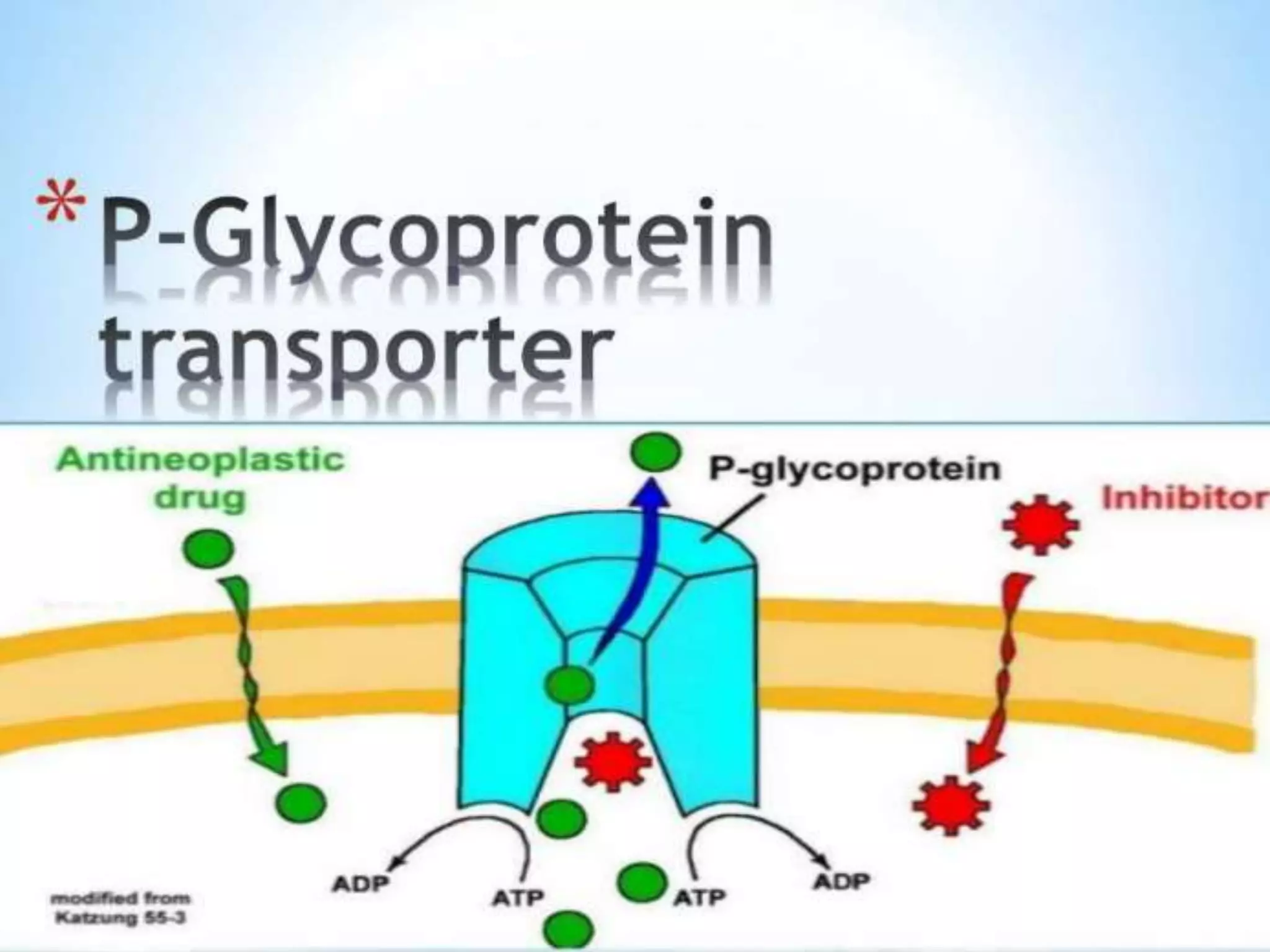
P-GP
• P-glycoprotein (p-gp) is an ATP-dependent effl ux
transporter that transports a broad range of substrates
out the cell.
• It affects drug disposition by reducing absorption and
enhancing renal and hepatic excretion.
• For example, P-gp is known to limit the intestinal
absorption of the anticancer drug paclitaxel and
restricts the CNS penetration of human
immunodeficiency virus (HIV) protease inhibitors.
• It also responsible for multidrug resistance in cancer
chemotherapy.
Inhibition of P-gp
• The inhibition of efflux pump is mainly done
in order to improve the delivery of therpeutic
agents.
• In general P-gp can be inhibited by 2
mechanism
1. Blocking drug binding site either
competively or non competively.
2.interfering with ATP
BCRP
• Breast cancer resistance protein
• It is an another ATP dependent efflux transport
• It confers resistance to a variety of anticancer
agents anthracyclins
• In addition to high level of experession in
hematological and solid tumors BCRP is
expressed in intestine,liver and brain thus
implicating is very complicated role in drug
disposition behaviour
Nucleoside Transporter
• It transport both naturally occuring nucleoside
and synthetic analogs that are used as
anticancer drugs and viral drugs.
• There are various type of nucleoside
transporter including concentrative nucleoside
transporter (CNT1 CNT2 CNT3) &
equilibrative nucleoside transporter (ENT1
ENT2 ENT3).
• Each have different substrate specificity.
• It have broad affinity, low selectivity & are
ubiquitously located.
• CNT have high affinity, selective located in
epittelia of intestive kidney, liver & brain,
indicating their involvement in drug disposition,
distribution & excretion.
• The first 3D, QSAR model for nucleoside
transporter was generated back in 1190.
• All model show the common features required for
nucleoside transporter mediated transport:
2 hydrophobic features & one hydrogen bond
acceptor on the pentose ring.
References
Computer application in pharmaceutical
research and development, by sean Ekins
published by john wiley and sons inc.
http://crdd.osdd.net/admet.php
https://en.wikipedia.org/wiki
httpps://www.solvobiotech.com/transporters/bc
rp
CAD note by Ms. Pushpa Sahani

CAD note by Ms. Pushpa Sahani

  • 1.
    SEMINAR ON SUBJECT: COMPUTERAIDED DRUG DEVELOPMENT SUBMITTED BY: SUBMITTED TO: PUSHPA SAHANI Prof K MAHALINGAN 2nd SEM M. Pharm Department of Pharmaceutics
  • 2.
  • 5.
    P-GP • P-glycoprotein (p-gp)is an ATP-dependent effl ux transporter that transports a broad range of substrates out the cell. • It affects drug disposition by reducing absorption and enhancing renal and hepatic excretion. • For example, P-gp is known to limit the intestinal absorption of the anticancer drug paclitaxel and restricts the CNS penetration of human immunodeficiency virus (HIV) protease inhibitors. • It also responsible for multidrug resistance in cancer chemotherapy.
  • 7.
    Inhibition of P-gp •The inhibition of efflux pump is mainly done in order to improve the delivery of therpeutic agents. • In general P-gp can be inhibited by 2 mechanism 1. Blocking drug binding site either competively or non competively. 2.interfering with ATP
  • 8.
    BCRP • Breast cancerresistance protein • It is an another ATP dependent efflux transport • It confers resistance to a variety of anticancer agents anthracyclins • In addition to high level of experession in hematological and solid tumors BCRP is expressed in intestine,liver and brain thus implicating is very complicated role in drug disposition behaviour
  • 9.
    Nucleoside Transporter • Ittransport both naturally occuring nucleoside and synthetic analogs that are used as anticancer drugs and viral drugs. • There are various type of nucleoside transporter including concentrative nucleoside transporter (CNT1 CNT2 CNT3) & equilibrative nucleoside transporter (ENT1 ENT2 ENT3). • Each have different substrate specificity.
  • 10.
    • It havebroad affinity, low selectivity & are ubiquitously located. • CNT have high affinity, selective located in epittelia of intestive kidney, liver & brain, indicating their involvement in drug disposition, distribution & excretion. • The first 3D, QSAR model for nucleoside transporter was generated back in 1190. • All model show the common features required for nucleoside transporter mediated transport: 2 hydrophobic features & one hydrogen bond acceptor on the pentose ring.
  • 11.
    References Computer application inpharmaceutical research and development, by sean Ekins published by john wiley and sons inc. http://crdd.osdd.net/admet.php https://en.wikipedia.org/wiki httpps://www.solvobiotech.com/transporters/bc rp