PRESENTED BY:
PRUTHWIRAJ DASH
M.Pharm First Year
Department Of Pharmaceutics
Gitam School of Pharmacy,Vizag
REGD NO- VP22PHAR0100017
1
PERFUMES
CONTENTS
Perfumes:
 Classification of perfumes,
 Perfume ingredients listed as allergens in EU regulation.
2
WHAT IS PERFUME
 Perfume is a mixture of fragrant essential oils or aromatic compounds,
fixatives and solvents used to give the human body, animal, food
objects and living spaces a pleasant scent.
 It is usually in liquid form and used to give a pleasant scent to a
person's body.
 Perfumes are supposed to release a continuous pleasant fragrance that
will provide a long lasting feeling of freshness.
 Initially it was only used for religious purpose but now it has become
an ornament of sophistication for both men and women.
3
ATTAR VS PERFUME
4
HISTORY OF PERFUMES
 The Egyptians were the first who used
perfume for personal enjoyment, but the
production of perfume was reserved for the
priests and they used it in religious purpose.
 The Greek used an extraordinary amount of
perfume and for each part of the body they
used a different fragrance for hygiene and cult
of the body.
 The oldest perfumery was discovered on the
island of Cyprus 4,000 years ago indicating
that perfume manufacturing was on an
industrial scale.
 The Hungarians introduced the first modern
perfume, made of scented oils blended in an
alcohol solution at the command of Queen
Elizabeth of Hungary.
5
 France is the birthplace of modern perfumery. France provided to grow
aromatic plants for perfume industry with raw materials.
 Even today, France remains the centre of the European perfume design
and trade.
 England and Germany also contributed a lot in modernization of
perfumery.
ADVANTAGES
 Wafting fragrance of a well-perfumed person.
 Smell more pleasing.
 Prevents from bad odour due to sweat.
6
7
DISADVANTAGES
 Some VOCs, such as formaldehyde, ethanol, and d-limonene, cause eye,
nose, and throat irritation, difficulty in breathing, allergy symptoms and
headaches.
 Chemicals may irritate others, especially in tight spaces.
 Contact dermatitis, an allergic reaction in the skin can occur.
 Diethyl phthalate (DEP) an irritant and suspected hormone disruptor that
is absorbed through the skin and can accumulate in human fat tissue.
8
NOTES IN PERFUME
 Perfume is described in a musical metaphor as
having three sets of notes, making the harmonious
scent accord.
 These notes are created carefully with knowledge
of the evaporation process of the perfume.
 The three notes are:
a. Top notes
b. Middle notes
c. Base notes
 Each of these levels, however, has its own primary
purpose.
9
Top Notes:
 They are generally the lightest of all notes
and recognized immediately after
application. Top notes consist of small, light
molecules with high volatility that
evaporate quickly.
 Common fragrances of top notes
include citrus (lemon, orange zest), light
fruits (grape, berries) and herbs (clary sage,
lavender).
10
Middle Notes:
 The middle notes, or the heart notes, make
an appearance once the top notes
evaporate.
 The middle note compounds form the
"heart" or main body of a perfume and act
to mask the often unpleasant initial
impression of base notes, which become
more pleasant with time.
 Common fragrances of middle notes
includes rose, lemon, lavender, nutmeg
and jasmine.
11
Base Notes:
 Base notes or bottom or dry notes appear
while middle notes are fading.
 The base and middle notes together are the
main theme of a perfume.
 Base notes bring depth and solidity to a
perfume.
 Common fragrances of base notes include
sandalwood, vanilla, amber and musk.
12
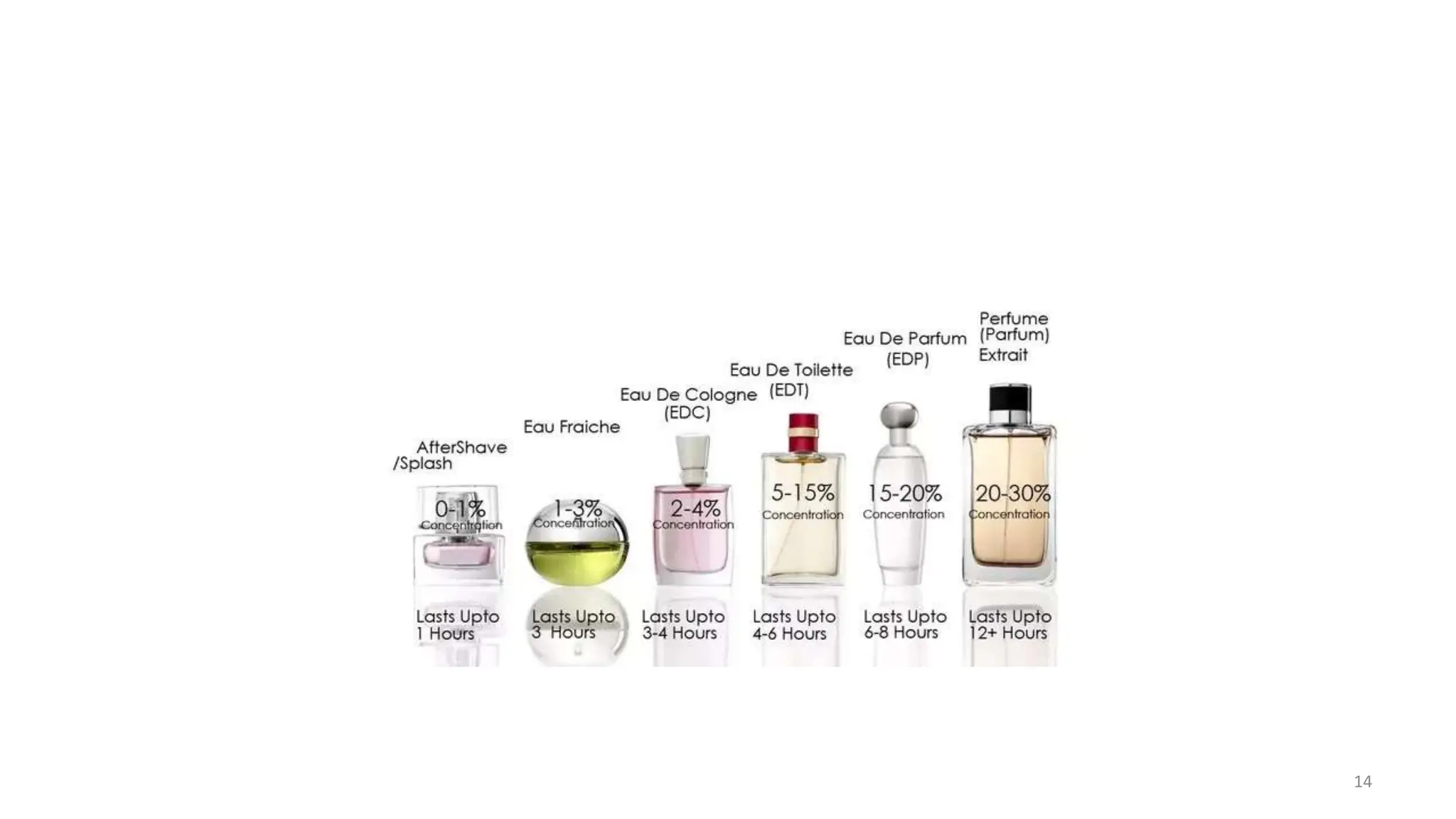
CLASSIFICATION OF PERFUMES
 Perfumes are classified into five major
groups on the basis of concentration of
fragrance and duration of lasting.
 They are,
 Parfume (perfume)
 Eau de parfum (EDP)
 Eau de toilette (EDT)
 Eau de cologne (EDC)
 Eau fraiche (EF)
13
14
 Perfumes can further be classified into following classes:
 Traditional
 Modern
TRADITIONAL:
 Single floral:
Fragrance that are dominated by a scent from one particular flower, in
french called soliflore (eg: serge Lutens’sa Majeste La rose which is
dominated by rose).
 Floral bouquet:
Containing the fragrance of several flowers in a scent.
Eg: Amber, Wood, Leather, Chypre, Fougere.
15
MODERN:
 Bright floral: Fragrance from one or several flowers.
 Green: Fragrance from cut grass or leaf. A light or more modern
interpretation of the chypre type.
 Aquatic: A very clean, modern smell leading to many of the modern
androgynous perfumes. E.g. Christian Dior’s Dune.
 Citrus: Has freshening effect.
 Fruity: Aromas of fruits other than citrus. E.g. Ginestet Botrytis
 Gourmand: Scent with edible or desert like qualities. E.g. Thierry
Mugler’s Angel.
16
AROMATIC SOURCES
Fragrances used in perfume can be found from following sources:
 Plant Source:
Barks, flowers, fruits, leaves, resin, roots, seeds, woods etc.
 Animal Source:
Ambergris, Castoreum, civet, honeycomb, Musk etc.
 Synthetic Source:
Calone, linalool and coumarin (synthesized from terpenes etc.)
17
MANUFACTURING PROCESS
 Perfumes can be manufactured by following
steps:
 Collection
 Extraction
 Blending
 Aging
1.COLLECTION
 Before manufacturing process begins the
sources of suitable fragrances are collected in the
manufacturing centre.
18
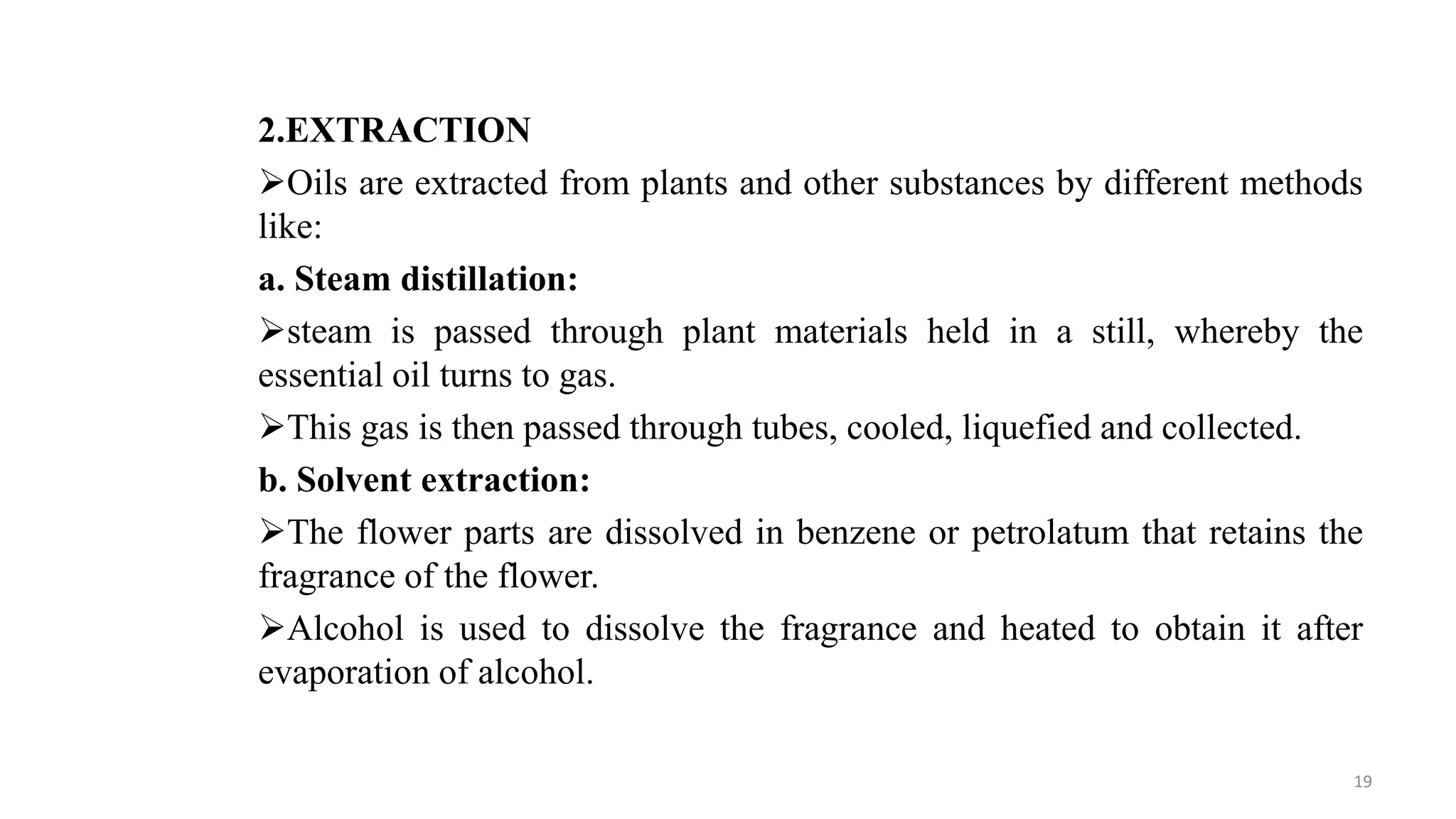
2.EXTRACTION
Oils are extracted from plants and other substances by different methods
like:
a. Steam distillation:
steam is passed through plant materials held in a still, whereby the
essential oil turns to gas.
This gas is then passed through tubes, cooled, liquefied and collected.
b. Solvent extraction:
The flower parts are dissolved in benzene or petrolatum that retains the
fragrance of the flower.
Alcohol is used to dissolve the fragrance and heated to obtain it after
evaporation of alcohol.
19
C. Maceration:
The plant material is soaked in vegetable oil, heated and strained.
This process creates more of infused oil, rather than essential oil.
These produced oils can be used for massage.
d. Expression:
This method is also known as cold pressing.
This process is used to extract volatile oils from citrus fruits such as
lemon, orange, grape fruit etc.
The rinds are separated from the fruit and then pressed.
The result is a watery mixture of essential oil and liquid which will
separate
20
e. Enflurage:
 The enflurage method is called pomade.
 It is a process that uses odorless fats that are solid at room
temperature to capture the fragrant compound exuded by plants.
 The process can be cold enflurage or hot enflurage.
 This method for producing essential oil is not used much any more,
as it is an expensive and time-consuming process.
21
3.BLENDING
Once the perfume oils are collected, they are ready to be blended together
according to a master formula.
After the scent has been created, it is mixed with alcohol.
 Most full perfumes are made of about 10-20% perfume oils dissolved in
alcohol and a trace of water.
4.AGING
 Fine perfume is often aged for several months or even years after
blending to ensure that the correct scent has been achieved.
22
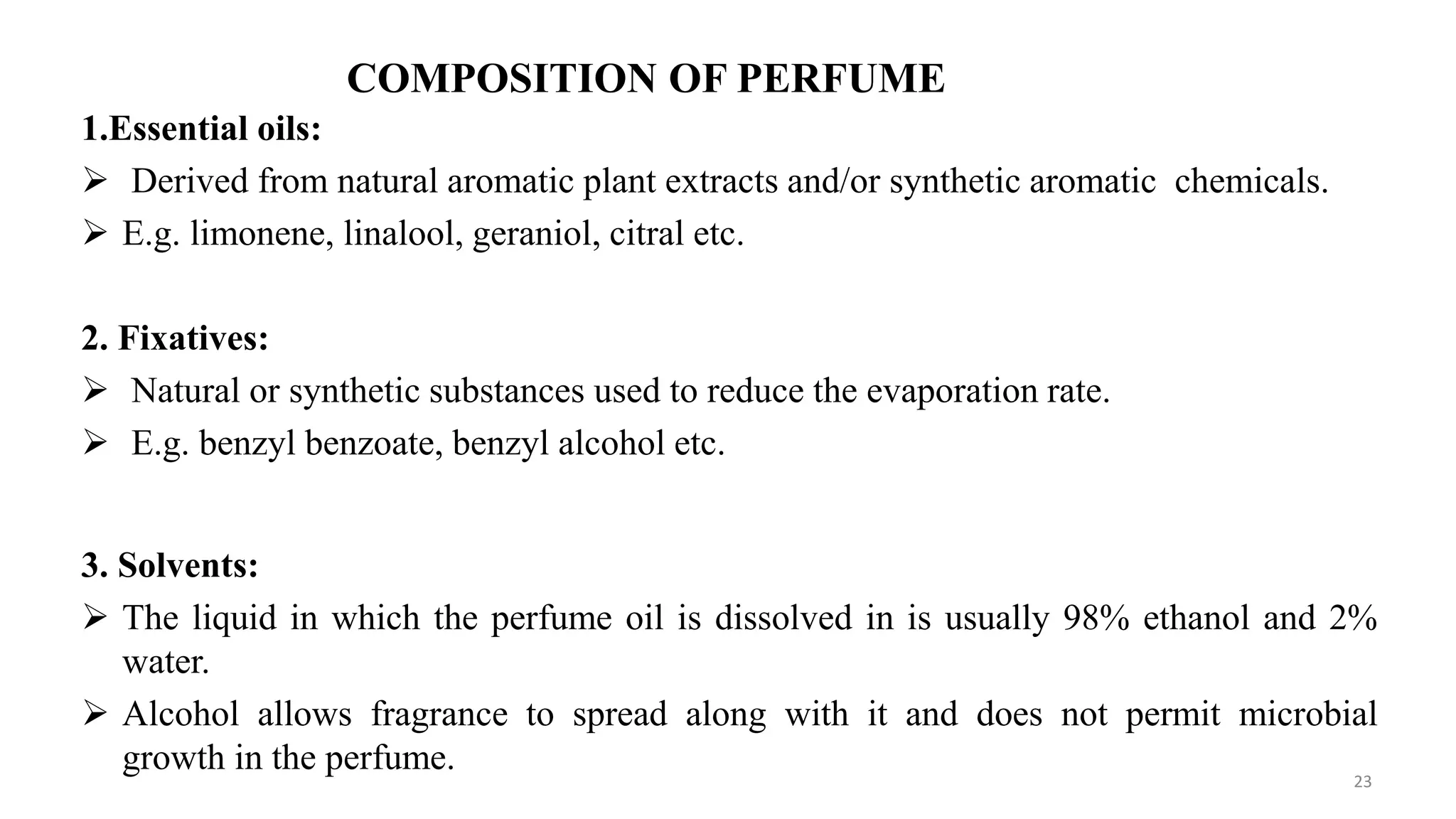
COMPOSITION OF PERFUME
1.Essential oils:
 Derived from natural aromatic plant extracts and/or synthetic aromatic chemicals.
 E.g. limonene, linalool, geraniol, citral etc.
2. Fixatives:
 Natural or synthetic substances used to reduce the evaporation rate.
 E.g. benzyl benzoate, benzyl alcohol etc.
3. Solvents:
 The liquid in which the perfume oil is dissolved in is usually 98% ethanol and 2%
water.
 Alcohol allows fragrance to spread along with it and does not permit microbial
growth in the perfume.
23
FRAGRANCE ALLERGENICITY
 Allergenicity caused by fragrance to the users when added in cosmetic products has
become a key issue and was addressed for the first time in the second meeting of
CHIC ( Cosmetic Harmonization and International Co-Operation).
 The EU representative addressed the issue of fragrance allergenicity, referring to the
SCCNFP (Scientific Committee for Cosmetic Products and Non Food Products)
opinion that fragrances are a leading cause of contact allergy and that 24 fragrance
ingredients were named as the main cause of fragrance allergenicity.
24
FRAGRANCE ALLERGEN REQUIREMENTS IN THE EU UPDATED
 Annex III of EU Cosmetic Regulation 1223/2009 currently lists 26 allergens, all of
which must be listed in the ingredients list on the label or packaging of a product if
they are present in concentrations greater than 0.001% in leave-on products and
0.01% inrinse-off products.
In 2011, the Scientific Committee on Consumer Safety (SCCS) published an opinion
on fragrance allergens in cosmetic products (SCCS/1459/11). In response to the
SCCS opinion, the European Commission published a public consultation on
fragrance allergens. The deadline for comments was 14 May 2014.
25
FRAGRANCE ALLERGENS
 All cosmetics that contain any fragrances will have the word ‘parfum’ in
the ingredients list.
 Fragrance ingredients are tested to assess how likely they are to cause skin
reactions.
 There are 26 fragrance ingredients, listed that are considered more likely to
cause reactions in susceptible people.
 These must be indicated in the list of ingredients, in addition to the word
‘parfum’.
 Their concentration should not exceeds 0.001% in leave-on products (e.g. a
moisturiser) and 0.01% in rinse-off products (e.g. a shampoo).
26
 This way of labelling cosmetics was introduced in 2005 to help people to
make informed choices about what they buy, particularly if they have a
diagnosed allergy to a specific fragrance ingredient.
 Such labelling will also aid dermatologists trying to identify the cause of a
patient’s reaction.
27
• Amyl cinnamal
• Anise alcohol
• Benzyl alcohol
• Benzyl cinnamate
• Cinnamyl alcohol
• Linalool
• Hydroxycitronellal
• Benzyl benzoate
• Isoeugenol
• Citronellol
• Amylcinnamyl alcohol
• Hexyl cinnamal
• Benzyl salicylate
• Limonene
• Farnesol
• Citral
• Butylphenyl
methylpropional
• Eugenol
• Cinnamal
• Methyl 2-octynoate
• Coumarin
• Alpha-Isomethyl ionone
• Geraniol
• Evernia prunastri
• Hydroxyisohexyl 3-
cyclohexene
• Evernia furfuracea
• carboxaldehyde
28
INCI name (International Nomenclature of Cosmetic Ingredients)
INGREDIENTS CAUSING ALLERGIC REACTIONS
29
STORAGE OF PERFUMES
• Fragrance compounds in perfumes will degrade or break down if improperly stored
in the presence of heat, light and oxygen.
• Perfumes are best preserved when kept in light tight aluminium bottles or in their
original packaging when not in use.
• Refrigerated at relatively low temperature between 3 – 7ºC.
• Sprays has an advantage of isolating fragrance inside a bottle and preventing it from
mixing with dust, skin, and detritus which would degrade and alter the quality of
perfume.
30
REFERENCES
1. Text book of cosmetics, Rajesh Kumar Nema, et al, First edition:2009, CBS
Publishers & Distributors, Pg:no:213-223.
2. Cosmetic Technology, Sanju Nanda et al, Reprint edition 2016-2017, Birla
Publications Pvt, Ltd. Pg:no:86-104, 366.
3. Poucher’s perfumes, cosmetics and soap, 10th edition, Edited by Hilda
Butler, Kluwer Academic Publishers,
4. http://www.sgs.com/en/news/2015/04/fragrance-allergen-requirements-in-
the-eu-updated
5. http://www.thefactsabout.co.uk/files/237201013545Allergy_Card.pdf
6. https://www.prevention.com/beauty/natural-beauty/10-controversial-
ingredients-in-your-beauty-products/slide/3
31
THANK YOU FOR
YOUR PATIENCE
32

Perfume ingredients listed as allergens in EU regulation.pptx

  • 1.
    PRESENTED BY: PRUTHWIRAJ DASH M.PharmFirst Year Department Of Pharmaceutics Gitam School of Pharmacy,Vizag REGD NO- VP22PHAR0100017 1 PERFUMES
  • 2.
    CONTENTS Perfumes:  Classification ofperfumes,  Perfume ingredients listed as allergens in EU regulation. 2
  • 3.
    WHAT IS PERFUME Perfume is a mixture of fragrant essential oils or aromatic compounds, fixatives and solvents used to give the human body, animal, food objects and living spaces a pleasant scent.  It is usually in liquid form and used to give a pleasant scent to a person's body.  Perfumes are supposed to release a continuous pleasant fragrance that will provide a long lasting feeling of freshness.  Initially it was only used for religious purpose but now it has become an ornament of sophistication for both men and women. 3
  • 4.
  • 5.
    HISTORY OF PERFUMES The Egyptians were the first who used perfume for personal enjoyment, but the production of perfume was reserved for the priests and they used it in religious purpose.  The Greek used an extraordinary amount of perfume and for each part of the body they used a different fragrance for hygiene and cult of the body.  The oldest perfumery was discovered on the island of Cyprus 4,000 years ago indicating that perfume manufacturing was on an industrial scale.  The Hungarians introduced the first modern perfume, made of scented oils blended in an alcohol solution at the command of Queen Elizabeth of Hungary. 5
  • 6.
     France isthe birthplace of modern perfumery. France provided to grow aromatic plants for perfume industry with raw materials.  Even today, France remains the centre of the European perfume design and trade.  England and Germany also contributed a lot in modernization of perfumery. ADVANTAGES  Wafting fragrance of a well-perfumed person.  Smell more pleasing.  Prevents from bad odour due to sweat. 6
  • 7.
  • 8.
    DISADVANTAGES  Some VOCs,such as formaldehyde, ethanol, and d-limonene, cause eye, nose, and throat irritation, difficulty in breathing, allergy symptoms and headaches.  Chemicals may irritate others, especially in tight spaces.  Contact dermatitis, an allergic reaction in the skin can occur.  Diethyl phthalate (DEP) an irritant and suspected hormone disruptor that is absorbed through the skin and can accumulate in human fat tissue. 8
  • 9.
    NOTES IN PERFUME Perfume is described in a musical metaphor as having three sets of notes, making the harmonious scent accord.  These notes are created carefully with knowledge of the evaporation process of the perfume.  The three notes are: a. Top notes b. Middle notes c. Base notes  Each of these levels, however, has its own primary purpose. 9
  • 10.
    Top Notes:  Theyare generally the lightest of all notes and recognized immediately after application. Top notes consist of small, light molecules with high volatility that evaporate quickly.  Common fragrances of top notes include citrus (lemon, orange zest), light fruits (grape, berries) and herbs (clary sage, lavender). 10
  • 11.
    Middle Notes:  Themiddle notes, or the heart notes, make an appearance once the top notes evaporate.  The middle note compounds form the "heart" or main body of a perfume and act to mask the often unpleasant initial impression of base notes, which become more pleasant with time.  Common fragrances of middle notes includes rose, lemon, lavender, nutmeg and jasmine. 11
  • 12.
    Base Notes:  Basenotes or bottom or dry notes appear while middle notes are fading.  The base and middle notes together are the main theme of a perfume.  Base notes bring depth and solidity to a perfume.  Common fragrances of base notes include sandalwood, vanilla, amber and musk. 12
  • 13.
    CLASSIFICATION OF PERFUMES Perfumes are classified into five major groups on the basis of concentration of fragrance and duration of lasting.  They are,  Parfume (perfume)  Eau de parfum (EDP)  Eau de toilette (EDT)  Eau de cologne (EDC)  Eau fraiche (EF) 13
  • 14.
  • 15.
     Perfumes canfurther be classified into following classes:  Traditional  Modern TRADITIONAL:  Single floral: Fragrance that are dominated by a scent from one particular flower, in french called soliflore (eg: serge Lutens’sa Majeste La rose which is dominated by rose).  Floral bouquet: Containing the fragrance of several flowers in a scent. Eg: Amber, Wood, Leather, Chypre, Fougere. 15
  • 16.
    MODERN:  Bright floral:Fragrance from one or several flowers.  Green: Fragrance from cut grass or leaf. A light or more modern interpretation of the chypre type.  Aquatic: A very clean, modern smell leading to many of the modern androgynous perfumes. E.g. Christian Dior’s Dune.  Citrus: Has freshening effect.  Fruity: Aromas of fruits other than citrus. E.g. Ginestet Botrytis  Gourmand: Scent with edible or desert like qualities. E.g. Thierry Mugler’s Angel. 16
  • 17.
    AROMATIC SOURCES Fragrances usedin perfume can be found from following sources:  Plant Source: Barks, flowers, fruits, leaves, resin, roots, seeds, woods etc.  Animal Source: Ambergris, Castoreum, civet, honeycomb, Musk etc.  Synthetic Source: Calone, linalool and coumarin (synthesized from terpenes etc.) 17
  • 18.
    MANUFACTURING PROCESS  Perfumescan be manufactured by following steps:  Collection  Extraction  Blending  Aging 1.COLLECTION  Before manufacturing process begins the sources of suitable fragrances are collected in the manufacturing centre. 18
  • 19.
    2.EXTRACTION Oils are extractedfrom plants and other substances by different methods like: a. Steam distillation: steam is passed through plant materials held in a still, whereby the essential oil turns to gas. This gas is then passed through tubes, cooled, liquefied and collected. b. Solvent extraction: The flower parts are dissolved in benzene or petrolatum that retains the fragrance of the flower. Alcohol is used to dissolve the fragrance and heated to obtain it after evaporation of alcohol. 19
  • 20.
    C. Maceration: The plantmaterial is soaked in vegetable oil, heated and strained. This process creates more of infused oil, rather than essential oil. These produced oils can be used for massage. d. Expression: This method is also known as cold pressing. This process is used to extract volatile oils from citrus fruits such as lemon, orange, grape fruit etc. The rinds are separated from the fruit and then pressed. The result is a watery mixture of essential oil and liquid which will separate 20
  • 21.
    e. Enflurage:  Theenflurage method is called pomade.  It is a process that uses odorless fats that are solid at room temperature to capture the fragrant compound exuded by plants.  The process can be cold enflurage or hot enflurage.  This method for producing essential oil is not used much any more, as it is an expensive and time-consuming process. 21
  • 22.
    3.BLENDING Once the perfumeoils are collected, they are ready to be blended together according to a master formula. After the scent has been created, it is mixed with alcohol.  Most full perfumes are made of about 10-20% perfume oils dissolved in alcohol and a trace of water. 4.AGING  Fine perfume is often aged for several months or even years after blending to ensure that the correct scent has been achieved. 22
  • 23.
    COMPOSITION OF PERFUME 1.Essentialoils:  Derived from natural aromatic plant extracts and/or synthetic aromatic chemicals.  E.g. limonene, linalool, geraniol, citral etc. 2. Fixatives:  Natural or synthetic substances used to reduce the evaporation rate.  E.g. benzyl benzoate, benzyl alcohol etc. 3. Solvents:  The liquid in which the perfume oil is dissolved in is usually 98% ethanol and 2% water.  Alcohol allows fragrance to spread along with it and does not permit microbial growth in the perfume. 23
  • 24.
    FRAGRANCE ALLERGENICITY  Allergenicitycaused by fragrance to the users when added in cosmetic products has become a key issue and was addressed for the first time in the second meeting of CHIC ( Cosmetic Harmonization and International Co-Operation).  The EU representative addressed the issue of fragrance allergenicity, referring to the SCCNFP (Scientific Committee for Cosmetic Products and Non Food Products) opinion that fragrances are a leading cause of contact allergy and that 24 fragrance ingredients were named as the main cause of fragrance allergenicity. 24
  • 25.
    FRAGRANCE ALLERGEN REQUIREMENTSIN THE EU UPDATED  Annex III of EU Cosmetic Regulation 1223/2009 currently lists 26 allergens, all of which must be listed in the ingredients list on the label or packaging of a product if they are present in concentrations greater than 0.001% in leave-on products and 0.01% inrinse-off products. In 2011, the Scientific Committee on Consumer Safety (SCCS) published an opinion on fragrance allergens in cosmetic products (SCCS/1459/11). In response to the SCCS opinion, the European Commission published a public consultation on fragrance allergens. The deadline for comments was 14 May 2014. 25
  • 26.
    FRAGRANCE ALLERGENS  Allcosmetics that contain any fragrances will have the word ‘parfum’ in the ingredients list.  Fragrance ingredients are tested to assess how likely they are to cause skin reactions.  There are 26 fragrance ingredients, listed that are considered more likely to cause reactions in susceptible people.  These must be indicated in the list of ingredients, in addition to the word ‘parfum’.  Their concentration should not exceeds 0.001% in leave-on products (e.g. a moisturiser) and 0.01% in rinse-off products (e.g. a shampoo). 26
  • 27.
     This wayof labelling cosmetics was introduced in 2005 to help people to make informed choices about what they buy, particularly if they have a diagnosed allergy to a specific fragrance ingredient.  Such labelling will also aid dermatologists trying to identify the cause of a patient’s reaction. 27
  • 28.
    • Amyl cinnamal •Anise alcohol • Benzyl alcohol • Benzyl cinnamate • Cinnamyl alcohol • Linalool • Hydroxycitronellal • Benzyl benzoate • Isoeugenol • Citronellol • Amylcinnamyl alcohol • Hexyl cinnamal • Benzyl salicylate • Limonene • Farnesol • Citral • Butylphenyl methylpropional • Eugenol • Cinnamal • Methyl 2-octynoate • Coumarin • Alpha-Isomethyl ionone • Geraniol • Evernia prunastri • Hydroxyisohexyl 3- cyclohexene • Evernia furfuracea • carboxaldehyde 28 INCI name (International Nomenclature of Cosmetic Ingredients)
  • 29.
  • 30.
    STORAGE OF PERFUMES •Fragrance compounds in perfumes will degrade or break down if improperly stored in the presence of heat, light and oxygen. • Perfumes are best preserved when kept in light tight aluminium bottles or in their original packaging when not in use. • Refrigerated at relatively low temperature between 3 – 7ºC. • Sprays has an advantage of isolating fragrance inside a bottle and preventing it from mixing with dust, skin, and detritus which would degrade and alter the quality of perfume. 30
  • 31.
    REFERENCES 1. Text bookof cosmetics, Rajesh Kumar Nema, et al, First edition:2009, CBS Publishers & Distributors, Pg:no:213-223. 2. Cosmetic Technology, Sanju Nanda et al, Reprint edition 2016-2017, Birla Publications Pvt, Ltd. Pg:no:86-104, 366. 3. Poucher’s perfumes, cosmetics and soap, 10th edition, Edited by Hilda Butler, Kluwer Academic Publishers, 4. http://www.sgs.com/en/news/2015/04/fragrance-allergen-requirements-in- the-eu-updated 5. http://www.thefactsabout.co.uk/files/237201013545Allergy_Card.pdf 6. https://www.prevention.com/beauty/natural-beauty/10-controversial- ingredients-in-your-beauty-products/slide/3 31
  • 32.
    THANK YOU FOR YOURPATIENCE 32