
Most frequency distributions exhibit a central tendency
ie:- a shape such that the bulk of the observations pile
up in the area between 2 extremes. There are 3
principal measures of central tendency:1. Mean
2. Median
3. Mode
Mean
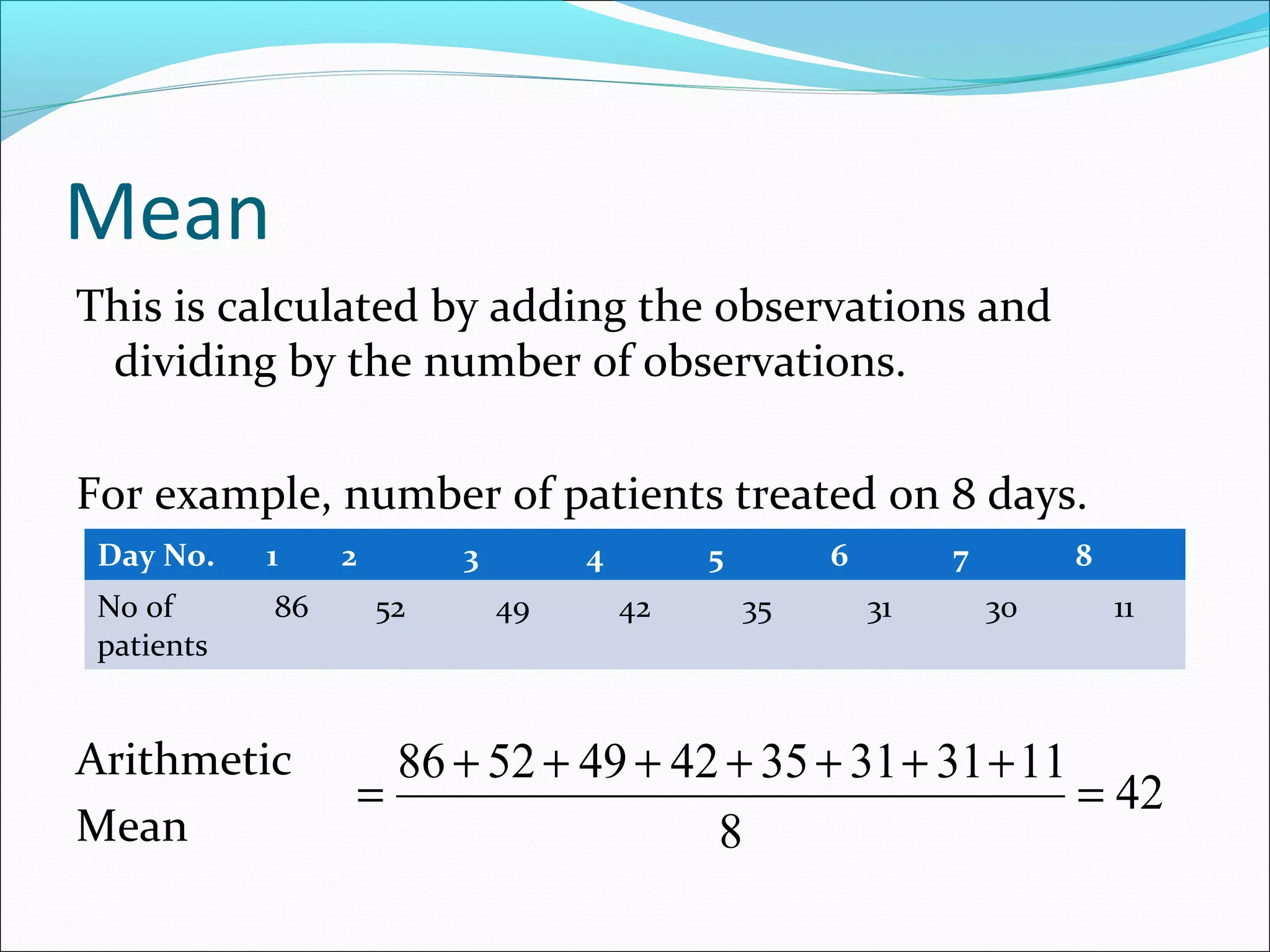
This is calculated by adding the observations and
dividing by the number of observations.
For example, number of patients treated on 8 days.
Day No.

1

No of
patients

86

Arithmetic
Mean

2

3
52

4
49

5
42

6
35

7
31

8
30

11

86 + 52 + 49 + 42 + 35 + 31 + 31 + 11
=
= 42
8
Median
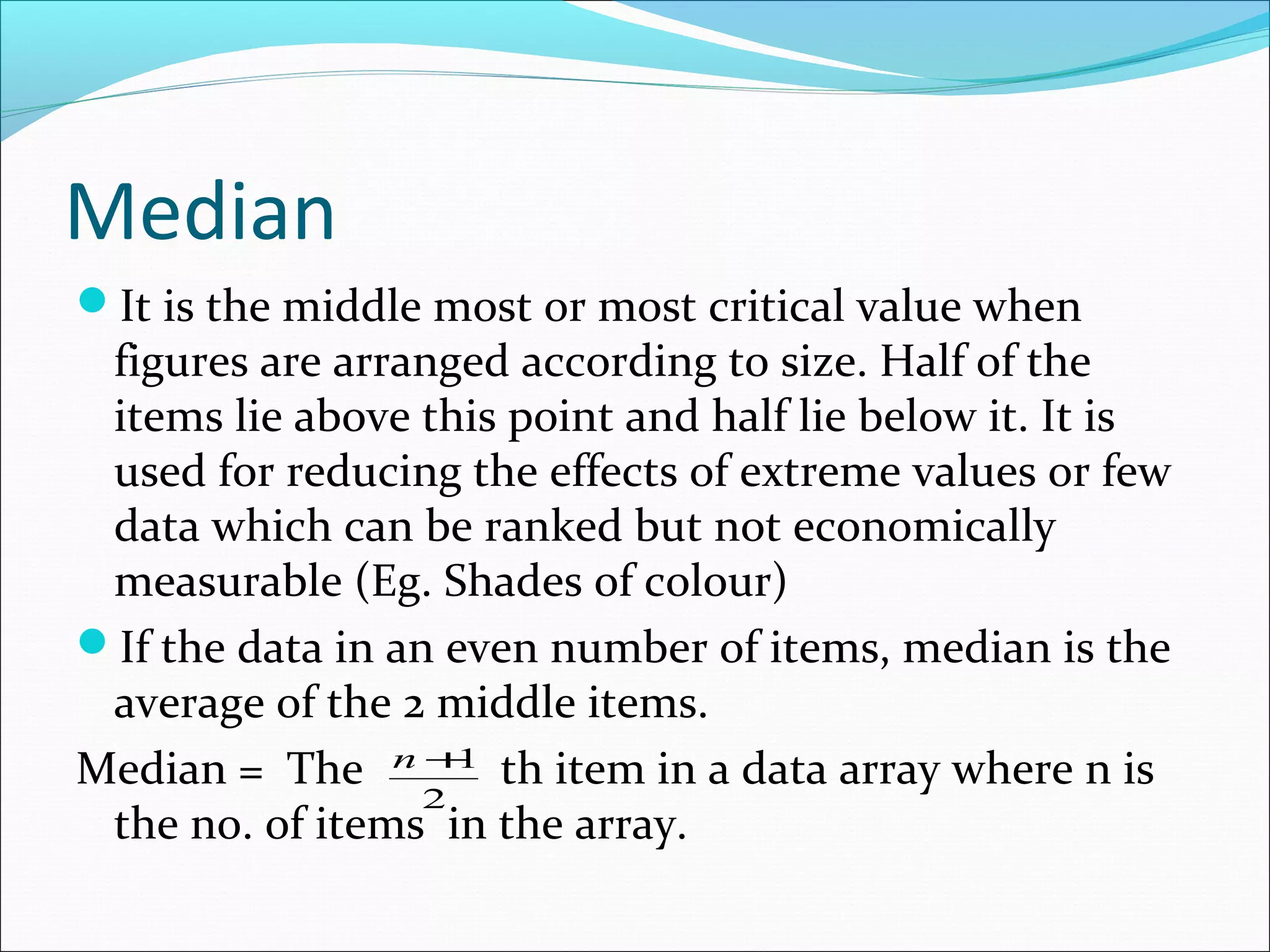
It is the middle most or most critical value when

figures are arranged according to size. Half of the
items lie above this point and half lie below it. It is
used for reducing the effects of extreme values or few
data which can be ranked but not economically
measurable (Eg. Shades of colour)
If the data in an even number of items, median is the
average of the 2 middle items.
1
Median = The n + th item in a data array where n is
2
the no. of items in the array.
Examples
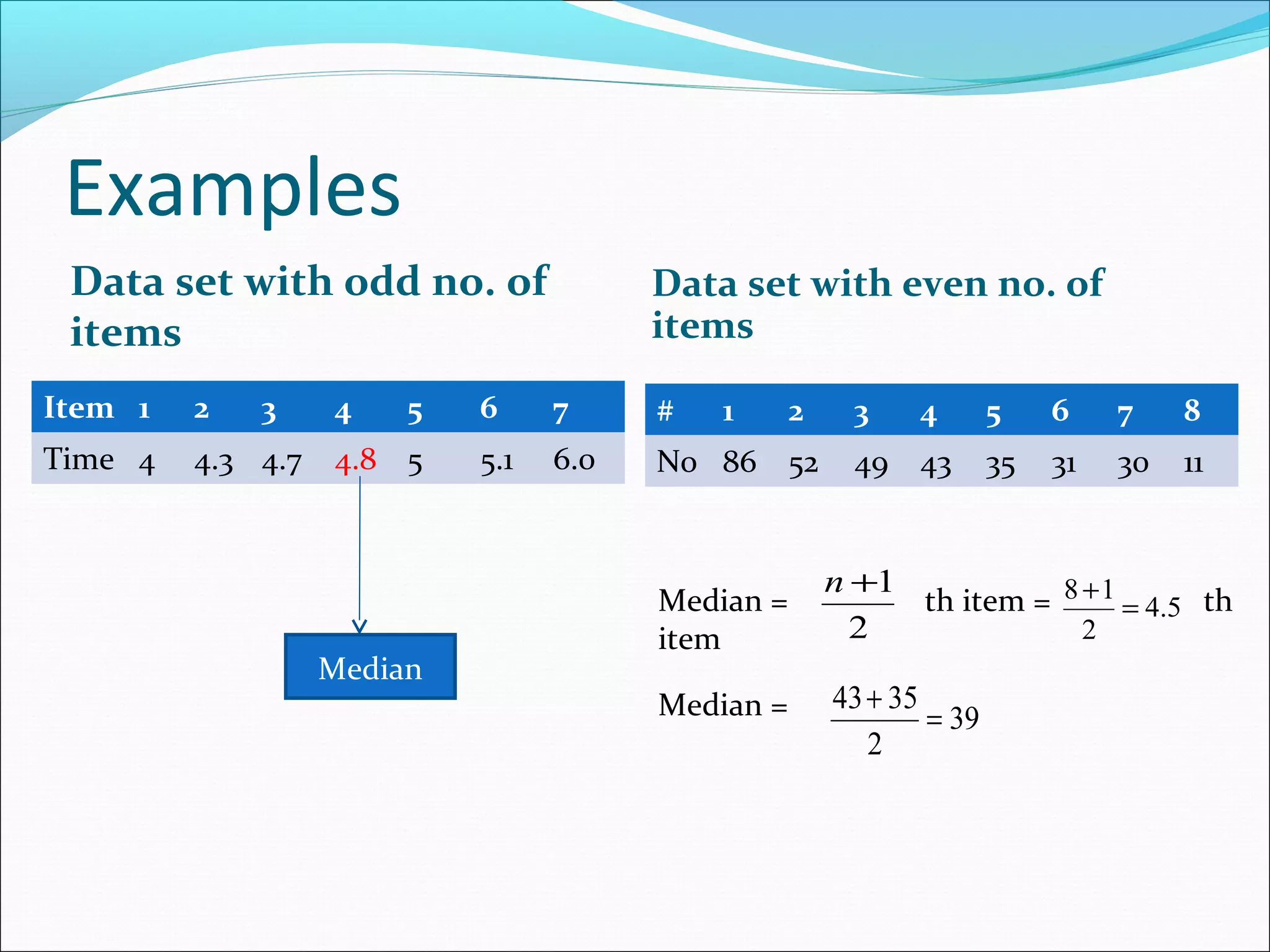
Data set with odd no. of
items
Item 1

2

3

Time 4

4.3 4.7

4

5

4.8 5

Median

Data set with even no. of
items

6

7

#

5.1

6.0

No 86 52

1

Median =
item
Median =

2

3

4

49 43

5

6

7

8

35

31

30

11

n +1
th item = 8 + 1 = 4.5 th
2
2
43 + 35
= 39
2
Mode
It is the value which occurs most often in data set.
It is the value which is used for severely skewed
distributions, describing irregular situations where 2
peaks are found or for eliminating the effect of
extreme values.
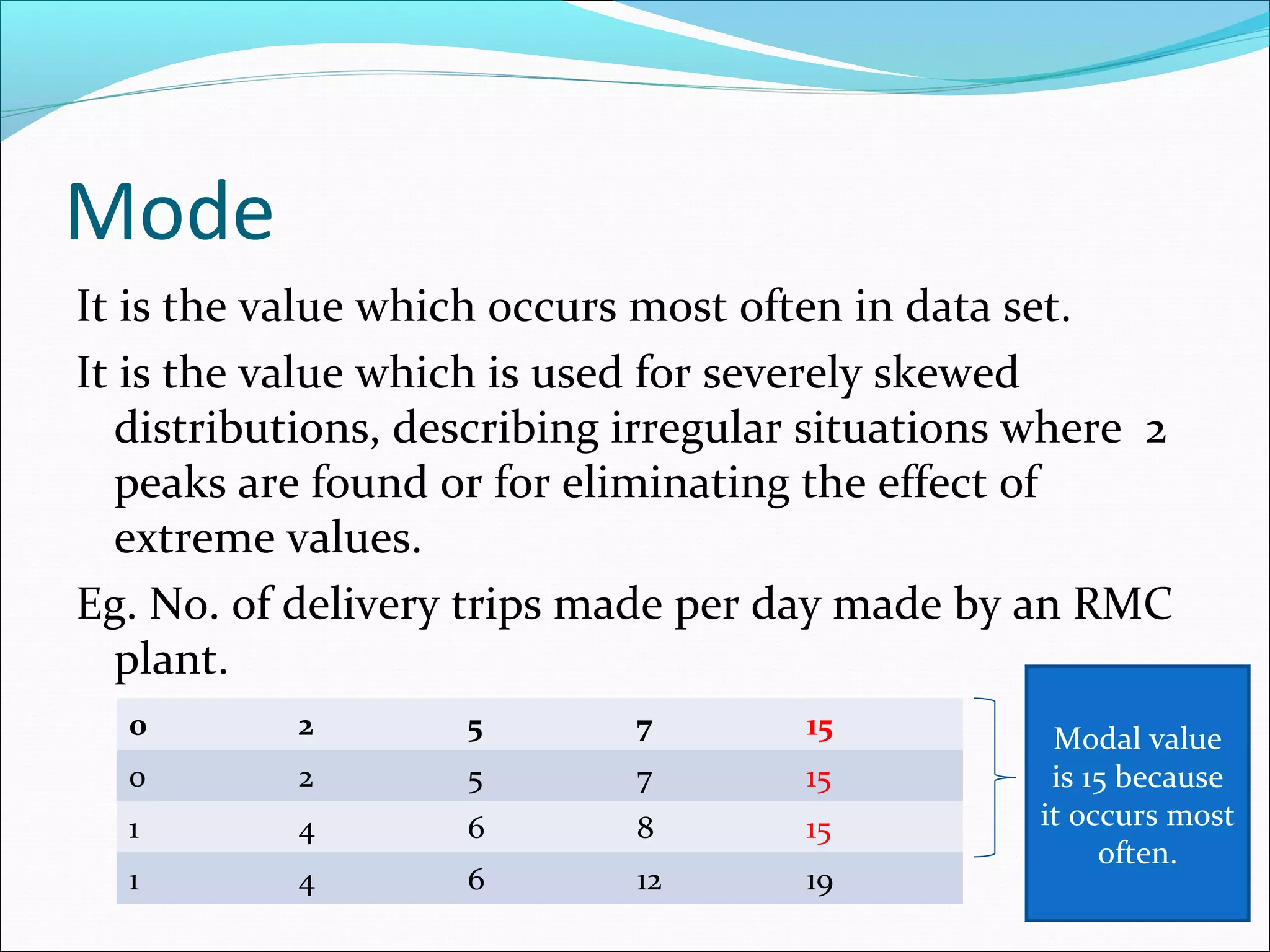
Eg. No. of delivery trips made per day made by an RMC
plant.
0

2

5

7

15

0

2

5

7

15

1

4

6

8

15

1

4

6

12

19

Modal value
is 15 because
it occurs most
often.
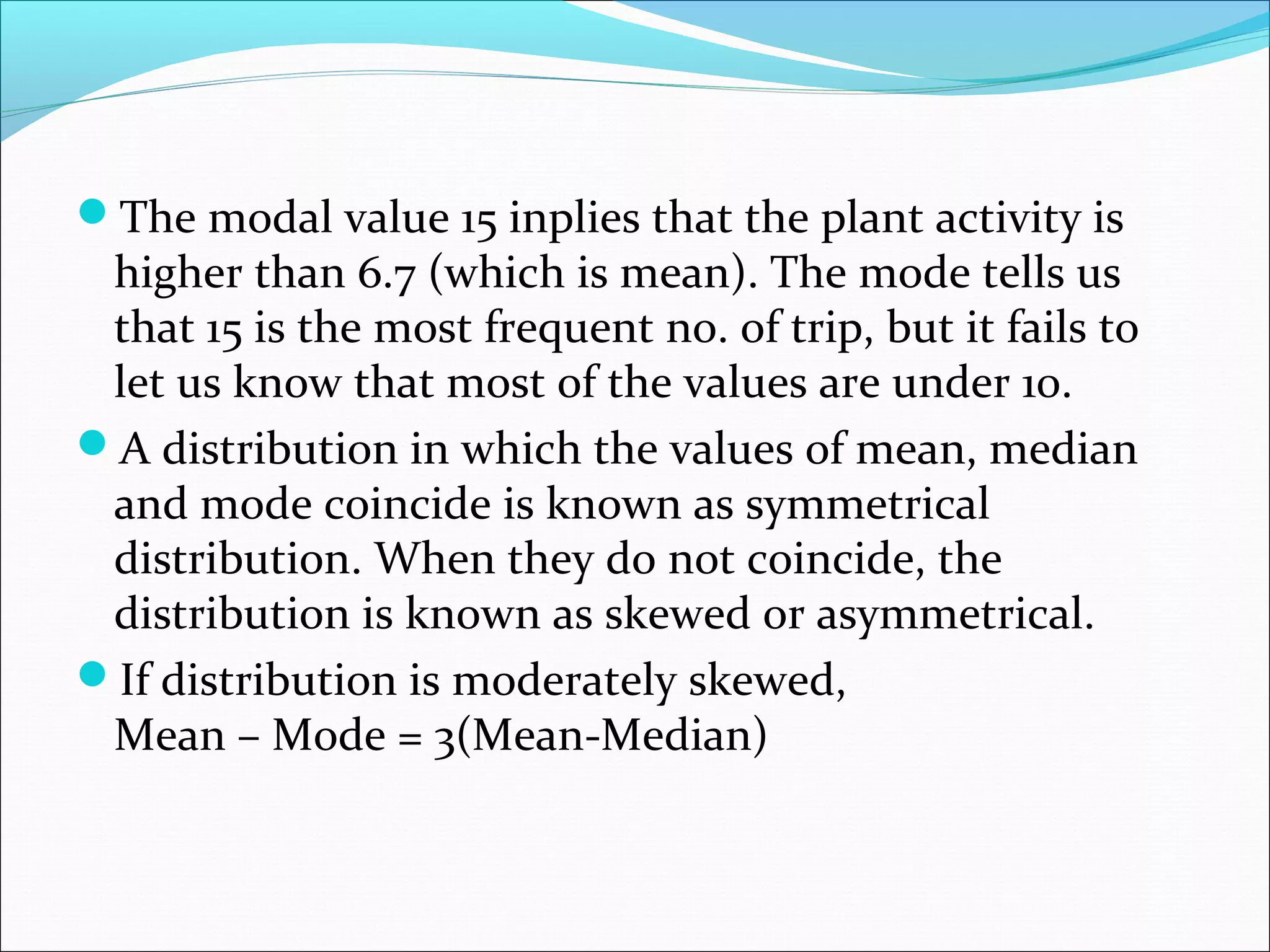
The modal value 15 inplies that the plant activity is

higher than 6.7 (which is mean). The mode tells us
that 15 is the most frequent no. of trip, but it fails to
let us know that most of the values are under 10.
A distribution in which the values of mean, median
and mode coincide is known as symmetrical
distribution. When they do not coincide, the
distribution is known as skewed or asymmetrical.
If distribution is moderately skewed,
Mean – Mode = 3(Mean-Median)
Dispersion
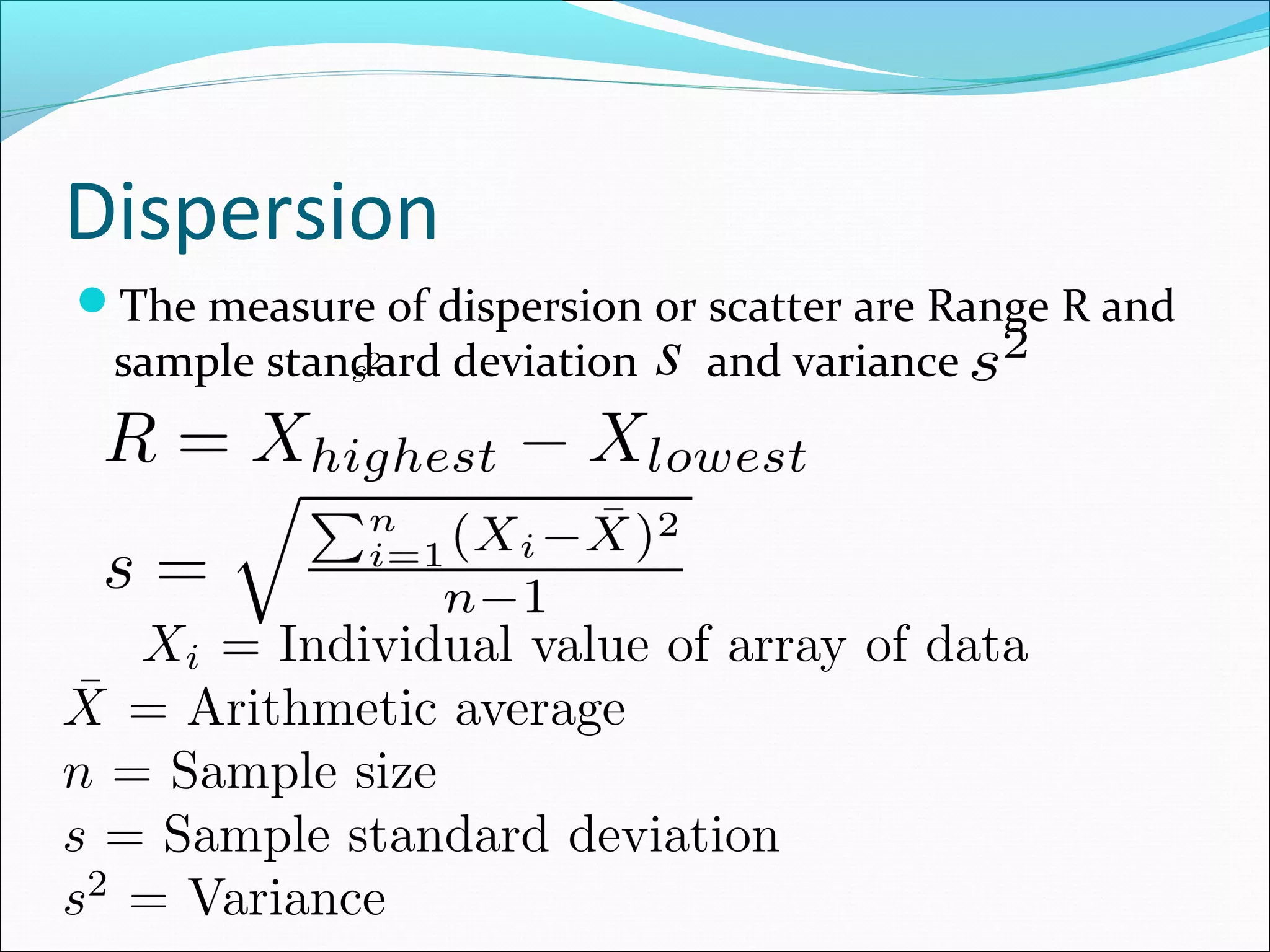
The measure of dispersion or scatter are Range R and

sample standard deviation

s

and variance
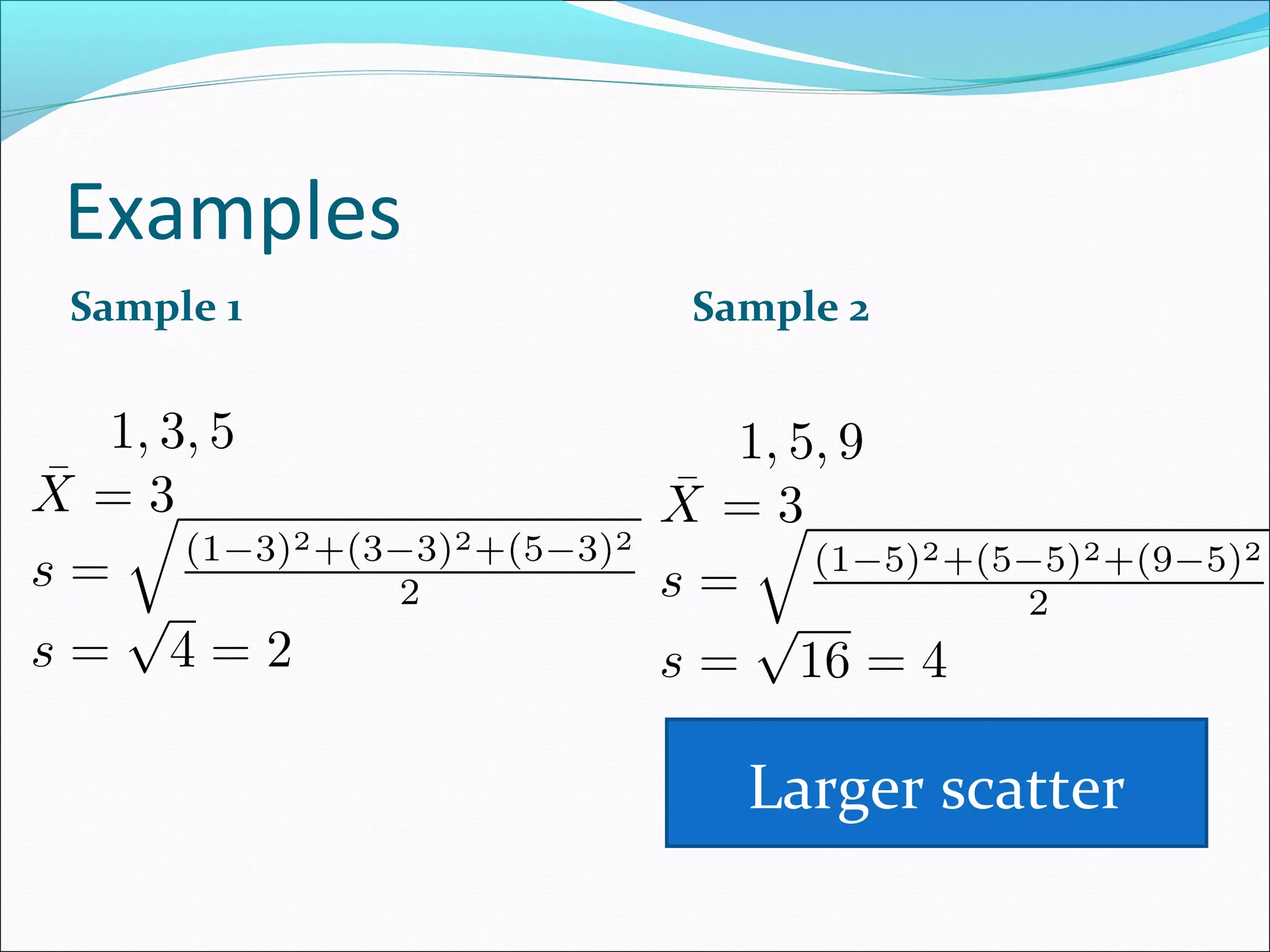
Examples
Sample 1

Sample 2

Larger scatter
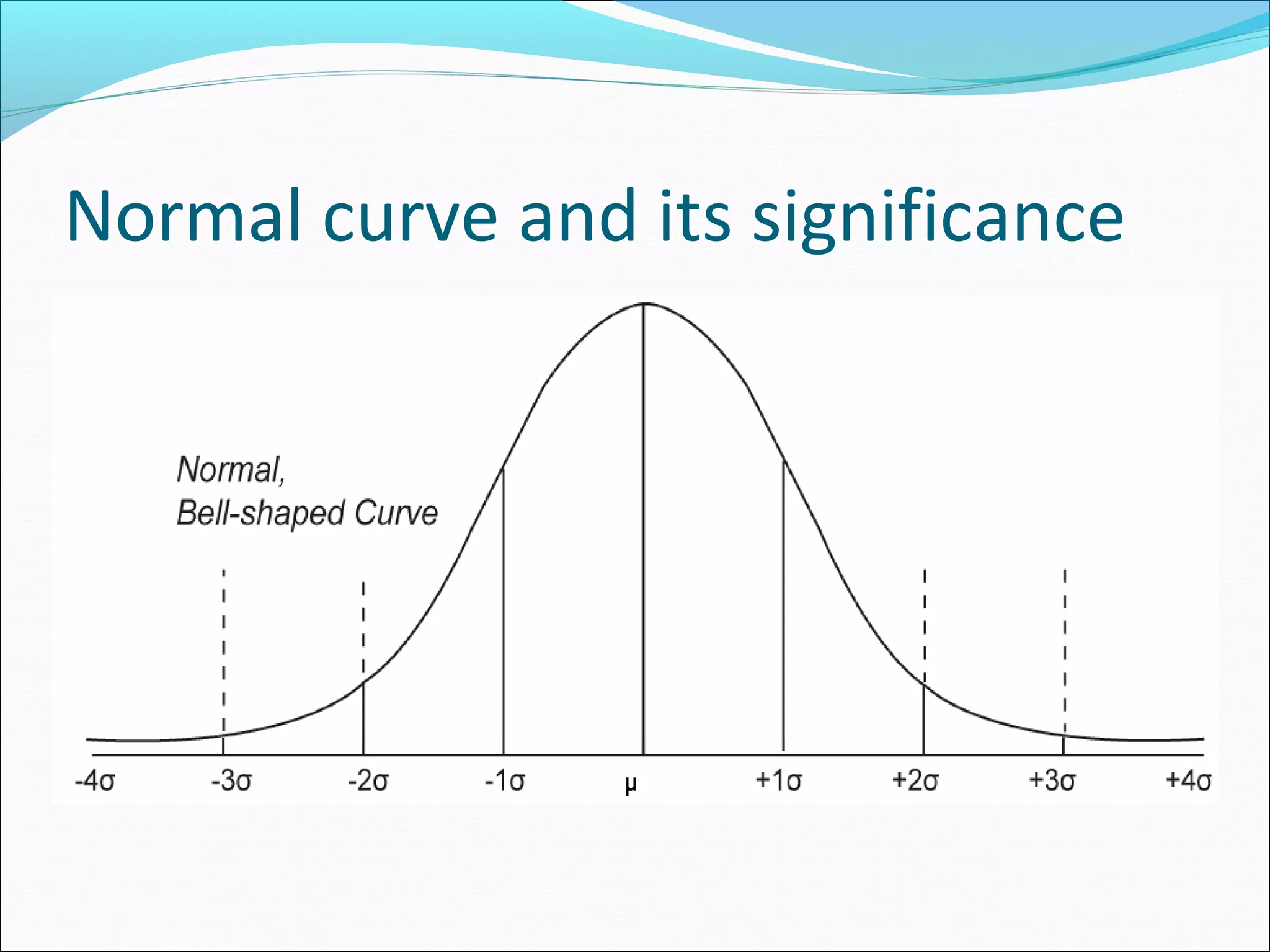
Normal curve and its significance
Much of the variation in nature and industry follows

the normal curve (Gaussian curve). It is the bell
shaped, symmetrical form as above. Although most of
the area is covered within the limits
, the
curve extends from -∞ to +∞.
Variation in height of human beings, variation of
weight of elements, life of 60W bulbs etc are expected
to follow the normal curve.
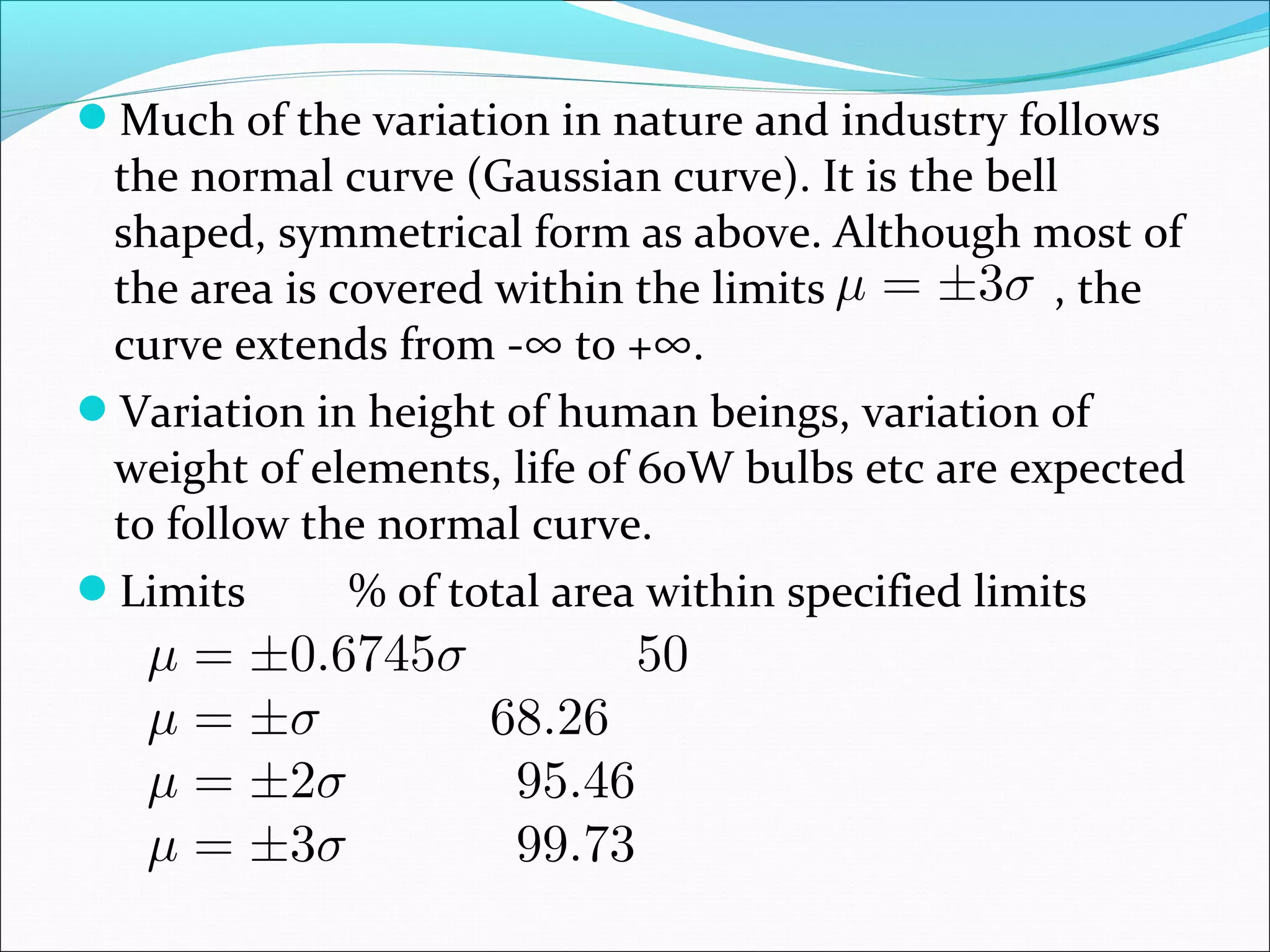
Limits
% of total area within specified limits
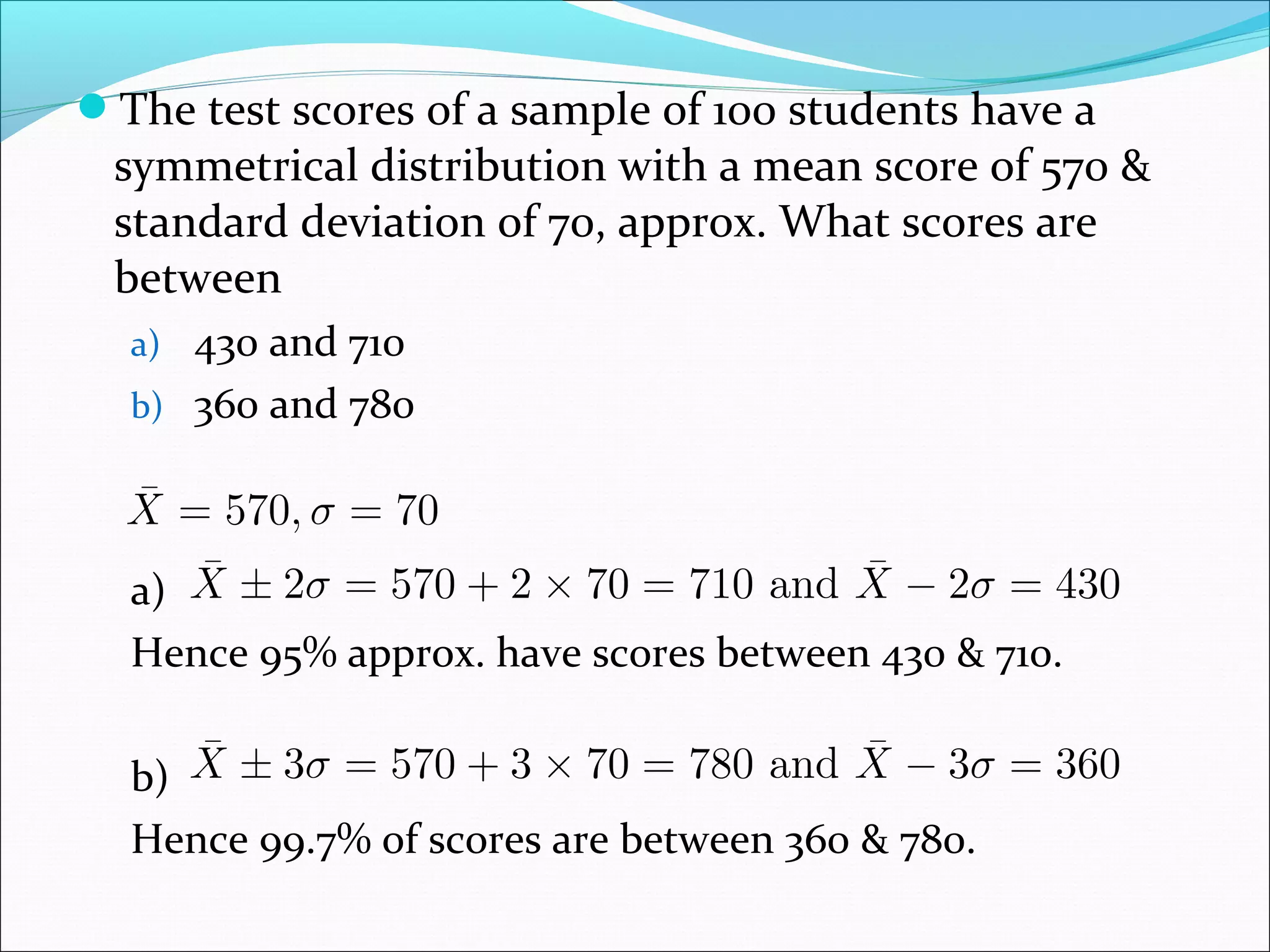
The test scores of a sample of 100 students have a

symmetrical distribution with a mean score of 570 &
standard deviation of 70, approx. What scores are
between
a) 430 and 710
b) 360 and 780

a)
Hence 95% approx. have scores between 430 & 710.
b)
Hence 99.7% of scores are between 360 & 780.
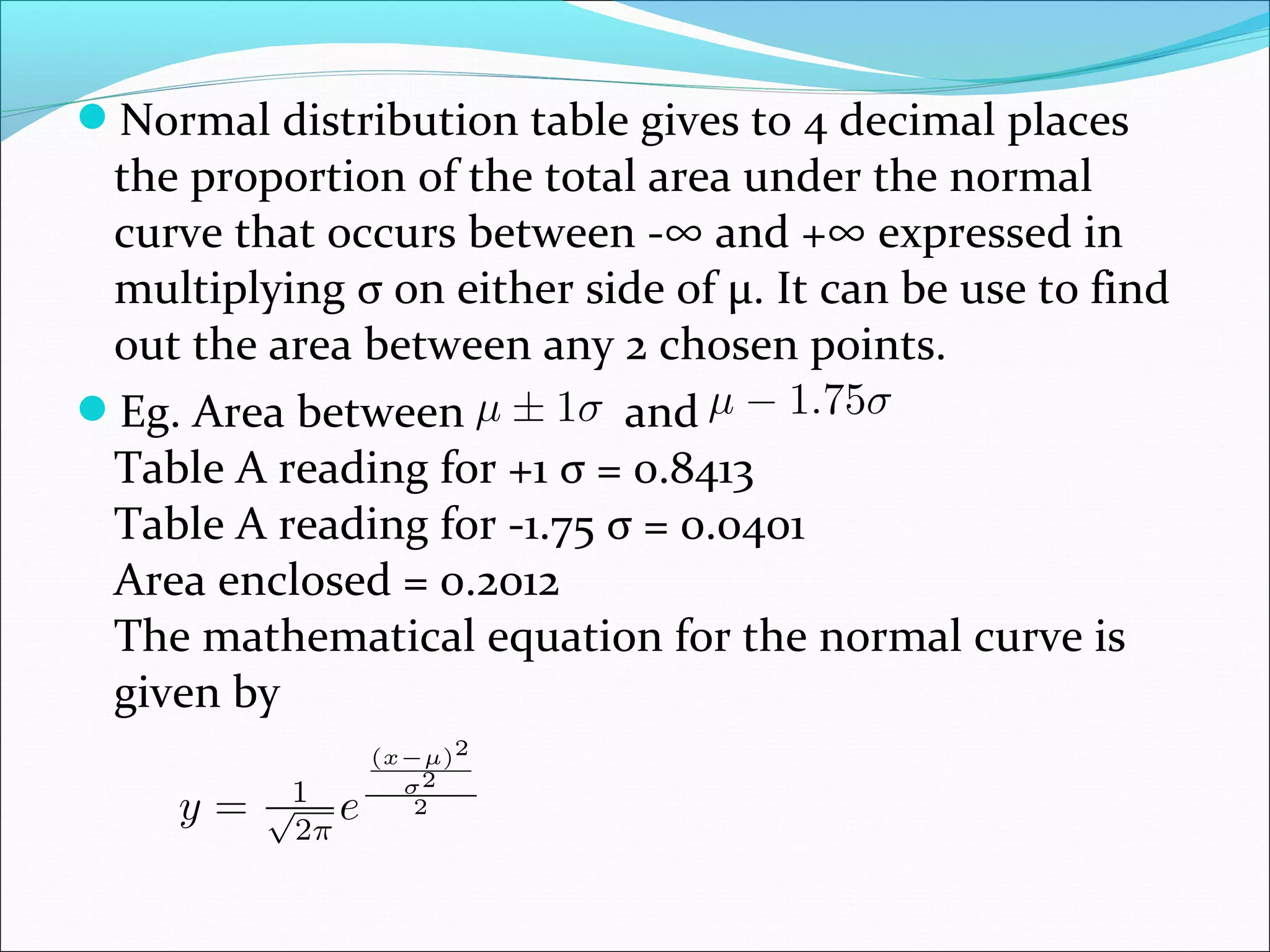
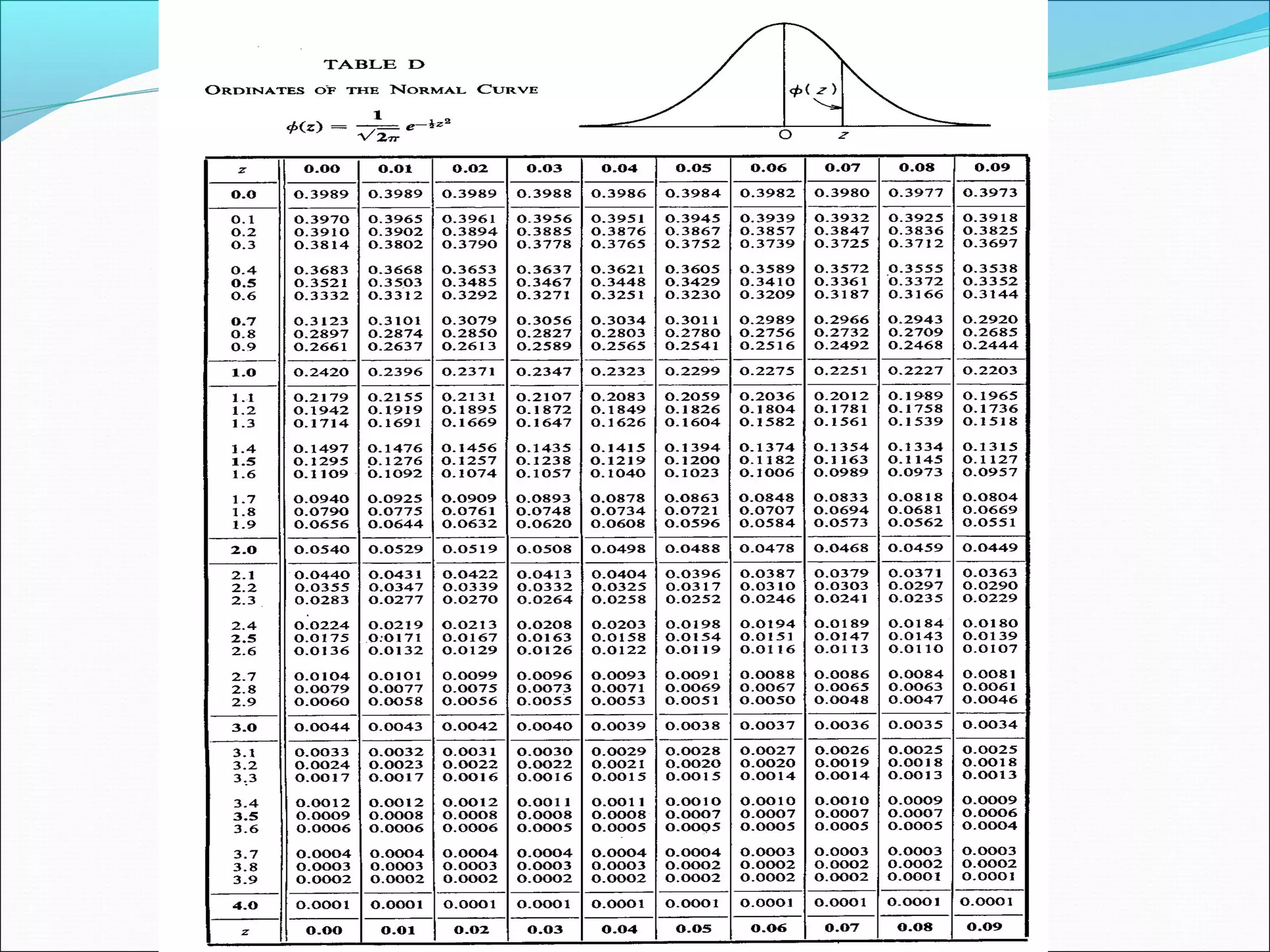
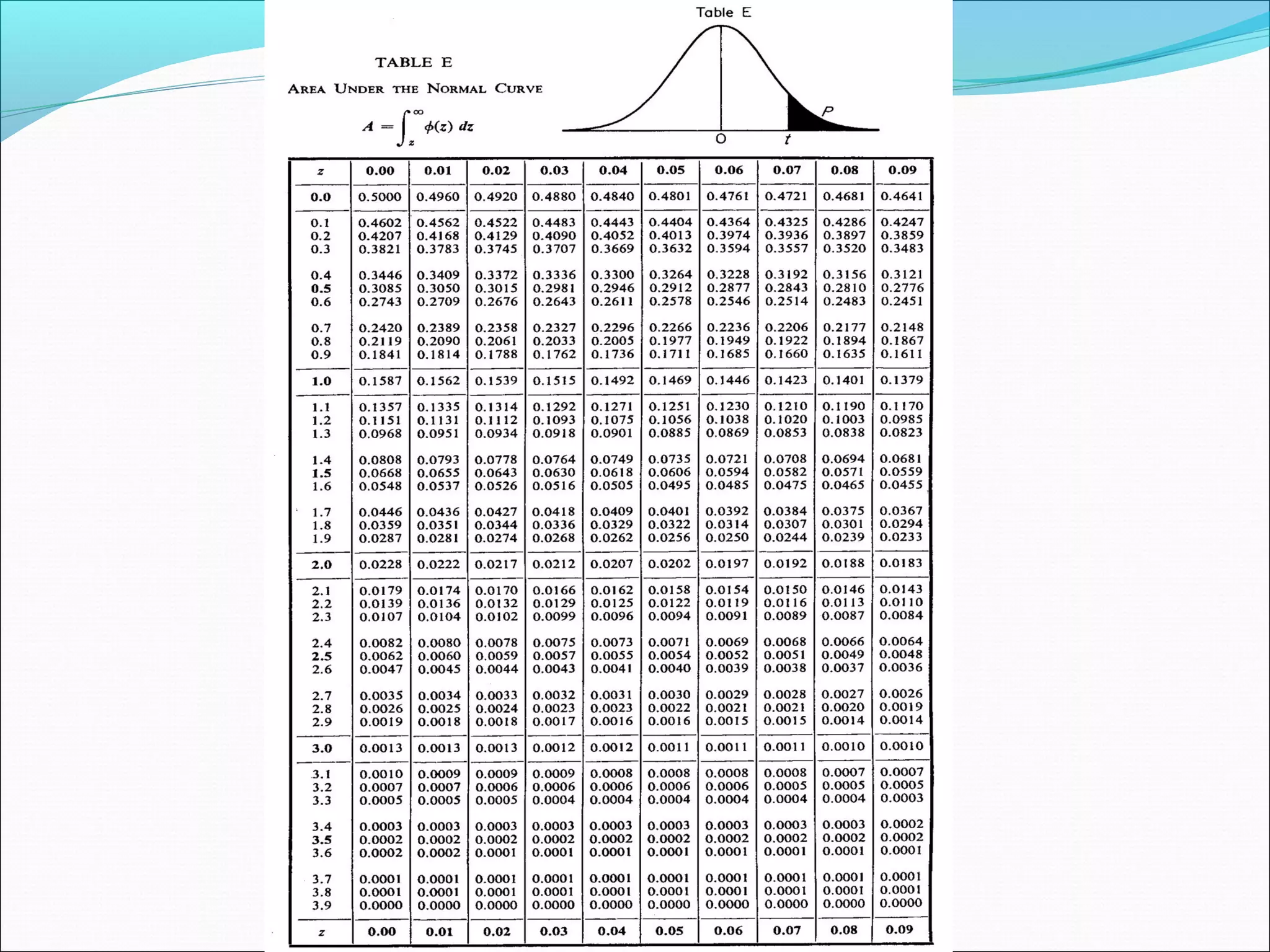
Normal distribution table gives to 4 decimal places

the proportion of the total area under the normal
curve that occurs between -∞ and +∞ expressed in
multiplying σ on either side of μ. It can be use to find
out the area between any 2 chosen points.
Eg. Area between
and
Table A reading for +1 σ = 0.8413
Table A reading for -1.75 σ = 0.0401
Area enclosed = 0.2012
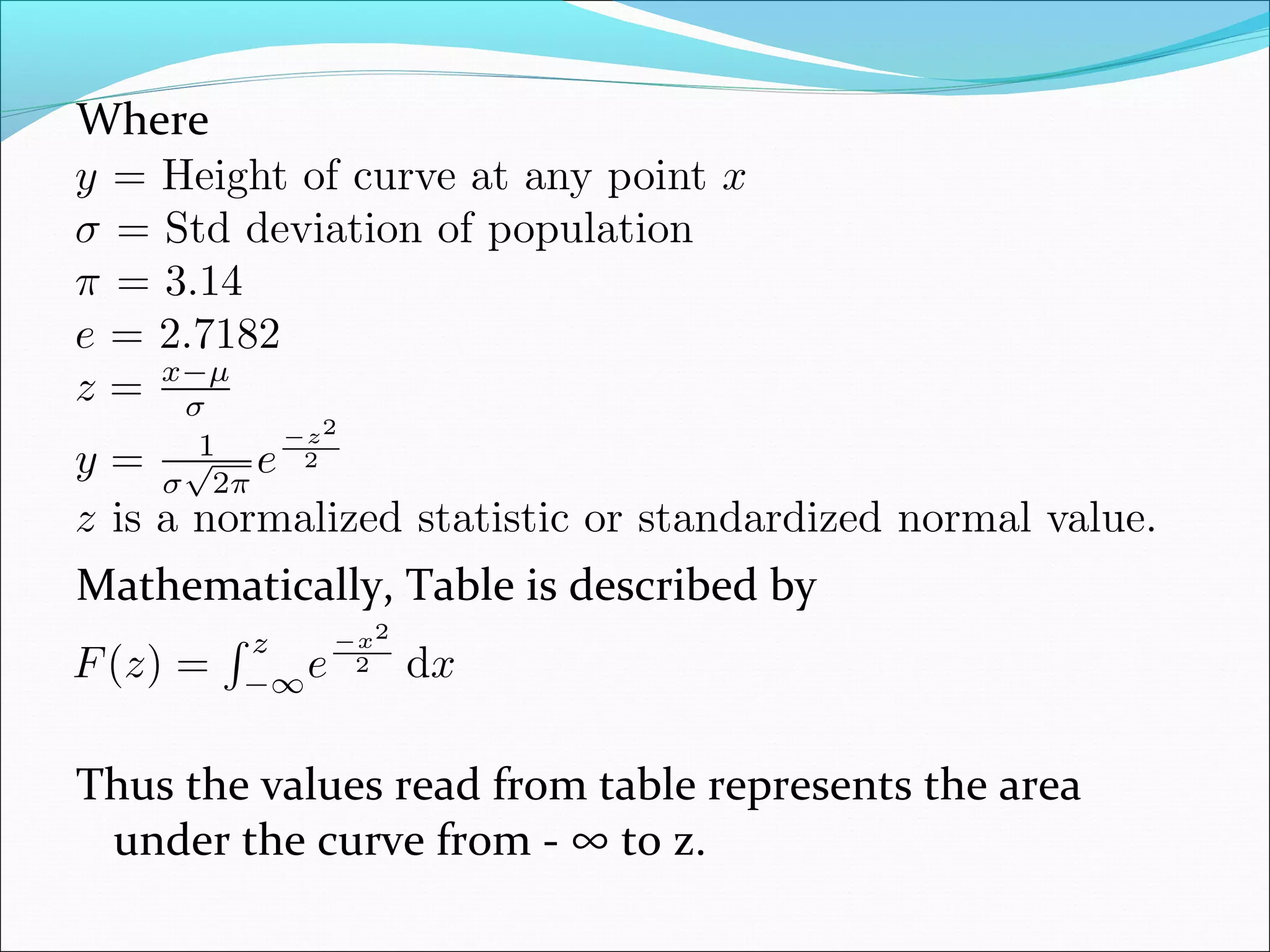
The mathematical equation for the normal curve is
given by
Where

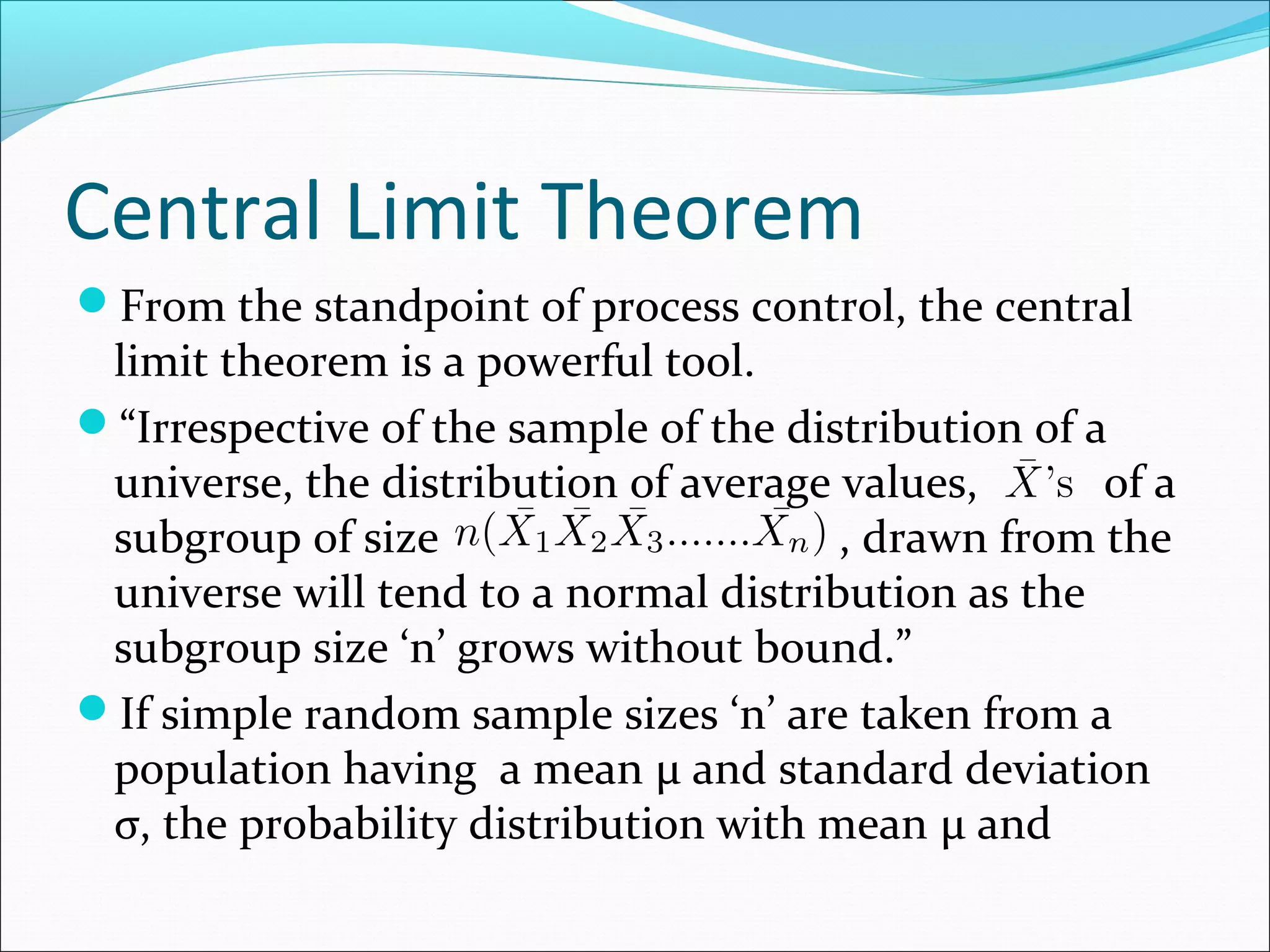
Mathematically, Table is described by

Thus the values read from table represents the area
under the curve from - ∞ to z.
Central Limit Theorem
From the standpoint of process control, the central

limit theorem is a powerful tool.
“Irrespective of the sample of the distribution of a
universe, the distribution of average values,
of a
subgroup of size
, drawn from the
universe will tend to a normal distribution as the
subgroup size ‘n’ grows without bound.”
If simple random sample sizes ‘n’ are taken from a
population having a mean μ and standard deviation
σ, the probability distribution with mean μ and
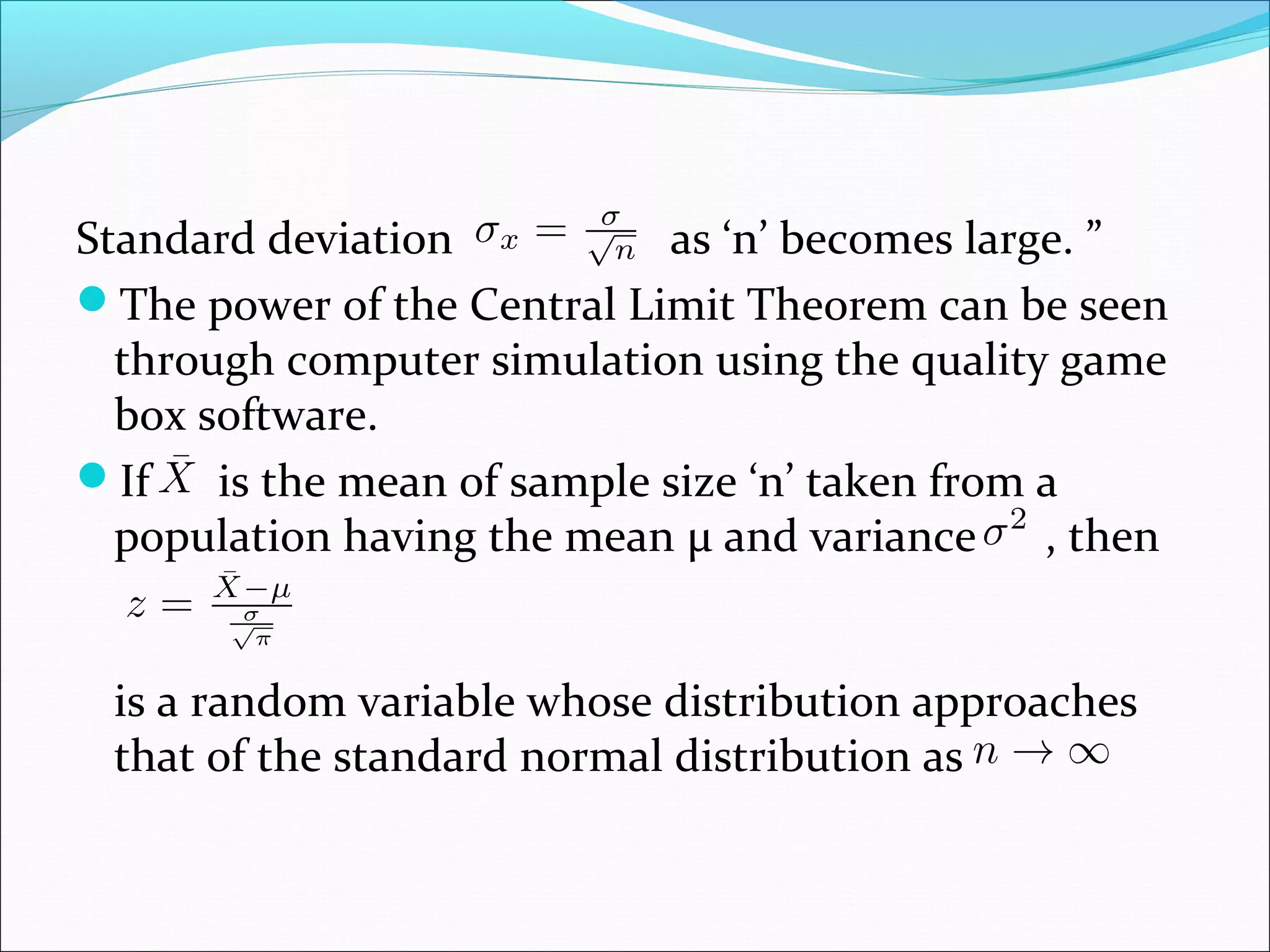
Standard deviation
as ‘n’ becomes large. ”
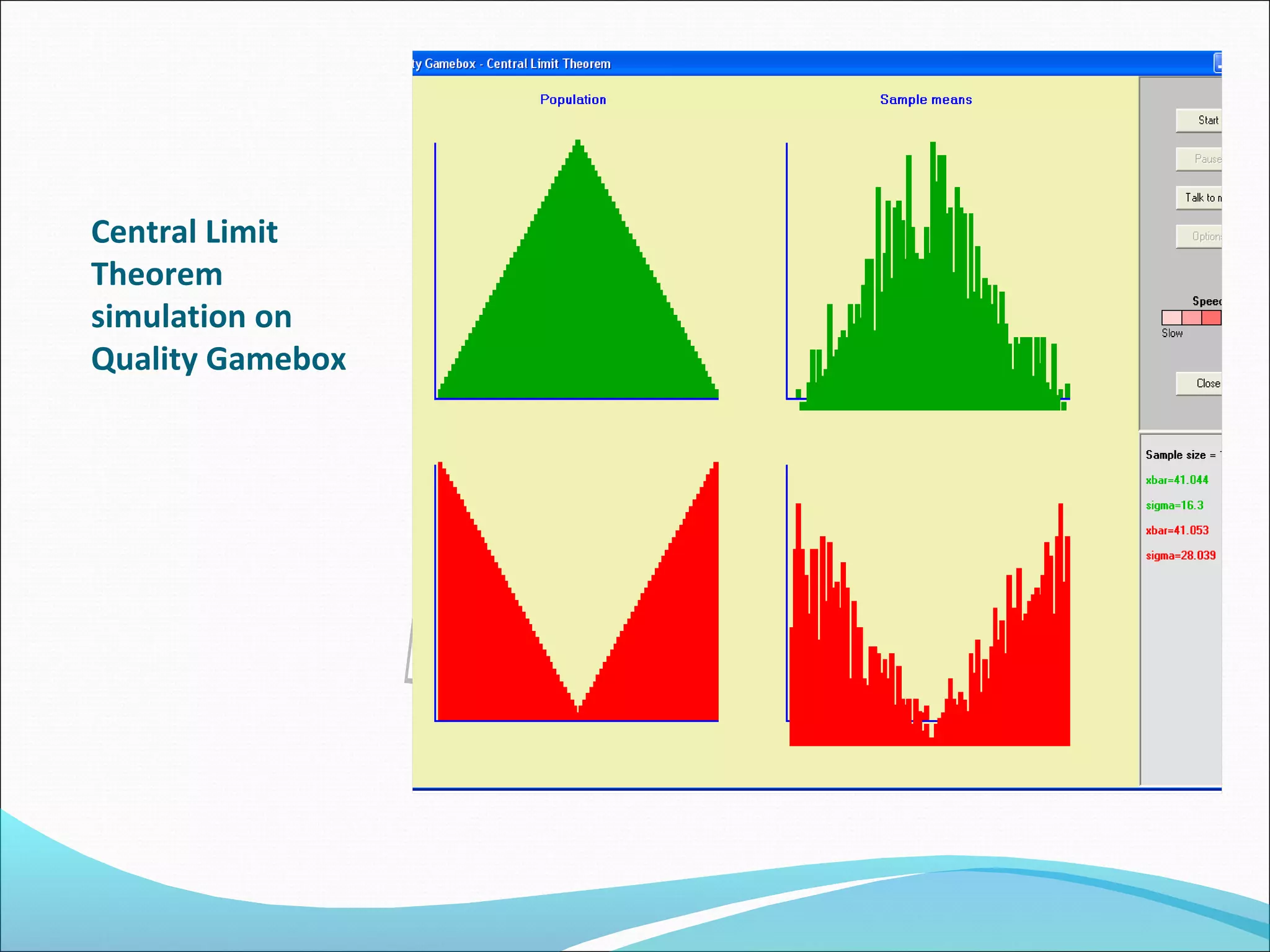
The power of the Central Limit Theorem can be seen
through computer simulation using the quality game
box software.
If
is the mean of sample size ‘n’ taken from a
population having the mean μ and variance , then
is a random variable whose distribution approaches
that of the standard normal distribution as
Central Limit
Theorem
simulation on
Quality Gamebox
Example
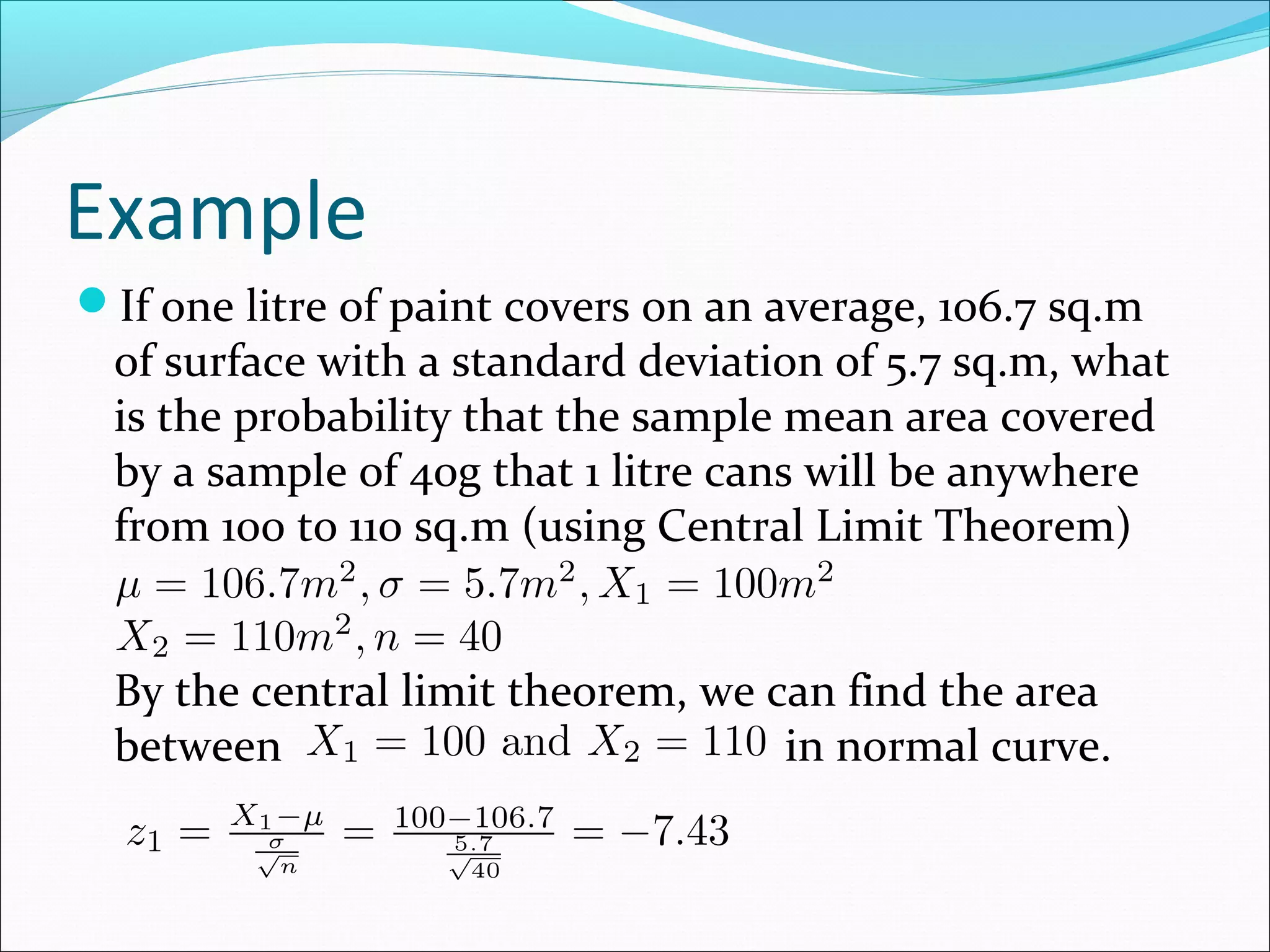
If one litre of paint covers on an average, 106.7 sq.m

of surface with a standard deviation of 5.7 sq.m, what
is the probability that the sample mean area covered
by a sample of 40g that 1 litre cans will be anywhere
from 100 to 110 sq.m (using Central Limit Theorem)
By the central limit theorem, we can find the area
between
in normal curve.
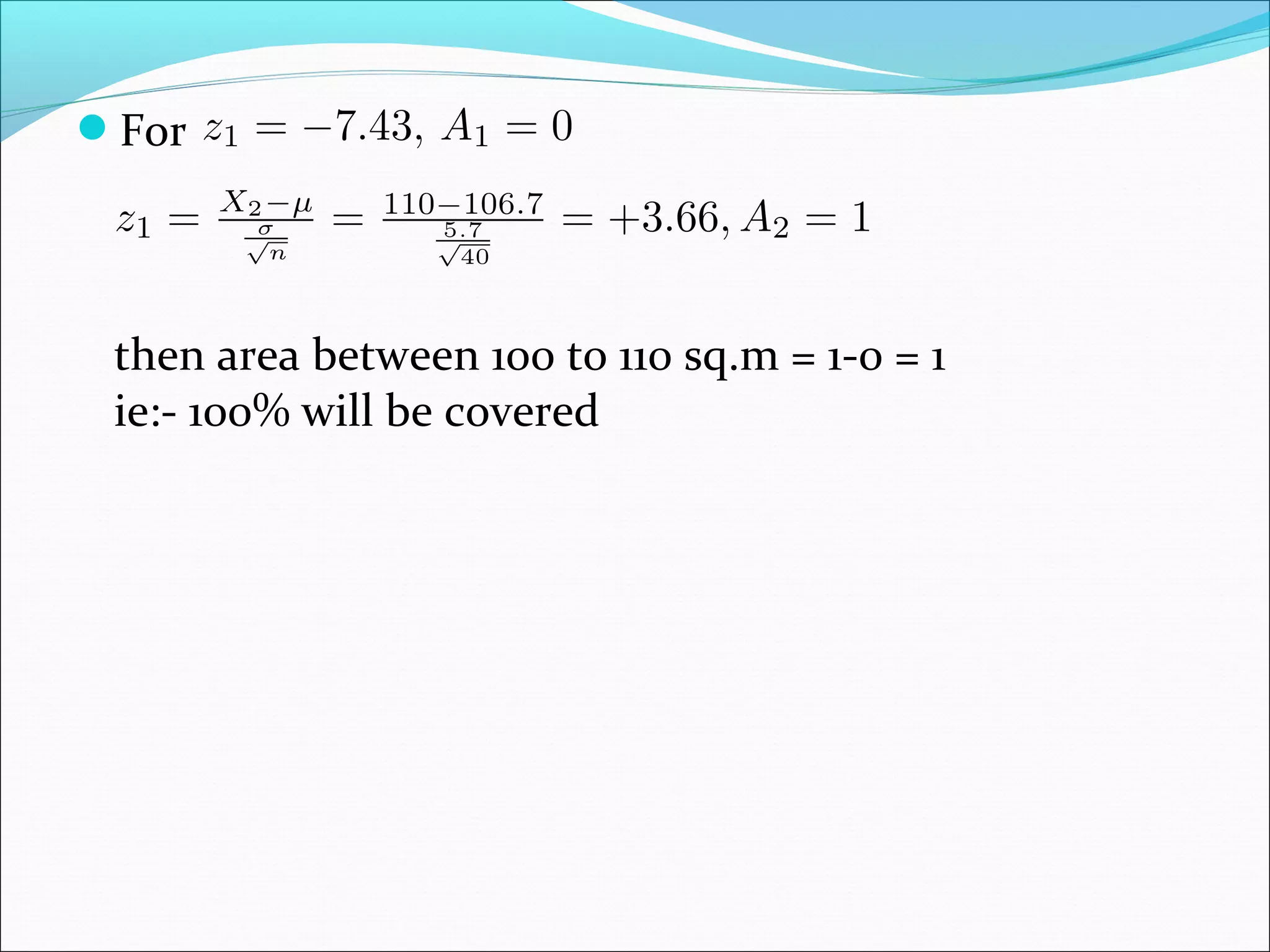
For

then area between 100 to 110 sq.m = 1-0 = 1
ie:- 100% will be covered
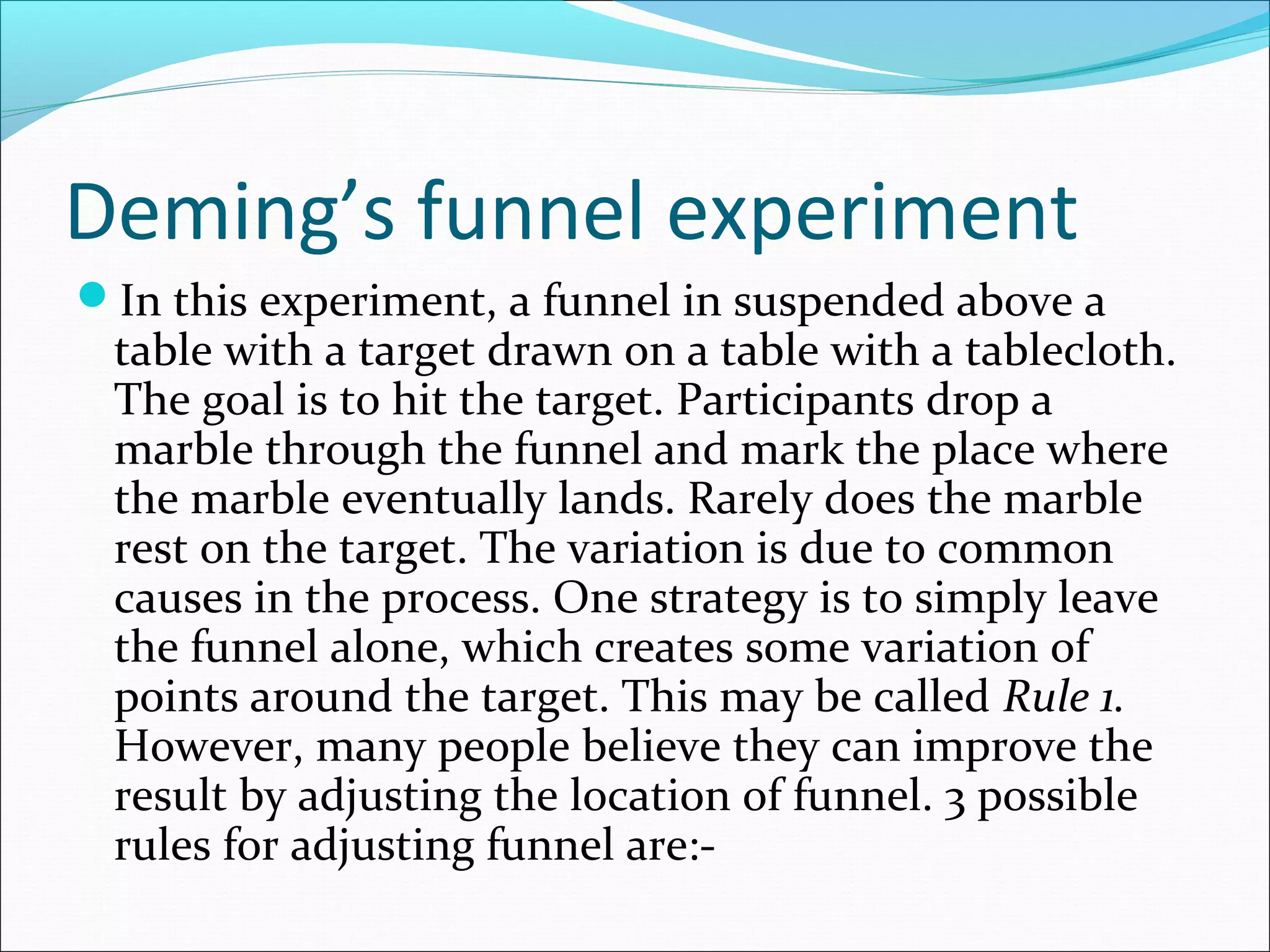
Deming’s funnel experiment
In this experiment, a funnel in suspended above a

table with a target drawn on a table with a tablecloth.
The goal is to hit the target. Participants drop a
marble through the funnel and mark the place where
the marble eventually lands. Rarely does the marble
rest on the target. The variation is due to common
causes in the process. One strategy is to simply leave
the funnel alone, which creates some variation of
points around the target. This may be called Rule 1.
However, many people believe they can improve the
result by adjusting the location of funnel. 3 possible
rules for adjusting funnel are:-
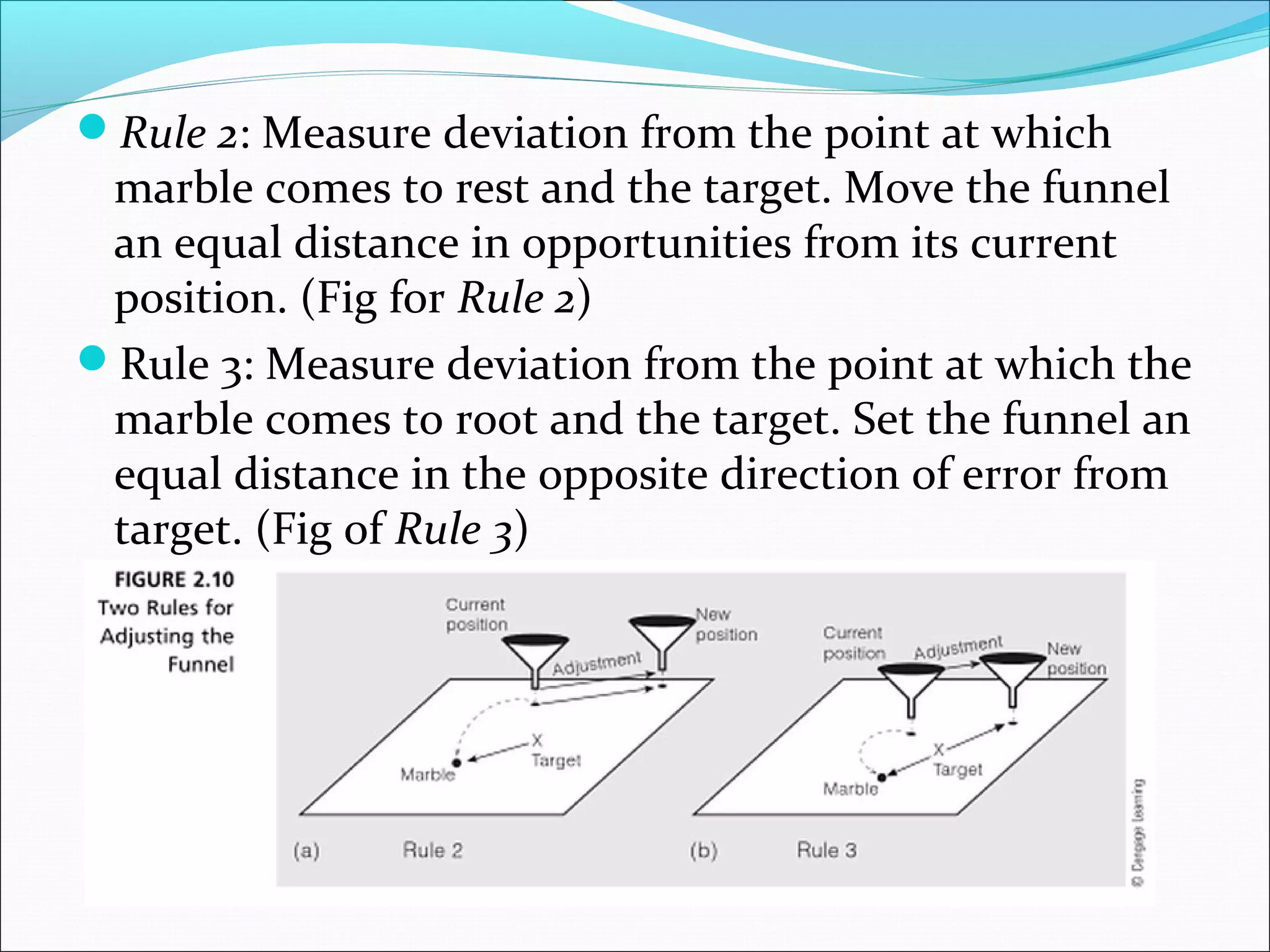
Rule 2: Measure deviation from the point at which

marble comes to rest and the target. Move the funnel
an equal distance in opportunities from its current
position. (Fig for Rule 2)
Rule 3: Measure deviation from the point at which the
marble comes to root and the target. Set the funnel an
equal distance in the opposite direction of error from
target. (Fig of Rule 3)
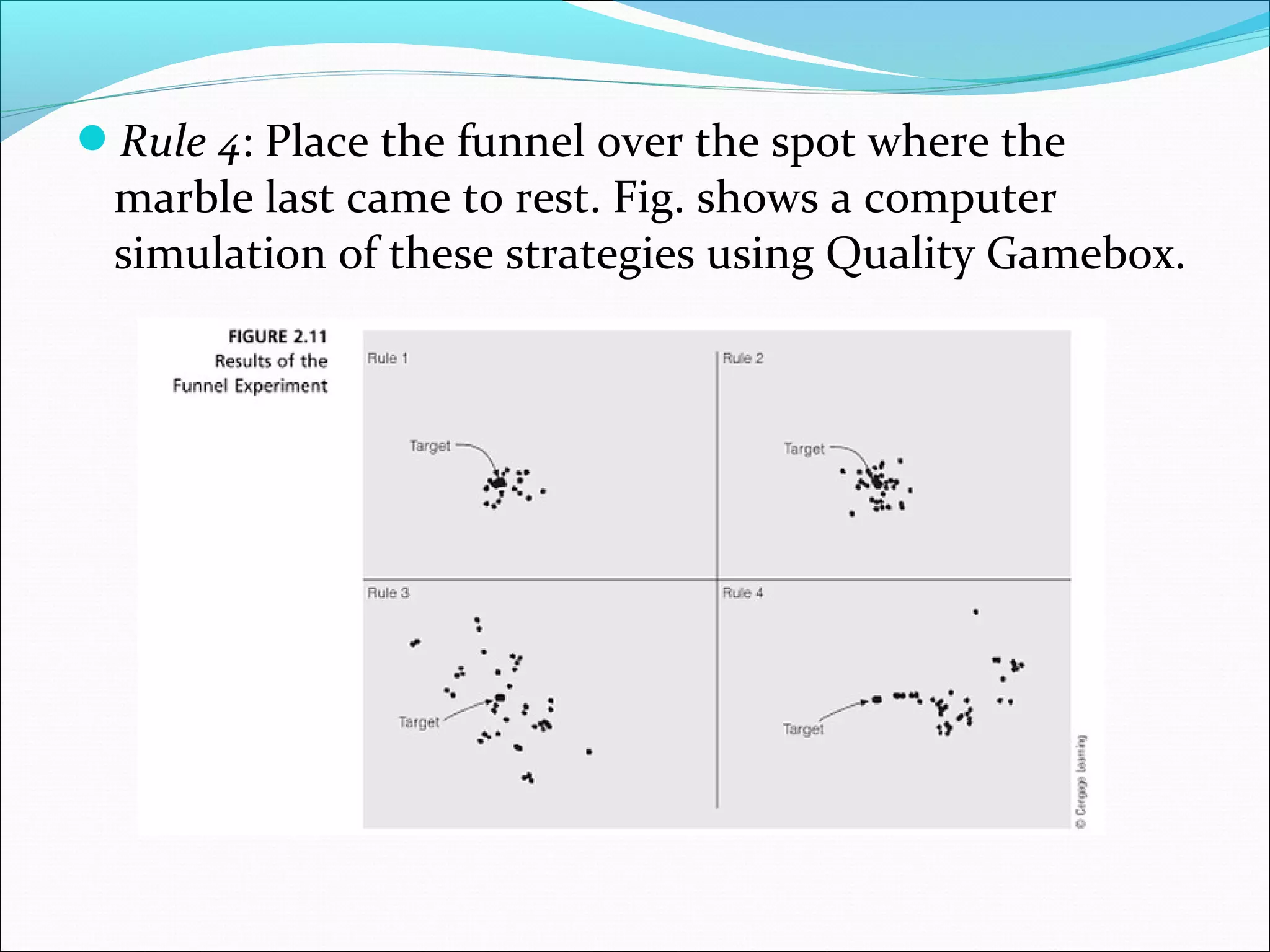
Rule 4: Place the funnel over the spot where the

marble last came to rest. Fig. shows a computer
simulation of these strategies using Quality Gamebox.
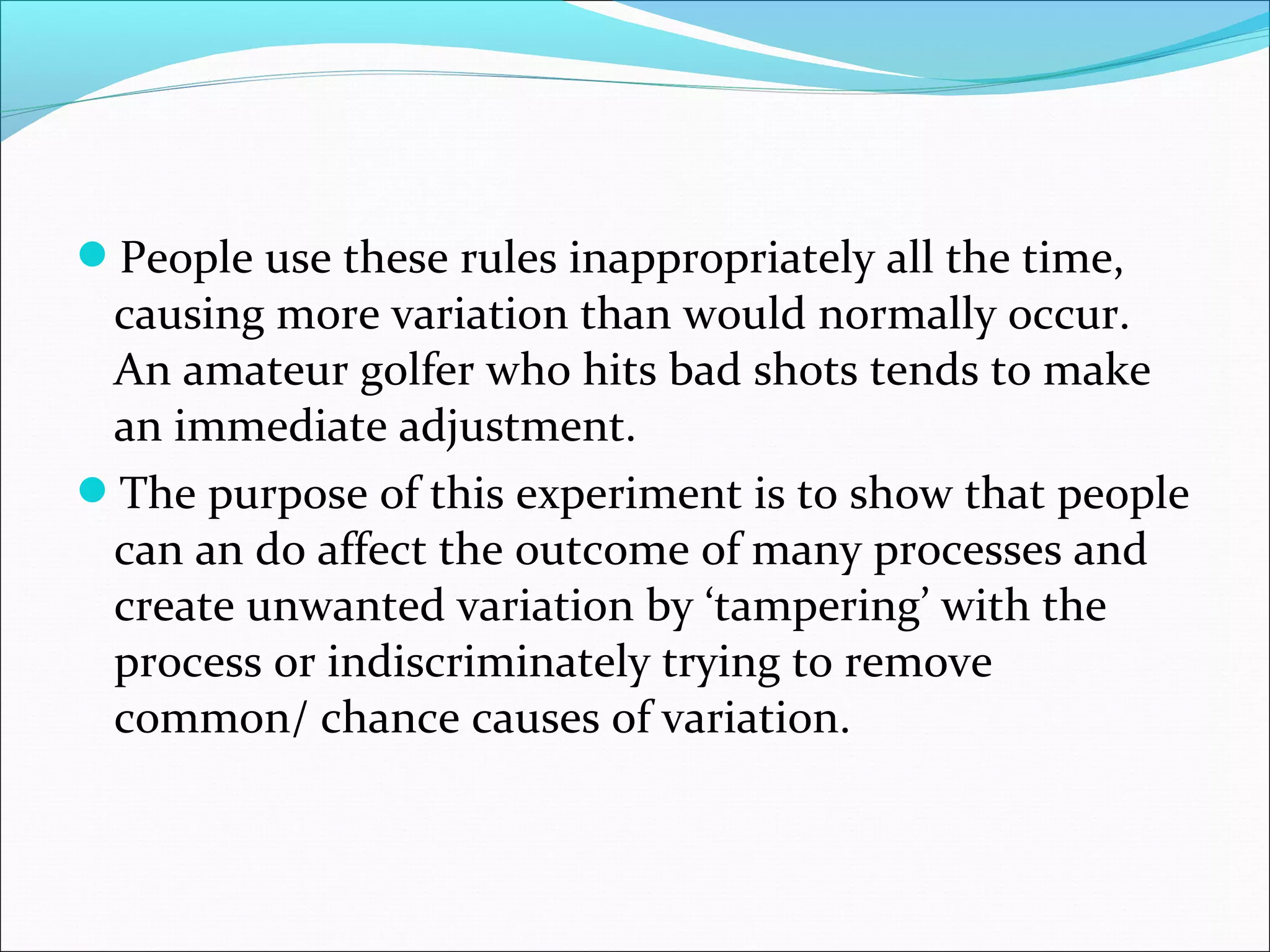
People use these rules inappropriately all the time,

causing more variation than would normally occur.
An amateur golfer who hits bad shots tends to make
an immediate adjustment.
The purpose of this experiment is to show that people
can an do affect the outcome of many processes and
create unwanted variation by ‘tampering’ with the
process or indiscriminately trying to remove
common/ chance causes of variation.

Modelling process quality

  • 2.
    Most frequency distributionsexhibit a central tendency ie:- a shape such that the bulk of the observations pile up in the area between 2 extremes. There are 3 principal measures of central tendency:1. Mean 2. Median 3. Mode
  • 3.
    Mean This is calculatedby adding the observations and dividing by the number of observations. For example, number of patients treated on 8 days. Day No. 1 No of patients 86 Arithmetic Mean 2 3 52 4 49 5 42 6 35 7 31 8 30 11 86 + 52 + 49 + 42 + 35 + 31 + 31 + 11 = = 42 8
  • 4.
    Median It is themiddle most or most critical value when figures are arranged according to size. Half of the items lie above this point and half lie below it. It is used for reducing the effects of extreme values or few data which can be ranked but not economically measurable (Eg. Shades of colour) If the data in an even number of items, median is the average of the 2 middle items. 1 Median = The n + th item in a data array where n is 2 the no. of items in the array.
  • 5.
    Examples Data set withodd no. of items Item 1 2 3 Time 4 4.3 4.7 4 5 4.8 5 Median Data set with even no. of items 6 7 # 5.1 6.0 No 86 52 1 Median = item Median = 2 3 4 49 43 5 6 7 8 35 31 30 11 n +1 th item = 8 + 1 = 4.5 th 2 2 43 + 35 = 39 2
  • 6.
    Mode It is thevalue which occurs most often in data set. It is the value which is used for severely skewed distributions, describing irregular situations where 2 peaks are found or for eliminating the effect of extreme values. Eg. No. of delivery trips made per day made by an RMC plant. 0 2 5 7 15 0 2 5 7 15 1 4 6 8 15 1 4 6 12 19 Modal value is 15 because it occurs most often.
  • 7.
    The modal value15 inplies that the plant activity is higher than 6.7 (which is mean). The mode tells us that 15 is the most frequent no. of trip, but it fails to let us know that most of the values are under 10. A distribution in which the values of mean, median and mode coincide is known as symmetrical distribution. When they do not coincide, the distribution is known as skewed or asymmetrical. If distribution is moderately skewed, Mean – Mode = 3(Mean-Median)
  • 8.
    Dispersion The measure ofdispersion or scatter are Range R and sample standard deviation s and variance
  • 9.
  • 10.
    Normal curve andits significance
  • 11.
    Much of thevariation in nature and industry follows the normal curve (Gaussian curve). It is the bell shaped, symmetrical form as above. Although most of the area is covered within the limits , the curve extends from -∞ to +∞. Variation in height of human beings, variation of weight of elements, life of 60W bulbs etc are expected to follow the normal curve. Limits % of total area within specified limits
  • 12.
    The test scoresof a sample of 100 students have a symmetrical distribution with a mean score of 570 & standard deviation of 70, approx. What scores are between a) 430 and 710 b) 360 and 780 a) Hence 95% approx. have scores between 430 & 710. b) Hence 99.7% of scores are between 360 & 780.
  • 13.
    Normal distribution tablegives to 4 decimal places the proportion of the total area under the normal curve that occurs between -∞ and +∞ expressed in multiplying σ on either side of μ. It can be use to find out the area between any 2 chosen points. Eg. Area between and Table A reading for +1 σ = 0.8413 Table A reading for -1.75 σ = 0.0401 Area enclosed = 0.2012 The mathematical equation for the normal curve is given by
  • 14.
    Where Mathematically, Table isdescribed by Thus the values read from table represents the area under the curve from - ∞ to z.
  • 15.
    Central Limit Theorem Fromthe standpoint of process control, the central limit theorem is a powerful tool. “Irrespective of the sample of the distribution of a universe, the distribution of average values, of a subgroup of size , drawn from the universe will tend to a normal distribution as the subgroup size ‘n’ grows without bound.” If simple random sample sizes ‘n’ are taken from a population having a mean μ and standard deviation σ, the probability distribution with mean μ and
  • 16.
    Standard deviation as ‘n’becomes large. ” The power of the Central Limit Theorem can be seen through computer simulation using the quality game box software. If is the mean of sample size ‘n’ taken from a population having the mean μ and variance , then is a random variable whose distribution approaches that of the standard normal distribution as
  • 17.
  • 18.
    Example If one litreof paint covers on an average, 106.7 sq.m of surface with a standard deviation of 5.7 sq.m, what is the probability that the sample mean area covered by a sample of 40g that 1 litre cans will be anywhere from 100 to 110 sq.m (using Central Limit Theorem) By the central limit theorem, we can find the area between in normal curve.
  • 19.
    For then area between100 to 110 sq.m = 1-0 = 1 ie:- 100% will be covered
  • 22.
    Deming’s funnel experiment Inthis experiment, a funnel in suspended above a table with a target drawn on a table with a tablecloth. The goal is to hit the target. Participants drop a marble through the funnel and mark the place where the marble eventually lands. Rarely does the marble rest on the target. The variation is due to common causes in the process. One strategy is to simply leave the funnel alone, which creates some variation of points around the target. This may be called Rule 1. However, many people believe they can improve the result by adjusting the location of funnel. 3 possible rules for adjusting funnel are:-
  • 23.
    Rule 2: Measuredeviation from the point at which marble comes to rest and the target. Move the funnel an equal distance in opportunities from its current position. (Fig for Rule 2) Rule 3: Measure deviation from the point at which the marble comes to root and the target. Set the funnel an equal distance in the opposite direction of error from target. (Fig of Rule 3)
  • 24.
    Rule 4: Placethe funnel over the spot where the marble last came to rest. Fig. shows a computer simulation of these strategies using Quality Gamebox.
  • 25.
    People use theserules inappropriately all the time, causing more variation than would normally occur. An amateur golfer who hits bad shots tends to make an immediate adjustment. The purpose of this experiment is to show that people can an do affect the outcome of many processes and create unwanted variation by ‘tampering’ with the process or indiscriminately trying to remove common/ chance causes of variation.