SLA Theories and FL Teaching: (Dis)Connections February 2006 Virginia M. Scott Vanderbilt University Copyright  by Virginia M. Scott  2006 All Rights Reserved
Goals of the workshop To question our individual notions about second language acquisition (SLA). To review current theories about SLA. To explore the ways SLA theories inform practice. To review the  ACTFL Proficiency Guidelines  and the  Standards for Language Learning in the 21 st  Century . To discuss the (dis)connections between theories, guidelines, standards and classroom practice. To tackle the role of  GRAMMAR  in light of these discussions.
Questions about SLA What does it mean to “know” another language? Do adults acquire a second language (L2) the way children acquire their native language (L1)? What is the best age for acquiring a L2? How do age, motivation, attitude, gender, learning style affect L2 acquisition?
Participant conversation (1) List  2  other questions you have about  HOW students acquire a second language.
More questions about SLA What is the role of grammar instruction in L2 acquisition? What is the role of interaction in L2 acquisition? What is the role of error correction in L2 acquisition? How do listening, speaking, reading, and writing contribute to L2 acquisition?
Participant reflections We will review several  Theories about SLA After each theory, you will see the following icon:   Write a FL teaching practice that might be linked to this theory.
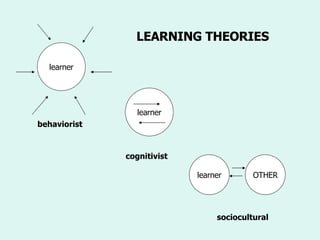
learner learner behaviorist cognitivist learner OTHER sociocultural LEARNING THEORIES
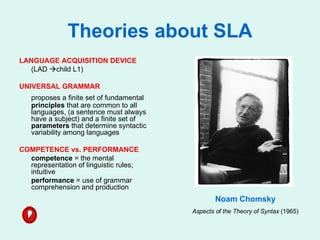
Theories about SLA LANGUAGE ACQUISITION DEVICE (LAD   child L1) UNIVERSAL GRAMMAR  proposes a finite set of fundamental  principles  that are common to all languages, (a sentence must always have a subject) and a finite set of  parameters  that determine syntactic variability among languages  COMPETENCE vs. PERFORMANCE competence  = the mental representation of linguistic rules; intuitive performance  = use of grammar comprehension and production Noam Chomsky Aspects of the Theory of Syntax  (1965)
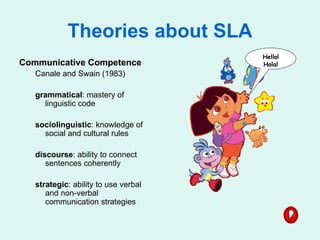
Theories about SLA Communicative Competence Canale and Swain (1983)  grammatical : mastery of linguistic code sociolinguistic : knowledge of social and cultural rules discourse : ability to connect sentences coherently strategic : ability to use verbal and non-verbal  communication strategies Hello! Hola!
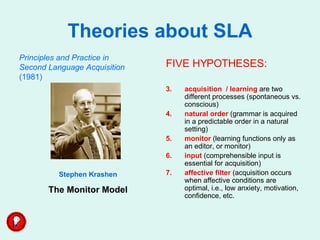
Theories about SLA FIVE HYPOTHESES: acquisition  / learning  are two different processes (spontaneous vs. conscious) natural order  (grammar is acquired in a predictable order in a natural setting) monitor  (learning functions only as an editor, or monitor) input  (comprehensible input is essential for acquisition) affective filter  (acquisition occurs when affective conditions are optimal, i.e., low anxiety, motivation, confidence, etc. Stephen Krashen The Monitor Model Principles and Practice in Second Language Acquisition  (1981)
Theories about SLA SOCIAL DEVELOPMENT THEORY Full cognitive development requires social interaction.  The range of skill that can be developed with adult guidance or peer collaboration exceeds what can be attained alone. [ child L1 acquisition] Pedagogical Psychology Institute  of Moscow Lev Vygotsky 1896-1934 Thought and Language   (1962) [discovered in the 1990s]
Participant conversation (2) You have heard about several SLA theories: Chomsky’s theories of LAD, UG, and Competence vs. Performance Canale & Swain’s theory of communicative competence Krashen’s Monitor Model Vygotsky’s Social Development Theory You have written an idea about each theory.  Share your ideas with another participant. List at least  3  FL teaching practices that are linked to these SLA theories.
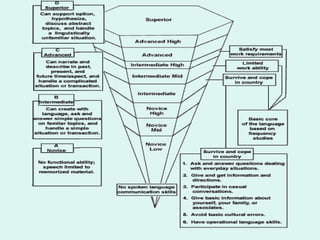
Guiding Principles ACTFL Proficiency Guidelines (1986) Four levels for assessing  speaking , listening, reading, writing proficiency: Novice  = words, phrases Advanced  = paragraphs Intermediate  = sentences Superior  = extended discourse
 
Guiding Principles ACTFL Proficiency Guidelines (1986) The guidelines represent a hierarchy of observable behaviors, or performance, in speaking, listening, reading, and writing. Each description is a representative, not an exhaustive, sample of a particular range of ability. These guidelines identify stages of  proficiency , as opposed to  achievement . They do not measure what individuals achieve through specific classroom instruction, but assess what individuals can and cannot do.  The levels of proficiency are designed for global assessment and are not related to where, when, or how the language was learned or acquired. The words "learned" and "acquired" are used in the broadest sense, and are not based on a particular linguistic theory or pedagogical method.
Guiding Principles ACTFL Proficiency Guidelines (1986) Proficiency is not a methodology.  Proficiency is not a measure of classroom instruction.  Proficiency is not a set of curriculum plans.  Proficiency is not synonymous with years of study.  Proficiency is not just oral.  Proficiency is not synonymous with lowered standards.  Proficiency is not just grammar-based.
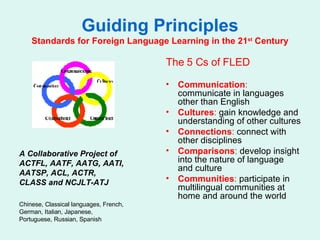
Guiding Principles Standards for Foreign Language Learning in the 21 st  Century The 5 Cs of FLED Communication :  communicate in languages other than English Cultures :  gain knowledge and understanding of other cultures Connections :  connect with other disciplines Comparisons :  develop insight into the nature of language and culture Communities :  participate in multilingual communities at home and around the world A Collaborative Project of ACTFL, AATF, AATG, AATI, AATSP, ACL, ACTR, CLASS and NCJLT-ATJ   Chinese, Classical languages, French, German, Italian, Japanese, Portuguese, Russian, Spanish
Guiding Principles Standards for Foreign Language Learning in the 21 st  Century Standard 1:  Communication   Communicate in Languages Other Than English Standard 1.1:  Students engage in conversations, provide and obtain information, express feelings and emotions, and exchange opinions Standard 1.2:  Students understand and interpret written and spoken language on a variety of topics Standard 1.3:  Students present information, concepts, and ideas to an audience of listeners or readers on a variety of topics.
Guiding Principles Standards for Foreign Language Learning in the 21 st  Century Standard 2:  Cultures Gain Knowledge and Understanding of Other Cultures Standard 2.1:  Students demonstrate an understanding of the relationship between the practices and perspectives of the culture studied Standard 2.2:  Students demonstrate an understanding of the relationship between the products and perspectives of the culture studied
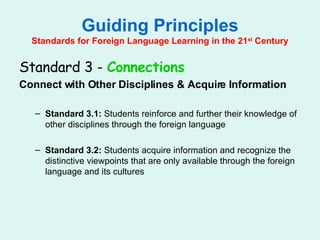
Guiding Principles Standards for Foreign Language Learning in the 21 st  Century Standard 3 -  Connections   Connect with Other Disciplines & Acquire Information Standard 3.1:  Students reinforce and further their knowledge of other disciplines through the foreign language Standard 3.2:  Students acquire information and recognize the distinctive viewpoints that are only available through the foreign language and its cultures
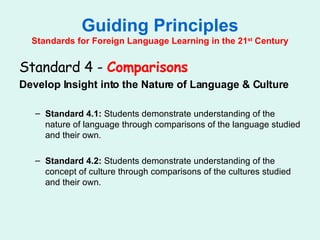
Guiding Principles Standards for Foreign Language Learning in the 21 st  Century Standard 4 -  Comparisons   Develop Insight into the Nature of Language & Culture Standard 4.1:  Students demonstrate understanding of the nature of language through comparisons of the language studied and their own. Standard 4.2:  Students demonstrate understanding of the concept of culture through comparisons of the cultures studied and their own.
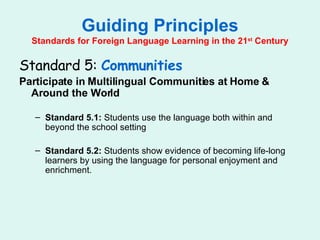
Guiding Principles Standards for Foreign Language Learning in the 21 st  Century Standard 5:  Communities Participate in Multilingual Communities at Home & Around the World Standard 5.1:  Students use the language both within and beyond the school setting Standard 5.2:  Students show evidence of becoming life-long learners by using the language for personal enjoyment and enrichment.
Guiding Principles Standards for Foreign Language Learning in the 21 st  Century The “ w e a v e ” of curricular elements Language system  *  Cultural knowledge  *  Communication strategies Critical thinking skills  *  Learning strategies  *  Technology “ The  Standards  (1999) grew out of the  Goals 2000: Educate America Act  ... and represent an effort to go beyond a limited four-skills view of language education, proposing in the process to change radically current teaching paradigms.[...] Rather than seeing language study as a fundamentally skill-oriented, self-contained enterprise that only tangentially includes culture in terms of practical competencies, the  Standards  encourage language instruction that focuses on its interdisciplinary implications and ability to influence learners in terms of developing an increased awareness of self and others and in terms of encouraging deep cognitive processing skills”(13). Jean Marie Schultz. 2001. The Gordian Knot: Language Literature, and Critical Thinking. In  SLA and the Literature Classroom,  edited by Virginia Scott and Holly Tucker. Boston: MA, Heinle.
TAKE  A  BREAK! (10 minutes)
Participant conversation (3) You have reviewed guiding principles described in ACTFL Proficiency Guidelines  Standards for FL Learning in the 21 st  Century You have taken a break!  Working with another participant, list at least 5 characteristics of a  good FL teacher .
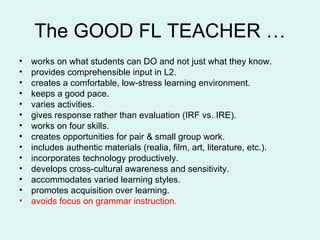
The GOOD FL TEACHER … works on what students can DO and not just what they know. provides comprehensible input in L2. creates a comfortable, low-stress learning environment. keeps a good pace. varies activities. gives response rather than evaluation (IRF vs. IRE). works on four skills. creates opportunities for pair & small group work. includes authentic materials (realia, film, art, literature, etc.). incorporates technology productively.  develops cross-cultural awareness and sensitivity.  accommodates varied learning styles. promotes acquisition over learning. avoids focus on grammar instruction.
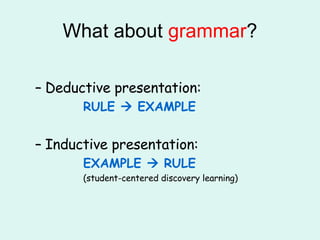
What about  grammar ? Deductive presentation: RULE    EXAMPLE Inductive presentation: EXAMPLE    RULE (student-centered discovery learning)
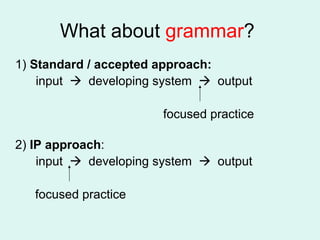
What about  grammar ?  1)  Standard / accepted approach: input     developing system     output focused practice 2)  IP approach : input     developing system     output focused practice
What about  grammar ?  Four kinds of IP activities: Binary options Matching Selecting alternatives Supplying information [Target structure:  ing ]
1. binary options Indicate if you think the statements about your teacher are TRUE or FALSE: TRUE FALSE She likes teaching. _____ _____ She likes going to the movies. _____ _____ She does not like hiking. _____ _____ She likes watching TV. _____ _____ She likes grading homework. _____ _____ She likes eating pizza. _____ _____ She does not like giving exams. _____ _____
2. matching Mark is … hungry. tired. cold. athletic. happy. angry. hot. Mark is … sleeping. laughing. sweating. shouting. eating. shivering. running. crying.
3. selecting alternatives When I have free time I enjoy ___ watching TV. ___ reading a book. ___ talking to friends. When I am hungry I prefer ___ going out to a restaurant. ___ cooking dinner at home. ___ getting fast food. When I go out with my friends we like ___ going to the movie theater. ___ sitting in a bar. ___ dancing in a club.
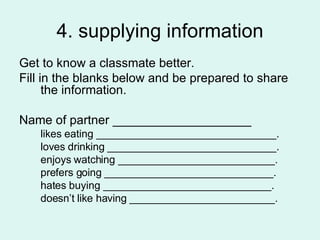
4. supplying information Get to know a classmate better.  Fill in the blanks below and be prepared to share the information.  Name of partner ____________________ likes eating _______________________________. loves drinking _____________________________. enjoys watching ___________________________. prefers going _____________________________. hates buying _____________________________. doesn’t like having _________________________.
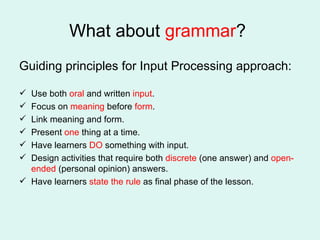
What about  grammar ?  Guiding principles for Input Processing approach: Use both  oral  and written  input . Focus on  meaning  before  form . Link meaning and form. Present  one  thing at a time. Have learners  DO  something with input. Design activities that require both  discrete  (one answer) and  open-ended  (personal opinion) answers. Have learners  state the rule  as final phase of the lesson.
Final reflections During this workshop we have reviewed  theories about SLA,  guiding principles regarding FL teaching,  and  a new approach to teaching grammar. Spend a moment reflecting on 3 challenges you would like to focus on before the end of this academic year.
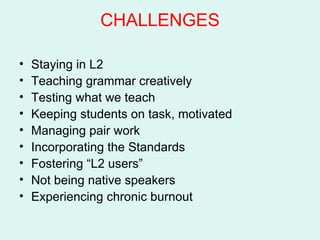
CHALLENGES Staying in L2 Teaching grammar creatively  Testing what we teach Keeping students on task, motivated Managing pair work Incorporating the Standards Fostering “L2 users”  Not being native speakers Experiencing chronic burnout
Closing visions “ Each act of language opens a small window to a new culture, its history, and its values.”  Janet Swaffar. “The Case for Foreign Language as a Discipline.” MLA  Profession 1999 : 155-67. Trompe l’oeil   by Ron Francis. Provence, France.  ( mural on fibreboard) http://users.senet.com.au/~rfrancis/

Dis Connections. Sla Theories

  • 1.
    SLA Theories andFL Teaching: (Dis)Connections February 2006 Virginia M. Scott Vanderbilt University Copyright by Virginia M. Scott 2006 All Rights Reserved
  • 2.
    Goals of theworkshop To question our individual notions about second language acquisition (SLA). To review current theories about SLA. To explore the ways SLA theories inform practice. To review the ACTFL Proficiency Guidelines and the Standards for Language Learning in the 21 st Century . To discuss the (dis)connections between theories, guidelines, standards and classroom practice. To tackle the role of GRAMMAR in light of these discussions.
  • 3.
    Questions about SLAWhat does it mean to “know” another language? Do adults acquire a second language (L2) the way children acquire their native language (L1)? What is the best age for acquiring a L2? How do age, motivation, attitude, gender, learning style affect L2 acquisition?
  • 4.
    Participant conversation (1)List 2 other questions you have about HOW students acquire a second language.
  • 5.
    More questions aboutSLA What is the role of grammar instruction in L2 acquisition? What is the role of interaction in L2 acquisition? What is the role of error correction in L2 acquisition? How do listening, speaking, reading, and writing contribute to L2 acquisition?
  • 6.
    Participant reflections Wewill review several Theories about SLA After each theory, you will see the following icon:  Write a FL teaching practice that might be linked to this theory.
  • 7.
    learner learner behavioristcognitivist learner OTHER sociocultural LEARNING THEORIES
  • 8.
    Theories about SLALANGUAGE ACQUISITION DEVICE (LAD  child L1) UNIVERSAL GRAMMAR proposes a finite set of fundamental principles that are common to all languages, (a sentence must always have a subject) and a finite set of parameters that determine syntactic variability among languages COMPETENCE vs. PERFORMANCE competence = the mental representation of linguistic rules; intuitive performance = use of grammar comprehension and production Noam Chomsky Aspects of the Theory of Syntax (1965)
  • 9.
    Theories about SLACommunicative Competence Canale and Swain (1983) grammatical : mastery of linguistic code sociolinguistic : knowledge of social and cultural rules discourse : ability to connect sentences coherently strategic : ability to use verbal and non-verbal communication strategies Hello! Hola!
  • 10.
    Theories about SLAFIVE HYPOTHESES: acquisition / learning are two different processes (spontaneous vs. conscious) natural order (grammar is acquired in a predictable order in a natural setting) monitor (learning functions only as an editor, or monitor) input (comprehensible input is essential for acquisition) affective filter (acquisition occurs when affective conditions are optimal, i.e., low anxiety, motivation, confidence, etc. Stephen Krashen The Monitor Model Principles and Practice in Second Language Acquisition (1981)
  • 11.
    Theories about SLASOCIAL DEVELOPMENT THEORY Full cognitive development requires social interaction. The range of skill that can be developed with adult guidance or peer collaboration exceeds what can be attained alone. [ child L1 acquisition] Pedagogical Psychology Institute of Moscow Lev Vygotsky 1896-1934 Thought and Language (1962) [discovered in the 1990s]
  • 12.
    Participant conversation (2)You have heard about several SLA theories: Chomsky’s theories of LAD, UG, and Competence vs. Performance Canale & Swain’s theory of communicative competence Krashen’s Monitor Model Vygotsky’s Social Development Theory You have written an idea about each theory.  Share your ideas with another participant. List at least 3 FL teaching practices that are linked to these SLA theories.
  • 13.
    Guiding Principles ACTFLProficiency Guidelines (1986) Four levels for assessing speaking , listening, reading, writing proficiency: Novice = words, phrases Advanced = paragraphs Intermediate = sentences Superior = extended discourse
  • 14.
  • 15.
    Guiding Principles ACTFLProficiency Guidelines (1986) The guidelines represent a hierarchy of observable behaviors, or performance, in speaking, listening, reading, and writing. Each description is a representative, not an exhaustive, sample of a particular range of ability. These guidelines identify stages of proficiency , as opposed to achievement . They do not measure what individuals achieve through specific classroom instruction, but assess what individuals can and cannot do. The levels of proficiency are designed for global assessment and are not related to where, when, or how the language was learned or acquired. The words "learned" and "acquired" are used in the broadest sense, and are not based on a particular linguistic theory or pedagogical method.
  • 16.
    Guiding Principles ACTFLProficiency Guidelines (1986) Proficiency is not a methodology. Proficiency is not a measure of classroom instruction. Proficiency is not a set of curriculum plans. Proficiency is not synonymous with years of study. Proficiency is not just oral. Proficiency is not synonymous with lowered standards. Proficiency is not just grammar-based.
  • 17.
    Guiding Principles Standardsfor Foreign Language Learning in the 21 st Century The 5 Cs of FLED Communication : communicate in languages other than English Cultures : gain knowledge and understanding of other cultures Connections : connect with other disciplines Comparisons : develop insight into the nature of language and culture Communities : participate in multilingual communities at home and around the world A Collaborative Project of ACTFL, AATF, AATG, AATI, AATSP, ACL, ACTR, CLASS and NCJLT-ATJ Chinese, Classical languages, French, German, Italian, Japanese, Portuguese, Russian, Spanish
  • 18.
    Guiding Principles Standardsfor Foreign Language Learning in the 21 st Century Standard 1: Communication Communicate in Languages Other Than English Standard 1.1:  Students engage in conversations, provide and obtain information, express feelings and emotions, and exchange opinions Standard 1.2:  Students understand and interpret written and spoken language on a variety of topics Standard 1.3:  Students present information, concepts, and ideas to an audience of listeners or readers on a variety of topics.
  • 19.
    Guiding Principles Standardsfor Foreign Language Learning in the 21 st Century Standard 2: Cultures Gain Knowledge and Understanding of Other Cultures Standard 2.1:  Students demonstrate an understanding of the relationship between the practices and perspectives of the culture studied Standard 2.2:  Students demonstrate an understanding of the relationship between the products and perspectives of the culture studied
  • 20.
    Guiding Principles Standardsfor Foreign Language Learning in the 21 st Century Standard 3 - Connections Connect with Other Disciplines & Acquire Information Standard 3.1:  Students reinforce and further their knowledge of other disciplines through the foreign language Standard 3.2:  Students acquire information and recognize the distinctive viewpoints that are only available through the foreign language and its cultures
  • 21.
    Guiding Principles Standardsfor Foreign Language Learning in the 21 st Century Standard 4 - Comparisons Develop Insight into the Nature of Language & Culture Standard 4.1:  Students demonstrate understanding of the nature of language through comparisons of the language studied and their own. Standard 4.2:  Students demonstrate understanding of the concept of culture through comparisons of the cultures studied and their own.
  • 22.
    Guiding Principles Standardsfor Foreign Language Learning in the 21 st Century Standard 5: Communities Participate in Multilingual Communities at Home & Around the World Standard 5.1:  Students use the language both within and beyond the school setting Standard 5.2:  Students show evidence of becoming life-long learners by using the language for personal enjoyment and enrichment.
  • 23.
    Guiding Principles Standardsfor Foreign Language Learning in the 21 st Century The “ w e a v e ” of curricular elements Language system * Cultural knowledge * Communication strategies Critical thinking skills * Learning strategies * Technology “ The Standards (1999) grew out of the Goals 2000: Educate America Act ... and represent an effort to go beyond a limited four-skills view of language education, proposing in the process to change radically current teaching paradigms.[...] Rather than seeing language study as a fundamentally skill-oriented, self-contained enterprise that only tangentially includes culture in terms of practical competencies, the Standards encourage language instruction that focuses on its interdisciplinary implications and ability to influence learners in terms of developing an increased awareness of self and others and in terms of encouraging deep cognitive processing skills”(13). Jean Marie Schultz. 2001. The Gordian Knot: Language Literature, and Critical Thinking. In SLA and the Literature Classroom, edited by Virginia Scott and Holly Tucker. Boston: MA, Heinle.
  • 24.
    TAKE A BREAK! (10 minutes)
  • 25.
    Participant conversation (3)You have reviewed guiding principles described in ACTFL Proficiency Guidelines Standards for FL Learning in the 21 st Century You have taken a break!  Working with another participant, list at least 5 characteristics of a good FL teacher .
  • 26.
    The GOOD FLTEACHER … works on what students can DO and not just what they know. provides comprehensible input in L2. creates a comfortable, low-stress learning environment. keeps a good pace. varies activities. gives response rather than evaluation (IRF vs. IRE). works on four skills. creates opportunities for pair & small group work. includes authentic materials (realia, film, art, literature, etc.). incorporates technology productively. develops cross-cultural awareness and sensitivity. accommodates varied learning styles. promotes acquisition over learning. avoids focus on grammar instruction.
  • 27.
    What about grammar ? Deductive presentation: RULE  EXAMPLE Inductive presentation: EXAMPLE  RULE (student-centered discovery learning)
  • 28.
    What about grammar ? 1) Standard / accepted approach: input  developing system  output focused practice 2) IP approach : input  developing system  output focused practice
  • 29.
    What about grammar ? Four kinds of IP activities: Binary options Matching Selecting alternatives Supplying information [Target structure: ing ]
  • 30.
    1. binary optionsIndicate if you think the statements about your teacher are TRUE or FALSE: TRUE FALSE She likes teaching. _____ _____ She likes going to the movies. _____ _____ She does not like hiking. _____ _____ She likes watching TV. _____ _____ She likes grading homework. _____ _____ She likes eating pizza. _____ _____ She does not like giving exams. _____ _____
  • 31.
    2. matching Markis … hungry. tired. cold. athletic. happy. angry. hot. Mark is … sleeping. laughing. sweating. shouting. eating. shivering. running. crying.
  • 32.
    3. selecting alternativesWhen I have free time I enjoy ___ watching TV. ___ reading a book. ___ talking to friends. When I am hungry I prefer ___ going out to a restaurant. ___ cooking dinner at home. ___ getting fast food. When I go out with my friends we like ___ going to the movie theater. ___ sitting in a bar. ___ dancing in a club.
  • 33.
    4. supplying informationGet to know a classmate better. Fill in the blanks below and be prepared to share the information. Name of partner ____________________ likes eating _______________________________. loves drinking _____________________________. enjoys watching ___________________________. prefers going _____________________________. hates buying _____________________________. doesn’t like having _________________________.
  • 34.
    What about grammar ? Guiding principles for Input Processing approach: Use both oral and written input . Focus on meaning before form . Link meaning and form. Present one thing at a time. Have learners DO something with input. Design activities that require both discrete (one answer) and open-ended (personal opinion) answers. Have learners state the rule as final phase of the lesson.
  • 35.
    Final reflections Duringthis workshop we have reviewed theories about SLA, guiding principles regarding FL teaching, and a new approach to teaching grammar. Spend a moment reflecting on 3 challenges you would like to focus on before the end of this academic year.
  • 36.
    CHALLENGES Staying inL2 Teaching grammar creatively Testing what we teach Keeping students on task, motivated Managing pair work Incorporating the Standards Fostering “L2 users” Not being native speakers Experiencing chronic burnout
  • 37.
    Closing visions “Each act of language opens a small window to a new culture, its history, and its values.” Janet Swaffar. “The Case for Foreign Language as a Discipline.” MLA Profession 1999 : 155-67. Trompe l’oeil by Ron Francis. Provence, France. ( mural on fibreboard) http://users.senet.com.au/~rfrancis/