Università degli Studi dell’Aquila


L22. Model-based Testing (Principles)
                                    Henry Muccini
                  DISIM, University of L’Aquila
 www.henrymuccini.com, henry.muccini@univaq.it
Copyright Notice
The material in these slides may be freely reproduced
and distributed, partially or totally, as far as an explicit
reference or acknowledge to the material author is
preserved.


                           Henry Muccini
Agenda
Modeling


MBT:
 →Why?

 →Modelsfor MBT
 →UML-based Testing
    ─ Testing activities
AGENDA
Modeling
                               Model-based testing

           Why?
                                   Models for MBT

           UML-based Testing
Modeling: there is not just programming

What is a model:
 →A model is a simplification of the reality
 →The reality is abstracted, since it is too complex

Why modeling
 →Models  are built for a better understanding of the
  system under development
Everything is a model ?!?
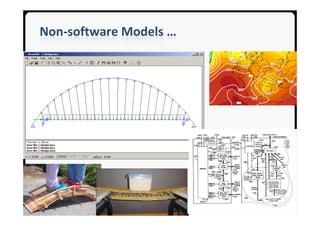
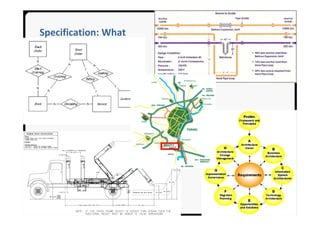
Non-software Models …
Specification: What
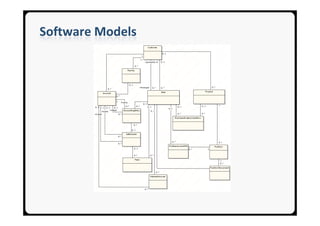
Software Models
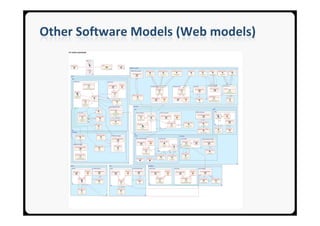
Other Software Models (Web models)
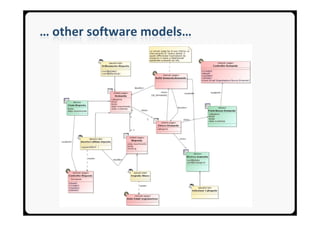
… other software models…
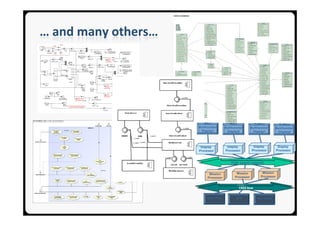
… and many others…


                         Pilot              Pilot         CoPilot           CoPilot
                     Multifunction      Multifunction   Multifunction     Multifunction
                      Display1           Display2        Display1          Display2


                      Display             Display           Display          Display
                     Processor           Processor         Processor        Processor


                                           High speed network
                                            High speed network


                            Mission             Mission          Mission
                           Processor           Processor        Processor


                                                1553 bus
                                                 1553 bus

                           Auto-Pilot          GPS            Nav Radio
Model Driven Development (MDD)
Models are becoming first core assets in
Software Engineering/Architecting:
 →models   are primary artifacts retained as first class
 entities that can be analyzed and manipulated by
 means of automated tools
 →the focus moves from writing and sharing
 documents to writing and sharing models.
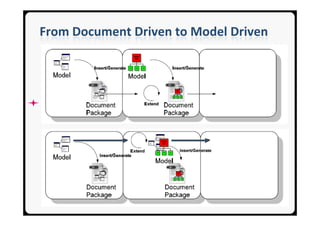
From Document Driven to Model Driven
Models in MDD
Models in MDD can be used for:

 →Documenting    design decisions
 →Guiding the coding phase

 →For analyzing and validating design choices

    ─ by complementing traditional code-level
      analysis techniques
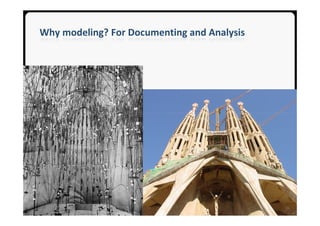
Why modeling? For Documenting and Analysis
What is MBT?
It consists in:
 →ExtractingTest Cases from the Model
 →Run the test case over the system implementation


Purpose:
 →Tovalidate the implementation conformance to the
  model
       ─ The model itself is the oracle, i.e., it represents the
        expected behavior
Model-based Testing
A model based testing approach

accepts two main inputs
 →a model of the software under test,
 →a set of test generation directives which guide the test cases
 selection
and outputs a test specification
 →which   includes a set of stimuli the tester should introduce in
  the system together with expected responses
Modeling for testing
Essentially, we need (at least) a behavioral model of
the software system:
 →Labelled  Transition System
 →StateCharts

 →UML State of Sequence Diagrams

 →IOLTS

 →Finite State Automata

 →…
The base-line technique for designing test cases
  →Timely
         ─ Often useful in refining specifications and assessing testability
            before code is written
  →Effective
         ─ finds some classes of fault (e.g., missing logic) that can elude
            other approaches
  →Widely      applicable
         ─ to any description of program behavior serving as spec
         ─ at any level of granularity from module to system testing.
  →Economical
         ─ typically less expensive to design and execute than structural
            (code-based) test cases


(C) 2007 MAURO PEZZÈ & MICHAL YOUNG
Program code is not necessary
  →Only a description of intended behavior is needed
  →Even incomplete and informal specifications can be used
         ─ Although precise, complete specifications lead to better test suites
Early functional test design has side benefits
  →Often reveals ambiguities and inconsistency in spec
  →Useful for assessing testability
         ─ And improving test schedule and budget by improving spec
  →Useful     explanation of specification
         ─ or in the extreme case (as in XP), test cases are the spec


(C) 2007 MAURO PEZZÈ & MICHAL YOUNG
Different testing strategies (functional, structural,
fault-based, model-based) are most effective for
different classes of faults
Functional testing is best for missing logic faults
  →A common problem: Some program logic was simply
  forgotten
  →Structural (code-based) testing will never focus on code that
  isn’t there!


(C) 2007 MAURO PEZZÈ & MICHAL YOUNG
Modeling for testing
Such a model can be produced:
 1. Through a formal specification language
    ─ Typically referred as formal testing


 2. Through a diagrammatic (visual) notation
    ─ Typically referred as UML-based Testing
1. MBT based on Formal Specifications
Since the 80’s, many specification-based testing
approaches have been proposed, based on formal
languages such as
 →Z,   VDM, CSP, CCS, LOTOS, SDL, and Petri Nets.
More recently:
 →Based    on dynamic behavior:
        ─ FSM-based (Bochmann&Petrenko, Lee&Yannakis, …)
        ─ LTS-based (Brinksma&Tretmans, Jard&Jeron …)

 →Focussing    on static aspects,
        ─ ADT theory (Bernot&Gaudel…)
        ─ Z-based (Hierons…)
Formal Specification-based Testing
TorX (Côte de Resyste)
   → on-the-fly test generation and execution
  → random

  → LOTOS and Promela

TGV (IRISA - Rennes)
   →derives tests in TTCN from LOTOS or SDL
  → uses test purposes

TVEDA (CNET - France Telecom)
   →   derives TTCN tests from SDL specification
2. MBT based on the UML
UML State-machine based testing:
  →which might require the translation of the UML
  diagrams into an intermediate formal description
Scenario-based testing:
  →based   on the use of opportunely annotated UML Sequence Diagram
State-based and Scenario-based:
combine the use of interaction diagrams and state diagram,
possibly annotated with further (formal) information (e.g. OCL)
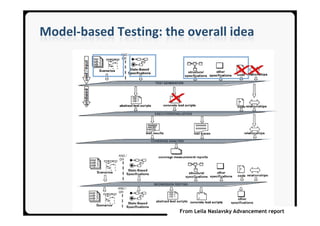
Model-based Testing: the overall idea


                        From Leila Naslavsky Advancement report
AsmL
                                       L
                                   TESTO
                                       OR
                                   UMLAU
                                       UT
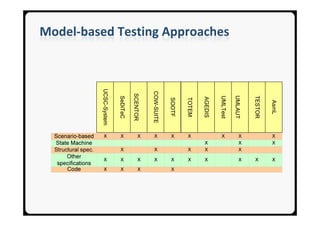
Model-based Testing Approaches


                                   UMLTe
                                       est
                                   AGEDI
                                       IS
                                   TOTEM
                                       M
                                   SOOT
                                      TF
                                 COW-SU
                                      UITE
                                  SCENTO
                                       OR
                                   SeDiTe
                                        eC
                                 UCSC-Sy
                                       ystem
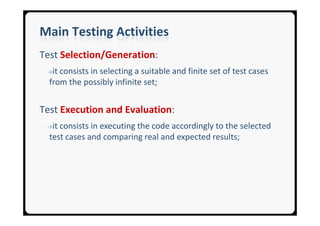
Main Testing Activities
Test Selection/Generation:
 →it consists in selecting a suitable and finite set of test cases
  from the possibly infinite set;


Test Execution and Evaluation:
 →it consists in executing the code accordingly to the selected
  test cases and comparing real and expected results;
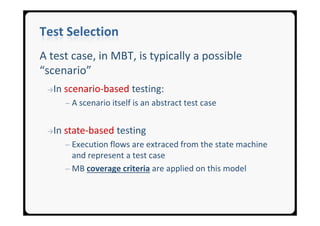
Test Selection
A test case, in MBT, is typically a possible
“scenario”
 →In   scenario-based testing:
       ─ A scenario itself is an abstract test case


 →In   state-based testing
       ─ Execution flows are extraced from the state machine
         and represent a test case
       ─ MB coverage criteria are applied on this model
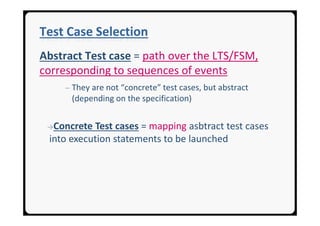
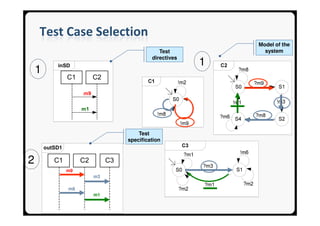
Test Case Selection
Abstract Test case = path over the LTS/FSM,
corresponding to sequences of events
     ─ They are not “concrete” test cases, but abstract
      (depending on the specification)


 →Concrete Test cases = mapping asbtract test cases
 into execution statements to be launched
Test Case Selection
                                                               Model of the
                                                 Test            system
                                              directives
            inSD                                           1
    1
                 C1        C2

                      m9

                      m1


                                         Test
                                     specification
        outSD1

2          C1         C2        C3
                 m9
                           m3

                 m8
                           m1
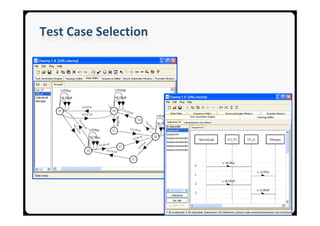
Test Case Selection
Test Execution
It consists in running the test cases on the system
implementation
 →So   to compare the real execution with the expected behavior
MBT practical concerns
Traceability, i.e. relating the abstract values of the
  specification to the concrete values of the
  implementation.


Execution, i.e. forcing the Implementation Under Test
  (IUT) to execute the specific sequence of events that
  has been selected.
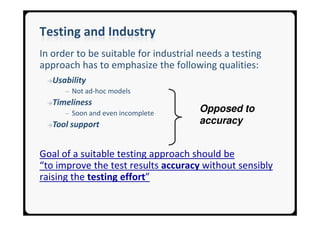
Testing and Industry
In order to be suitable for industrial needs a testing
approach has to emphasize the following qualities:
 →Usability
      ─ Not ad-hoc models
 →Timeliness
      ─ Soon and even incomplete
                                      Opposed to
 →Tool   support                      accuracy


Goal of a suitable testing approach should be
“to improve the test results accuracy without sensibly
raising the testing effort”
MBT Tools
There are some automated tools for MBT:
 →Telelogic Tau and Tau Tester
 →Leirios Test Designer

 →Conformiq Qtronic

 →Rhapsody Test Conductor and Automatic Test Generation

 →AGEDIS
MBT in industry: challenges and issues
As remarked by Alan Hartman in his 2006 speech at ISSTA:
 →“Only   1% of industry uses it”


Why?
Why?
The main reasons I foresee:
 →Model2Code    (and viceversa) traceability problems
 →modeling is not yet so widely recognized as part of
 the development process.
     ─ Legacy systems


 →because  of tool/service problems
 →cost/effectiveness is still under exploration
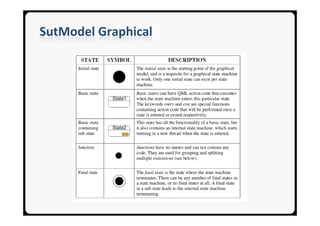
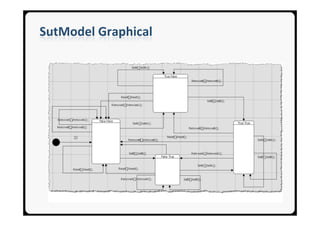
Conformiq: Two models are required in
Input


•SutModel.Java (in QML)
•SutModel.xmi (Graphical Notation)
QML
Just like Java, QML consists of variables and
expressions, all strictly typed and known before the
compilation.


The types are divided into the same three groups that
Java has: primitives, references and values
QML
QML extends Java with:
      Records
      Ports
      System block
      State machines
SutModel Graphical
SutModel Graphical
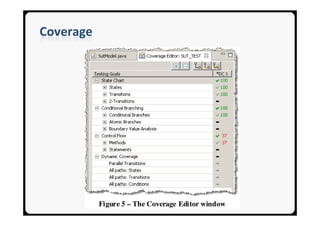
Coverage


           Figure 5 – The Coverage Editor window

Model-based Testing Principles

  • 1.
    Università degli Studidell’Aquila L22. Model-based Testing (Principles) Henry Muccini DISIM, University of L’Aquila www.henrymuccini.com, henry.muccini@univaq.it
  • 2.
    Copyright Notice The materialin these slides may be freely reproduced and distributed, partially or totally, as far as an explicit reference or acknowledge to the material author is preserved. Henry Muccini
  • 4.
    Agenda Modeling MBT: →Why? →ModelsforMBT →UML-based Testing ─ Testing activities
  • 5.
    AGENDA Modeling Model-based testing Why? Models for MBT UML-based Testing
  • 6.
    Modeling: there isnot just programming What is a model: →A model is a simplification of the reality →The reality is abstracted, since it is too complex Why modeling →Models are built for a better understanding of the system under development Everything is a model ?!?
  • 7.
  • 8.
  • 9.
  • 10.
  • 11.
  • 12.
    … and manyothers… Pilot Pilot CoPilot CoPilot Multifunction Multifunction Multifunction Multifunction Display1 Display2 Display1 Display2 Display Display Display Display Processor Processor Processor Processor High speed network High speed network Mission Mission Mission Processor Processor Processor 1553 bus 1553 bus Auto-Pilot GPS Nav Radio
  • 13.
    Model Driven Development(MDD) Models are becoming first core assets in Software Engineering/Architecting: →models are primary artifacts retained as first class entities that can be analyzed and manipulated by means of automated tools →the focus moves from writing and sharing documents to writing and sharing models.
  • 14.
    From Document Drivento Model Driven
  • 15.
    Models in MDD Modelsin MDD can be used for: →Documenting design decisions →Guiding the coding phase →For analyzing and validating design choices ─ by complementing traditional code-level analysis techniques
  • 16.
    Why modeling? ForDocumenting and Analysis
  • 17.
    What is MBT? Itconsists in: →ExtractingTest Cases from the Model →Run the test case over the system implementation Purpose: →Tovalidate the implementation conformance to the model ─ The model itself is the oracle, i.e., it represents the expected behavior
  • 18.
    Model-based Testing A modelbased testing approach accepts two main inputs →a model of the software under test, →a set of test generation directives which guide the test cases selection and outputs a test specification →which includes a set of stimuli the tester should introduce in the system together with expected responses
  • 19.
    Modeling for testing Essentially,we need (at least) a behavioral model of the software system: →Labelled Transition System →StateCharts →UML State of Sequence Diagrams →IOLTS →Finite State Automata →…
  • 20.
    The base-line techniquefor designing test cases →Timely ─ Often useful in refining specifications and assessing testability before code is written →Effective ─ finds some classes of fault (e.g., missing logic) that can elude other approaches →Widely applicable ─ to any description of program behavior serving as spec ─ at any level of granularity from module to system testing. →Economical ─ typically less expensive to design and execute than structural (code-based) test cases (C) 2007 MAURO PEZZÈ & MICHAL YOUNG
  • 21.
    Program code isnot necessary →Only a description of intended behavior is needed →Even incomplete and informal specifications can be used ─ Although precise, complete specifications lead to better test suites Early functional test design has side benefits →Often reveals ambiguities and inconsistency in spec →Useful for assessing testability ─ And improving test schedule and budget by improving spec →Useful explanation of specification ─ or in the extreme case (as in XP), test cases are the spec (C) 2007 MAURO PEZZÈ & MICHAL YOUNG
  • 22.
    Different testing strategies(functional, structural, fault-based, model-based) are most effective for different classes of faults Functional testing is best for missing logic faults →A common problem: Some program logic was simply forgotten →Structural (code-based) testing will never focus on code that isn’t there! (C) 2007 MAURO PEZZÈ & MICHAL YOUNG
  • 23.
    Modeling for testing Sucha model can be produced: 1. Through a formal specification language ─ Typically referred as formal testing 2. Through a diagrammatic (visual) notation ─ Typically referred as UML-based Testing
  • 24.
    1. MBT basedon Formal Specifications Since the 80’s, many specification-based testing approaches have been proposed, based on formal languages such as →Z, VDM, CSP, CCS, LOTOS, SDL, and Petri Nets. More recently: →Based on dynamic behavior: ─ FSM-based (Bochmann&Petrenko, Lee&Yannakis, …) ─ LTS-based (Brinksma&Tretmans, Jard&Jeron …) →Focussing on static aspects, ─ ADT theory (Bernot&Gaudel…) ─ Z-based (Hierons…)
  • 25.
    Formal Specification-based Testing TorX(Côte de Resyste) → on-the-fly test generation and execution → random → LOTOS and Promela TGV (IRISA - Rennes) →derives tests in TTCN from LOTOS or SDL → uses test purposes TVEDA (CNET - France Telecom) → derives TTCN tests from SDL specification
  • 26.
    2. MBT basedon the UML UML State-machine based testing: →which might require the translation of the UML diagrams into an intermediate formal description Scenario-based testing: →based on the use of opportunely annotated UML Sequence Diagram State-based and Scenario-based: combine the use of interaction diagrams and state diagram, possibly annotated with further (formal) information (e.g. OCL)
  • 27.
    Model-based Testing: theoverall idea From Leila Naslavsky Advancement report
  • 28.
    AsmL L TESTO OR UMLAU UT Model-based Testing Approaches UMLTe est AGEDI IS TOTEM M SOOT TF COW-SU UITE SCENTO OR SeDiTe eC UCSC-Sy ystem
  • 29.
    Main Testing Activities TestSelection/Generation: →it consists in selecting a suitable and finite set of test cases from the possibly infinite set; Test Execution and Evaluation: →it consists in executing the code accordingly to the selected test cases and comparing real and expected results;
  • 30.
    Test Selection A testcase, in MBT, is typically a possible “scenario” →In scenario-based testing: ─ A scenario itself is an abstract test case →In state-based testing ─ Execution flows are extraced from the state machine and represent a test case ─ MB coverage criteria are applied on this model
  • 31.
    Test Case Selection AbstractTest case = path over the LTS/FSM, corresponding to sequences of events ─ They are not “concrete” test cases, but abstract (depending on the specification) →Concrete Test cases = mapping asbtract test cases into execution statements to be launched
  • 32.
    Test Case Selection Model of the Test system directives inSD 1 1 C1 C2 m9 m1 Test specification outSD1 2 C1 C2 C3 m9 m3 m8 m1
  • 33.
  • 34.
    Test Execution It consistsin running the test cases on the system implementation →So to compare the real execution with the expected behavior
  • 35.
    MBT practical concerns Traceability,i.e. relating the abstract values of the specification to the concrete values of the implementation. Execution, i.e. forcing the Implementation Under Test (IUT) to execute the specific sequence of events that has been selected.
  • 36.
    Testing and Industry Inorder to be suitable for industrial needs a testing approach has to emphasize the following qualities: →Usability ─ Not ad-hoc models →Timeliness ─ Soon and even incomplete Opposed to →Tool support accuracy Goal of a suitable testing approach should be “to improve the test results accuracy without sensibly raising the testing effort”
  • 37.
    MBT Tools There aresome automated tools for MBT: →Telelogic Tau and Tau Tester →Leirios Test Designer →Conformiq Qtronic →Rhapsody Test Conductor and Automatic Test Generation →AGEDIS
  • 38.
    MBT in industry:challenges and issues As remarked by Alan Hartman in his 2006 speech at ISSTA: →“Only 1% of industry uses it” Why?
  • 39.
    Why? The main reasonsI foresee: →Model2Code (and viceversa) traceability problems →modeling is not yet so widely recognized as part of the development process. ─ Legacy systems →because of tool/service problems →cost/effectiveness is still under exploration
  • 40.
    Conformiq: Two modelsare required in Input •SutModel.Java (in QML) •SutModel.xmi (Graphical Notation)
  • 41.
    QML Just like Java,QML consists of variables and expressions, all strictly typed and known before the compilation. The types are divided into the same three groups that Java has: primitives, references and values
  • 42.
    QML QML extends Javawith: Records Ports System block State machines
  • 43.
  • 44.
  • 45.
    Coverage Figure 5 – The Coverage Editor window